有机化学 ›› 2026, Vol. 46 ›› Issue (8): 3276-3287.DOI: 10.6023/cjoc202604018 上一篇 下一篇
研究论文
易千禧†, 梁宸伟†, 程瑶航, 安光辉*( )
)
收稿日期:2026-04-09
修回日期:2026-04-29
发布日期:2026-05-26
作者简介:基金资助:
Qianxi Yi†, Chenwei Liang†, Yaohang Cheng, Guanghui An*()
Received:2026-04-09
Revised:2026-04-29
Published:2026-05-26
Contact:
*E-mail: chemagh@163.com
About author:Supported by:文章分享
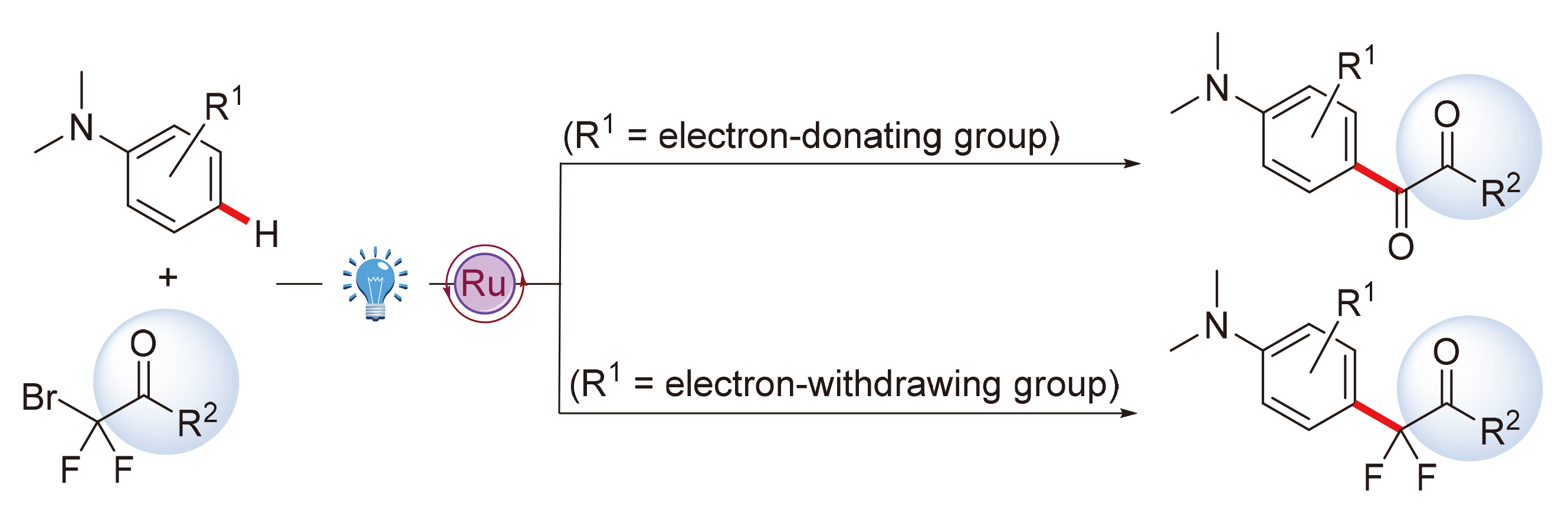
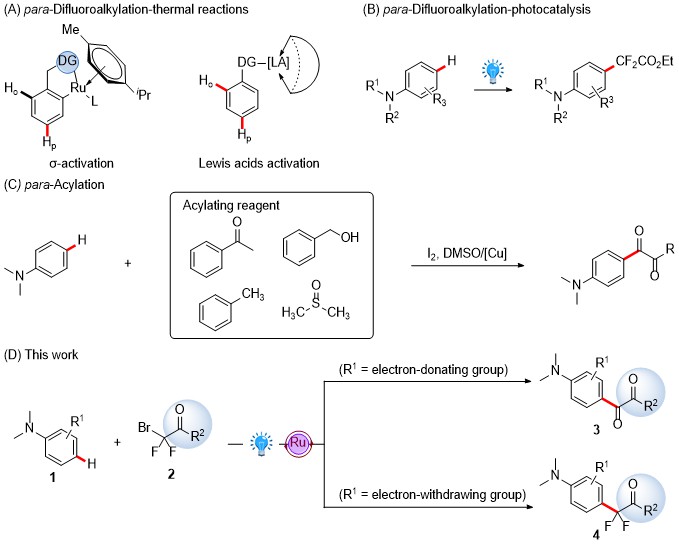
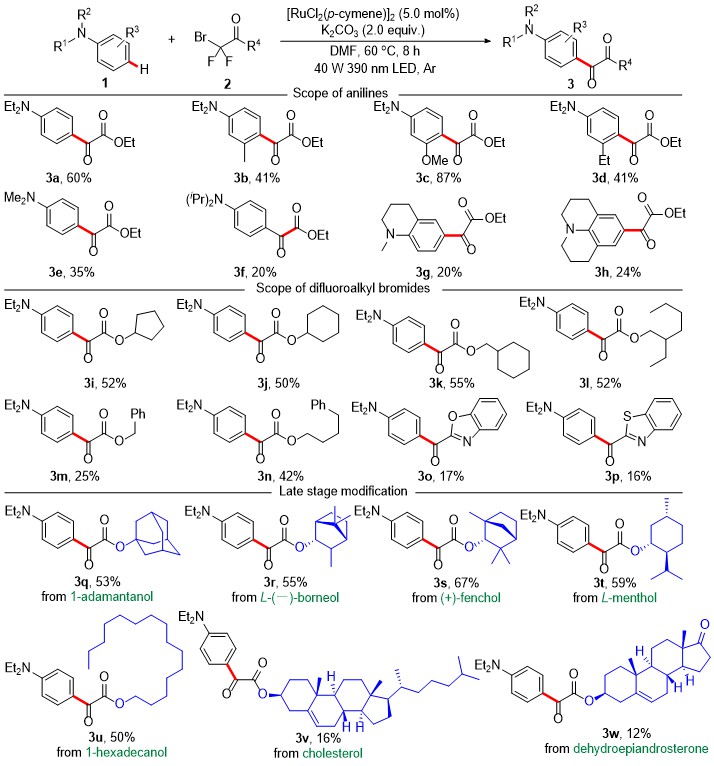
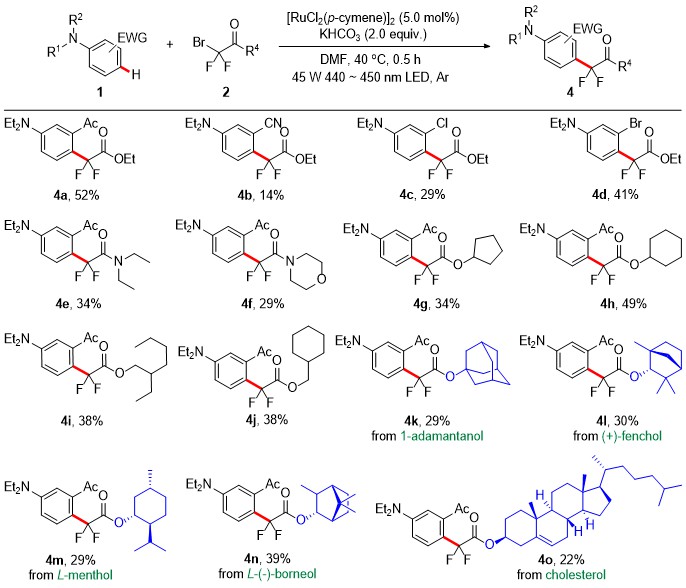
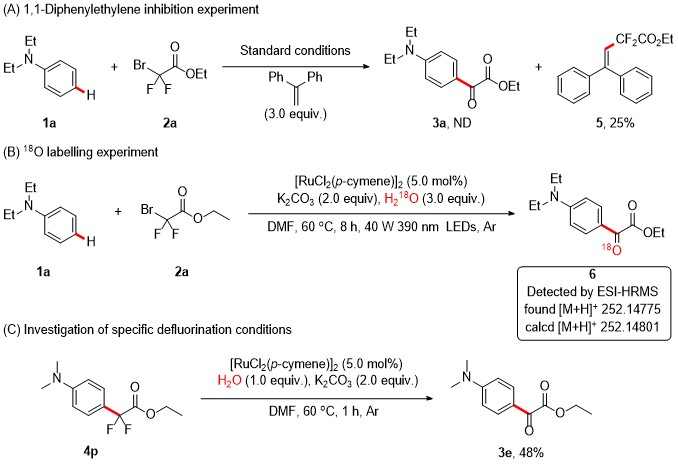
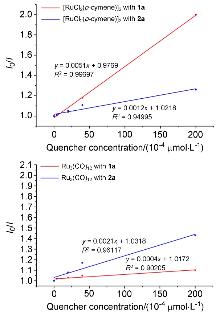
开发了一种可见光介导的钌催化苯胺衍生物对位C—H酰基化及二氟烷基化方法. 该策略避免了传统方法中的高温条件且具有良好的官能团耐受性. 机理研究表明, 钌催化剂首先被还原为零价钌, 从而进行催化循环. 酰基化的关键路径涉及二氟甲基化中间体的顺序脱氟与亲核加成过程.
易千禧, 梁宸伟, 程瑶航, 安光辉. 可见光介导钌催化苯胺衍生物对位酰基化和二氟烷基化[J]. 有机化学, 2026, 46(8): 3276-3287.
Qianxi Yi, Chenwei Liang, Yaohang Cheng, Guanghui An. Visible-Light-Mediated Ruthenium-Catalyzed para-Acylation and Difluoroalkylation of Aniline Derivatives[J]. Chinese Journal of Organic Chemistry, 2026, 46(8): 3276-3287.
| Entry | Deviation from the standard conditions | Yieldb/% |
|---|---|---|
| 1 | None | 60 |
| 2 | Without light irradiation or [RuCl2(p-cymene)]2 | 0 |
| 3 | Without Ar | 0 |
| 4 | RuCl3 instead of [RuCl2(p-cymene)]2 | 13 |
| 5 | [RuCl2(benzene)]2 instead of [RuCl2(p-cymene)]2 | 44 |
| 6c | Ru3(CO)12 instead of [RuCl2(p-cymene)]2 | 57 |
| 7c | 2 h instead of 8 h | 57 |
| 8 | Cs2CO3, Na2CO3 instead of K2CO3 | 18, 43 |
| 9 | 25 or 40 ℃ instead of 60 ℃ | 39, 43 |
| Entry | Deviation from the standard conditions | Yieldb/% |
|---|---|---|
| 1 | None | 60 |
| 2 | Without light irradiation or [RuCl2(p-cymene)]2 | 0 |
| 3 | Without Ar | 0 |
| 4 | RuCl3 instead of [RuCl2(p-cymene)]2 | 13 |
| 5 | [RuCl2(benzene)]2 instead of [RuCl2(p-cymene)]2 | 44 |
| 6c | Ru3(CO)12 instead of [RuCl2(p-cymene)]2 | 57 |
| 7c | 2 h instead of 8 h | 57 |
| 8 | Cs2CO3, Na2CO3 instead of K2CO3 | 18, 43 |
| 9 | 25 or 40 ℃ instead of 60 ℃ | 39, 43 |
| Entry | Deviation from the standard conditions | Yieldb/% 4a |
|---|---|---|
| 1 | None | 52 |
| 2c | Standard condition in | 28 |
| 3 | Without light irradiation or [RuCl2(p-cymene)]2 | 0 |
| 4 | Without Ar | 0 |
| 5 | RuCl3 instead of [RuCl2(p-cymene)]2 | 20 |
| 6 | [RuCl2(benzene)]2 instead of [RuCl2(p-cymene)]2 | 39 |
| 7 | Ru3(CO)12 instead of [RuCl2(p-cymene)]2 | 52 |
| 8 | 30 min or 1 h instead of 2 h | 52, 52 |
| 9 | 25 or 60 ℃ instead of 40 ℃ | 41, 27 |
| 10 | Cs2CO3, Na2CO3 instead of KHCO3 | 42, 46 |
| Entry | Deviation from the standard conditions | Yieldb/% 4a |
|---|---|---|
| 1 | None | 52 |
| 2c | Standard condition in | 28 |
| 3 | Without light irradiation or [RuCl2(p-cymene)]2 | 0 |
| 4 | Without Ar | 0 |
| 5 | RuCl3 instead of [RuCl2(p-cymene)]2 | 20 |
| 6 | [RuCl2(benzene)]2 instead of [RuCl2(p-cymene)]2 | 39 |
| 7 | Ru3(CO)12 instead of [RuCl2(p-cymene)]2 | 52 |
| 8 | 30 min or 1 h instead of 2 h | 52, 52 |
| 9 | 25 or 60 ℃ instead of 40 ℃ | 41, 27 |
| 10 | Cs2CO3, Na2CO3 instead of KHCO3 | 42, 46 |
| [1] |
|
| [2] |
|
| [3] |
|
| [4] |
|
| [5] |
|
| [6] |
|
| [7] |
|
| [8] |
|
| [9] |
|
| [10] |
|
| [11] |
|
| [12] |
|
| [13] |
|
| [14] |
|
| [15] |
|
| [16] |
|
| [17] |
|
| [18] |
|
| [19] |
|
| [20] |
|
| [21] |
|
| [22] |
|
| [23] |
|
| [24] |
|
| [25] |
|
| [26] |
|
| [27] |
|
| [28] |
|
| [29] |
|
| [30] |
|
| [31] |
|
| [32] |
|
| [33] |
|
| [34] |
|
| [35] |
|
| [36] |
|
| [37] |
|
| [38] |
|
| [39] |
|
| [40] |
|
| [41] |
|
| [42] |
|
| [43] |
|
|
(谢赫男, 程瑶航, 安光辉, 有机化学, 2026, 46, 475.)
|
|
| [44] |
|
| [45] |
|
| [46] |
|
| [47] |
|
| [48] |
|
| [49] |
|
| [50] |
|
| [51] |
|
| [52] |
|
| [53] |
|
| [54] |
|
| [55] |
|
| [56] |
|
| [57] |
|
| [58] |
|
| [59] |
|
| [60] |
|
| [61] |
|
| [62] |
|
| [63] |
|
| [64] |
|
| [65] |
|
| [66] |
|
| [67] |
|
| [68] |
|
| [69] |
|
| [70] |
|
| [71] |
|
| [1] | 廖云, 唐丽娟, 宗映彤, 于道鸿. 钌催化C(sp²)—H键的不对称官能化研究进展[J]. 有机化学, 2026, 46(5): 1795-1812. |
| [2] | 毛婷, 曾鳞媛, 温吉林, 贾佳. 可见光介导下铱催化脂肪族α-溴代三氟甲基的脱溴环化反应[J]. 有机化学, 2025, 45(7): 2520-2528. |
| [3] | 区洁晴, 屈培珍, 赵亮. 可见光介导下钯催化脂肪族α-溴代三氟甲基的脱溴还原反应[J]. 有机化学, 2025, 45(4): 1334-1341. |
| [4] | 周章涛, 王杨, 程冰心, 叶伟平. [RuCl(p-cymene)-(S)-BINAP]Cl催化不对称合成反式-3-氨基-双环[2.2.2]辛烷-2-甲酸乙酯[J]. 有机化学, 2023, 43(8): 2961-2967. |
| [5] | 南江, 黄冠杰, 胡岩, 王波. 钌催化喹唑啉酮与碳酸亚乙烯酯的C—H [4+2]环化反应[J]. 有机化学, 2023, 43(4): 1537-1549. |
| [6] | 闫法超, 李洋, 李玉东, Mohamed Makha, 李跃辉. 氰甲基导向的吲哚选择性C—H烯基化[J]. 有机化学, 2022, 42(7): 2192-2200. |
| [7] | 李涛, 刘艺, 白雪, 周遵军, 左鹏, 麻妙锋, 仲崇民, 左亚杰. 咪唑离子官能化的HG-II型手性钌催化剂的制备及其催化的不对称烯烃复分解反应[J]. 有机化学, 2022, 42(6): 1713-1721. |
| [8] | 林聪, 高震博, 腾秋汛, 薛博文, 李小花, 高飞, 申亮. 钌(II)催化的亚胺酯碳-氢键官能化/环化反应合成烯基取代的二氢异喹诺酮[J]. 有机化学, 2020, 40(9): 2863-2870. |
| [9] | 方霄龙, 段宁, 章敏, 李斌. 金属-配体协同作用下钌催化剂用于草酸酯加氢制乙二醇的研究进展[J]. 有机化学, 2020, 40(9): 2692-2701. |
| [10] | 白其凡, 何静耀, 祝小青, 冯高峰, 金城安. 可见光催化合成6H-苯并[c]苯并吡喃类化合物[J]. 有机化学, 2019, 39(2): 527-531. |
| [11] | 陈姝琪, 杨文, 姚永祺, 杨新, 邓颖颍, 杨定乔. 钌催化β-酮酸酯不对称氢化反应的研究进展[J]. 有机化学, 2018, 38(10): 2534-2552. |
| [12] | 曾明, 宋婵, 崔冬梅. 基于钌催化醇类化合物脱氢的C—N/C—C偶联反应的研究进展[J]. 有机化学, 2017, 37(6): 1352-1367. |
| [13] | 王志惠, 张振锋, 刘燕刚, 张万斌. 烯醇酯的不对称催化氢化研究进展[J]. 有机化学, 2016, 36(3): 447-459. |
| [14] | 王英杰, 张振锋, 张万斌. 环状脱氢氨基酸及其衍生物的不对称催化氢化研究[J]. 有机化学, 2015, 35(3): 528-538. |
| [15] | 杨辉琼, 谌儒, 邓国军. 钌催化芳香硝基化合物和脂肪三级胺反应一锅法合成喹啉衍生物[J]. 有机化学, 2012, 32(9): 1725-1731. |
| 阅读次数 | ||||||
|
全文 |
|
|||||
|
摘要 |
|
|||||


