综述与进展
钟晟昱a, 史雷*,a
收稿日期:2026-06-24
修回日期:2026-08-19
发布日期:2026-09-14
基金资助:Zhong Shengyua, Shi Lei*,a
Received:2026-06-24
Revised:2026-08-19
Published:2026-09-14
Supported by:文章分享
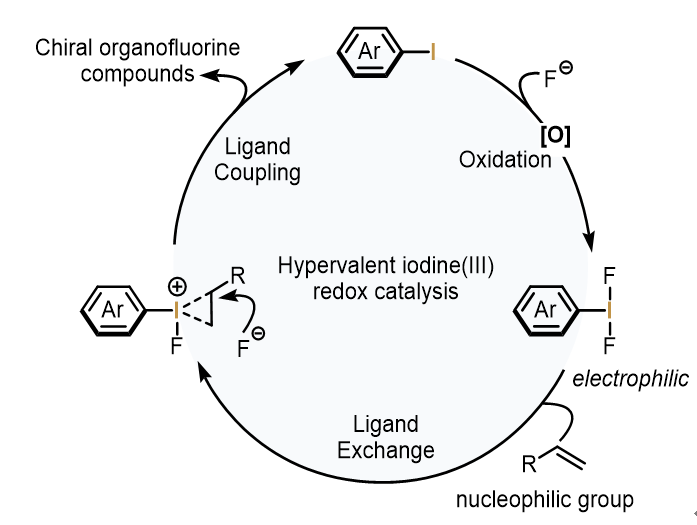
含氟有机分子在药物和农药等领域有着广泛应用,但自然界中天然存在的有机氟化物极为稀少. 碳-氟键的构建本身也面临诸多挑战. 有机三价碘催化通过极性反转策略,将廉价亲核氟源转化为亲电性有机三价碘氟物种,为温和条件下不对称合成手性含氟化合物提供了独特路径. 本文系统梳理了2014年至今有机三价碘催化不对称合成手性含氟化合物的研究进展,以手性单氟化合物、双氟化合物和多氟化合物的合成为框架,依次讨论了羰基α-氟化、烯烃氟环化、苯酚去芳构化氟化、联烯氟化、1,2-二氟化、偕二氟化、1,3-二氟化以及基于含三氟甲基烯烃的氟化反应等转化类型,分析了代表性体系的催化剂设计、对映选择性控制因素和催化机制,总结了该领域在催化剂发展、氧化还原循环和机理认知等方面的现状与挑战,并对未来发展方向进行了展望.
钟晟昱, 史雷. 有机三价碘不对称催化合成手性含氟化合物的研究进展[J]. 有机化学, doi: 10.6023/cjoc202606029.
Zhong Shengyu, Shi Lei. Advances in Asymmetric Synthesis of Chiral Organofluorine Compounds via Hypervalent Iodine Catalysis[J]. Chinese Journal of Organic Chemistry, doi: 10.6023/cjoc202606029.
| [1] (a) O′Hagan, D. Chem. Soc. Rev.2008, 37, 308. (b) Liu Q.; Ni C.; Hu, J. Natl. Sci. Rev. 2017, 4, 303. (c) Aufiero M.; Gilmour, R. Acc. Chem. Res. 2018, 51,1701. (d) Meyer, S.; Häfliger, J.; Gilmour, R.Chem. Sci. 2021, 12, 10686. (e) Poole, W. G.; Peron, F.; Fox, S. J.; Wells, N.; Skylaris, C.-K.; Essex, J. W.; Kuprov, I.; Linclau, B. J. Org. Chem. 2024, 89, 8789. [2] (a) Müller K.; Faeh C.; Diederich F. Science2007, 317, 1881. (b) Purser S.; Moore P. R.; Swallow S.; Gouverneur, V. Chem. Soc. Rev.2008, 37, 320. (c) Gillis, E.; Eastman, K. J.; Hill, M. D.; Donnelly, D. J.; Meanwell, N. A. J. Med. Chem. 2015, 58, 8315. [3] (a) Wang J.; Sánchez-Roselló M.; Aceña J. L.; del Pozo C.; Sorochinsky A. E.; Fustero S.; Soloshonok V. A.; Liu H. Chem. Rev.2014, 114, 2432. (b) Zhou Y.; Wang J.; Gu Z.; Wang S.; Zhu W.; Aceña J. L.; Soloshonok V. A.; Izawa K.; Liu H. Chem. Rev.2016, 116, 422. (c) Meanwell, N. A. J. Med. Chem. 2018, 61, 5822. (d) Inoue, M.; Sumii, Y.; Shibata, N. ACS Omega 2020, 5, 10633. (e) Grygorenko, O. O.; Melnykov, K. P.; Holovach, S.; Demchuk, O. ChemMedChem 2022, 17, e202200365. (f) Du, Y.; Bian, Y.; Baecker, D.; Dhawan, G.; Semghouli, A.; Kiss, L.; Zhang, W.; Sorochinsky, A. E.; Soloshonok, V. A.; Han, J. Chem. Eur. J. 2025, 31, e202500662. [4] (a) Fujiwara T.; O′Hagan, D. J. Fluorine Chem.2014, 167, 16. (b) Ogawa Y., Tokunaga E., Kobayashi O., Hirai K., Shibata N. iScience2020, 23, 101467. (c) Wang, Q., Song, H., and Wang, Q. Chin. Chem. Lett. 2022, 33, 626. [5] (a) Preshlock S.; Tredwell M.; Gouverneur V. Chem. Rev.2016, 116, 719. (b) Rong J.; Haider A.; Jeppesen T. E.; Josephson L.; Liang, S. H. Nat. Commun.2023, 14, 3257. [6] (a) O′Hagan D.; Harper, D. B. J. Fluorine Chem.1999, 100, 127. (b) Walker M. C.; Chang, M. C. Y. Chem. Soc. Rev.2014, 43, 6527. (c) Reichel, M.; Karaghiosoff, K. Angew. Chem., Int. Ed. 2020, 59, 12268. [7] O′Hagan D.; Deng H. Chem. Rev.2015, 115, 634. [8] (a) Butler A.; Sandy M. Nature2009, 460, 848. (b) Petkowski J. J.; Seager S.; Bains W. Sci. Rep.2024, 14, 15575. [9] Wei L.; Huang C.; Luo Y.Sci. China: Life Sci. 2025, 55, 2124. [10] (a) Lal G. S.; Pez G. P.; Syvret, R. G. Chem. Rev.1996, 96, 1737. (b) Ma J.-A.; Cahard D. Chem. Rev.2004, 104, 6119. (c) Brunet, V. A.; O′Hagan, D. Angew. Chem., Int. Ed. 2008, 47, 1179. (d) Kirk, K. L. Org. Process Res. Dev. 2008, 12, 305. (e) Zhu, Y.; Han, J.; Wang, J.; Shibata, N.; Sodeoka, M.; Soloshonok, V. A.; Coelho, J. A. S.; Toste, F. D. Chem. Rev. 2018, 118, 3887. (f) Li, M.; Xue, X.-S.; Cheng, J.-P. Acc. Chem. Res. 2020, 53, 182. (g) Kalita, S. J.; Qi, J.; Xiao, L.; Saha, D.; Huang, Y.-Y.; Shibata, N. Chem. Rev. 2025, 125, 8477. [11] (a) Meyer D.; Jangra H.; Walther F.; Zipse H.; Renaud P. Nat. Commun.2018, 9, 4888. (b) Bui T. T.; Hong W. P.; Kim, H.-K. J. Fluorine Chem.2021, 247, 109794. (c) Zou, Z.; Zhang, W.; Wang, Y.; Pan, Y. Org. Chem. Front. 2021, 8, 2786. (d) Wang, M.; Ruskin, J.; Marques, J.; Garrison, N.; Lectka, T. Chem. Rev. 2025, 125, 9382. (e) Li, J.; Chiou, M.-F.; Bao, H. Org. Chem. Front. 2026, 13, 10.1039/D6QO00260A. [12] (a) Champagne P. A.; Desroches J.; Hamel J.-D.; Vandamme M.; Paquin J.-F. Chem. Rev.2015, 115, 9073. (b) Caron, S. Org. Process Res. Dev.2020, 24, 470. (c) Leibler, I. N.-M.; Gandhi, S. S.; Tekle-Smith, M. A.; Doyle, A. G. J. Am. Chem. Soc. 2023, 145, 9928. [13] (a) Li X.; Chen P.; Liu, G. Beilstein J. Org. Chem.2018, 14, 1813. (b) Bauer A.; Maulide N. Chem. Sci.2021, 12, 853. (c) Yoshimura, A.; Zhdankin, V. V. Chem. Rev. 2024, 124, 11108. [14] Okuyama T.; Takino T.; Sueda T.; Ochiai, M. J. Am. Chem. Soc.1995, 117, 3360. [15] Weinland R. F.; Stille, W. Ber. Dtsch. Chem. Ges.1901, 34, 2631. [16] Stang P. J.; Zhdankin, V. V. Chem. Rev.1996, 96, 1123. [17] (a) Zupan, M.; Pollak, A.J. Chem. Soc., Chem. Commun. 1975, 715. (b) Hara S.; Nakahigashi J.; Ishi-I K.; Sawaguchi M.; Sakai H.; Fukuhara T.; Yoneda N. Synlett1998, 495. (c) Sawaguchi, M.; Hara, S.; Yoneda, N.J. Fluor. Chem. 2000, 105, 313. (d) Yoneda, N. J. Fluor. Chem. 2004, 125, 7. [18] (a) Kitamura T.; Kuriki S.; Morshed M. H.; Hori Y. Org. Lett.2011, 13, 2392. (b) Sarie J. C.; Thiehoff C.; Mudd R. J.; Daniliuc C. G.; Kehr G.; Gilmour, R. J. Org. Chem.2017, 82, 11792. [19] Kong W.; Feige P.; de Haro T.; Nevado, C. Angew. Chem., Int. Ed.2013, 52, 2469. [20] Roth H. G.; Romero N. A.; Nicewicz D. A. Synlett2016, 27, 714. [21] (a) Dohi T.; Maruyama A.; Yoshimura M.; Morimoto K.; Tohma H.; Kita, Y. Angew. Chem., Int. Ed.2005, 44, 6193. (b) Ochiai M.; Takeuchi Y.; Katayama T.; Sueda T.; Miyamoto, K. J. Am. Chem. Soc.2005, 127, 12244. [22] (a) Cai Q.; Ma, H. Acta Chim. Sin.2019, 77, 213 (in Chinese) (蔡倩, 马浩文, 化学学报, 2019, 77, 213). (b) Parra, A. Chem. Rev. 2019, 119, 12033. (c) Singh, F. V.; Shetgaonkar, S. E.; Krishnan, M.; Wirth, T. Chem. Soc. Rev. 2022, 51, 8102. [23] Basdevant B.; Legault, C. Y. Org. Lett.2015, 17, 4918. [24] Suzuki S.; Kamo T.; Fukushi K.; Hiramatsu T.; Tokunaga E.; Dohi T.; Kita Y.; Shibata N. Chem. Sci.2014, 5, 2754. [25] Pluta R.; Krach P. E.; Cavallo L.; Falivene L.; Rueping M. ACS Catal.2018, 8, 2582. [26] Wang Y.; Yuan H.; Lu H.; Zheng W.-H. Org. Lett.2018, 20, 2555. [27] Zhou H.-J.; Yao Y.-P.; Zhang T.; Chen B.; Wu X.; Zhao H.; Zeng J.; Chen J.-A.; Xiao X.; Chen F.-E. Green Chem.2023, 25, 10447. [28] Zhong S.; Yu Z.; Zhu Y.; Shi L. Org. Lett.2025, 27, 3452. [29] (a) Scheidt F.; Neufeld J.; Schäfer M.; Thiehoff C.; Gilmour R. Org. Lett.2018, 20, 8073. (b) Neufeld J.; Stünkel T.; Mück-Lichtenfeld C.; Daniliuc C. G.; Gilmour, R. Angew. Chem., Int. Ed.2021, 60, 13647. (c) Wang, Q.; Biosca, M.; Himo, F.; Szabό, K. J. Angew. Chem., Int. Ed. 2021, 60, 26327. (d) Longuet, M.; Vitse, K.; Martin-Mingot, A.; Michelet, B.; Guégan, F.; Thibaudeau, S. J. Am. Chem. Soc. 2024, 146, 12167. (e) Sweeting, S. G.; Lennox, A. J. J. J. Am. Chem. Soc. 2025, 147, 19329. [30] Woerly E. M.; Banik S. M.; Jacobsen, E. N. J. Am. Chem. Soc.2016, 138, 13858. [31] Menie K. M.; Banik S. M.; Reichert E. C.; Jacobsen, E. N. J. Am. Chem. Soc.2018, 140, 4797. [32] Sarie J.; Thiehoff C.; Neufeld J.; Daniliuc C. G.; Gilmour, R. Angew. Chem., Int. Ed.2020, 59, 15069. [33] Häfliger J.; Sokolova O. O.; Lenz M.; Daniliuc C. G.; Gilmour, R. Angew. Chem., Int. Ed.2022, 61, e202205277. [34] Wang Q.; Lübcke M.; Biosca M.; Hedberg M.; Eriksson L.; Himo F.; Szabό, K. J. J. Am. Chem. Soc.2020, 142, 20048. [35] Zhu W.; Zhen X.; Wu J.; Cheng Y.; An J.; Ma X.; Liu J.; Qin Y.; Zhu H.; Xue J.; Jiang X. Nat. Commun.2021, 12, 3957. [36] Chen J.; Li J.; Li X. Org. Lett.2025, 27, 13827. [37] Stünkel T.; Siebold K.; Okumatsu D.; Murata K.; Ruyet L.; Daniliuc C. G.; Gilmour R. Chem. Sci.2023, 14, 13574. [38] Wang Z.-X.; Xu Y.; Gilmour R. Nat. Commun.2024, 15, 5770. [39] Banik S. M.; Medley J. W.; Jacobsen, E. N. J. Am. Chem. Soc.2016, 138, 5000. [40] Molnár I. G.; Gilmour, R. J. Am. Chem. Soc.2016, 138, 5004. [41] Scheidt F.; Schäfer M.; Sarie J. C.; Daniliuc C. G.; Molloy J. J.; Gilmour, R. Angew. Chem., Int. Ed.2018, 57, 16431. [42] Haj M. K.; Banik S. M.; Jacobsen, E. N. Org. Lett.2019, 21, 4919. [43] Banik S. M.; Medley J. W.; Jacobsen E. N. Science2016, 353, 51. [44] Zhou B.; Haj M. K.; Jacobsen E. N.; Houk K. N.; Xue, X.-S. J. Am. Chem. Soc.2018, 140, 15206. [45] Levin M. D.; Ovian J. M.; Read J. A.; Sigman M. S.; Jacobsen, E. N. J. Am. Chem. Soc.2020, 142, 14831. [46] Häfliger J.; Livingstone K.; Daniliuc C. G.; Gilmour R. Chem. Sci.2021, 12, 6148. [47] Tu F.-H.; Wang Y.; Li Z.; Yang S.; Li Y.; Tan D.-H.; Li Q.; Gao H.; Wang, H. Cell Rep. Phys. Sci.2022, 3, 101194. [48] Ruyet L.; Roblick C.; Häfliger J.; Wang Z.-X.; Stoffels T. J.; Daniliuc C. G.; Gilmour, R. Angew. Chem., Int. Ed.2024, 63, e202403957. [49] Banik S. M.; Mennie K. M.; Jacobsen, E. N. J. Am. Chem. Soc.2017, 139, 9152. [50] Sharma H. A.; Mennie K. M.; Kwan E. E.; Jacobsen, E. N. J. Am. Chem. Soc.2020, 142, 16090. [51] Zhong S.; Gan S.; Zhang X.; Song L.; Shi L. Adv. Sci.2025, 12, e06041. [52] Kwon Y.-D.; Son J.; Chun J.-H. Org. Lett.2018, 20, 7902. [53] Dean A. C.; Randle E. H.; Lacey A. J. D.; Giorio G. A. M.; Doobary S.; Cons B. D.; Lennox, A. J. J. Angew. Chem., Int. Ed.2024, 63, e202404666. [54] Tu H.-F.; Lin S.; Tang Y.-J.; Liu L.-C.; Li Q.; Wang, H. Tetrahedron Chem.2023, 8, 100052. [55] Meyer S.; Häfliger J.; Schäfer M.; Molloy J. J.; Daniliuc C. G.; Glimour, R. Angew. Chem., Int. Ed.2021, 60, 5430. [56] Schäfer M.; Stünkel T.; Daniliuc C. G.; Gilmour, R. Angew. Chem., Int. Ed.2022, 61, e202205508. [57] Yu Y.-J.; Häfliger J.; Wang Z.-X.; Daniliuc C. G.; Gilmour, R. Angew. Chem., Int. Ed.2023, 62, e202309789. [58] (a) Winterson B.; Bhattacherjee D.; Wirth, T. Adv. Synth. Catal.2023, 365, 2676. (b) Sokolovs, I.; Suna, E.; Francke, R.Acc. Chem. Res. 2026, 59, 1949. [59] Wang Q.; Biosca M.; Himo F.; Szabό, K. J. Angew. Chem., Int. Ed.2021, 60, 26327. [60] Lv W.-X.; Li Y.; Cai Y.-H.; Tan D.-H.; Li Z.; Li J.-L.; Li Q.; Wang H. Chem. Sci.,2022, 13, 2981. [61] (a) Ning, Y.; Sivaguru, P.; Zanoni, G.; Anderson, E. A.; Bi, X.Chem 2020, 6, 486. (b) Liu, X.-B.; Feng, S.-X.; Lin, S.; Qin, Q.-H.; Wang, H.*; Li, Q.CCS Chem. 2026, 8, 271. [62] Li Y.; Liu X.-B.; Sham V.; Logvinenko I.; Xue J.-H.; Wu J.-Y.; Fu J.-L.; Lin S.; Liu Y.; Li Q.; Mykhailiuk P. K.; Wang, H. Angew. Chem., Int. Ed.2025, 64, e202422899. |
| [1] | 黄锦龙, 肖帆, 吴慧敏, 董秀琴, 王春江. 铱催化不对称串联烯丙基化/iso-Pictet-Spengler环化反应合成手性四氢-γ-咔啉[J]. 有机化学, 2026, 46(9): 3769-3776. |
| [2] | 张瑞楠, 郑琪智, 赖圣怡, 罗文俊, 许冰, 张展鸣, 张俊良. Sadphos在丰产金属催化反应中的应用[J]. 有机化学, 2026, 46(9): 3390-3398. |
| [3] | 李家圆, 陈品红, 刘国生. 铜催化烯丙位C—H键不对称氧化反应[J]. 有机化学, 2026, 46(9): 3630-3639. |
| [4] | 郑浩宇, 李传莹, 周友运. 过渡金属不对称催化通过C—O键形成合成手性叔烷基醚的研究进展[J]. 有机化学, 2026, 46(8): 2892-2925. |
| [5] | 陈颂耀, 冯雪, 屠蔓苏, 郝文娟, 姜波. 镍(II)/双咪唑啉催化不对称高阶(5+3)环化反应构建兼具中心与轴手性的马鞍形八元桥联联芳基衍生物[J]. 有机化学, 2026, 46(7): 2796-2807. |
| [6] | 熊康宇, 陆展. 过渡金属催化1,1-二取代烯烃的不对称硼氢化反应研究进展[J]. 有机化学, 2026, 46(7): 2493-2510. |
| [7] | 赵凯凯, 范润奇, 林国强, 冯陈国. 叔丁基亚砜-噁唑啉配体的合成及其在钯催化不对称烯丙基烷基化反应中的应用[J]. 有机化学, 2026, 46(6): 2458-2463. |
| [8] | 张超, 罗洲, 赵申, 沈安, 杨国强, 刘媛媛. 配体接力促进的钯催化卡宾插入/Tsuji-Trost串联反应实现不对称[4+1]环化构筑手性茚满[J]. 有机化学, 2026, 46(6): 2431-2441. |
| [9] | 廖云, 唐丽娟, 宗映彤, 于道鸿. 钌催化C(sp²)—H键的不对称官能化研究进展[J]. 有机化学, 2026, 46(5): 1795-1812. |
| [10] | 沈健, 王彦博, 吴正兴, 徐德锋, 张万斌. α,β-不饱和γ-内酯(酰胺)的不对称催化合成[J]. 有机化学, 2025, 45(8): 2637-2659. |
| [11] | 杜一鸣, 贾均松, 李玉龙, 舒伟. 手性α-芳基酮的催化合成研究进展[J]. 有机化学, 2025, 45(6): 1838-1870. |
| [12] | 苏雷, 杨熙, 闫捷, 蒋元力, 陈丽娟, 郑庆舒, 刘家旺. 不对称羰基化偶联反应研究进展[J]. 有机化学, 2025, 45(6): 2007-2047. |
| [13] | 王霜, 毛羊杰, 娄绍杰, 许丹倩. 基于氧化型导向基团的不对称C—H键官能团化反应研究进展[J]. 有机化学, 2025, 45(6): 1961-1994. |
| [14] | 唐梦瑶, 杨晓瑜. 手性磷酸催化不对称亲电胺化反应研究进展[J]. 有机化学, 2025, 45(6): 1785-1818. |
| [15] | 蒋晨阳, 尹艳丽, 江智勇. 光酶催化不对称自由基加成反应研究进展[J]. 有机化学, 2025, 45(5): 1614-1633. |
| 阅读次数 | ||||||
|
全文 |
|
|||||
|
摘要 |
|
|||||