2,5-二取代噻吩衍生物的“一锅化”串联合成及光学性质
收稿日期: 2016-12-15
修回日期: 2017-02-22
网络出版日期: 2017-03-08
基金资助
江苏省高校自然科学基金(No.14JKD150009)、江苏高校品牌专业建设工程资助项目.
One-Pot Synthesis and Optical Properties of 2,5-Diphenylthiophene Derivatives
Received date: 2016-12-15
Revised date: 2017-02-22
Online published: 2017-03-08
Supported by
Project supported by the Natural Science Foundation of the Jiangsu Higher Education Institutions (No.14JKD150009) and the Excellent Specialties Program Development of Jiangsu Higher Education Institutions.
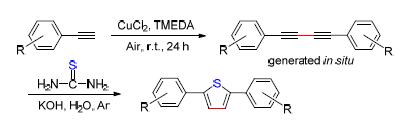
以芳基乙炔与硫脲为起始原料,通过一锅法,经过在无溶剂条件下的氧化偶联反应和在水相中的成环反应,两步串联绿色合成了2,5-二苯基噻吩及其衍生物.所合成化合物经1H NMR,13C NMR,HRMS表征,均为目标产物.在此基础上,进一步探索了所合成化合物的UV和荧光性质,实验结果表明,所合成化合物的紫外最大吸收波长在292~341 nm之间,荧光光谱表明该类化合物具有良好的荧光性,在甲醇中最大发射波长在386~454.5 nm之间,在二氯甲烷中测定的最大发射波长在390~412 nm之间.实验结果显示,随共轭体系增大,荧光发射波长发生红移.
钱存卫 , 臧世宇 , 周倩 , 王栋 , 李万鑫 , 王茂元 . 2,5-二取代噻吩衍生物的“一锅化”串联合成及光学性质[J]. 有机化学, 2017 , 37(7) : 1781 -1786 . DOI: 10.6023/cjoc201612045
The paper describes a convenient and facile methodology for the synthesis of 2,5-diphenylthiophene derivatives. The environmentally friendly synthetic approach is supported by a one-pot tandem reaction process. All of the target products was confirmed by 1H NMR, 13C NMR and HRMS. On this basis, UV and fluorescence properties of the synthesized compounds were further explored. The experimental results showed that the UV maximum absorption wavelengths of the compounds are between 292 and 341 nm. The fluorescence spectra showed that these compounds have good fluorescence. The fluorescence emission wavelengths measured in methanol are between 386 and 454.5 nm, and the fluorescence emission wavelengths measured in dichloromethane are between 390 and 412 nm. The increase of conjugation system led to the red shift of fluorescence.
[1] For selected review, see:(a) Wu, X. F.; Neumann, H.; Beller, M. Chem. Rev. 2013, 113, 1.
(b) Zeni, G.; Larock, R. C. Chem. Rev. 2006, 106, 4644.
(c) Lipshutz, B. H. Chem. Rev. 1986, 86, 795.
(d) Lu, H.; Liu, G. T. Planta Med. 1992, 58, 311.
(e) Navarro, E.; Alonso, S. J.; Trujillo, J.; Jorge, E.; Pérez, C. J. Nat. Prod. 2001, 64, 134.
(f) Cacchi, S.; Fabrizi, G.; Goggiamani, A. Org. Biomol. Chem. 2011, 9, 641.
(g) Flynn, B. L.; Hamel, E.; Jung, M. K. J. Med. Chem. 2002, 45, 2670.
(h) Palkowitz, A. D.; Glasebrook, A. L.; Thrasher, K. J.; Hauser, K. L.; Short, L. L.; Philips, D. L.; Muehl, B. S.; Sato, M.; Shetler, P. K.; Cullinan, G. J.; Pell, T. R.; Bryant, H. U. J. Med. Chem. 1997,40, 1407.
(i) Tsuji, H.; Cantagrel, G.; Ueda, Y.; Chen, T.; Wan, L. J.; Nakamura, E. Chem. Asian J. 2013, 8, 2377.
[2] Joule, J. A.; Mills, K. Heterocyclic Chemistry, Trans. by You, Y.-C.; Gao, D.-B. Science Press, Beijing, 2004, p. 324(in Chinese). (J. A. 焦耳, K. 米尔斯, 杂环化学, 由业诚, 方大彬译, 科学出版社, 北京, 2004, p. 324.)
[3] (a) Snégaroff, K.; Komagawa, S.; Chevallier, F.; Gros, P. C.; Golhen, S.; Roisnel, T.; Uchiyama, M.; Mongin, F. Chem.-Eur. J. 2010, 16, 8191.
(b) Kel'in, A. V.; Gevorgyan, V. J. Org. Chem. 2002, 67, 95.
(c) Rao, H. S. P.; Jothilingam, S. J. Org. Chem. 2003, 68, 5392.
(d) Aponick, A.; Li, C. Y.; Malinge, J.; Marques, E. F. Org. Lett. 2009, 11, 4624.
(e) Egi, M.; Azechi, K.; Akai, S. Org. Lett. 2009, 11, 5002.
(f) Dheur, J.; Sauthier, M.; Castanet, Y.; Mortreux, A. Adv. Synth. Catal. 2010, 352, 557.
[4] (a) Sun, H.; Wu, X.; Hua, R. Tetrahedron Lett. 2011, 52, 4408.
(b) Singha, R.; Nandi, S.; Ray, J. K. Tetrahedron Lett. 2012, 53, 6531.
(c) Pridmore, S. J.; Slatford, P. A.; Williams, J. M. J. Tetrahedron Lett. 2007, 48, 5111.
(d) Kramer, S.; Madsen, J. L. H.; Rottl€ander, M.; Skrydstrup, T. Org. Lett. 2010, 12, 2758.
(e) Nun, P.; Dupuy, S.; Gaillard, S.; Poater, A.; Cavallod, L.; Nolan, S. P. Catal. Sci. Technol. 2011, 1, 58.
(f) Jiang, H.; Zeng, W.; Li, Y.; Wu, W.; Huang, L.; Fu, W. J. Org. Chem. 2012, 77, 5179.
(g) Zheng, Q.; Hua, R.; Yin, T. Curr. Org. Synth. 2013, 10, 161.
(h) Beny, J.-P.; Dhawan, S. N.; Kagan, J.; Sundlass, S. J. Org. Chem. 1982, 47, 2201.
(i) Pridmore, S. J.; Slatford, P. A.; Daniel, A.; Whittlesey, M. K.; Williams, J. M. J. Tetrahedron Lett. 2007, 48, 5115.
(j) Lavallo, V.; Frey, G. D.; Donnadieu, B.; Soleilhavoup, M.; Bertrand, G. Angew. Chem., Int. Ed. 2008, 47, 5224.
(k) Zheng, Q.; Hua, R. Tetrahedron Lett. 2010, 51, 4512.
(l) Mandadapu, A. K.; Sharma, S. K.; Gupta, S.; Krishna, D. G. V.; Kundu, B. Org. Lett. 2011, 13, 3162.
(m) Mandadapu, A. K.; Dathi, M. D.; Arigela, R. K.; Kundu, B. Tetrahedron 2012, 68, 8207.
(n)Wang, L.; Yu, X.; Feng, X.; Bao, M. Org. Lett. 2012, 14, 2418.
(o) Zheng, Q.; Hua, R.; Yin, T. Curr. Org. Synth. 2013, 10, 161.
(p) Jiang, H.; Zeng, W.; Li, Y.; Wu, W.; Huang, L.; Fu, W. J. Org. Chem. 2012, 77, 5179.
[5] (a) Zheng, Q.; Hua, R.; Jiang, J.; Zhang, L. Tetrahedron 2014, 70, 8252.
(b) Zhang, G.; Yi, H.; Chen, H.; Bian, C.; Liu, C.; Lei, A. Org. Lett. 2014, 16, 6156.
(c) Tang, J.; Zhao, X. RSC Adv. 2012, 2, 5488.
[6] (a) Li, D.; Yin, K.; Li, J.; Jia, X. Tetrahedron Lett. 2008, 49, 5918.
(b) Li, L.; Wang, J.; Zhang, G.; Liu, Q. Tetrahedron Lett. 2009, 50, 4033.
[7] Urselmann, D.; Antovic, D.; Müller T. Beilstein J. Org. Chem. 2011, 7, 1499.
[8] Irudayanathan, F. M.; Raja, G. C. E.; Lee, S. Tetrahedron 2015, 71, 4418.
/
| 〈 |
|
〉 |