含大位阻结构的柔性尿酸转运体1(URAT1)抑制剂的设计、合成和生物活性研究
收稿日期: 2017-04-24
修回日期: 2017-05-18
网络出版日期: 2017-05-25
基金资助
山东省自然科学基金(No.ZR2015BM028)资助项目.
Design, Synthesis and Bioactivity of Highly Sterically Congested Flexible Uric Acid Transporter 1 (URAT1) Inhibitors
Received date: 2017-04-24
Revised date: 2017-05-18
Online published: 2017-05-25
Supported by
Project supported by the Natural Science Foundation of Shandong Province (No. ZR2015BM028).
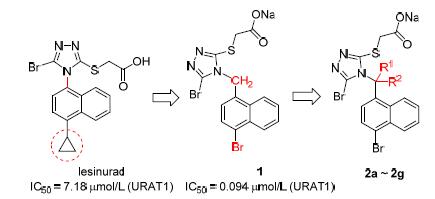
含柔性萘三唑甲烷结构的尿酸转运体1(URAT1)抑制剂1是一类新型的用于痛风和高尿酸血症治疗的强效候选药物.为了进一步研究其构效关系,探究其分子结构中萘环和三唑环之间CH2连接臂上取代基的空间位阻对候选药物1的生物活性的影响,设计并合成了7个含有大位阻结构的化合物2-[(5-溴-4-取代-4H-1,2,4-三唑-3-基)硫]乙酸钠(2a~2g).所设计的化合物使用了1H NMR,13C NMR和HRMS进行了表征,并测试了它们对URAT1的体外抑制活性.结果发现,CH2连接臂上不能容忍其他取代基,因为引入取代基后活性普遍显著降低,且引入取代基后的分子的柔性越差,活性越弱.本研究的结果对URAT1抑制剂的结构设计具有重要的指导作用.
蔡文卿 , 刘巍 , 张硕 , 王建武 , 赵桂龙 . 含大位阻结构的柔性尿酸转运体1(URAT1)抑制剂的设计、合成和生物活性研究[J]. 有机化学, 2017 , 37(9) : 2303 -2314 . DOI: 10.6023/cjoc201704038
The flexible naphthyltriazolylmethane-bearing uric acid transporter 1 (URAT1) inhibitor 1 is a novel, highly potent drug candidate for the treatment of hyperuricemia and gout. In order to understand the effect of substituents at the CH2 linker between naphthalene and triazole rings on the bioactivity, 7 highly congested compounds 2a~2g were designed and synthesized. All the synthesized compounds were characterized by 1H NMR, 13C NMR and HRMS, and their in vitro URAT1 inhibitory assay was studied. The results showed that the bioactivity decreased dramatically after the introduction of substituents to the CH2 linker, and among the synthesized compounds the bioactivity dropped as the flexibility of the molecules decreased, strongly indicating that any substituents at the CH2 linker were intolerable. The structure-activity relationship discovered here will be valuable to the design of URAT1 inhibitors.
[1] Richette, P.; Bardin, T. Lancet 2010, 375, 318.
[2] Punzi, L.; Scanu, A.; Ramonda, R.; Oliviero, F. Autoimmun. Rev. 2012, 12, 66.
[3] Dalbeth, N.; Merriman, T. R.; Stamp, L. K. Lacent 2016, 388, 2039.
[4] Kuo, C, F.; Grainge, M. J.; Zhang, W. Y.; Doherty, M. Nat. Rev. Rheumatol. 2015, 11, 649.
[5] Hyndman, D.; Liu, S.; Miner, J. N. Curr. Rheumatol. Rep. 2016, 18, 34.
[6] Enomoto, A.; Kimura, H.; Chairoungdua, A.; Shigeta, Y.; Jutabha, P.; Cha, S. H.; Hosoyamada, M.; Takeda, M.; Sekine, T.; Igarashi, T.; Matsuo, H.; Kikuchi, Y.; Oda, T.; Ichida, K.; Hosoya, T.; Shimokata, K.; Niwa, T.; Kanai, Y.; Endou, H. Nature 2002, 417, 447.
[7] Cai, W.; Liu, W.; Liu, C.; Wang, J.; Zhao, G. Chin. J. Struct. Chem. 2017, 36, 897.
[8] Tian, H.; Wu, J.; Liu, Y.; Xie, Y.; Wang, J.; Zhao, G. Chin. J. Org. Chem. 2017, 37, 1748(in Chinese). (田禾, 吴景卫, 刘钰强, 谢亚非, 王建武, 赵桂龙, 有机化学, 2017, 37, 1748.)
[9] Hoy, S. M. Drugs 2016, 76, 509.
[10] Shen, Z.; Yeh, L. T.; Wallach, K.; Zhu, N.; Kerr, B.; Gillen, M. Clin. Drug Invest. 2016, 36, 443.
[11] Zhang, X.; Wu, J.; Liu, W.; Liu, Y.; Xie, Y.; Shang, Q.; Zhou, Z.; Xu, W.; Tang, L.; Wang, J.; Zhao, G. Med. Chem. 2017, 13, 260.
[12] Miyake, H.; Nakao, Y.; Sasaki, M. Chem. Lett. 2006, 11, 1262.
[13] Miyake, H.; Nakao, Y.; Sasaki, M. Tetrahedron 2007, 63, 10433.
[14] Zhang, X.; Liu, Y.; Xie, Y.; Li, C.; Xin, X.; Xu, W.; Tang, L.; Zhao, G. Drugs Clin. 2015, 30, 1179(in Chinese). (张宪生, 刘钰强, 谢亚非, 李川, 辛晓, 徐为人, 汤立达, 赵桂龙, 现代药物与临床, 2015, 30, 1179.)
[15] Bertus, P.; Szymoniak, J. J. Org. Chem. 2003, 68, 7133.
[16] Michailidis, F. R.; Pupier, M.; Besnard, C.; Burgi, T.; Alexakis, A. Org. Lett. 2014, 16, 4988.
[17] Li, W. J.; Gao, J, J.; Lorenz, J. C.; Xu, J. H.; Johnson, J.; Ma, S. L.; Lee, H.; Grinberg, N.; Busacca, C. A.; Lu, B.; Senanayake, C. H. Org. Process Res. Dev. 2012, 16, 836.
[18] Haudrechy, A.; Chassaing, C.; Riche, C.; Langlois, Y. Tetrahedron 2000, 56, 3181.
[19] Murayama, K.; Yoshioka, T. Tetrahedron Lett. 1968, 11, 1363.
[20] Glaser, R.; Hillebrand, R.; Wycoff, W.; Camasta, C.; Gates, K, S. J. Org. Chem. 2015, 80, 4360.
[21] Cakmak, O.; Kahveci, I.; Demirta, I.; Hokelek, T.; Smith, K. Collect. Czech. Chem. Commun. 2000, 65, 791.
/
| 〈 |
|
〉 |