



在过去二十多年里, 丰产金属[1], 特别是镍[2]催化的偶联化学得到了快速发展. 其中, Fu[2b]发展的氧化还原中性偶联反应以及Weix, Gong和Reisman等发展的还原偶联反应[2c]在这一领域中表现突出(Scheme 1, A). 然而, 这些转化不足之处在于偶联反应需要两分子预活化底物, 且反应位点局限于两分子底物活性最高的原位位点. 为推动镍催化偶联化学的进一步发展, 探索更廉价易得的烃类底物的远程惰性C—H键的直接官能团化将为分子编辑提供新工具. 本文将重点介绍近年来1,n-Ni/H迁移模式的发展及相关迁移偶联化学的最新研究进展(Scheme 1, B)[3-5].
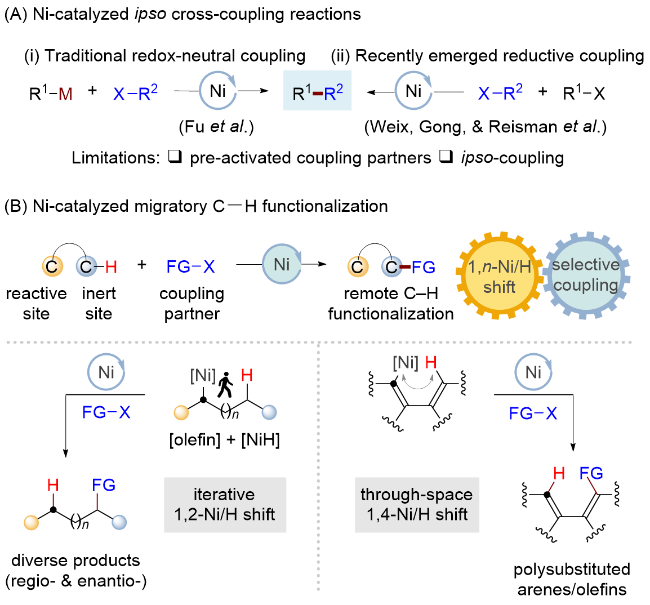
烯烃来源广泛且易于制备, 也是石油炼化产业中的大宗化学品, 烯烃官能团化是有机化学的一个重要研究领域. 在过去二十年中, 丰产金属如Fe, Co, Ni, Cu和Mn催化的烯烃原位选择性氢官能团化和双官能团化取得了显著的进展, 然而这些转化主要集中在烯烃C=C双键的原位. “链行走或金属行走”用来描述烷基金属物种沿着烷基碳链发生迭代的1,2-或者1,3-M/H迁移过程. 早在20世纪80年代, 人们就在烯烃聚合反应中观察到镍和钯催化剂能发生烷基金属的迁移异构现象[6]. 在过去十年中, 化学家通过发展镍氢化学, 开发了温和条件下产生镍氢物种的新方式, 发展了高效的1,2-Ni/H迁移配体, 实现了烯烃的系列迁移单官能团化[3]和迁移双官能团化[4]. 迁移过程中, 镍氢物种催化的烯烃异构过程既有可解离的模式, 又有非解离的模式. 这些进展极大丰富了远程C(sp3)—H键官能团化工具箱. 本文第一部分将重点阐述这一领域的研究进展(Scheme 1, B).
作为一类重要的核心结构单元, 多取代芳烃和多取代烯烃广泛存在于药物、材料和天然产物分子结构中. 然而, 目前模块化高效合成这些核心结构的方法仍然十分有限. 在第一部分讨论的1,2-Ni/H迁移偶联化学基础上, 本文的第二部分将重点介绍空间1,4-Ni/H迁移偶联化学及其实现的远程C(sp2)—H键官能团化[5], 并探讨其在合成多取代芳烃和多取代烯烃方面的研究进展(Scheme 1, B).
1 迭代的1,2-Ni/H迁移偶联
1.1 镍氢催化体系启动的烯烃迁移官能团化
1.1.1 迁移氢芳基化
1.1.1.1 反应发现
2017年, 朱少林课题组[7]通过外加等物质的量的氢源和镍催化剂现场产生镍氢, 基于高迁移活性配体的开发, 通过串联迭代的1,2-Ni/H迁移和选择性偶联化, 首次成功构建了镍氢催化的烯烃迁移还原偶联反应体系. 该策略通过原位生成的镍氢物种和烯烃底物现场生成烷基镍物种, 避免了传统偶联反应中所需的等物质的量的金属试剂的预制备, 同时也提高了反应的官能团兼容性. 该过程的一大好处是后续的选择性偶联和原来烯烃的几何构型以及位置没有太大的关系. 以烯烃迁移还原氢芳基化为例(Scheme 2), 该反应以NiCl2为催化剂前体, 6,6'-二甲基-2,2'-联吡啶(L1)为迁移配体, 工业副产品聚甲基氢硅氧烷(PMHS)为氢源, 氟化铯为碱, 易得易制备的烯烃和商业可得的芳基碘为原料, 在室温下以优异的区域选择性实现了烯烃及其异构体混合物的迁移苄位归一化芳基化, 高效制备一类重要的1,1-二芳基烷烃类药物分子骨架. 该反应条件温和, 底物适用范围广, 活化和非活化的端烯以及顺(反)式或者顺反混合的内烯都适用于该反应(Scheme 2).
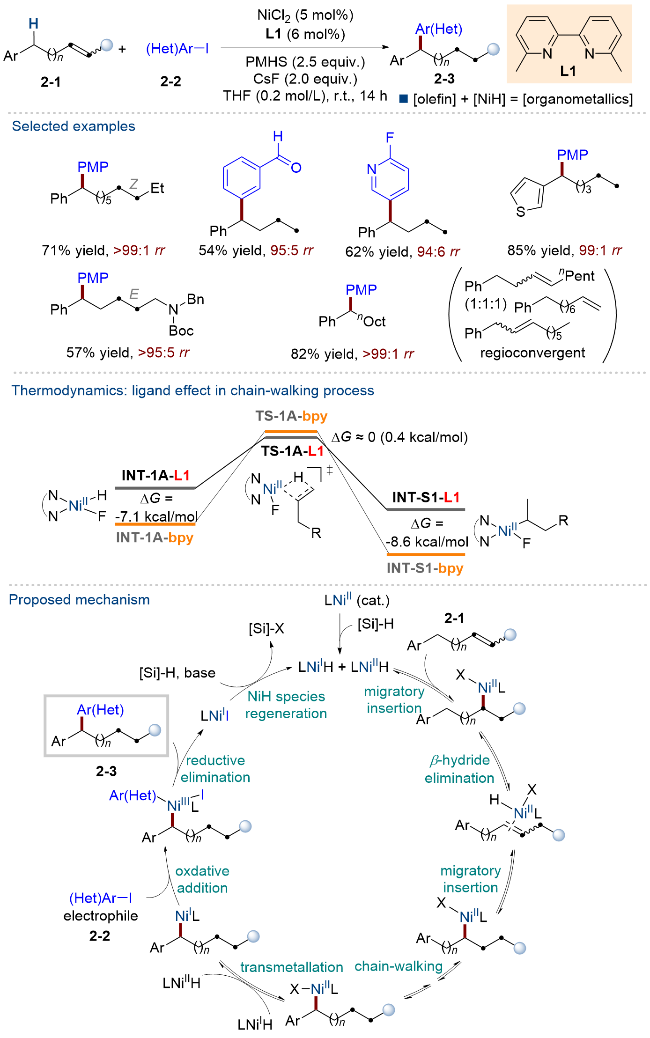
该反应成功的关键因素之一是开发了能够同时促进动态链行走和选择性偶联的配体(L1). 密度泛函计算表明, 联吡啶配体L1中6,6'-位烷基取代基阻碍了相应的镍(II)氢和烷基镍(II)物种形成理想的平面正方形构型, 升高了这两个中间体的能量, 降低了链行走过程中的能垒, 从而提高了迁移活性(Scheme 2).
作者设想如下的催化循环(Scheme 2): 二价镍前体在配体和等物质的量的硅氢存在下, 原位生成一价和二价镍氢物种混合物. 相比一价镍氢物种, 二价镍氢可以更有效地促进烯烃链行走过程, 插入烯烃得到二价烷基镍物种, 随后发生快速迭代的β-H消除/迁移插入过程, 得到烯烃碳链上不同位置的烷基镍物种. 其中二价烷基镍与一价镍发生转金属后可以生成相应的一价烷基镍物种. 通过上述催化过程, 得到系列不同位置的一价和二价烷基镍的混合物. 如果某个位置的烷基镍异构体能优先和芳基碘发生选择性偶联, 通过选择性氧化加成−还原消除就可以得到单一的迁移偶联产物和碘化镍, 体系中外加的氟盐和硅氢可与碘化镍交换再生活性镍氢物种, 从而完成催化循环.
1.1.1.2 反应发展
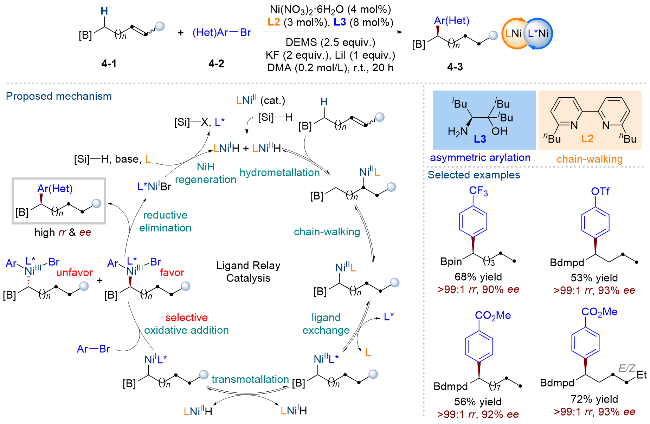
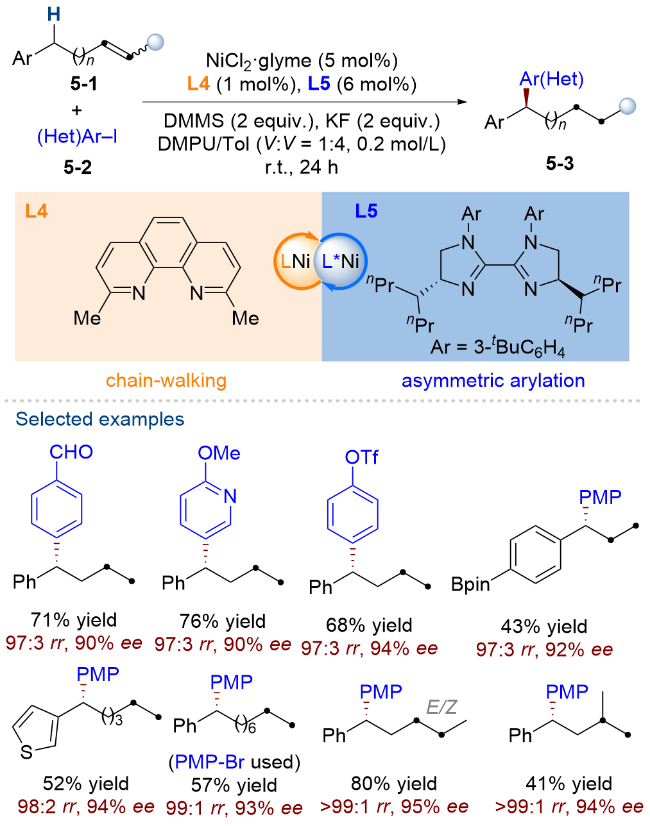
迁移偶联反应的一大挑战在于同时控制反应的区域和对映选择性. 2021年, 朱少林和梁勇课题组[9a]合作, 通过配体接力催化策略, 成功实现了烯烃的迁移不对称氢芳基化(Scheme 4). 传统的金属催化转化过程中, 经典策略需要挑战性地设计结构和功能复杂的单个配体来同时促进催化循环的各个步骤, 实现反应效率和选择性. 为了简化配体设计, 同时提高反应效率和选择性, 朱少林课题组提出了配体接力催化的概念. 以迁移不对称官能团化为例, 通过选择性组合两个结构简单的不同功能配体, 其中迁移配体(烷基取代联吡啶配体L2)负责镍催化的高效迁移异构过程, 相应的手性偶联配体(手性氨基醇配体L3)负责镍催化循环中高效率以及高区域和对映选择性的偶联. 最终以优异的区域和对映选择性, 高收率地实现了含硼烯烃的迁移不对称氢芳基化. 计算和实验结果表明该反应对映选择性决定步骤在于手性配体调控的选择性氧化加成. 配体接力催化策略促进的迁移不对称偶联反应中的一大关键在于合适的配体组合. 为了实现优异的区域和对映选择性, 在相应的选择性偶联步骤中, 手性偶联配体配位的相应烷基镍物种的偶联活性要远远大于相应迁移配体配位的烷基镍物种的背景偶联反应.
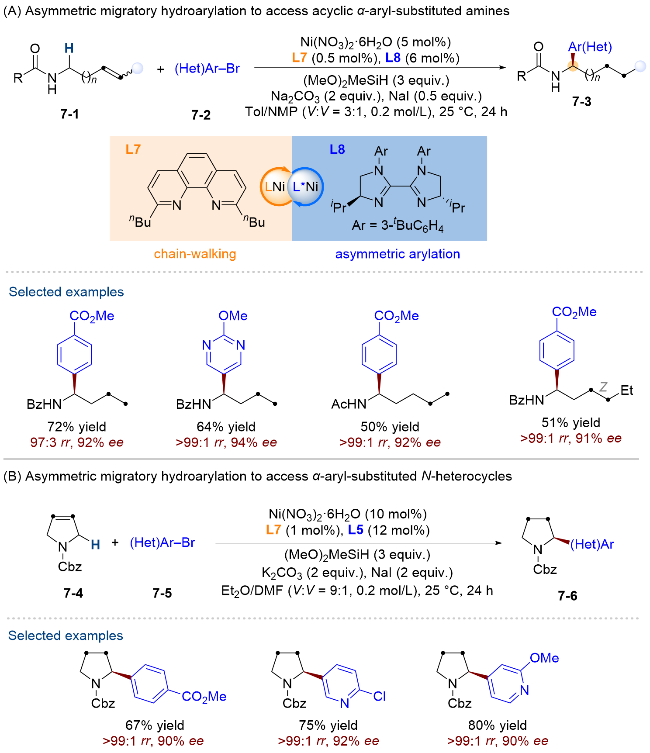
同期, 朱少林课题组[11]简单组合链行走菲啰啉配体L7和不对称芳基化配体L8, 通过接力催化策略实现了上述迁移氢芳基化反应的不对称转化, 以良好的区域和对映选择性实现了手性α-(杂)芳基取代胺及其衍生物的高效制备(Scheme 7, A). 进一步的研究发现, 烯烃的底物范围不限于链状烯烃, 该策略还适用于环状烯烃2,5-二氢吡咯烷-1-甲酸苄酯, 以良好的产率和优异的区域和对映选择性得到手性N-α-(杂)芳基取代的杂环化合物(Scheme 7, B).
常见氢源除了硅氢, 在还原性Mn或Zn粉存在的条件下, 烷基卤化物也可作为氢源和烯烃前体. 2017年, 朱少林课题组[12]报道了烷基溴与芳基溴的迁移还原亲电偶联反应(Scheme 8, A). 在经典的镍催化的还原交叉亲电偶联反应中, 通常Ni(0)优先对芳基卤化物而不是烷基卤化物氧化加成. 作者发现在链行走配体L1的调控下, 可以逆转Ni(0)对两种卤代烃(芳基卤化物和烷基卤化物)的氧化加成反应活性, L1Ni(0)可以选择性地与非活化烷基卤化物进行氧化加成, 生成烷基镍物种来参与后面的链行走和选择性芳基化. 猜测的反应机理如下: 首先, 锰粉还原二价镍到零价镍, 零价镍选择性地与烷基溴发生氧化加成生成二价烷基镍中间体, 紧接着发生迭代的β-H消除/迁移插入的链迁移过程生成热力学稳定的苄位二价烷基镍物种, 再被锰粉还原为一价烷基镍中间体, 其与芳基溴发生氧化加成-还原消除得到目标1,1-二芳基产物, 同时生成的一价镍再被锰粉还原为零价镍, 完成整个催化循环.
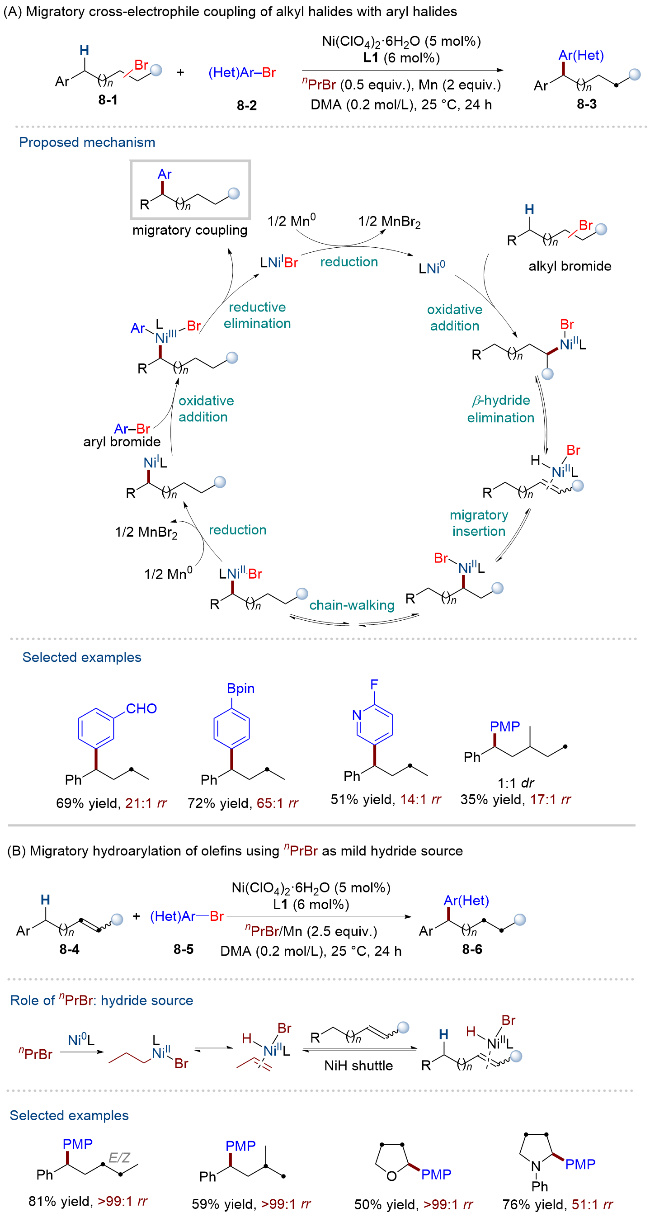
在上述过程中, 作者发现额外添加商业可得的nPrBr作为氢源能提高反应收率. 受此启发, 朱少林课题组[7]直接利用商业可得的nPrBr作氢源, 在等物质的量的锰粉作还原剂条件下, 实现了各种烯烃和芳基溴的迁移氢芳基化(Scheme 8, B). 其中nPrBr在催化剂Ni(0)和还原剂锰的作用下, 氧化加成生成的丙基镍发生β-H消除, 原位生成关键的镍氢和丙烯加合物, 后续从丙烯上解离的镍氢物种可以实现底物烯烃的迁移氢芳基化反应. 值得注意的是, 实验中未明显观察到nPrBr的芳基化产物, 表明该迁移交叉偶联反应具有较好的化学选择性.
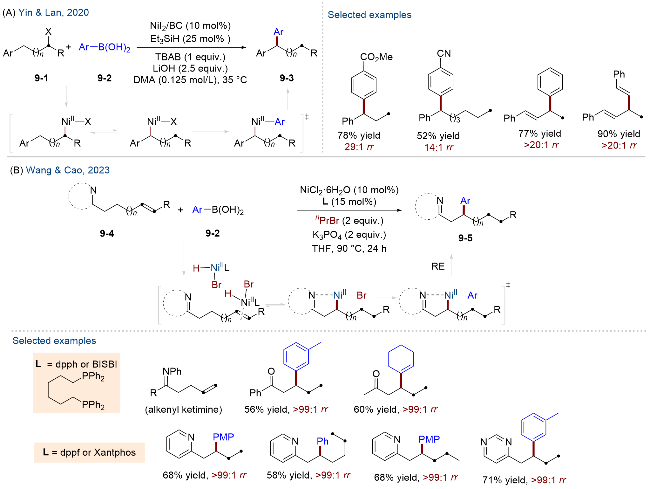
2020年, 阴国印和蓝宇课题组[13a]报道了烷基卤化物和芳基硼酸的迁移偶联(Scheme 9, A). 反应的机理可能是经过二价烷基镍的迁移异构, 合适位置的烷基镍选择性和芳基硼酸转金属/还原消除得到目标的迁移苄位芳基化产物. 2024年, 王鹏课题组[13b]报道了使用溴丙烷作为氢源, 与零价镍氧化加成, 经β-H消除, 解离丙烯得到二价镍氢中间体. 接着镍氢物种插入远程含导向基的烯烃, 得到的烷基镍物种发生快速的迁移异构, 最后得到更加稳定的N配位六元环烷基镍物种, 其选择性和芳基硼酸转金属, 接着还原消除得到迁移芳基化产物(Scheme 9, B).
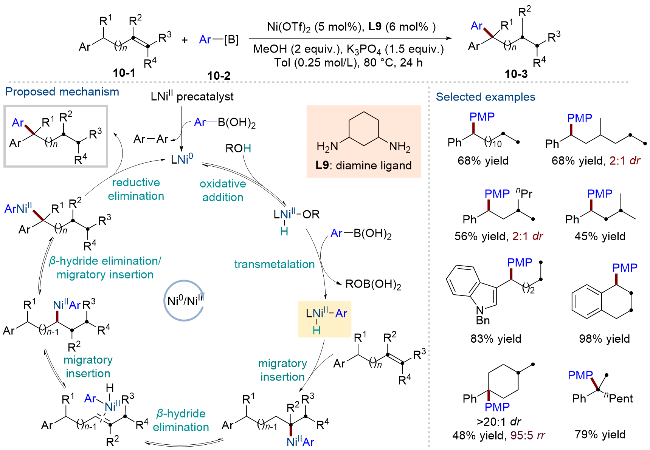
2020年, 朱少林课题组[14]报道了二胺配体L9促进的镍催化烯烃与芳基硼酸的氧化还原中性迁移氢芳基化反应(Scheme 10). 反应以甲醇和芳基硼酸分别作为氢源和芳基源, 生成关键物种Ar-Ni(II)-H, 经过插入烯烃-链行走-选择性还原消除得到了一系列结构多样的1,1-二芳基烷烃. 设想的反应机理如下: 首先, 二价镍前体与芳基硼酸反应形成零价镍物种, 然后与醇氧化加成生成二价镍氢中间体, 随后与芳基硼酸发生转金属反应形成活性二价芳基镍氢, 插入烯烃生成烷基-镍-芳基中间体; 紧接着发生迭代的β-H消除/迁移插入过程生成热力学稳定的苄位二价烷基镍物种, 选择性还原消除得到目标产物和零价镍, 完成整个催化循环.
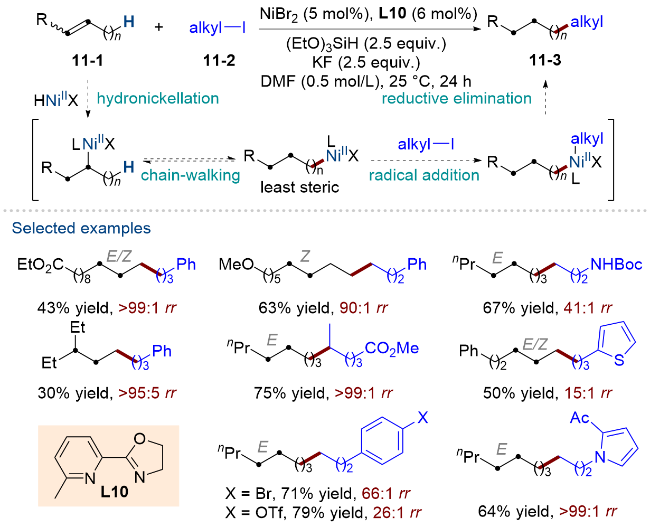
1.1.2 迁移氢烷基化
使用多样化的烷基偶联试剂, 镍氢催化的烯烃(迁移)氢烷基化可以构建常见的C(sp3)—C(sp3)键, 在偶联位点选择性的基础上, 通过手性配体调控, 还可以进一步控制反应的对映选择性, 具有非常强的实用性, 也是目前所有迁移官能团化转化中研究最多最热门的一个分支. 镍氢催化的烯烃(迁移)不对称氢烷基化可以从消旋的烷基偶联试剂出发, 通过对映归一化烷基化在烷基偶联试剂一侧构建手性中心, 也可以通过镍氢物种对烯烃的对映选择性迁移插入在烯烃一侧构建手性中心. 下面按照烷基化试剂和烯烃类型的多样性展开介绍.
1.1.2.1 多样性烷基化试剂
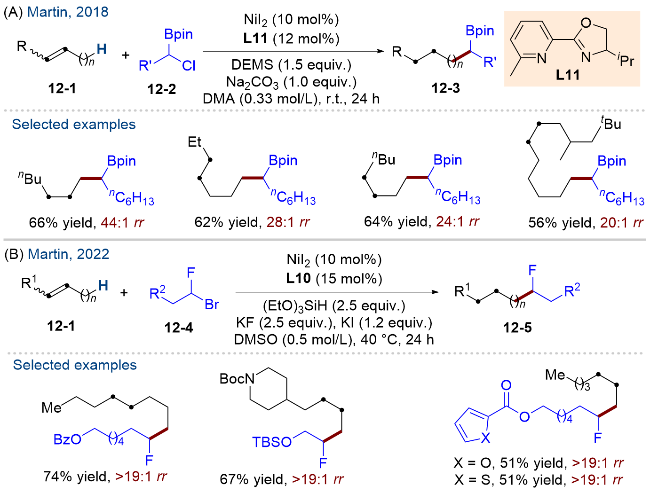
随后, Martin课题组[16a]使用同样的策略, 利用α-卤代硼烷作为亲电烷基化试剂, 通过类似的迁移端位烷基化得到了系列烯烃端位烷基化的烷基硼产物(Scheme 12, A). 2022年, Martin课题组[16b]以α-单氟取代的烷基溴作为烷基化试剂, L10为配体, 通过类似的迁移端位烷基化, 合成了一系列单氟烷基化产物(Scheme 12, B).
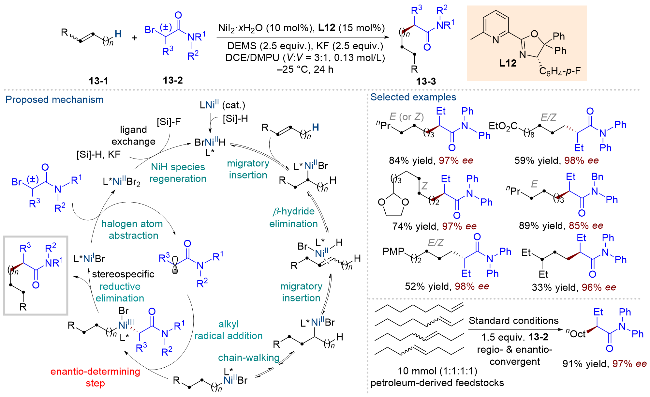
2018年底, 朱少林课题组[17]通于手性迁移配体L12的开发, 在低温下(-25 ℃)成功实现了烯烃与消旋α-溴代酰胺的迁移不对称氢烷基化反应, 以优异的区域和对映选择性得到了一系列烯烃端位不对称烷基化产物(Scheme 13). 从反应机理可以看出, 反应的对映选择性决定步骤是对映选择性的自由基加成. 该策略可用于石化产业中烯烃异构体混合物的区域和立体归一化转化, 以优异的区域和对映选择性得到高附加值α-手性酰胺单一产物, 进一步展示了其潜在的合成应用价值. 同期, Fu课题组[18]报道了非活化端烯烃和外消旋的卤代烷烃(包括二级α-溴代酰胺/酯和三级α-溴代-β-内酰胺)的原位不对称氢烷基化.
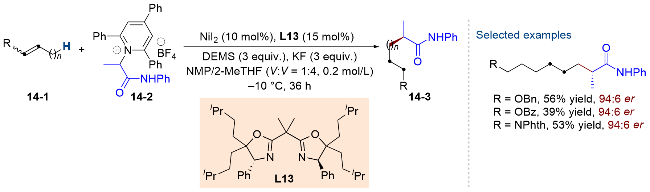
1.1.2.2 多样性烯烃
以烯烃远程氮原子上的保护基团为导向基团, 2019年, 胡喜乐课题组[20]使用消旋的迁移配体PyrOx-L14, 实现了环状烯烃3-吡咯啉底物的迁移氢烷基化反应, 合成了一系列结构多样的N-α-烷基化四氢吡咯(Scheme 15, A). N-碳酸酯基团在一定程度上稳定了N-α-烷基镍中间体, 从而使N-α-烷基化占优势. 将N-杂环内烯烃的去对称化与N-酰基保护的导向基团结合, 2023年, 荣子强课题组[21]使用手性配体BOX-L15实现了该反应的不对称转化, 合成了一系列手性N-α-烷基四氢吡咯(Scheme 15, B).
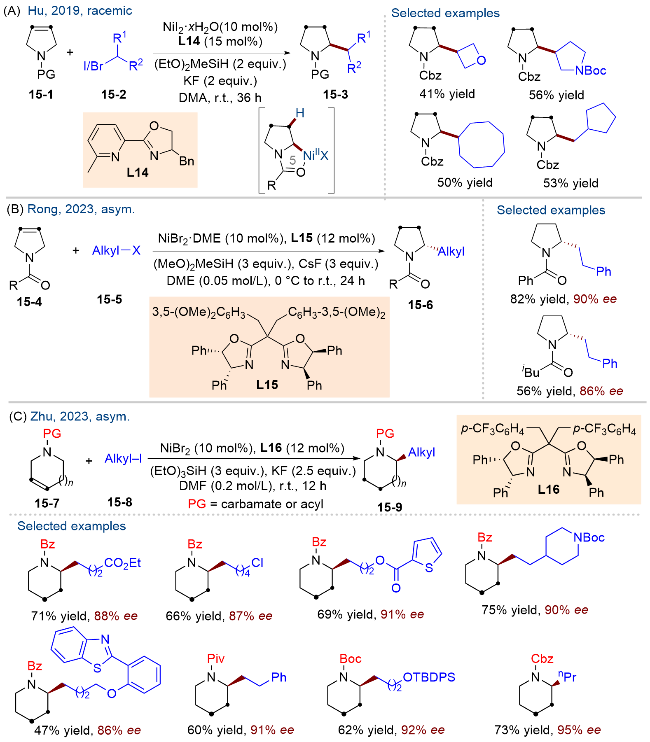
2023年, 朱少林课题组[22]使用手性配体BOX-L16, 实现了镍氢催化的六元氮杂环烯烃的迁移不对称氢烷基化(Scheme 15, C). 反应以N-杂环烯烃异构体及其混合物为原料, 烷基碘代物为烷基化试剂, 高区域和立体选择性地实现了N-α-烷基取代的手性六元氮杂环的高效构建, 可用于多种生物碱的高效合成. 反应的对映选择性决定步骤可能是镍氢的对映选择性插入.
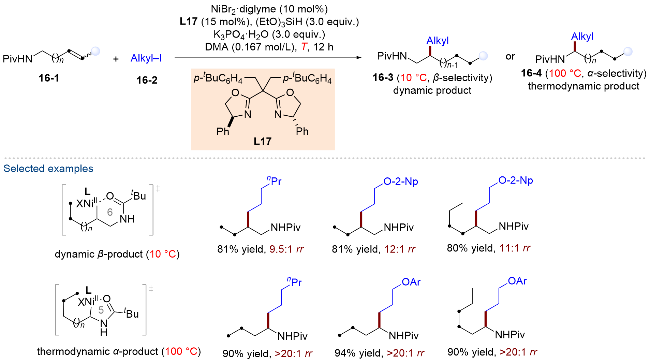
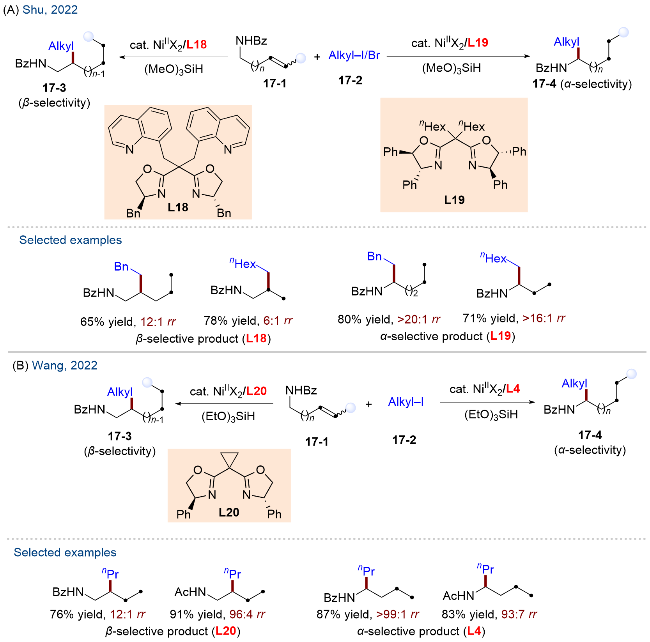
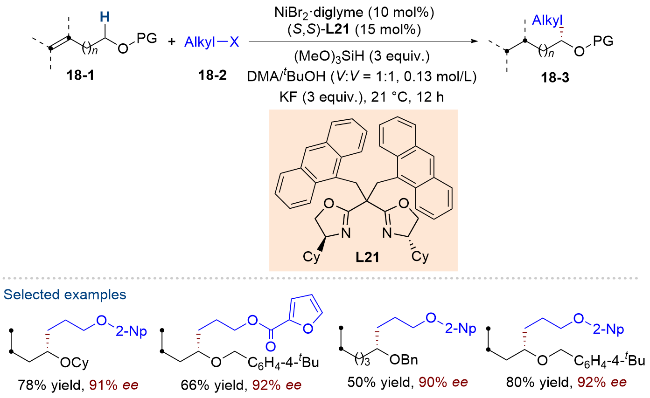
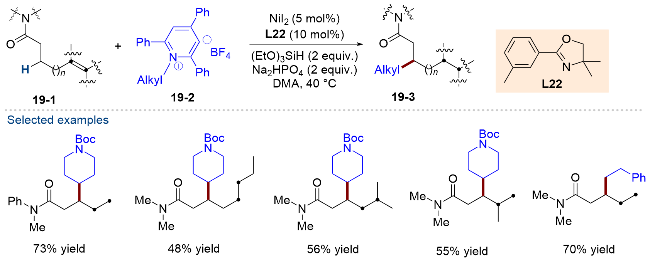
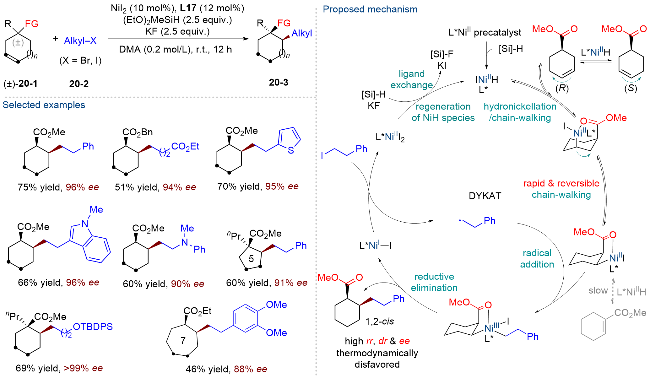
同年, 舒伟课题组[24]和王超课题组[25]分别报道了通过配体调控上述迁移氢烷基化反应的区域选择性. 舒伟课题组发现, 以烷基碘(少数情况下使用活化的烷基溴)为烷基化试剂, 使用Bn-BOX配体L18可得到N-β-位选择性烷基化产物, 而使用Ph-Box配体L19则可得到N-α-位选择性烷基化产物 (Scheme 17, A). 王超课题组发现, 使用双噁唑啉类配体L20则可得到N-β-位选择性烷基化产物, 而使用菲罗啉类L4可得到N-α-位选择性烷基化产物(Scheme 17, B).
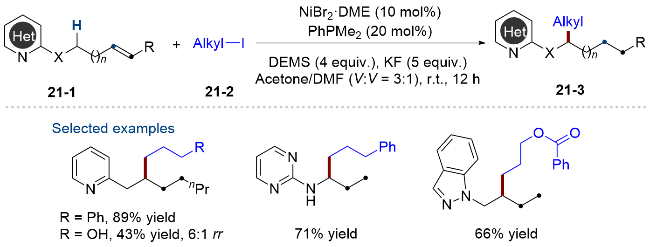
1.1.2.3 烷基卤化物作为烯烃前体
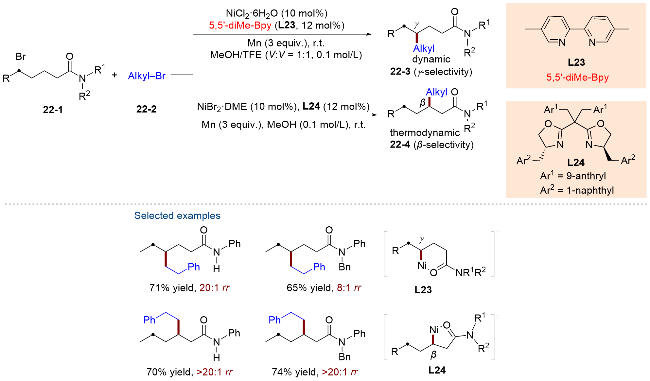
1.1.3 迁移氢烯基化
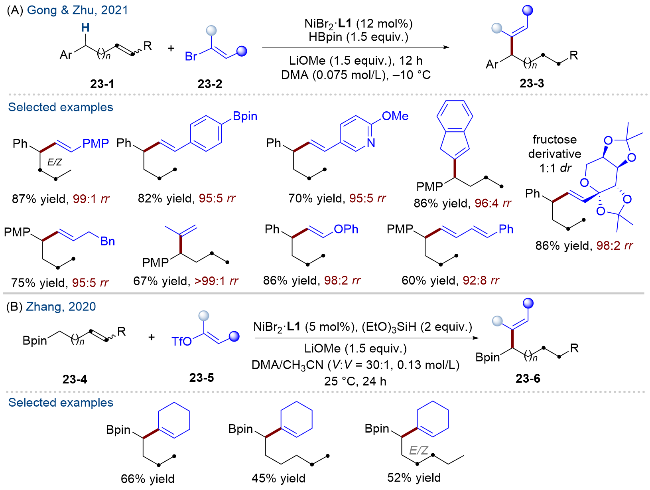
和前面的芳基化和烷基化相比, 烯烃与烯基溴化物的迁移氢烯基化反应更具挑战性, 因为无论是底物烯烃和烯基溴, 还是烯基化产物, 都含有C=C双键, 均有可能经历竞争性的链行走或烯基化过程.
2021年, 龚和贵课题组和朱少林课题组[31a]合作报道了镍氢催化的烯烃与烯基溴化物的迁移氢烯基化反应(Scheme 23, A), 以高收率和优异的区域选择性获得了苄位烯基化产物. 研究发现, 低温下使用频哪醇硼烷(HBpin)作为氢源, 能顺利地进行目标的迁移氢烯基化反应, 同时防止烯烃产物进一步异构化或随后的烯基化. 张淳课题组[31b]进一步拓展了烯烃底物的范围到远程硼酸酯取代的烯烃, 高效构建了烯丙基硼酸酯(Scheme 23, B).
1.1.4 迁移氢炔基化
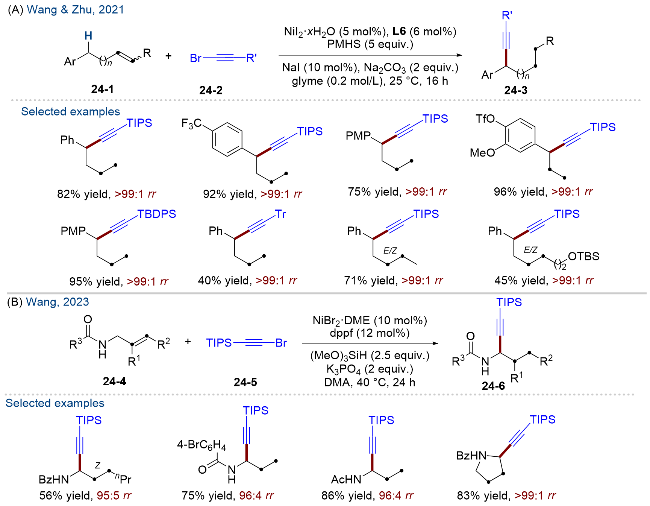
与上述迁移氢烯基化反应类似, 烯烃的迁移氢炔基化反应的难点也在于反应的化学选择性. 生成的NiH物种必须选择性地插入底物烯烃而不是炔烃试剂或炔基化产物. 2021年, 朱少林课题组[32a]报道了镍氢催化的烯烃与炔基溴化物的迁移氢炔基化反应, 以高产率和优异的区域选择性获得了相应的苄位炔基化产物(Scheme 24, A). 2023年, 王超课题组[32b]基于1,1'-双(二苯基膦)二茂铁(dppf)双膦配体实现了非活化烯烃迁移氢炔基化, 以中等至优秀的产率生成α-取代的炔丙基胺(Scheme 24, B).
1.1.5 迁移脱氟烯烃偶联反应
偕二氟烯烃作为一类重要的有机含氟化合物, 在药物分子设计中可以将其看作是醛基或者酮基的生物电子等排体, 可以显著提高药物的稳定性和活性, 同时偕二氟烯烃类化合物也是含氟聚合物的聚合单体, 并且在有机合成中可以转化为多种多样的含氟化合物, 因此发展温和高效的偕二氟烯烃合成方法具有重要意义. 2020年, 朱少林课题组[33a]报道了镍氢催化非活化烯烃与三氟甲基取代烯烃的迁移脱氟交叉偶联制备偕二氟烯烃的新方法(Scheme 25, A). 当烯烃链上有芳基或者N, O杂原子时, 可以高选择性地得到苄位或者N, O杂原子的α-位偕二氟代烯丙基化产物. 迁移生成的某个位置的烷基镍物种选择性被三氟甲基取代的受体烯烃捕获, 并经过随后的β-氟消除得到迁移脱氟偶联产物.
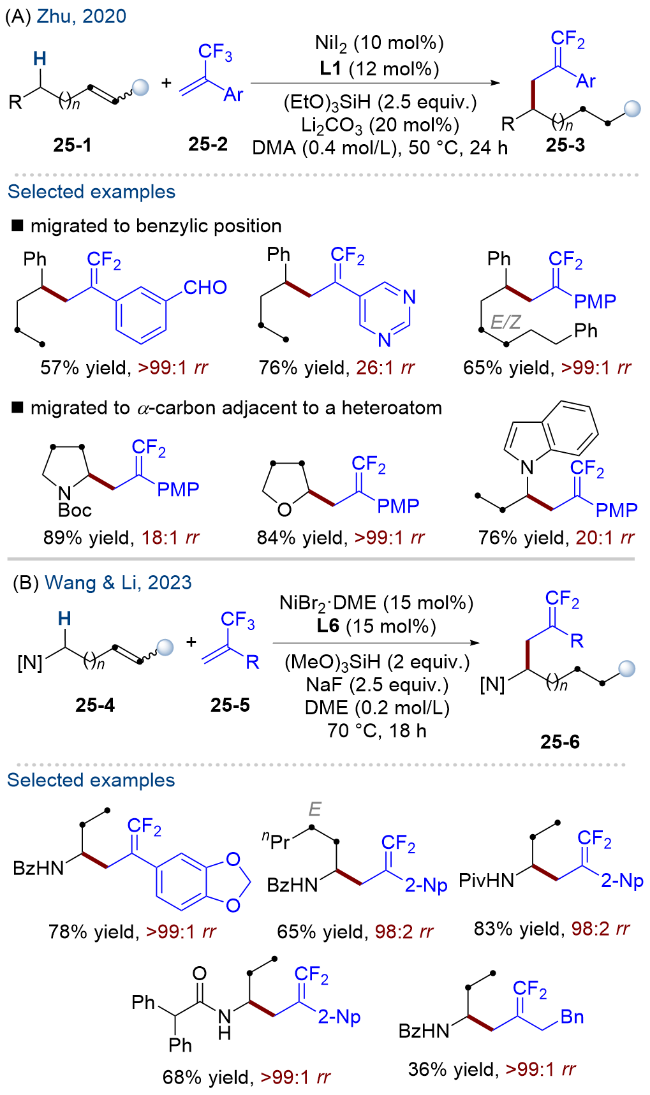
2023年, 王超和李文艺课题组[33b]合作发展了镍氢催化的远程酰基胺导向的烯基与芳基/烷基取代的三氟甲基烯烃的迁移氢偕二氟烯丙基化反应, 得到了迁移的α-选择性产物(Scheme 25, B).
1.1.6 迁移氢羧基化和迁移氢酰基化反应
1.1.6.1 迁移羧基化
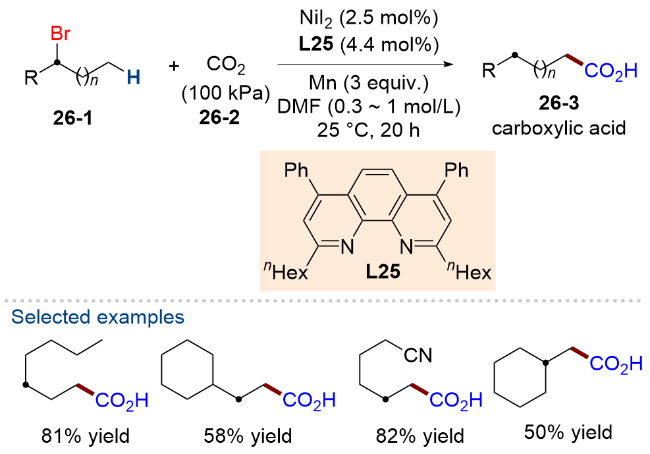
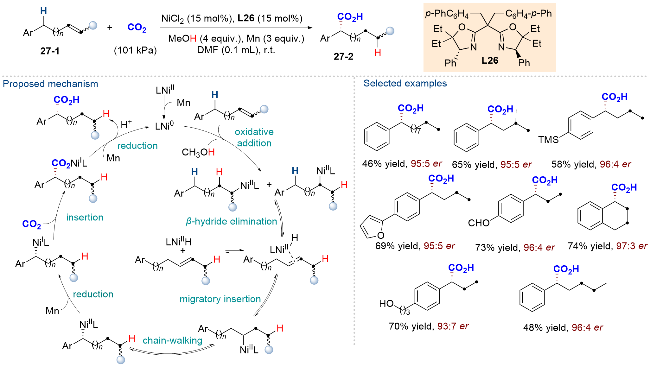
2024年, 唐勇和周友运课题组[35]报道了镍催化的非活化烯烃与二氧化碳的迁移不对称羧基化反应(Scheme 27). 在温和的条件下, 该反应利用手性边臂双噁唑啉(Sa-BOX)配体, 实现了烯烃底物与二氧化碳的迁移苄位不对称羧基化, 以优异的区域和对映选择性得到了α-手性羧酸. 作者利用氘代实验证明了反应的氢源来自甲醇, 且链行走过程中有烯烃-镍氢络合物的解离过程. 可能的反应机理如下: 镍通过Mn还原生成零价镍, 和甲醇发生氧化加成生成二价镍氢中间体插入烯烃底物生成烷基镍中间体; 随后, 手性配体控制烷基中间体进行β-H消除和迁移插入的链行走过程后得到手性苄基中间体, 该中间体经CO2插入和质子化后生成手性的α-芳基羧酸产物.
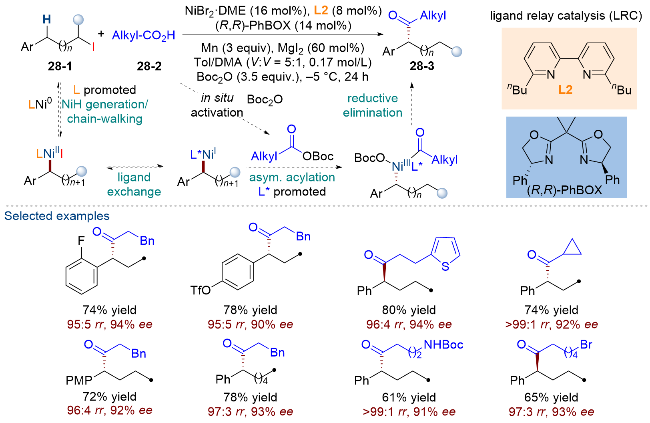
1.1.6.2 迁移氢酰基化
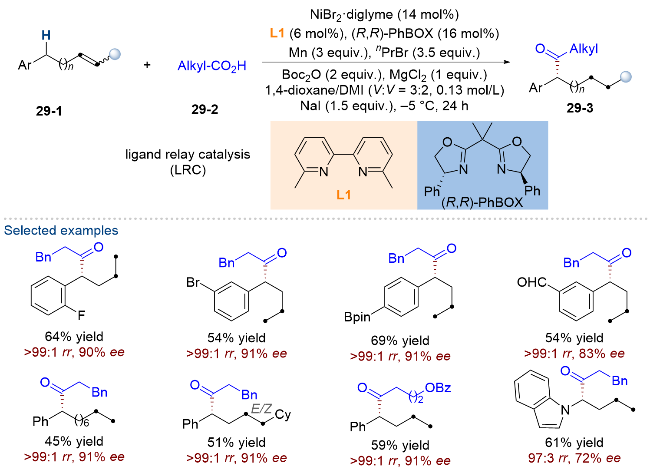
1.1.7 迁移氢硫醚化反应
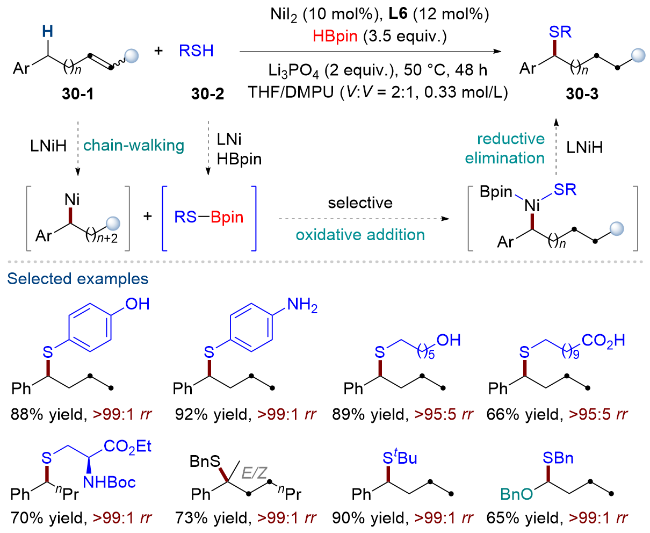
1.1.8 迁移氢胺化反应
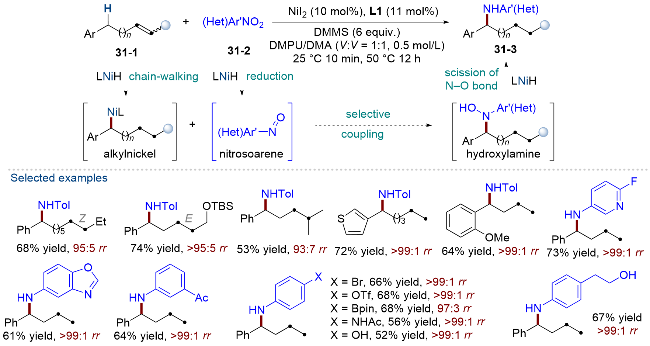
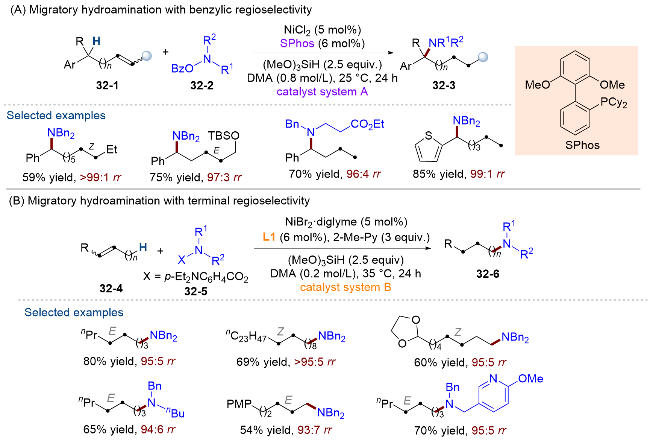
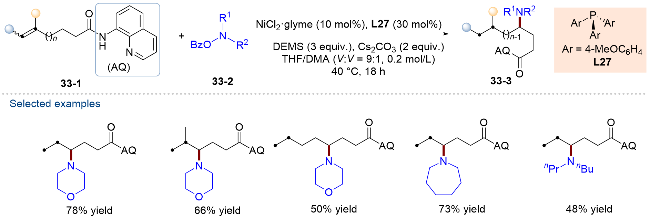
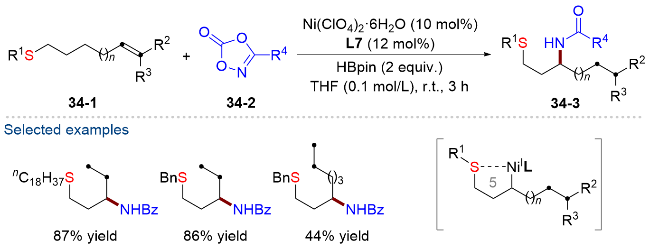
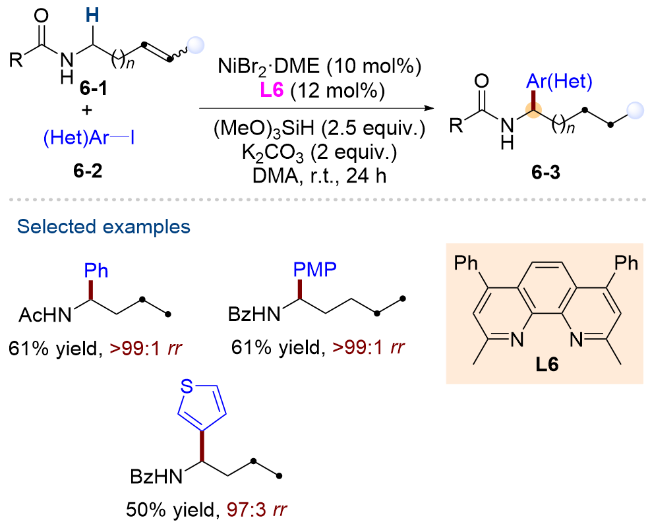
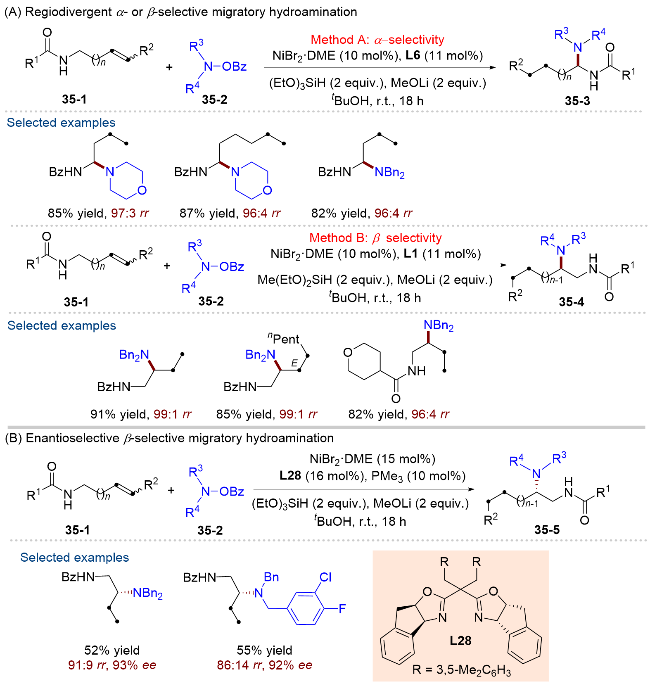
2023年, 王超课题组[43]报道了配体调控的含远程酰胺导向基团的烯烃区域选择性迁移氢胺化反应(Scheme 35, A). 实验结果表明, 使用菲啰啉类配体L6时, 反应优先通过五元环镍中间体发生后续的选择性胺化, 获得N-α-位选择性的1,1-二胺热力学产物; 当使用联吡啶类配体L1时, 反应优先通过六元环镍中间体发生后续的选择性胺化, 获得N-β-位选择性的1,2-二胺动力学产物. 进一步研究发现, 当使用手性配体L28时, 可以以优异的区域和对映选择性实现β-选择性迁移不对称氢胺化反应(Scheme 35, B).
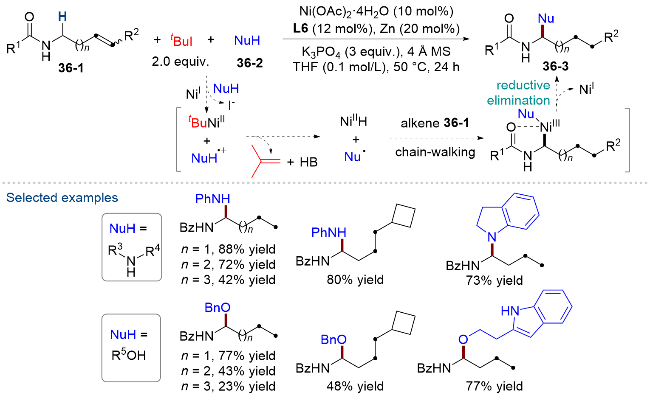
2023年, 张万斌和袁乾家课题组[44]报道了温和条件下镍催化烯烃与未活化的胺或醇的迁移氢胺化和氢醚化反应(Scheme 36). 以迁移氢胺化为例, 反应可能的机理如下: 作为氢化物给体和自由基前体的叔丁基碘(tBuI)均裂形成碘自由基, 去氧化胺得到氨基自由基阳离子, 磷酸钾攫取质子得到高活性的胺自由基; 与此同时, 叔丁基自由基氧化镍(I)为镍(II), 自身通过β-H消除得到异丁烯; 镍(II)与烯烃配位后形成的中间体沿烷基链经历链行走过程, 通过多次β-H消除和插入, 最终获得稳定的五元环烷基镍(II)中间体; 中间体与胺自由基被烷基镍选择性捕获, 还原消除最终获得偕二胺和N,O-缩醛类产物.
1.2 镍硼催化体系启动的烯烃迁移官能团化
有机含硼化合物是一类重要的有机合成中间体, 硼官能团能进行多样性的衍生化, 进一步得到多样性产物. 前面一部分我们综述了通过引入等物质的量的硅氢产生镍氢物种对烯烃底物插入, 后续经历动态迁移和选择性偶联得到迁移偶联产物. 类似使用等物质的量的联硼X2B-BX2, 如B2pin2等替代硅氢, 产生的镍硼物种对烯烃底物插入来启动反应, 后续经历类似的动态迁移和选择性偶联得到烯烃1,n-双官能团化产物. 这类反应为合成含硼化合物提供了一类模块化的合成策略. 按照迁移的位点选择性, 常见的迁移产物可以分为1,1-双官能团化、1,3-双官能团化以及少量1,n-双官能团化(n>3). 下面按照引入的官能团种类的不同进行展开介绍.
1.2.1 迁移硼芳基化
1.2.1.1 反应发现
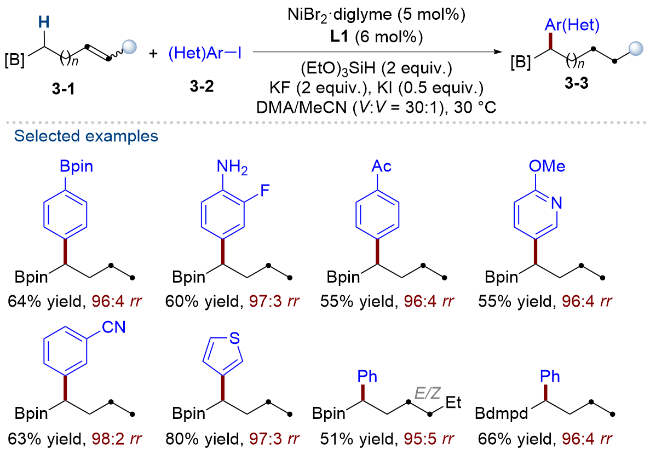
2019年, 阴国印课题组[45]首次报道了镍催化的端烯烃迁移1,n-硼芳基化(n>2) (Scheme 37, A). 该反应以二价镍NiBr2•DME为镍源, C-6取代的PyrOx-L29为迁移配体, 在等物质的量的B2pin2和LiOMe存在条件下, 原位生成的镍硼物种Bpin-Ni(II)-Br对端烯烃插入生成相应的烷基镍, 后续通过烷基镍迁移, 选择性地在苄位芳基化得到目标产物, 其中烯烃链增长所得目标产物的产率都有所降低.
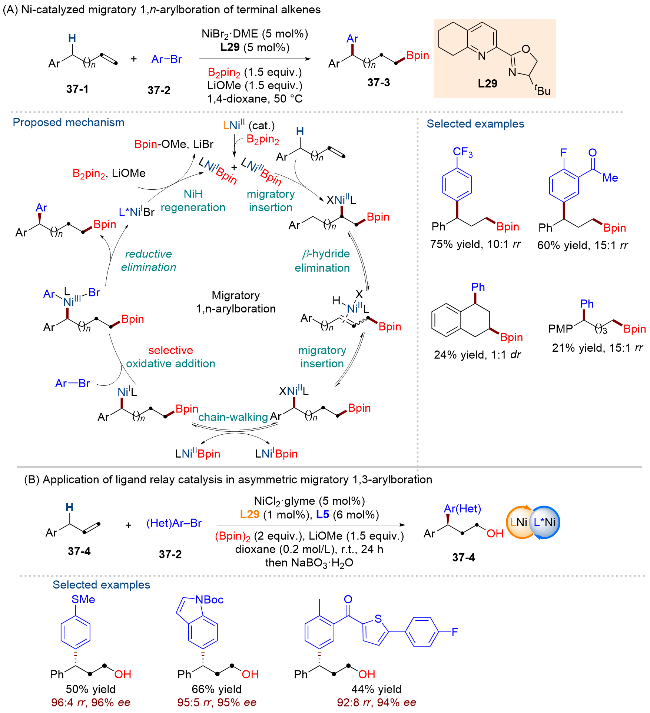
在此基础上, 2022年, 朱少林和梁勇课题组[9b]通过配体接力策略(组合迁移配体L29和不对称偶联配体L5)进一步实现了Ni(II)-Bpin物种引发的烯烃迁移不对称硼芳基化(Scheme 37, B).
1.2.1.2 反应发展
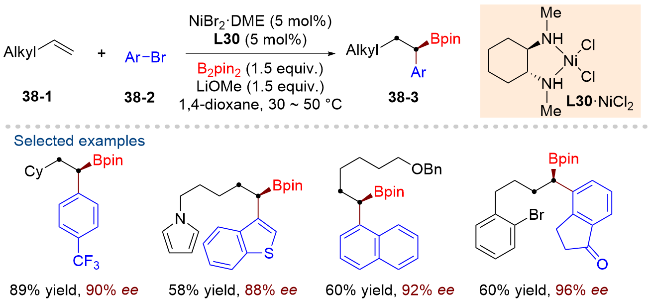
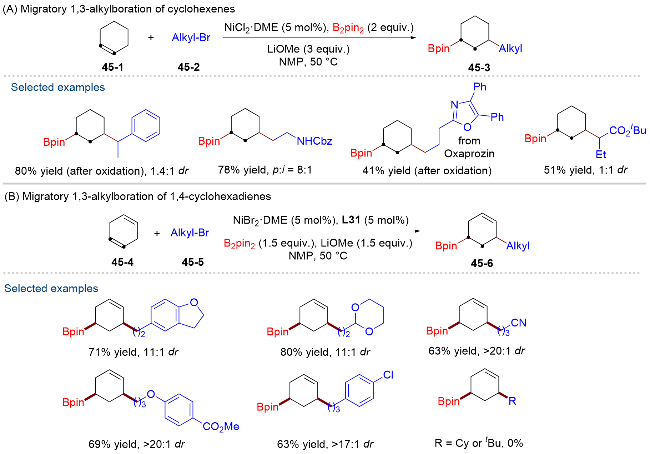
在此基础上, 2023年, 阴国印课题组[47a]实现了环己烯的迁移1,3-硼芳基化反应(Scheme 39, A). 2024年, 他们[47b]进一步实现了1,4-环己二烯的1,3-硼芳基化反应(Scheme 39, B).
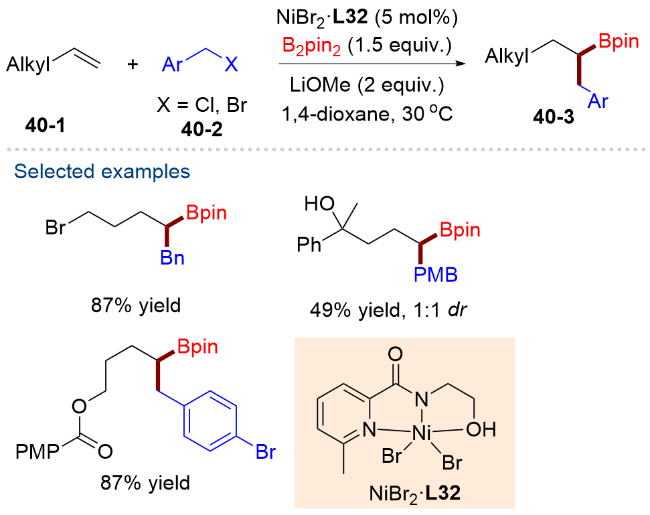
1.2.2 迁移硼烷基化
1.2.2.1 端烯烃
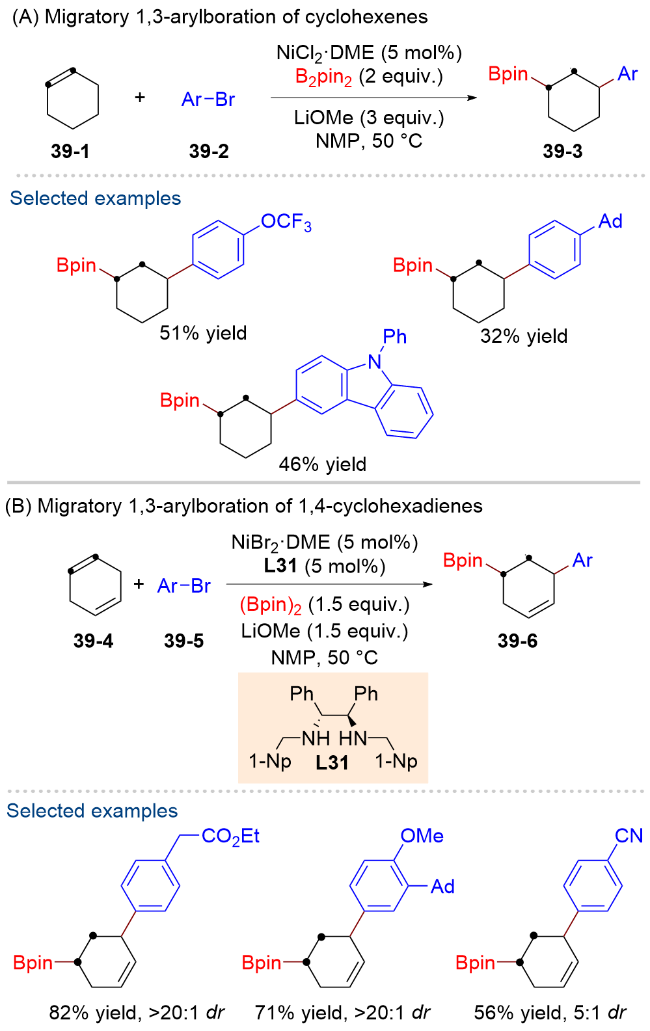
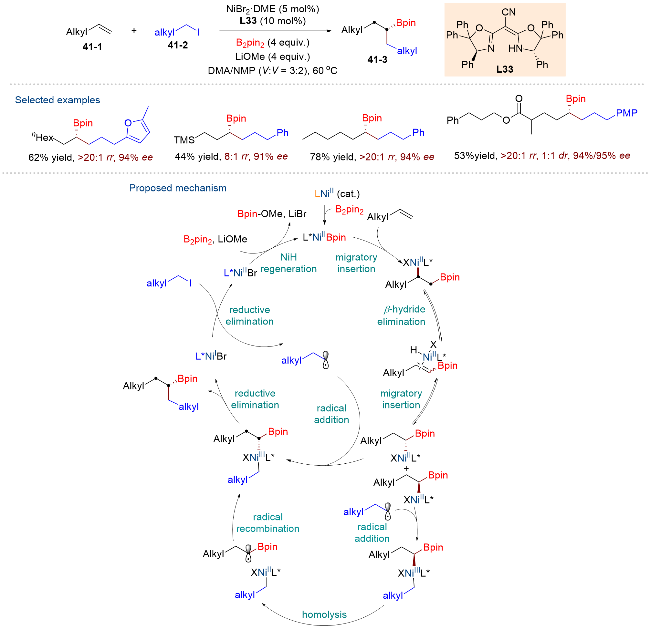
在此基础上, 2023年, 阴国印课题组[49]报道了镍催化烷基取代端烯烃的迁移不对称1,1-硼烷基化反应(Scheme 41). 该反应利用手性配体L33可以实现系列手性烷基硼酸酯类化合物的合成. 该工作一个有意思的地方在于反应的对映选择性决定步骤, 相关机理实验得出反应可能的机理如下: 原位生成二价镍硼物种启动反应, 插入端烯烃后得到的烷基镍进一步发生β-氢消除和镍氢的迁移插入, 得到两种立体构型的镍α-位烷基镍中间体, 捕获烷基自由基得到三价镍中间体, 其中一个构型优先还原消除, 另一构型相反的三价镍中间体发生均裂得到硼α-位烷基自由基和二价镍物种, 在手性配体的调控下发生自由基对二价烷基镍的再结合过程, 实现立体构型的反转, 从而立体归一化地得到高ee值的目标产物.
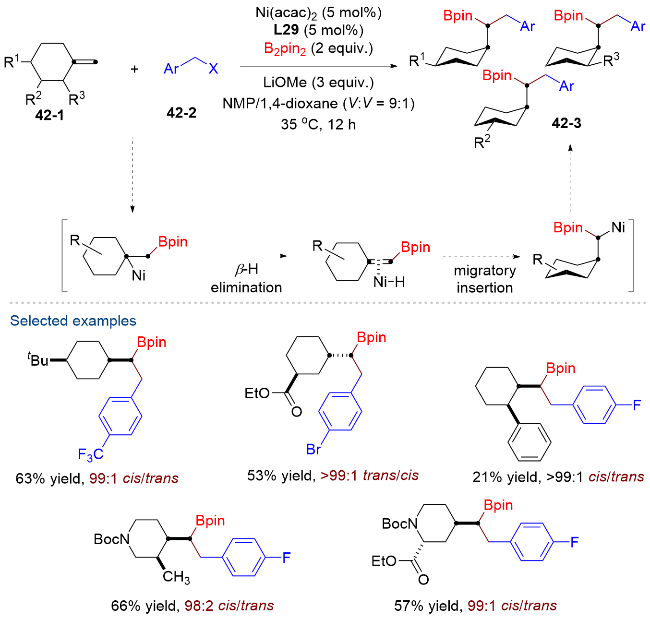
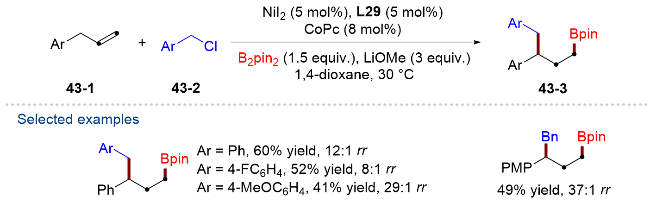
1.2.2.2 环状烯烃
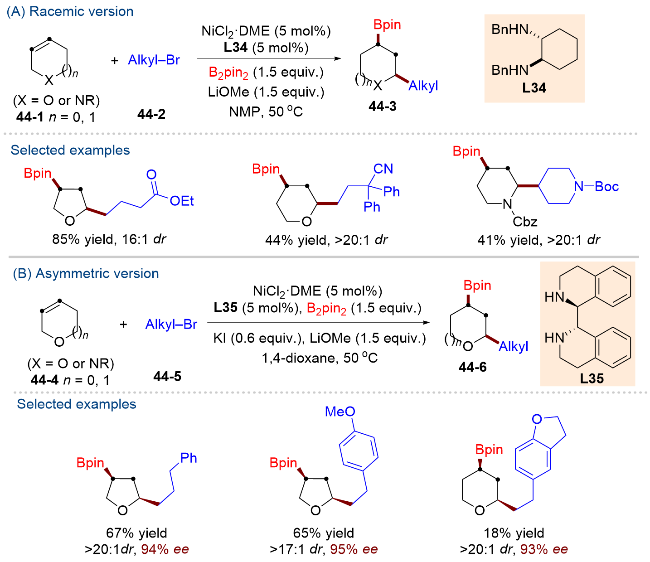
2021年, 阴国印课题组[52]报道了杂环烯烃的迁移1,3-硼烷基化反应(Scheme 44). 使用双胺配体L34, 系列五元、六元氧杂环烯以及六元氮杂环烯均可与一级和二级烷基溴化物等烷基亲电试剂进行反应, 高区域和非对映选择性地得到迁移顺式1,3-硼烷基化产物(Scheme 44, A). 其中氮杂六元环底物得到硼远离杂原子的硼烷基化产物, 暗示镍硼物种插入烯烃底物时金属镍和杂原子有一定的配位作用. 反应的高dr值暗示反应过程中得到的烷基镍物种发生迁移时生成的镍氢物种没有从环烯烃中间体上解离, 而是通过非解离的方式实现迁移, 得到相应的1,3-顺式烷基镍中间体. 使用手性双胺配体L35时相应的五元或六元氧杂环烯底物可以进一步高对映选择性地得到目标产物, 但相应的六元氮杂环烯无法在该条件下进行反应(Scheme 44, B). 反应从镍硼物种启动, 经历插入/迁移后得到的杂原子α-位烷基镍物种优先捕获烷基自由基, 最后进行还原消除得到相应的产物.
随后, 阴国印课题组[47a]发现在没有配体条件下, NiCl2•DME可以直接催化环己烯发生迁移1,3-硼烷基化反应(Scheme 45, A). 2024年, 他们[47b]使用1,2-二胺作为配体, 进一步实现了1,4-环己二烯的迁移1,3-硼芳基化反应(Scheme 45, B).
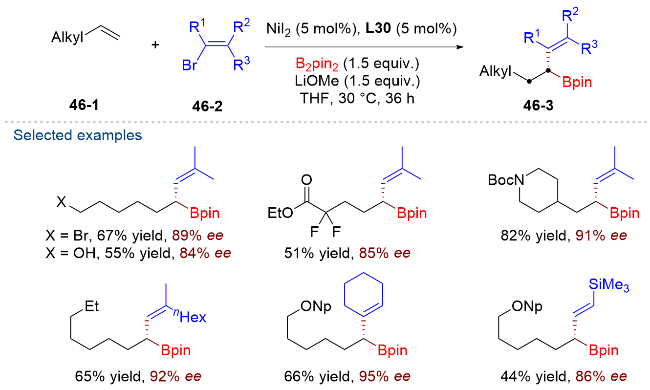
1.2.3 迁移硼烯基化
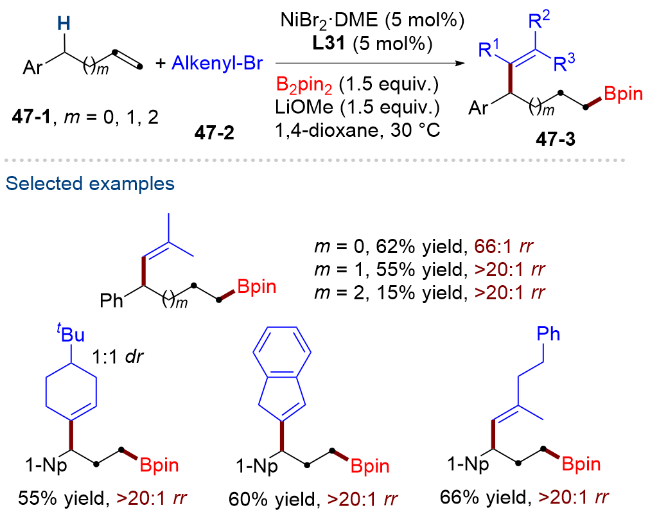
1.2.4 迁移硼炔基化
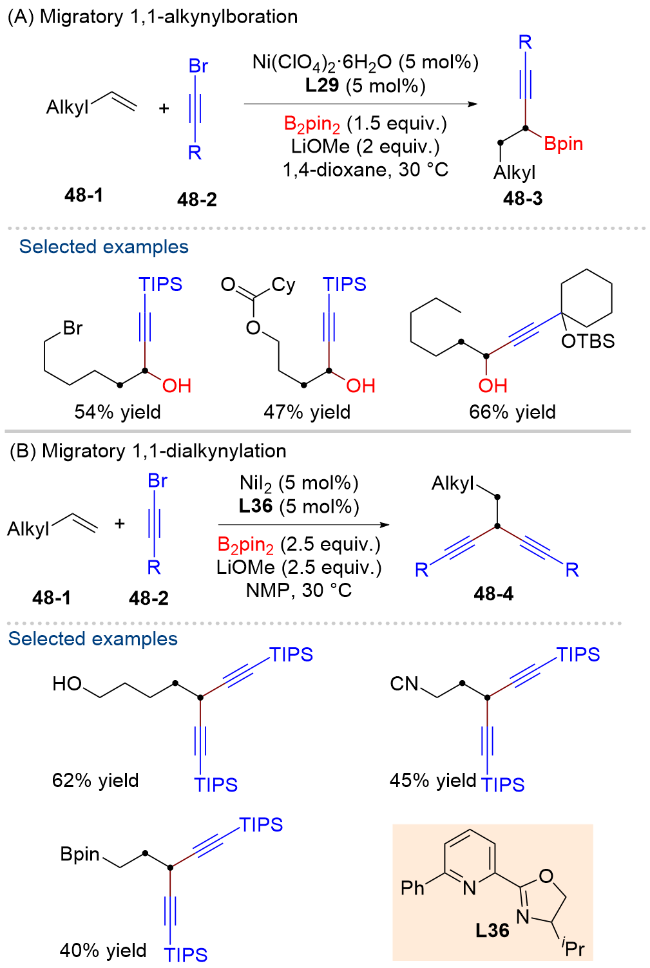
2020年, 阴国印课题组[55]报道了镍催化烷基取代端烯烃的迁移1,1-硼炔基化反应(Scheme 48). 该反应利用同骨架不同取代基的配体L29和L36调控端位烯烃与一分子炔烃或两分子炔烃进行偶联反应. 使用L29作为配体时(Scheme 48, A), 相应的迁移1,1-硼炔基化反应和前面的迁移1,1-硼芳基化反应类似, 得到1,1-硼炔基化产物48-4. 使用配体L36作为配体时(Scheme 48, B), 得到的1,1-硼炔基化产物可以进一步和炔基溴48-2偶联, 得到相应的1,1-双炔基化产物48-5.
1.2.5 迁移硼胺基化
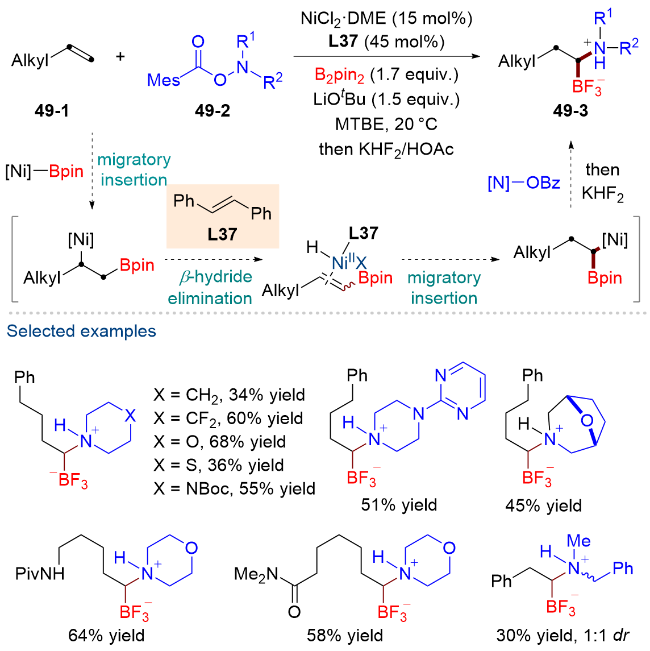
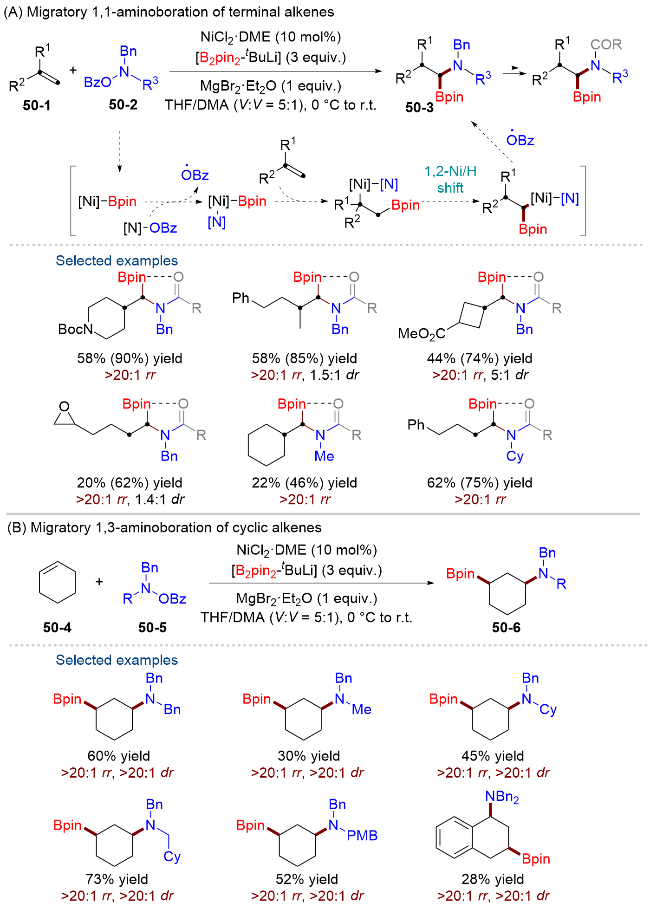
同年, Brown课题组[57]也报道了非活化端烯的1,1-硼胺基化反应, 同样用于制备α-胺基硼酸衍生物(Scheme 50, A). 该反应无需配体, 直接以NiCl2•DME为催化剂, 以预处理过的联硼-碱混合物作为反应的硼源(预混和tBuLi/Bpin2生成活性tBuBpin物种), 反应的端烯底物范围也适用于更为挑战性的1,1-二取代端烯烃. 在反应中, 若氮原子上取代基由苄基更换为位阻较小的甲基时产率会明显降低, 位阻较大的环己基时产率相对会提升. 和上述Martin课题组设想的较为常见的Ni-Bpin中间体直接插入烯烃不同, 作者推测镍硼物种的插入/迁移过程有亲电试剂[N]-OBz的参与: 镍催化剂和活性tBuBpin物种形成Ni-Bpin中间体并不直接插入烯烃, 而是优先和Bn2NOBz反应形成Bn2N-Ni(II)-Bpin中间体和•OBz自由基, 生成的Bn2N-Ni(II)-Bpin中间体迁移插入烯烃, 随后该中间体经历β-H消除和迁移插入得到硼基α-位的镍物种, 再选择性捕获一个•OBz自由基生成高价镍还原消除得到目标产物. 在该工作中, Brown课题组还同时实现了镍催化环己烯底物的迁移1,3-硼胺基化反应, 以优异的区域和非对映选择性得到1,3-硼胺基化产物(Scheme 50, B).
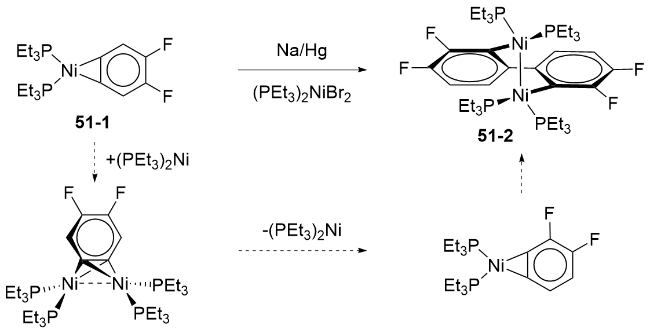
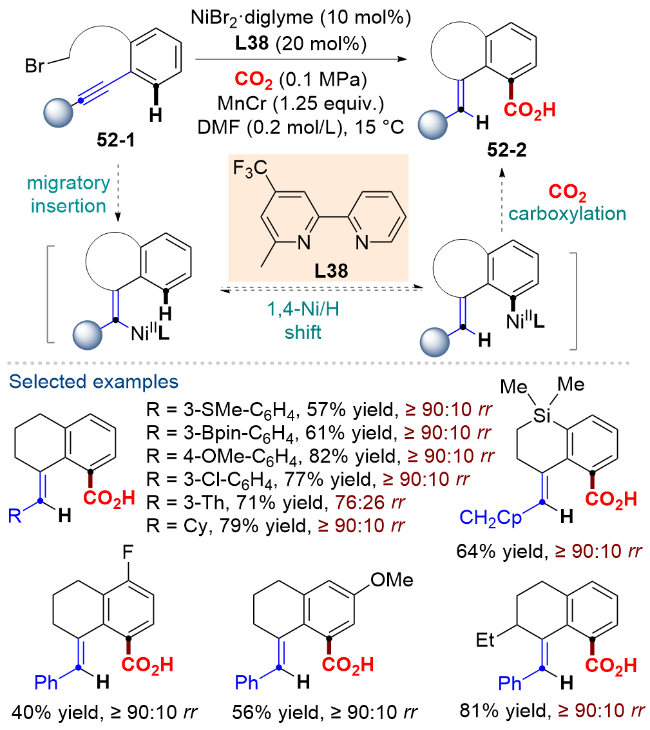
2 空间的1,4-Ni/H迁移偶联
2.1 烯基到芳基1,4-Ni/H迁移
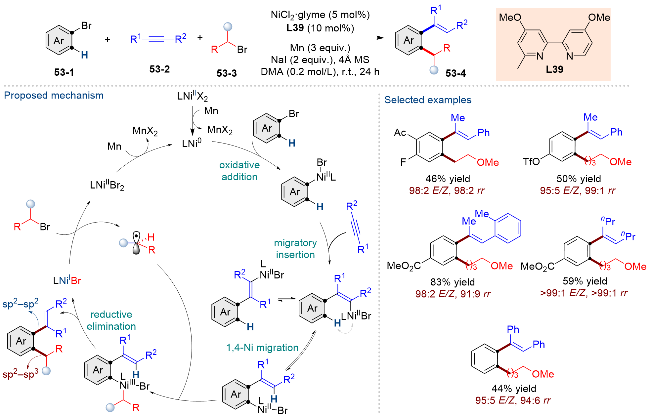
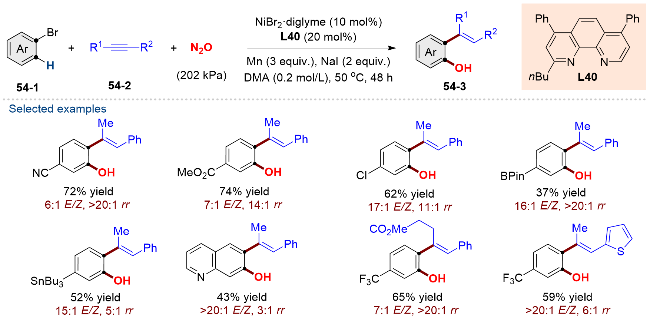
2.2 芳基到烯基1,4-Ni/H迁移
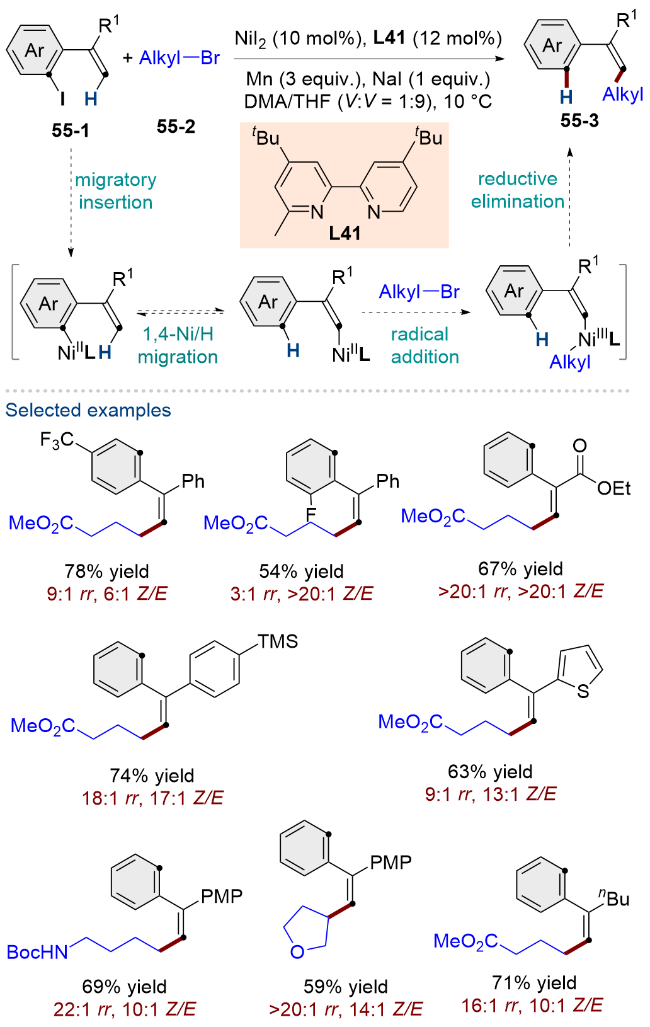
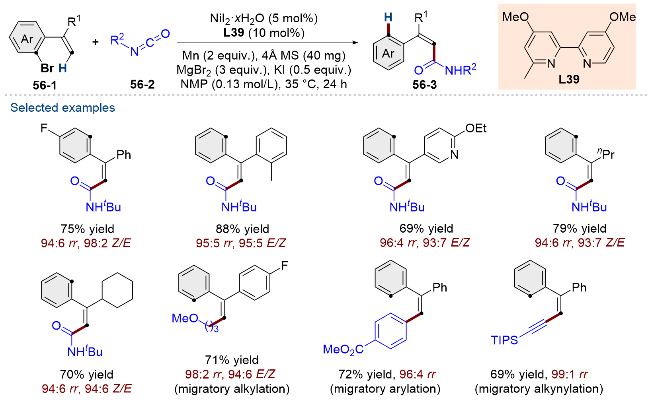
先前的机理研究已经证明了烯基镍和芳基镍中间体之间的1,4-镍/氢迁移过程是可逆的, 那么在适当情况下, 亦可以发生原位生成的芳基镍中间体通过可逆的1,4-镍/氢迁移过程得到烯基镍, 然后选择性捕获烯基镍中间体得到相应迁移烯基位点官能团化产物. 2023年, 基于该思想, 梁永民/刘雪原课题组[62](Scheme 55)和朱少林课题组[63](Scheme 56)同时报道了芳基到烯基的1,4-镍迁移偶联过程, 用于制备多取代烯烃. 梁永民/刘雪原的工作以芳基碘为起始原料[62], 和零价镍氧化加成后生成二价芳基镍, 在迁移配体调控下可以实现可逆的1,4-镍迁移得到位阻小、活性高且立体选择性好的烯基镍物种, 其选择性捕获烷基自由基(来自烷基溴), 通过迁移烷基化以优秀立体选择性得到一系三取代烯烃.


3 总结与展望
综上所述, 过去的几年时间里, 通过碳金属物种动态迁移异构结合选择性偶联的策略, 丰产金属镍催化的迁移偶联化学取得了一系列进展, 从易得原料出发, 在温和条件下, 实现了底物挑战性远程惰性位点选择性官能团化. 在此过程中取得了一系列的进展: (1)开发了多样性的迁移模式, 迁移模式从迭代的连续1,2-Ni/H迁移(chain-walking)发展到空间的1,4-Ni/H迁移; (2)开发了系列高活性迁移配体, 通过升高相应碳镍物种的过渡态能量降低了迁移异构的能垒, 从而提高了迁移活性; (3)开发了系列碳和杂原子偶联试剂, 实现了迁移官能团化的多样性; (4)开发了配体接力催化策略, 简化了单个配体的结构和功能, 通过科学组合不同配体, 提高了反应整体催化效率和选择性. 目前该领域虽然取得了一系列进展, 但是仍然面临着一系列挑战, 包括: (1)反应位点的区域发散性. 目前通过迁移异构较容易实现热力学稳定的碳镍物种选择性偶联或者位阻较小的碳镍物种的动力学选择性偶联, 也能实现含导向基底物、导向基稳定的碳镍物种的选择性偶联. 但是, 如何选择性实现底物碳链任意位点的偶联仍然是该领域的一大挑战. 从仿生角度出发, 发展(拟)酶配体, 通过其口袋的灵活改造, 有望实现不同反应位点碳镍物种偶联活性和反应对映选择性的区分. (2)从更加易得的烷烃和芳烃原料出发的直接迁移偶联. 为了形成迁移所需的碳镍物种, 目前的转化大多局限于烯烃/烷基卤或者芳基卤/硼酸等原料, 相信随着光/电等外场条件的辅助和活化策略的进一步开发, 未来可以从更易得的烃类原料出发实现相关转化. (3)转化的重要工业化应用. 工业化涉及到反应效率和催化成本, 丰产金属催化有其天生的优势, 将迁移偶联和连续流化学、光电等外场激励等手段相结合, 相信迁移偶联反应未来一定会应用于精细化学品和功能分子的工业化合成中.
(Zhao, C.)