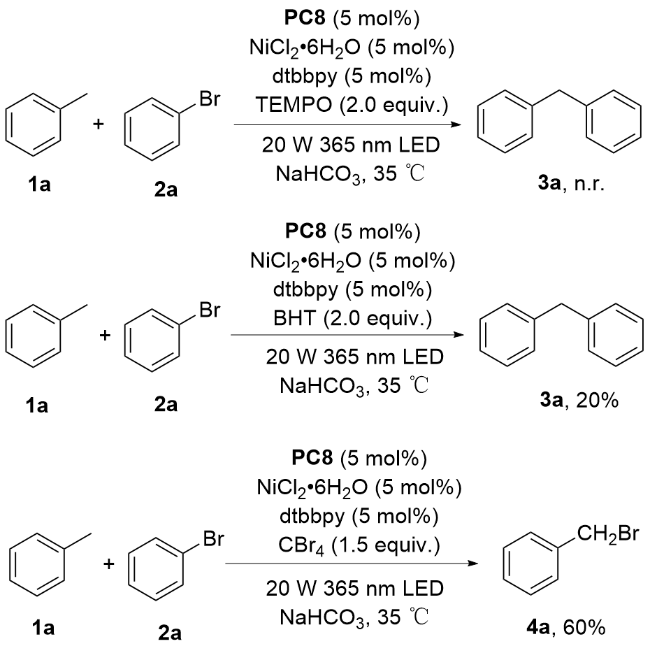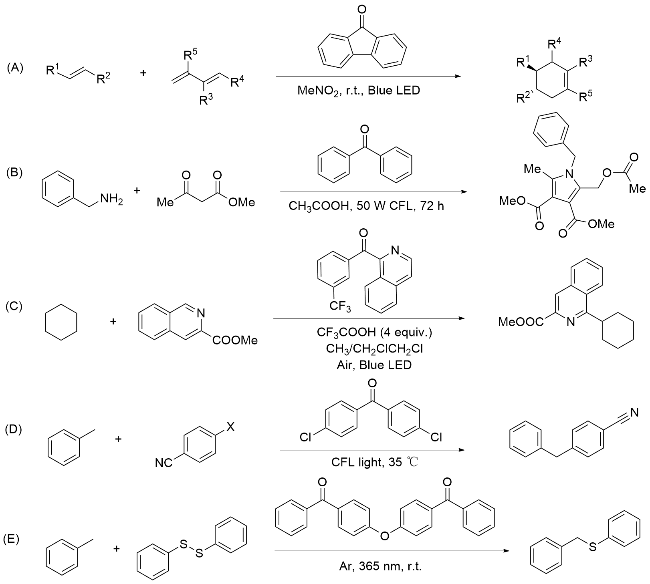
图1 (A)芴酮光催化Diels-Alder反应; (B)可见光驱动合成高取代吡咯; (C)异喹啉衍生的二芳基酮型光催化剂催化脱氢偶联; (D)对溴苯腈与甲苯的芳基偶联; (E)甲苯衍生物的C—S功能化Figure 1 (A) Fluorenone photocatalytic Diels-Alder reaction; (B) visible light-driven synthesis of highly substituted pyrroles; (C) isoquinoline-derived diaryl ketone-based photocatalysts for catalytic dehydrogenation coupling; (D) aryl coupling of p-bromobenzonitrile with toluene; (E) C—S functionalisation of toluene derivatives |
1 结果与讨论
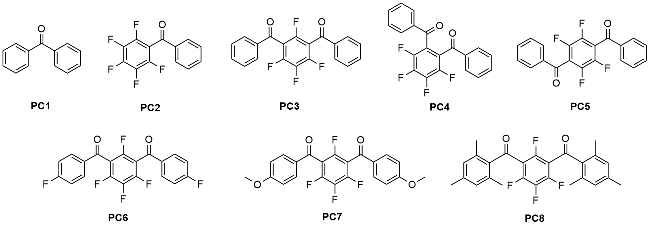
表1 光催化甲苯与溴苯的C(sp3)—H偶联反应条件优化aTable 1 Reaction conditions for photocatalytic C(sp3)—H coupling reaction of toluene with bromobenzene |

| Entry | Photocatalyst (mol%) | Solvent | Base | Time/h | Yieldb/% | |
|---|---|---|---|---|---|---|
| 1 | PC1 (20) | Toluene | NaHCO3 | 18 | 30 | |
| 2c | — | Toluene | NaHCO3 | 18 | None | |
| 3 | PC2 (20) | Toluene | NaHCO3 | 18 | 92 | |
| 4 | PC3 (20) | Toluene | NaHCO3 | 18 | 93 | |
| 5 | PC4 (20) | Toluene | NaHCO3 | 18 | 33 | |
| 6 | PC5 (20) | Toluene | NaHCO3 | 18 | 79 | |
| 7 | PC6 (20) | Toluene | NaHCO3 | 18 | 57 | |
| 8 | PC7 (20) | Toluene | NaHCO3 | 18 | 79 | |
| 9 | PC8 (20) | Toluene | NaHCO3 | 18 | 99 | |
| 10 | PC8 (5) | Toluene | NaHCO3 | 18 | 99 | |
| 11d | PC8 (5) | Toluene | NaHCO3 | 18 | None | |
| 12e | PC8 (5) | Toluene | NaHCO3 | 18 | None | |
| 13f | PC8 (5) | Toluene | NaHCO3 | 18 | None | |
| 14 | PC8 (5) | Toluene | NaHCO3 | 10 | 99 | |
| 15 | PC8 (5) | Toluene | K2HPO4 | 10 | 84 | |
| 16 | PC8 (5) | Toluene | CH3COONa | 10 | 23 | |
| 17 | PC8 (5) | Toluene | K2CO3 | 10 | 33 | |
| 18 | PC8 (5) | Toluene | Na2CO3 | 10 | 56 | |
| 19 | PC8 (5) | Toluene | NaHCO3 | 0.5 | 96 | |
| 20 | PC8 (5) | DMSO (0.1 mol/L) | NaHCO3 | 18 | None | |
| 21 | PC8 (5) | Hexane (0.1 mol/L) | NaHCO3 | 18 | Trace | |
| 22 | PC8 (5) | EtOAc (0.1 mol/L) | NaHCO3 | 18 | 7 | |
| 23 | PC8 (5) | MeCN (0.1 mol/L) | NaHCO3 | 18 | 32 | |
| 24 | PC8 (5) | MeCN (0.2 mol/L) | NaHCO3 | 18 | 55 | |
| 25 | PC8 (5) | MeCN (0.4 mol/L) | NaHCO3 | 18 | 99 | |
| 26 | PC8 (5) | MeCN (0.4 mol/L) | NaHCO3 | 0.5 | 87 | |
a Reaction conditions: a mixture of 2a (0.4 mmol, 1.0 equiv.), base (0.8 mmol, 2.0 equiv.), NiCl2•6H2O (0.02 mmol, 5 mol%), PC (5~20 mol%), ligand (0.02 mmol, 5 mol%), in solvents (5 mL) was stirred at room temperature irradiated by 20 W 365 nm LEDs under an Ar atmosphere for 0.5~18 h. b Product yield determined by HPLC using diethyl phthalate as the internal standard. c No PC. d Without NiCl2•6H2O. e Without dtbppy. f In the dark. |
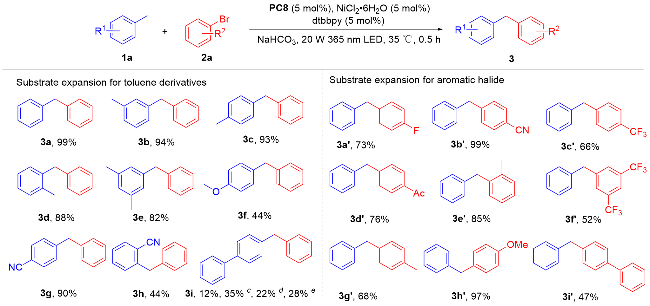
图3 甲基芳烃与芳基溴化物的底物拓展a,bFigure 3 Substrate scope of methylarenes and aryl bromides a Reaction conditions: a mixture of 2a (0.4 mmol, 1.0 equiv.), NaHCO3 (0.8 mmol, 2.0 equiv.), NiCl2•6H2O (0.02 mmol, 5 mol%), PC8 (5 mol%), and dtbbpy (0.02 mmol, 5 mol%), in solvents (5 mL) was stirred at room temperature irradiated by 20 W blue LEDs under an Ar atmosphere for 0.5 h. b Product yield determined by HPLC using diethyl phthalate as the internal standard; c Acetonitrile/benzene (V:V=3:1) replaced pure acetonitrile. d Temperature was 50 ℃. e K3PO4 instead of NaHCO3. |
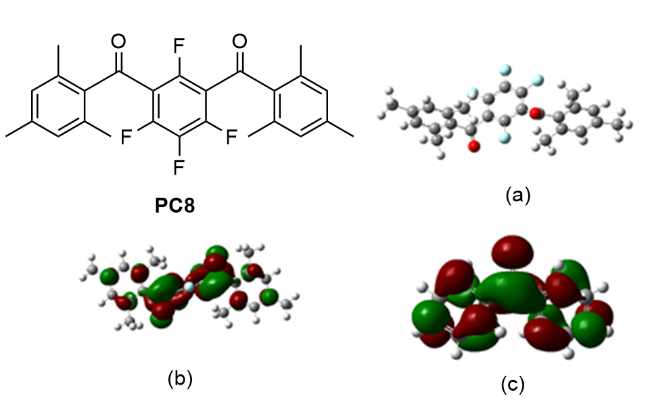
图6 (a) PC8的几何形状; (b) PC8的HOMO轨道定位; (c) PC8的LUMO轨道定位Figure 6 (a) Geometry of PC8; (b) HOMO orbital localization for PC8; (c) LUMO orbital localization for PC8 |
表2 DFT计算Table 2 Density functional theory (DFT) calculations |
| Entry | PC | ELUMO/eV | EHOMO/eV | ΔE/eV | ΔES-T/eV |
|---|---|---|---|---|---|
| 1 | PC1 | -2.08 | -6.86 | 4.78 | 1.84 |
| 2 | PC2 | -2.76 | -7.76 | 5.00 | 2.06 |
| 3 | PC3 | -2.64 | -7.57 | 4.94 | 2.00 |
| 4 | PC8 | -2.50 | -6.92 | 4.42 | 1.48 |