


1 Introduction
Ultra-long organic room temperature phosphorescence (RTP) materials have aroused extensive attention due to the academic significance and the potential applications in display, information storage, molecular sensors, bio-imaging and anti-counterfeiting in terms of low cost, bio-compati- bility, and diverse structures and excited state properties.[1] Among them, RTP polymers through doping small amounts of conjugated organic molecules attract much increasing interest due to the advantages of inherent strength, toughness, economy, and good process-ability.[2] Polymers rich in hydrogen bonds, such as polyvinyl alcohol (PVA), poly- acrylamide (PAM) and their co-polymers are usually effective matrices for ultra-long RTP afterglows (such as duration>15 s and RTP lifetime τP>2 s).[3] Such polymers can provide high rigid environments and strong interactions with polar organic dopants to effectively hamper molecular internal rotations and vibrations.[2c,4] However, the problem is followed by the severe deterioration of RTP and mechanical properties in ambient air due to the strong hygroscopicity.[3a,5] Moreover, such polymers can only be processed into film via solution casting and cannot be thermoplastic processed, losing valuable processing properties and limiting practical applications. Herein, it is highly desired to develop ultra-long RTP polymers using general, hydrophobic, and thermoplastic polymers as matrices.[6]
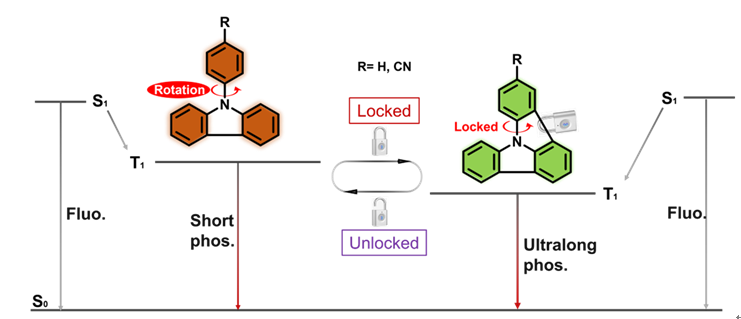
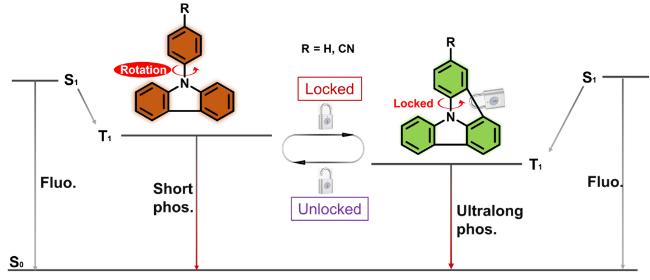
Unfortunately, general and thermoplastic polymers including poly(methyl methacrylate) (PMMA) are very difficult to effectively inhibit the internal rotations of organic dopant and can rarely stabilize ultra-long RTP.[7] Since intramolecular rotation is so detrimental to RTP, locking up the internal rotation in advance by chemical approach probably provides a prerequisite for stabilizing triplet states by diverse polymers, enabling ultralong organic RTP to be no longer a hard task. N-Phenylcarbazole derivatives are a class of hetero-cyclic compounds with a large and readily accessible family of analogues, and it is very meaningful to develop them as effective dopants for RTP polymers. In fact, some of them have been doped into PVA and PMMA in the study of crystal RTP, but almost no RTP has been observed and ascribed to the energy dissipation of triplet excited states by the intramolecular phenyl-carbazole rotation.[8] Recently, we verify that some N-phenyl-carbazole derivatives can show RTP properties by dispersing in PMMA although their RTP afterglows are not enough bright and/ or ultralong.[9] Therefore, it is expected that locking up internal rotation of phenyl-carbazole in advance should be conducive to ultra-long RTP polymers. In view of that N-(ortho-bromophenyl)-carbazole can take place the intramolecular cyclization and form indolo[3,2,1-jk]carba- zole (ICz) to lock up internal rotation, herein, we design and synthesize two ICz compounds and study their RTP properties in PMMA (Figure 1). It is noted that some ICz derivatives have been synthesized, but they are used as donors for electroluminescent materials and have never been used as RTP dopants to the best of our knowledge.[10] We report that ICzs can exhibit bright and ultra-long blue afterglows in PMMA with RTP lifetimes over 2 s, and persistent red and even white-emitting afterglows can be successfully modulated by co-doping red and orange organic fluorescent dyes.
2 Results and discussion
The laboratory self-made 9H-carbazole from 2-amino- biphenyl was used, and ICzs were prepared in good overall yields of above 70%. Both ICz and ICz-pCN hardly show crystal RTP, regardless of the existence of nitrogen atom and peripheral cyano as well as the structural planarization. However, the persistent and bright phosphorescence is observed after frozen in liquid nitrogen, indicating the presence of abundant triplet population, but crystallization itself cannot effectively inhibit triplet state thermal deactivation at room temperature even though the internal rotation has been locked up. However, intermolecular interactions and molecular confined environments in crystals and polymers are different, and their RTP properties cannot be deduced from each other.
ICz and ICz-pCN were doped into PMMA by a low weight ratio of 1∶1000 via volatilizing their solutions for dispersing dopants at the molecular level, and then the obtained solution-cast films were thermoplastic processed into sheets to study RTP properties. As shown in Figure 2a, these sheets emitted bright and ultra-long RTP afterglows after photo-activated for ca. 5 s by 365 nm light, and afterglow duration time was over 30 s viewed by naked eyes in the dark. Moreover, ICz-pCN showed brighter and longer afterglow than ICz itself due to the cooperation of additional n-π transition and enhanced interactions with the matrix. The steady-state photoluminescence (PL) spectra indicated that ICzs/PMMA sheets emit narrow near UV fluorescence and broad sky-blue RTP with the similar spectral shapes and positions (Figure 2c). The time-resolved RTP decay curves monitored at the respective maximal wavelengths are depicted in Figure 2c, and the fitted long-component RTP life-times (τP) are up to 2.02 and 2.33 s for ICz and ICz-pCN in PMMA matrix, respectively. The total PL efficiency was determined with an integrating sphere spectrometer (C11347, Hamamatsu, Japan), and average lifetimes are depicted in Figure 2d. Therefore, the introduction of cyano promoting n-π transition is conducive to ultra-long and efficient RTP.
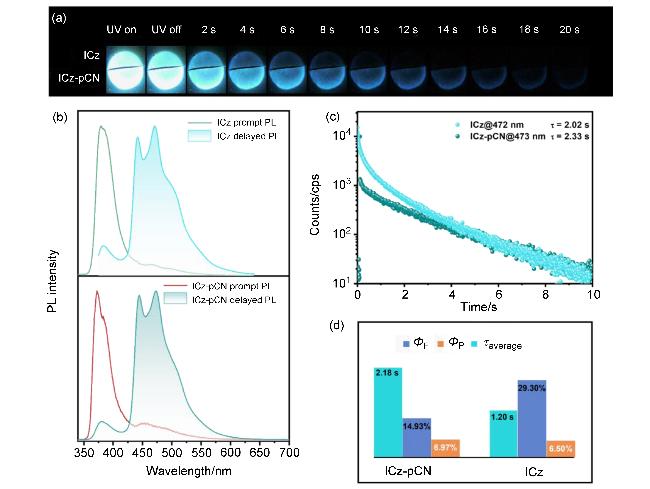
Figure 2 (a) PL photographs of thermoplasticized 0.1% ICz-pCN and 0.1% ICz doped into PMMA sheets before and after removing 365 nm light excitation; (b) Prompt and delayed PL spectra of 0.1% ICz-pCN and 0.1% ICz in PMMA at 365 nm in film state at 298 K; (c) Time-resolved RTP decay curves and fitted long-component lifetimes of photo-activated thermoplasticized PMMA doped sheets under 365 nm light excitation; (d) RTP efficiency calculated by differential method, and average lifetimes (All the samples are sustainably photo-activated by 365 nm lamp (0.3 mW/cm2) for 10 s before measurements) |
To gain some insight into the effect of changes in molecular structure and composition on RTP properties, the precursors of ICzs (OB and 2X4Q) were comparatively studied. OB and 2X4Q exhibited no and inferior RTP in PMMA matrix even after a long-time photo-activation, and their low temperature phosphorescence (LTP) was also rather poorer than that of ICzs/PMMA (Figure 3a). Since the influences of molecular motions and oxygen quenching on phosphorescence have been effectively weakened in liquid nitrogen, LTP basically reflects the ability of molecular triplet population and radiation of different chemical composition and structure. In this context, the formation of fused heterocycles not only locked up intramolecular rotation but also promoted the triplet population and radiation to enable brighter and more ultralong RTP. The single-crystal analyses indicated that 2X4Q and ICz-pCN adopted a strong distorted conformation and a near planar structure (Figure 3b), respectively. Additionally, cyclization shortened the bond lengths adjacent to the pyrrole N-atom, which enhanced molecular rigidity and facilitated n-π transitions. Consequently, triplet state population was promoted, and the non-radiative rate constant was reduced from 1.85 s-1 of 2X4Q to 0.44 s-1 of ICz-pCN. Quantum chemical calculations indicated that 2X4Q and ICz-pCN have distinctly different excited triplet molecular orbital distributions (Figure 3c). Moreover, spin-orbital couplings for the possible inter-system crossing (ISC) channels calculated by usual quantum chemistry method were extremely stronger for 2X4Q than for ICz-pCN (Figure 3d). Spin-orbital couplings for both ISC and triplet radiation of ICz-pCN were so small that its RTP should be inferior or impossible. However, the bright yet ultra-long LTP and RTP were all observed in ICz-pCN/PMMA rather than in 2X4Q/PMMA, signifying that they possibly have different mechanisms in enhancing triplet state population and radiation. Interestingly, the similar dichotomy between quantum chemical calculations and real RTP properties has been found in fused aromatic hydrocarbons such as hexabenzocoronene, coronene, truxene, and pyrene in rigid and polar polymers,[11] which cannot be explained by the current organic RTP views. Conjugated organic fused rings with large π electron systems and spatially superposed frontier molecular orbitals should have unique and unknown enhanced triplet population, and radiation tricks.
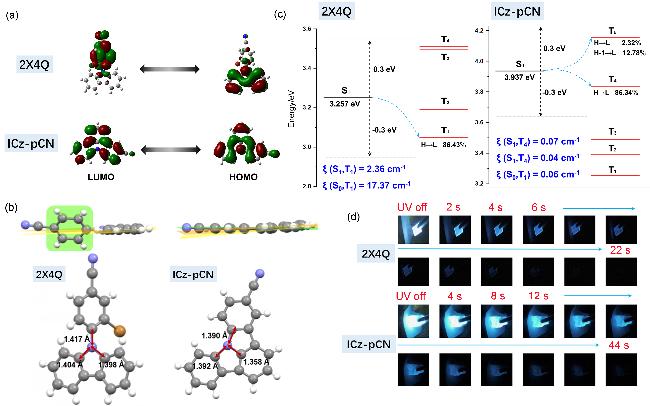
Figure 3 (a) Natural transition orbitals for ICz-pCN and 2X4Q molecules in crystals; (b) Single-crystal structure and dihedral angle of ICz-pCN and 2X4Q: (c) Excited state energy level diagram of ICz-pCN and 2X4Q molecules (The blue dotted arrow indicates the possible ISC channel (ES1±0.3 eV)); (d) Low temperature phosphorescence photo of 0.1% 2X4Q and 0.1% ICz-pCN doped into PMMA sheets (The samples are sustainably photo-activated by 365 nm lamp (0.3 mW/cm2) for 5 s before measurements) |
Given bright and ultra-long blue afterglows of ICzs in PMMA, their triplet state (T1) energies are higher than the singlet state (S1) energies of orange and red fluorescent dyes. Therefore, the triplet-to-singlet energy transfer is accessible and persistent, providing a possibility to modulate afterglow colors by regulating types and contents of co-doped dyes. Two fluorescent dyes of orange (OFD) and red (RFD) were doped into ICz-pCN/PMMA and their afterglow properties were investigated (Figure 4). The absorption spectra of both OFD and RFD showed the part overlaps with the delayed PL spectrum of ICz-pCN/PMMA (Figure 4a). When 1.0% OFD (weight percent in PMMA) was doped, an orange afterglow was observed with camera- recorded duration time over 5 s (Figure 4b). As detected by the delayed PL spectrum (Figure 4c), the almost complete energy transfer was observed. When the doping amount was 0.2%, an orange-white long afterglow appeared with the duration time of ca. 12 s. Thereby, the doping amount was decreased to 0.1%, and the white afterglow with a duration time over 15 s was realized (Figures 4b, 4c). This is an effective, simple, and controllable strategy to persistent white afterglow because it only involves the choice of dye and its doping amount. The time-resolved afterglow decay curves monitored at 472 and 595 nm for 0.1% OFD doped ICz-pCN/PMMA were determined under 365 nm light excitation (Figure 4d). The fitted long-component (τD) and average (<τD>) lifetimes were 2.07 and 1.77 s, and 1.80 and 1.39 s, respectively. According to the Förster resonance energy transfer (FRET) mechanism, energy transfer efficiency (ΦFRET=1-<τD>/<τD0>) was calculated to be 13.3%, where <τD> was the average lifetime before OFD doping.[12]
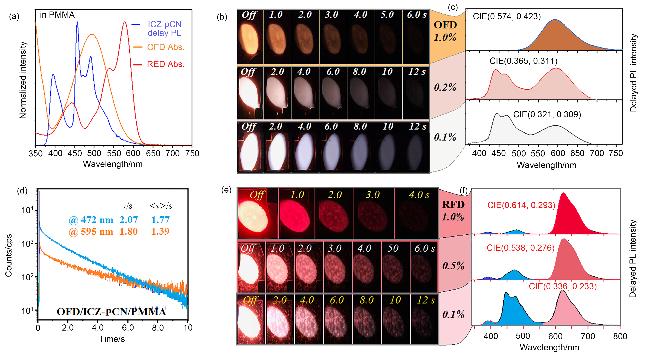


Figure 4 (a) Phosphorescence emission of ICz-pCN-PMMA overlaps with the absorption characteristics of OFD and RFD; (b) Afterglow photos of 0.1% ICz-pCN and different mass fractions of OFD doped in PMMA at 365 nm film state at 298 K; (c) Commission International de l’Eclairage (CIE) color coordinates and delayed PL spectra of PMMA doped with 0.1% ICz-pCN and different mass fractions of OFD; (d) Time-resolved RTP decay curves and fitted long-component lifetimes of photo-activated thermoplasticized OFD/ICz- pCN-PMMA doped sheets under 365 nm light excitation; (e) Afterglow photos of 0.1% ICz-pCN and different mass fractions of RFD doped in PMMA at 365 nm film state at 298 K; (f) Delayed PL spectra of 0.1% ICz-pCN-0.1% RFD in PMMA at 365 nm in film state at 298 K |
Subsequently, 0.1%, 0.5%, or 1.0% red dye (RFD) was doped into ICz-pCN/PMMA. The results showed that a low RFD doping amount (0.1%) afforded blueish pink afterglow with duration time more than 13 s viewed by the naked eye (Figure 4e), and the afterglow spectrum indicated that only the partial delayed PL emission form ICz-pCN/PMMA was transferred to RFD, showing the distinct red and sky-blue dual emission bands (Figure 4f). When doping amount of RFD was increased to 0.5%, the pink afterglow with shortened duration was observed, and the delayed spectrum indicated the significantly enhanced energy transfer. With the further increase of doping amount of RFD, the real red color afterglow was observed and the corresponding spectrum hardly displayed sky-blue emission band. Therefore, regulating the dye type and doping amount can tune afterglow colors and duration time, and enables the displaying and anti-counterfeiting applications.
3 Conclusions
In summary, the existence of internal rotation moiety is indeed detrimental to organic RTP, resulting in that OB and 2X4Q containing bromine and/or cyano hardly have RTP afterglow in PMMA. Locking up their internal rotation has greatly boosted RTP afterglow intensities and lifetimes. The ability of rigidity and polarity of polymers is after all limited to inhibit molecular internal rotation and vibration, and decrease triplet thermal deactivation, in this context, chemically locking the internal rotation of dopant itself in advance provides a more effective and extendable strategy for ultra-long organic RTP polymers. Moreover, locking up of internal rotation will decrease the dependency of ultra- long RTP matrix on rigid and polar polymers, which may enable many non-bibulous general polymers to be effective doping matrices. This will greatly enlarge types and properties of RTP polymers, and the relevant work is underway in our laboratory. On the other hand, like full aromatic fused hydrocarbons,[11] ICzs exhibit excellent RTP afterglow properties in PMMA although quantum chemical calculations afford inferior and even no spin-orbital coupling effect, signifying that they possibly have unknown and unique mechanisms in enhancing triplet population and radiation, and calling for deeper and wider researches.
4 Experimental section
4.1 General experimental information
All chemicals and solvents were purchased from Energy Chemical Co. (Shanghai, China). Polymethyl methacrylate (PMMA, ACRYREX® CM-211, MFR: 230 ℃/3.8 kg) is from Chi Mei Co. (Taiwan, China). 1H NMR and 13C NMR spectra were recorded on a Bruker AC 500 spectrometer at 500 MHz and 125 MHz, respectively, using deuterated chloroform or deuterated dimethyl sulfoxide as the solvent and tetramethylsilane (TMS) as the internal standard. Elemental analyses were recorded on a Carlo Erba 1106 Elemental Analyzer. The room temperature photoluminescence and excitation spectra were recorded on a Hitachi F-4600 spectrophotometer. UV-visible absorption was recorded on a Hitachi U-4100 spectrophotometer. The PL photographs were captured by the FDR-AX700 4K HDR digital cameras (SONY, Japan). Absolute PL quantum yields (PLQY) were determined with a spectrometer C11347 (Hamamatsu, Japan). The RTP yields were generally obtained by peak- differentiation-imitating analysis from the delay PL spectrum, the transient PL spectra and the absolute total quantum yield (Φ). By peak differentiation-imitating analysis, the RTP ratio can be identified, and from Φ, both fluorescent and RTP yields can be figured out. Photoluminescence decay curves were recorded by a Hamamatsu compact fluorescence lifetime spectrometer (FLS-1000).
The Gaussian 09 program was utilized to perform the time-dependent density-functional theory (TD-DFT) calculations. The exciton energies of the n-th singlet (Sn) and n-th triplet states (Tn) were obtained on the corresponding excited state structure using TD-B3LYP/6-31G*. The Kohn-Sham frontier orbital analysis and spin density distributions were obtained in order to elucidate the mechanisms of possible singlet-triplet intersystem crossings (ISC). The possible S1 to Tn ISC channels are believed to share part of the same transition orbital compositions, and the energy levels of possible Tn are considered to lie within the range of ES1±0.3 eV. Especially, the major ISC channels are mainly determined based on two elements. First, the ratio of the same transition configuration in S1 and Tn should be large in all the transition orbital compositions. Secondly, the energy gap between S1 and the specific Tn state should be small. And for model systems, the spin-orbit coupling (SOC) matrix elements between singlet and triplet states are given at B3LYP/G def2-SVP level from ORCA 4.1.1 based on geometry optimization.
4.2 Experimental procedures
4.2.1 Synthesis of lab 9H-carbazole (LCZ)
In a 100 mL two-necked flask, 2-aminobiphenyl (2.50 g, 14.77 mmol), [Cp*IrCl2]2 (0.25 g, 0.31 mmol), Cu(OAc)2 (0.54 g, 2.97 mmol), and PivOH (3.05 g, 29.86 mmol) in NMP (50 mL) were stirred under air at 120 ℃ for 3 h. After cooling, the reaction mixture was extracted with ethyl acetate (50 mL×3). The combined organic layer was dried with anhydrous MgSO4, filtered and concentrated in vacuo. The crude product was purified by silica-gel column chro- matography (eluent: petroleum ether/dichloromethane, V∶V=5∶1), affording a white solid LCZ (1.31 g, 53% yield). m.p. 246.3 ℃; 1H NMR (500 MHz, DMSO-d6) δ: 11.27 (s, 1H), 8.13 (d, J=7.7 Hz, 2H), 7.51 (d, J=8.1 Hz, 2H), 7.41 (t, J=7.6 Hz, 2H), 7.18 (t, J=7.4 Hz, 2H); 13C NMR (126 MHz, DMSO-d6) δ: 139.66, 125.44, 122.34, 120.08, 118.42, 110.87. Anal. calcd for C18H13N: C 88.17, H 6.55, N 8.28; found C 88.18, H 6.53, N 8.29.
4.2.2 Synthesis of indolo[3,2,1-jk]carbazole-11-carbo- nitrile (ICz-pCN)
In a 100 mL bottom flask, a mixture of LCZ (1.50 g, 8.97 mmol) and NaH (0.43 g, 17.94 mmol) in N,N-dimethyl- formamide (DMF) (50 mL) was stirred at 0 ℃ for 1 h. 3-Bromo-4-fluorobenzonitrile (M1) (1.97 g, 9.87 mmol) was added into the mixture and the resulted mixture was stirred at 150 ℃ for 18 h. After cooling, the reaction mixture was extracted with ethyl acetate (50 mL×3). The combined organic layer was dried with anhydrous MgSO4, filtered and concentrated in vacuo. The crude product was purified by silica-gel column chromatography using petroleum ether/ dichloromethane (V∶V=3∶1), affording a white solid 2X4Q (2.67 g, 78% yield).
2X4Q (4.29 g, 12.4 mmol, 1 equiv.), K2CO3 (8.57 g, 62.1 mmol, 5 equiv.) and BnEt3NCl (2.82 g, 12.4 mmol, 1 equiv.) were dissolved in N,N-dimethylacetamide (100 mL). The reaction mixture was degassed by bubbling N2 through for 15 min. Pd(OAc)2 (0.42 g, 1.9 mmol, 0.15 equiv.) and PPh3 (1.14 g, 4.3 mmol, 0.35 equiv.) were added and the resulting mixture was heated to 160 ℃ for 6 h. After cooling, the reaction mixture was extracted with dichloro- methane (50 mL×3). The combined organic layer was dried with anhydrous MgSO4, filtered and concentrated in vacuo. The crude product was purified by silica-gel column chromatography (eluent: petroleum ether/dichloromethane, V∶V=1∶1), affording a grey solid ICz-pCN (2.465 g, 75% yield). m.p. 271.1 ℃; 1H NMR (500 MHz, Chloro- form-d) δ: 8.41 (d, J=1.7 Hz, 1H), 8.17 (d, J=7.8 Hz, 1H), 8.11 (dd, J=8.0, 2.8 Hz, 1H), 8.07 (d, J=7.5 Hz, 1H), 7.93~7.86 (m, 2H), 7.82 (dd, J=8.4, 1.6 Hz, 1H), 7.68~7.60 (m, 2H), 7.46 (dd, J=8.9, 6.1 Hz, 1H); 13C NMR (126 MHz, CDCl3) δ: 144.01, 139.75, 138.07, 130.30, 130.07, 129.95, 127.17, 127.01, 123.85, 123.37, 123.00, 120.56, 119.78, 119.72, 118.87, 116.74, 112.49, 112.23, 104.50, 77.28, 77.03, 76.77. Anal. calcd for C19H10N2: C 85.70, H 3.79, N 10.52; found C 85.72, H 3.78, N 10.53.
Supporting Information 1H NMR and 13C NMR spectra of 2X4Q, ICz and ICz-pCN. The Supporting Information is available free of charge via the Internet at http://sioc- journal.cn.
(Zhao, C.)