



1 Introduction
Nitrogen-sulfur (N—S) scaffolds, including sulfenami- des, sulfinamides, sulfonamides, sulfilimines, sulfinami- dines, sulfoximines, and related compounds, exist widely in nature and play essential roles in various scientific domains (Scheme 1a).[1-4] They have found broad applications in pharmaceutical discovery, materials science, and catalysis, owing largely to the diverse oxidation states of sulfur, which range from -2 to +6 (Scheme 1b).[5-8] Given their significance, considerable efforts have been devoted to the development of efficient methods for N—S containing compounds.[9-11] In special, sulfinamides are particularly important in organic synthesis, where they serve as valuable intermediates, ligands, and catalysts.[12-21]
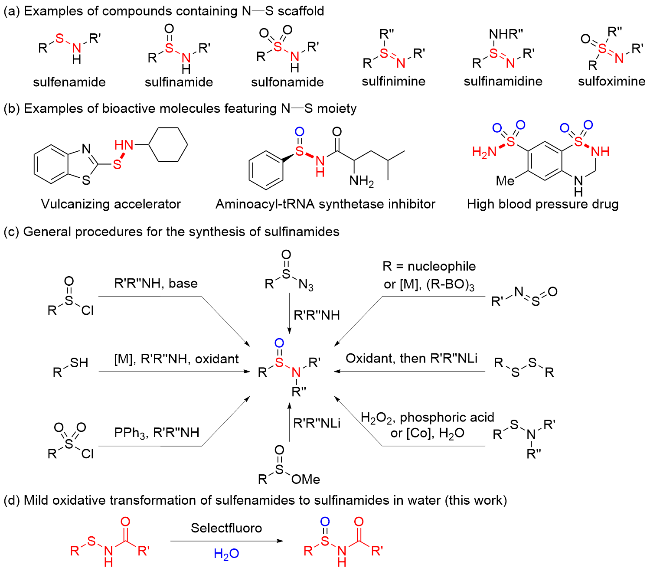
Traditionally, sulfinamides are synthesized via the reaction of sulfinyl chlorides with amines,[22] oxidative coupling of thiols and amines,[10,23-26] or reductive coupling of sulfonyl chlorides with amines[27] (Scheme 1c). However, these classical approaches often require harsh conditions, which limit functional group tolerance and reduce the practicality of these methods. Moreover, the high reactivity of starting materials and the propensity for overoxidation frequently lead to undesired side products, thereby constraining their synthetic utility. Alternative strategies employing sulfonates,[28] sulfoxides,[29] disulfides,[24] and benzenesulfinyl azides[30] as sulfinylating agents have been developed (Scheme 1c). These transformations often rely on transition-metal catalysts to achieve the sulfinylation of amines. The transformation of N=S=O functional group with nucleophiles also presents a viable option under controlled conditions.[31-34] Additionally, sulfenamides, known for their unique reactivity as thiolation or bifunctional reagents, have emerged as valuable precursors for constructing higher oxidation state N—S derivatives.[35-46] Their conversion to sulfinamides offers a promising route,[47-48] however, it still suffers from issues related to environmental impacts (Scheme 1c). Therefore, the development of general, sustainable, and mild synthetic methodologies for the efficient construction of sulfinamides remains a high- ly desirable goal in synthetic chemistry.
Water is widely regarded as the ideal green solvent due to its non-toxic nature, low cost, non-flammability, and high specific heat capacity.[49-56] Over the years, it has played a crucial role in green chemistry, particularly in commercial-scale synthesis processes, due to its advantages of ease removal and environmental compatibility. Owing to these favorable properties, extensive efforts have been devoted to developing water-mediated strategies for the synthesis of a wide range of organic molecules, aligning with the principles of sustainable chemistry and making contributions to reduce the environmental concerns.
Therefore, we herein report a controllable oxidation strategy for sulfinamides synthesis, which involves the oxidation of sulfenamides with Selectfluor as the oxidant in aqueous media in this context (Scheme 1d). This strategy provides an environmentally friendly and efficient route to access sulfinamides under mild conditions.
2 Results and discussion
To initiate our study, commercially available 1,2-ben- zo[d]isothiazol-3(2H)-one (1a) was selected as the model substrate. To our satisfaction, 1a was converted into the desired sulfinamide 3a in good yield using Selectfluor (2) as the oxidant in the presence of KOH as a basic additive (Table 1, Entry 1). Then the role of the base in this transformation was investigated. When K3PO4 was used instead of KOH, a moderate yield was obtained (Table 1, Entry 2). However, no product formation was observed when tert- butoxide bases were employed (Table 1, Entries 3~5). Interestingly, a comparable yield to KOH was achieved even in the absence of any base additive (Table 1, Entry 6), suggesting that the reaction may proceed without the need for a base under certain conditions. Temperature moderation revealed that conducting the reaction at a lower temperature was beneficial, resulting in a higher yield (Table 1, Entry 7). A solvent screening was then carried out, and water emerged as the optimal medium, giving a positive result, whereas no reaction was observed in several other organic solvents (Table 1, Entries 8~12). Further yield improvement was achieved by slightly increasing the amount of Selectfluor (2), which enhanced the efficiency of the reaction (Table 1, Entries 13~14). However, attempts to further improve the yield by conducting the reaction at a lower temperature proved unsuccessful (Table 1, Entry 15).
Table 1 Conditions optimizationa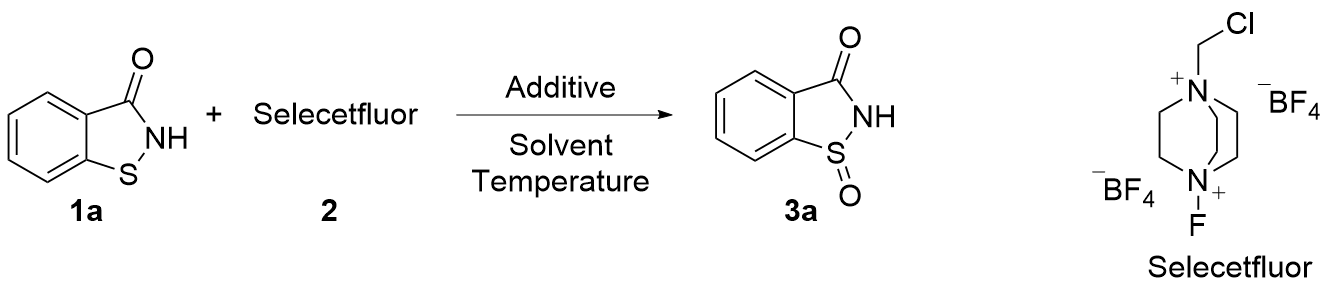 |
| Entry | 2/equiv. | Additive | Solvent | Temperature/℃ | Yieldb/% |
|---|---|---|---|---|---|
| 1 | 1.0 | KOH | MeCN | r.t. | 69 |
| 2 | 1.0 | K3PO4 | MeCN | r.t. | 51 |
| 3 | 1.0 | tBuOLi | MeCN | r.t. | — |
| 4 | 1.0 | tBuOK | MeCN | r.t. | — |
| 5 | 1.0 | tBuONa | MeCN | r.t. | — |
| 6 | 1.0 | — | MeCN | r.t. | 67 |
| 7 | 1.0 | — | MeCN | 0~r.t.c | 77 |
| 8 | 1.0 | — | THF | 0~r.t. | — |
| 9 | 1.0 | — | MeOH | 0~r.t. | — |
| 10 | 1.0 | — | MeNO2 | 0~r.t. | 76 |
| 11 | 1.0 | — | Toluene | 0~r.t. | — |
| 12 | 1.0 | — | H2O | 0~r.t. | 78 |
| 13 | 1.2 | — | H2O | 0~r.t. | 90 |
| 14 | 1.6 | — | H2O | 0~r.t. | 82 |
| 15 | 1.2 | — | H2O | 0 | 73 |
a Reaction was performed using 0.5 mmol of 1a, 1.0 equiv. of additive. b Isolated yield. c See experimental procedures. |
With the optimized conditions in hand, the generality of this protocol for the transformation of sulfenamides into sulfonamides was next explored, as illustrated in Scheme 2. Overall, a broad range of S-aryl sulfenamides were successfully converted to their corresponding sulfinamides in moderate to good yields. Substrates of S-aryl sulfenamides bearing halogen substituents, which are known for their potential in further functionalization via cross-coupling reactions, at various positions on the aromatic ring reacted smoothly, affording the desired products 3b~3e in good yields. Electron-donating groups, such as methyl and methoxy, were also well tolerated under the standard conditions, affording the corresponding sulfinamides 3f~3i efficiently. While substituents at the para- or meta-positions had minimal impact on the reaction outcome, an obvious decrease in yield was observed with large ortho- substitution, likely due to the serious steric hindrance effects (3j~3k). Notably, a substrate featuring an extended π-conjugated system also proved compatible, furnishing product 3l in good yield.
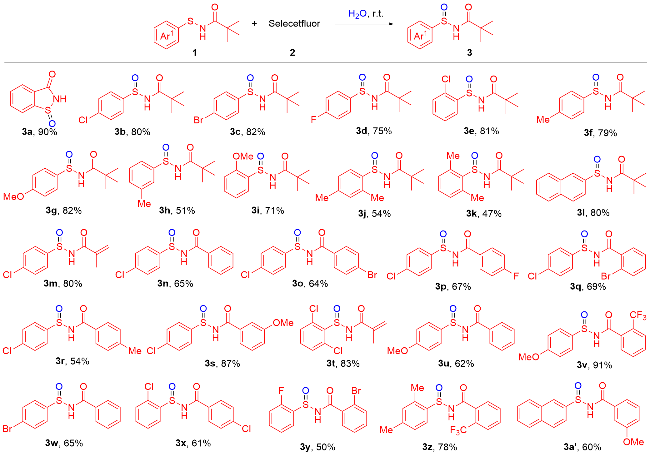
The influence of different acyl groups on the sulfenamide moiety was then investigated. Sulfenamide bearing vinyl amide moiety was efficiently transformed into the corresponding sulfinamides (3m), with the vinyl group being well tolerated. Furthermore, sulfenamides bearing aryl groups on the acyl moiety were also compatible, providing the target sulfinamides 3n~3s in moderate to good yields. Substituents on the aryl rings, including halogens, alkyl, and alkoxy groups, had only a slight effect on the efficiency of this oxidative process. To further demonstrate the simplicity and flexibility of the method, we evaluated sulfenamides derived from diverse combinations of thiol and amide partners. These cross-coupled sulfenamides underwent smooth conversion under the optimized conditions, affording the corresponding sulfinamides in yields ranging from 50% to 91% (3t~3a').
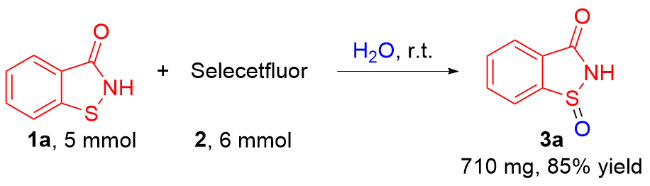
To further demonstrate the practicality and efficiency of this oxidative sulfinamide synthesis strategy, a scale-up reaction was performed for the preparation of product 3a under the optimized conditions (Scheme 3). The reaction proceeded smoothly, affording 3a in a yield comparable to that achieved in the small-scale screening experiments. This result highlights the robustness and scalability of the protocol, underscoring its potential for practical appli- cations.
To elucidate the mechanism of this Selectfluor oxidized synthesis of sulfinamides in water, control experiments were conducted (Scheme 4). Under the optimized reaction conditions, the formation of sulfinamides was completely suppressed upon the addition of 2 equiv. of either 2,2,6,6-tetramethyl-1-piperidinyloxyl (TEMPO) or butyla- ted hydroxytoluene (BHT)—both typical radical scaven- gers. This observation confirms that the reaction proceeds via a radical pathway (Scheme 4a).
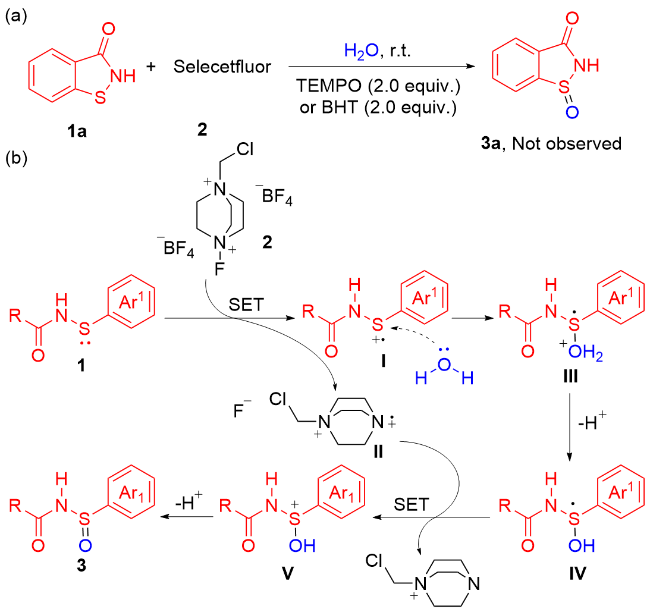


Based on the results above and related precedents from previous literature,[38] a plausible reaction mechanism is proposed (Scheme 4b). The transformation is initiated by the single-electron transfer (SET) process between sulfenamide 1 and Selectfluor (2), generating the sulfur radical cation I and nitrogen radical cation II. Subsequent reaction of intermediate I with water leads to the formation of intermediate III. Deprotonation then occurs to give intermediate IV, followed by a second SET process with intermediate II. With the formation of intermediate V, a deprotonation process provides the desired sulfinamide product 3.
3 Conclusions
In conclusion, a mild and efficient strategy for the synthesis of sulfinamides through the selective oxidation of sulfenamides using Selectfluor has been developed. Notably, water served as a green and effective reaction medium, complying well with the principles of sustainable and environmentally friendly chemistry. A good range of substrates bearing various functional groups were successfully transformed into the corresponding sulfinamides in moderate to good yields, demonstrating excellent functional group tolerance. Moreover, the successful scale-up synthesis of the model product with consistent performance highlights the robustness and scalability of this method. These results underscore the practical potential of this protocol for applications in larger-scale synthesis.
4 Experimental section
4.1 General information
All the chemicals that are not mentioned in the subsequent parts were purchased from Bidepharm, Energy Chemical, Aladdin, Macklin or TCI and used without further purification. For column chromatography, flash column and thin-layer chromatography (TLC) (SiO2, 60M, pore size 0.04~0.063 mm) were used. The TLC-glass- plates consisted of a 0.25 mm layer of silica 60 with Fluorescence indicator UV254. TLCs were checked under UV-light (254 nm or 365 nm) and stained with an aq. KMnO4-solution. Melting points were measured with SGW X-4B from INESA. All 1H, 13C, 19F NMR spectra were measured with a BRUKER Avance 400 spectrometer. For 1H and 13C measurements, the chemical shift refers to TMS, showing a signal at δ 0. As an internal standard, the remaining protons or respectively the carbons of the corresponding deuterated solvent were used [CDCl3, δ 7.26 (1H NMR), δ 77.16 (13C NMR)]. High-resolution mass spectra (HRMS) were reported from a Bruker ultrafleXtreme MALDI TOF/TOF or a Bruker autoflex maX MALDI-TOF(TOF) instrument with an ESI source. A chromatographic purification was performed before each measurement.
4.2 Experimental procedures
4.2.1 General procedure for the synthesis of sulfinamides in water
To a reaction vial equipped with a stirring bar was charged with benzo[d]isothiazol-3-one (1, 0.5 mmol, 1.0 equiv.) and 1-chloromethyl-4-fluoro-1,4-diazoniabicyclo- [2.2.2]octane bis(tetrafluoroborate) (2, 0.6 mmol, 1.2 equiv.), followed by the addition of water (2 mL). The reaction vial was sealed and placed in an ice-water bath. After 1 h, the bath was removed and the temperature increased gradually to room temperature. When the reaction finished, monitored by TLC, the resulting mixture was extracted with EtOAc (2 mL×3), dried over Na2SO4 and concentrated under reduced pressure. The crude product was purified by column chromatography using silica gel with ethyl acetate in petroleum ether [V(EtOAc)∶V(PE)=3∶7] as the eluent.
Benzo[d]isothiazol-3(2H)-one 1-oxide (3a): 75.3 mg, 90% yield, white solid, m.p. 156.9~157.7 ℃ (lit.[57] m.p. 158.0~159.0 ℃); 1H NMR (400 MHz, DMSO-d6) δ: 11.51 (s, 1H), 8.03 (d, J=7.6 Hz, 1H), 7.88~7.78 (m, 2H), 7.74 (t, J=7.6 Hz, 1H).
N-((4-Chlorophenyl)sulfinyl)pivalamide (3b): 103.9 mg, 80% yield, white solid, m.p. 134.6~135.8 ℃ (lit.[58] m.p. 136.0~137.0 ℃); 1H NMR (400 MHz, CDCl3) δ: 7.88 (s, 1H), 7.65~7.61 (m, 2H), 7.54~7.50 (m, 2H), 1.23 (s, 9H).
N-((4-Bromophenyl)sulfinyl)pivalamide (3c): 124.7 mg, 82% yield, white solid, m.p. 143.3~143.9 ℃ (lit.[59] m.p. 143.0~144.0 ℃); 1H NMR (400 MHz, CDCl3) δ: 8.01 (s, 1H), 7.69~7.66 (m, 2H), 7.56~7.53 (m, 2H), 1.23 (s, 9H).
N-((4-Fluorophenyl)sulfinyl)pivalamide (3d): 91.3 mg, 75% yield, white solid, m.p. 138.8~139.5 ℃ (lit.[60] m.p. 139.0~140.0 ℃); 1H NMR (400 MHz, DMSO-d6) δ: 10.76 (s, 1H), 7.75~7.70 (m, 2H), 7.49~7.43 (m, 2H), 1.14 (s, 9H).
N-((2-Chlorophenyl)sulfinyl)pivalamide (3e): 105.2 mg, 81% yield, white solid, m.p. 143.1~143.8 ℃ (lit.[58] m.p. 144.0~145.0 ℃); 1H NMR (400 MHz, CDCl3) δ: 8.05~8.01 (m, 1H), 7.73 (s, 1H), 7.55~7.51 (m, 2H), 7.48~7.44 (m, 1H), 1.22 (s, 9H).
N-(p-Tolylsulfinyl)pivalamide (3f): 94.6 mg, 79% yield, white solid, m.p. 121.9~122.5 ℃ (lit.[61] m.p. 122.0~123.0 ℃); 1H NMR (400 MHz, DMSO-d6) δ: 10.68 (s, 1H), 7.56~7.52 (m, 2H), 7.41 (d, J=8.0 Hz, 2H), 2.39 (s, 3H), 1.13 (d, J=1.1 Hz, 9H).
N-((4-Methoxyphenyl)sulfinyl)pivalamide (3g):[62] 104.8 mg, 82% yield, colorless oil. 1H NMR (400 MHz, CDCl3) δ: 8.06 (s, 1H), 7.81~7.78 (m, 2H), 6.90 (d, J=8.7 Hz, 2H), 3.83 (s, 3H), 1.28 (s, 9H).
N-(m-Tolylsulfinyl)pivalamide (3h): 61.1 mg, 51% yield, white solid, m.p. 99.1~99.8 ℃ (lit.[60] m.p. 100.0~101.0 ℃); 1H NMR (400 MHz, CDCl3) δ: 7.66 (s, 1H), 7.47 (t, J=1.7 Hz, 1H), 7.42~7.33 (m, 2H), 7.31~7.27 (m, 1H), 2.37 (s, 3H), 1.16 (s, 9H).
N-((2-Methoxyphenyl)sulfinyl)pivalamide (3i): 90.4 mg, 71% yield, white solid, m.p. 123.7~124.4 ℃; 1H NMR (400 MHz, DMSO-d6) δ: 10.55 (s, 1H), 7.73 (dd, J=7.7, 1.7 Hz, 1H), 7.58 (ddd, J=8.8, 7.5, 1.7 Hz, 1H), 7.24~7.15 (m, 2H), 3.81 (s, 3H), 1.12 (s, 9H); 13C NMR (101 MHz, DMSO-d6) δ: 179.6, 156.6, 133.5, 130.7, 126.5, 121.1, 112.2, 56.3, 39.5, 27.0; HRMS (ESI) calcd for C12H18NO3S [M+H]+ 256.1002, found 256.1002.
N-((2,4-Dimethylphenyl)sulfinyl)pivalamide (3j): 68.0 mg, 54% yield, white solid, m.p. 133.2~133.8 ℃; 1H NMR (400 MHz, CDCl3) δ: 7.88 (d, J=8.0 Hz, 1H), 7.51 (s, 1H), 7.26~7.22 (m, 1H), 7.09~7.06 (m, 1H), 2.39 (s, 3H), 2.33 (s, 3H), 1.21 (s, 9H); 13C NMR (101 MHz, DMSO-d6) δ: 179.6, 141.5, 138.5, 135.5, 132.0, 127.4, 125.1, 39.7, 26.9, 21.2, 18.1; HRMS (ESI) calcd for C13H20NO2S [M+H]+ 254.1209, found 254.1210.
N-((2,6-Dimethylphenyl)sulfinyl)pivalamide (3k): 59.6 mg, 47% yield, white solid, m.p. 117.0~117.8 ℃; 1H NMR (400 MHz, DMSO-d6) δ: 10.61 (s, 1H), 7.33 (t, J=7.6 Hz, 1H), 7.14 (d, J=7.6 Hz, 2H), 2.48 (s, 6H), 1.14 (s, 9H); 13C NMR (101 MHz, DMSO-d6) δ: 179.9, 138.9, 138.4, 131.4, 130.3, 39.6, 27.0, 19.4; HRMS (ESI) calcd for C13H20NO2S [M+H]+ 254.1209, found 254.1209.
N-(Naphthalen-2-ylsulfinyl)pivalamide (3l): 110.1 mg, 80% yield, white solid, m.p. 139.0~139.8 ℃ (lit.[18] m.p. 139.0~140.0 ℃); 1H NMR (400 MHz, CDCl3) δ: 8.34 (d, J=1.8 Hz, 1H), 8.00~7.90 (m, 3H), 7.73 (s, 1H), 7.67~7.57 (m, 3H), 1.23 (s, 9H).
N-((4-Chlorophenyl)sulfinyl)methacrylamide (3m): 97.5 mg, 80% yield, white solid, m.p. 88.7~89.4 ℃ (lit.[52] m.p. 88.0~89.0 ℃); 1H NMR (400 MHz, CDCl3) δ: 8.45 (s, 1H), 7.56 (d, J=8.6 Hz, 2H), 7.44 (d, J=8.6 Hz, 2H), 5.74 (s, 1H), 5.52 (q, J=1.5 Hz, 1H), 1.90 (s, 3H).
N-((4-Chlorophenyl)sulfinyl)benzamide (3n): 102.1 mg, 65% yield, white solid, m.p. 145.0~145.8 ℃; 1H NMR (400 MHz, DMSO-d6) δ: 11.74 (s, 1H), 7.94~7.90 (m, 2H), 7.85~7.80 (m, 2H), 7.73~7.69 (m, 2H), 7.63~7.57 (m, 2H); 13C NMR (101 MHz, DMSO-d6) δ: 167.6, 142.7, 138.4, 136.9, 131.0, 130.8, 129.7, 129.2, 127.8; HRMS (ESI) calcd for C13H11ClNO2S [M+H]+ 280.0194, found 280.0197.
4-Bromo-N-((4-chlorophenyl)sulfinyl)benzamide (3o): 114.8 mg, 64% yield, white solid, m.p. 131.2~131.8 ℃; 1H NMR (400 MHz, DMSO-d6) δ: 11.74 (s, 1H), 7.85~7.80 (m, 4H), 7.76~7.69 (m, 4H); 13C NMR (101 MHz, DMSO-d6) δ: 167.8, 142.7, 136.9, 132.1, 131.3, 131.0, 129.7, 127.8, 127.5; HRMS (ESI) calcd for C13H10Br- ClNO2S [M+H]+ 357.9299, found 357.9302.
N-((4-Chlorophenyl)sulfinyl)-4-fluorobenzamide (3p): 99.8 mg, 67% yield, white solid, m.p. 134.9~135.8 ℃; 1H NMR (400 MHz, DMSO-d6) δ: 11.68 (s, 1H), 8.01~7.96 (m, 2H), 7.84~7.80 (m, 2H), 7.73~7.69 (m, 2H), 7.39~7.34 (m, 2H); 13C NMR (101 MHz, DMSO-d6) δ: 167.5, 165.4 (d, J=251.2 Hz), 142.8, 136.8, 131.9 (d, J=9.5 Hz), 129.6, 128.7 (d, J=2.9 Hz), 127.8, 116.1 (d, J=22.0 Hz); HRMS (ESI) calcd for C13H20ClFNO2S [M+ H]+ 298.0100, found 298.0104.
2-Bromo-N-((4-chlorophenyl)sulfinyl)benzamide (3q): 123.7 mg, 69% yield, white solid, m.p.>210 ℃; 1H NMR (400 MHz, DMSO-d6) δ: 11.85 (s, 1H), 7.82 (d, J=8.4 Hz, 2H), 7.73~7.68 (m, 3H), 7.54~7.40 (m, 3H); 13C NMR (101 MHz, DMSO-d6) δ: 169.0, 142.6, 136.9, 136.5, 133.4, 132.6, 129.7, 129.6, 128.2, 127.5, 119.2; HRMS (ESI) calcd for C13H10BrClNO2S [M+H]+ 357.9299, found 357.9299.
N-((4-Chlorophenyl)sulfinyl)-4-methylbenzamide (3r): 79.4 mg, 54% yield, white solid, m.p. 141.2~141.6 ℃; 1H NMR (400 MHz, DMSO-d6) δ: 11.58 (s, 1H), 7.84~7.78 (m, 4H), 7.73~7.68 (m, 2H), 7.32 (d, J=8.0 Hz, 2H), 2.37 (s, 3H); 13C NMR (101 MHz, DMSO-d6) δ: 168.4, 143.9, 143.0, 136.7, 129.61, 129.56, 129.4, 129.0, 127.8, 21.6; HRMS (ESI) calcd for C14H13ClNO2S [M+ H]+ 294.0350, found 294.0352.
N-((4-Chlorophenyl)sulfinyl)-3-methoxybenzamide (3s): 134.2 mg, 87% yield, colourless oil. 1H NMR (400 MHz, DMSO-d6) δ: 11.65 (s, 1H), 7.83~7.79 (m, 2H), 7.73~7.69 (m, 2H), 7.51~7.48 (m, 1H), 7.45~7.41 (m, 2H), 7.23~7.19 (m, 1H), 3.80 (s, 3H); 13C NMR (101 MHz, DMSO-d6) δ: 168.3, 159.7, 142.9, 136.8, 133.5, 130.2, 129.7, 127.8, 121.1, 119.4, 113.8, 55.9; HRMS (ESI) calcd for C14H13ClNO3S [M+H]+ 310.0299, found 310.0303
N-((2,6-Dichlorophenyl)sulfinyl)methacrylamide (3t): 115.4 mg, 83% yield, white solid, m.p. 84.4~85.1 ℃; 1H NMR (400 MHz, DMSO-d6) δ: 11.41 (s, 1H), 7.59~7.57 (m, 3H), 5.91~5.89 (m, 1H), 5.69 (q, J=1.5 Hz, 1H), 1.90 (dd, J=1.6, 0.9 Hz, 3H); 13C NMR (101 MHz, DMSO-d6) δ: 170.0, 138.0, 137.3, 134.8, 134.0, 131.0, 124.6, 18.7; HRMS (ESI) calcd for C10H10Cl2NO2S [M+H]+ 277.9804, found 277.9802.
N-((4-Methoxyphenyl)sulfinyl)benzamide (3u): 85.4 mg, 62% yield, white solid, m.p. 114.0~114.6 ℃ (lit.[63] m.p. 114.0~115.0 ℃); 1H NMR (400 MHz, DMSO-d6) δ: 11.51 (s, 1H), 7.92~7.88 (m, 2H), 7.74~7.70 (m, 2H), 7.65~7.60 (m, 1H), 7.53~7.48 (m, 2H), 7.21~7.16 (m, 2H), 3.85 (s, 3H).
N-((4-Methoxyphenyl)sulfinyl)-2-(trifluoromethyl)ben- zamide (3v): 156.2 mg, 91% yield, pale yellow solid, m.p. 146.2~146.9 ℃; 1H NMR (400 MHz, DMSO-d6) δ: 11.81 (s, 1H), 7.84 (d, J=7.7 Hz, 1H), 7.79~7.70 (m, 4H), 7.65 (d, J=7.5 Hz, 1H), 7.22~7.17 (m, 2H), 3.85 (s, 3H); 13C NMR (101 MHz, DMSO-d6) δ: 170.8, 168.8, 162.4, 134.7, 134.1, 133.0, 131.2, 129.1, 127.1, 126.8, 124.0 (q, J=273.7 Hz), 115.1, 56.0; HRMS (ESI) calcd for C15H12F3NNaO3S [M+Na]+ 366.0382, found 366.0382.
N-((4-Bromophenyl)sulfinyl)benzamide (3w): 105.4 mg, 65% yield, white solid, m.p. 163.2~163.7 ℃ (lit.[64] m.p. 163.0~164.0 ℃); 1H NMR (400 MHz, DMSO-d6) δ: 11.67 (s, 1H), 7.92~7.89 (m, 2H), 7.87~7.83 (m, 2H), 7.76~7.72 (m, 2H), 7.67~7.62 (m, 1H), 7.55~7.49 (m, 2H).
4-Chloro-N-((2-chlorophenyl)sulfinyl)benzamide (3x): 95.9 mg, 61% yield, white solid, m.p. 159.9~160.5 ℃; 1H NMR (400 MHz, DMSO-d6) δ: 11.77 (s, 1H), 7.94 (dd, J=36.7, 7.4 Hz, 3H), 7.77~7.51 (m, 5H); 13C NMR (101 MHz, DMSO-d6) δ: 167.6, 140.8, 138.4, 133.8, 130.7, 130.7, 129.2, 128.4, 127.6; HRMS (ESI) calcd for C13H9Cl2NNaO2S [M+Na]+ 335.9623, found 335.9622.
2'-Bromo-N-((2-fluorophenyl)sulfinyl)benzamide (3y): 85.5 mg, 50% yield, white solid, m.p. 106.7~107.4 ℃; 1H NMR (400 MHz, DMSO-d6) δ: 12.02 (s, 1H), 7.85 (td, J=7.5, 1.8 Hz, 1H), 7.73~7.67 (m, 2H), 7.50 (t, J=7.6 Hz, 2H), 7.45~7.41 (m, 3H); 13C NMR (101 MHz, DMSO-d6) δ: 168.8, 158.5 (d, J=248.2 Hz), 136.4, 134.7 (d, J=8.0 Hz), 133.5, 132.6, 130.5 (d, J=15.7 Hz), 129.4, 128.2, 127.0, 125.7 (d, J=3.4 Hz), 119.2, 116.7 (d, J=19.8 Hz); HRMS (ESI) calcd for C13H10BrFNO2S [M+ H]+ 341.9594, found 341.9595.
N-((2,4-Dimethylphenyl)sulfinyl)-2-(trifluoromethyl)-benzamide (3z): 133.1 mg, 78% yield, white solid, m.p. 93.5~95.3 ℃; 1H NMR (400 MHz, DMSO-d6) δ: 11.70 (s, 1H), 7.82 (d, J=7.6 Hz, 1H), 7.78~7.69 (m, 3H), 7.53 (d, J=7.4 Hz, 1H), 7.29 (dd, J=8.1, 1.8 Hz, 1H), 7.17 (d, J=1.7 Hz, 1H), 2.34 (s, 6H); 13C NMR (101 MHz, DMSO-d6) δ: 168.8, 142.0, 138.2, 135.7, 134.0, 133.0, 132.0, 131.2, 129.0, 126.9 (d, J=4.6 Hz), 124.7, 124.0 (q, J=273.7 Hz), 21.2, 17.8; HRMS (ESI) calcd for C16H15- F3NO2S [M+H]+ 342.0770, found 342.0771.
3-Methoxy-N-(naphthalen-2-ylsulfinyl)benzamide (3a'): 97.7 mg, 60% yield, white solid, m.p. 105.6~105.9 ℃; 1H NMR (400 MHz, DMSO-d6) δ: 11.68 (s, 1H), 8.47~8.43 (m, 1H), 8.21~8.13 (m, 2H), 8.10~8.05 (m, 1H), 7.79 (dd, J=8.6, 1.8 Hz, 1H), 7.72~7.65 (m, 2H), 7.55~7.50 (m, 1H), 7.48~7.40 (m, 2H), 7.20 (ddd, J=8.3, 2.6, 1.0 Hz, 1H), 3.79 (s, 3H); 13C NMR (101 MHz, DMSO-d6) δ: 168.3, 159.7, 141.2, 134.7, 133.7, 132.8, 130.2, 129.6, 129.2, 128.6, 128.4, 127.8, 126.1, 121.9, 121.2, 119.3, 113.8, 55.9; HRMS (ESI) calcd for C18H16NO3S [M+H]+326.0846, found 326.0847.
Supporting Information The 1H NMR spectra of all products. The 13C NMR spectra and HRMS of new products 3i~3k, 3n, 3o~3t, 3v, 3x~3z, 3a'. The Supporting Information is available free of charge via the Internet at http://sioc-journal.cn/.
(Cheng, F.)