


1 Introduction
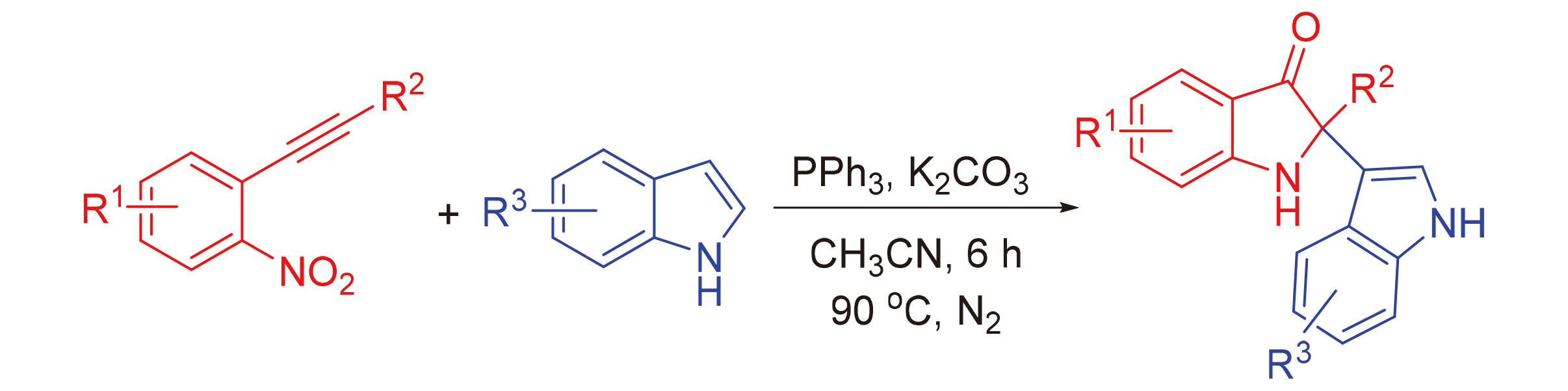
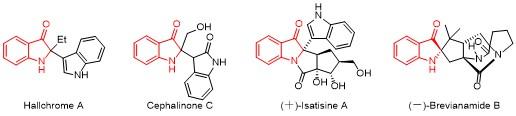
Indoles are a class of nitrogen-containing organic compounds, which can be widely found in many bioactive alkaloids such as indigo,[1] evodiamine,[2] reserpine,[3] and vinblastine.[4] Due to its special chemical structure, indole is often used as a crucial starting material in organic synthesis and is capable of participating in various chemical reactions to construct complex organic molecular structures.[5] Indolin-3-ones are a kind of special indoles containing a valuable carbonyl group, and most of them exhibit significant bioactivities.[6] Examples include Hallchrome A,[6] Cephalinone C,[6] (+)-Isatisine A[6] and (-)-Brevianamide B[6] (Figure 1). Additionally, indolin-3-ones are usually served as important intermediates in the synthesis of natural products. Due to their significance, the synthesis of indolin-3-ones has attracted more attention and a lot of synthetic methods have been reported.[7] Our group has also done a lot of works on indolin-3-ones for a long time. In 2017, it was found that α-imino metal carbenes[8] generated in situ served as efficient intermediates for the construction of heterocycles[9] and also reported palladium- catalyzed synthesis of 1H-indole-3-sulfonates from 2-alky- nyl arylazides with sulfonic acids, which provided excellent product yields.[10] Then we reported a series of palladium-catalyzed one-pot synthesis of C(2)-quaternary indolin-3-ones[11] via 1H-indole-3-sulfonates and 3H-indole- 3-ones.[12] In these works, various nucleophiles including indoles were examined.[13]
Recently, the construction of the indolin-3-ones bearing an indoxyl functional group has emerged as an efficient synthetic strategy. In 2019, Yu and co-workers[14] reported the synthesis of 2-(1H-indol-3-yl)-2-indolin-3-ones from indoles using tert-butyl hydroperoxide (TBHP) as an oxidizer under microwave conditions (Scheme 1, a). In 2020, Zhang and co-workers[15] described a method for preparing 2-(1H-indol-3-yl)-2-indolin-3-ones by employing indoles and 2,2,6,6-tetra-methyl-1-piperidinyloxy (TEMPO) (Scheme 1, b). In 2023, Zhong’s group[16] developed a copper efflux-oxidase-catalyzed synthesis of 2-(1H-indol- 3-yl)-2-indolin-3-ones from 3-hydroxyindole esters and indoles (Scheme 1, c). In 2025, Jaisankar’s group[17] explored a synthetic strategy for the construction of C(2)- quaternaryindoles using indium(III) trifluoromethansul- phonate as a catalyst and TBHP as an oxidant in water at room temperature (Scheme 1, d). Although these reported methods are efficient, they suffer from limitations such as the requirement for metal catalyst or potentially hazardous oxidizing agents. Additionally, the key intermediates 2- aryl-3H-indol-3-ones are highly reactive and not easily prepared in high yields. Therefore, the development of novel strategies for the preparation of indoxyl-substituted indolin-3-ones remains necessary.
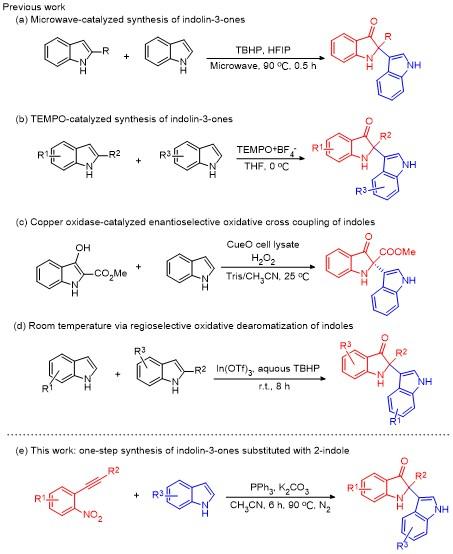
To address these challenges, we herein report a metal-free, PPh3-mediated synthesis of indoxyl-substituted indolin-3-ones from nitroalkynes (Scheme 1, e).
2 Results and discussion
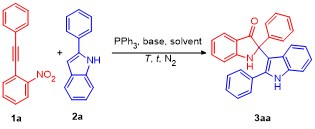
At the onset of this study, 1-nitro-2-phenyl-ethynyl- benzene (1a) and 2-phenyl-indole (2a) were selected as model substrates to optimize the reaction conditions (Table 1). Initial experiments revealed that treating 1a (0.1 mmol) with PPh3 (1 mmol), K2CO3 (0.3 mmol) and 2a (0.5 mmol), in CH3CN (1 mL) at 90 ℃ under N2 for 4 h gave 2-phenyl- 2-(2-phenyl-1H-indol-3-yl)indolin-3-one (3aa) in 95% yield (Entry 1). Subsequently, other bases including 1,8- diazabicyclo[5.4.0]undec-7-ene (DBU), NaOH, Cs2CO3, and t-BuOK were screened under the similar reaction conditions but provided 3aa in lower yields (27%~80%) or trace amounts (Entries 2~5). Increasing the base loading to 0.5 mmol improved the yield to 97% (Entries 6, 7), but further changing 2a to 0.2 mmol or 1 mmol did not enhance the product yield (Entries 8, 9). Next, different solvents such as Et3N, H2O, dimethyl sulfoxide (DMSO), and 1,4-dioxane were examined, but the desired product 3aa was afforded in lower yields of 13%~38% or trace amount (Entries 10~13). Lowering the temperature to 60 ℃ significantly reduced the yield (Entry 14), and the reaction at room temperature led to a trace amount of product 3aa (Entry 15).
Table 1 Optimization of the reaction conditionsa |
| Entry | Base/equiv. | Solvent | PPh3/equiv. | 2a/equiv. | Yieldb/% |
|---|---|---|---|---|---|
| 1 | K2CO3 (3) | CH3CN | 10 | 5 | 95 |
| 2 | DBU (3) | CH3CN | 10 | 5 | 27 |
| 3 | NaOH (3) | CH3CN | 10 | 5 | Trace |
| 4 | Cs2CO3 (3) | CH3CN | 10 | 5 | 80 |
| 5 | t-BuOK (3) | CH3CN | 10 | 5 | Trace |
| 6 | K2CO3 (5) | CH3CN | 10 | 5 | 97 |
| 7 | K2CO3 (2) | CH3CN | 10 | 5 | 89 |
| 8 | K2CO3 (5) | CH3CN | 10 | 2 | 90 |
| 9 | K2CO3 (5) | CH3CN | 10 | 10 | 97 |
| 10 | K2CO3 (5) | Et3N | 10 | 5 | Trace |
| 11 | K2CO3 (5) | H2O | 10 | 5 | 38 |
| 12 | K2CO3 (5) | DMSO | 10 | 5 | 25 |
| 13 | K2CO3 (5) | 1,4-Dioxane | 10 | 5 | 13 |
| 14c | K2CO3 (5) | CH3CN | 10 | 5 | 60 |
| 15d | K2CO3 (5) | CH3CN | 10 | 5 | Trace |
| 16 | K2CO3 (5) | CH3CN | 5 | 5 | 78 |
| 17e | K2CO3 (5) | CH3CN | 5 | 5 | 98 |
| 18 | — | CH3CN | 5 | 5 | Trace |
| 19 | K2CO3 (5) | CH3CN | 2 | 5 | 55 |
a Reaction conditions: 1a (0.1 mmol, 1 equiv.), PPh3, 2a, base and solvent (1 mL) at 90 ℃ under N2 for 4 h. b Isolated yield. c 60 ℃. d Room temperature. e 6 h. |
In addition, reducing PPh3 to 0.5 mmol decreased the product yield to 78% but extending the reaction time to 6 h increased it to 98% (Entries 16, 17). Notably, the trace amount of product 3aa was observed in the absence of a base (Entry 18). When the amount of PPh3 was reduced to 0.2 mmol and the reaction was carried out for 6 h, the target product was obtained in 55% yield (Entry 19). Based on these results, the reaction containing 1a (0.1 mmol), 2a (5 equiv.), PPh3 (5 equiv.), and K2CO3 (5 equiv.) in CH3CN (1 mL) under N2 at 90 ℃ for 6 h was deemed as the best reaction conditions.
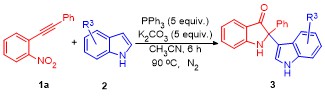
With the optimized reaction conditions in hand, the scope of this reaction was next investigated by examining a series of different indoles and the corresponding results were summarized in Table 2. This revealed that reactions of 2-substituted indoles (R=H, CH3) gave the corresponding products 3ab~3ac in good to excellent yields (60%~96%). Indoles bearing 5-, 7-methyl group or other electron-withdrawing/donating groups afford the corresponding products 3ad~3ah in excellent yields of 96%~99% yield. The target product 3ai could still be obtained in 95% yield when a substituent (R=Br) was introduced at the 6-position.
Table 2 Substrates scope of the indolesa,b |
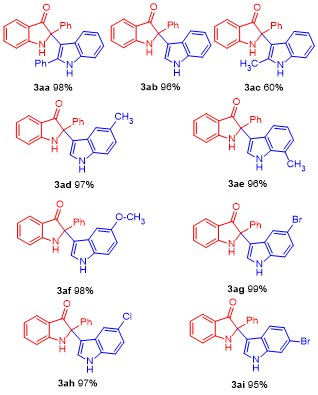 |
a Reaction conditions: 1a (0.1 mmol), PPh3 (5 equiv.), 2 (0.5 mmol), K2CO3 (5 equiv.) and CH3CN (1 mL) under N2 at 90 ℃ for 6 h. b Isolated yield. |
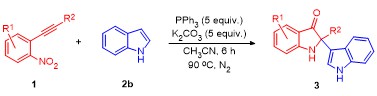
To further explore the substrate scope of the present process, various nitroalkynes were investigated under the optimized reaction conditions (Table 3). Under the best reaction conditions, reactions of 2-alkynylnitrobenzenes containing either electron-withdrawing or electron-donating groups on the alkynyl moiety gave the corresponding pro- ducts 3bb~3gb in yields of 83%~98% yield. Similarly, changing the R2 from the substituted aromatic groups to a thiophene or a cyclopropane was found to have no significant influence and the desired products 3hb~3ib were obtained in 82%~97% yields. However, it was found that the reaction failed to obtain the corresponding products 3jb and most of the starting material was left. Notably, the 2-phenylethynylnitrobenzene containing 5-CH3, or 4-OCH3 group on the aromatic ring could afford the corresponding products 3kb~3lb in yields of 39%~50% yield. In contrast, reactions of 2-phenylethynylnitrobenzene with 5-CF3, 4-F, 5-Cl or 4-Cl functional group on the aromatic ring gave the desired products 3mb~3pb in 89%~99% yields.
Table 3 Substrates scope of nitroalkynesa,b |
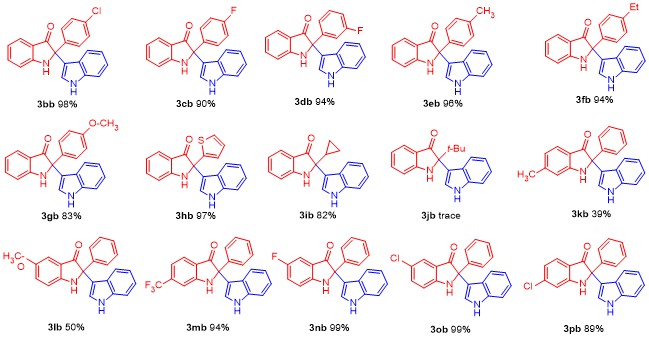 |
a Reaction conditions: 1 (0.1 mmol), PPh3 (5 equiv.), 2b (0.5 mmol), K2CO3 (5 equiv.) and CH3CN (1 mL) under N2 at 90 ℃ for 6 h. b Isolated yield. |
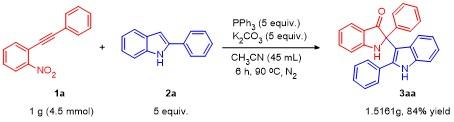
To evaluate the practicality of this synthetic method, a gram-scale reaction was conducted under standard conditions (Scheme 2). When 1a (4.5 mmol) reacted with 2a in the presence of PPh3 and K2CO3 at 90 ℃ for 6 h, the corresponding product 3aa was isolated in 84% yield.
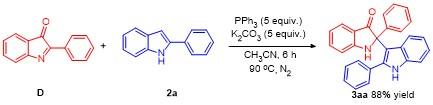
Next, a control experiment was conducted. Intermediate D (0.1 mmol), prepared according to known methods,[11,18] was used as the starting material and reacted with K2CO3 (5 equiv.) in CH3CN (1 mL) under N2 atmosphere. After stirring for 6 h, the desired product 3aa was obtained in 88% yield (Scheme 3). Based on thin-layer chromatography (TLC) monitoring and the conversion to 3aa, compound D was demonstrated to be a key intermediate in this reaction.
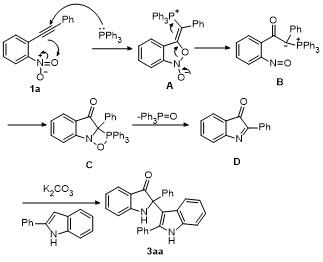
Based on the above experimental results, a possible reaction mechanism was tentatively proposed in Scheme 4. First, nucleophilic attack of PPh3 to alkyne moiety leads to 5-exo-dig cyclization of 1a and produces cyclic intermediate A. Then, intramolecular charge transfer resultes in phosphorus ylide B. Rearrangement of B forms a four- membered ring C. The intermediate indolin-3-one D is generated through collapse of the strained ring C along with the release of triphenylphosphine oxide. The side product triphenylphosphine oxide (O=PPh3) can be detected by TLC.[18] Finally, D is trapped by the indole nucleophile to give the desired product 3aa.


3 Conclusions
In summary, we have developed a simple and efficient method to construct indolin-3-ones from 2-alkynylnitro- benzenes and indoles. This reaction has the advantages of short reaction time and mild conditions. And most of the products could be obtained in 60%~99% yields under mild reaction conditions. In addition, 2-alkynylnitroarenes used as the starting materials were stable enough and could be easily obtained in one step. Finally, our group is currently conducting further research on the application of this synthetic method.
4 Experimental section
4.1 General considerations
Unless specified, all reagents and starting materials were purchased from commercial sources and used as received. Solvents were purified following standard literature procedures. Analytical thin layer chromatography (TLC) was performed using pre-coated silica gel plate. Visualization was achieved by UV light (254 nm). Flash chromatography was performed using silica gel and a gradient solvent system (ethyl acetate/petrol ether as eluant). 1H NMR and 13C NMR spectra were measured on Bruker Avance III HD 400 MHz and 600 MHz spectrometers. Chemical shifts were recorded with tetramethylsilane (TMS) as the internal reference standard. All the starting materials 1-nitro-2- (phenylethynyl)benzenes (1) were prepared by reported methods.[19-20] Melting points were determined using a digital melting point apparatus.
4.2 General experimental procedure for the synthesis of product 3
To a 10 mL of flask were added 1 (0.1 mmol, 1 equiv.), PPh3 (0.5 mmol), 2 (0.5 mmol), K2CO3 (0.5 mmol) and CH3CN (1 mL). The reaction mixture was stirred at 90 ℃ under N2, until the nitroalkynes disappeared monitored by TLC (about 6 h for 1). Upon cooling to room temperature, the reaction mixture was directly subjected to purification by flash column chromatography (eluent: petrol ether/ethyl acetate, V∶V=20∶1~8∶1) on silica gel to give the desired product 3.
2-Phenyl-2-(2-phenyl-1H-indol-3-yl)indolin-3-one (3aa):[21,25] Yellow solid, 98% yield. m.p. 227~228 ℃; 1H NMR (DMSO-d6, 400 MHz) δ: 6.63 (d, J=8.0 Hz, 1H), 6.72~6.77 (m, 2H), 6.99 (d, J=8.0 Hz, 1H), 7.04~7.08 (m, 6H), 7.13~7.19 (m, 3H), 7.26 (d, J=7.6 Hz, 1H), 7.36 (d, J=8.0 Hz, 1H), 7.40~7.42 (m, 2H), 7.50~7.54 (m, 1H), 8.34 (d, J=9.2 Hz, 1H), 11.36 (s, 1H); 13C NMR (CDCl3, 101 MHz) δ: 201.0, 160.6, 140.2, 138.4, 138.0, 136.2, 133.7, 130.0, 128.1, 127.9, 127.8, 127.6, 127.5, 127.5, 124.9, 121.6, 120.8, 119.1, 118.9, 118.0, 112.4, 111.7, 111.5, 71.6.
2-(1H-Indol-3-yl)-2-phenylindolin-3-one (3ab):[14,21] Yellow solid, 96% yield. m.p. 214~216 ℃; 1H NMR (DMSO-d6, 400 MHz) δ: 6.74 (t, J=7.2 Hz, 1H), 6.85 (t, J=7.6 Hz, 1H), 6.99 (d, J=8.0 Hz, 1H), 7.04~7.12 (m, 3H), 7.27~7.36 (m, 3H), 7.39 (d, J=8.0 Hz, 1H), 7.47~7.53 (m, 4H), 8.34 (s, 1H), 11.08 (s, 1H).
2-(2-Methyl-1H-indol-3-yl)-2-phenylindolin-3-one (3ac):[21] Yellow solid, 60% yield. m.p. 182~185 ℃; 1H NMR (DMSO-d6, 400 MHz) δ: 1.89 (s, 3H), 6.62 (d, J=8.0 Hz, 1H), 6.67~6.74 (m, 2H), 6.90~6.93 (m, 2H), 7.23 (d, J=8.0 Hz, 1H), 7.30~7.36 (m, 3H), 7.46~7.50 (m, 2H), 7.54 (d, J=7.6 Hz, 2H), 8.15 (s, 1H), 10.96 (s, 1H).
2-(5-Methoxy-1H-indol-3-yl)-2-phenylindolin-3-one (3ad):[14,22] Yellow solid, 97% yield. m.p. 197~198 ℃; 1H NMR (CDCl3, 400 MHz) δ: 2.33 (s, 3H), 5.45 (s, 1H), 6.91~6.98 (m, 3H), 7.02 (d, J=8.0 Hz, 1H), 7.13 (s, 1H), 7.28~7.33 (m, 4H), 7.50~7.54 (m, 1H), 7.57 (d, J=8.0 Hz, 2H), 7.71 (d, J=7.6 Hz, 1H), 8.20 (s, 1H).
2-(7-Methyl-1H-indol-3-yl)-2-phenylindolin-3-one (3ae):[22] Yellow solid, 96% yield. m.p. 186~189 ℃; 1H NMR (CDCl3, 400 MHz) δ: 2.44 (s, 3H), 5.49 (s, 1H), 6.87~6.93 (m, 3H), 6.99 (d, J=6.8 Hz, 1H), 7.04 (d, J=8.0 Hz, 1H), 7.09 (d, J=2.4 Hz, 1H), 7.28~7.29 (m, 3H), 7.50 (t, J=7.2 Hz, 1H), 7.57~7.59 (m, 2H), 7.70 (d, J=7.6 Hz, 1H), 8.37 (s, 1H).
2-(5-Chloro-1H-indol-3-yl)-2-phenylindolin-3-one (3ah):[14,21] Yellow solid, 97% yield. m.p. 120~122 ℃; 1H NMR (DMSO-d6, 400 MHz) δ: 6.75 (t, J=7.2 Hz, 1H), 6.98 (d, J=8.4 Hz, 1H), 7.06 (d, J=8.8 Hz, 1H), 7.10 (s, 1H), 7.20 (s, 1H), 7.29~7.35 (m, 3H), 7.38~7.41 (m, 3H), 7.48 (d, J=7.6 Hz, 1H), 7.52 (t, J=7.6 Hz, 1H), 8.41 (s, 1H), 11.29 (s, 1H).
2-(6-Bromo-1H-indol-3-yl)-2-phenylindolin-3-one (3ai):[14,17] Yellow solid, 95% yield. m.p. 137~139 ℃; 1H NMR (DMSO-d6, 600 MHz) δ: 11.23 (s, 1H), 8.37 (s, 1H), 7.59 (d, J=1.7 Hz, 1H), 7.54~7.46 (m, 2H), 7.44~7.40 (m, 2H), 7.35~7.25 (m, 3H), 7.14 (d, J=2.4 Hz, 1H), 7.07~6.94 (m, 3H), 6.75 (t, J=7.3 Hz, 1H); 13C NMR (DMSO-d6, 151 MHz) δ: 200.6, 161.4, 140.3, 138.3, 138.3, 128.7, 128.0, 127.0, 125.6, 125.2, 125.1, 122.2, 122.0, 118.1, 117.7, 115.3, 114.8, 114.7, 112.4, 70.9.
2-(4-Chlorophenyl)-2-(1H-indol-3-yl)indolin-3-one (3bb):[21] Yellow solid, 98% yield. m.p. 168~174 ℃; 1H NMR (DMSO-d6, 400 MHz) δ: 6.76 (t, J=7.2 Hz, 1H), 6.87 (t, J=7.6 Hz, 1H), 6.99 (d, J=8.4 Hz, 1H), 7.05~7.09 (m, 3H), 7.38~7.41 (m, 3H), 7.46~7.54 (m, 4H), 8.35 (s, 1H), 11.12 (s, 1H).
2-(3-Fluorophenyl)-2-(1H-indol-3-yl)indolin-3-one (3db):[21] Yellow solid, 94% yield. m.p. 155~158 ℃; 1H NMR (DMSO-d6, 400 MHz) δ: 6.77 (t, J=7.2 Hz, 1H), 6.88 (t, J=7.6 Hz, 1H), 7.01 (d, J=8.0 Hz, 1H), 7.06~7.13 (m, 4H), 7.23 (d, J=10.8 Hz, 1H), 7.37~7.42 (m, 3H), 7.51~7.55 (m, 2H), 8.39 (s, 1H), 11.14 (s, 1H).
2-(1H-Indol-3-yl)-2-(p-tolyl)indolin-3-one (3eb):[21] Yellow solid, 96% yield. m.p. 98~102 ℃; 1H NMR (CDCl3, 400 MHz) δ: 2.32 (s, 3H), 5.42 (s, 1H), 6.86~6.90 (m, 2H), 6.98 (t, J=7.6 Hz, 1H), 7.07 (d, J=2.4 Hz, 1H), 7.10 (d, J=8.0 Hz, 2H), 7.14~7.19 (m, 2H), 7.32 (d, J=8.0 Hz, 1H), 7.43 (d, J=8.0 Hz, 2H), 7.47~7.51 (m, 1H), 7.69 (d, J=7.6 Hz, 1H), 8.36 (s, 1H).
2-(4-Ethylphenyl)-2-(1H-indol-3-yl)indolin-3-one (3fb):[21] Yellow solid, 94% yield. m.p. 122~126 ℃; 1H NMR (CDCl3, 400 MHz) δ: 1.21 (t, J=7.6 Hz, 3H), 2.62 (q, J=7.6 Hz, 2H), 5.42 (s, 1H), 6.85~6.91 (m, 2H), 6.98 (t, J=7.6 Hz, 1H), 7.08~7.20 (m, 5H), 7.32 (d, J=8.0 Hz, 1H), 7.45-7.51 (m, 3H), 7.69 (d, J=7.6 Hz, 1H), 8.34 (s, 1H).
2-(4-Methoxy-phenyl)-2-(1H-indol-3-yl)indolin-3-one (3gb):[22] Yellow solid, 83% yield. m.p. 114~119 ℃; 1H NMR (CDCl3, 400 MHz) δ: 3.76 (s, 3H), 5.39 (s, 1H), 6.81 (d, J=8.4 Hz, 2H), 6.88 (t, J=8.8 Hz, 2H), 6.98 (t, J=7.6 Hz, 1H), 7.07 (d, J=0.4 Hz, 1H), 7.14~7.19 (m, 2H), 7.33 (d, J=8.0 Hz, 1H), 7.44~7.51 (m, 3H), 7.69 (d, J=7.6 Hz, 1H), 8.32 (s, 1H).
2-(1H-Indol-3-yl)-2-(thiophen-2-yl)indolin-3-one (3hb):[21,24] Yellow solid, 97% yield. m.p. 97~101 ℃; 1H NMR (DMSO-d6, 400 MHz) δ: 6.80 (t, J=7.6 Hz, 1H), 6.88 (t, J=7.6 Hz, 1H), 6.97~7.02 (m, 2H), 7.05~7.09 (m, 2H), 7.13 (d, J=2.4 Hz, 1H), 7.18 (d, J=8.0 Hz, 1H), 7.38~7.43 (m, 2H), 7.54 (t, J=7.6 Hz, 2H), 8.41 (s, 1H), 11.11 (s, 1H).
2-Cyclopropyl-2-(1H-indol-3-yl)indolin-3-one (3ib):[21] Yellow solid, 82% yield. m.p. 164~169 ℃; 1H NMR (DMSO-d6, 400 MHz) δ: 0.08~0.14 (m, 1H), 0.26~0.33 (m, 1H), 0.44~0.51 (m, 1H), 0.61~0.68 (m, 1H), 1.61~1.68 (m, 1H), 6.74 (t, J=7.2 Hz, 1H), 6.80 (t, J=7.6 Hz, 1H), 6.85 (d, J=8.0 Hz, 1H), 7.02 (t, J=7.2 Hz, 2H), 7.35~7.37 (m, 2H), 7.45~7.51 (m, 2H), 7.54 (d, J=1.6 Hz, 1H), 11.07 (s, 1H).
2-(1H-Indol-3-yl)-6-methyl-2-phenylindolin-3-one (3kb):[23] Yellow solid, 39% yield. m.p. 175~181 ℃; 1H NMR (DMSO-d6, 400 MHz) δ: 2.32 (s, 3H), 6.57 (d, J=8.0 Hz, 1H), 6.76 (s, 1H), 6.83 (t, J=7.6 Hz, 1H), 7.01~7.08 (m, 3H), 7.27~7.37 (m, 5H), 7.45 (d, J=7.6 Hz, 2H), 8.23 (s, 1H), 11.04 (s, 1H).
2-(1H-Indol-3-yl)-5-methoxy-2-phenylindolin-3-one (3lb):[21] Yellow solid, 50% yield. m.p. 130~134 ℃; 1H NMR (DMSO-d6, 400 MHz) δ: 3.82 (s, 3H), 6.32 (d, J=8.8 Hz, 1H), 6.40 (s, 1H), 6.84 (t, J=7.6 Hz, 1H), 7.02~7.10 (m, 3H), 7.25~7.33 (m, 3H), 7.36~7.39 (m, 2H), 7.45 (d, J=7.6 Hz, 2H), 8.35 (s, 1H), 11.04 (s, 1H).
2-(1H-Indol-3-yl)-2-phenyl-6-(trifluoromethyl)indolin-3-one (3mb):[21] Yellow solid, 94% yield. m.p. 89~93 ℃; 1H NMR (CDCl3, 400 MHz) δ: 5.67 (s, 1H), 6.98 (t, J=7.6 Hz, 1H), 7.05 (d, J=2.0 Hz, 1H), 7.09~7.20 (m, 4H), 7.30~7.35 (m, 4H), 7.53~7.55 (m, 2H), 7.76 (d, J=8.0 Hz, 1H), 8.28 (s, 1H).
5-Fluoro-2-(1H-indol-3-yl)-2-phenylindolin-3-one (3nb):[21] Yellow solid, 99% yield. m.p. 93~97 ℃; 1H NMR (DMSO-d6, 400 MHz) δ: 5.30 (s, 1H), 6.86~6.89 (m, 1H), 6.98 (t, J=7.6 Hz, 1H), 7.08~7.10 (m, 1H), 7.13~7.19 (m, 2H), 7.24~7.36 (m, 6H), 7.54~7.56 (m, 2H), 8.29 (s, 1H).
5-Chloro-2-(1H-indol-3-yl)-2-phenylindolin-3-one (3ob):[21] Yellow solid, 99% yield. m.p. 94~97 ℃; 1H NMR (CDCl3, 400 MHz) δ: 5.46 (s, 1H), 6.84 (d, J=8.8 Hz, 1H), 6.98 (d, J=7.6 Hz, 1H), 7.05 (s, 1H), 7.13 (d, J=8.0 Hz, 1H), 7.17 (t, J=7.6 Hz, 1H), 7.29~7.30 (m, 3H), 7.34 (d, J=8.0 Hz, 1H), 7.43 (d, J=8.8 Hz, 1H), 7.52~7.54 (m, 2H), 7.63 (s, 1H), 8.29 (s, 1H).
6-Chloro-2-(1H-indol-3-yl)-2-phenylindolin-3-one (3pb):[21] Yellow solid, 89%; m.p. 143~148 ℃; 1H NMR (CDCl3, 400 MHz) δ: 6.74 (d, J=8.0 Hz, 1H), 6.87 (t, J=7.6 Hz, 1H), 6.99 (s, 1H), 7.05~7.08 (m, 3H), 7.27~7.35 (m, 3H), 7.39 (d, J=8.4 Hz, 1H), 7.45 (d, J=7.6 Hz, 2H), 7.50 (d, J=8.0 Hz, 1H), 8.60 (s, 1H) 11.12 (s, 1H).
Supporting Information ¹H NMR spectra and part of ¹³C NMR spectra of products 3aa~3pb. The Supporting Information is available free of charge via the Internet at http://sioc-journal.cn.
(Zhao, C.)