研究论文

炔基亚砜的分子内交叉偶联/[3,3]-硫鎓离子重排策略构建环烷并[c]呋喃

  • 郭闻涛 ,
  • 孟书玉 ,
  • 王全瑞 , *
展开
  • 复旦大学化学系 上海 200438

收稿日期: 2025-07-02

  修回日期: 2025-08-24

  网络出版日期: 2025-10-15

基金资助

国家自然科学基金(21971042)

Intramolecular Cross-Coupling/[3,3]-Sulfonium Rearrangement of Alkynyl Sulfoxides for the Construction of Cycloalkano[c]furans

  • Wentao Guo ,
  • Shuyu Meng ,
  • Quanrui Wang , *
Expand
  • Department of Chemistry, Fudan University, Shanghai 200438

Received date: 2025-07-02

  Revised date: 2025-08-24

  Online published: 2025-10-15

Supported by

National Natural Science Foundation of China(21971042)

摘要

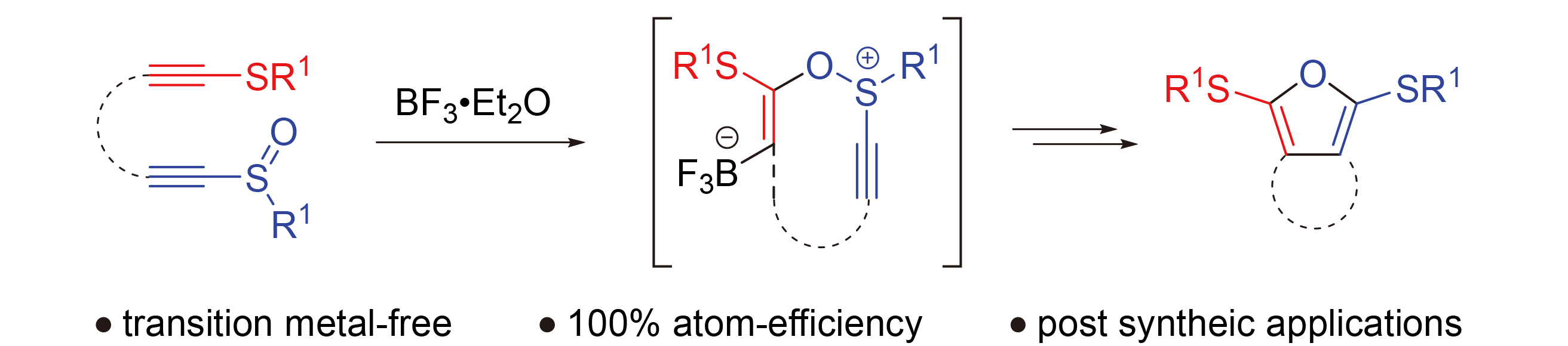
报道了一种基于分子内串联重排反应的双环呋喃类化合物的合成策略. 该串联反应由三氟化硼乙醚络合物催化的炔基硫醚与炔基亚砜的分子内交叉偶联引发, 随后经历[3,3]-σ硫鎓离子重排及5-exo-dig环化反应, 最终以中等产率以及100%原子经济性获得产物环烷并[c]呋喃. 所得呋喃类化合物的合成应用价值已通过对产物中烷硫基和呋喃环的后修饰反应得到验证.

本文引用格式

郭闻涛 , 孟书玉 , 王全瑞 . 炔基亚砜的分子内交叉偶联/[3,3]-硫鎓离子重排策略构建环烷并[c]呋喃[J]. 有机化学, 2026 , 46(2) : 594 -602 . DOI: 10.6023/cjoc202507003

Abstract

An intramolecular tandem rearrangement for the synthesis of bicyclic furans is reported. The reaction was initiated by an intramolecular cross-coupling of the built-in alkynyl sulfoxide and alkynyl sulfide motifs in the presence of BF3•Et2O, followed by a [3,3]-sigmatropic sulfonium rearrangement and 5-exo-dig cyclization, affording cycloalkano[c]furans as final products in moderate yields with 100% atom economy. The synthetic utility of the resulting furans has been demonstrated through late-stage diversification by utilizing the alkylthio groups or the furan rings.

1 Introduction

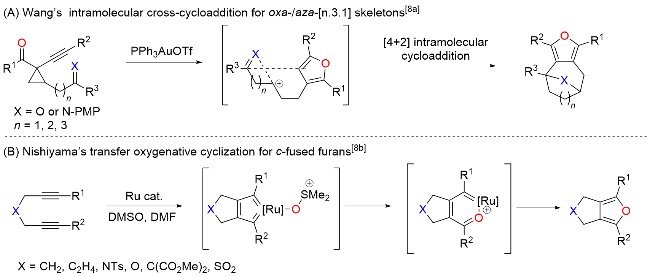
The furan ring is a pervasive structural motif found in a broad range of natural products and pharmacologically active compounds.[1] Fused furans are a class of polycyclic furan derivatives with multifaceted significance and can be classified into either b-fused furans (2,3-fused furans) or c-fused furans (3,4-fused furans), which exist in a vast number of biologically active molecules.[2] For example, the antiproliferative activity of natural product asperfuranone was found to be active against human non-small A549 lung cancer cells.[3] Axially chiral furan-based scaffolds have been recognized as a class of important heteroaryl atropisomers and constitutes the core units of many chiral phosphine ligands and bioactive molecules.[4] Over the past decades, considerable efforts has been devoted to the synthesis of fused furans from non-cyclic precursors, especially for benzo[b]furans due to their benzenoid structure[5] and potential in the construction of axially chiral scaffolds.[6] In contrast, methods to achieve the c-fused furans are quite limited.[7] Tandem reaction is an efficient strategy for the one-pot synthesis of c-fused furans.[8] In this context, Wang and coworkers[8a] have reported the construction of oxa-/aza-[n.3.1]skeletons through an Au(I)- catalyzed intramolecular cross-cycloaddition of alkynylcyclopropane ketones (Scheme 1A). Similarly, Nishiyama et al.[8b] also have reported a Ru-catalyzed transfer oxygenative cyclization of α,ω-diynes for the synthesis of c-fused furans (Scheme 1B), where the O atom in bicyclic furan products was transferred from dimethyl sulfoxide (DMSO).
Scheme 1 Representative synthesis of c-fused furans
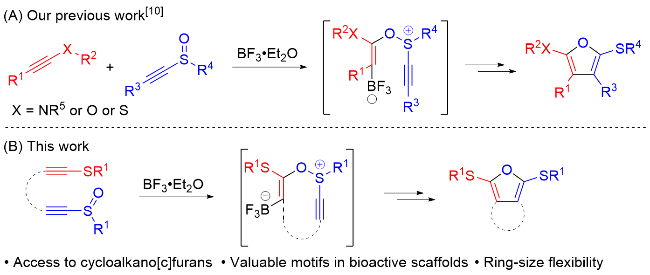
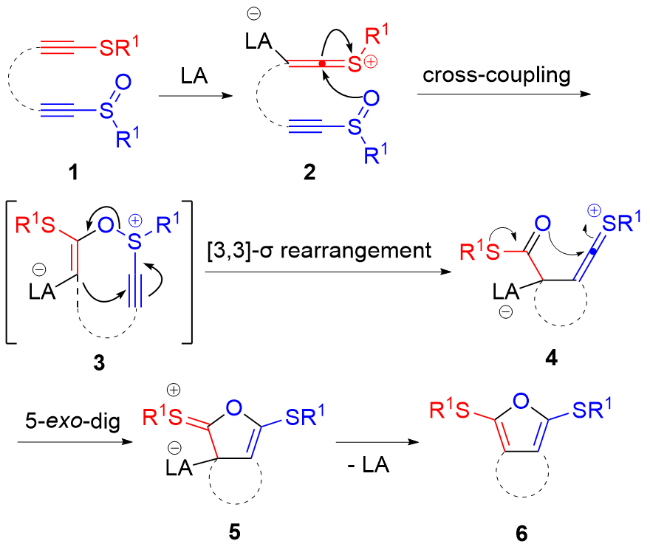
In recent years, we have been committed to developing novel tandem reactions for the synthesis of key structural motifs, especially tandem rearrangements via oxonium ion[9] or sulfonium ion[10] intermediates. Inspired by the stereodivergent synthesis of 1,4-dicarbonyl compounds via [3,3]-sulfonium rearrangement of sulfoxides reported by Maulide and coworkers,[11] we[10] have reported a novel tandem [3,3]-sulfonium rearrangement strategy for the construction of tetrasubstituted furans (Scheme 2A). This transition-metal-free tandem reaction was initiated by the cross-coupling of heterosubstituted alkynes and alkynyl sulfoxides in the presence of boron trifluoride diethyl etherate (BF3•Et2O) followed by a [3,3]-sigmatropic sulfonium rearrangement and heterocyclization to furnish tetrasubstituted furans as the final product with 100% atom economy. Encouraged by the success of this intermolecular sulfonium rearrangement, we naturally envisioned that an intramolecular [3,3]-sulfonium rearrangement could proceed via a similar reaction pathway, providing cycloalkano[c]furans as products (Scheme 2B). The proposed mechanism of the tandem intramolecular rearrangement was illustrated in Scheme 3. Electrophilic activation of alkylthio/alkylsulfinyl substituted diynes 1 by Lewis acid initiated the intramolecular cross-coupling of alkynyl sulfides and alkynyl sulfoxides, thereby generating the O-al- kenylsulfoxonium ion intermediate 3. The consecutive [3,3]-sigmatropic sulfonium rearrangement gives thioketene intermediate 4, followed by a 5-exo-dig heterocyc- lization and aromatization process to deliver cycloalkano-[c]furans 6. The positively charged sulfur could be an extra driving force for the rearrangement.[12] However, this intramolecular tandem reaction faces a significant challenge from the potential competing intermolecular rearrangement which leads to undesired intermolecular cross- coupling products or oligomers. Accordingly, minimizing the interference from intermolecular reactions and ensuring the designed intramolecular reaction pathway are crucial for achieving selective access to cycloalkano[c]furans 6.
Scheme 2 Tandem cross-coupling/[3,3]-sigmatropic sulfonium rearrangement strategy for accessing tetrasubstituted furans and cycloalkano[c]furans
Scheme 3 Proposed reaction mechanism for the intramolecular sulfonium rearrangement

2 Results and discussion

Our research began with the preparation of diyne sulfide sulfones 1 which serve as starting materials. Compounds 1 can be synthesized through the nucleophilic substitution of terminal diynes to disulfides[13] and the successive mono- oxidation with m-CPBA or Oxone.[14]
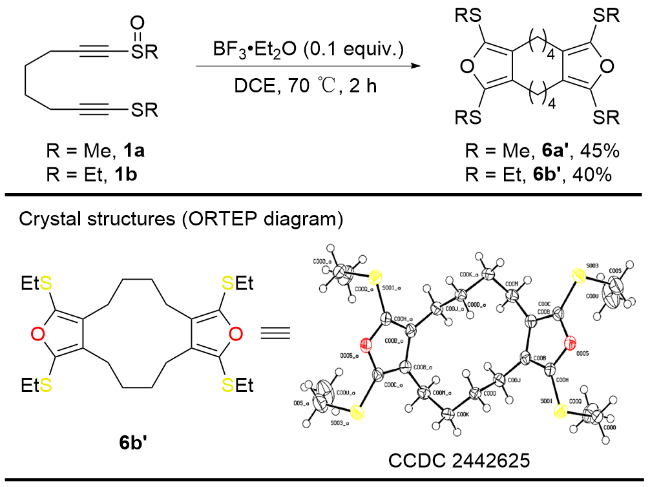
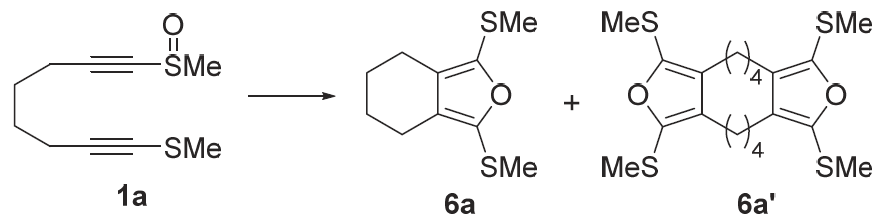
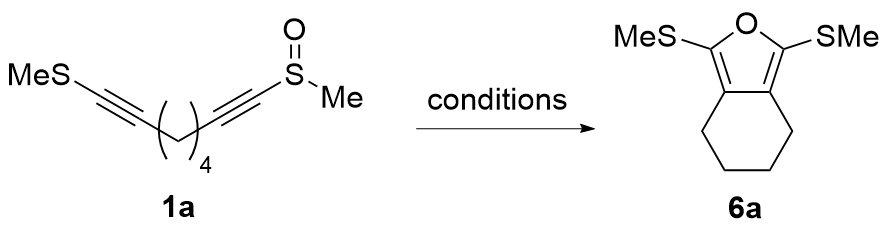
To begin with, a pilot experiment was conducted to evaluate the validity of the strategy, using methyl(8-(meth- ylsulfinyl)octa-1,7-diyn-1-yl)sulfane (1a) as the substrate in 1,2-dichloroethane (DCE). BF3•Et2O was chosen as the catalyst based on the previous performances.[10] Unexpectedly, product 6a' was isolated instead of the predicted product 6a with a yield of 45% (Scheme 4). High-resolu- tion mass spectrometry (HRMS) revealed that the exact mass of 6a' was twice as many as the bicyclic 6a’s, suggesting that this unlooked-for product might result from the double reaction of 1a. To verify the hypothesis, the ethyl analogue 6b' was synthesized. Its structure was unambiguously identified by single-crystal X-ray crystallography, revealing a 12-membered ring scaffold. Obviously, 6a' and 6b' were formed via intramolecular rearrangement of the cross-dimeric intermediate, which was originated from sulfoxide 1 through an intermolecular sulfonium rearrangement similar to our previously described sequence. The occurrence of this undesired reaction led us to seek conditions that suppress the competitive dimerization of sulfoxide 1 (Table 1). To our delight, decreasing the substrate concentration to 0.01 mol/L delivered the desired product 6a with a 50% isolated yield without detection of dimeric byproduct 6a' (Entry 3).
Scheme 4 Intermolecular dimerization of substrate alkynyl sulfoxide 1a and 1b

All reactions were catalyzed by 0.1 equiv. of BF3•Et2O in 1,2-dichloro- ethane at 70 ℃ for 2 h. Isolated yields.

Table 1 Optimization of the substrate concentration with alkynyl sulfoxide 1aa
Entry c(1h)/(mol•L-1) Yieldb/%
6a 6a'
1 0.2 Trace 45
2 0.1 18 27
3 0.01 48 Trace
4 0.005 46 Trace

a Unless indicated otherwise, the reactions were performed on a 1 mmol scale with 0.1 equiv. of BF3•Et2O in 1,2-dichloroethane at 70 ℃ for 2 h. b Isolated yields.

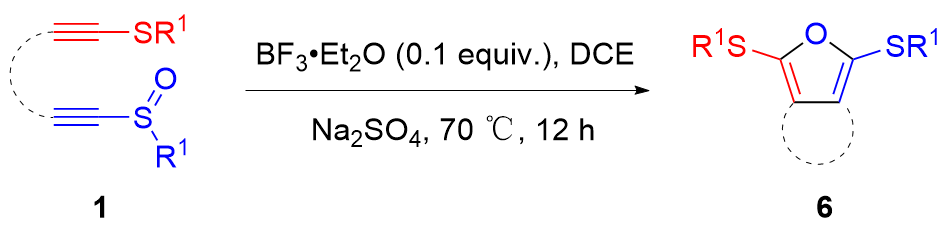
After examining the substrate concentration, the influence of other reaction parameters was further investigated. Selected conditions for optimization are summarized in Table 2. Elevating reaction temperature was proved to enhance the yield (Entries 4 and 5). In addition, extending reaction time led to the complete conversion of 1a with slightly improved yields (Entries 2 and 3). The application of anhydrous sodium sulfate as a drying agent led to a slightly improved isolated yield (62%) of 6a (Entry 6). Increasing the catalyst dosage from 0.1 equiv. to 1.0 equiv. did not further improve the yields (Entries 7~9), prompting us to explore several other catalysts. Reactions with Brønsted acid TfOH or Tf2NH gave slightly inferior yields with complex product mixtures (Entries 10 and 11). Other catalysts including several transition-metal catalysts commonly employed for alkyne activation[15] were also attempted, which worked even worse than BF3•Et2O (Entries 12~19). As for solvent selection, 1,2-dichloroethane (DCE) turned out to be the optimal choice for its high boiling point. Other common nucleophilic solvents were not involved here to prevent possible interference with heterocyclization process. Based on these examinations above, the optimized reaction conditions were determined to be: 0.5 mmol of alkynyl sulfoxide 1, 0.1 equiv. of BF3•Et2O and 2.0 g of anhydrous Na2SO4 in 50 mL of DCE at 70 ℃ for 12 h.
Table 2 Optimization of the substrate concentration with alkynyl sulfoxide 1aa
Entry Cat. (equiv.) Solv. T/℃ t/h Conv.b/%
1 BF3•Et2O (0.1) DCE 70 2 50 (48)c
2 BF3•Et2O (0.1) DCE 70 6 52
3 BF3•Et2O (0.1) DCE 70 12 57
4 BF3•Et2O (0.1) DCE 25 6 46
5 BF3•Et2O (0.1) DCE 25 12 49
6d BF3•Et2O (0.1) DCE 70 12 65 (62)c
7d BF3•Et2O (0.1) DCE 70 12 35
8d BF3•Et2O (0.1) DCE 70 12 29
9d BF3•Et2O (0.1) DCE 70 12 27
10d TfOH (0.1) DCE 70 12 43
11d Tf2NH (0.1) DCE 70 6 41
12d AgSbF6 (0.1) DCE 70 6 26
13d TiCl4 (0.1) DCE 70 12 13
14d AuCl3 (0.1) DCE 70 12 18
15d SnCl4 (0.1) DCE 70 12 31
16d In(OTf)3 (0.1) DCE 70 12 28
17d Eu(OTf)3 (0.1) DCE 70 12 35
18d SmI2 (0.1) DCE 70 12 <5
19d BuBOTf (0.1) DCE 70 12 41
20d BF3•Et2O (0.1) Toluene 70 6 32
21d BF3•Et2O (0.1) MeCN 70 8 41
22d BF3•Et2O (0.1) MeNO2 70 4 27
23d BF3•Et2O (0.1) CCl4 70 12 46

a All reactions were performed on a 0.5 mmol scale in 50 mL of corresponding solvent. b Determined by analysis of crude 1H NMR spectra with 1,3,5-tri- tert-butylbenzene as internal standard. c Isolated yields. d 2 g of Na2SO4 was added in Entries 6~23.

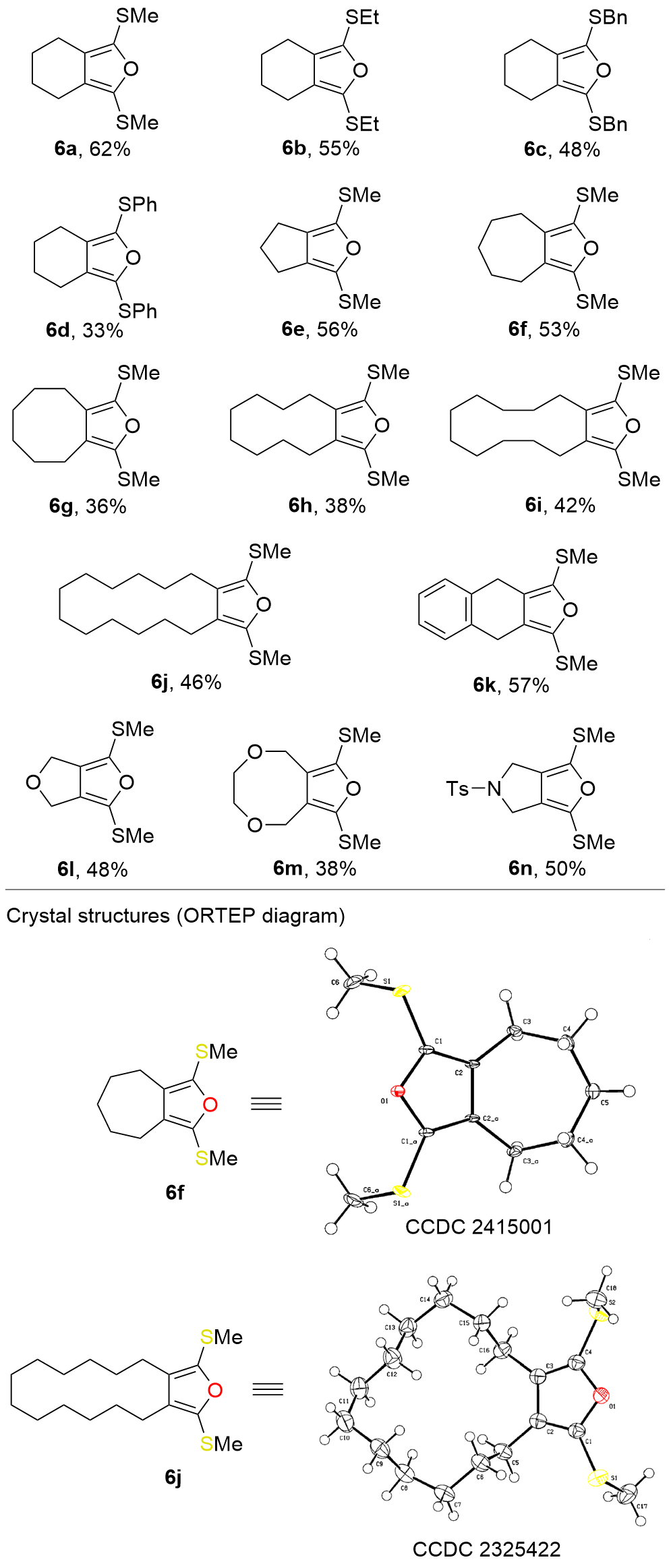
Employing the optimal conditions shown above, the substrate scope of this intramolecular rearrangement was examined (Table 3). The impact of steric hindrance on the RS substituents was first investigated (6a~6d). Introduction of a bulky group such as phenyl group (6d) led to a significantly decreased yield of 33%. Subsequently, the influence of the carbon tether length was examined (6e~6j). The result showed that sulfoxides were tolerated regardless of extending or shortening the carbon tethers, suggesting the flexibility on the fused-ring size. To our surprise, 1g and 1h could also undergo the reaction, affording furan products containing medium-sized rings (6g and 6h), although with relatively lower separation yields. It should be noted that medium-sized rings are typically challenging to synthesize due to the unfavorable transannular steric interactions and entropic effects.[16] For macrocycle products, 12- and 14-membered ring products (6i and 6j) were also furnished smoothly with slightly higher isolated yields than their medium-ring counterparts (42% and 46%). To further increase the product diversity, several substrates containing benzo ring (6k) or heteroatoms (6l~6n) in carbon tethers were employed and no significant drops in isolated yields were found in corresponding c-fused furan products. Additionally, the structures of cycloalkano[c]furans 6f and 6j have been unambiguously confirmed by single-crystal X-ray crystallography.
Table 3 Scope of the intramolecular sulfonium rearrangementa

aUnless indicated otherwise, the reactions were performed on a 0.5 mmol scale in 50 mL of 1,2-dichloroethane at 70 ℃ for 12 h. Isolated yields.

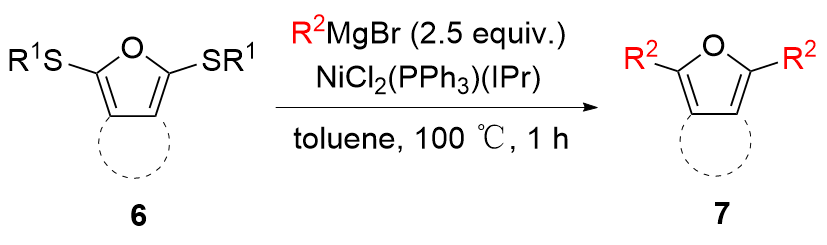
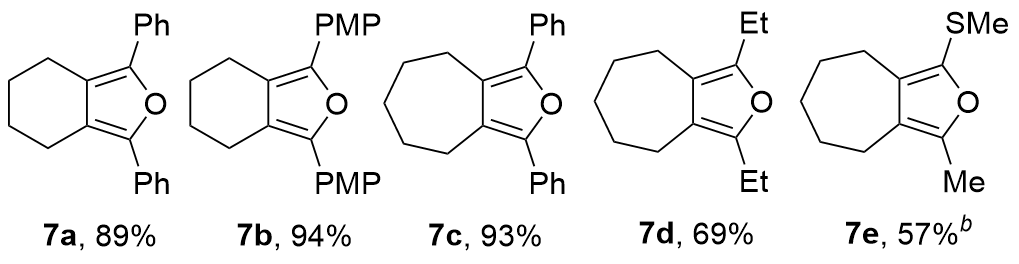
Finally, subsequent post modification of the cycloalkano[c]furan products was investigated. The Ni-NHC catalyzed cross-coupling of aryl sulfides with Grignard reagents, as reported by Yorimitsu and coworkers,[17] was utilized for the conversion of alkylthio groups in cycloalkano[c]furan products (Table 4). Both alkyl and aryl Grignard reagents were adaptable, providing the correspond- ing cycloalkano[c]furan products 7a~7d. Additionally, by decreasing the amount of Grignard reagent, partial modification of the alkylthio groups has also been achieved, furnishing product 7e with one alkylthio substituent untouched.
Table 4 Post-modification of cycloalkano[c]furan products through Ni-NHC-catalyzed cross-couplinga

aUnless indicated otherwise, the reactions were performed with 2.5 equiv. of R2MgBr and catalyzed by 20 mol% NiCl2(PPh3)(IPr) at 100 ℃ for 1 h. Isolated yields. b 1.0 equiv. of MeMgBr.

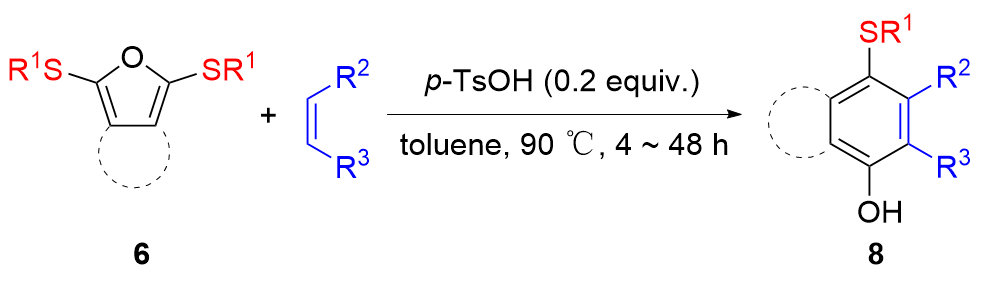
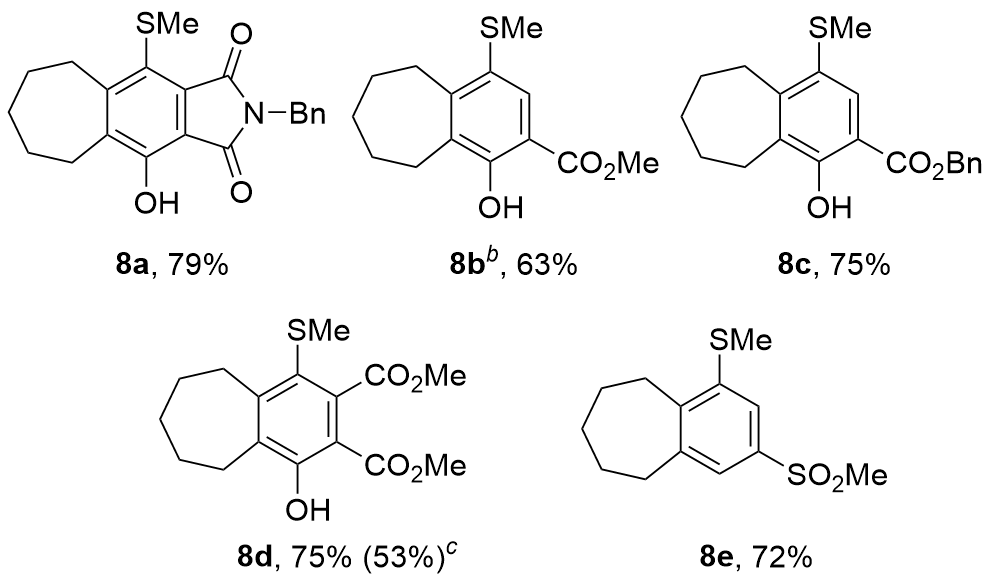
Next, the c‑fused furan ring was employed as a diene in Diels-Alder reactions (Table 5).[18] To start with, the methylthio-substituted cycloalkano[c]furan product 3b was selected as a representative substrate. To our delight, 3b underwent Diels-Alder cycloaddition with N-benzylmalei- mide accompanied by an acid-promoted aromatization[19] successfully, affording arylated product 8a containing a benzene core. cis-Disubstituted alkenes, monosubstituted alkenes and alkynes participated well in this tandem reaction, affording the corresponding benzoannulated products (8b~8d). A point worth mentioning is that the Diels-Alder reactions with dimethyl maleate or dimethyl acetylenedicarboxylate gave the same product 8d, while the isolated yield with the alkyne was relatively lower. However, reaction with methyl ethenyl sulphone bearing an electron- withdrawing sulfonyl group led to the formation of 8e, which lacks a hydroxyl substituent on the phenyl substituent, indicating an embedded oxidation process by the oxygen in air during aromatization.
Table 5 Post-modification of cycloalkano[c]furan products through Diels-Alder reaction followed by deoxygenative aromatizationa

a Unless indicated otherwise, the reactions were performed with 3.0 equiv. of dienophile at 90 ℃ for 4~48 h. Isolated yields. b Reaction was performed at 65 ℃. c Isolated yield with dimethyl acetylenedicarboxylate as dienophile in- stead of dimethyl cis-but-2-ene-1,4-dioate.

3 Conclusions

In summary, a direct and convenient protocol has been described for the synthesis of cycloalkano[c]furans, which are of high biological interests. The sequence extends intermolecular [3,3]-rearrangements of sulfonium ions to the intramolecular mode, embedded within a bicycle-generat- ing furan transformation. Mechanistically, this reaction was initiated by a Lewis acid-catalyzed intramolecular cross-coupling, followed by a [3,3]-rearrangement of the resulting O-alkenylsulfoxonium ion intermediates and subsequent heterocyclization to furnish cycloalkano[c]- furans. The advantages include the easy access of starting materials, mild conditions with the flexibility on the annulated ring size. Further functionalization of the furan products was achieved by Ni-NHC-catalyzed cross-coupling of the alkylthio groups and Diels-Alder cyclization of furan rings, which enriched the structural diversity of the resulting furan products.

4 Experimental section

4.1 General experimental information

All reactions were performed under nitrogen using solvents and reagents from commercial suppliers without further purification. Solvents for extraction and chromatography were analytical grade and used as received without further treatment for purification. Flash chromatography was performed using Tsingdao Haiyang Chemical silica gel (200±300 mesh) and silica gel Merck grade (60 Å). The eluting solvent for the purification of each compound was determined by thin-layer chromatography (TLC) on glass plates coated with silica gel 60 F254 and visualized by ultraviolet light. NMR spectra were recorded with 400 MHz Bruker spectrometer instruments. The chemical shifts for 1H NMR spectra are reported in δ referenced to the residual proton signal of the deuterated solvent. 13C NMR spectra were referenced to the carbon signals of the deuterated solvent; the nature of the carbon atoms (C, CH, CH2, or CH3) was determined by recording the DEPT-135 experiments. IR spectra were recorded with a ThermoFisher Nicolet iS10 and expressed in cm-1. High resolution MS (HRMS) data were obtained from a Q-Exactive™ Focus Hybrid Quadrupole-Orbitrap Mass Spectrometer equipped with a Dionex Ultimate 3000 HPLC system (ESI-QTRAP) or a Waters Xevo G2-xs tof (ESI-TOF). X-ray single crystal diffraction data were recorded with a Bruker D8 VENTURE MetalJet. Melting point data were measured on a Shenguang SGW X-4 melting point apparatus in Celsius degrees and were uncorrected.

4.2 General procedure for the synthesis of cyclo- alkano[c]furans (6)

A nitrogen flushed 100 mL three-necked flask was charged with alkynyl sulfide 1 (0.5 mmol, 1.0 equiv.), anhydrous Na2SO4 (2.0 g) and 1,2-dichloroethane (50 mL). After the mixture was heated in an oil bath to 70 ℃, BF3•Et2O (7.7 mg, 7 μL, 0.1 mmol, 0.1 equiv.) was added in one portion through syringe. The mixture was stirred at 70 ℃ until complete conversion of alkynyl sulfide 1 as indicated by TLC. The reaction mixture was quenched with a saturated solution of NaHCO3 (25 mL). The organic phase was separated and the aqueous layer was extracted with EtOAc (25 mL×3). The organic layers were combined, washed with brine (25 mL), dried under Na2SO4 and evaporated in vacuo. The residue was purified by flash chromatography to yield cycloalkano[c]furan 6.
1,3-Bis(methylthio)-4,5,6,7-tetrahydroisobenzofuran (6a): Using general procedure with 1a as the substrate. Purification by flash chromatography [V(EtOAc)∶V(n-he- xane)=1∶20] furnished 6a as colorless oil (67 mg, 62% yield). 1H NMR (400 MHz, CDCl3) δ: 2.50~2.44 (m, 4H), 2.34 (s, 6H), 1.66~1.60 (m, 4H); 13C NMR (100 MHz, CDCl3) δ: 144.7, 130.7, 28.2, 21.8, 18.7; IR (thin film) ν: 2917, 2867, 1654, 1419, 1350, 1065 cm-1; HRMS (ESI- TOF) calcd for C10H15OS2 [M+H] 215.0559, found 215.0551.
1,3-Bis(ethylthio)-4,5,6,7-tetrahydroisobenzofuran (6b): Using general procedure with 1b as the substrate. Purification by flash chromatography [V(EtOAc)∶V(n-hexane)=1∶20] furnished 6b as colorless oil (67 mg, 55% yield). 1H NMR 400 MHz, CDCl3) δ: 2.76 (q, J=7.4 Hz, 4H), 2.51~2.45 (m, 4H), 1.66~1.60 (m, 4H), 1.22 (t, J=7.4 Hz, 6H); 13C NMR (100 MHz, CDCl3) δ: 143.8, 131.9, 30.0, 28.3, 22.0, 15.3; IR (thin film) ν: 2917, 2867, 1654, 1419, 1350, 1065 cm-1; HRMS (ESI-TOF) calcd for C12- H19OS2 [M+H] 243.0877, found 243.0875.
1,3-Bis(benzylthio)-4,5,6,7-tetrahydroisobenzofuran (6c): Using general procedure with 1c as the substrate. Purification by flash chromatography [V(EtOAc)∶V(n-he- xane)=1∶20] furnished 6c as colorless oil (88 mg, 48% yield). 1H NMR (400 MHz, CDCl3) δ: 2.76 (q, J=7.4 Hz, 4H), 2.51~2.45 (m, 4H), 1.66~1.60 (m, 4H), 1.22 (t, J=7.4 Hz, 6H); 13C NMR (100 MHz, CDCl3) δ: 143.8, 131.9, 30.0, 28.3, 22.0, 15.3; IR (thin film) ν: 2917, 2867, 1654, 1419, 1350, 1065 cm-1; HRMS (ESI-TOF) calcd for C22- H23OS2 [M+H]367.1190, found 367.1192.
1,3-Bis(phenylthio)-4,5,6,7-tetrahydroisobenzofuran (6d): Using general procedure with 1d as the substrate. Purification by flash chromatography [V(EtOAc)∶V(n-he- xane)=1∶20] furnished 6d as colorless oil (56 mg, 33% yield). 1H NMR (400 MHz, CDCl3) δ: 7.42~7.38 (m, 4H), 7.32~7.27 (m, 4H), 7.19~7.15 (m, 2H), 2.49 (td, J=5.1, 2.1 Hz, 4H), 1.80~1.72 (m, 4H); 13C NMR (100 MHz, CDCl3) δ: 140.7, 136.1, 132.1, 129.1, 127.5, 126.2, 22.7, 21.2; IR (thin film) ν: 2917, 2867, 1654, 1419, 1350, 1065 cm-1; HRMS (ESI-TOF) calcd for C20H19OS2 [M+H] 339.0877, found 339.0871.
1,3-Bis(methylthio)-5,6-dihydro-4H-cyclopenta[c]furan (6e): Using general procedure with 1e as the substrate. Purification by flash chromatography [V(EtOAc)∶V(n-he- xane)=1∶20] furnished 6e as colorless oil (56 mg, 56% yield). 1H NMR (400 MHz, CDCl3) δ: 2.38 (s, 6H), 2.27~2.20 (m, 4H), 2.12 (q, J=6.7 Hz, 2H); 13C NMR (100 MHz, CDCl3) δ: 144.6, 130.0 28.7, 20.2, 18.5; IR (thin film) ν: 2917, 2867, 1654, 1419, 1350, 1065 cm-1; HRMS (ESI-TOF) calcd for C9H13OS2 [M+H] 201.0402, found 201.0408.
1,3-Bis(methylthio)-5,6,7,8-tetrahydro-4H-cyclohepta-[c]furan (6f): Using general procedure with 1f as the substrate. Purification by flash chromatography [V(EtOAc)∶V(n-hexane)=1∶20] furnished 6f as a white solid (61 mg, 53% yield). m.p. 68.1~68.7 ℃; 1H NMR (400 MHz, CDCl3) δ: 2.59~2.55 (m, 4H), 2.33 (s, 6H), 1.78 (q, J=5.5 Hz, 2H), 1.63~1.57 (m, 4H); 13C NMR (100 MHz, CDCl3) δ: 143.4, 133.1, 32.7, 29.0, 26.9, 19.2; IR (thin film) ν: 2917, 2867, 1654, 1419, 1350, 1065 cm-1; HRMS (ESI-TOF) calcd for C11H17OS2 [M+H] 229.0721, found 229.0722.
1,3-Bis(methylthio)-4,5,6,7,8,9-hexahydrocycloocta[c]-furan (6g): Using general procedure with 1g as the substrate. Purification by flash chromatography [V(EtOAc)∶V(n-hexane)=1∶20] furnished 6g as a white solid (44 mg, 36% yield). m.p. 69.9~70.2 ℃; 1H NMR (400 MHz, CDCl3) δ: 2.57~2.53 (m, 4H), 2.34 (s, 6H), 1.61~1.55 (m, 4H), 1.42 (p, J=2.7 Hz, 4H); 13C NMR (100 MHz, CDCl3) δ: 143.8, 131.7, 30.5, 25.6, 23.3, 19.3; IR (thin film) ν: 2917, 2867, 1654, 1419, 1350, 1065 cm-1; HRMS (ESI-TOF) calcd for C12H19OS2 [M+H] 243.0872, found 243.0865.
1,3-Bis(methylthio)-4,5,6,7,8,9,10,11-octahydrocyclo-deca[c]furan (6h): Using general procedure with 1h as the substrate. Purification by flash chromatography [V(EtO- Ac)∶V(n-hexane)=1∶20] furnished 6h as a white solid (51 mg, 38% yield). m.p. 78.1~78.5 ℃; 1H NMR (400 MHz, CDCl3) δ: 2.56 (t, J=6.8 Hz, 4H), 2.35 (s, 6H), 1.76 (m, 4H), 1.44 (q, J=3.9 Hz, 4H), 1.28~1.23 (m, 4H); 13C NMR (100 MHz, CDCl3) δ: 144.7, 130.7, 27.9, 26.2, 22.1, 21.0, 18.6; IR (thin film) ν: 2917, 2867, 1654, 1419, 1350, 1065 cm-1; HRMS (ESI-TOF) calcd for C14H23OS2 [M+H] 271.1190, found 271.1191.
1,3-Bis(methylthio)-4,5,6,7,8,9,10,11,12,13-decahydro-cyclododeca[c]furan (6i): Using general procedure with 1i as the substrate. Purification by flash chromatography [V(EtOAc)∶V(n-hexane)=1∶20] furnished 6i as a white solid (66 mg, 42% yield). m.p. 82.9~83.3 ℃; 1H NMR (400 MHz, CDCl3) δ: 2.40 (t, J=7.5 Hz, 4H), 2.35 (s, 6H), 1.68~1.62 (m, 4H), 1.48~1.44 (m, 4H), 1.43~1.36 (m, 8H); 13C NMR (100 MHz, CDCl3) δ: 144.7, 131.4, 28.4, 26.4, 25.6, 23.2, 22.0, 18.9; IR (thin film) ν: 2917, 2867, 1654, 1419, 1350, 1065 cm-1; HRMS (ESI-TOF) calcd for C16H27OS2 [M+H] 299.1503, found 299.1499.
1,3-Bis(methylthio)-4,5,6,7,8,9,10,11,12,13,14,15-dode-cahydrocyclotetradeca[c]furan (6j): Using general procedure with 1j as the substrate. Purification by flash chromatography [V(EtOAc)∶V(n-hexane)=1∶20] furnished 6j as a white solid (75 mg, 46% yield). m.p. 88.7~89.2 ℃; 1H NMR (400 MHz, CDCl3) δ: 2.41~2.36 (m, 4H), 2.34 (s, 6H), 1.47 (dt, J=10.7, 6.1 Hz, 4H), 1.36~1.30 (m, 8H), 1.29~1.26 (m, 8H); 13C NMR (100 MHz, CDCl3) δ: 144.6, 130.9, 30.4, 29.8, 29.6, 29.5, 29.3, 24.8, 19.0; IR (thin film) ν: 2917, 2867, 1654, 1419, 1350, 1065 cm-1; HRMS (ESI-QTRAP) calcd for C18H31OS2 [M+H] 327.1816, found 327.1819.
1,3-Bis(methylthio)-4,9-dihydronaphtho[2,3-c]furan (6k): Using general procedure with 1k as the substrate. Purification by flash chromatography [V(EtOAc)∶V(n-he- xane)=1∶20] furnished 6k as a white solid (75 mg, 57% yield). m.p. 86.7~87.0 ℃; 1H NMR (400 MHz, CDCl3) δ: 7.28 (dd, J=5.5, 3.6 Hz, 2H), 7.20 (dd, J=5.7, 3.3 Hz, 2H), 3.82 (s, 4H), 2.39 (s, 6H); 13C NMR (100 MHz, CDCl3) δ: 142.50, 134.44, 129.13, 127.12, 126.43, 26.85, 18.76; IR (thin film) ν: 2917, 2867, 1654, 1419, 1350, 1065 cm-1; HRMS (ESI-TOF) calcd for C14H15OS2 [M+H]263.0559, found 263.0556.
4,6-Bis(methylthio)-1H,3H-furo[3,4-c]furan (6l): Us- ing general procedure with 1l as the substrate. Purification by flash chromatography [V(EtOAc)∶V(n-hexane)=1∶20] furnished 6l as colorless oil (48 mg, 48% yield). 1H NMR (400 MHz, CDCl3) δ: 4.77 (s, 4H), 2.41 (s, 6H); 13C NMR (100 MHz, CDCl3) δ: 137.7, 135.5, 65.9, 18.5; IR (thin film) ν: 2917, 2867, 1654, 1419, 1350, 1065 cm-1; HRMS (ESI-TOF) calcd for C8H11O2S2 [M+H]203.0201, found 203.0199.
1,3-Bis(methylthio)-6,7-dihydro-4H,9H-furo[3,4-f][1,4]-dioxocine (6m): Using general procedure with 1m as the substrate. Purification by flash chromatography [V(EtO- Ac)∶V(n-hexane)=1∶20] furnished 6m as colorless oil (47 mg, 38% yield). 1H NMR (400 MHz, CDCl3) δ: 4.72 (s, 4H), 3.79 (s, 4H), 2.38 (s, 6H); 13C NMR (100 MHz, CDCl3) δ: 146.0, 127.4, 72.0, 65.5, 18.6; IR (thin film) ν: 2917, 2867, 1654, 1419, 1350, 1065 cm-1; HRMS (ESI- TOF) calcd for C10H15O3S2 [M+H] 247.0463, found 247.0460.
1,3-Bis(methylthio)-5-tosyl-5,6-dihydro-4H-furo[3,4-c]-pyrrole (6n): Using general procedure with 1n as the reaction substrate. Purification by flash chromatography (EtO- Ac/n-hexane=1/10) furnished 6n as a white solid (89 mg, 50% yield). m.p. 98.9~99.3 ℃; 1H NMR (400 MHz, CDCl3) δ: 7.77~7.74 (m, 2H), 7.35~7.33 (m, 2H), 4.31 (s, 4H), 2.43 (s, 3H), 2.36 (s, 6H); 13C NMR (100 MHz, CDCl3) δ: 143.9, 133.8, 130.6, 129.9, 127.5, 117.7, 46.8, 21.6, 18.3; IR (thin film) ν: 2917, 2867, 1654, 1419, 1350, 1065 cm-1; HRMS (ESI-TOF) calcd for C15H17O3S3Na [M+Na]378.0263, found 378.0265.

4.3 General procedure for the cross-coupling of cycloalkano[c]furans (7)

A nitrogen flushed 25 mL three-necked flask was charged with cycloalkano[c]furan 6 (50 mg, 1.0 equiv.), tetrahydrofuran (THF, 10 mL) and NiCl2(PPh3)(IPr) (0.2 equiv.). Then R2MgBr (2.5 equiv., 1.0 mol/L solution in THF) was added dropwise through syringe. The reaction mixture was stirred at 100 ℃ until TLC showed a complete conversion of 5. The mixture was quenched with a saturated aqueous solution of NH4Cl (10 mL). The organic phase was separated and the aqueous layer was extracted with EtOAc (10 mL×3). The organic layers were combined, washed with brine (10 mL), dried under Na2SO4 and evaporated in vacuo. The residue was purified by flash chromatography [V(EtOAc)∶V(n-hexane)=1∶50] to yield furan 7.
1,3-Diphenyl-4,5,6,7-tetrahydroisobenzofuran (7a): Using general procedure, 6a was reacted with phenylmagne- sium bromide. Purification by flash chromatography [V(Et- OAc)∶V(n-hexane)=1∶50] furnished 7a as a white solid (57 mg, 89% yield). m.p. 90.8~91.0 ℃; 1H NMR (400 MHz, CDCl3) δ: 7.73 (d, J=7.1 Hz, 4H), 7.42~7.37 (m, 4H), 7.24~7.19 (m, 2H), 2.83~2.78 (m, 4H), 1.82~1.76 (m, 4H); 13C NMR (100 MHz, CDCl3) δ: 145.79, 131.95, 128.60, 126.33, 124.51, 120.91, 23.25, 23.08; IR (thin film) ν: 3020, 2917, 1664, 1595, 1441, 1204 cm-1; HRMS (ESI-TOF) calcd for C20H19O [M+H]275.1430, found 275.1432.
1,3-Di(4-methoxyphenyl)-4,5,6,7-tetrahydroisobenzo-furan (7b): Using general procedure, 6a was reacted with 4-methoxyphenylmagnesium bromide. Purification by flash chromatography [V(EtOAc)∶V(n-hexane)=1∶50] furnished 7b as a white solid (73 mg, 94% yield). m.p. 168.9~169.2 ℃; 1H NMR (400 MHz, CDCl3) δ: 7.67~7.64 (d, J=7.6 Hz, 4H), 7.53~7.48 (m, 2H), 7.01~6.96 (m, 4H), 3.87 (s, 6H), 2.74~2.71 (m, 4H), 1.75~1.68 (m, 4H); 13C NMR (100 MHz, CDCl3) δ: 158.71, 133.50, 127.75, 124.19, 118.96, 114.18, 55.37, 28.92; IR (thin film) ν: 2921, 2841, 1610, 1588, 1440, 1204 cm-1; HRMS (ESI-TOF) calcd for C22H23O3 [M+H]335.1642, found 335.1635.
1,3-Diphenyl-5,6,7,8-tetrahydro-4H-cyclohepta[c]furan (7c): Using general procedure, 6f was reacted with phenyl- magnesium bromide. Purification by flash chromatography [V(EtOAc)∶V(n-hexane)=1∶50] furnished 7c as a white solid (61 mg, 93% yield). m.p. 94.1~94.3 ℃; 1H NMR (400 MHz, CDCl3) δ: 7.61 (d, J=7.6 Hz, 4H), 7.43~7.38 (m, 4H), 7.27 (d, J=7.6 Hz, 2H), 2.86~2.81 (m, 4H), 1.89~1.82 (m, 2H), 1.75~1.68 (m, 4H); 13C NMR (100 MHz, CDCl3) δ: 147.0, 131.9, 128.5, 127.0, 126.7, 125.8, 32.5, 28.9, 26.1; IR (thin film) ν: 3020, 2916, 1664, 1600, 1447, 1204 cm-1; HRMS (ESI-TOF) calcd for C21H21O [M+H] 289.1587, found: 289.1590.
1,3-Diethyl-5,6,7,8-tetrahydro-4H-cyclohepta[c]furan (7d): Using general procedure, 6f was reacted with ethylmagnesium bromide. Purification by flash chromatography [V(EtOAc)∶V(n-hexane)=1∶50] furnished 7d as colorless oil (29 mg, 69% yield). 1H NMR (400 MHz, CDCl3) δ: 2.52 (q, J=7.5 Hz, 4H), 2.42~2.37 (m, 4H), 1.75 (dq, J=8.7, 5.3 Hz, 2H), 1.61~1.55 (m, 4H), 1.16 (t, J=7.5 Hz, 6H); 13C NMR (100 MHz, CDCl3) δ: 148.4, 120.9, 33.0, 29.9, 25.8, 19.3, 13.7; IR (thin film) ν: 2917, 1657, 1600, 1447, 1206 cm-1; HRMS (ESI-TOF) calcd for C13H21O [M+H] 193.1587, found 193.1581.
1-Methyl-3-(methylthio)-5,6,7,8-tetrahydro-4H-cyclo-hepta[c]furan (7e): Using general procedure, 6f was reacted with methylmagnesium bromide (1.0 equiv., 1.0 mol/L solution in THF). Purification by flash chromatography [V(EtOAc)∶V(n-hexane)=1∶30] to furnish 7e as colorless oil (25 mg, 57% yield). 1H NMR (400 MHz, CDCl3) δ: 2.59~2.52 (m, 4H), 2.43~2.39 (m, 2H), 2.27 (s, 3H), 1.80~1.74 (m, 2H), 1.62~1.56 (m, 4H), 1.17 (t, J=7.6 Hz, 3H); 13C NMR (100 MHz, CDCl3) δ: 153.5, 138.3, 133.4, 122.2, 32.8, 29.6, 29.23, 27.0, 25.7, 19.9, 19.6, 13.3; IR (thin film) ν: 2917, 2866, 1654, 1421, 1350, 1206, 1065 cm-1; HRMS (ESI-TOF) calcd for C11H17OS [M+H] 197.0995, found 197.0990.

4.4 General procedure for the post-transformation of cycloalkano[c]furans (8) via Diels-Alder reaction

A nitrogen flushed 25 mL three-necked flask was charged with cycloalkano[c]furan 6 (50 mg, 1.0 equiv.), diene (3.0 equiv.), p-TsOH (0.2 equiv.) and toluene (10 mL). The reaction mixture was stirred at 90 ℃ until a maximum conversion of alkano[c]-furan 6 as indicated by TLC analysis. The mixture was quenched with a saturated solution of NH4Cl (5 mL). The organic phase was separated and the aqueous layer was extracted with EtOAc (10 mL×3). The combined organic layers were washed with brine (10 mL), dried under Na2SO4 and evaporated in vacuo. The residue was purified by flash chromatography [V(EtOAc)∶ V(n-hexane)=1∶20] to yield furan 8.
2-Benzyl-4-hydroxy-10-(methylthio)-6,7,8,9-tetrahydro-cyclohepta[f]isoindole-1,3(2H,5H)-dione (8a): Using general procedure, 6f was reacted with N-benzylmaleimide. Purification by flash chromatography [V(EtOAc)∶V(n-he- xane)=1∶20] furnished 8a as a white solid (64 mg, 79% yield). m.p. 161.8~162.2 ℃; 1H NMR (400 MHz, CDCl3) δ: 8.12 (s, 1H), 7.45~7.41 (m, 2H), 7.33~7.25 (m, 3H), 4.79 (s, 2H), 3.37~3.31 (m, 2H), 2.98~2.93 (m, 2H), 2.38 (s, 3H), 1.89~1.82 (m, 2H), 1.63~1.58 (m, 4H); 13C NMR (100 MHz, CDCl3) δ: 170.2, 166.6, 157.5, 152.0, 138.9, 136.3, 129.7, 128.7, 128.7, 127.9, 126.6, 113.7, 41.5, 32.1, 31.3, 26.8, 26.4, 25.4, 20.2; IR (thin film) ν: 2921, 2852, 2360, 2342, 1757, 1695, 1419, 1399 cm-1; HRMS (ESI-TOF) calcd for C21H22NO3S [M+H]368.1320, found 368.1320.
Methyl 1-hydroxy-4-(methylthio)-6,7,8,9-tetrahydro-5- benzo[7]annulene-2-carboxylate (8b): Using general procedure, 6f was reacted with acrylic acid methyl ester at 65 ℃; Purification by flash chromatography [V(EtOAc)∶V(n-hexane)=1∶20] furnished 8b as a white solid (37 mg, 63% yield). m.p. 69.2~69.6 ℃; 1H NMR (400 MHz, CDCl3) δ: 11.01 (s, 1H), 7.75 (d, J=1.8 Hz, 1H), 3.93 (s, 3H), 3.16~3.09 (m, 2H), 2.98~2.91 (m, 2H), 2.35 (s, 3H), 1.88~1.82 (m, 2H), 1.61 (dt, J=11.2, 5.5 Hz, 4H); 13C NMR (100 MHz, CDCl3) δ: 170.7, 157.8, 153.1, 132.6, 129.4, 125.8, 110.3, 52.3, 32.4, 32.0, 26.9 (2C), 25.2, 19.0; IR (thin film) ν: 3153, 2921, 2851, 1671, 1437, 1331, 1244, 1116 cm-1; HRMS (ESI-TOF) calcd for C14H19O3S [M+H] 267.1055, found 267.1048.
Benzyl 1-hydroxy-4-(methylthio)-6,7,8,9-tetrahydro-5- benzo[7]annulene-2-carboxylate (8c): Using general procedure, 6f was reacted with benzylacrylate. Purification by flash chromatography [V(EtOAc)∶ V(n-hexane)=1∶20] furnished 8c as a white solid (56 mg, 75% yield). m.p. 91.2~91.6 ℃; 1H NMR (400 MHz, CDCl3) δ: 11.05 (s, 1H), 7.83 (s, 1H), 7.46~7.36 (m, 5H), 5.39 (s, 2H), 3.17~3.12 (m, 2H), 2.99~2.92 (m, 2H), 2.33 (s, 3H), 1.86 (p, J=5.9 Hz, 2H), 1.62 (dt, J=11.1, 5.4 Hz, 4H); 13C NMR (100 MHz, CDCl3) δ: 170.1, 158.1, 153.5, 135.5, 132.7, 130.0, 128.7, 128.5, 128.3, 125.7, 110.4, 66.9, 32.4, 32.0, 29.7, 26.9, 26.9, 25.2, 19.2; IR (thin film) ν: 3154, 2922, 2852, 1669, 1603, 1437, 1331, 1263, 1243, 1162 cm-1; HRMS (ESI-TOF) calcd for C20H23O3S [M+H] 343.1368, found 343.1365.
Dimethyl 1-hydroxy-4-(methylthio)-6,7,8,9-tetrahydro- 5H-benzo[7]annulene-2,3-dicarboxylate (8d): Using general procedure, 6f was reacted with dimethyl cis-but- 2-ene-1,4-dioate or dimethyl acetylenedicarboxylate. Purification by flash chromatography [V(EtOAc)∶V(n-he- xane)=1∶20] furnished 8d as a white solid (53 mg, 75% yield for dimethyl cis-but-2-ene-1,4-dioate; 38 mg, 53% yield for dimethyl acetylenedicarboxylate). m.p. 89.5~89.9 ℃; 1H NMR (400 MHz, CDCl3) δ: 11.57 (s, 1H), 3.90 (d, J=5.4 Hz, 6H), 3.32~3.25 (m, 2H), 2.99~2.91 (m, 2H), 2.18 (s, 3H), 1.83 (p, J=5.9 Hz, 2H), 1.58 (m, 4H); 13C NMR (100 MHz, CDCl3) δ: 169.5, 168.7, 159.5, 156.6, 140.3, 134.1, 121.8, 107.0, 53.0, 52.2, 32.3, 32.2, 27.1, 26.6, 25.5, 21.2; IR (thin film) ν: 2917, 2867, 1654, 1419, 1350, 1065 cm-1; HRMS (ESI-TOF) calcd for C16- H21O5S [M+H] 325.1110, found 325.1112.
Dimethyl 1-hydroxy-4-(methylthio)-6,7,8,9-tetrahydro- 5H-benzo[7]annulene-2,3-dicarboxylate (8e): Using general procedure, 6f was reacted with methyl ethenyl sulphone. Purification by flash chromatography [V(EtOAc)∶V(n-hexane)=1∶15] furnished 8e as a white solid (43 mg, 72% yield). m.p. 61.3~61.6 ℃; 1H NMR (400 MHz, CDCl3): δ 7.40 (s, 1H), 6.75 (s, 1H), 3.11~3.05 (m, 2H), 2.97~2.90 (m, 2H), 2.35 (s, 3H), 2.32 (s, 3H), 1.84 (p, J=5.9 Hz, 2H), 1.65~1.60 (m, 4H); 13C NMR (100 MHz, CDCl3) δ 152.6, 147.8, 134.2 (2C), 130.5, 126.8, 118.5, 32.5, 31.6, 27.2, 27.1, 26.9, 20.2, 19.1; IR (thin film) ν: 3392, 2921, 2851, 1733, 1428, 1311, 1249 cm-1; HRMS (ESI-TOF) calcd for C13H19O2S2 [M+H]271.0826, found 271.0821.
Supporting Information Detailed X-Ray crystallographic data of 6b', 6f and 6j, copies of 1H NMR and 13C NMR spectra of 1a~1n, 6a~6n, 7a~7f, 8a~8d, 6a' and 6b'. The Supporting Information is available free of charge via the Internet at http://sioc-journal.cn/.
(Cheng, F.)
[1]
(a) Hou X. L.; Cheung H. Y.; Hon T. Y.; Kwan P. L.; Lo T. H.; Tong S. Y.; Wong H. N. C. Tetrahedron 1998, 54, 1955.

DOI

(b) Hou X.-L.; Yang Z.; Yeung K.-S.; Wong H. N. C. In Progress in Heterocyclic Chemistry, Vol. 21, Eds.Eds.: Gribble, G. W.; Joule, J. A., Elsevier Linacre House, Jordan Hill, Oxford OX2 8DP, UK, 2009, pp. 179-223.

[2]
(a) Kohmoto S.; Mcconnell O. J.; Wright A.; Cross S. Chem. Lett. 1987, 16, 1687.

DOI

(b) Fotso S.; Maskey R. P.; Grün-Wollny I.; Schulz K.-P.; Munk M.; Laatsch H. J. Antibiot. 2003, 56, 931.

DOI

(c) Ataur Rahman M.; Kim N.-H.; Yang H.; Huh S.-O. Mol. Cell. Biochem. 2012, 369, 95.

DOI PMID

[3]
Chiang Y.-M.; Szewczyk E.; Davidson A. D.; Keller N.; Oakley B. R.; Wang C. C. J. Am. Chem. Soc. 2009, 131, 2965.

DOI

[4]
(a) Andersen N. G.; Parvez M.; Keay B. A. Org. Lett. 2000, 2, 2817.

PMID

(b) Tan W.; Wu X.-Y.; Shi F. ChemCatChem 2024, 16, e202401022.

[5]
Heravi M. M.; Zadsirjan V. In Advances in Heterocyclic Chemistry, Vol 117, Eds.Eds.: Scriven, E. F. V.; Ramsden, C. A., Elsevier Inc., San Diego, U. S. A., 2015, pp. 261-376.

[6]
(a) Lu S.; Ong J.-Y.; Yang H.; Poh S. B.; Liew X.; Seow C. S. D.; Wong M. W.; Zhao Y. J. Am. Chem. Soc. 2019, 141, 17062.

DOI

(b) Wang J.-Y.; Gao C.-H.; Ma C.; Wu X.-Y.; Ni S.-F.; Tan W.; Shi F. Angew. Chem., Int. Ed. 2024, 63, e202316454.

(c) Jin L.; Shi B. Chin. J. Org. Chem. 2024, 44, 657 (in Chinese).

DOI

(金良, 史炳锋, 有机化学, 2024, 44, 657.)

DOI

[7]
Manna S. K.; Giri S.; Mondal S.; Sana R. N.; Samal A. K.; Mandal A. ChemistrySelect 2023, 8, e202203150.

[8]
(a) Bai Y.; Tao W.; Ren J.; Wang Z. Angew. Chem.,Int. Ed. 2012, 51, 4112.

DOI

(b) Yamashita K.; Yamamoto Y.; Nishiyama H. J. Am. Chem. Soc. 2012, 134, 7660.

DOI PMID

[9]
(a) Zhou L.; Li Z.; Zou Y.; Wang Q.; Sanhueza I. A.; Schoenebeck F.; Goeke A. J. Am. Chem. Soc. 2012, 134, 20009.

DOI

(b) Zou Y.; Ding C.; Zhou L.; Li Z.; Wang Q.; Schoenebeck F.; Goeke A. Angew. Chem., Int. Ed. 2012, 51, 5647.

DOI

(c) Meng S.; Guo W.; Liu J.; Zheng J.; Wang Q. ChemistrySelect 2022, 7, e202202760.

[10]
(a) Meng S.; Wang Y.; Liu J.; Zheng J.; Qian X.; Wang Q. Org. Lett. 2022, 24, 757.

DOI

(b) Meng S.; Guo W.; Wang Q. Chin. J. Org. Chem. 2024, 44, 2274 (in Chinese).

DOI

(孟书玉, 郭闻涛, 王全瑞, 有机化学, 2024, 44, 2274.)

DOI

[11]
Kaldre D.; Klose I.; Maulide N. Science 2018, 361, 664.

DOI

[12]
Schaumann E. Sulfur-Mediated Rearrangements II, Vol. 2, Springer-Verlag, Berlin Heidelberg, 2007, pp. 14-49.

[13]
Pommainville A.; Campeau D.; Gagosz F. Angew. Chem., Int. Ed. 2022, 61, e202205963.

[14]
Trost B. M.; Curran D. P. Tetrahedron Lett. 1981, 22, 1287.

DOI

[15]
Yamamoto Y.; Gridnev I. D.; Patil N. T.; Jin T. Chem. Commun. 2009, 5075.

[16]
(a) Illuminati G.; Mandolini L. Acc. Chem. Res. 1981, 14, 95.

DOI

(b) Galli C.; Mandolini L. Eur. J. Org. Chem. 2000, 3117.

(c) Reyes R. L.; Iwai T.; Sawamura M. Chem. Rev. 2021, 121, 8926.

DOI

[17]
Baralle A.; Otsuka S.; Guérin V.; Murakami K.; Yorimitsu H.; Osuka A. Synlett 2015, 26, 327.

DOI

[18]
Kappe C. O.; Murphree S. S.; Padwa A. Tetrahedron 1997, 53, 14179.

DOI

[19]
(a) Sarkar T. K.; Panda N.; Basak S. J. Org. Chem. 2003, 68, 6919.

PMID

(b) Haut F.-L.; Habiger C.; Wein L. A.; Wurst K.; Podewitz M.; Magauer T. J. Am. Chem. Soc. 2021, 143, 1216.

DOI

文章导航

/