


1 Introduction
Indole-fused heterocycles have been found widely existing in natural products, drug molecules, and functional materials.[1-2] In particular, γ-carbolinones, an important class of indole-fused heterocycle compounds, have attracted wide interest from synthetic and pharmaceutical chemists owing to their unique biological activities.[3] For example, compound A exhibits psychoactive properties,[4] whereas compounds B and C demonstrate activities as histone deacetylase 6 (HDAC6) inhibitors, antitumor agents, and histamine H1 antagonists, respectively (Scheme 1, a).[5] Therefore, it is quite appealing and interesting to develop strategies for the construction of functionalized γ-carbo- linone derivatives. In 2010, Jiao and co-workers[6] reported a Pd-catalyzed dehydrogenative annulation of indole carboxamides with internal alkynes under 100 ℃ (Scheme 1, b). In 2018, the Sato group[7] reported a one-pot reaction between a dicarboxylated compound and methylamine to afford a cyclic imide (Scheme 1, b). Subsequently, Sen’s group[8] reported a telescoping methodology for the one-pot synthesis of γ-carboline derivatives in 2021 (Scheme 1, b). However, these reported reactions are limited by high- temperature requirements and challenges in substrate synthesis. Recently, N-acryloyl-1H-indole-3-carboxamides, which could be easily prepared from 1H-indole-3-carb- oxylic acid, have been considered as an effective synthon to construct γ-carboline skeletons. The groups of Guan,[9] Han,[10] and Du[11] independently developed photocatalytic and electrochemical radical cyclization strategies for the synthesis of γ-carbolinones, using acyl chlorides, sodium sulfinates, and sulfonohydrazides as radical precursors (Scheme 1, b). Despite this advance and considering the importance of γ-carbolinone derivatives, it is still highly desirable to develop new and efficient synthetic strategy to construct diverse functionalized γ-carbolinone derivatives.
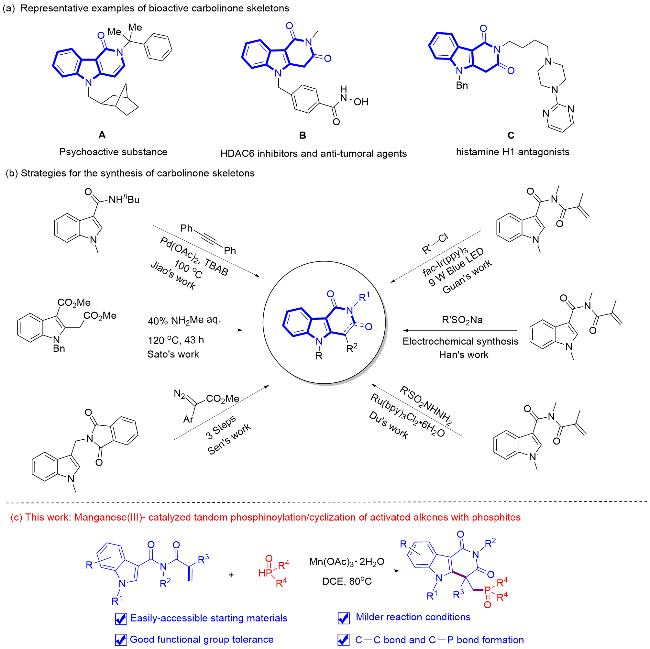
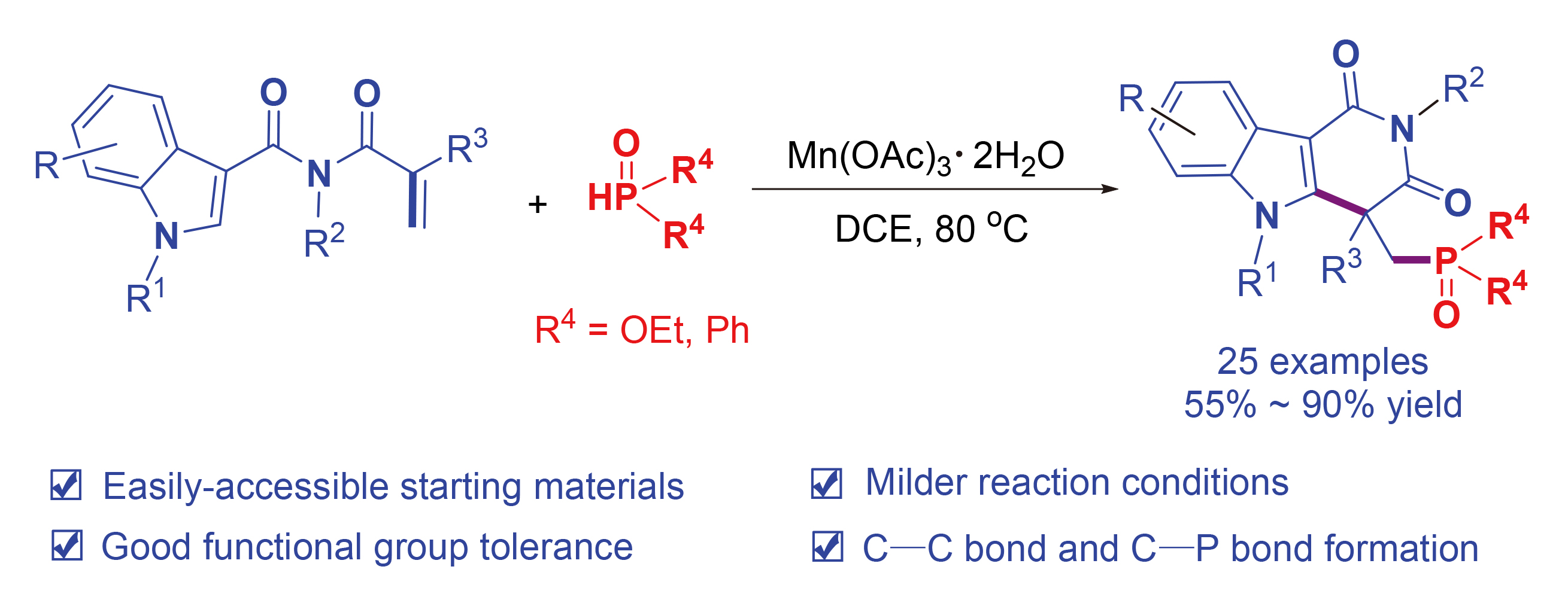
Organophosphorus compounds, especially those with heterocyclic structures, constitute important structural moieties prevalent in drugs, bioactive molecules, functional materials, and pesticides.[12] The incorporation of phosphorus substituents into organic molecules is capable of enhancing their biological and physical properties.[13] In this context, phosphites, which are usually commercially available, have been extensively utilized in the synthesis of organophosphorus compounds in the past few years.[14] However, to the best of our knowledge, there has been no report on the synthesis of phosphoryl-substituted γ-carbo- linone by employing phosphite as phosphoryl source. Encouraged by the significant progress in the radical functionalization of N-acryloyl-1H-indole-3-carboxamides, we envisioned that the phosphinyl radical might be produced under a metal oxidant and then trapped by C=C bond of N-acryloyl-1H-indole-3-carboxamide, affording a new and efficient strategy for assembling phosphoryl-substituted γ- carbolinone derivatives. In continuation of our efforts on the radical functionalization reactions,[15] we herein report an efficient manganese(III)-promoted tandem phosphinoylation/cyclization of N-acryloyl-1H-indole-3-carboxamides with phosphites to prepare phosphoryl-substituted γ-carbo- linone derivatives under mild conditions (Scheme 1, c).
2 Results and discussion
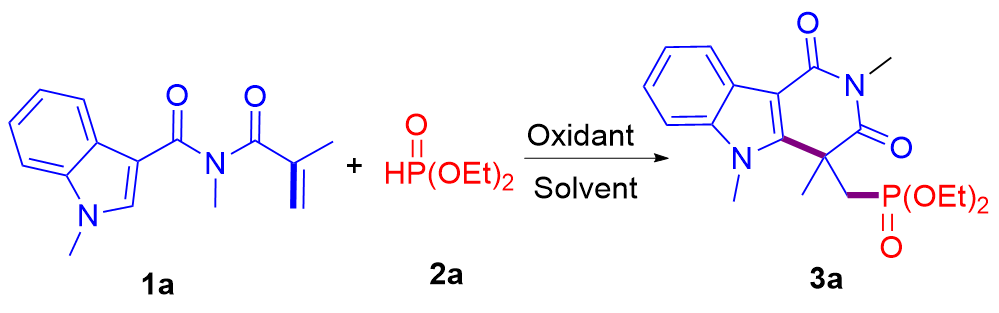
Initially, N-methacryloyl-N,1-dimethyl-1H-indole-3- carboxamide (1a) and diethyl phosphite (2a) were chosen as the model substrates to explore the optimal reaction condi- tions. To our delight, the reaction between 1a and 2a proceeded smoothly with CH3CN as solvent and Mn(OAc)3• 2H2O as radical initiator, delivering the target product 3a in 40% yield (Table 1, Entry 1). Other solvents, such as dimethyl sulfoxide (DMSO), 1,2-dichloroethane (DCE), N,N- dimethylformamide (DMF), and HOAc were tested, and the results showed that DCE was the best choice, affording 3a with yield of 74% (Table 1, Entries 2~5). Catalyst screening revealed that Mn(OAc)2, MnCl2 and Fe(OTf)3 were ineffective, while MnO2 and AgNO3 delivered product 3a in yields of 15% and 35%, respectively (Table 1, Entries 6~10). Further exploration showed that increasing the amount of 2a and initiator Mn(OAc)3•2H2O to 2.5 equiv. could improve the reaction efficiency, affording 3a in 77% yield (Table 1, Entry 11). Increasing the amount of Mn(OAc)3•2H2O to 3.0 equiv. has no positive effect on the reaction efficiency (Table 1, Entry 12). Reducing the reaction temperature to 60 ℃ gave inferior results, with only 50% yield of product 3a obtained (Table 1, Entry 13). Finally, adding 2.0 equiv. of K2CO3 as a weak base or conducting the reaction under an Ar atmosphere resulted in reduced efficiency, yielding 3a with a lower yield of 40% and 68%, respectively (Table 1, Entries 14, 15).
Table 1 Optimization of reaction conditionsa |
| Entry | Oxidant | Solvent | Yieldb/% |
|---|---|---|---|
| 1 | Mn(OAc)3•2H2O | CH3CN | 40 |
| 2 | Mn(OAc)3•2H2O | DMSO | 43 |
| 3 | Mn(OAc)3•2H2O | DCE | 74 |
| 4 | Mn(OAc)3•2H2O | DMF | 45 |
| 5 | Mn(OAc)3•2H2O | HOAc | 44 |
| 6 | Mn(OAc)2 | DCE | 0 |
| 7 | MnO2 | DCE | 15 |
| 8 | MnCl2 | DCE | 0 |
| 9 | AgNO3 | DCE | 35 |
| 10 | Fe(OTf)3 | DCE | Trace |
| 11c | Mn(OAc)3•2H2O | DCE | 77 |
| 12d | Mn(OAc)3•2H2O | DCE | 75 |
| 13e | Mn(OAc)3•2H2O | DCE | 50 |
| 14f | Mn(OAc)3•2H2O | DCE | 40 |
| 15g | Mn(OAc)3•2H2O | DCE | 68 |
a Reaction conditions: 1a (0.25 mmol), 2a (0.5 mmol, 2.0 equiv.), Mn(OAc)3• 2H2O (0.5 mmol, 2.0 equiv.) and solvent (2.0 mL) were stirred under 80 ℃ for 8 h. b Isolated yield. c 2a (2.5 equiv.) and Mn(OAc)3•2H2O (2.5 equiv.) were used. d Mn(OAc)3•2H2O (3.0 equiv.) was used. e Under 60 ℃. f K2CO3 (2.0 equiv.) was added. g Under Ar atmosphere. |
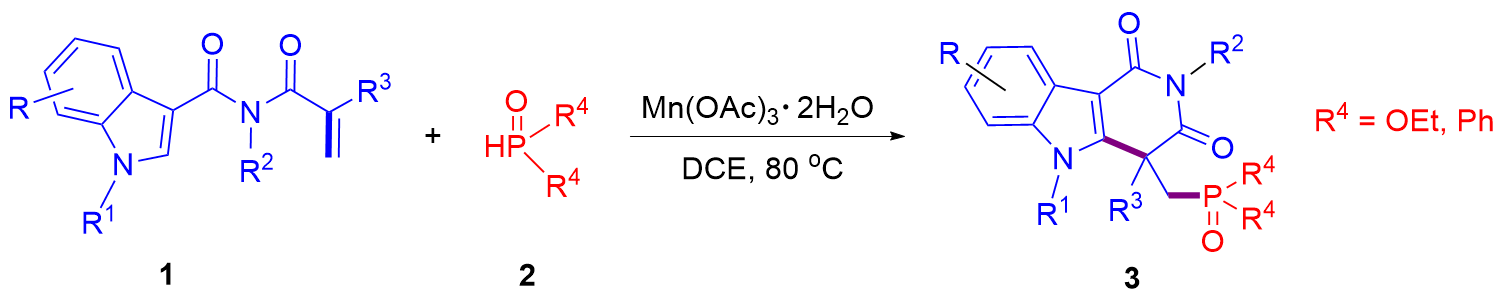
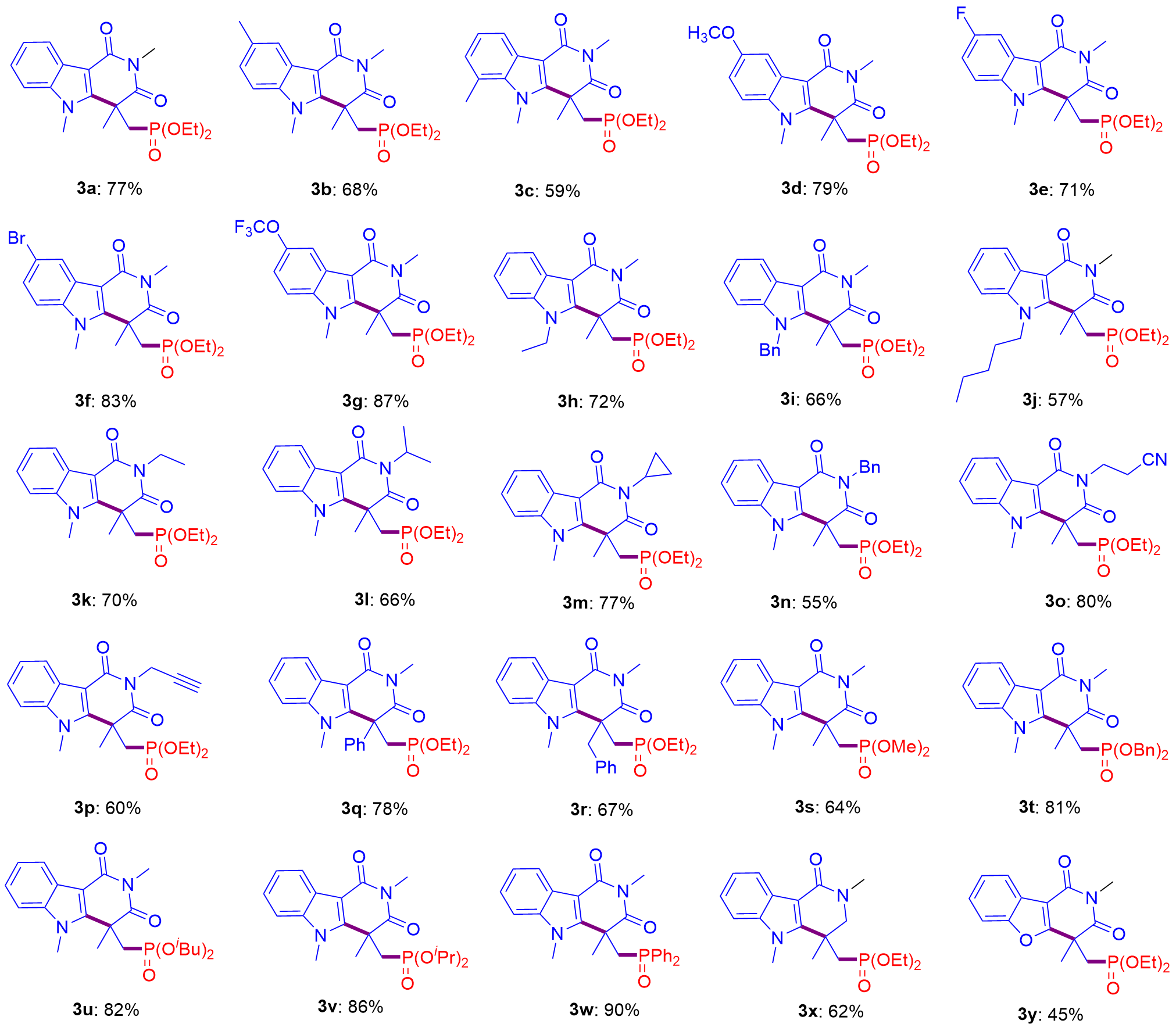
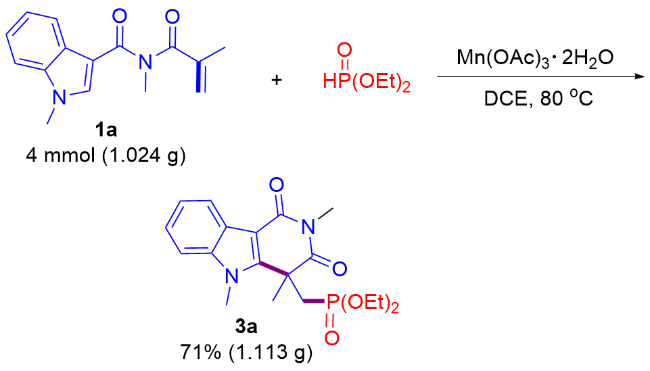
With the optimal conditions established, the scope of N- acryloyl-1H-indole-3-carboxamides with phosphites was next investigated, and the results are presented in Table 2. The N-acryloyl-1H-indole-3-carboxamide derivatives, substituted with both electron-donating (methyl, methoxy) and electron-withdrawing (fluoro, bromo, trifluoromethyl) groups on the indole ring, tolerated the conditions well, yielding the corresponding products 3b~3g in 59%~87% yields. Notably, substrates bearing halogen atoms provide potential sites for further modification via classical cross- coupling reactions. The indole ring bearing methyl, benzyl, and n-pentyl protecting groups on the nitrogen atom was compatible with the reaction conditions, furnishing the expected products 3h, 3i, and 3j in yields of 72%, 66%, and 57%, respectively. Moreover, this transformation was successfully applied to N-acryloyl-1H-indole-3-carboxamides with various R2 substituents, which were well-tolerated under the optimized reaction conditions, affording products 3k~3p in moderate to good yields. It is worth noting that the current phosphinoylation/cyclization protocol exhibits high regioselectivity with both cyclopropyl, alkynyl and cyano moieties remaining intact throughout the process, which enables further transformations. The cascade reaction was also not sensitive to steric-hinerance effect. The phenyl and benzyl substituents at the R3 position of N-acryloyl-1H- indole-3-carboxamide had no obvious effect on the reaction outcome, affording the desired products 3q and 3r in yields of 67%~78%. Next, the feasibility of various phosphites in this reaction system was investigated. It was found that different phosphites, such as dimethyl phosphite, dibenzyl phosphite, diisobutyl phosphite and diisopropyl phosphite, all successfully underwent this transformation, generating the desired products 3s~3v in satisfactory yields. In addition, diphylphosphine oxide was also amenable to the present reaction conditions to furnish the desired product 3w in 90% yield. Furthermore, the reaction could expand to an internal alkene and benzofuran derivative, affording the target products 3x and 3y in moderate yields. To verify the scalability of the present reaction, a 4.0 mmol-scale reaction of 1a with diethyl phosphite was performed, and the desired product 3a was obtained in 71% yield, suggesting that this reaction could be readily scalable (Scheme 2).
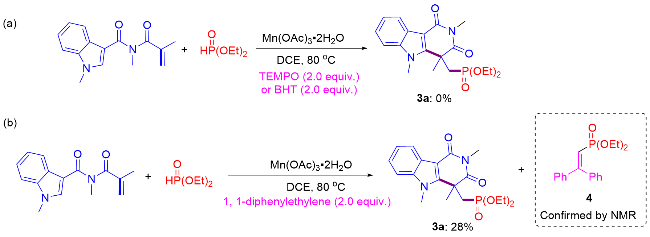
To investigate the mechanism of this phosphinoylation/ cyclization reaction, some control experiments were performed. The reaction was entirely inhibited when 2.0 equiv. of radical inhibitors 2,2,6,6-tetramethylpiperidine-1-oxyl (TEMPO) or butylated hydroxytoluene (BHT) were added (Scheme 3, a). In addition, when 1,1-diphenyl-ethylene, a radical scavenger, was added to the reaction mixture, the radical adducts 4 was confirmed by NMR, suggesting that a phosphinyl radical was involved in the reaction (Scheme 3, b).
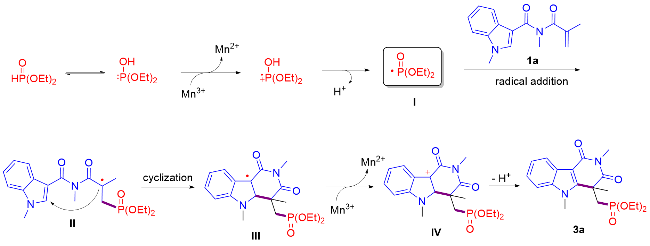
Based on the above control experiments and previous literatures,[9-11,14,16] a plausible mechanism is depicted in Scheme 4. First, phosphinyl radical I is generated via single-electron transfer with Mn(III) oxidant. Then phosphinyl radical I attacks the C=C bond of 1a to form radical intermediate II, which is followed by an intramolecular radical addition reaction to give intermediate III. Next, intermediate radical III was further oxidized to form cationic intermediate IV with the aid of Mn(III) oxidant. Finally, deprotonation of intermediate IV affords the phosphoryl-substituted γ-carbolinone product 3a.


3 Conclusions
In conclusion, we have developed a manganese(III)- promoted tandem phosphinoylation/cyclization of activated alkenes with phosphites to synthesize γ-carbolinone derivatives. The present method exhibits excellent compatibility with various N-acryloyl-1H-indole-3-carboxamides and phosphites, and is easy to scale up, providing various γ-carbolinone derivatives in moderate to good yields. Notably, cyclopropyl, alkynyl, and cyano moieties are retained in the final products, which enables further transformations. Further preparation of other useful heterocycles is currently underway in our laboratory.
4 Experimental section
4.1 General information
All reagents and solvents were purchased from commercial suppliers and used without purifications. Thin layer chromatography (TLC) was performed on silica gel plates (200~300 mesh) using UV light (254/365 nm) for detection and column chromatography was performed on silica gel (200~300 mesh). The 1H NMR, 13C NMR and 31P spectra were recorded at 25 ℃ in CDCl3 at 400, 101 and 162 MHz by using a Bruker Avance 400 spectrometer, respectively, with TMS as the internal standard. High resolution mass spectra (HRMS) were obtained on a TOF MS instrument with ESI source. Melting points were measured with an X-4B digital point apparatus.
4.2 General procedure for the synthesis of γ-carbo- linones
To a solution of N-acryloyl-1H-indole-3-carboxamides (0.25 mmol) in DCE (2 mL) were added phosphites (0.625 mmol, 2.5 equiv.) and Mn(OAc)3•2H2O (0.625 mmol, 2.5 equiv.). The resulting mixture was stirred in air under 80 ℃ for 8 h. After the reaction was complete, the reaction mixture was concentrated in vacuo. The residue was purified by flash column chromatography (petroleum ether/ethyl acetate, V∶V=1∶1) to afford the desired products 3a~3w.
Diethyl-((2,4,5-trimethyl-1,3-dioxo-2,3,4,5-tetrahydro-1H-pyrido[4,3-b]indol-4-yl)methyl)phosphonate (3a): Pale yellow oil. 1H NMR (400 MHz, CDCl3) δ: 8.31 (d, J=7.0 Hz, 1H), 7.47~7.29 (m, 3H), 3.92 (s, 3H), 3.72 (dddd, J=41.1, 32.8, 15.7, 7.0 Hz, 4H), 3.39 (s, 3H), 3.26~3.07 (m, 1H), 2.67 (t, J=16.2 Hz, 1H), 1.76 (s, 3H), 1.01 (t, J=7.0 Hz, 3H), 0.79 (t, J=7.1 Hz, 3H); 13C NMR (101 MHz, CDCl3) δ: 175.2, 162.1, 145.2, 138.6, 124.3, 123.8, 122.7, 121.5, 109.3, 103.5, 62.2 (d, JC-P=6.0 Hz), 61.4 (d, JC-P=7.0 Hz), 43.2, 35.1 (d, JC-P=141.0 Hz), 32.1, 28.6 (d, JC-P=19.0 Hz), 26.7, 16.1 (d, JC-P=6.0 Hz), 15.7 (d, JC-P=7.0 Hz); 31P NMR (162 MHz, CDCl3) δ: 24.01; HRMS (ESI) calcd for C19H26N2O5P [M+H]+ 393.1579, found 393.1587.
Diethyl-((2,4,5,8-tetramethyl-1,3-dioxo-2,3,4,5-tetrahy-dro-1H-pyrido[4,3-b]indol-4-yl)methyl)phosphonate (3b): Pale yellow oil. 1H NMR (400 MHz, CDCl3) δ: 8.10 (s, 1H), 7.30~7.22 (m, 1H), 7.16 (dd, J=8.4, 1.7 Hz, 1H), 3.88 (s, 3H), 3.85~3.59 (m, 4H), 3.38 (s, 3H), 3.24~3.08 (m, 1H), 2.65 (d, J=32.5 Hz, 1H), 2.48 (s, 3H), 1.74 (s, 3H), 1.01 (t, J=7.1 Hz, 3H), 0.82 (t, J=7.1 Hz, 3H); 13C NMR (101 MHz, CDCl3) δ: 175.3, 162.1, 145.0, 137.0, 132.3, 125.3, 124.5, 121.2, 108.9, 103.0, 62.2 (d, JC-P=7.0 Hz), 61.4 (d, JC-P=7.0 Hz), 43.2 (d, JC-P=4.0 Hz), 35.1 (d, JC-P=141.0 Hz), 32.0, 28.6 (d, JC-P=19.0 Hz), 26.7, 21.4, 16.1 (d, JC-P=6.0 Hz), 15.8 (d, JC-P=7.0 Hz); 31P NMR (162 MHz, CDCl3) δ: 24.02; HRMS (ESI) calcd for C20H28N2O5P [M+H]+ 407.1736, found 407.1744.
Diethyl-((2,4,5,6-tetramethyl-1,3-dioxo-2,3,4,5-tetrahy-dro-1H-pyrido[4,3-b]indol-4-yl)methyl)phosphonate (3c): Pale yellow oil. 1H NMR (400 MHz, CDCl3) δ: 8.21 (d, J=7.0 Hz, 1H), 7.16 (t, J=7.6 Hz, 1H), 7.03 (d, J=7.2 Hz, 1H), 4.17 (s, 3H), 3.89~3.61 (m, 4H), 3.38 (s, 3H), 3.26~3.12 (m, 1H), 2.81 (s, 3H), 2.73~2.62 (m, 1H), 1.76 (d, J=3.3 Hz, 3H), 1.04 (t, J=7.1 Hz, 3H), 0.86 (t, J=7.1 Hz, 3H); 13C NMR (101 MHz, CDCl3) δ: 175.4, 161.9, 145.9, 137.3, 127.3, 125.4, 122.7, 121.1, 119.7, 103.4, 62.2 (d, JC-P=7.0 Hz), 61.4 (d, JC-P=7.0 Hz), 43.4 (d, JC-P=4.0 Hz), 35.4, 35.1 (d, JC-P=141.0 Hz), 28.5 (d, JC-P=19.0 Hz), 26.7, 20.8, 16.1 (d, JC-P=6.0 Hz), 15.7 (d, JC-P=7.0 Hz); 31P NMR (162 MHz, CDCl3) δ: 24.10; HRMS (ESI) calcd for C20H28N2O5P [M+H]+ 407.1736, found 407.1730.
Diethyl-((8-methoxy-2,4,5-trimethyl-1,3-dioxo-2,3,4,5-tetrahydro-1H-pyrido[4,3-b]indol-4-yl)methyl)phosphonate (3d): Pale yellow solid. m.p. 103~104 ℃; 1H NMR (400 MHz, CDCl3) δ: 7.70 (d, J=2.6 Hz, 1H), 7.27~7.14 (m, 1H), 6.89 (dd, J=8.9, 2.6 Hz, 1H), 3.82 (s, 3H), 3.80 (s, 3H), 3.77~3.52 (m, 4H), 3.31 (s, 3H), 3.14~3.00 (m, 1H), 2.64~2.50 (m, 1H), 1.67 (d, J=3.4 Hz, 3H), 0.93 (t, J=7.1 Hz, 3H), 0.76 (t, J=7.1 Hz, 3H); 13C NMR (101 MHz, CDCl3) δ: 174.2, 161.2, 155.3, 144.0, 132.5, 124.0, 113.1, 109.2, 102.1, 101.6, 61.2 (d, JC-P=6.0 Hz), 60.4 (d, JC-P=6.0 Hz), 54.8, 42.3 (d, JC-P=5.0 Hz), 34.0 (d, JC-P=142.0 Hz), 31.1, 27.5 (d, JC-P=19.0 Hz), 25.6, 15.1 (d, JC-P=6.0 Hz), 14.8 (d, JC-P=7.0 Hz); 31P NMR (162 MHz, CDCl3) δ: 24.03; HRMS (ESI) calcd for C20H28N2O6P [M+H]+ 423.1685, found 423.1678.
Diethyl-((8-fluoro-2,4,5-trimethyl-1,3-dioxo-2,3,4,5-tetrahydro-1H-pyrido[4,3-b]indol-4-yl)methyl)phosphonate (3e): Pale yellow oil. 1H NMR (400 MHz, CDCl3) δ: 7.89 (dd, J=9.1, 2.6 Hz, 1H), 7.26~7.19 (m, 1H), 7.01 (td, J=9.0, 2.6 Hz, 1H), 3.83 (s, 3H), 3.81~3.53 (m, 4H), 3.31 (s, 3H), 3.15~3.03 (m, 1H), 2.65~2.51 (m, 1H), 1.69 (d, J=3.4 Hz, 3H), 0.95 (t, J=7.1 Hz, 3H), 0.75 (t, J=7.1 Hz, 3H); 13C NMR (101 MHz, CDCl3) δ: 175.1, 161.8, 159.6 (d, JC-F=237.0 Hz), 146.3, 135.1, 125.0 (d, JC-F=12.0 Hz), 112.1 (d, JC-F=26.0 Hz), 110.2 (d, JC-F=10.0 Hz), 106.9 (d, JC-F=25.0 Hz), 103.6 (d, JC-F=4.0 Hz), 62.3 (d, JC-P=6.0 Hz), 61.5 (d, JC-P=7.0 Hz), 43.3 (d, JC-P=5.0 Hz), 35.0 (d, JC-P=141.0 Hz), 32.3, 28.5 (d, JC-P=18.0 Hz), 26.7, 16.1 (d, JC-P=6.0 Hz), 15.8 (d, JC-P=6.0 Hz); 31P NMR (162 MHz, CDCl3) δ: 23.88; HRMS (ESI) calcd for C19H25F- N2O5P [M+H]+ 411.1485, found 411.1493.
Diethyl-((8-bromo-2,4,5-trimethyl-1,3-dioxo-2,3,4,5-tetra-hydro-1H-pyrido[4,3-b]indol-4-yl)methyl)phosphonate (3f): Pale yellow oil. 1H NMR (400 MHz, CDCl3) δ: 8.43 (d, J=1.9 Hz, 1H), 7.41 (dd, J=8.7, 2.0 Hz, 1H), 7.24 (d, J=8.7 Hz, 1H), 3.90 (s, 3H), 3.87~3.60 (m, 4H), 3.37 (s, 3H), 3.22~3.09 (m, 1H), 2.64 (t, J=16.2 Hz, 1H), 1.77 (d, J=3.4 Hz, 3H), 1.02 (t, J=7.1 Hz, 3H), 0.86 (t, J=7.1 Hz, 3H); 13C NMR (101 MHz, CDCl3) δ: 175.0, 161.7, 146.0, 137.3, 126.7, 125.8, 124.0, 116.1, 110.8, 103.1, 62.2 (d, JC-P=6.0 Hz), 61.5 (d, JC-P=7.0 Hz), 43.3 (d, JC-P=5.0 Hz), 35.0 (d, JC-P=141.0 Hz), 32.2, 28.4 (d, JC-P=18.0 Hz), 26.7, 16.1 (d, JC-P=6.0 Hz), 15.8 (d, JC-P=7.0 Hz); 31P NMR (162 MHz, CDCl3) δ: 23.77; HRMS (ESI) calcd for C19H25BrN2O5P [M+H]+ 471.0684, found 471.0690.
Eiethyl-((2,4,5-trimethyl-1,3-dioxo-8-(trifluoromethoxy)-2,3,4,5-tetrahydro-1H-pyrido[4,3-b]indol-4-yl)methyl)-phosphonate (3g): Pale yellow oil. 1H NMR (400 MHz, CDCl3) δ: 8.09 (s, 1H), 7.29 (d, J=8.9 Hz, 1H), 7.13 (d, J=11.3 Hz, 1H), 3.86 (s, 3H), 3.79~3.55 (m, 4H), 3.30 (s, 3H), 3.17~2.95 (m, 1H), 2.59 (t, J=16.2 Hz, 1H), 1.69 (d, J=3.4 Hz, 3H), 0.94 (t, J=7.1 Hz, 3H), 0.76 (t, J=7.1 Hz, 3H); 13C NMR (101 MHz, CDCl3) δ: 174.0, 160.7, 145.7 (d, JC-F=3.0 Hz), 144.1, 135.9, 123.7, 119.7 (q, JC-F=255.0 Hz), 116.7, 112.9, 109.3, 102.8, 61.3 (d, JC-P=6.0 Hz), 60.5 (d, JC-P=6.0 Hz), 42.4 (d, JC-P=4.0 Hz), 33.9 (d, JC-P=141.0 Hz), 31.3, 27.4 (d, JC-P=19.0 Hz), 25.7, 15.0 (d, JC-P=6.0 Hz), 14.7 (d, JC-P=6.0 Hz); 31P NMR (162 MHz, CDCl3) δ: 23.81; HRMS (ESI) calcd for C20H25F3N2O6P [M+H]+ 477.1402, found 477.1409.
Diethyl-((5-ethyl-2,4-dimethyl-1,3-dioxo-2,3,4,5-tetrahydro-1H-pyrido[4,3-b]indol-4-yl)methyl)phosphonate (3h): Pale yellow oil. 1H NMR (400 MHz, CDCl3) δ: 8.29~8.20 (m, 1H), 7.37~7.19 (m, 3H), 4.34~4.20 (m, 2H), 3.79~3.53 (m, 4H), 3.31 (s, 3H), 3.09~2.95 (m, 1H), 2.63~2.49 (m, 1H), 1.73 (d, J=3.4 Hz, 3H), 1.49 (t, J=7.2 Hz, 3H), 0.89 (t, J=7.1 Hz, 3H), 0.70 (t, J=7.1 Hz, 3H); 13C NMR (101 MHz, CDCl3) δ: 174.2, 161.1, 143.6, 136.4, 123.8, 122.7, 121.6, 120.6, 108.9, 102.4, 61.2 (d, JC-P=7.0 Hz), 60.4 (d, JC-P=7.0 Hz), 42.3 (d, JC-P=4.0 Hz), 39.6, 35.0 (d, JC-P=141.0 Hz), 27.9 (d, JC-P=18.0 Hz), 25.7, 15.0 (d, JC-P=6.0 Hz), 14.7 (d, JC-P=7.0 Hz), 13.6; 31P NMR (162 MHz, CDCl3) δ: 23.80; HRMS (ESI) calcd for C20H28N2O5P [M+H]+ 407.1736, found 407.1742.
Diethyl-((5-benzyl-2,4-dimethyl-1,3-dioxo-2,3,4,5-tetrahydro-1H-pyrido[4,3-b]indol-4-yl)methyl)phosphonate (3i): Pale yellow oil. 1H NMR (400 MHz, CDCl3) δ: 8.36 (d, J=8.8 Hz, 1H), 7.33~7.19 (m, 5H), 7.11 (d, J=8.3 Hz, 1H), 6.99 (d, J=6.0 Hz, 2H), 5.57 (s, 2H), 3.90~3.62 (m, 4H), 3.40 (s, 3H), 3.20~3.07 (m, 1H), 2.70 (t, J=16.2 Hz, 1H), 1.57 (d, J=3.4 Hz, 3H), 1.02 (t, J=7.1 Hz, 3H), 0.84 (t, J=7.1 Hz, 3H); 13C NMR (101 MHz, CDCl3) δ: 175.3, 162.1, 145.2, 138.4, 135.7, 129.1, 127.9, 125.7, 124.5, 124.1, 122.9, 121.5, 110.6, 104.2, 62.2 (d, JC-P=6.0 Hz), 61.5 (d, JC-P=7.0 Hz), 49.1, 43.5 (d, JC-P=5.0 Hz), 35.6 (d, JC-P=141.0 Hz), 29.2 (d, JC-P=18.0 Hz), 26.8, 16.1 (d, JC-P=6.0 Hz), 15.8 (d, JC-P=7.0 Hz); 31P NMR (162 MHz, CDCl3) δ: 23.89; HRMS (ESI) calcd for C25H30N2O5P [M+H]+ 469.1892, found 469.1886.
Diethyl-((2,4-dimethyl-1,3-dioxo-5-pentyl-2,3,4,5-tetrahydro-1H-pyrido[4,3-b]indol-4-yl)methyl)phosphonate (3j): Pale yellow oil. 1H NMR (400 MHz, CDCl3) δ: 8.25 (s, 1H), 7.32 (d, J=42.1 Hz, 3H), 4.27~4.04 (m, 2H), 3.81~3.51 (m, 4H), 3.31 (s, 3H), 3.16~2.94 (m, 1H), 2.67~2.48 (m, 1H), 1.73 (s, 3H), 1.53~1.15 (m, 6H), 1.06~0.85 (m, 6H), 0.71 (d, J=7.4 Hz, 3H); 13C NMR (101 MHz, CDCl3) δ: 174.3, 161.1, 143.5, 136.7, 123.7, 122.7, 121.6, 120.6, 109.0, 102.4, 61.1 (d, JC-P=6.0 Hz), 60.3 (d, JC-P=7.0 Hz), 45.2, 42.3, 35.0 (d, JC-P=141.0 Hz), 28.3, 28.0, 27.9 (d, JC-P=18.0 Hz), 25.7, 21.3, 15.0 (d, JC-P=6.0 Hz), 14.7 (d, JC-P=7.0 Hz), 13.0; 31P NMR (162 MHz, CDCl3) δ: 23.79; HRMS (ESI) calcd for C23H34N2O5P [M+H]+ 449.2205, found 449.2196.
Diethyl-((2-ethyl-4,5-dimethyl-1,3-dioxo-2,3,4,5-tetrahydro-1H-pyrido[4,3-b]indol-4-yl)methyl)phosphonate (3k): Pale yellow oil. 1H NMR (400 MHz, CDCl3) δ: 8.37~8.24 (m, 1H), 7.42~7.26 (m, 3H), 4.07 (qd, J=12.9, 5.7 Hz, 2H), 3.92 (s, 3H), 3.88~3.61 (m, 4H), 3.26~3.12 (m, 1H), 2.67 (t, J=16.3 Hz, 1H), 1.74 (d, J=3.4 Hz, 3H), 1.27 (t, J=7.0 Hz, 3H), 1.00 (t, J=7.1 Hz, 3H), 0.84 (t, J=7.1 Hz, 3H); 13C NMR (101 MHz, CDCl3) δ: 174.7, 161.7, 145.1, 138.6, 124.4, 123.8, 122.7, 121.4, 109.3, 103.6, 62.1 (d, JC-P=7.0 Hz), 61.5 (d, JC-P=7.0 Hz), 43.2 (d, JC-P=5.0 Hz), 35.1, 34.8 (d, JC-P=142.0 Hz), 32.0, 28.7 (d, JC-P=19.0 Hz), 16.1 (d, JC-P=6.0 Hz), 15.8 (d, JC-P=7.0 Hz), 13.2; 31P NMR (162 MHz, CDCl3) δ: 24.21; HRMS (ESI) calcd for C20H28N2O5P [M+H]+ 407.1736, found 407.1747.
Diethyl-((2-isopropyl-4,5-dimethyl-1,3-dioxo-2,3,4,5-tetrahydro-1H-pyrido[4,3-b]indol-4-yl)methyl)phosphonate (3l): Pale yellow oil. 1H NMR (400 MHz, CDCl3) δ: 8.30 (dd, J=6.6, 2.1 Hz, 1H), 7.38~7.27 (m, 3H), 5.24 (p, J=6.9 Hz, 1H), 3.90 (s, 3H), 3.87~3.62 (m, 4H), 3.24~3.14 (m, 1H), 2.71~2.58 (m, 1H), 1.71 (s, 3H), 1.52 (dd, J=10.8, 7.0 Hz, 6H), 0.99 (t, J=7.1 Hz, 3H), 0.89 (t, J=7.1 Hz, 3H); 13C NMR (101 MHz, CDCl3) δ: 175.0, 162.4, 144.9, 138.6, 124.5, 123.7, 122.6, 121.4, 109.3, 103.9, 62.0 (d, JC-P=7.0 Hz), 61.6 (d, JC-P=6.0 Hz), 44.6, 43.6 (d, JC-P=4.0 Hz), 34.6 (d, JC-P=141.0 Hz), 32.0, 28.8 (d, JC-P=19.0 Hz), 19.8, 19.6, 16.1 (d, JC-P=6.0 Hz), 15.9 (d, JC-P=6.0 Hz); 31P NMR (162 MHz, CDCl3) δ: 24.52; HRMS (ESI) calcd for C21H30N2O5P [M+H]+ 421.1892, found 421.1897.
Diethyl-((2-cyclopropyl-4,5-dimethyl-1,3-dioxo-2,3,4,5-tetrahydro-1H-pyrido[4,3-b]indol-4-yl)methyl)phosphonate (3m): Pale yellow oil. 1H NMR (400 MHz, CDCl3) δ: 8.30 (d, J=7.4 Hz, 1H), 7.33 (dt, J=20.8, 7.6 Hz, 3H), 3.90 (s, 3H), 3.85~3.57 (m, 4H), 3.26~3.06 (m, 1H), 2.78~2.49 (m, 2H), 1.71 (s, 3H), 1.16 (d, J=7.9 Hz, 2H), 0.92 (dt, J=28.6, 7.1 Hz, 6H), 0.71 (t, J=11.4 Hz, 2H); 13C NMR (101 MHz, CDCl3) δ: 176.3, 162.7, 144.9, 138.6, 124.4, 123.8, 122.7, 121.5, 109.3, 104.0, 62.0 (d, JC-P=7.0 Hz), 61.5 (d, JC-P=6.0 Hz), 43.6 (d, JC-P=5.0 Hz), 34.7 (d, JC-P=140.0 Hz), 32.0, 28.3 (d, JC-P=18.0 Hz), 24.0, 16.0 (d, JC-P=6.0 Hz), 15.8 (d, JC-P=6.0 Hz), 8.5, 8.3; 31P NMR (162 MHz, CDCl3) δ: 24.25; HRMS (ESI) calcd for C21H28N2O5P [M+H]+ 419.1736, found 419.1743.
Diethyl-((2-benzyl-4,5-dimethyl-1,3-dioxo-2,3,4,5-tetrahydro-1H-pyrido[4,3-b]indol-4-yl)methyl)phosphonate (3n): Pale yellow oil. 1H NMR (400 MHz, CDCl3) δ: 8.31 (dd, J=6.3, 2.1 Hz, 1H), 7.48 (d, J=7.9 Hz, 2H), 7.38~7.28 (m, 5H), 7.22 (d, J=7.3 Hz, 1H), 5.30~5.11 (m, 2H), 3.90 (s, 3H), 3.86~3.48 (m, 4H), 3.25~3.13 (m, 1H), 2.67 (t, J=16.2 Hz, 1H), 1.70 (d, J=3.3 Hz, 3H), 1.00 (t, J=7.1 Hz, 3H), 0.73 (t, J=7.1 Hz, 3H); 13C NMR (101 MHz, CDCl3) δ: 161.8, 145.2, 138.7, 137.8, 128.7, 128.3, 127.2, 124.4, 123.8, 122.7, 121.5, 109.3, 103.5, 62.2 (d, JC-P=6.0 Hz), 61.4 (d, JC-P=6.0 Hz), 43.5 (d, JC-P=4.0 Hz), 43.2, 34.8 (d, JC-P=141.0 Hz), 32.1, 28.8 (d, JC-P=19.0 Hz), 16.1 (d, JC-P=6.0 Hz), 15.7 (d, JC-P=6.0 Hz); 31P NMR (162 MHz, CDCl3) δ: 23.99; HRMS (ESI) calcd for C25H30N2O5P [M+H]+ 469.1892, found 469.1898.
Eiethyl-((2-(2-cyanoethyl)-4,5-dimethyl-1,3-dioxo-2,3,4,5-tetrahydro-1H-pyrido[4,3-b]indol-4-yl)methyl)phosphonate (3o): Pale yellow oil. 1H NMR (400 MHz, CDCl3) δ: 8.29~8.24 (m, 1H), 7.43~7.28 (m, 3H), 4.46~4.21 (m, 2H), 3.92 (s, 3H), 3.89~3.35 (m, 4H), 3.16~3.04 (m, 1H), 2.86~2.77 (m, 2H), 2.74~2.63 (m, 1H), 1.80 (s, 3H), 1.06 (t, J=7.1 Hz, 3H), 0.74 (t, J=7.1 Hz, 3H); 13C NMR (101 MHz, CDCl3) δ: 175.0, 161.1, 145.2, 138.7, 124.2, 124.1, 123.0, 121.4, 117.8, 109.4, 103.2, 61.9 (d, JC-P=7.0 Hz), 61.7 (d, JC-P=6.0 Hz), 43.3 (d, JC-P=4.0 Hz), 35.2, 35.2 (d, JC-P=141.0 Hz), 32.1, 28.2 (d, JC-P=18.0 Hz), 16.1 (d, JC-P=6.0 Hz), 16.0, 15.8 (d, JC-P=6.0 Hz); 31P NMR (162 MHz, CDCl3) δ: 24.34; HRMS (ESI) calcd for C21H27N3O5P [M+H]+ 432.1688, found 432.1695.
Diethyl-((4,5-dimethyl-1,3-dioxo-2-(prop-2-yn-1-yl)-2,3,4,5-tetrahydro-1H-pyrido[4,3-b]indol-4-yl)methyl)phosphonate (3p): Pale yellow oil. 1H NMR (400 MHz, CDCl3) δ: 8.24 (t, J=10.6 Hz, 1H), 7.83~7.14 (m, 3H), 5.00~4.53 (m, 2H), 4.36~3.48 (m, 7H), 3.12 (t, J=15.6 Hz, 1H), 2.85~2.51 (m, 1H), 2.10 (s, 1H), 1.70 (s, 3H), 1.36~0.67 (m, 6H); 13C NMR (101 MHz, CDCl3) δ: 174.4, 160.7, 145.3, 138.7, 124.3, 124.0, 122.9, 121.5, 109.4, 103.3, 79.0, 70.2, 62.3 (d, JC-P=7.0 Hz), 61.5 (d, JC-P=7.0 Hz), 43.6 (d, JC-P=5.0 Hz), 34.8 (d, JC-P=141.0 Hz), 32.1, 29.2, 28.6 (d, JC-P=19.0 Hz), 16.1 (d, JC-P=6.0 Hz), 15.8 (d, JC-P=7.0 Hz); 31P NMR (162 MHz, CDCl3) δ: 23.83; HRMS (ESI) calcd for C21H26N2O5P [M+H]+ 417.1579, found 417.1573.
Diethyl-((2,5-dimethyl-1,3-dioxo-4-phenyl-2,3,4,5-tetrahydro-1H-pyrido[4,3-b]indol-4-yl)methyl)phosphonate (3q): Pale yellow oil. 1H NMR (400 MHz, CDCl3) δ: 8.41~8.34 (m, 1H), 7.41~7.29 (m, 6H), 7.20~7.13 (m, 2H), 3.92~ 3.62 (m, 5H), 3.38 (s, 3H), 3.32 (s, 3H), 2.93 (dd, J=17.7, 15.1 Hz, 1H), 0.99 (t, J=7.1 Hz, 3H), 0.85 (t, J=7.1 Hz, 3H); 13C NMR (101 MHz, CDCl3) δ: 173.1, 162.2, 144.2, 139.1, 138.9, 138.5, 129.4, 128.6, 126.4, 126.3, 124.3, 123.9, 122.8, 121.6, 109.5, 105.5, 62.4 (d, JC-P=6.0 Hz), 61.6 (d, JC-P=6.0 Hz), 49.9 (d, JC-P=3.0 Hz), 33.7 (d, JC-P=142.0 Hz), 31.3, 26.9, 16.0 (d, JC-P=6.0 Hz), 15.8 (d, JC-P=7.0 Hz); 31P NMR (162 MHz, CDCl3) δ: 24.35; HRMS (ESI) calcd for C24H28N2O5P [M+H]+ 455.1736, found 455.1745.
Diethyl-((4-benzyl-2,5-dimethyl-1,3-dioxo-2,3,4,5-tetrahydro-1H-pyrido[4,3-b]indol-4-yl)methyl)phosphonate (3r): Pale yellow oil. 1H NMR (400 MHz, CDCl3) δ: 8.16 (dt, J=7.8, 1.0 Hz, 1H), 7.47~7.24 (m, 3H), 7.01 (dt, J=37.4, 7.2 Hz, 3H), 6.52 (d, J=7.0 Hz, 2H), 4.03 (s, 3H), 3.90~3.57 (m, 4H), 3.45~3.27 (m, 3H), 3.13 (s, 3H), 2.90~2.76 (m, 1H), 1.02 (t, J=7.1 Hz, 3H), 0.78 (t, J=7.1 Hz, 3H); 13C NMR (101 MHz, CDCl3) δ: 173.9, 161.6, 142.5, 138.6, 133.6, 128.9, 128.1, 127.7, 124.1, 123.8, 122.6, 121.5, 109.3, 106.1, 62.3 (d, JC-P=6.0 Hz), 61.4 (d, JC-P=7.0 Hz), 49.6 (d, JC-P=4.0 Hz), 47.8 (d, JC-P=19.0 Hz), 34.3 (d, JC-P=141.0 Hz), 32.4, 26.2, 16.1 (d, JC-P=6.0 Hz), 15.7 (d, JC-P=7.0 Hz); 31P NMR (162 MHz, CDCl3) δ: 23.90; HRMS (ESI) calcd for C25H30N2O5P [M+H]+ 469.1892, found 469.1899.
Dimethyl-((2,4,5-trimethyl-1,3-dioxo-2,3,4,5-tetrahydro-1H-pyrido[4,3-b]indol-4-yl)methyl)phosphonate (3s): Pale yellow solid. m.p. 149~150 ℃; 1H NMR (400 MHz, CDCl3) δ: 8.23 (dd, J=6.6, 1.8 Hz, 1H), 7.34~7.20 (m, 3H), 3.84 (s, 3H), 3.33 (s, 3H), 3.25 (dd, J=15.0, 11.0 Hz, 6H), 3.18~3.06 (m, 1H), 2.60 (t, J=16.3 Hz, 1H), 1.68 (d, J=3.5 Hz, 3H); 13C NMR (101 MHz, CDCl3) δ: 175.3, 162.0, 144.9, 138.7, 124.3, 123.9, 122.8, 121.5, 109.3, 103.5, 52.9 (d, JC-P=7.0 Hz), 52.3 (d, JC-P=7.0 Hz), 43.2 (d, JC-P=5.0 Hz), 34.5 (d, JC-P=142.0 Hz), 32.0, 28.4 (d, JC-P=18.0 Hz), 26.7; 31P NMR (162 MHz, CDCl3) δ: 26.57; HRMS (ESI) calcd for C17H22N2O5P [M+H]+ 365.1266, found 365.1260.
Dibenzyl-((2,4,5-trimethyl-1,3-dioxo-2,3,4,5-tetrahydro-1H-pyrido[4,3-b]indol-4-yl)methyl)phosphonate (3t): Pale yellow oil. 1H NMR (400 MHz, CDCl3) δ: 8.33 (dd, J=6.6, 2.3 Hz, 1H), 7.36~7.29 (m, 2H), 7.19 (dt, J=23.5, 6.5 Hz, 7H), 6.99 (d, J=9.5 Hz, 2H), 6.89 (d, J=7.0 Hz, 2H), 4.73~4.62 (m, 2H), 4.53~4.43 (m, 2H), 3.70 (s, 3H), 3.33~3.19 (m, 1H), 3.13 (s, 3H), 2.67 (t, J=16.2 Hz, 1H), 1.68 (d, J=3.5 Hz, 3H); 13C NMR (101 MHz, CDCl3) δ: 175.1, 161.8, 144.8, 138.6, 135.5, 135.4, 135.2, 135.1, 128.5, 128.5, 128.4, 128.1, 127.9, 124.3, 123.7, 122.6, 121.4, 109.6, 103.5, 67.6 (d, JC-P=6.0 Hz), 67.3 (d, JC-P=7.0 Hz), 43.2 (d, JC-P=4.0 Hz), 35.2 (d, JC-P=141.0 Hz), 31.9, 28.7 (d, JC-P=21.0 Hz), 26.5; 31P NMR (162 MHz, CDCl3) δ: 25.21; HRMS (ESI) calcd for C29H30N2O5P [M+H]+ 517.1892, found 517.1899.
Diisobutyl-((2,4,5-trimethyl-1,3-dioxo-2,3,4,5-tetrahydro-1H-pyrido[4,3-b]indol-4-yl)methyl)phosphonate (3u): Pale yellow oil. 1H NMR (400 MHz, CDCl3) δ: 8.29 (dd, J=6.9, 2.0 Hz, 1H), 7.40~7.28 (m, 3H), 3.93 (s, 3H), 3.58~3.40 (m, 4H), 3.39 (s, 3H), 3.21~3.13 (m, 1H), 2.77~2.62 (m, 1H), 1.76 (d, J=3.5 Hz, 3H), 1.48 (ddd, J=25.2, 13.4, 6.7 Hz, 2H), 0.73~0.61 (m, 12H); 13C NMR (101 MHz, CDCl3) δ: 175.2, 162.0, 145.1, 138.7, 124.4, 123.8, 122.7, 121.4, 109.3, 103.5, 72.1 (d, JC-P=6.0 Hz), 71.7 (d, JC-P=7.0 Hz), 43.2 (d, JC-P=5.0 Hz), 34.9 (d, JC-P=141.0 Hz), 32.1, 29.0 (d, JC-P=6.0 Hz), 28.9 (d, JC-P=6.0 Hz), 28.5 (d, JC-P=18.0 Hz), 26.8, 18.6, 18.4, 18.4, 18.4; 31P NMR (162 MHz, CDCl3) δ: 24.18; HRMS (ESI) calcd for C23H34N2O5P [M+H]+ 449.2205, found 449.2213.
Diisopropyl-((2,4,5-trimethyl-1,3-dioxo-2,3,4,5-tetrahydro-1H-pyrido[4,3-b]indol-4-yl)methyl)phosphonate (3v): Pale yellow oil. 1H NMR (400 MHz, CDCl3) δ: 8.30 (dd, J=6.6, 1.7 Hz, 1H), 7.40~7.27 (m, 3H), 4.52~4.24 (m, 2H), 3.91 (s, 3H), 3.39 (s, 3H), 3.14~3.00 (m, 1H), 2.73~2.56 (m, 1H), 1.75 (d, J=3.4 Hz, 3H), 1.09 (d, J=6.1 Hz, 3H), 1.01 (d, J=6.1 Hz, 3H), 0.85 (dd, J=6.2, 3.7 Hz, 6H); 13C NMR (101 MHz, CDCl3) δ: 175.2, 162.1, 145.3, 138.6, 124.4, 123.7, 122.6, 121.4, 109.3, 103.6, 70.8 (d, JC-P=7.0 Hz), 70.2 (d, JC-P=6.0 Hz), 43.3 (d, JC-P=5.0 Hz), 36.3 (d, JC-P=142.0 Hz), 32.1, 28.6 (d, JC-P=18.0 Hz), 26.7, 23.8 (d, JC-P=4.0 Hz), 23.7 (d, JC-P=5.0 Hz), 23.4 (t, JC-P=5.0 Hz); 31P NMR (162 MHz, CDCl3) δ: 22.05; HRMS (ESI) calcd for C21H30N2O5P [M+H]+ 421.1892, found 421.1886.
4-((Diphenylphosphoryl)methyl)-2,4,5-trimethyl-4,5-dihydro-1H-pyrido[4,3-b]indole-1,3(2H)-dione (3w): Colorless oil. 1H NMR (400 MHz, CDCl3) δ: 8.32~8.24 (m, 1H), 7.49~7.38 (m, 5H), 7.30 (qd, J=9.0, 8.2, 4.9 Hz, 5H), 7.12 (td, J=7.7, 2.8 Hz, 3H), 3.89~3.77 (m, 1H), 3.67 (s, 3H), 3.11 (s, 3H), 3.09~3.01 (m, 1H), 1.77 (d, J=2.3 Hz, 3H); 13C NMR (101 MHz, CDCl3) δ: 175.35, 161.69, 144.17, 138.41, 132.44, 132.12, 131.92, 131.53, 131.07, 130.97, 130.36, 130.26, 128.40, 128.28, 128.23, 128.11, 124.25, 123.62, 122.58, 121.35, 109.57, 104.03, 43.17 (d, JC-P=4.0 Hz), 39.07 (d, JC-P=68.0 Hz), 32.20, 29.17 (d, JC-P=13.0 Hz), 26.69; 31P NMR (162 MHz, CDCl3) δ: 25.36; HRMS (ESI) calcd for C27H26N2O3P [M+H]+ 457.1681, found 457.1687.
Diethyl-((2,4,5-trimethyl-1-oxo-2,3,4,5-tetrahydro-1H-pyrido[4,3-b]indol-4-yl)methyl)phosphonate (3x): Pale yellow oil. 1H NMR (400 MHz, CDCl3) δ: 8.18 (dd, J=5.6, 2.2 Hz, 1H), 7.25~7.13 (m, 3H), 4.02~3.84 (m, 4H), 3.82 (s, 3H), 3.55 (d, J=12.5 Hz, 1H), 3.48 (d, J=14.5 Hz, 1H), 3.05 (s, 3H), 2.14 (d, J=18.3 Hz, 2H), 1.69 (s, 3H), 1.17 (t, J=7.0 Hz, 3H), 1.06 (t, J=7.1 Hz, 3H); 13C NMR (101 MHz, CDCl3) δ: 164.3, 146.8, 136.8, 124.1, 121.6, 120.8, 120.4, 108.1, 104.8, 60.9 (d, JC-P=6.0 Hz), 60.8 (d, JC-P=7.0 Hz), 59.8 (d, JC-P=7.0 Hz), 34.4, 32.4, 31.2 (d, JC-P=136.0 Hz), 31.0, 21.4, 15.4 (d, JC-P=6.0 Hz), 15.2 (d, JC-P=7.0 Hz); 31P NMR (162 MHz, CDCl3) δ: 26.32; HRMS (ESI) calcd for C19H28N2O4P [M+H]+ 379.1787, found 379.1794.
Diethyl ((2,4-dimethyl-1,3-dioxo-1,2,3,4-tetrahydrobenzofuro[3,2-c]pyridin-4-yl)methyl)phosphonate (3y): 1H NMR (400 MHz, CDCl3) δ: 8.14~8.07 (m, 1H), 7.58~7.52 (m, 1H), 7.40 (dd, J=6.0, 3.3 Hz, 2H), 3.87~3.69 (m, 4H), 3.38 (s, 3H), 2.95~2.81 (m, 1H), 2.67~2.53 (m, 1H), 1.74 (s, 3H), 0.98 (t, J=7.1 Hz, 3H), 0.83 (t, J=7.0 Hz, 3H); 13C NMR (101 MHz, CDCl3) δ: 174.0, 164.4, 161.5, 155.5, 125.8, 124.8, 123.5, 121.7, 111.5, 108.2, 62.0 (d, JC-P=6.0 Hz), 61.7 (d, JC-P=6.0 Hz), 43.2, 35.4 (d, JC-P=140.0 Hz), 28.4 (d, JC-P=7.0 Hz), 26.9, 16.0 (d, JC-P=7.0 Hz), 15.7 (d, JC-P=6.0 Hz); 31P NMR (162 MHz, CDCl3) δ: 23.76; HRMS (ESI) calcd for C18H23NO6P [M+H]+ 380.1263, found 380.1270.
Supporting Information 1H NMR and 13C NMR spectra of the products. The Supporting Information is available free of charge via the Internet at http://sioc-journal.cn.
(Zhao, C.)