


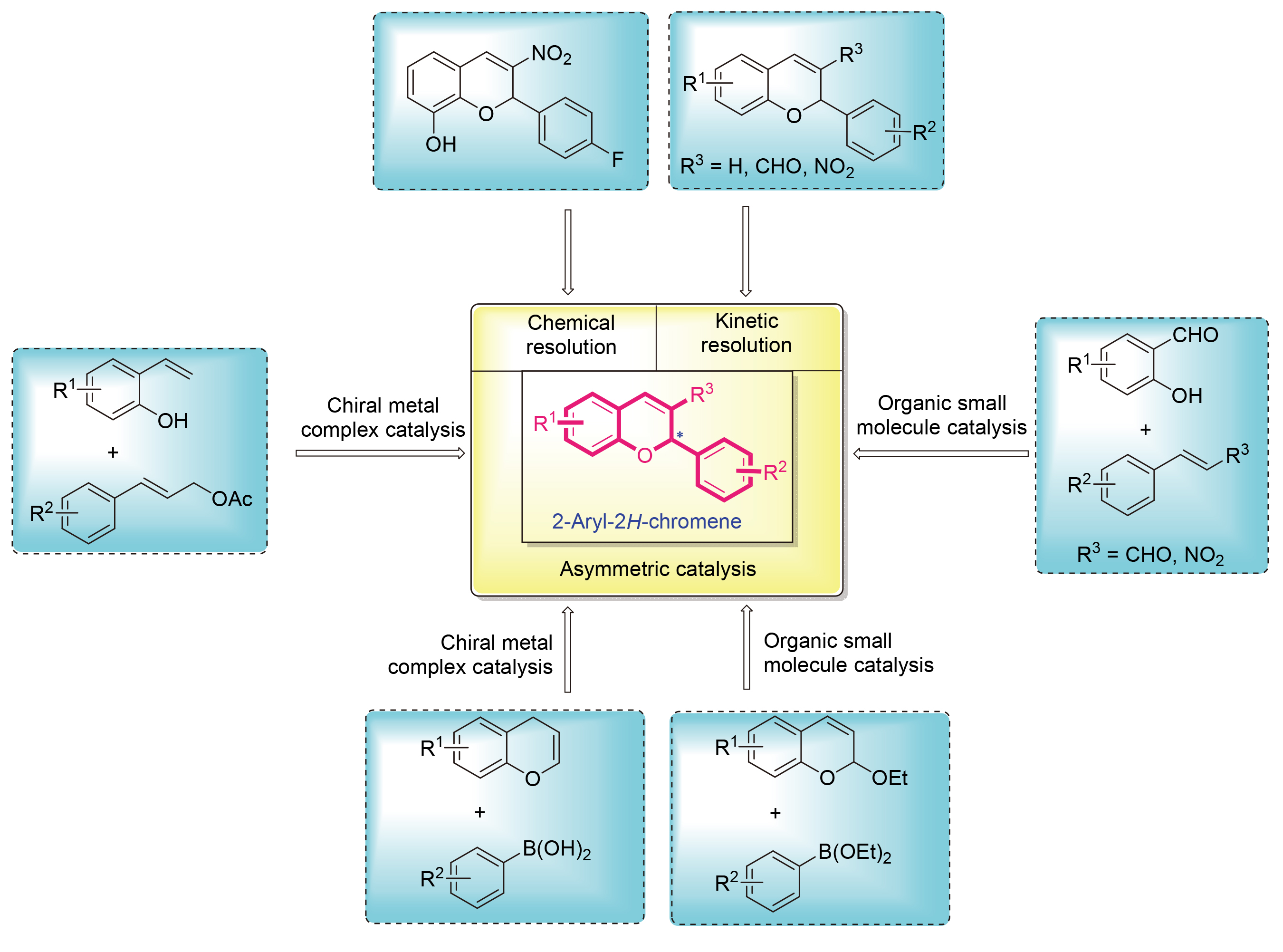
杂环化合物在我们的日常生活中具有重要意义, 其广泛存在于自然界中, 并对有效药物成分的设计和发现起着至关重要的作用. 2-芳基-2H-色烯属于杂环化合物含氧杂环[1-2]中的一类重要功能分子, 具有广泛的生物特性, 如抗氧化、抗炎、抗菌、抗癌和抗艾滋病病毒等. 其中, 手性的2-芳基-2H-色烯骨架具有很高的药物潜力和较低的毒性, 是活性药物分子的常见母体结构[3-5], 如治疗高血压的药物依普利酮[6]和治疗乳腺癌的候选药物阿可比芬[7], 同时, 在农业上还被用作杀虫剂[8].
基于手性2-芳基-2H-色烯具有很重要的生物学意义, 该类化合物的合成在有机合成领域备受关注, 合成消旋的2-芳基-2H-色烯类化合物相对容易[9-12], 但要获取其相应的手性化合物有一定的难度, 因为在有机合成中能够产生手性中心的方法虽然较多[13], 但应用到实际目标分子时却存在一定的局限性.
本文综述了近年来2-芳基-2H-色烯类化合物的手性合成研究进展, 主要包括以下几类: (1)化学拆分; (2)动力学拆分; (3)通过手性金属配合物或有机小分子参与的不对称催化. 期望对未来2-芳基-2H-色烯类化合物的手性合成有一定启示及促进作用.
1 化学拆分
经典化学拆分是通过将外消旋体与手性试剂反应, 生成非对映异构体(Diastereomers). 由于非对映异构体的物理性质不同(如溶解度、极性和熔点等), 可通过结晶或色谱等方法分离. 分离后, 再通过化学反应复原即得对映体富集的手性单体.
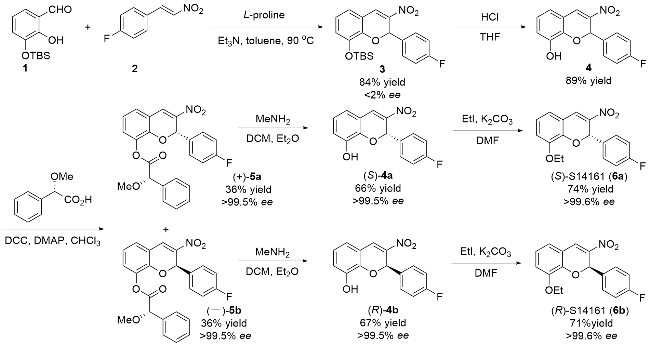
2013年, 刘兆鹏课题组[14]为了探究磷酸肌醇强效抑制剂S14161 (6)的抗癌活性, 采用化学拆分的方法制备了该活性分子的一对对映异构体(S)-6a和(R)-6b (Scheme 1). 该课题组以叔丁基二甲基硅基(TBS)保护的水杨醛衍生物1为底物, 以L-脯氨酸为催化剂, 在三乙胺存在下与反式4-氟-β-硝基苯乙烯(2)发生oxa- Michael-Henry反应, 以较高产率但极低的对映体, 选择性地获得了2-芳基-3-硝基-2H-色烯3 (84%, ee<2%). 为了获得手性单体, 在脱除3的TBS保护基后, 测试了多种衍生剂, 最终确定(S)-(+)-α-甲氧基苯乙酸为最佳拆分试剂, 将酚4与(S)-(+)-α-甲氧基苯乙酸缩合后得到两个可硅胶柱色谱分离的非对映异构体(+)-5a (>99.5% ee)和(-)-5b (>99.5% ee). 用甲胺去除酯(+)-5a和(-)-5b的手性拆分剂, 分别获得对映体富集的酚(S)-4a (>99.5% ee)和(R)-4b (>99.5% ee). 最后, 用碘乙烷乙基化形成具有极好ee值(>99.6% ee)的两个手性单体(S)-S14161 (6a)和(R)-S14161 (6b).
2 动力学拆分
动力学拆分是合成手性2-芳基-2H-色烯的重要策略之一. 该方法基于易得的消旋底物, 利用手性催化剂在反应中选择性识别一对对映体的速率差异, 从而实现间接分离. 鉴于消旋色烯类化合物的合成已较为成熟, 催化动力学拆分策略在经济性方面展现出一定优势, 为获取光学纯手性色烯提供了一条较为实用的途径.
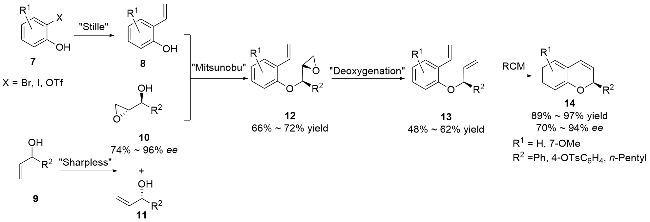
2003年, Doris课题组[15]报道了一种以Sharpless不对称环氧化为关键反应, 合成光学活性2-芳基-2H-色烯的简明方法. 该方法从合成邻乙烯基苯酚8和手性环氧醇10开始, 其中化合物8由相应的卤代前体7经Stille烯基化反应[16]制备, 而手性环氧醇10则是通过Sharpless动力学拆分消旋体烯丙醇9制得, ee值达74%~96%[使用酒石酸二异丙酯(DIPT)/Ti(OiPr)4/ t-BuOOH体系][17]. 随后, 通过Mitsunobu反应将酚8与环氧醇10连接, 构建出手性色烯的基本骨架12, 再经脱氧得到关键环化前体13, 该二烯13最终通过关环复分解反应(RCM)高效环化, 以较高收率和良好对映选择性获得一系列2-芳基-2H-色烯类化合物14. 虽然这一策略未直接构建出手性色烯, 但是成功地将前期引入的手性环氧结构整合至色烯骨架中, 进而实现了从手性环氧到手性色烯的较为高效的转化, 对于含有2H-色烯骨架的色烯衍生物的合成具有一定的参考意义(Scheme 2).
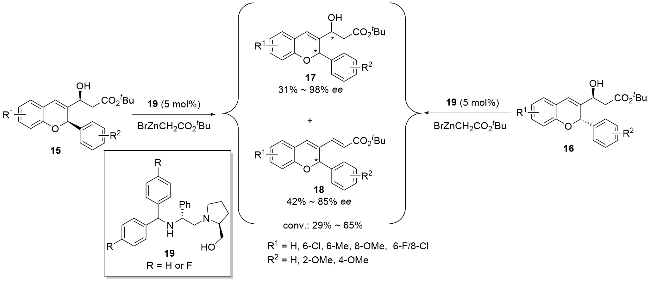
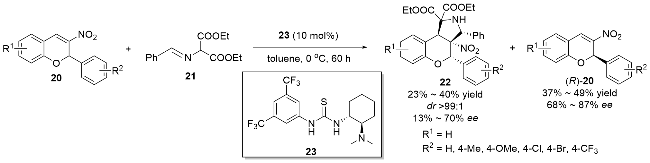
2010年, 谢建武课题组[19]报道了手性硫脲-三级胺双功能有机催化剂催化外消旋体2-芳基-3-硝基-2H-色烯类化合物20的动力学拆分. 该工作基于[3+2]环加成反应, 可得到相对应的手性环加成产物22及对映体富集的手性2-芳基-3-硝基-2H-色烯类化合物(R)-20 (Scheme 4). 在该反应的优化条件下, 利用Takemoto催化剂23, 探索了多种消旋2-芳基-3-硝基-2H-色烯类化合物20与α-氨基丙二酸亚胺21的反应. 在此过程中, 芳基上具有吸电子取代基团或供电子基团的2-芳基-3-硝基-2H-色烯类化合物(R)-20, 均可通过该方法获取, 但对映体选择性略有差异(68%~87% ee).
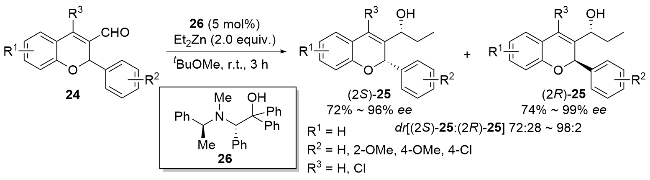
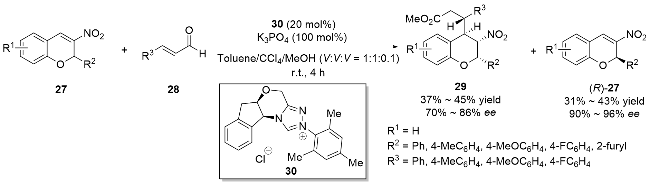
2019年, Maji课题组[21]开发了一种N-杂环卡宾(NHC)催化的2-芳基-2H-色烯类化合物的高对映体选择性动力学拆分方法. 该课题组以消旋的2-芳基-3-硝基- 2H-色烯类化合物27和肉桂醛类化合物28为底物, 采用手性三唑鎓盐类NHC 30为催化剂, 在K3PO4碱性条件下, 以Toluene-CCl4-MeOH混合物为溶剂, 实现了通过Azolium homoenolate中间体途径的迈克尔加成反应(Scheme 6). 该策略以37%~45%的产率和较高对映体选择性(ee 70%~86%)获得加成产物29, 并以31%~43%的产率通过回收原料的方式获得高光学纯度的2-芳基-3-硝基-2H-色烯底物(R)-27 (ee 90%~96%). 值得注意的是, 该方法可兼容多种芳基和杂芳基取代的色烯底物, 包括含供电子基(4-OMe)和吸电子基(4-Br、4-F)的衍生物. 通过进一步将产物转化为C(3)-胺功能化色烯类化合物, 展示了该方法的合成实用性.
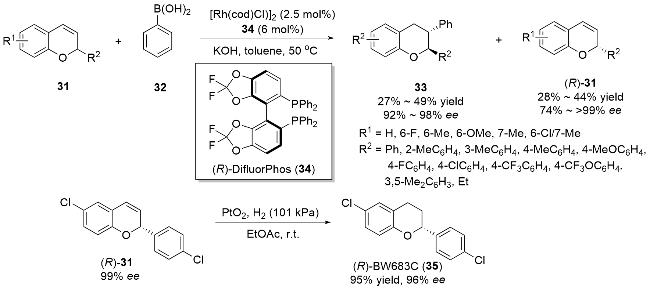
2019年, 汪君课题组[22]首次报道了基于铑催化的不对称氢芳基化反应的2-芳基-2H-色烯的高效动力学拆分策略. 在该动力学拆分中, 他们以消旋的2-芳基- 2H-色烯31为底物, 芳基硼酸32为芳基化试剂, 通过对铑配合物催化的不对称氢芳基化动力学研究及对手性配体的筛选, 确定了最佳手性配体(R)-DifluorPhos (34), 进而得到氢芳基化产物33, 同时以回收原料的形式获得一系列手性2-芳基-2H-色烯(R)-31, 其中最高ee值>99% (Scheme 7). 值得注意的是, 通过动力学拆分得到的手性化合物(R)-31, 可通过氢化反应轻松转化为色烷骨架. 基于此, 为了体现该反应的合成应用潜力, 该课题组合成了生物活性化合物(R)-BW683C[23](35).
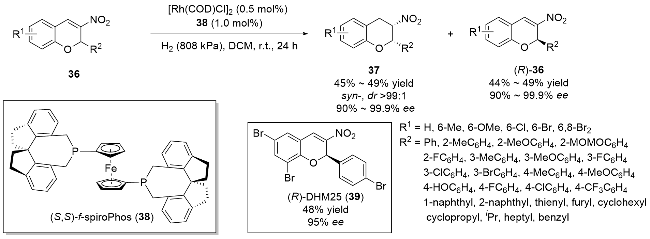
2025年, 侯国华课题组[24]研究了2-芳基-3-硝基- 2H-色烯类化合物36的铑催化不对称氢化动力学拆分反应, 利用[Rh(COD)Cl]₂/(S,S)-f-spiroPhos (38)催化体系, 以消旋的36为底物, 在二氯甲烷中808 kPa的氢气压力下反应, 以高非对映选择性(dr>99∶1, ee高达99.9%)获得含相邻手性中心的syn-2-芳基-3-硝基-2H-色烷(37), 同时以高对映选择性(ee高达99.9%)回收对应的起始底物2-芳基-2H-色烯类化合物(R)-36 (Scheme 8). 该策略反应条件相对温和, 底物适用范围广, 且以克级规模实现了抗肿瘤活性的化合物(R)-DHM25 (39)的高效合成, 验证了该方法的实用性, 为手性色烯衍生物的合成提供了较为高效的策略.
3 不对称催化
3.1 手性金属配合物催化
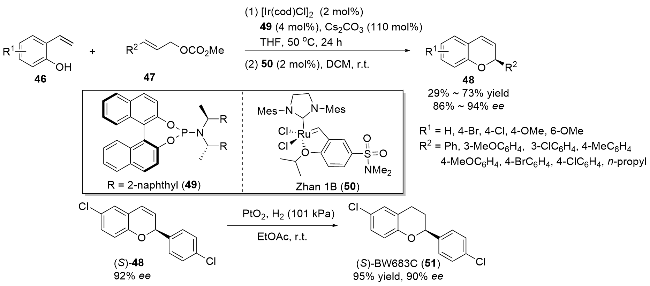
2012年, 游书力课题组[30]报道了一种基于不对称烯丙基化的2-芳基-2H-色烯类化合物48的手性合成方法. 该课题组在逆合成思路的分析下, 选择用2-乙烯基酚46及烯丙醇酯47为原料, 在(1,5-环辛二烯)氯化铱(I)二聚体和由1,1'-联-2-萘酚(BINOL)衍生的手性磷酰胺配体49的催化作用下, 通过分子间不对称烯丙基醚化反应, 先得到手性的环化前体, 后通过关环复分解反应, 在Zhan-1B (50)催化剂作用下环合六元烯烃环, 以中等收率及较好的对映体选择性得到系列2-芳基-2H-色烯类化合物48 (Scheme 10). 该策略通过连续的过渡金属催化反应, 间接但快速地构建手性2-芳基-2H-色烯骨架, 具有操作简便和条件温和的特点. 为了体现该反应的合成应用, 该课题组通过简单的加氢转化, 合成了生物活性化合物(S)-BW683C[23] (51).
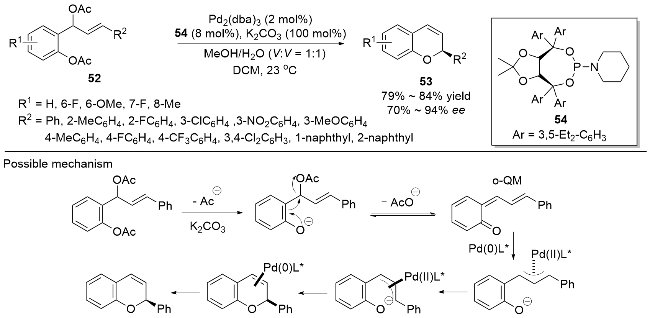
2014年, Scheidt课题组[31]结合前人经验和有效方法, 进一步探究了单齿亚磷酰胺类配体在不对称烯丙基取代反应中的应用. 他们以双乙酰基保护的邻位烯丙醇取代的酚类化合物52为底物, 于钯催化体系下评估了一系列手性配体, 筛选出由基于酒石酸骨架的手性二醇化合物衍生的新型单齿亚磷酰胺类配体54为最佳手性配体, 其在6-endo-trig型不对称烯丙基化反应中表现良好, 以较好的产率及对映选择性获得系列手性2-芳基- 2H-色烯类化合物53 (Scheme 11). 值得一提的是, 在此方案中, 作者通过三个巧妙的“连续”步骤来实现手性2-芳基-2H-色烯骨架的构建, 分别为: 碱水解促进酚形成, 为后续环化做准备; 通过手性金属配合物催化剂来激活烯丙醇酯体系; 由酚提供的苯氧离子促进的6-endo-trig型关环反应, 反应机理见Scheme 11.
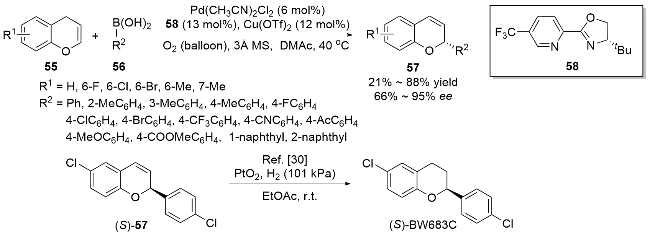
3.2 有机小分子催化
有机小分子催化是手性合成领域迅速发展的一种不对称催化方法, 与传统的手性金属配合物催化相比, 其优点在于手性有机小分子可直接参与反应, 不需要过渡金属的参与, 从而避免了金属对产物及环境的污染, 更重要的是由于催化剂能循环使用, 从而降低了生产成本, 因而可以被广泛应用到工业生产中. 自文献报道奎宁生物碱及L-脯氨酸等有机小分子可作为一种有效的催化剂参与手性化合物的制备后, 有机小分子催化在不对称合成中逐渐显示出巨大的前景. 在前人的开创性研究中, 该类氨基催化剂具有合成效益高等优点, 因此其在手性化合物的合成中广受青睐. 除此之外, 手性膦试剂[35]及手性Brønsted酸试剂[33]等也被广泛应用到手性合成中. 目前, 种类繁多的非金属手性有机小分子已广泛应用于手性杂环化合物的制备, 并取得良好效果[34]. 因有机小分子催化对手性合成的巨大推动作用, 其相关研究获得2021年诺贝尔化学奖, 并依旧是不对称催化合成中的研究热点.
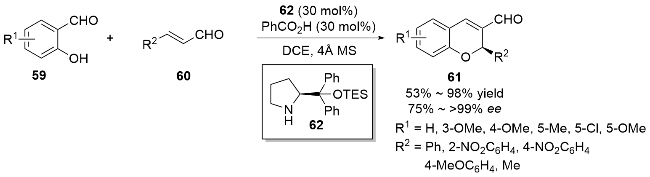
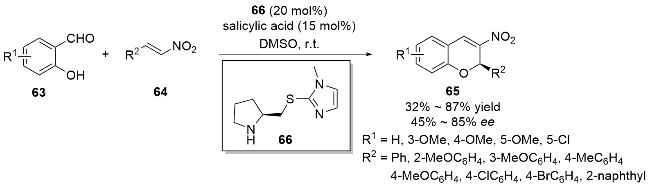
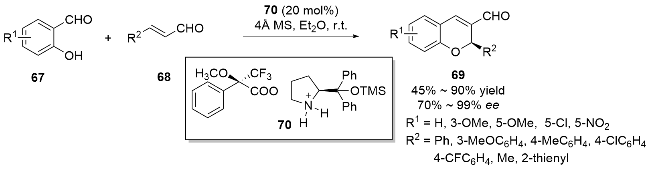
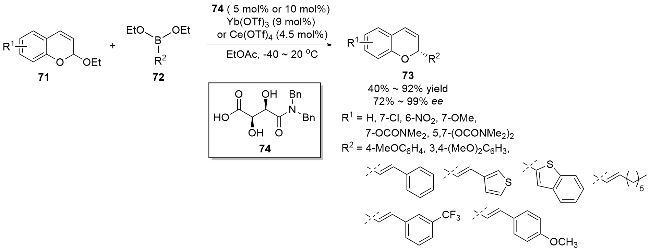
2010年, Schaus课题组[38]报道了一种手性Brønsted酸/Lewis酸协同催化的色烯缩醛71对硼酸酯72的对映体选择性加成反应. 为了实现在普通低温条件下的高效转化, 该课题组对催化剂、溶剂和温度等进行了详细的探索研究, 并发现酒石酸衍生的手性Brønsted酸74及镧系三氟甲磺酸盐类路易斯酸[Ce(OTf)4或Yb(OTf)3]的协同作用, 可高效促进该加成反应的发生, 进而以较高的产率及对映体选择性获得系列2-芳基-2H色烯类化合物73 (Scheme 16). 值得一提的是, 反应中使用的布朗斯特酸及路易斯酸催化剂均具有低毒且廉价易得的特点, 满足绿色化学及合成成本的需求.
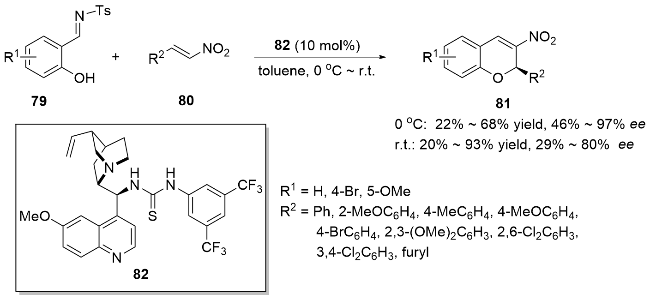
2011年, Schreiner课题组[40]以水杨醛的亚胺衍生物79与硝基乙烯类化合物80为原料, 采用新颖的oxa- Michael-aza-Henry-desulfonmidation串联反应, 合成了手性2-芳基-2H-色烯类化合物(Scheme 18). 该方法在由金鸡纳碱衍生的双功能手性硫脲82催化下, 以同时协同作用于两反应底物的方式, 可以良好的对映体选择性直接获得手性2-芳基-3-硝基-2H-色烯类化合物81. 该方案使用水杨醛的亚胺衍生物作为底物, 与常见的水杨醛相比, 其产率及对映体选择性均有显著提高. 该课题组认为, 该反应的高对映选择性可能源于一个由手性硫脲催化剂82控制的动力学主导的脱磺酰胺步骤.
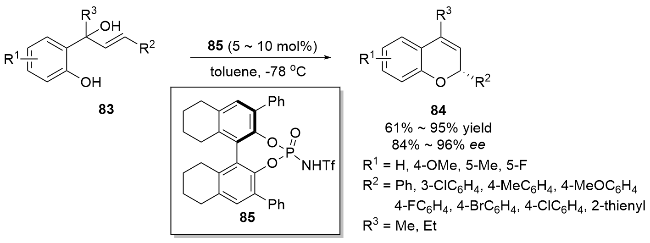
2011年, Rueping课题组[41]报道了一种基于手性有机接触离子对的不对称烯丙基取代反应. 他们这一策略避开了金属试剂的使用及高活性的中间体, 是一种很具有吸引力的合成方法. 在该催化过程中, 由BINOL衍生的磷酰胺类手性阴离子, 及由此产生的离子对在氧亲核试剂对烯丙基阳离子的进攻中起到至关重要的作用, 诱导了很高的对映体选择性. 该策略以含有烯丙醇结构的酚类化合物83为底物, 以手性布朗斯特酸85为催化剂, 在甲苯溶剂中于特定温度(最优为-78 ℃)下进行分子内不对称烯丙基氧烷基化反应, 以优秀的产率及对映体选择性, 合成了系列手性2-芳基-2H-色烯类化合物84 (Scheme 19).
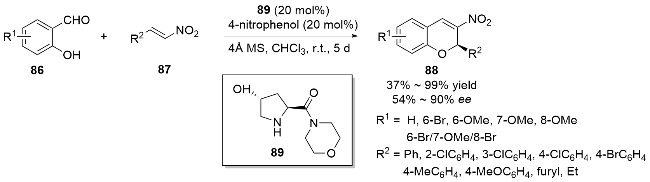
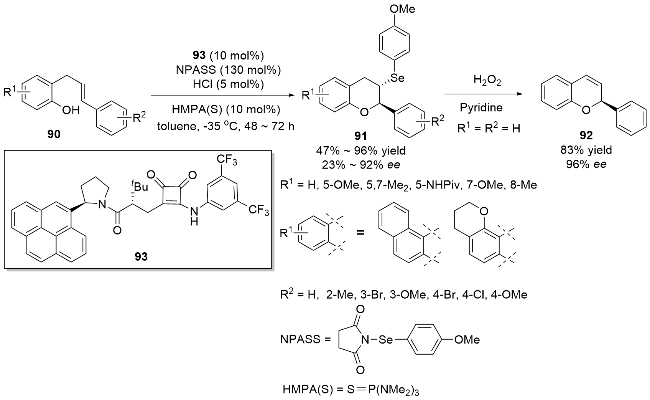
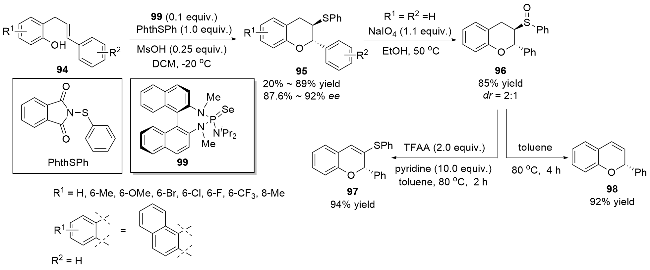
2017年, Denmark课题组[44]研究了酚羟基与分子内烯烃的高立体选择性环化反应, 该反应由基于1,1'-联-2-萘胺(BINAM)的磷酰胺类路易斯碱99催化, 通过形成具有高立体选择性的硫杂环丙烷阳离子中间体, 以优秀的产率及立体选择性合成2-芳基-3-苯硫基色烷类化合物95 (20%~89%, ee 87.6%~92%). 以产物95的3位芳基硫醚为进一步转化位点, 用高碘化钠氧化, 以85%的产率得到亚砜96, 其非对映体的比例为2∶1. 两种非对映体在甲苯中进行热消除, 以92%的收率高效获得手性2-芳基-2H-色烯98. 亚砜96在三氟乙酸酐(TFAA)和吡啶的作用下, 本期望发生Pummerer重排反应, 却意外以94%的收率获得具有乙烯基硫醚结构的2-芳基-2H-色烯97, 作者推测该产物通过硫酰基碳正离子脱质子路径生成(Scheme 22).
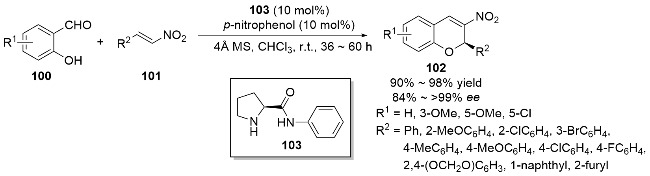
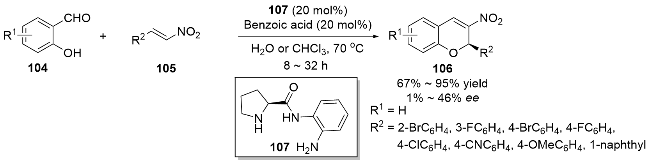
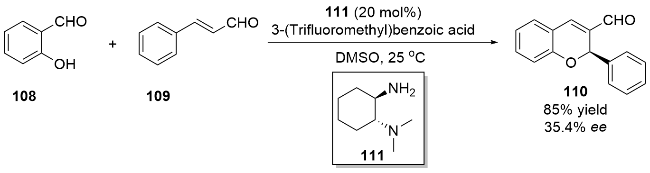
2020年, Bez课题组[45]以水杨醛类化合物100与共轭硝基烯烃类化合物101为原料, 通过改进现有催化剂, 利用简单易得的手性脯氨酰氨类小分子103来高效调控串联oxa-Michael-Henry反应的反应性及对映体选择性, 实现了系列手性2-芳基-3-硝基-2H-色烯类化合物102的高产率及高对映体选择性合成. 值得一提的是, 在该工作中, 该课题组通过优化由脯氨酸衍生的二级胺催化剂103, 成功解决了困扰该串联反应的两个关键问题, 即1,4-加成反应过程中酚氧的较低亲核性和由oxa-Michael步骤的可逆性导致的低立体选择性, 进而实现了该反应的高产率及高立体选择性, 并具有低催化剂载量及反应时间短的优点(Scheme 23).


4 小结与展望
鉴于手性2-芳基-2H-色烯结构在医药学及农业等领域中的应用十分广泛, 特别是该类化合物的手性合成取得了重要进展, 本文总结了近年来2-芳基-2H-色烯类化合物的对映体选择性合成方法. 手性催化是最为常见的对映体选择性合成方法, 大致可分为三类, 即手性金属配合物催化、非金属有机小分子催化和酶催化. 本文除了介绍动力学拆分与化学拆分外, 主要综述了前两种催化合成方法, 并根据底物的不同及其反应条件的差异, 分别对其合成策略进行分析、归纳和总结. 目前, 该领域应用最多的策略仍以酚类底物的亲核性为关键点, 并进一步结合手性金属配体复合物或有机小分子催化剂的调控. 预计将有更多高效的金属催化剂及非金属小分子催化剂被开发并应用于此类转化, 其中生物酶参与的该类化合物手性合成尤为值得期待, 相信其合成方法和策略将更加绿色、经济.
(Zhao, C.)