


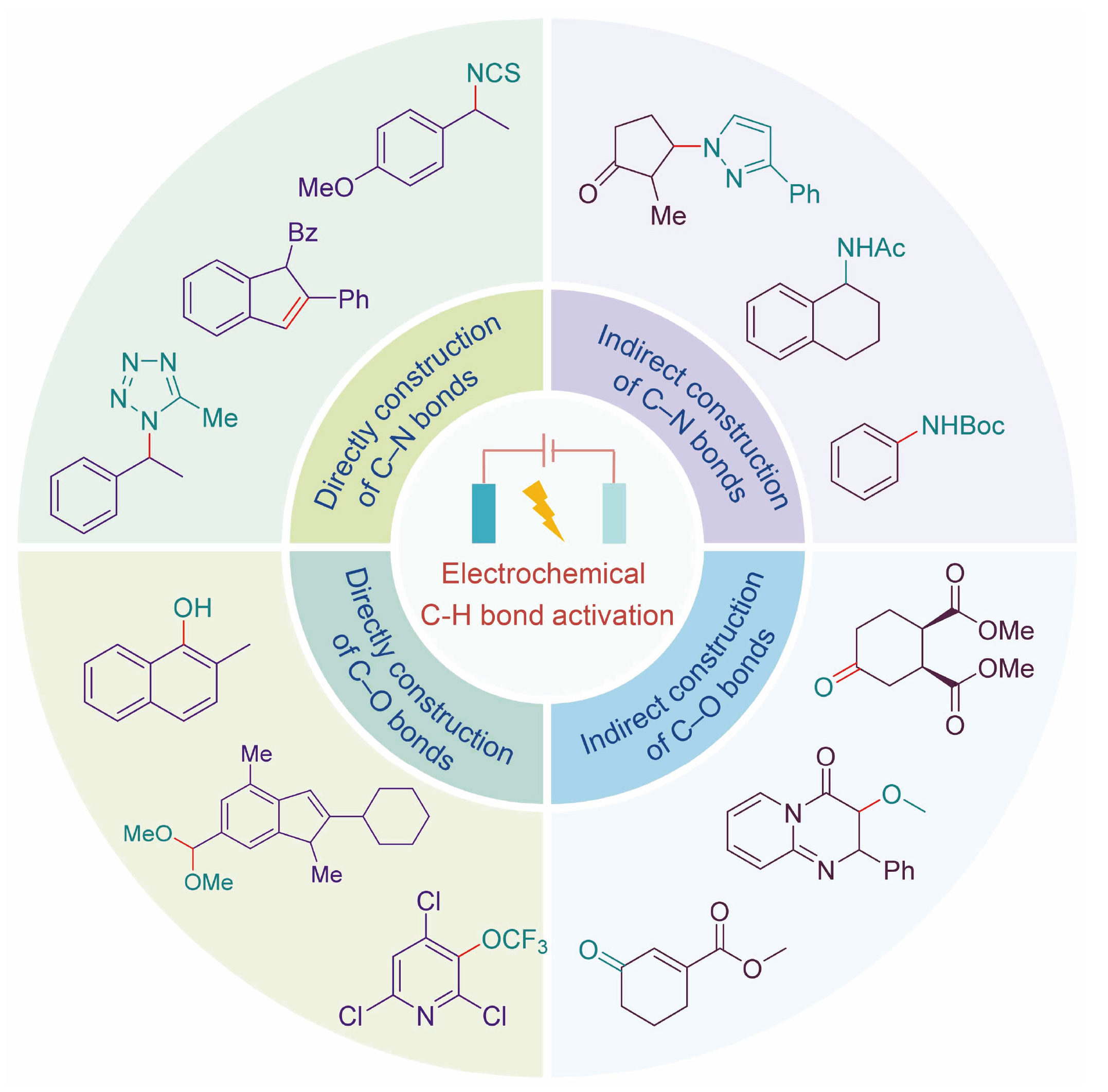
C—H键的选择性活化/官能团化是合成化学中备受关注的问题, 是现代有机合成化学领域一项革命性策略, 被誉为合成中的“圣杯”[1-4]. 直接、高选择性的 C—H键官能团化, 可为活性与功能分子的构建提供高效手段[5]. 从原理上看, C—H键的转化不依赖预官能团化的底物, 具有原子经济性与步骤简洁性, 并且广泛存在的C—H键为合成化学提供了丰富的反应位点, 为高效制备结构多样的化合物库和优化分子性能提供强大工具[6-10]. 然而, C—H键的惰性与活化能垒使得活化这些键通常需要高活性催化剂、剧烈反应条件或特殊活化手段, 这可能导致副反应增多、官能团耐受性降低和底物适用范围受限, 并且产物的选择性难以控制[11-14]. 传统C—H官能化通常指过渡金属催化的C—H键断裂反应, 但在实际应用中, 过渡金属催化的C—H官能化面临诸多挑战: (1)部分底物与过渡金属反应活性较低; (2)引入和去除导向基团需额外步骤; (3)过渡金属价格昂贵且非金属催化剂活性不足; (4)寻找匹配的催化剂和配体过程复杂. 这些制约了传统C—H键官能化技术的广泛应用[15-19].
在绿色化学发展趋势的推动下, 电化学合成凭借其环保、温和的特点备受瞩目[20-22]. 在有机电合成中, 电极电势作为驱动力, 电子则作为清洁试剂. 通过精准调控电子转移过程, 可以高效地协调氧化还原反应. 因此, 该技术已成为现代有机合成中极具价值的研究工 具[23-26]. 这种方法无需使用化学计量的氧化剂和还原剂, 多数电化学反应在室温或低温、常压下进行, 避免高温高压带来的能耗与安全风险. 并且通过精确控制电极电势, 能实现传统方法难以完成的复杂化学转 化[27-30]. 因此, 相较于传统过渡金属催化的C—H键官能团化反应, 电化学C—H键的官能团化具有诸多优势(表1). 同时, 电化学驱动具有独特的反应机制, 可与光催化、酶催化或连续流控制技术联用, 实现多机制协同的精准合成. 因此, 相较于传统的合成方法, 电化学展现出更优的反应效率、更高的原子利用率, 大大提高了反应的经济性和选择性[31-32].
表1 过渡金属催化与无金属电化学C—H官能化的比较Table 1 Comparison of transition metal-catalyzed and metal-free electrochemical C—H functionalization |
| Item compared | Transition metal-catalyzed C—H functionalization | Metal-free electrochemical C—H functionalization |
|---|---|---|
| Reaction mechanism | Using transition metals as catalysts, through elementary steps such as ligand exchange, oxidative addition, migration insertion, and reductive elimination, the activation and functionalization of C—H bonds are achieved. | Using electrons as clean oxidants or reductants, through electron transfer at the electrode surface, the substrate is transformed into active intermediates, thereby achieving the cleavage and functionalization of C—H bonds. |
| Reactive driving force | Chemical oxidants (such as Ag salts, Cu salts, peroxides, etc.) or reductants provide or consume electrons to complete the catalytic cycle. | Electric energy. By applying an external voltage or current, the redox potential of the reaction can be precisely controlled. |
| major advantage | (1) The method is mature and has a wide range of applications; (2) It offers strong selectivity and can be precisely controlled through ligand engineering; (3) The reaction conditions are relatively mild and facilitate large-scale production. | (1) Green and sustainable, reducing the use of metals and oxidants; (2) Economical in steps, without the need for pre-functionalization steps; (3) Unique reactivity, facilitating the generation of highly reactive free radical species; (4) High safety, capable of avoiding some dangerous chemical oxidants. |
| Main challenges and limitations | (1) The cost of metals is high and they may be toxic; (2) Metal residues affect the purity of the products, especially in the pharmaceutical industry; (3) They rely on chemical reagents for oxidation, generating chemical waste. | (1) Selective control (especially regional and stereoscopic selectivity) is a major challenge; (2) Reaction scaling is difficult due to limitations imposed by electrode area and mass transfer efficiency; (3) Special equipment (electrolytic cells, power supplies) is required; (4) Requirements exist for the conductivity of the substrate and solvent. |
| Catalyst and cost | (1) Expensive transition metal catalysts (such as Pd, Rh, Ir) are required; (2) It may involve the design and synthesis of complex ligands; (3) There is a problem of metal residue, which is not friendly to drug synthesis. | (1) No need for transition metal catalysts, and the cost is relatively low; (2) It may use inexpensive media (such as salts, acids, and bases) to facilitate conductivity; (3) No metal residues, especially suitable for the fields of medicine and materials. |
| Reaction selecti- vity | Regional selectivity: Usually precisely controlled through the spatial/electronic effects of directing groups or ligands, as well as catalysts. Stereoselectivity: High enantioselectivity can be achie- ved through chiral ligands. | Regional selectivity: It can be regulated by substrate structure (such as inherent electronic effects at the site), electrode potential, and medium, but precise activation of the distal C—H bond poses greater challenges. Stereoselectivity: It is relatively difficult to control and is currently a research difficulty. |
| Sustainability and “Green Chemis- try” | Using stoichiometric oxidants results in poorer atom economy. (1) Toxic or expensive metals may be used; (2) The process has high economic efficiency, but the environmental footprint is relatively large. | The atomic economy is high, and electrons act as “clean reagents”. (1) It is more in line with the principles of green chemistry (reducing waste and using renewable sources); (2) It can be combined with renewable energy sources (solar energy, wind energy). |
与过渡金属催化的C—H官能化不同的是, 无金属电化学C—H官能化通常能在简单温和的反应条件下顺利进行, 使其被视为一类更环保高效的C—H键官能化方法[33-36]. 无金属电化学C—H键的活化/官能团化, 在消除金属残留、提升原子经济性、拓展反应选择性方面突破传统合成瓶颈[37-40]. 使其在合成化学领域, 尤其是对金属残留限量极为严格的药物化学领域展现出广阔应用前景[42]. 其技术内核完美契合绿色化学原则, 为药物绿色合成、大宗化学品制备及CO2资源化利用提供了可行性的解决方案, 是未来合成化学向低毒化、低碳化转型的核心方向[43-46].
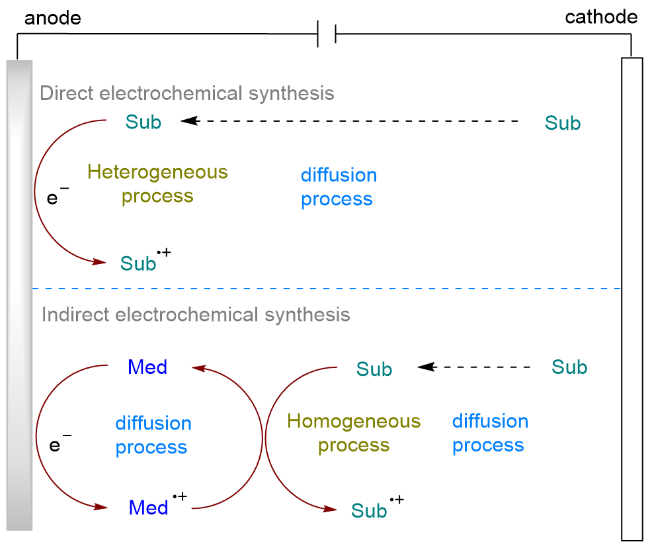
无金属电化学C—H键的活化/官能团化在反应机制上主要可分为两大类, 即直接电化学C—H键活化和非金属介导的间接电化学C—H键活化(Scheme 1)[47-49]. 这两种策略共同构成了该领域的核心方法学, 但其作用原理和适用场景各有侧重. 直接电化学C—H键的活化是指底物直接在电极表面发生电子转移, 并在电极表面生成相应的自由基阳离子或阴离子的过程, 是异相过 程[50]. 直接电化学C—H键的活化注重效率提升、实现原子利用率最大化并减少不必要的原子浪费. 但也存在诸多问题, 例如直接电化学C—H键的活化只适用于特定基底的选择性电解, 在处理具有高氧化/还原电位的基底或复杂的底物时, 由于电极与基底之间存在异质性的电子传递特性, 过电位会导致官能团兼容性差. 并且电极表面会积累大量活性物质, 容易发生自由基二聚、过度氧化或与电极反应, 最终导致电极钝化[27,51-54]. 非金属介导的间接电化学C—H键的活化, 使用氧化还原介质在电化学驱动下生成活性中间体, 随后与底物发生外层电子转移, 此外, 当反应层脱离电极时, 活性自由基阴离子/阳离子从电极的流动与电解液中底物的流动达到平衡, 这是均相过程[55]. 添加有机介质可减少或避免电极钝化现象, 因为活性物质是在溶液中生成而非在电极表面. 此外, 不同有机介质能提供独特的选择性, 并为理想的电化学转化创造多种可能性[41,56-59].
本文将以这两种核心活化模式为基本框架, 系统梳理近五年来无金属电化学活化C—H键构建C—N/C—O键的重要进展. 全文将深入探讨C—N键与C—O键的构建. 在综述文献过程中, 我们将进一步遵循“直接活化”到“间接活化”的论述顺序: 首先探讨底物在电极表面直接发生电子转移的策略, 随后介绍通过氧化还原介质实现的间接活化过程. 通过这种由表及里、从简到繁的结构, 旨在不仅总结反应实例, 更着重于阐明其内在的电化学机理, 揭示电极界面与均相溶液中的不同反应规律. 我们期望这种结构化的梳理能够为后续研究, 特别是在氧化还原介质的设计与反应路径的精准调控方面, 提供有价值的视角与借鉴.
1 无金属电化学C—H键活化构建C—N键
1.1 电化学直接C—H键活化构建C—N键
C—N键是生命与生物分子基石, 是许多天然产物、农药医药和功能分子的重要骨架, 因此, C—N键的构建能力直接决定了合成化学家创造具有生物活性新分子的能力[60]. 传统构建C—N键的方法有: (1)亲核取代, (2) Buchwald-Hartwig偶联, (3) Ullmann反应, (4)还原胺化等, 虽然取得了巨大成功, 但普遍存在依赖预官能团化、使用等物质的量比的氧化还原剂、强碱或贵金属, 条件苛刻、废物多、选择性控制难等不足. 电化学合成技术的应用为C—N键构建提供了革命性的解决方案.
直接电化学C—H键活化构建C—N键是通过电极表面直接转移电子来实现化学转化, 为构建C—N键提供了一种强大且可行的合成方案, 其优势在于将C—H键的惰性活化与电化学的清洁、精准特性相结合, 实现了传统方法难以企及的高效、绿色转化. 根据反应机理与关键中间体的不同, 本节将从以下几个方面进行阐述.
1.1.1 经由碳正离子中间体的直接胺化
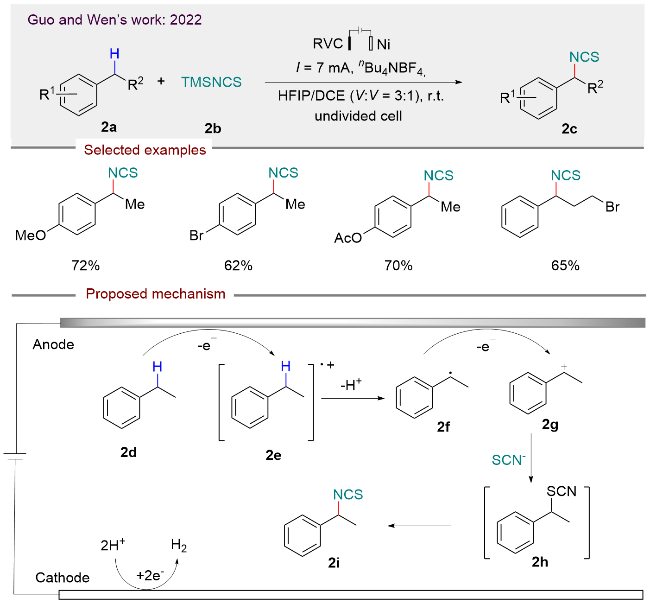
该类反应的共同路径是: 底物在阳极发生单电子氧化生成自由基阳离子, 随后脱质子形成自由基, 并进一步氧化生成高活性的碳正离子中间体, 最终被含氮亲核试剂(如胺、叠氮、异硫氰根等)捕获. 2022年, 郭维斯和文丽荣团队[61]报道了苄位C(sp3)—H键的异硫氰基化的策略(Scheme 2). 该工作利用三甲基硅基异硫氰酸酯(TMS-NCS)作为亲核试剂, 在石墨毡阳极和镍阴极的电解体系中, 实现了苄位碳氢键的高化学与位点选择性转化. 区别于传统硫氰基化反应, 其创新性在于原位发生的硫氰酸酯向异硫氰酸酯的电化学异构化, 这一独特机制确保了反应的高选择性. 该方法对伯、仲、叔苄位 C—H键均适用, 兼容卤素、酯基等官能团, 机理研究表明, 阳极氧化触发底物形成苄基自由基阳离子2e, 经脱质子过程和单电子氧化生成苄基碳正离子中间体2g, 最终被TMSNCS亲核捕获并异构化为异硫氰酸酯2i. 该策略突破了传统异硫氰酸酯合成对剧毒试剂的依赖, 为硫脲类药物砌块的制备提供了便捷的途径.
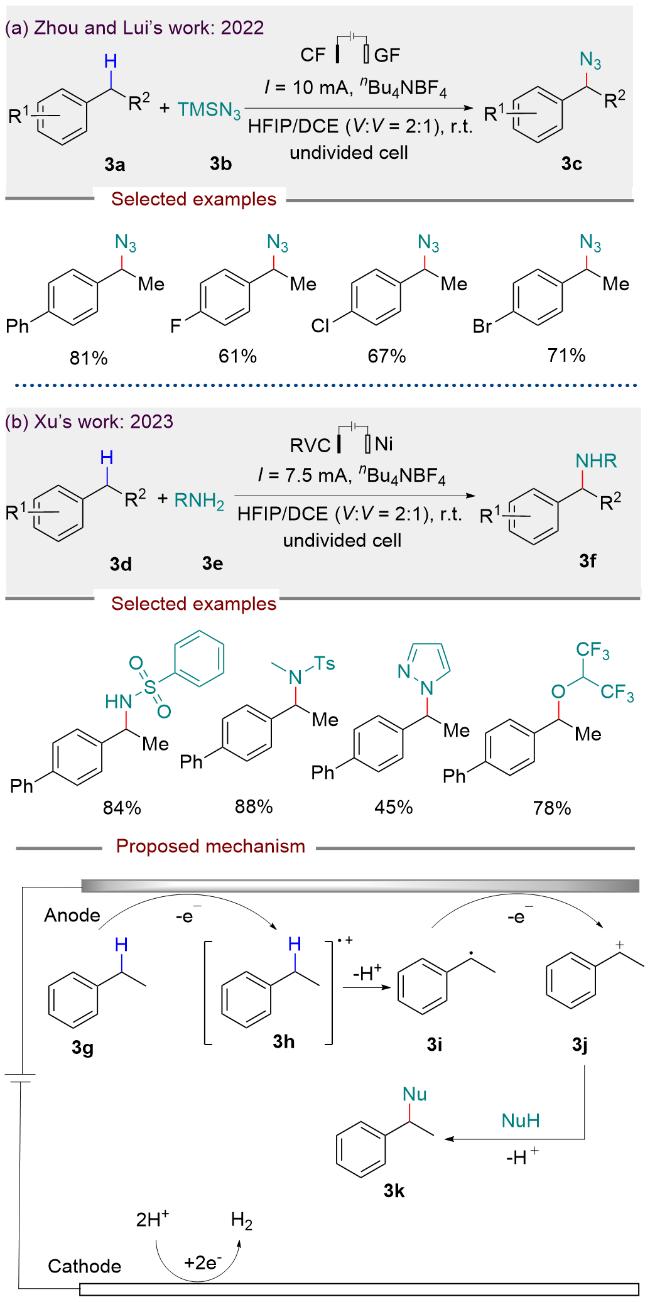
2022年, 周宇和柳红团队[62]报道了以廉价石墨板为电极、TMSN3为亲核试剂, 在不分隔电解池中实现了苄位C(sp3)—H键的直接叠氮化的策略(Scheme 3a). 该方法通过优化混合溶剂体系, 在10 mA恒电流条件下成功规避了传统方法对过渡金属催化剂、等物质的量比氧化剂或高毒性叠氮试剂的依赖. 在2023年. 徐海超课题 组[63]报道了电化学苄位直接C—H键的胺化反应(Scheme 3b), 反应的关键在于采用六氟异丙醇(HFIP)作为共溶剂, 可调节烷基苯底物与胺化产物的氧化电位, 有效避免产物过度氧化, 实现了优异的苄位选择性. 石墨板阳极的选用也是该反应获得高产率的重要因素. 石墨材料具有较宽的电位窗口和较高的析氧过电位, 使得它能够在HFIP溶剂中提供足够高的阳极电势, 以氧化烷基苯底物, 同时又不会引发溶剂或支持电解质的分解. 电极材料与溶剂体系的这种协同作用, 也是实现精准电位调控并获得高选择性的关键. 该反应的机理是, 苄位C—H键在阳极发生单电子氧化生成自由基阳离子中间体3h, 随后脱去质子形成苄基自由基3i, 该自由基经二次单电子氧化转化为苄基碳正离子3j, 最终被胺亲核试剂捕获形成C—N键3k. 徐海超和前述的工作都使用了六氟异丙醇作溶剂, 但他们用途不同. 在郭维斯和文丽荣[61]的工作中, 六氟异丙醇是稳定的高活性自由基和阳离子中间体, 而徐海超的工作中, 六氟异丙醇可差异化调控底物与产物的氧化电位. 主要表现在, 六氟异丙醇存在的体系中, 乙苯底物与其胺化产物的电位差扩大至0.1 V, 有效抑制了产物的过氧化; 而在乙腈溶剂中, 二者电位差仅0.03 V (vs. Ag/AgCl), 导致反应完全失效. 这种机制彰显HFIP在电合成中的关键作用与电化学电位的精准调控.
1.1.2 Ritter反应构建酰胺键
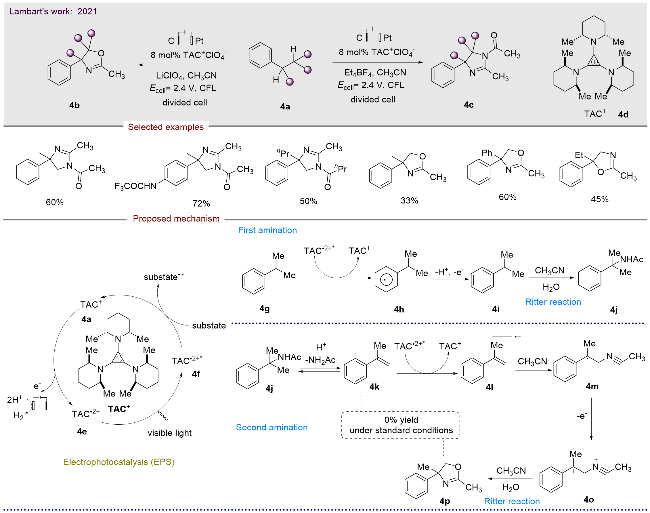
Ritter反应是有机合成中一类重要的构建C—N键的反应, 机理是碳正离子与腈类化合物的亲核加成-水解过程, 生成N-取代酰胺或进一步转化为胺类. 电化学可以通过氧化实现电子转移得到碳正离子中间体, 是实现Ritter型反应强有力的工具. 2021年, Lambert课题 组[64]发展了一种三氨基环丙烯鎓离子催化的无金属电化学催化策略(Scheme 4), 利用乙腈为氮源, 实现了烷基芳烃邻位C—H键的双胺化, 一步构建了4,5-二氢咪唑或2-噁唑啉结构. 该反应的关键在于通过光/电协同产生的高活性催化剂物种(4f), 能够引发连续的Ritter- type胺化反应. 其独特之处在于可通过更换电解质来精确调控产物类别, 从而分别获得双胺化或氧胺化产物.该反应结合电化学氧化与光激发的协同效应. 催化剂在阳极被温和氧化后, 经光激发产生的氧化性, 能够通过单电子转移过程活化底物的C—H键, 引发Ritter-type胺化反应. 反应的关键是首次胺化生成的酰胺产物(4j)在酸性条件下发生可逆的E1消除, 生成共轭烯烃中间体(4k). 该烯烃因其与芳环共轭, 更易被再次氧化, 从而驱动第二个相邻C—H键发生胺化, 最终环化生成4,5-二氢咪唑或2-噁唑啉产物. Lambert的策略具有优异的官能团兼容性, 被成功用于多种生物活性分子的后期修饰, 如塞来昔布、沙利度胺类似物等的后期衍生化, 直接快速地在复杂分子中引入1,2-二胺结构, 并能从廉价原料简洁合成高价值的1,2-二胺和β-氨基醇, 展示了极高的合成应用价值.
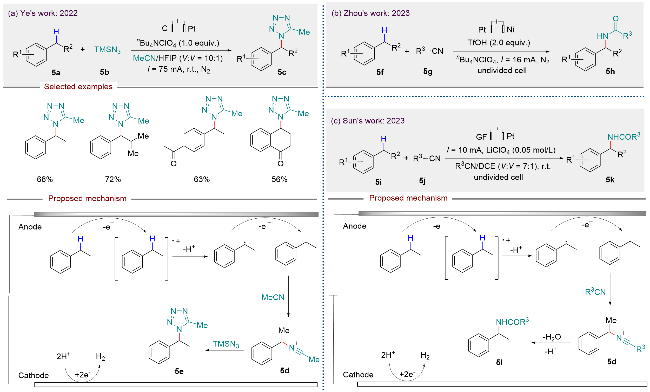
2022年, 叶克印课题组[65]报道了一种直接利用烷基芳烃、乙腈和TMSN3三组分电化学氧化, 实现苄位C(sp3)—H键的直接四唑化(Scheme 5a). 完全依赖电化学阳极氧化驱动反应, 避免了传统方法对导向基团、过渡金属催化剂、或等物质的量比的氧化剂的依赖, 并且通过溶剂HFIP和电解质实现了高选择性. 文章中的机理研究表明, 反应涉及分步电子/质子转移(ET/PT)和Ritter型腈鎓离子中间体的反应路径, 生成的腈鎓离子5d又被TMSN3捕获, 生成了独特邻位叠氮四唑化合物. 证实电化学对传统Ritter反应的绿色升级潜力, 为酰胺键构建提供了安全经济的新策略. 2023年, 周向葛课题组[66] (Scheme 5b)和孙佩佩课题组[67](Scheme 5c)也报道了类似的反应, 将苄位C(sp3)—H键直接转化为C—N键, 最后水解为相应的酰胺.
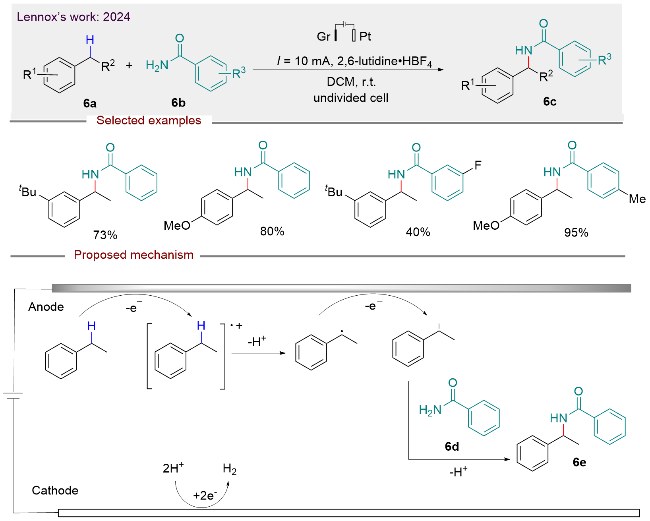
在2024年, Lennox课题组[68]实现了苄位C(sp3)—H键与苯甲酰胺的直接酰胺化反应(Scheme 6). 与之前所述的电化学Ritter型反应不同的是, 该工作突破了传统Ritter反应依赖大量腈类溶剂的限制, 采用近等物质的量比的苯甲酰胺作为高效亲核试剂捕获阳极氧化生成的苄位碳正离子, 以中等至优异的收率合成一系列仲酰胺. 底物适用范围涵盖乙苯、二苯甲烷、茚满及四氢萘等苄位底物, 且富电子芳环与间位取代苯甲酰胺兼容性良好, 成功实现了从毫克级批式反应到克级连续流生产的放大, 展示了良好的工业化潜力. 在微反应器中, 反应物的溶解度、反应时间及传质效率直接影响反应的结果. 在工业化规模放大时, 这些因素的变化使反应效率下降, 因此如何确保反应均匀性, 并解决溶解度和反应时间的平衡问题, 是目前亟待解决的挑战. 此外, 如何进一步降低电解反应中的能量消耗, 以及优化设备以降低生产成本, 也将影响该技术的经济性. 作者在这项工作中采用多级串联的方法, 很好地解决了电化学在放大方面存在的问题. 该策略为电化学酰胺键的绿色构筑和工业化放大开辟了新路径.
1.1.3 自由基路径与环化策略
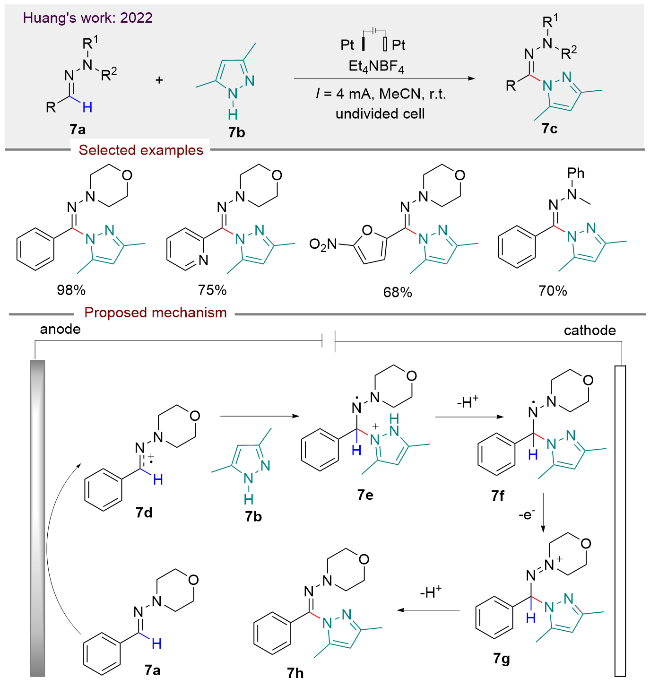
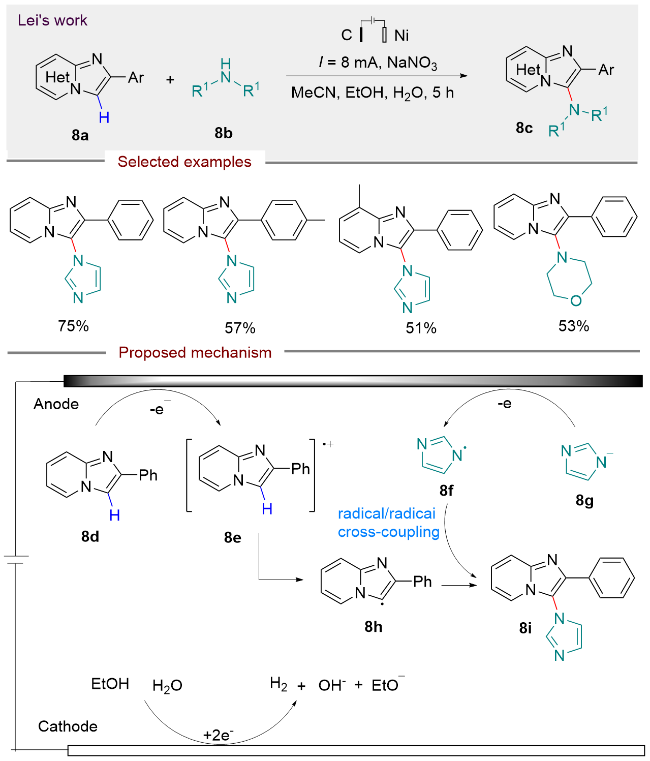
除了占主导地位的碳正离子路径, 电化学直接C—H胺化也可通过自由基偶联或涉及自由基的环化过程实现, 为C—N键的构建提供了多样化的手段. 2022年, 黄静梅课题组[69]报道了一种醛腙电化学胺化反应(Scheme 7), 该反应通过阳极氧化策略直接活化醛腙的惰性C(sp2)—H键, 在温和条件下构建C—N键. 其创新性在于实现了醛腙与唑类化合物的电化学交叉脱氢胺化, 反应展现出优异的立体控制能力, 专一性生成热力学不稳定的Z-构型胺化产物(Z/E>99∶1). 其反应机理在于阳极发生单电子氧化形成关键自由基阳离子中间体7d, 该物种被唑类亲核试剂捕获后, 经历脱质子化及二次阳极氧化, 生成高活性质子化亚胺正离子7g, 最终通过去质子化完成C—N键构建. 动力学研究进一步指出, 脂肪醛腙因自由基阳离子稳定性较低及交换电流密度差异, 导致其反应活性弱于芳香族化合物. 自由基/自由基偶联是一种直接、高效的键形成策略. 虽受限于选择性, 但通过电化学技术已可以精准控制. 其在复杂分子合成、绿色化学及功能材料领域具有不可替代的价值. 雷爱文课题组[70]报道了一种无金属、无化学氧化剂的电化学C—H/N—H交叉偶联反应(Scheme 8), 实现咪唑并[1,2-a]吡啶C-3位胺化. 该反应的关键步骤在于在电极上同步氧化咪唑并[1,2-a]吡啶和相应的胺, 生成活性碳自由基8h和氮自由基8f中间体, 两者高效偶联合成目标产物.
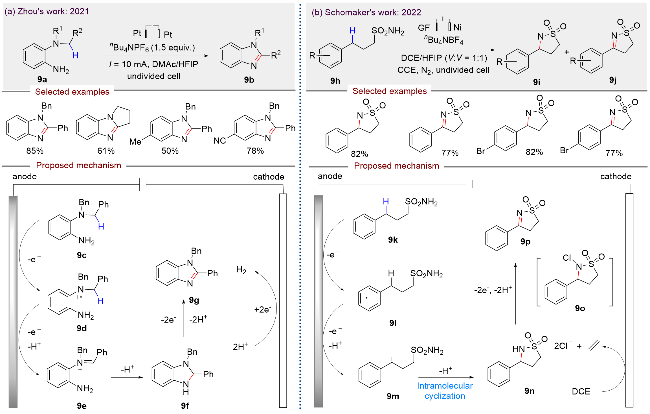
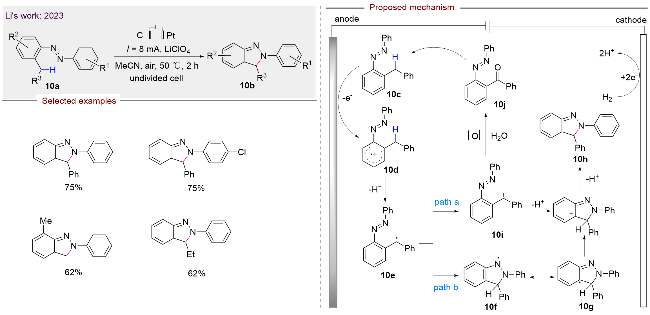
电化学环化可以将电化学的精准氧化还原控制与环化反应的高效性结合, 实现更绿色、高选择性的复杂环系构建. 2021年, 周从善课题组[71]报道了一种通过阳极氧化直接实现苯并咪唑类化合物的分子内C(sp3)—H/N—H脱氢环化的电化学策略, 无需过渡金属催化剂或化学氧化剂即可实现C—N键构建(Scheme 9a). 底物适用范围研究表明, 芳环上带有供电子/吸电子基团(如甲基、甲氧基、卤素、三氟甲基等)的衍生物均可兼容, 以较高的收率获得1,2-二取代苯并咪唑, 并展现出一定的位点选择性. 该方法的创新在于利用电化学氧化原位生成氮自由基中间体9d, 触发连续的脱质子、环化、芳构化过程, 成功规避了传统方法对强氧化剂和贵金属的依赖. 2022年, Schomaker课题组[72]开发了一种通过精准调控电极电位实现碳氢键选择性胺化或亚胺化的策略(Scheme 9b). 在配对电解机制下(paired electrolysis), 仅需改变施加电流(0.5 mA或5.5 mA), 即可高选择性地将芳基磺酰胺类底物分别转化为五元/六元环状胺或亚胺产物. 配对电解机制通过同时调节阳极和阴极的反应条件, 实现两者协同作用. 在阳极上, 电子被驱动向溶液中释放; 而在阴极上, 电子被捕获并参与还原反应. 这种协同关系使电化学反应能够高效且选择性地进行, 避免了副反应的发生. 机理研究表明, 低电位下通过阳极氧化直接触发C(sp3)—H键胺化环化, 而高电位下则利用溶剂1,2-二氯乙烷(DCE)的阴极还原产物氯离子作为氧化还原媒介, 实现胺至亚胺的二次转化. 这种电位调控选择性(dialing in potentials)策略, 避免了传统方法对过渡金属催化剂或化学计量氧化剂的依赖. 该方法的合成价值进一步体现在产物可作为导向基, 成功应用于后续C(sp2)—H键芳基化反应. 为复杂含氮杂环的绿色构建提供了新方法.
1.2 非金属介导的电化学活化C—H键构建C—N键
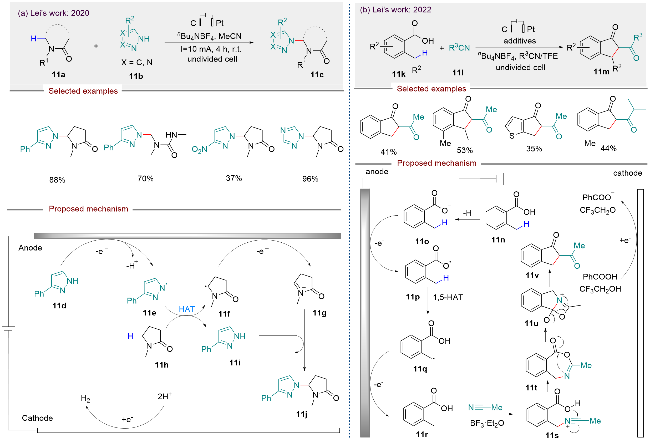
氢原子转移(HAT)过程在非金属介导的电化学活化C—H活化转化中扮演核心角色, 往往在转化中决定反应的速率. 2020年, 雷爱文课题组[74]报道了内酰胺或酰胺α-位C(sp3)—H键与唑类化合物N—H键的直接交叉脱氢偶联, 实现惰性C(sp3)—H键的官能团化(Scheme 11a). 该反应利用杂原子导向, 使反应优先发生在内酰胺α-位C—H键和唑类特定位置. 机理研究表明, 阳极生成氮原子自由基是引发HAT是电化学C—H官能化中的关键步骤. 2022年, 雷爱文课题组[75]又报道了通过电化学生成的芳酰氧自由基介导分子内1,5-HAT活化苄位C(sp3)—H键, 实现了邻烷基苯甲酸与腈类化合物的分子间或分子内串联反应, 一锅法合成具有重要生物活性的异吲哚啉酮类化合物(Scheme 11b). 该反应的关键是利用电化学稳定芳酰氧自由基11p进行1,5-HAT实现远程苄位C(sp3)—H的活化, 产生了高活性的碳自由基11q, 从而引发了Ritter型反应. 在经过分子内环化重排合成异吲哚啉酮. 这些工作展示了电化学在实现自由基HAT的远程C(sp3)—H键官能团化构建高价值杂环骨架方面的强大能力.
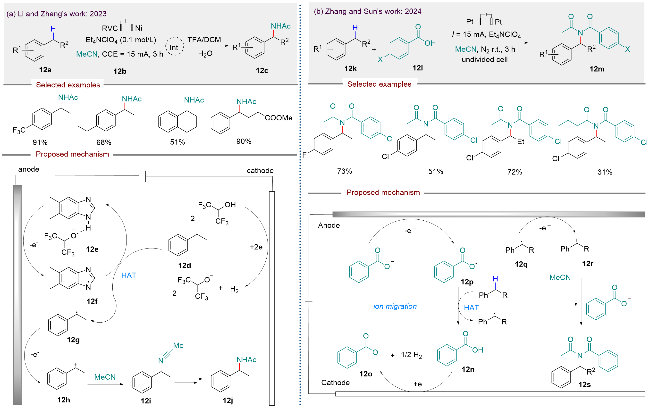
2023年, 李曼波和张盛团队[76]创新性地利用苯并咪唑衍生物作为氢原子转移介质, 实现了强吸电子基取代苄位的高选择性胺化(Scheme 12a). 该策略的创新性在于通过电化学氧化原位生成结构明确的氮中心自由基(NCRs), 其高键解离能(BDE≈418.4 kJ/mol)与低氧化电位(0.9~1.7 V vs. Ag/Ag+)特性使其成为高效HAT催化剂, 成功解决了传统电化学胺化中强吸电子底物, 如CF3、CN、CHO, 反应惰性及产物过度氧化两大难题. 尤为突出的是, 该介质展现出非常规位点选择性, 即优先活化键能更高的仲C—H键而非位阻更小的伯C—H键, 突破了传统电子转移(ET)催化剂的反应逻辑. 底物涵盖醛基、硼酸酯、邻卤代芳烃等敏感基团. 作者提出该反应可能的机理: 苯并咪唑在阴极生成的醇盐阴离子辅助下, 通过质子耦合电子转移(PCET)过程被氧化为氮中心自由基12f. 随后, 活性自由基从乙苯12d中夺取一个氢原子, 生成苄基自由基12g, 该自由基立即通过单电子转移转化为碳正离子12h. 碳正离子经与乙腈结合发生亲核取代, 形成腈基12i, 最后水解生成相应的产物12j. 值得一提的是, 该方法不仅具有广泛的底物范围, 并且在布洛芬、塞隆酰胺等药物分子后期修饰中, 实现克级规模应用. 通过电化学方法, C—H键的活化可以在无金属催化剂的条件下完成, 从而避免了金属残留的风险. 具体步骤包括使用无金属电化学催化剂, 在电解槽中进行C—H键的电化学活化, 通过反应生成自由基或阳离子中间体, 然后与亲核试剂进行官能化反应, 成功实现布洛芬等药物分子的修饰. 在大规模生产过程中, 反应物的溶解度和反应物与电极表面的传质问题, 将显著影响反应效率. 因此, 在工业应用中, 如何优化电解槽设计和反应条件, 尤其是在较高反应物浓度下, 依然是一个重要挑战. 此外, 电化学反应的能量消耗和反应时间的控制是另一个关键因素, 需要进一步优化以降低成本. 2024年, 张胜和孙奇团队[77]利用苯甲酸衍生的氧中心自由基(OCRs)实现苄位酰亚胺化(Scheme 12b). 该反应的原理是, 4-氯苯甲酸在阳极氧化生成的氧自由基12p触发氢原子转移, 形成苄基自由基12q, 并进一步氧化为碳正离子12r, 最终与乙腈和苯甲酸阴离子经Ritter型反应构建C—N键.
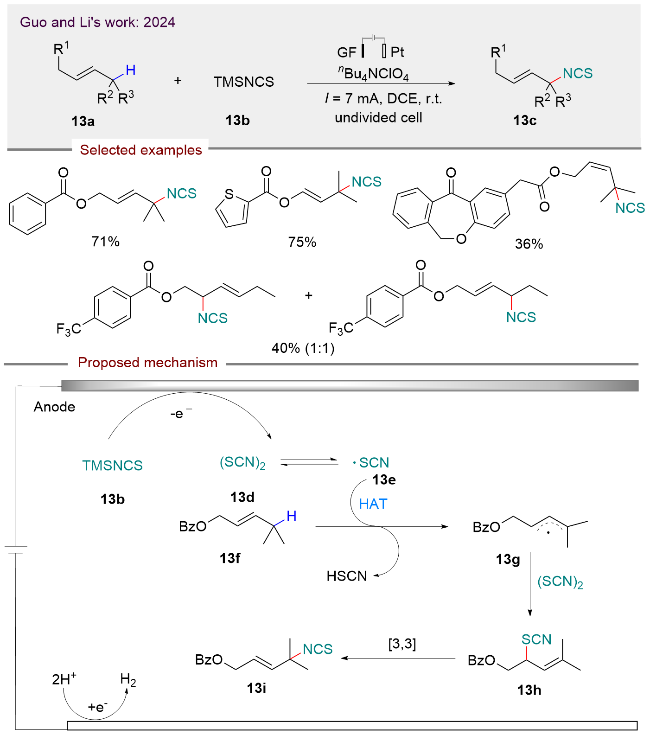
2024年, 郭维斯和李明团队[78]报道了内烯烃的烯丙位C(sp3)—H高选择性的异硫氰基化反应(Scheme 13), 该反应利用阳极氧化产生的硫氰基自由基13e, 通过氢原子转移选择性攫取烯丙基C(sp3)—H键中的氢原子, 生成关键的烯丙基自由基中间体13g. 随后, 该烯丙基自由基被体系中的硫氰13d捕获, 形成烯丙基硫氰酸酯中间体13h. 机理研究发现, 该硫氰酸酯中间体并非直接产物, 而是经历了一个快速的、热力学驱动的[3,3]-σ重排过程, 不可逆地转化为最终观察到的、更稳定的烯丙基异硫氰酸酯产物13i. 其中, 三甲基硅基异硫氰酸酯在该体系中扮演了双重角色, 既是硫氰自由基的前体作为HAT试剂, 也是异硫氰基的最终来源. 这种独特的重排机制, 结合硫氰自由基对三级烯丙位C—H键的优先攫取, 共同促成了该反应优异的位置选择性和化学选择性, 有效规避了常见的烯烃双硫氰基化副反应.
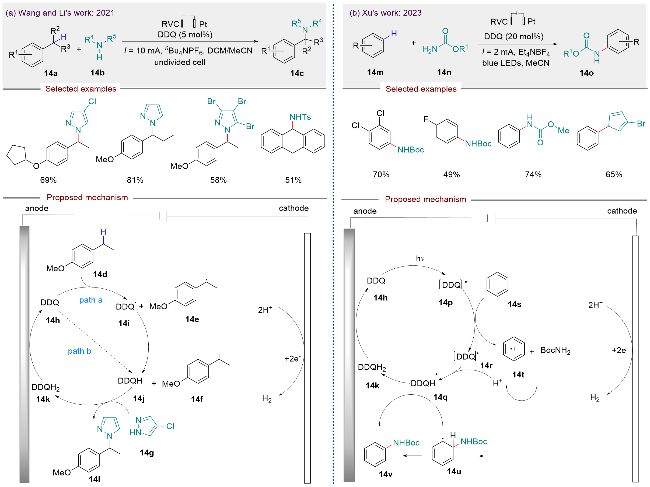
2021年, 王雷和李来强团队[79]通过利用2,3-二氯- 5,6-二氰基苯醌(DDQ)作为氧化还原介质, 电化学驱动下烷基芳烃与唑类化合物可实现高区域选择性的C—H/ N—H脱氢交叉偶联(Scheme 14). 该方法对伯/仲/叔苄位C—H键均适用, 兼容烯烃、卤素、酮、酯基等敏感官能团, 并成功应用于氨基酸、甾体等复杂分子的后期修饰. 该反应是通过底物与DDQ之间的氢原子转移触发, 随后富电子的苄基自由基14e被DDQH•氧化生成碳正离子14f和DDQH- (Scheme 14a, path a). 另一种可能的反应路径是, 该反应通过氢转移从14d向DDQ进行, 从而形成DDQH-和碳正离子14f (Scheme 14a, path b), 随后碳正离子14f被胺类亲核试剂14g捕获, 最终形成胺化产物14l. 在此过程中, DDQH-发生质子化反应生成DDQH2. 随后, DDQH2经阳极氧化反应生成DDQ, 参与下一催化循环. 在该电合成过程中, RVC电极材料决定了DDQ介质再生的效率. DDQH2在阳极的氧化再生需要匹配的电极电势. 所选用的电极材料必须能在此电位下稳定运行, 并高效地将DDQH2转化回DDQ, 以维持催化循环. 2023年, 徐海超课题组[80]融合可见光激发与电化学氧化, 以DDQ为分子催化剂, 实现了芳烃作为低剂量试剂(最低1.1 equiv.), 与氨基甲酸酯氧化还原中性C—N偶联(Scheme 14b), 成功活化惰性苯及卤代苯, 如邻二氯苯、氟氯苯等. 密度泛函理论(DFT)计算揭示了卤素取代基通过调节LUMO分布控制对位优先的区域选择性. 机理研究表明, 光激发DDQ产生强氧化性激发态14p, 攫取芳烃单电子生成自由基正离子14u, 进而被氮亲核试剂捕获14v, 最终, DDQ通过电极过程再生, 从而完成了催化循环.
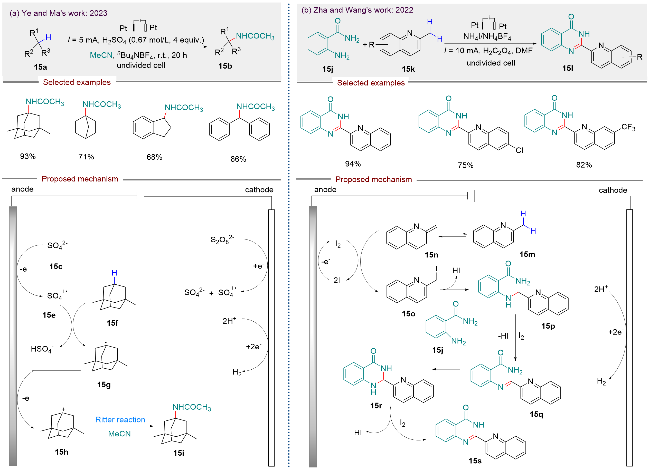
2022年, 叶金星和马跃跃[81]团队报道了电化学策略用于惰性C(sp3)—H键的直接胺化(Scheme 15a). 反应具有优异的底物适用性, 成功应用于71个实例, 涵盖三级、二级脂肪烷烃、含酯基/卤素等官能团的烷烃以及烷基苯, 甚至包含硝基、碘、游离氨基等敏感基团, 收率高达93%, 具有良好的区域选择性, 尤其在烷基苯胺化中优先发生在苄位, 或在多官能团烷烃中倾向于远离吸电子基的位置. 该方法创新性地利用电能原位电解硫酸盐($SO_{4}^{2-1}$)产生硫酸根自由基15e, 后者作为高效的氢原子转移试剂, 从烷烃或烷基苯的C(sp3)—H键攫取氢原子, 生成烷基自由基15g. 该自由基随后在阳极进一步氧化为关键的碳正离子中间体15h, 进而与腈类溶剂发生经典的Ritter反应, 高效构建C—N键. 查正根和王志勇团队[82]开发了碘介导喹唑啉酮稠合杂环的电化学合成(Scheme 15b), 反应的机理为: 在酸催化下, 2-甲基氮杂芳烃首先异构化为更具亲核性的烯胺形式15n. 随后, 阳极氧化产生的活性碘对烯胺的甲基进行亲电进攻, 生成关键的烷基碘中间体15o. 该中间体被2-氨基苯甲酰胺亲核取代形成C—N键, 得到酰胺中间体15q. 此中间体进一步被碘氧化为亚胺15r, 并发生分子内亲核环化, 经氧化芳构化得到目标产物喹唑啉酮15s.
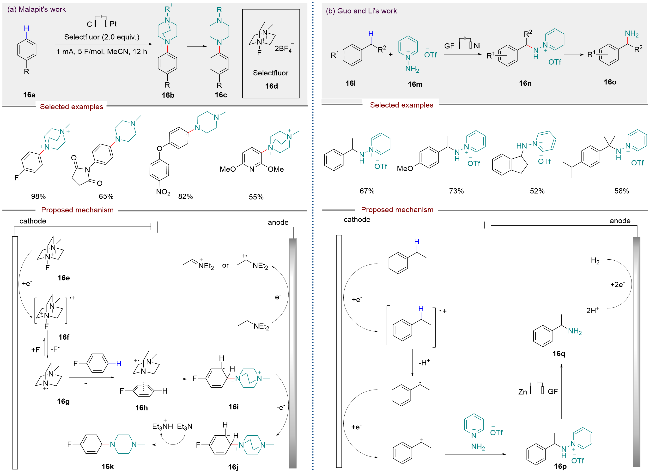
2024年, Malapit团队[83]报道了高度位点选择性的芳烃C(sp2)—H直接胺化反应, 成功构建了芳基 C(sp2)—N键, 生成了芳基1,4-二氮杂二环[2.2.2]辛鎓盐(DABCOnium) (Scheme 16a). 该反应对缺电子芳烃与富电子芳烃均能顺利进行, 生成相应目标产物, 突破了传统阳极氧化方法对缺电子芳烃的应用局限. 该反应的关键在于: 通过阴极还原生成关键活性物种N-中心双阳离子自由基, 而非采用传统阳极氧化芳烃的路径. 这些自由基能高效地参与芳香族C—H官能团化反应, 并引导芳香族取代反应的区域选择性. 氮自由基阳离子-π相互作用与自然界中存在的芳烃发生电荷转移机制相似, 随后形成芳香族C—N键. 反应在未分隔电解池中进行, 且无需额外添加支持电解质, 简化了操作流程, 提高了实用性. 2024年, 郭维斯和李明团队[84]报道了一种N-氨基吡啶鎓盐介导的双功能化策略(Scheme 16b). 烷基芳烃与N-氨基吡啶三氟甲磺酸盐直接C—H/N—H交叉偶联反应, 实现苄基C(sp3)—H氨基吡啶化修饰的电化学方法. 该工作通过阳极氧化原位生成苄基碳正离子, 与N-氨基吡啶鎓盐发生分子间C—H/N—H交叉偶联, 高效构建苄基胺吡啶鎓中间体, 并进一步通过阴极还原实现N—N键断裂, 一锅法转化为高附加值苄胺类化合物.
2 无金属电化学C—H键活化构建C—O键
2.1 电化学直接活化C—H键构建C—O键
在有机分子中, C—N键和C—O键分别具有不同的功能和作用. C—N键广泛存在于许多天然产物、药物分子和生物分子中, 是其骨架结构的重要组成部分. 相比之下, C—O键在含氧药物分子中占据更为关键的位置, 其中的氧原子不仅参与分子的极性调节, 还对分子的生物活性起着重要作用. 因此, 尽管C—N键和C—O键在分子结构中扮演着不同的角色, 但其构建方法和反应机理仍有许多相似之处. 在无金属电化学方法下, C—N键和C—O键的构建有许多共同的技术特点. 首先, 这两类键的构建均依赖于电位调控, 通过精准的电位控制可以调节底物的电子转移, 进而实现高效的化学转化. 然而, 构建C—O键时面临的一大独特挑战, 在于氧源的选择性问题. 在电化学反应中, 氧源的选择至关重要, 因为其不仅需要满足反应的氧化还原条件, 还必须能够与底物反应生成所需的C—O键. 因此, 虽然C—N和 C—O键的构建方法在很多方面存在相似性, 但它们的技术要求和反应条件却有所不同. 醇、醛、酮三类含氧有机化合物是生命活动与化学工业不可或缺的基石, 它们共同魅力在于其官能团, 羟基和羰基赋予的高度反应活性, 使其能够方便地相互转化, 并参与多样化的反应, 从而高效地构建复杂的分子结构, 服务于从医药、香料、材料到日常用品的方方面面. 直接电化学C—H键活化构建含氧化合物, 通过阳极氧化一步实现惰性C—H键的选择性官能团化. 无需预活化底物或外加化学氧化剂, 在温和条件下直接利用电流精准调控反应路径, 大幅简化合成步骤, 减少有毒副产物, 同时通过电位控制实现高化学选择性与位点选择性, 为高效、可持续的含氧分子合成提供了革新性策略.
2.1.1 C—H键羟基化构建醇与酚
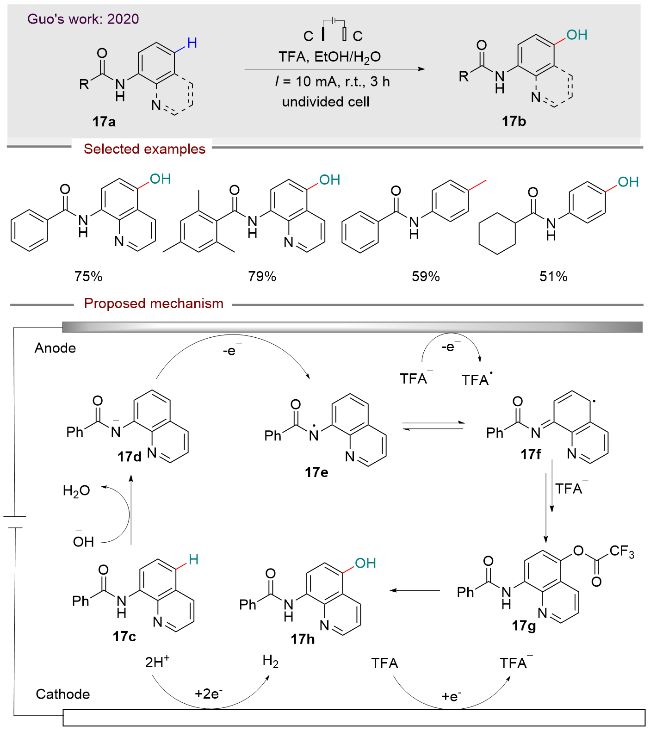
将惰性C—H键直接转化为羟基是极具吸引力的合成路径. 电化学为此提供了独特解决方案, 其关键在于如何避免产物的过度氧化并控制区域选择性. 2020年, 郭凯课题组[85]报道了一种N-芳酰胺的对位选择性羟基化的策略(Scheme 17). 该反应通过三氟乙酸(TFA)阴离子的阳极氧化产生酰氧自由基, 进而触发自由基串联过程. 18O同位素标记实验证实羟基氧源完全来自TFA而非水, 不同于传统电化学羟基化的氧传递路径. 作者观察到, 在底物存在时TFA的氧化电位发生负移, 同时伴随电流增强. 这一现象表明该反应经过了质子耦合电子转移(PCET)机制, 即酰胺氮阴离子17d经单电子氧化生成氮自由基中间体17e, 17e经分子内1,5-氢迁移形成共振稳定的碳自由基17f, 最终被酰氧自由基捕获并水解, 得到最终产物. 该机理成功解释了为何无需酸性溶剂或季铵盐电解质, TFA同时充当质子源与自由基前体, 而水/乙醇混合溶剂既促进导电又参与最终水解.
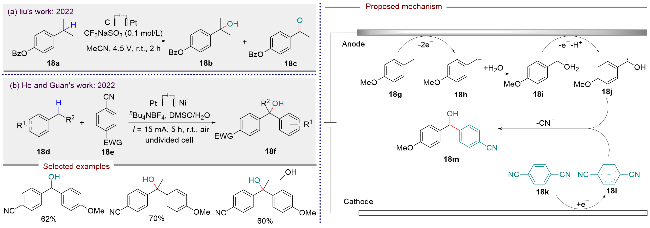
2022年, 柳忠全课题组[86]报道了无金属电化学通过电子-氧气协同机制, 实现惰性C(sp3)—H羟基化的方法(Scheme 18a). 该反应利用O2为氧化剂, 并且添加HCl抑制羟基化副产物. 同年, 何延红和官智团队[87]基于配对电解策略, 报道了一种无金属催化的未活化苄位碳(sp3/sp2/sp)直接羟基芳基化的方法(Scheme 18b). 该反应利用电化学氧化, 将廉价易得的烷基/烯基/炔基苯转化为关键碳自由基中间体18j, 同时在阴极还原氰基芳烃产生持久性自由基阴离子18l, 两者通过自由基-自由基交叉偶联高效构建C—C键, 并以水为绿色羟基源引入羟基官能团. 这一过程在室温、敞口空气下进行, 无需任何金属催化剂、氧化还原介质或额外添加剂, 成功实现了对惰性苄位C—H键的直接官能化, 一步合成具有重要药物价值的空二芳基甲醇及三芳基甲醇衍生物.
2.1.2 C—H键氧化构建羰基化合物
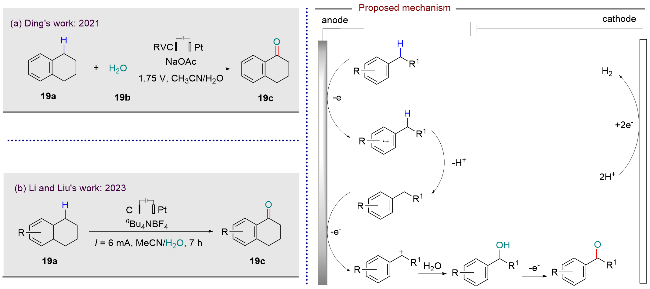
将C—H键一步转化为醛或酮是更高氧化态的转化, 对合成化学提出了更大挑战. 电化学通过精准控制氧化程度, 在此领域展现出强大潜力. 2021年, 丁梦 宁[88]报道了以水为氧源实现酮的高选择性合成(Scheme 19a). 该反应的创新性在于水分子作为绿色氧源与动态亲核试剂, 通过协同电极界面效应, 实现高选择性酮合成. 反应机理是阳极氧化首先生成苄基碳正离子中间体, 其亲电性驱动水分子直接进攻形成醇中间体, 而非传统氧分子参与的路径. 该过程受电极/溶液界面微环境精密调控-亲水性电极表面显著富集水分子, 加速亲核捕获步骤, 添加的弱碱则通过稳定碳正离子, 并促进醇中间体脱氢, 有效抑制脱水副反应, 实现酮的专一选择性. 2023年, 李靖和柳凌艳团队[89]也报道过类似的反应(Scheme 19b).
2025年, 仇友爱课题组[90]报道了一种创新的无金属电化学策略, 实现了苄位C(sp3)—H键高选择性直接羟基化(Scheme 20a). 该策略的关键突破在于利用六氟异丙醇(HFIP)作为溶剂, 通过独特的溶剂效应精准调控反应进程, 有效解决了长期存在的醇产物过度氧化难题. 机理研究表明, HFIP的核心作用在于与生成的苄醇产物形成强氢键网络20j. 这种相互作用不仅显著降低了苄醇分子中芳香环的电子密度, 更重要的是, 大幅提升了其自身的氧化电位, 使其远高于初始烷基芳烃底物的氧化电位. 这一关键的氧化电位差(约300 mV)在乙腈等溶剂中并不存在, 为选择性抑制苄醇的进一步氧化提供了动力学基础, 实现了“动态保护”效应. 反应起始于阳极单电子氧化烷基芳烃生成苄位自由基阳离子中间体20f, 该中间体经历逐步的质子-电子转移过程, 形成高活性的苄基碳正离子20h, 最终被水分子亲核捕获, 生成目标苄醇20i. 动力学同位素效应表明, C—H键断裂并非决速步骤, 电流密度与反应速率的线性关系进一步证实, 电子转移过程是整体反应的速率决定步骤. 因此, HFIP在该电化学体系中的角色超越了传统溶剂, 通过氢键介导的氧化电位调控, 充当了实现高选择性苄位羟基化的关键“分子开关”.
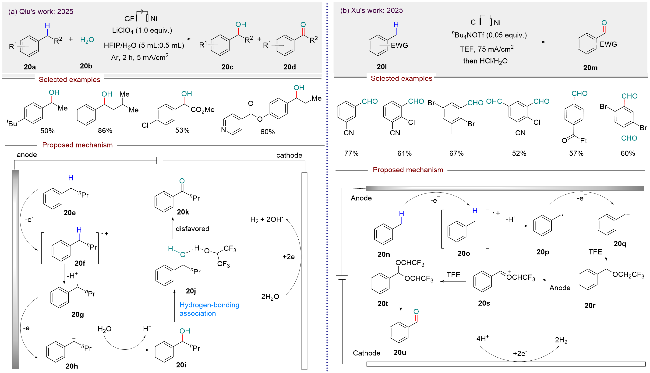
2025年, 徐海超课题组[91]开发了一种面向工业应用的电化学策略(Scheme 20b), 成功实现缺电子甲基芳烃向芳醛的低电解质浓度(0.05 equiv.)与三氟乙醇(TFE)溶剂的协同作用, 解决了缺电子底物氧化电位高、易发生芳香环副反应的核心难题. 机理研究表明, 低电解质条件扩大了底物/中间体与产物的氧化电位窗口, 有效抑制了缩醛产物的过度氧化分解, 显著提升反应选择性, 这与传统认知相反. 作者通过原位表征, 揭示了甲基芳烃经苯甲醚中间体转化为缩醛的分步机制, 其中TFE溶剂通过弱亲核性, 优先捕获苄基碳正离子中间体20q, 避免强亲核溶剂导致的竞争性副反应. 作者还通过竞争电解实验, 显示了高氧化电位的缺电子底物无法与富电子底物竞争氧化, 证明了阳极单电子转移(SET)生成芳环自由基阳离子的启动步骤. 同时, 三氟乙醇(TFE)的抗氧化性抑制了溶剂自身分解, 其低介电常数特性进一步优化了电极界面双电层结构, 协同低电解质条件, 实现高电流密度下的稳定运行.
2.1.3 连续流电化学在C—O键构建中的应用
近年来, 电化学连续流技术因其传质主导的高效性和精准的热力学控制等优势, 逐渐代替了传统的电化学合成模式. 其关键在于通过微尺度反应单元重构反应时空维度, 实现传质、传热及过程控制的协同强化. 2022年, 徐海超团队[92]在连续流动微反应器中, 实现了芳烃 C—H键的羟基化, 高效合成酚类化合物(Scheme 21a). 该方法具有极其广泛的底物普适性, 成功应用于富电子(如苯甲醚衍生物、多环芳烃、含杂环芳烃)、中性以及缺电子(如卤苯、苯甲醛、苯甲酸酯、苯)等各类芳烃的羟基化. 工作的机理创新在于精准调控自由基阳离子反应路径与微反应器时空特性, 阳极氧化生成的芳烃自由基阳离子, 通过单占据分子轨道(SOMO)分布决定区域选择性, 与经典亲电取代规律一致. 生成的三氟乙酸酯中间体的电位屏障作用显著高于原料和酚产物, 为抑制过度氧化提供内在保护. 电化学连续流反应器提供的22 s超短停留时间则强制截断反应进程, 使高活性中间体在降解前离开电极界面, 这种“超短停留时间”就像是一个“反应闹钟”, 它通过极短的反应时间窗口, 在中间体降解前终止反应, 从而有效防止过度氧化. 这个快速的反应过程能够保证产物的选择性, 避免了不必要的副反应生成, 有效抑制了酚类产物易被过度氧化这一长期难题, 克服了传统间歇电化学法的瓶颈. 在C—O键的构建中, 反应的选择性和反应物的传质问题仍然是瓶颈. 在大规模工业化生产时, 如何精确控制反应的区域选择性, 避免过度氧化或副反应的发生, 是电化学在放大生产中需要解决的关键问题. 此外, 如何降低电化学反应中的能量消耗, 并优化设备以提高生产效率, 将对工业化过程的成本控制起到关键作用. 该方法为电化学反应器的选型、传质效率的提升以及副反应的抑制, 提供了切实可行的思路与案例.
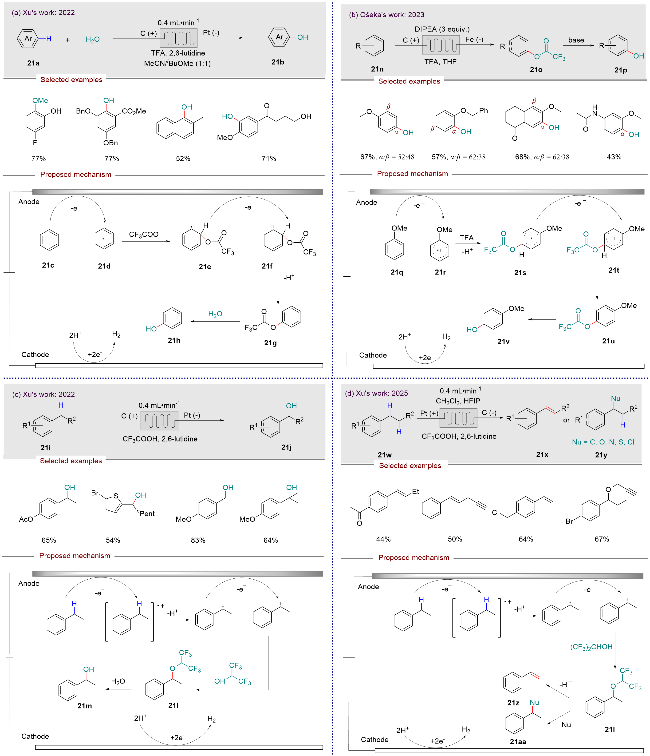
同年, Ošeka课题组[93]报道了相似的策略(Scheme 21b), 与徐海超工作不同的是, Ošeka的工作更注重富电子芳烃, 对缺电子芳烃无效, 特别是未能解决苯直接羟基化这一难题. 此外, 该工作提出以2,6‑二甲基吡啶作为“过充保护剂”, 用以稳定反应体系. 2023年, 徐海超课题组[94]报道了连续流电化学苄位C(sp3)—H羟基化策略(Scheme 21c). 该反应的机理为: 阳极单电子氧化生成高活性芳烃自由基阳离子后, 经历逐步电子/质子转移形成苄基碳正离子, 该中间体被三氟乙酸(CF3CO2H)特异性捕获生成三氟乙酸酯中间体21l. 由于该酯类的氧化电位远高于底物烷基芳烃, 可有效阻断醇产物的过度氧化路径. 同时, 连续流微反应器的超短停留时间进一步抑制了酯中间体的分解, 使其在后续水解中定量转化为苄醇. 该机制通过极性敏感的电子转移步骤实现位点选择性, 芳环电荷分布主导自由基阳离子的不可逆去质子化, 优先断裂电子云密度最高的苄位C—H键, 同时, 三氟乙酸的弱亲核性与连续流的精准控时特性, 协同避免了强亲核溶剂(如MeCN)导致的Ritter胺化等副反应. 2025年, 徐海超团队[95]又报道了一种电化学苄位C(sp3)—H氧化反应(Scheme 21d), 与之前工作不同的是, 这篇工作将三氟乙酸酯作为多功能合成子, 精准调控碳正离子反应性, 通过酸促进消除或亲核取代, 实现多样性转化. 解决了传统电合成中亲核试剂受限与立体控制不足的难题.
2.1.4 C—H键烷氧基化与醚化
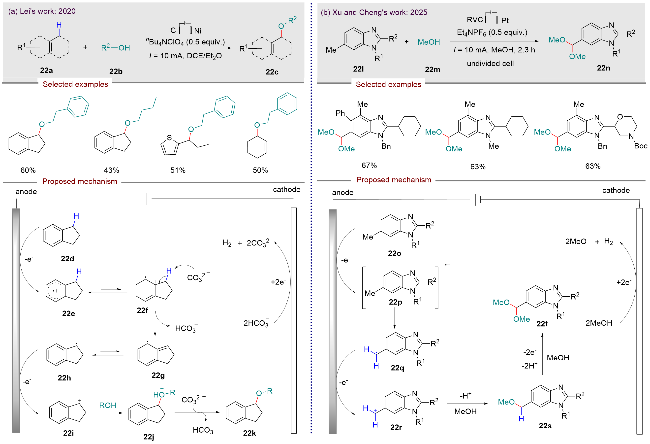
直接构建醚键或酯键是另一类重要的转化. 电化学驱动的C—H键烷氧基化/酰氧基化为该反应提供了一条高原子经济性的合成路径. 2020年, 雷爱文课题组[96]报道了一种通过阳极氧化诱导的C(sp3)—H/O—H交叉偶联实现醚化反应(Scheme 22a). 相较于传统醚化方法存在底物需预官能团化、依赖强氧化剂或金属催化剂, 且步骤繁琐、原子经济性低下的弊端, 该方法完全避免金属催化剂与氧化剂的使用, 环境友好, 原子经济性高; 该反应的机理在于巧妙利用底物氧化电位的差异进行选择性活化. 研究发现, 苄基或烯丙基底物在阳极上经历单电子转移(SET)过程, 优先氧化生成关键的芳基自由基阳离子中间体22e. 该中间体可发生共振, 并在碱协助下攫取氢原子生成自由基22g, 其进一步共振形成苄基自由基22h. 随后, 22h在阳极经历第二次单电子氧化, 生成高亲电性的苄基碳正离子中间体22i. 此时, 作为亲核试剂的醇进攻该碳正离子中心, 最终形成C—O键, 并伴随阴极析氢, 完成整个电化学循环. 该策略成功实现了多种苄基/烯丙基底物与伯/仲醇的直接醚化. 2020年, 徐海超和程俊团队[97]实现了甲基苯并杂环在C6位点的精准氧化至芳香缩醛(Scheme 22b), 揭示了自由基阳离子介导的β-裂解途径. 研究发现, 阳极单电子氧化(SET)优先发生在富电子的苯并杂芳环上, 生成关键的芳基自由基阳离子中间体22p. 该中间体的自旋密度与电荷分布高度局域化于C6位, 驱动其发生选择性β-裂解, 形成苄基自由基22q. 随后, 22q在阳极经历第二次单电子氧化, 生成高亲电性的苄基碳正离子中间体22r. 该碳正离子与甲醇溶剂发生亲核加成, 最终形成缩醛产物22t. 电化学法则展现出独特的C6位点选择性, 显著区别于传统自由基HAT路径. 这一电子效应主导的机制成功克服了杂原子配位对金属催化剂的抑制问题.
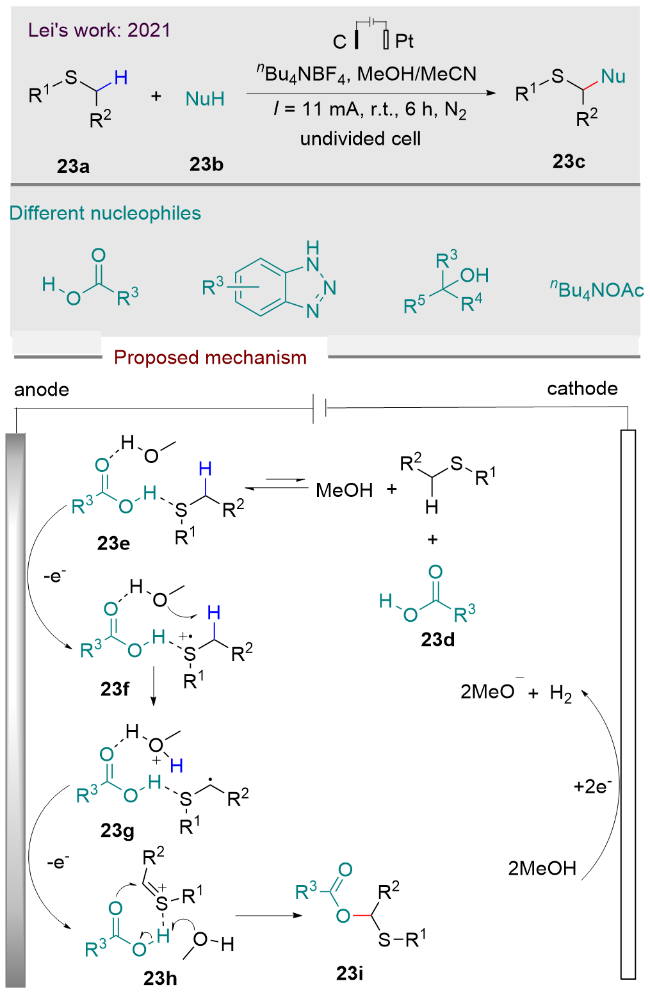
2021年, 雷爱文课题组[98]通过自组装诱导的区域选择性C(sp3)—H/O—H交叉偶联, 实现高效酰氧基化(Scheme 23). 该工作揭示了微量甲醇对反应物自组装的调控作用. 甲醇可诱导乙酸(AcOH)形成自缔合簇23d, 并促进AcOH、硫醚与甲醇形成三元组装体23e. 在此组装结构中, 硫醚通过氢键与AcOH预结合, 使其阳极氧化电位显著降低, 优先经单电子转移生成硫自由基阳离子中间体23f. 组装体的空间导向作用使甲醇能特异性地从位阻较小的α-硫甲基攫取质子, 实现高区域选择性脱质子, 形成硫鎓离子23h. 这一关键步骤得到动力学同位素效应(KIE)的证明, 表明甲醇通过碱促进机制, 加速了脱质子过程. 生成的强亲电硫鎓离子随即被邻近的AcOH亲核进攻, 完成C—O键构建. 该“动态自组装”机制成功克服了硫醚易过度氧化、多 C(sp3)—H键选择性差等难题.
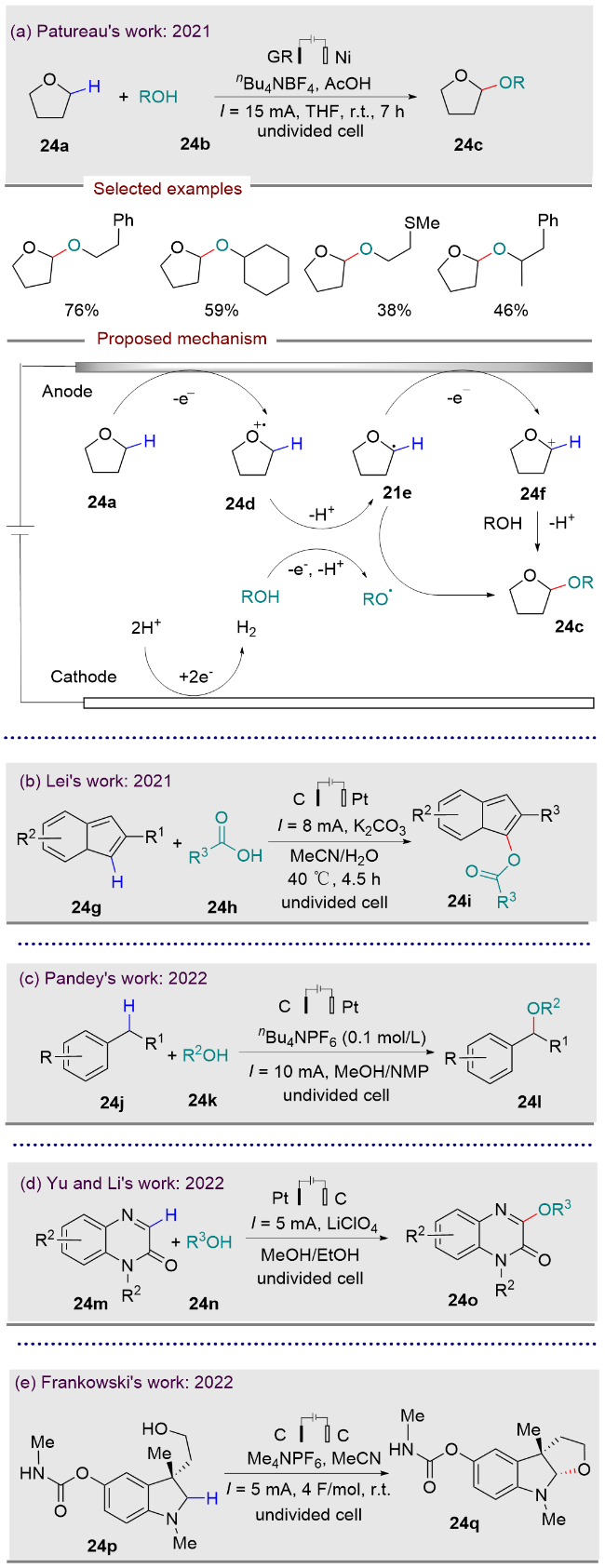
2021年, Patureau团队[99]报道了醇与四氢呋喃之间高效的C(sp3)—H/O—H交叉偶联(Scheme 24a), 实现了醇羟基的四氢呋喃(THF)保护基原位引入. 该反应通过THF自由基阳离子介导的C(sp3)—H键活化路径, 突破传统缩醛化对强酸或高温的依赖, 高温条件下以THF兼作溶剂与试剂, 实现高原子经济性转化. 同年. 雷爱文课题组[100]以羧酸为酰氧源, 通过阳极氧化实现咪唑并[1,2-a]吡啶类化合物(imidazo[1,2-a]pyridines) C3—H与羧酸O—H键的偶联(Scheme 24b). 该反应的关键是, 底物优先氧化产生自由基阳离子中间体, 随后被亲核试剂捕获得到产物. Pandey课题组[101]实现了甲苯衍生物苄位C(sp3)—H键与醇类的直接交叉脱氢烷氧基化(Scheme 24c). 俞传明和李坚军[102]也报道了喹喔啉- 2(1H)-酮与醇类的C(sp2)—H/O—H直接偶联策略(Scheme 24d). 该方法对喹喔啉酮N-取代基及芳环取代基展现出优异兼容性. 机理研究表明, 反应通过阳极氧化形成阳离子中间体后, 被醇捕获. 2022年, Frankowski[103]在天然产物合成领域发展了分子内电化学C—O成键关键反应(Scheme 24e), 实现了吲哚啉骨架的直接环醚化. 该策略通过阳极氧化生成亚胺离子中间体, 驱动羟基对C(sp3)—H位点的亲核环化, 避免了传统路线中强还原剂的使用.
2022年, 卿凤翎团队[104]利用廉价三氟甲基源与氧气实现芳烃的直接C—H三氟甲氧基化(Scheme 25a). 该工作的核心机理在于通过阴极调控的级联自由基转化实现CF3O•的高效生成与精准捕获. 首先生成CF3自由基25h, 经氧气捕获形成CF3OO•中间体25i, 进一步还原为关键CF3O•自由基25j, 最终与(杂)芳烃发生自由基加成/氧化芳构化, 高效构建C(sp2)—OCF3键. HFIP不仅通过氢键活化底物, 其高溶氧性及稳定自由基的特性对维持自由基链式反应至关重要. 该“阴极触发-阳极终止”的双极协同机制, 成功规避了传统三氟甲氧基化对不稳定阴离子(CF3O-)或昂贵试剂的依赖, 实现三氟甲氧基基团的“一锅”原位组装.
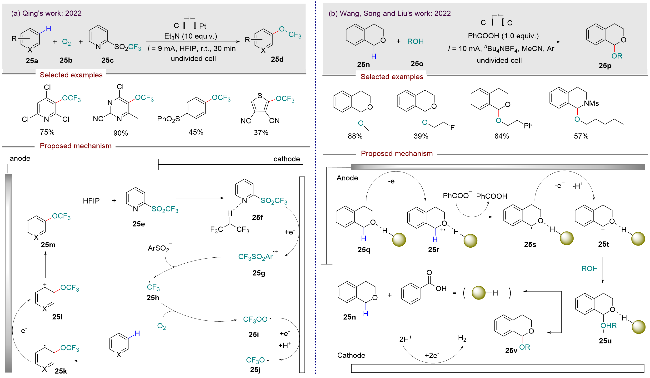
同年, 王庆明、宋红健和刘玉秀团队[105]报道了氢键介导的电化学策略, 实现了异色满α-C(sp3)—H键的高效烷氧基化(Scheme 25b). 其中, 苯甲酸通过氢键作用显著提升反应效率, 并抑制α-羰基化等副反应. 反应的关键机理是苯甲酸通过氢键稳定中间体, 促进异色满阳极氧化形成自由基和阳离子, 最终被醇捕获, 生成相应的烷氧基化产物.
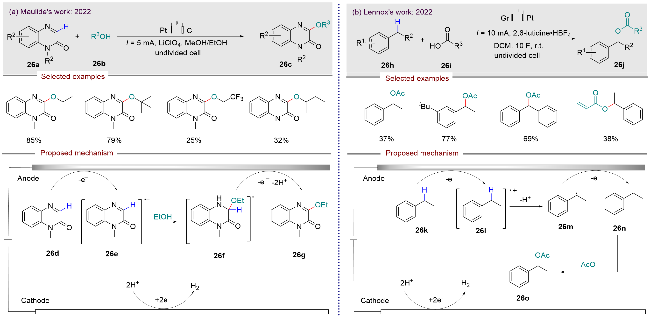
电化学极性翻转(Electrochemical polarity inversion)是一种通过电极调控底物电子特性, 逆转其固有反应活性的策略. 该机制通过单电子转移改变底物氧化态, 将亲核位点转化为亲电位点(或反之), 突破传统极性限制, 实现非常规键合模式. 2022年, Maulide团队[106]报道了一种电化学Umpolung合成策略, 实现了氧吲哚 C3(sp3)—H键的直接官能团化(Scheme 26a). 将传统上呈现亲核性的氧吲哚C3位, 通过阳极氧化转化为亲电位点, 成功构建了多种非对称3,3-二取代氧吲哚衍生物. 机理研究表明, 底物在阳极失去电子, 随后脱质子发生极性反转, 生成碳正离子, 随后被亲核试剂捕获. 同年, Lennox课题组[107]报道了一种无金属电化学苄位 C(sp3)—H键的直接酰氧化反应(Scheme 26b). 该反应拓展了羧酸的底物范围, 不仅限于传统的醋酸, 更涵盖了空间位阻显著或带有季碳中心的烷基羧酸, 以及含不饱和键的羧酸. 该方法的关键在于精准调控反应条件, 有效规避了羧酸组分在阳极上发生氧化, 从而确保反应选择性地由电化学生成的苄基碳正离子中间体进行, 并被羧酸亲核捕获生成苄酯.
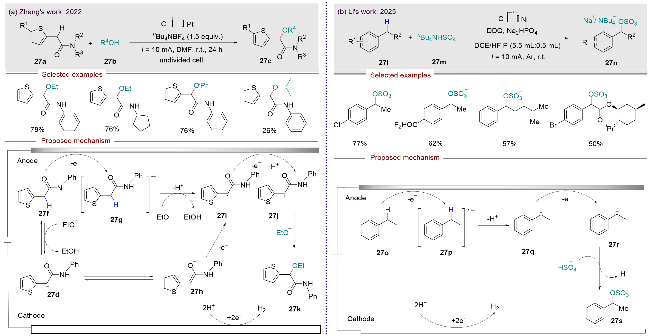
2024年, 张云飞课题组[108]报道了电化学极性翻转策略, 实现了噻吩乙酰胺α-C(sp3)—H键的直接烷氧基化(Scheme 27a). 该方法对仲酰胺、伯酰胺及三级酰胺均适用, 可兼容甲醇、异丙醇等脂肪醇以及水, 成功应用于氘代甲氧基标记. 反应通过阴极还原醇类, 产生烷氧基负离子, 同时驱动酰胺底物的阳极氧化, 成功逆转了了传统酰胺α-碳的亲核性, 实现极性翻转. 李家昆课题组[109]报道了通过电化学C—H磺化反应实现苄位C—H 键的直接磺化(Scheme 27b). 该反应突破了传统磺化反应需要预装羟基的限制, 通过电化学一步形成C—OSO键. 通过精确控制电极电位, 可以实现对不同位点的选择性磺化. 机理研究表明, 该反应过程始于阳极介导的芳烃单电子氧化, 生成自由基阳离子中间体27p, 其通过位点选择性去质子化生成苄基自由基27q, 随后在电极表面进一步氧化为关键苄基碳正离子27r, 最终被四丁基铵稳定的硫酸氢根亲核捕获, 构建C—OSO3键. 其中, α-磺酸基的吸电子效应降低了芳环电子密度, 阻碍了二次氧化, 并且四丁基铵离子通过增强硫酸氢根亲核性稳定产物, 多重作用使得含游离羟基的底物也能专一发生C—H磺化. 该机制突破了强酸性条件下硫酸根亲核性不足的限制, 为惰性碳氢键的极性反转提供电化学策略.
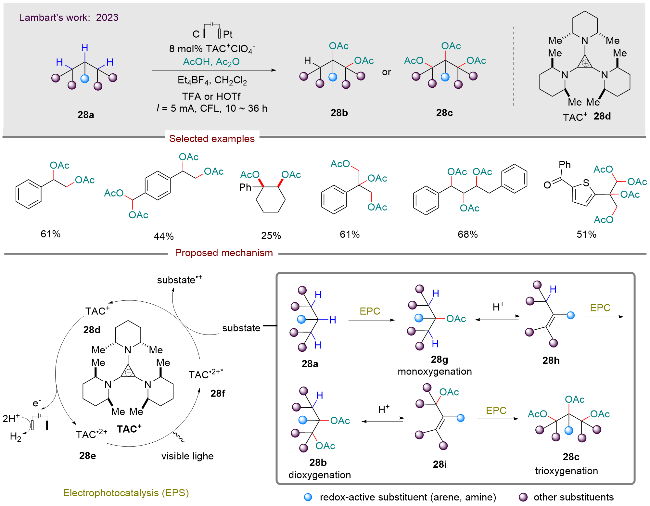
长期以来, 如何选择性地在相邻的多个C—H位点同时引入氧原子是一项极具挑战性的工作. 传统方法很容易导致过度氧化. Lambert团队[110]发展了一种三氨基环丙烯鎓离子催化的无金属电化学催化策略(Scheme 28), 实现了对烷基芳烃及三氟乙酰胺中多个相邻C—H键的直接、选择性氧合. 该工作的突破性在于: 通过调控反应条件, 能够高选择性地获得二或三醋酸酯产物(28b, 28c), 精准控制了传统方法中极易发生的过度氧化问题. 该策略的关键在于利用三氨基环丙烯鎓离子作为氧化性电化学催化剂. 该催化剂在阳极被低电位氧化后, 在光激发下产生极具氧化性的激发态(28f), 能够活化底物生成自由基阳离子. 该活性中间体在醋酸体系中, 经历了一系列单电子转移/去质子化/亲核捕获的循环, 并通过巧妙的E1型消除步骤生成共轭烯烃中间体(28h), 从而实现对下一个相邻C—H键的再次活化, 最终完成连续的多重氧合. 该方法通过精确调节酸的强度(TFA或TfOH), 可以高选择性地分别获得双氧合或三氧合产物, 有效规避了长期以来困扰化学家的过度氧化难题, 并成功应用于多种生物活性分子的后期修饰与简洁合成, 如氟比洛芬、舍曲林的后期官能团化, 显著缩短了抗真菌药物Genaconazole和一种糖苷酶抑制剂的合成路线, 从原来的从8步大幅缩减至3步, 充分展现了其在提升合成效率方面的巨大潜力. 这项工作不仅首次实现了在单一反应器中对三个相邻C—H键进行可控氧合, 更通过“电化学催化”这一无金属策略, 为复杂分子的精准、高效构筑提供了新模式.
2.2 非金属介导的电化学C—H键活化构建C—O键
直接电化学C—H活化策略, 通过在电极表面发生直接的电子转移, 为构建C—O键提供了最直接的路径, 并展现出优异的原子经济性. 然而, 该策略在处理高氧化电位底物或复杂分子时, 常面临电极钝化、官能团兼容性有限及选择性难以精确调控等挑战. 为了突破这些瓶颈, 非金属介导的间接电化学策略应运而生, 并发展成为该领域不可或缺的强大工具. 该策略的核心在于, 利用可溶性的氧化还原介质(Redox Mediators)作为“电子穿梭体”, 优先在电极表面发生可逆的氧化还原反应, 生成高活性的中间体(如自由基、高价态物种), 随后在均相溶液中与底物发生氢原子转移或电子转移, 从而实现对惰性C—H键的远程活化. 这一“均相活化”过程有效避免了电极与底物的直接、非特异性相互作用, 显著增强了反应的普适性、选择性与可控性.
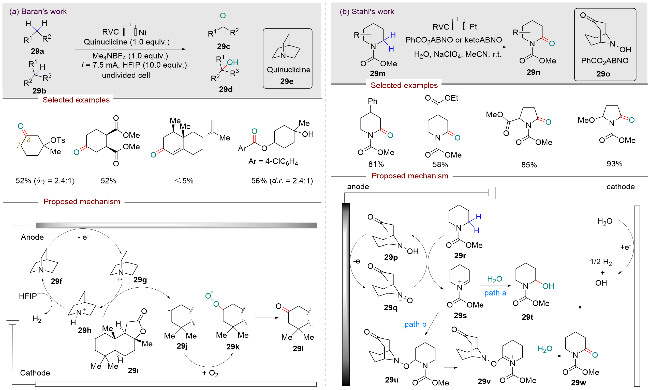
Baran课题组[111]用简单廉价的试剂奎宁环啶(Qui- nuclidine), 在温和的条件下, 高效且高选择性地实现了最具挑战性的未活化的C(sp3)—H键向羰基的转化(Scheme 29a), 该机制突破了传统化学氧化剂对杂原子敏感的限制, 实现与吡啶氮、游离羟基的兼容性. 反应的机制是, 奎宁环在阳极优先氧化生成高能自由基阳离子, 该瞬态物种通过均裂氢原子攫取活化键能高的亚甲基/次甲基位点, 生成碳自由基中间体29j, 该中间体与分子氧结合形成过氧自由基29k, 最终经阴极析氢驱动的还原裂解转化为羰基产物. 其中, 溶剂六氟异丙醇(HFIP)通过氢键网络稳定自由基中间体, 同时调控阴极析氢反应维持电荷平衡. Stahl课题组[112]报道了一种氨基氧介导的低电位电化学策略, 用于实现环状氨基甲酸酯的Shono型α-氧化反应(Scheme 29b). 作者通过引入双环氨基氧介质, 通过氢负转移机制活化非活化底物的α-C(sp3)—H键, 避免了传统Shono氧化所需的高电位. 该策略以水为亲核试剂, 在温和条件下实现了环状氨基甲酸酯的α-羟基化, 成功兼容传统Shono条件无法反应的富电子芳环以及卤素、酯基、磺酰基等敏感基团. 反应的机理是双环氨基氧介质在阳极氧化生成氧铵离子29q, 该高活性物种通过协同氢负攫取直接氧化底物的α-氨基C—H键, 生成亚胺离子中间体29v. 该中间体被水捕获形成半缩醛类似物, 经二次氧化转化为α-羟基产物.
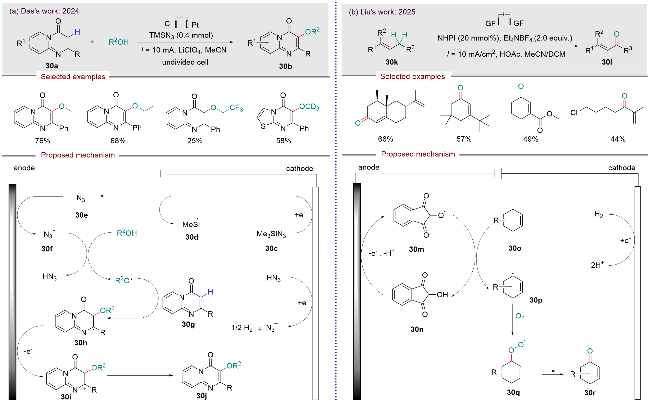
2024年, Das课题组[113]通过TMSN3介导的HAT过程, 实现了吡啶并[1,2-a]嘧啶-4-酮与脂肪醇的电化学烷氧基化(Scheme 30a). 该反应的机理是阴极还原TMSN3生成叠氮自由基30f与三甲基硅基自由基30d, 其中叠氮自由基通过均裂攫取醇的O—H键产生亲电性的烷氧自由基, 该自由基选择性加成至吡啶并嘧啶酮的C3位, 生成苄位稳定的碳自由基中间体30h, 经阳极氧化形成碳正离子3i, 最终脱质子得C(sp2)—O键产物. 2025年, 柳忠全课题组[114]报道了一种无金属、空气氧化驱动的电化学烯丙位C(sp3)—H氧化策略(Scheme 30b), 利用N-羟基邻苯二甲酰亚胺(NHPI)作为氢原子转移介导剂, 在不分隔电解池中实现烯烃向烯酮的高效转化. 该方法以空气为绿色氧源, 乙酸为添加剂, 成功避免了传统方法对过渡金属催化剂和等物质的量的有毒氧化剂或过氧化物的依赖.


3 总结与展望
本文总结了近5年来电化学驱动下实现惰性C—H键活化、构建C—N/C—O键的研究进展, 并重点分析了相关反应机理. 这类反应利用电子作为“清洁试剂”, 避免了贵金属催化剂和等物质的量的氧化剂的使用, 具有反应条件温和可控、底物适用范围广、反应机制灵活且易于放大的优点, 显示了电化学在C—N/C—O键构建方面的巨大潜力. 然而, 该领域仍面临一些挑战, 特别是在脂肪族惰性C—H键活化效率较低和兼容性不足方面, 主要受限于其较高的键能和较低的反应性. 未来的研究应着力优化电极材料、催化剂设计和反应条件, 以提高脂肪族复杂分子后期修饰的效率. 在无金属电化学C—H活化中, 对映选择性的控制仍然是一个亟待解决的问题. 为此, 未来的研究可通过新型催化剂设计、反应条件优化以及光电协同催化等手段来应对这一挑战. 此外, 反应的规模化应用仍面临传质问题和成本控制等难题. 未来的研究将侧重于提升脂肪族C(sp3)—H活化效率, 优化催化体系以增强对映选择性, 并探索新兴的光电协同催化和机器学习辅助电合成等方向, 推动电化学合成技术的进一步发展和工业化应用. 相信这些新兴技术有望为该领域带来突破, 推动无金属电化学技术成为绿色化学的重要组成部分. 无金属电化学C—H活化凭借其独特的反应性和可持续性, 已成为现代合成化学中的重要工具. 随着机制研究的深入、新催化体系的出现以及反应工程的优化, 该技术有望在药物合成、材料科学和精细化工领域实现更广泛的应用, 为碳-杂原子键的高效构建提供变革性解决方案.
(Cheng, F.)