


1 Introduction
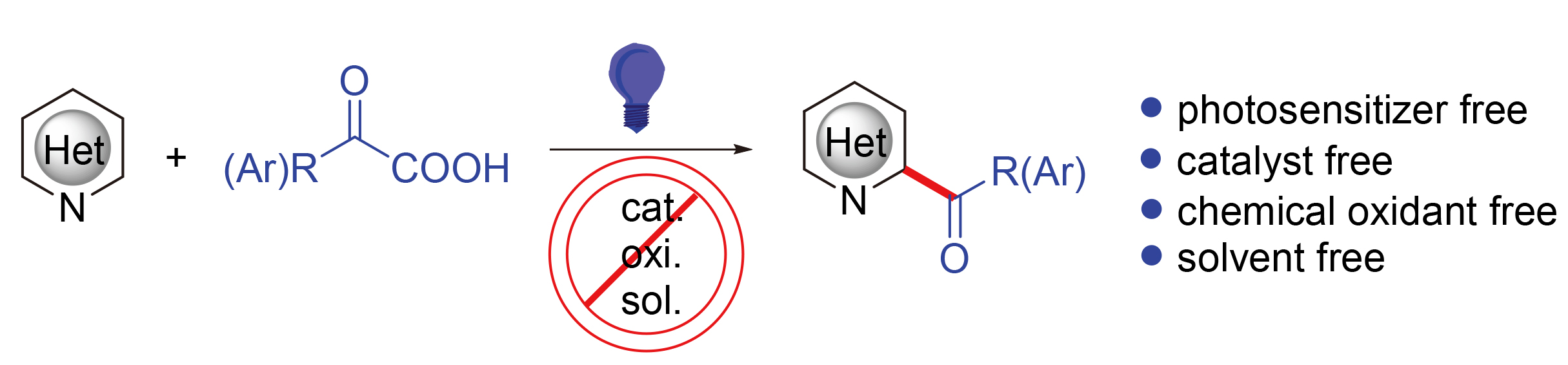
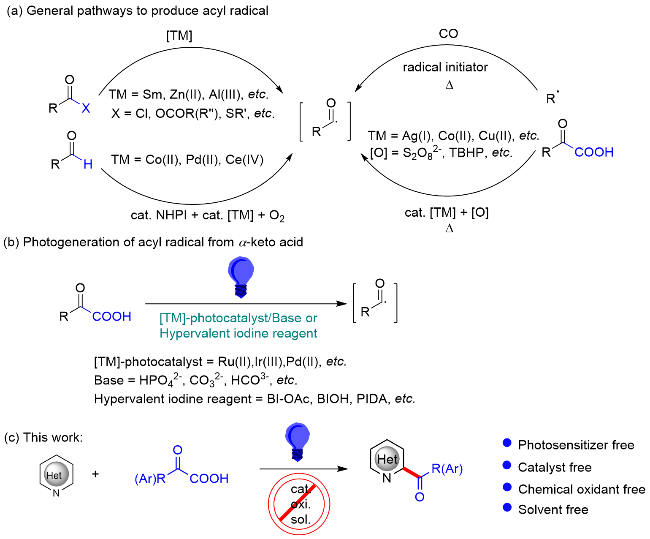
The addition of an acyl radical to an electron deficient N-heteroarene is an efficient access to N-heteroaryl ketones.[1] In general, acyl radicals can be produced from the following four pathways: cleavage of C—X bond in RC(O)X (X=Cl, OCOR', SR' etc.),[2] hydrogen-atom transfer (HAT) from RCHO,[3] addition of alkyl radical to carbon monoxide,[4] decarboxylation of α-keto acids[5] (Scheme 1a). Among them, the free radical acylation via decarboxylation of α-keto acids has received much attention due to their good functional group tolerance and mild conditions. Previous methods usually require metal salts as catalysts (Ag(I), Co(II), Cu(II), Fe(II) etc.) and excess oxidants ($\mathrm{S}_{2} \mathrm{O}_{8}^{2-}$, peroxide, etc.).[6] Later, a series of photochemical acylations with α-keto acids have been developed[7] (Scheme 1b). However, most photochemical acylation reactions require photocatalyst and stoichiometric oxidants or hypervalent iodine reagents.[8] Our interest in the decarboxylative free radical processes[9] promotes to explore more efficient and green method for decarboxylative acylation with α-keto acids. Fortunately, a visible-light initiated acylation of N-heteroarenes was discovered without using any catalyst, oxidant or solvent (Scheme 1c).
2 Results and discussion
Initially, quinoxaline (1a) and acetophenolic acid (2a) were used as model reactants to optimize the reaction conditions. As demonstrated in Table 1, it was found that phenyl(quinoxalin-2-yl)methanone was isolated in good yields under irradiation of blue LED at room temperature in dichloromethane (DCM) solution (Entry 1). Increasing the amount of 2a had little effect on the reaction (Entries 2 and 3). In addition, light played a crucial role in the reaction. When DCM is used as the reaction solvent, the reaction cannot be carried out in total darkness or natural ambient light conditions, but under blue or white light conditions, the target acylation product can be generated, and blue light is better than others (Entries 4~6). Furthermore, we found that the solvent is also important. A wide variety of solvents were screened (Entries 7~10). Interestingly, water was found to be a highly efficient solvent. It can not only improve the yield, but also shorten the reaction time (Entries 8 and 9). Surprisingly, the acylated product was isolated nearly quantitatively without any solvent (Entry 10). What’s even more surprising is that the reaction rate under solvent-free conditions is at least 10 times faster than that in solution.
Table 1 Optimization of the reaction conditionsa |

| Entry | 2a/equiv. | Light source | Solvent/mL | Time/h | Yieldb/% |
|---|---|---|---|---|---|
| 1 | 1.2 | Blue LED | DCM (4.0) | 20 | 70 |
| 2 | 1.5 | Blue LED | DCM (4.0) | 20 | 66 |
| 3 | 3.0 | Blue LED | DCM (4.0) | 18 | 68 |
| 4 | 1.2 | White LED | DCM (4.0) | 36 | 57 |
| 5 | 1.2 | Ambient light | DCM (4.0) | — | NDc |
| 6 | 1.2 | Dark | DCM (4.0) | — | NDc |
| 7 | 1.2 | Blue LED | DCE (4.0) | 16 | 73 |
| 8 | 1.2 | Blue LED | H2O (4.0) | 10 | 66 |
| 9 | 1.2 | Blue LED | H2O (2.0) | 10 | 80 |
| 10 | 1.2 | Blue LED | Solvent-free | 1.5 | 94 |
a Reaction conditions: quinoxaline (1.0 mmol, 1.0 equiv.), room temperature. b Isolated yield. c ND=not detected. |
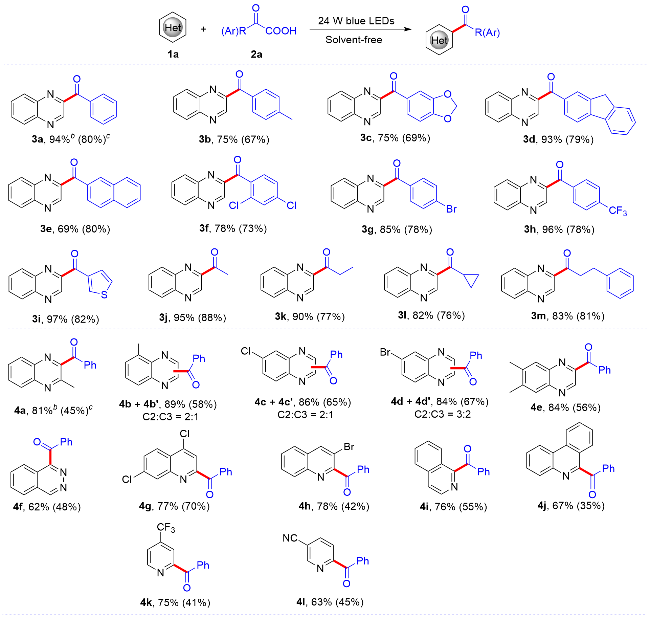
Next, the scope of the reaction was investigated. As depicted in Scheme 2A, both aryl and alkyl α-keto acids are compatible with this system. Results from electronic effect studies indicate that electron-deficient keto acids gave higher yields than the electron-rich ones (3b~3i). Additionally, short chain alkyl keto acids are more efficient than long chain substrates (3j~3m). In some cases, very little aldehydes were observed as by-products, which should be due to the hydrogen abstraction by the acyl radicals. Furthermore, an array of N-heteroaromatics were screened under the typical conditions (Scheme 2B). A wide range of N-heteroarenes, such as quinoxalines, phthalazine, quinolines, isoquinolines, phenanthridine, pyridines gave the corresponding acylation products in good yields (4a~4l). Generally, the efficiency of solvent-free reactions is higher than that in water. A series of regio-isomers were obtained with substrates 4b~4d, and the cite-selectivity might be dominated by the electronic effect of N-hetero- arenes. In addition, very little reductive coupling alcohols were observed with quinolines (4h and 4i). Gratifyingly, pyridines were also effective substrates (4k and 4l), but only mono-acylated products were observed.
To further study the solvent effect, a set of controlled experiments in different solvents were carried out. As demonstrated in the Table 2, it is found that the efficiency of reactions under solvent-free conditions is obviously higher than that in H2O, CH2Cl2, CH2Cl2/H2O, CH3CN, and C6H12 (cyclohexane).
Table 2 Control experiments in different solvents |
| Product | Time/h | Yield/% | |||||
|---|---|---|---|---|---|---|---|
| Solvent-free | H2O | CH2Cl2 | CH2Cl2/H2O | CH3CN | C6H12 | ||
| 3a | 1.5 | 94 | 80 | 53 | 55 | 32 | 72 |
| 3c | 2.0 | 75 | 69 | 51 | 49 | 28 | 55 |
| 3d | 2.0 | 93 | 79 | 58 | 66 | 50 | 79 |
| 3f | 4.0 | 78 | 73 | <10 | 33 | 40 | 42 |
| 3g | 2.0 | 85 | 78 | 69 | 64 | <5 | 71 |
| 3h | 1.0 | 96 | 78 | 42 | 61 | 67 | 59 |
| 3i | 2.5 | 97 | 82 | 42 | 48 | <10 | 18 |
| 3j | 2.0 | 95 | 88 | 10 | <1 | 71 | <1 |
| 3k | 8.0 | 90 | 77 | 75 | 73 | 31 | 78 |
| 3l | 3.0 | 82 | 76 | 75 | 69 | 37 | 67 |
| 3m | 3.0 | 83 | 81 | 58 | 42 | 69 | 77 |
| 4b+4b' | 4.0 | 89 | 58 | 69 | 68 | 51 | 70 |
| 4g | 5.0 | 77 | 70 | 60 | 64 | <10 | 58 |
| 4k | 2.5 | 75 | 41 | 60 | 61 | 48 | 72 |
| 4l | 3.0 | 63 | 45 | 43 | 41 | 20 | 45 |
| 4b+4b' | 4.0 | 89 | 58 | 69 | 68 | 51 | 70 |
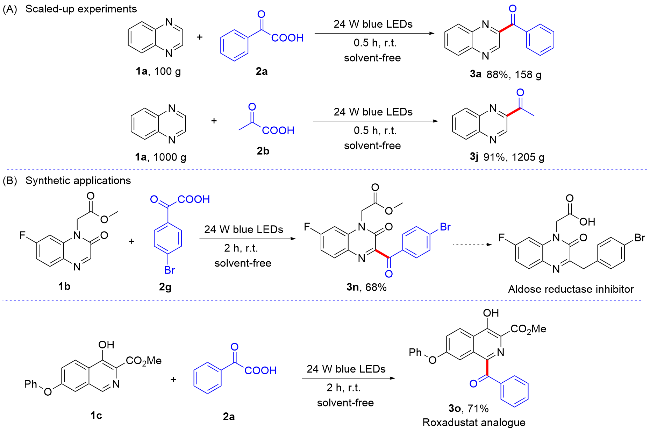
To explore the practicality of this method, a series of scaled-up experiments and synthetic applications were carried out. As demonstrated in Scheme 3A, it is found that the present strategy can be easily scaled-up to 100 g even 1 kg without losing the efficiency. It’s noteworthy that the reaction rate increases with increasing amounts of reactants. In addition, an intermediate of aldose reductase inhibitor and a roxadustat analogue were smoothly synthesized by this method (Scheme 3B).
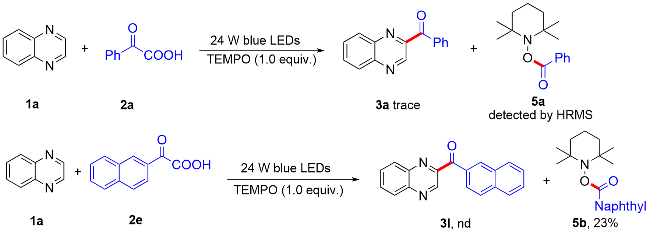
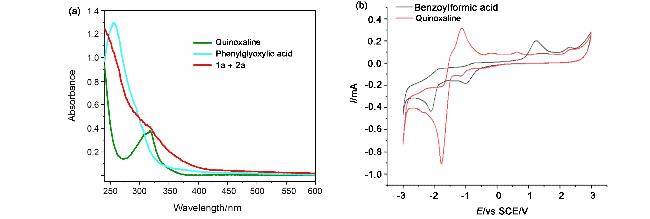
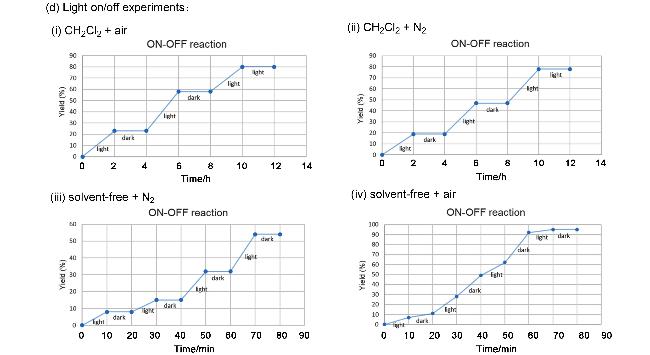
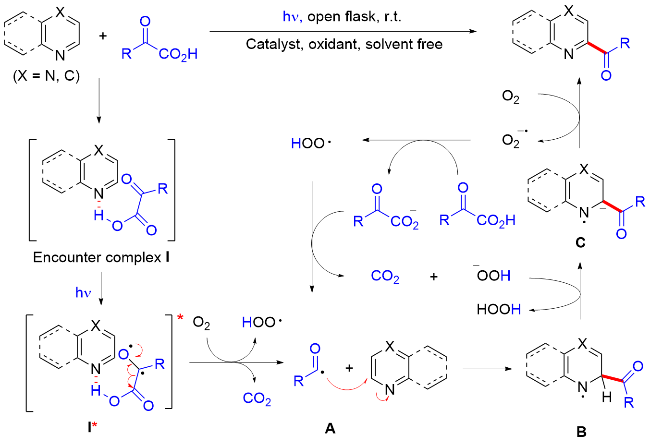
To gain insight into the mechanism of this transformation, a series of experiments were carried out. Firstly, radical inhibition and trapping experiments were performed (Scheme 4). The addition of 1.0 equiv. of 2,2,6,6- tetramethyl-1-piperidinyloxy (TEMPO) completely suppressed the acylation processes. Meanwhile, the adduct of acyl radicals with TEMPO 5a was identified by high-reso- lution mass spectrometry (HRMS). Furthermore, the adduct 5b was isolated in 23% yields, which suggests that acyl radical should be involved in this process. It was observed that there was gas emission when large scale experi- ment occurred. And it was collected to detect its composition using a gas detection tube (Japan GASTEC), confirming that it contains CO2. In addition, the UV-vis absorption spectrum in solid state depicted the light harvesting ability of α-keto acids, quinoxaline and their mixture (Figure 1a). Furthermore, the cyclic voltammetry profiles of quinoxa-line and benzoylformic acid were measured in Figure 1b. Then a set of light on/off experiments were conducted (Figure 2). Light irradiation is necessary for reactions in CH2Cl2 with oxygen or not (i and ii). However, under solvent-free conditions, only anaerobic reaction requires continuous photo-irradiation (iii), the aerobic solvent-free reaction can proceed continuously once it is initiated by light (iv). Based on the experimental data and literature precedent,[10] the possible mechanism for the reaction was proposed (Scheme 5). An encounter complex I will be formed by combination of N-heteroarene with α-keto acid, which then becomes to the excited state I* under irradiation. Next, an oxygen-promoted intramolecular β-fragmentation of the diradical I* will generate the acyl radical A and hydroperoxide radical along with CO2 releasing. Addition of radical A to N-heteroarene will afford radical B, which loses a proton to give a radical anion C. Subsequently, single-electron oxidation of C by O2 gives the product and superoxide anion $\mathrm{O}_{2}^{-\cdot }$, which combines a proton to afford hydroperoxyl radical. This strong oxidant obtains an electron from the α-keto acid anion to produce hydrogen peroxide anion and release CO2 and acyl radical A. In solution, the concentration of O2 is not high enough to oxidize intermediate C to the product constantly, so it requires another oxidant I* to accomplish this process. That’s why systems (i)~(iii) need continuous photoirradiation, but system iv does not (Figure 2).


3 Conclusions
In conclusion, we disclosed here a green access to a wide range of acylated N-heteroaromatics via simple photo-irradiation of the mixture of α-keto acids with N-hetero- cycles. In contrast to previous methods, the present strategy does not need any photosensitizers, catalysts, oxidants or solvents. This system does not even require constant light-irradiation, only photo-initiation is enough to promote this aerobic free-radical acylation reaction.
4 Experimental section
4.1 Instruments and reagents
NMR spectra were recorded on Bruker AVANCE AV 500 instruments and all NMR experiments were reported using residual solvent peaks as internal reference. High-resolution mass spectrometry (HRMS) data were obtained on an LC-MS instrument (ESI- HRMS, Agilent 6520 Q-TOF LC/MS). All reactions were carried out in a 10 mL glass vial (Thermo SCIENTIFIC National B7999-2, made from superior quality 33 expansion borosilicate clear glass), sealed with a PTEF cap on bench top. Blue LED lights 24 W were used for photo-promoted reactions. TLC were performed on silica gel Leyan HSGF254 plates and visualization of the developed chromatogram was performed by fluorescence quenching (λmax=254 nm). Flash chromatography was performed using silica gel (200~300 mesh) purchased from Shanghai Haohong Scientific Co., Ltd.
All commercial materials were used as received unless otherwise noted. Superdry solvents and deuterated solvents were purchased from Energy Chemical. Starting materials for this study were purchased from Leyan or were synthesized according to reported procedures.
4.2 General procedure
Quinoxaline (1.0 mmol, 1.0 equiv.) and α-keto acid (1.2 mmol, 1.2 equiv.) were successively added into a 10.0 mL quartz reaction bottle and the reaction was started in a blue light reactor. The thin-layer chromatography (TLC) plate monitored the reaction until it remained unchanged, and the reaction was stopped. Then column chromatography gave the products.
4.3 General procedure for scaled-up experiments
Quinoxaline (740.7 mmol, 1 equiv.) and pyruvic acid (888.8 mmol, 1.2 equiv.) were added to a 5000 mL glass flask. After 1 min of exposure to blue light, turn off the light source and let it stand for 0.5 h for reaction. TLC showed that the reaction was complete. Batch column chromatography or recrystallization yielded the product.
4.4 Synthesis of substrates
4.4.1 General procedure for synthesis of quinoxaline analogues
A mixture of 40% aqueous solution of glyoxal (15 mmol, 1.5 equiv.), and sodium bisulfite or sodium pyrosulfite (30 mmol, 3.0 equiv.) were heated to 70 ℃ in water (16 mL). It is then poured over a water suspension of 1,2-diaminobenzene (10 mmol, 1.0 equiv.). The reaction mixture was then brought to room temperature with solid sodium carbonate to adjust the pH to 7.5. After TLC monitoring the complete reaction, dichloromethane was added to extract the organic phase, washed with water for 3 times, and then washed with salt water for 1 time. The organic layer separated by anhydrous Na2SO4 was dried, filtered and concentrated, and finally separated by silica gel column. The hydrogen spectrum data are consistent with those reported in literature.
4.4.2 General procedure for synthesis of α-keto acids
In a dried 25 mL round-bottom flask, α-methylketone (10 mmol, 1.0 equiv.) and selenium dioxide (15 mmol, 1.5 equiv.) were added followed by anhydrous pyridine (7 mL). The reaction mixture was then stirred overnight at 110 ℃. The reaction progress was monitored by TLC. After the reaction was complete, the solution containing the precipitated selenium was filtered through a Brucellosis funnel and the residue was washed with DCM (30 mL). The filtrate was treated with 1 mol/L sodium hydroxide aqueous solution until alkaline, and the water layer was separated. It was then treated with a solution of 1 mol/L hydrochloric acid until acidic. The aqueous phase was extracted with DCM (15 mL×3), the organic phase was combined, dried over sodium sulfate, filtered, concentrated, and finally separated by silica gel column to obtain the product.
4.5 Characterization data of products
Phenyl(quinoxalin-2-yl)methanone (3a): White solid, 110 mg, 94% yield. m.p. 80~81 ℃; 1H NMR (500 MHz, Chloroform-d) δ: 9.50 (s, 1H), 8.23 (dd, J=15.9, 8.3 Hz, 4H), 7.93~7.85 (m, 2H), 7.69~7.65 (m, 1H), 7.55 (t, J=7.8 Hz, 2H); 13C NMR (126 MHz, Chloroform-d) δ: 192.38, 148.66, 145.34, 143.20, 140.46, 135.53, 133.68, 132.06, 131.28, 130.84, 130.48, 129.44, 128.42. The spectral data obtained were identical with those reported in literature.[11]
Quinoxalin-2-yl(p-tolyl)methanone (3b): Red solid, 93 mg, 75% yield. m.p. 98~99 ℃; 1H NMR (500 MHz, Chloroform-d) δ: 9.45 (s, 1H), 8.18 (d, J=8.1 Hz, 2H), 8.14 (d, J=8.1 Hz, 2H), 7.85 (dt, J=15.0, 7.5 Hz, 2H), 7.32 (d, J=7.9 Hz, 2H), 2.45 (s, 3H); 13C NMR (126 MHz, Chloroform-d) δ: 191.95, 148.98, 145.36, 144.75, 143.11, 140.44, 132.95, 131.90, 131.42, 130.77, 130.44, 129.40, 129.17, 21.86. The spectral data obtained were identical with those reported in literature.[12]
Benzo[d][1,3]dioxol-5-yl(quinoxalin-2-yl)methanone (3c): Yellow solid, 104 mg, 75% yield. m.p. 65~66 ℃; 1H NMR (500 MHz, Chloroform-d) δ: 9.44 (s, 1H), 8.23~8.18 (m, 2H), 7.92 (dd, J=13.6, 8.3, 2H), 7.89~7.85 (m, 1H), 7.77 (d, J=1.7 Hz, 1H), 6.94 (d, J=8.2 Hz, 1H), 6.11 (s, 2H); 13C NMR (126 MHz, Chloroform-d) δ: 190.17, 152.55, 149.19, 148.04, 145.43, 143.05, 140.30, 131.87, 130.81, 130.36, 129.99, 129.41, 128.70, 110.55, 108.04, 102.02. HRMS (ESI, Q-TOF) calcd for C16H11N2O3 [M+H]+ 279.0764, found 279.0764.
(9H-Fluoren-2-yl)(quinoxalin-2-yl)methanone (3d): Yellow solid, 150 mg, 93% yield. m.p. 84~86 ℃; 1H NMR (500 MHz, Chloroform-d) δ: 9.50 (s, 1H), 8.42 (d, J=1.4 Hz, 1H), 8.30 (dd, J=8.1, 1.6 Hz, 1H), 8.23 (dd, J=8.1, 5.1, 1.7 Hz, 2H), 7.93~7.87 (m, 4H), 7.63~7.58 (m, 1H), 7.46~7.39 (m, 2H), 4.01 (s, 2H); 13C NMR (126 MHz, Chloroform-d) δ: 192.20, 149.36, 147.18, 145.45, 144.79, 143.16, 143.15, 140.50, 140.46, 133.88, 131.90, 130.89, 130.81, 130.46, 129.46, 128.31, 127.81, 127.16, 125.33, 121.14, 119.64, 37.01. HRMS (ESI, Q-TOF) calcd for C22H15N2O [M+H]+ 323.1179, found 323.1180.
Naphthalen-2-yl(quinoxalin-2-yl)methanone (3e): Yellow solid, 98 mg, 69% yield. m.p. 58~59 ℃; 1H NMR (500 MHz, Chloroform-d) δ: 9.57 (s, 1H), 8.86~8.84 (m, 1H), 8.30~8.27 (m, 2H), 8.26~8.25 (m, 1H), 8.02~7.99 (m, 2H), 7.98~7.94 (m, 2H), 7.91 (dd, J=8.4, 6.9, 1.6 Hz, 1H), 7.67 (dd, J=8.2, 6.8, 1.3 Hz, 1H), 7.60 (dd, J=8.1, 6.8, 1.2 Hz, 1H); 13C NMR (126 MHz, Chloroform-d) δ: 192.29, 149.03, 145.43, 143.23, 140.54, 135.86, 134.21, 132.86, 132.37, 132.05, 130.88, 130.52, 130.01, 129.49, 128.98, 128.35, 127.85, 126.82, 125.90. HRMS (ESI, Q-TOF) calcd for C19H13N2O [M+H]+ 285.1022, found 285.1022.
(2,4-Dichlorophenyl)(quinoxalin-2-yl)methanone (3f): Brown solid, 118 mg, 78% yield. m.p. 61~62 ℃; 1H NMR (500 MHz, Chloroform-d) δ: 8.21 (dd, J=8.4, 1.4 Hz, 1H), 8.09 (dd, J=8.5, 1.4 Hz, 1H), 7.91 (dd, J=8.4, 6.9 Hz, 1H), 7.83 (dd, J=8.4, 6.9 Hz, 1H), 7.59 (d, J=8.2 Hz, 1H), 7.51 (d, J=1.9 Hz, 1H), 7.43 (dd, J=8.2, 2.0 Hz, 1H); 13C NMR (126 MHz, Chloroform-d) δ: 193.64, 147.08, 144.13, 143.67, 140.98, 137.83, 135.51, 133.62, 132.63, 131.68, 130.94, 130.65, 130.13, 129.47, 127.15. HRMS (ESI, Q-TOF) calcd for C15H9Cl2N2O [M+H]+ 303.0086, found 303.0079.
(4-Bromophenyl)(quinoxalin-2-yl)methanone (3g): Yellow solid, 133 mg, 85% yield. m.p. 82~85 ℃; 1H NMR (500 MHz, Chloroform-d) δ: 9.40 (s, 1H), 8.12~8.04 (m, 4H), 7.79 (dd J=22.6, 8.4, 2H), 7.58~7.54 (m, 2H); 13C NMR (126 MHz, Chloroform-d) δ: 190.86, 147.95, 145.21, 143.14, 140.17, 134.18, 132.72, 132.19, 131.61, 130.88, 130.37, 129.40, 128.99. The spectral data obtained were identical with those reported in literature.[12]
Quinoxalin-2-yl(4-(trifluoromethyl)phenyl)methanone (3h): Yellow solid, 145 mg, 96% yield. m.p. 87~88 ℃; 1H NMR (500 MHz, Chloroform-d) δ: 9.52 (s, 1H), 8.34 (d, J=8.1 Hz, 2H), 8.17 (dd, J=12.9, 8.3 Hz, 2H), 7.90 (dd, J=8.4, 6.9Hz, 1H), 7.85 (dd, J=8.4, 6.9 Hz, 1H), 7.77 (d, J=8.2 Hz, 2H); 13C NMR (126 MHz, Chloroform-d) δ: 191.23, 147.54, 145.15, 143.36, 140.33, 138.42, 134.63, 134.37, 132.48, 131.51, 131.03, 130.46, 129.48, 125.31, 125.28, 125.25, 125.22, 124.74, 122.57; 19F NMR (471 MHz, Chloroform-d) δ: -63.14. The spectral data obtained were identical with those reported in literature.[12]
Quinoxalin-2-yl(thiophen-3-yl)methanone (3i): Brown solid, 116 mg, 97% yield. m.p. 90~91 ℃; 1H NMR (500 MHz, Chloroform-d) δ: 9.48 (s, 1H), 8.96 (dd, J=3.0, 1.2 Hz, 1H), 8.12 (dd, J=16.1, 8.0Hz, 2H), 7.89 (dd, J=5.1, 1.2 Hz, 1H), 7.83~7.76 (m, 2H), 7.32 (dd, J=5.1, 2.9 Hz, 1H); 13C NMR (126 MHz, Chloroform-d) δ: 184.39, 148.30, 145.09, 143.20, 140.38, 139.26, 137.68, 132.05, 130.78, 130.35, 129.41, 129.12, 125.57. HRMS (ESI, Q-TOF) calcd for C13H9N2OS [M+H]+ 241.0430, found 241.0430.
1-(Quinoxalin-2-yl)ethan-1-one (3j): White solid, 82 mg, 95% yield. m.p. 77~79 ℃; 1H NMR (500 MHz, Chloroform-d) δ: 9.47 (s, 1H), 8.19~8.13 (m, 2H), 7.89~7.82 (m, 2H), 2.84 (s, 3H); 13C NMR (126 MHz, Chloroform-d) δ: 199.79, 146.54, 143.86, 143.04, 141.05, 132.19, 130.72, 130.48, 129.42, 25.55. The spectral data obtained were identical with those reported in literature.[12]
1-(Quinoxalin-2-yl)propan-1-one (3k): Yellow solid, 84 mg, 90% yield. m.p. 67~69 ℃; 1H NMR (500 MHz, Chloroform-d) δ: 9.43 (s, 1H), 8.12 (t, J=8.2 Hz, 2H), 7.85~7.78 (m, 2H), 3.33 (q, J=7.3 Hz, 2H), 1.24 (t, J=7.3 Hz, 3H); 13C NMR (126 MHz, Chloroform-d) δ: 202.25, 146.33, 143.85, 143.15, 140.98, 132.01, 130.63, 130.40, 129.38, 30.98, 7.74. The spectral data obtained were identical with those reported in literature.[13]
Cyclopropyl(quinoxalin-2-yl)methanone (3l): Yellow solid, 81 mg, 82% yield. m.p. 73~74 ℃; 1H NMR (500 MHz, Chloroform-d) δ: 9.38 (d, J=7.1 Hz, 1H), 8.13~8.03 (m, 2H), 7.77 (d, J=14.6 Hz, 2H), 3.57 (dt, J=6.2, 3.7 Hz, 1H), 1.27 (p, J=4.1 Hz, 2H), 1.13 (dt, J=8.4, 4.3 Hz, 2H); 13C NMR (126 MHz, Chloroform-d) δ: 200.84, 146.49, 143.77, 143.19, 140.97, 131.96, 130.58, 130.44, 129.32, 15.85, 13.19. HRMS (ESI, Q-TOF) calcd for C12H11N2O [M+H]+ 199.0866, found 199.0866.
3-Phenyl-1-(quinoxalin-2-yl)propan-1-one (3m): Yellow liquid, 109 mg, 83% yield. 1H NMR (500 MHz, Chloroform-d) δ: 9.52 (s, 1H), 8.19 (dd, J=8.0, 1.9 Hz, 2H), 7.85~7.93 (m, 2H), 7.31~7.37 (m, 4H), 7.21~7.27 (m, 1H), 3.73 (dd, J=8.2, 7.2 Hz, 2H), 3.17 (t, J=7.7 Hz, 2H); 13C NMR (500 MHz, Chloroform-d) δ: 200.7, 146.3, 143.9, 143.2, 141.1, 141.0, 132.2, 130.7, 130.5, 129.4, 128.5, 128.5, 126.2, 39.4, 29.8. The spectral data obtained were identical with those reported in literature.[12]
Methyl 2-(3-(4-bromobenzoyl)-7-fluoro-2-oxoquinoxalin-1(2H)-yl)acetate (3n): Yellow solid 142 mg, 68% yield. m.p. 88~90 ℃; 1H NMR (500 MHz, Chloroform-d) δ: 7.88~7.84 (m, 2H), 7.66 (dd, J=8.6, 2.3 Hz, 3H), 7.43~7.40 (m, 1H), 7.16 (dd, J=9.2, 4.5 Hz, 1H), 5.08 (s, 2H), 3.82 (s, 3H); 13C NMR (500 MHz, Chloroform-d) δ: 189.88, 166.99, 159.96, 158.01, 155.01, 152.49, 133.35, 132.17, 131.40, 129.98, 120.51, 120.32, 116.81, 116.63, 114.85, 114.79, 53.14, 43.44. HRMS (ESI, Q-TOF) calcd for C18H13BrFN2O4 [M+H]+ 417.9964, found 417.9965.
Methyl 1-benzoyl-4-hydroxy-7-phenoxyisoquinoline-3- carboxylate (3o): Yellow liquid, 142 mg, 71% yield. 1H NMR (500 MHz, Chloroform-d) δ: 12.15 (s, 1H), 8.50 (d, J=9.1 Hz, 1H), 8.00 (dd, J=8.3, 1.4 Hz, 2H), 7.81 (d, J=2.4 Hz, 1H), 7.63~7.58 (m, 1H), 7.54 (dd, J=9.2, 2.4 Hz, 1H), 7.49~7.44 (m, 2H), 7.43~7.38 (m, 2H), 7.22 (tt, J=7.3, 1.1 Hz, 1H), 7.12~7.07 (m, 2H), 4.04 (s, 3H); 13C NMR (126 MHz, Chloroform-d) δ: 193.07, 170.95, 160.28, 157.75, 155.19, 145.63, 136.72, 133.32, 131.73, 131.17, 130.19, 128.19, 125.75, 124.87, 124.03, 123.00, 120.00, 118.39, 111.69, 53.11. HRMS (ESI, Q-TOF) calcd for C24H18NO5 [M+H]+ 399.1107, found 399.1107.
(3-Methylquinoxalin-2-yl)(phenyl)methanone (4a): red solid, 100 mg, 81% yield. m.p. 66~67 ℃; 1H NMR (500 MHz, Chloroform-d) δ: 8.05 (dt, J=8.2, 1.9 Hz, 2H), 7.94 (dd, J=8.4, 1.4 Hz, 2H), 7.78 (dd, J=8.4, 6.9, 1.5 Hz, 1H), 7.71 (dd, J=8.5, 6.9, 1.5 Hz, 1H), 7.62~7.58 (m, 1H), 7.49~7.44 (m, 2H), 2.78 (s, 3H); 13C NMR (126 MHz, Chloroform-d) δ: 194.02, 152.29, 150.78, 142.11, 139.37, 135.54, 134.15, 131.25, 130.68, 129.73, 129.49, 128.68, 128.62, 22.79. The spectral data obtained were identical with those reported in literature.[14]
(8-Methylquinoxalin-2-yl)(phenyl)methanone (4b): Ye- llow solid, 78 mg, 59% yield. m.p. 85~57 ℃; 1H NMR (500 MHz, Chloroform-d) δ: 9.48 (s, 1H), 8.24 (dd, J=8.4, 1.4 Hz, 2H), 8.04~8.01 (m, 1H), 7.73 (d, J=6.9 Hz, 2H), 7.65 (t, J=7.4 Hz, 1H), 7.53 (t, J=7.7 Hz, 2H), 2.85 (s, 3H); 13C NMR (126 MHz, Chloroform-d) δ: 192.56, 148.28, 144.01, 142.35, 140.62, 137.82, 135.64, 133.59, 131.99, 131.28, 130.57, 128.39, 128.30, 17.33. The spectral data obtained were identical with those reported in literature.[12]
(5-Methylquinoxalin-2-yl)(phenyl)methanone (4b'): Ye- llow solid, 40 mg, 30% yield. m.p. 85~86 ℃; 1H NMR (500 MHz, Chloroform-d) δ: 9.51 (s, 1H), 8.33~8.30 (m, 2H), 7.99 (d, J=8.0 Hz, 1H), 7.76~7.72 (m, 1H), 7.63 (t, J=8.1 Hz, 2H), 7.52 (d, J=8.0 Hz, 2H), 2.75 (s, 3H); 13C NMR (126 MHz, Chloroform-d) δ: 192.03, 146.99, 144.90, 143.33, 139.55, 139.12, 135.80, 133.37, 131.93, 131.43, 130.68, 128.18, 127.10, 17.19. The spectral data obtained were identical with those reported in literature.[12]
(7-Chloroquinoxalin-2-yl)(phenyl)methanone (4c): Yellow solid, 81 mg, 57% yield. m.p. 52~54 ℃; 1H NMR (500 MHz, Chloroform-d) δ: 9.49 (s, 1H), 8.22 (dd, J=8.4, 1.4 Hz, 2H), 8.19 (d, J=2.3 Hz, 1H), 8.13 (d, J=8.9 Hz, 1H), 7.80 (dd, J=9.0, 2.3 Hz, 1H), 7.67 (t, J=7.4 Hz, 1H), 7.54 (t, J=7.8 Hz, 2H); 13C NMR (126 MHz, Chloroform-d) δ: 191.96, 148.64, 146.25, 143.42, 138.94, 138.16, 135.35, 133.78, 132.01, 131.62, 131.23, 128.45, 128.41. The spectral data obtained were identical with those reported in literature [12]
(6-Chloroquinoxalin-2-yl)(phenyl)methanone (4c'): Orange solid, 41 mg, 29% yield. m.p. 55~56 ℃; 1H NMR (500 MHz, Chloroform-d) δ: 9.44 (s, 1H), 8.20 (dd, J=8.4, 1.4 Hz, 2H), 8.17 (d, J=2.3 Hz, 1H), 8.11 (d, J=9.0 Hz, 1H), 7.80 (dd, J=8.9, 2.3 Hz, 1H), 7.65 (t, J=7.3 Hz, 1H), 7.52 (t, J=7.9 Hz, 2H); 13C NMR (126 MHz, Chloroform-d) δ: 191.87, 149.23, 145.43, 141.67, 140.67, 136.77, 135.26, 133.80, 132.96, 131.23, 130.62, 129.15, 128.43. The spectral data obtained were identical with those reported in literature.[12]
(7-Bromoquinoxalin-2-yl)(phenyl)methanone (4d): Yel- low solid, 82 mg, 50% yield. m.p. 59~60 ℃; 1H NMR (500 MHz, Chloroform-d) δ: 9.48 (s, 1H), 8.39 (d, J=2.1 Hz, 1H), 8.22 (dd, J=8.4, 1.4 Hz, 2H), 8.06 (d, J=9.0 Hz, 1H), 7.93 (dd, J=8.9, 2.2 Hz, 1H), 7.69~7.65 (m, 1H), 7.54 (t, J=7.8 Hz, 2H); 13C NMR (126 MHz, Chloroform-d) δ: 191.98, 148.73, 146.21, 143.62, 139.18, 135.33, 134.58, 133.80, 131.82, 131.64, 131.23, 128.46, 126.53. HRMS (ESI, Q-TOF) calcd for C15H10BrN2O [M+H]+ 329.0284, found 329.0280.
(6-Bromoquinoxalin-2-yl)(phenyl)methanone (4d'): Ye- llow solid, 55 mg, 34% yield. m.p. 58~60 ℃; 1H NMR (500 MHz, Chloroform-d) δ: 9.47 (s, 1H), 8.37 (d, J=2.2 Hz, 1H), 8.22~8.19 (m, 2H), 8.05 (d, J=8.9 Hz, 1H), 7.94 (dd, J=8.9, 2.2 Hz, 1H), 7.68~7.64 (m, 1H), 7.54~7.51 (m, 2H); 13C NMR (126 MHz, Chloroform-d) δ: 191.88, 149.16, 145.57, 141.92, 140.94, 135.51, 135.26, 133.83, 132.57, 131.24, 130.68, 128.45, 124.97. HRMS (ESI, Q-TOF) calcd for C15H10BrN2O [M+H]+ 329.0284, found 329.0280.
(6,7-Dimethylquinoxalin-2-yl)(phenyl)methanone (4e): Yellow solid, 110 mg, 84% yield. m.p. 79~80 ℃; 1H NMR (500 MHz, Chloroform-d) δ: 9.39 (s, 1H), 8.22 (dd, J=8.3, 1.4 Hz, 2H), 7.91 (s, 2H), 7.63 (t, J=7.4 Hz, 1H), 7.52 (t, J=7.8 Hz, 2H), 2.52 (s, 3H), 2.50 (s, 3H); 13C NMR (126 MHz, Chloroform-d) δ: 192.58, 147.82, 144.51, 143.25, 142.20, 141.60, 139.40, 135.81, 133.43, 131.26, 129.36, 128.38, 128.31, 20.65, 20.37. The spectral data obtained were identical with those reported in literature.[12]
Phenyl(phthalazin-1-yl)methanone (4f): Yellow solid, 72 mg, 62% yield. m.p. 74~76 ℃; 1H NMR (500 MHz, Chloroform-d) δ: 9.65 (s, 1H), 8.22 (d, J=8.3 Hz, 1H), 8.09~8.05 (m, 3H), 8.01~7.94 (m, 2H), 7.66 (td, J=7.3, 1.3 Hz, 1H), 7.53~7.50 (m, 2H); 13C NMR (126 MHz, Chloroform-d) δ: 192.86, 156.04, 152.14, 136.06, 134.27, 133.54, 133.05, 131.06, 128.64, 127.13, 126.90, 125.25, 124.89. HRMS (ESI, Q-TOF) calcd for C15H11N2O [M+H]+ 234.0793, found 234.0790.
(4,7-Dichloroquinolin-2-yl)(phenyl)methanone (4g): White solid, 116 mg, 77% yield. m.p. 85~86 ℃; 1H NMR (500 MHz, Chloroform-d) δ: 8.29 (d, J=9.0 Hz, 1H), 8.27~8.21 (m, 4H), 7.73 (dd, J=9.0, 2.1 Hz, 1H), 7.70~7.65 (m, 1H), 7.58~7.52 (m, 2H); 13C NMR (126 MHz, Chloroform-d) δ: 192.17, 155.44, 147.93, 143.96, 137.23, 135.54, 133.45, 131.39, 130.40, 129.69, 128.28, 125.61, 125.55, 121.19. The spectral data obtained were identical with those reported in literature.[8]
(3-Bromoquinolin-2-yl)(phenyl)methanone (4h): Brown solid, 120 mg, 78% yield. m.p. 68~70 ℃; 1H NMR (500 MHz, Chloroform-d) δ: 8.53 (d, J=0.9 Hz, 1H), 8.14 (dq, J=8.4, 0.9 Hz, 1H), 7.95~7.90 (m, 2H), 7.86 (dd, J=8.2, 1.4 Hz, 1H), 7.82 (dd, J=8.5, 6.9, Hz, 1H), 7.71~7.63 (m, 2H), 7.53~7.48 (m, 2H), 7.29 (d, J=6.9 Hz, 1H); 13C NMR (126 MHz, Chloroform-d) δ: 193.36, 155.87, 145.67, 139.72, 135.01, 134.17, 130.62, 130.49, 129.75, 129.15, 128.73, 128.58, 126.85, 113.42. The spectral data obtained were identical with those reported in literature.[15]
Isoquinolin-1-yl(phenyl)methanone (4i): Yellow solid, 88 mg, 76% yield. m.p. 50~53 ℃; 1H NMR (500 MHz, Chloroform-d) δ: 8.61 (d, J=5.7 Hz, 1H), 8.23 (d, J=8.5 Hz, 1H), 7.96 (dd, J=8.3, 1.4 Hz, 2H), 7.93 (d, J=8.3 Hz, 1H), 7.82 (d, J=5.6 Hz, 1H), 7.75 (ddd, J=8.2, 6.8, 1.2 Hz, 1H), 7.65~7.60 (m, 2H), 7.48 (t, J=7.7 Hz, 2H); 13C NMR (126 MHz, Chloroform-d) δ: 194.80, 156.45, 141.20, 136.73, 136.63, 133.72, 130.79, 130.76, 128.50, 128.37, 127.13, 126.45, 126.20, 122.63. The spectral data obtained were identical with those reported in literature.[13]
Phenanthridin-6-yl(phenyl)methanone (4j): Yellow solid, 94 mg, 67% yield. m.p. 55~57 ℃; 1H NMR (500 MHz, Chloroform-d) δ: 8.72 (d, J=8.3 Hz, 1H), 8.65 (dd, J=7.9, 1.8 Hz, 1H), 8.22 (dd, J=7.9, 1.7 Hz, 1H), 8.15 (s, 1H), 8.05 (dd, J=8.4, 1.4 Hz, 2H), 7.92~7.88 (m, 1H), 7.81~7.75 (m, 2H), 7.68~7.61 (m, 2H), 7.48 (t, J=7.8 Hz, 2H); 13C NMR (126 MHz, Chloroform-d) δ: 194.85, 157.52, 142.69, 136.17, 134.03, 133.31, 131.30, 130.85, 130.67, 129.13, 128.62, 128.22, 127.84, 127.35, 124.50, 123.82, 122.35, 122.20. The spectral data obtained were identical with those reported in literature.[16]
Phenyl(4-(trifluoromethyl)pyridin-2-yl)methanone (4k): White solid, 94 mg, 75% yield. m.p. 51~53 ℃; 1H NMR (500 MHz, Chloroform-d) δ: 8.94 (d, J=5.0 Hz, 1H), 8.32 (dt, J=1.7, 0.9 Hz, 1H), 8.14~8.08 (m, 2H), 7.75 (dd, J=5.1, 1.6 Hz, 1H), 7.69~7.63 (m, 1H), 7.57~7.51 (m, 2H); 13C NMR (126 MHz, Chloroform-d) δ: 192.30, 156.28, 149.54, 139.59, 135.54, 133.44, 131.05, 128.34, 123.60, 121.62, 121.60, 120.51, 120.48; 19F NMR (471 MHz, Chloroform-d) δ: -64.79. The spectral data obtained were identical with those reported in literature.[17]
6-Benzoylnicotinonitrile (4l): Brown solid, 65 mg, 63% yield. m.p. 49~51 ℃; 1H NMR (500 MHz, Chloroform-d) δ: 9.01 (dd, J=2.0, 1.0 Hz, 1H), 8.24~8.16 (m, 2H), 8.13~8.06 (m, 2H), 7.71~7.64 (m, 1H), 7.57~7.51 (m, 2H); 13C NMR (126 MHz, Chloroform-d) δ: 192.00, 157.41, 151.15, 140.54, 135.17, 133.73, 131.02, 128.44, 124.32, 116.03, 112.09. The spectral data obtained were identical with those reported in literature.[18]
2,2,6,6-Tetramethylpiperidin-1-yl-2-naphthoate (5b): Yellow solid, 75 mg, 23% yield. m.p. 66~67 ℃; 1H NMR (500 MHz, Chloroform-d) δ: 8.64 (d, J=1.7 Hz, 1H), 8.10 (dd, J=8.6, 1.7 Hz, 1H), 7.98 (d, J=8.0 Hz, 1H), 7.90 (t, J=7.7 Hz, 2H), 7.63~7.53 (m, 2H), 1.87~1.78 (m, 2H), 1.74 (s, 1H), 1.62 (dt, J=12.6, 2.9 Hz, 2H), 1.50 (s, 1H), 1.34 (s, 6H), 1.17 (s, 6H); 13C NMR (126 MHz, Chloroform-d) δ: 166.62, 135.52, 132.57, 130.98, 129.36, 128.26, 128.24, 127.80, 126.97, 126.70, 125.30, 60.51, 39.11, 32.04, 20.98, 17.06. HRMS (ESI, Q-TOF) calcd for C20H26NO2 [M+H]+ 311.1885, found 311.1884.
Acknowledgements We thank Zhehuai Liu and Ye Huang from Jurong Country Garden School, Zhenjiang, Jiangsu Province.
Supporting Information The 1H NMR and 13C NMR spectra are involved of 3a~3o, 4a~4l and 5b. The Supporting Information is available free of charge via the Internet at http://sioc-journal.cn.
(Lu, Y.)