


1 Introduction
Imidazo[1,2-a]pyridine derivatives, as a pivotal class of nitrogen-containing fused heterocyclic compounds, hold significant importance in medicinal chemistry and organic materials science. Their distinctive molecular framework, formed by the fusion of a pyridine ring and an imidazole ring, endows these compounds with a broad spectrum of biological activities.[1-3] In medicinal chemistry, the imidazopyridine scaffold is present in a multitude of drug molecules, both commercially available agents and those in the research and development pipeline. For instance, zolpidem, an imidazo[1,2-a]pyridine derivative, represents a new ge- neration of non-benzodiazepine hypnotics, exhibiting a potent sleep-inducing effect and demonstrating remarkable efficacy in the short-term management of insomnia.[4] Furthermore, certain imidazo[1,2-a]pyridine derivatives display favorable performance in analgesia, anti-cancer activity, anti-osteoporosis, and anti-anxiety.[5-7] In the realm of organic materials, some donor-acceptor bipolar deep-blue fluorescent emitters designed based on imidazopyridine (such as IP-PPI and IP-DPPI), possess excellent thermal stability and high emission quantum yields.[8] Among the various modification strategies for imidazo[1,2-a]pyridine derivatives, C3-position functionalization has emerged as a research hotspot due to its ability to profoundly alter the biological activities and physicochemical properties of the compounds.[9] Notably, C3-position halogenation reactions play a central role in the construction of imidazopyridine derivatives with specific functionalities. From a biological activity standpoint, the introduction of halogen atoms can enhance molecular lipophilicity and optimize the binding mode and interaction strength with biological targets. From a chemical synthesis perspective, halogen atoms, as excellent leaving groups, can provide crucial active sites for subsequent cross-coupling reactions, such as Suzuki and Stille reactions. Through these reactions, a diverse range of functional groups or structural moieties can be introduced, thereby greatly expanding the structural diversity of imidazopyridine derivatives and creating extensive opportunities for the research and development of novel drug molecules and functional materials.[10-12] Therefore, the development of an efficient and selective method for the C3- position halogenation of imidazo[1,2-a]pyridine derivatives carries substantial theoretical significance and high practical application value.
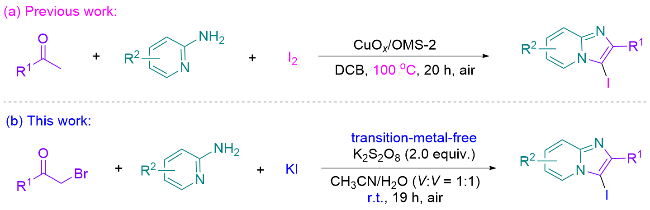
In recent years, a variety of approaches for the synthesis of 3-iodoimidazo[1,2-a]pyridines have been developed, with direct C3-H iodination of imidazo[1,2-a]pyridines emerging as one of the most effective strategies.[13-20] However, despite the high efficiency of these methodologies, they all necessitate the use of purified imidazo[1,2- a]pyridines as starting materials, thereby adding extra steps for the synthesis and isolation of imidazo[1,2-a]pyridines. As molecular structures grow increasingly complex, one- pot multi-step reactions have emerged as increasingly advantageous and appealing, primarily due to their ability to minimize the number of handling and purification steps involved.[21-24] Employing one-pot tandem reactions thus avoids cumbersome repetitive synthesis steps and the concomitant costs associated with waste disposal, thereby offering both economic and environmental benefits.[25-29] Notably, such one-pot multi-step strategies have found application in the synthesis of 3-iodoimidazo[1,2-a]pyri- dines. For instance, in 2015, Zhao and colleagues reported the aerobic synthesis of 3-iodoimidazo[1,2-a]pyridines from 2-aminopyridines, acetophenones, and iodine through a one-pot heterogeneous catalytic process utilizing a copper-supported manganese oxide-based octahedral molecular sieve (CuOx/OMS-2) as the catalyst, encompassing a tandem cyclization/iodination sequence (Scheme 1a).[30] While this method is notable in its efficacy, it necessitates transition metal catalysts (e.g., copper and manganese), relatively elevated reaction temperatures (up to 100 ℃), and iodinating reagents that are cumbersome to store (iodine tends to sublime and is susceptible to loss, undergoes photodegradation readily, and exhibits inherent toxicity). Thus, the development of a straightforward, mild, green, and efficient one-pot multi-step protocol for the synthesis of 3-iodoimidazo[1,2-a]pyridine derivatives remains highly desirable and challenging.
Potassium iodide (KI) or sodium iodide (NaI), a common inorganic compound, has emerged as an ideal iodinating reagent for the C3 iodination of imidazopyridine derivatives due to its multiple significant advantages.[31-35] From the perspective of economic cost, KI is not only low in price but also widely available and easily accessible, which can significantly reduce the raw material cost of the reaction. In terms of stability, KI has stable chemical properties, facilitating long-term storage and transportation, and is not prone to decomposition or deterioration under conventional experimental conditions.
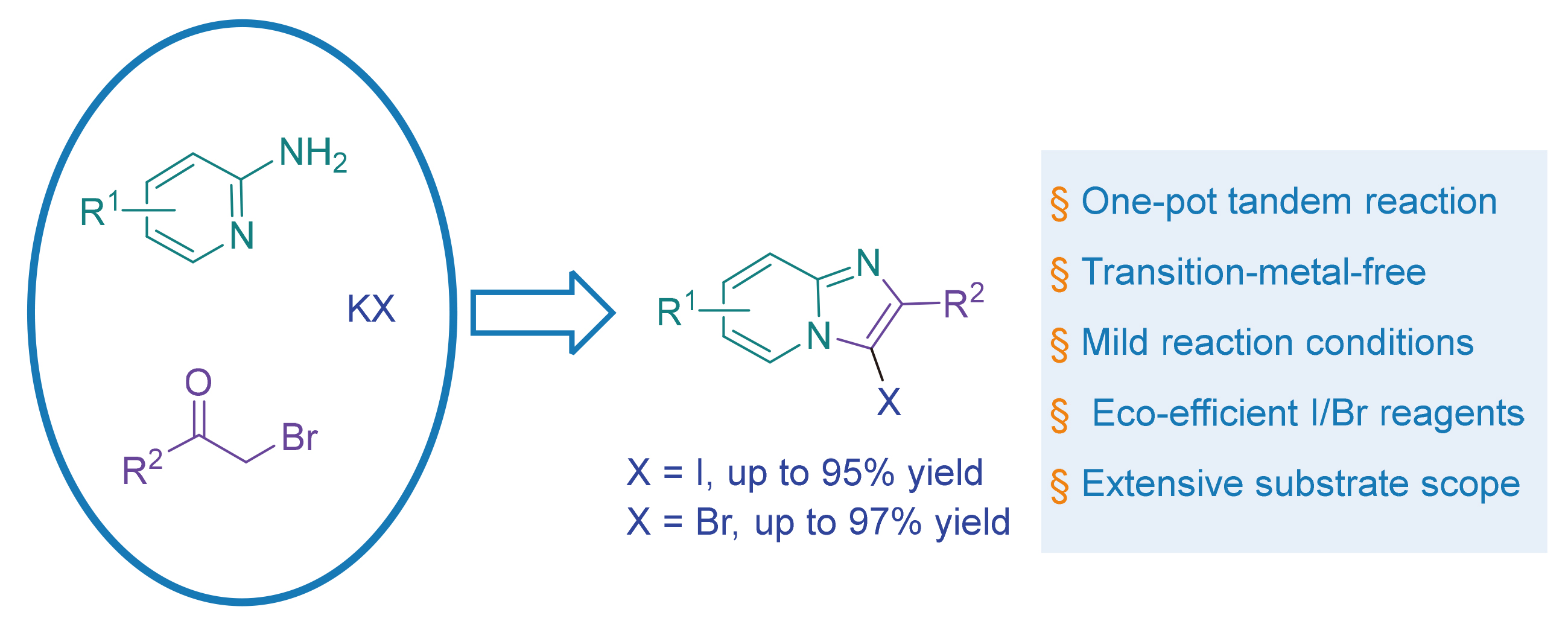
Our team has long been committed to developing simple, mild, green, and efficient synthetic methods for the preparation of small molecules with important values.[36-39] Based on previous research results, we herein report a transition-metal-free one-pot multi-step reaction strategy for the efficient synthesis of 3-iodoimidazo[1,2-a]pyridine derivatives using 2-aminopyridines, formyl methyl bromides, and KI as the reactants (Scheme 1b). This method features prominent advantages such as no involvement of transition metals, simple and mild reaction conditions (conductible at room temperature), and green and non- toxic iodinating reagents.
2 Results and discussion
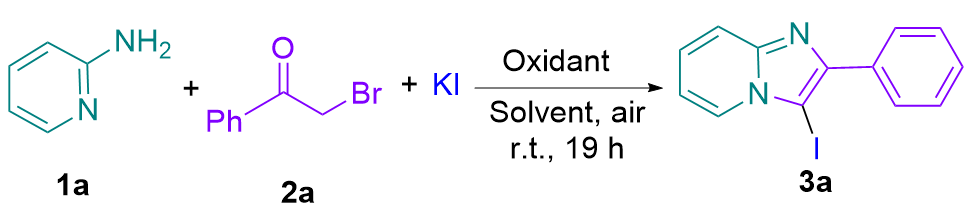
Initially, a model reaction was established with 2-amino- pyridine (1a), 2-bromoacetophenone (2a), and KI as reactants, potassium persulfate (K₂S₂O₈) as the oxidant, and 1,2-dichloroethane (DCE) as the solvent. Stirring at room temperature under an air atmosphere for 19 h afforded the target product 3a in 86% yield (Table 1, Entry 1). Subsequently, the influence of various solvents was evaluated, including petroleum ether (PE), ethyl acetate (EA), N,N- dimethylformamide (DMF), 1,4-dioxane, ethanol (EtOH), toluene, acetonitrile (CH3CN), H2O, and CH3CN/H2O. CH3CN/H2O (V/V=1/1) proved to be the optimal solvent with the highest reactivity (Table 1, Entries 1~11 vs. Entry 12). The apparent increase in yield relative to the use of CH3CN as the solvent is presumably attributed to the fact that the introduction of H2O significantly improves the solubility of inorganic salts. Further screening of oxidants, tert-butyl hydroperoxide (TBHP), di-tert-butyl peroxide (DTBP), sodium persulfate (Na2S2O8), ammonium persulfate ((NH4)2S2O8), and oxone (KHSO₅) demonstrated that all were inferior to K2S2O8 (Table 1, Entries 13~17 vs. Entry 12). Notably, the iodination reaction was nearly quenched in the absence of K2S2O8, confirming its critical role (Table 1, Entry 18). Additionally, neither shortening nor extending the reaction time led to a significant improvement in the yield of 3a (Table 1, Entries 19~20 vs. Entry 12). Therefore, the optimized reaction conditions are as follows: 0.2 mmol of 2-aminopyridine (1a), 0.22 mmol of 2-bromoacetophenone (2a), 0.6 mmol of KI, and 0.4 mmol of K2S2O8 in 2.0 mL of CH3CN/H2O (V/V=1/1), stirred at room temperature under an air atmosphere for 19 h (Table 1, Entry 12).
Table 1 Screening the optimal reaction conditionsa |
| Entry | Solvent | Oxidant | Yieldb/% |
|---|---|---|---|
| 1 | DCE | K2S2O8 | 86 |
| 2 | PE | K2S2O8 | 48 |
| 3 | EA | K2S2O8 | <5 |
| 4 | DMF | K2S2O8 | <5 |
| 5 | 1,4-Dioxane | K2S2O8 | 63 |
| 6 | EtOH | K2S2O8 | 67 |
| 7 | Toluene | K2S2O8 | 55 |
| 8 | CH3CN | K2S2O8 | 23 |
| 9 | H2O | K2S2O8 | 76 |
| 10 | CH3CN/H2O (V/V=2/1) | K2S2O8 | 91 |
| 11 | CH3CN/H2O (V/V=1/2) | K2S2O8 | 88 |
| 12 | CH3CN/H2O (V/V=1/1) | K2S2O8 | 94 |
| 13 | CH3CN/H2O (V/V=1/1) | TBHP | <5 |
| 14 | CH3CN/H2O (V/V=1/1) | DTBP | <5 |
| 15 | CH3CN/H2O (V/V=1/1) | Na2S2O8 | 90 |
| 16 | CH3CN/H2O (V/V=1/1) | (NH4)2S2O8 | 78 |
| 17 | CH3CN/H2O (V/V=1/1) | KHSO5 | 82 |
| 18 | CH3CN/H2O (V/V=1/1) | — | <5 |
| 19c | CH3CN/H2O (V/V=1/1) | K2S2O8 | 94 |
| 20d | CH3CN/H2O (V/V=1/1) | K2S2O8 | 92 |
a Reaction conditions: 1a (0.2 mmol, 18.8 mg), 2a (0.22 mmol, 43.6 mg), KI (0.6 mmol, 99.6 mg), oxidant (0.4 mmol), solvent (2.0 mL), under air for 19 h at room temperature. b Isolated yield. c For 20 h. d For 18 h. |
Upon establishing the optimized reaction conditions, the substrate scope of this iodination system was first explored using a series of 2-aminopyridine derivatives with diverse substituents, and the results are summarized in Table 2. This system exhibits excellent compatibility with 2-amino- pyridines bearing substituents on the pyridine ring, furni- shing the target products (3b~3h) in yields ranging from 56% to 95%. A comparison indicated that substrates substituted with electron-donating groups (EDGs) afforded slightly higher yields of iodinated products compared to those with electron-withdrawing groups (EWGs). For example, when EDGs such as methyl and methoxy were employed,, the iodinated products were obtained in 90%~95% yields (3b~3e); in contrast, with EWGs like bromine and chlorine, the corresponding products (3f~3g) were formed in 84% and 90% yields, respectively. Notably, even with a strong EWG (e.g., trifluoromethyl) on the pyridine ring, the iodination proceeded smoothly, yielding product 3h in 56% yield. Subsequently, the applicability of 2-bromo-acetophenone derivatives as substrates were evaluated. The results demonstrated that neither electron- donating groups nor electron-withdrawing groups on the benzene ring of 2-bromo-acetophenones significantly impeded the reaction, with all reactions proceeding smoothly to afford iodinated products (3i~3n) in 81%~95% yields. Similarly, substrates with EDGs gave marginally higher yields than those with EWGs: Substitution with EDGs (methyl, methoxy) afforded yields of 95% and 92%, respectively (3i~3j), while EWGs (bromine, chlorine, fluorine, trifluoromethyl) gave 81%~91% yields (3k~3n). Furthermore, the iodination reaction proceeded efficiently with other heteroarene-substituted formyl methyl bromides (e.g., 2-bromo-1-(naphthalen-2-yl)ethan-1-one and 2-bromo-1-(thiophen-2-yl)ethan-1-one), delivering products 3o and 3p in 89% and 91% yields, respectively. It is noteworthy that 1-bromo-3,3-dimethylbutan-2-one and 2-bromo-1-cyclohexylethan-1-one were also compatible with the reaction, giving products 3q~3r in 86% and 88% yields, respectively. However, 2-bromoacetaldehyde (2s) failed to undergo iodination, presumably due to the instability of its aldehyde group under the reaction conditions.
Table 2 Substrates scope with 2-aminopyridine and formyl methyl bromide derivativesa,b |

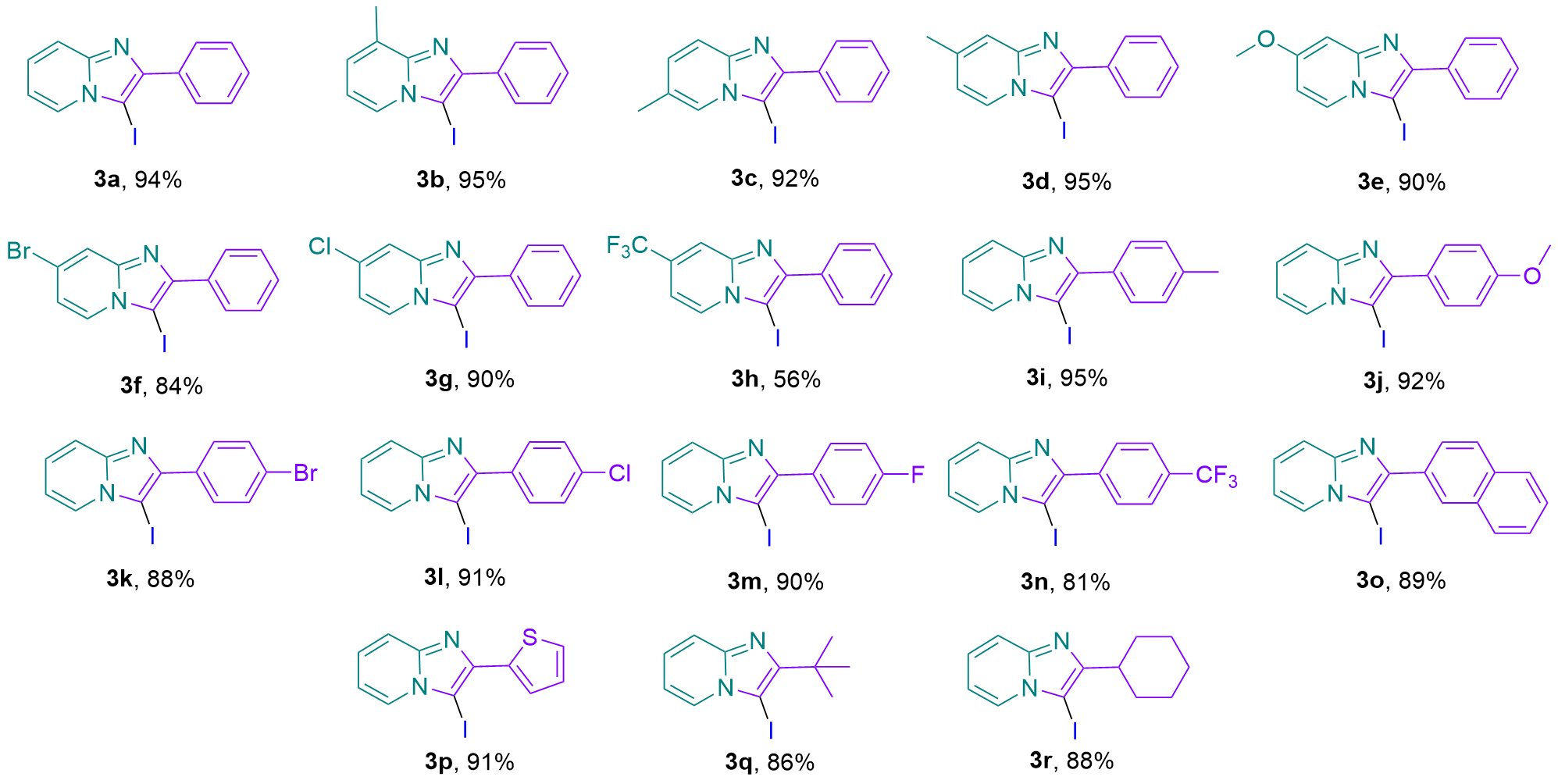 |
a Reaction conditions: 1 (0.2 mmol), 2 (0.22 mmol), KI (0.6 mmol, 99.6 mg), K2S2O8 (0.4 mmol, 108.0 mg), CH3CN/H2O (V/V=1/1) (2.0 mL), under air for 19 h at room temperature. b Isolated yield. |
Building on the promising results of the one-pot iodination reaction described above, our investigation was extended to a one-pot bromination protocol using potas-sium bromide (KBr) as the bromine source, targeting the synthesis of 3-bromoimidazo[1,2-a]pyridine derivatives (Table 3). The outcomes mirrored those of iodination reaction with the desired brominated products (4a~4r) obtained in yields ranging from 55% to 97%. Since bromide ions (Br-) exhibit significantly lower reducibility than iodide ions (I-), the bromination reaction required a higher temperature (65 ℃). Under these optimized conditions, the reaction time was substantially shortened to 6 h while retaining high product yields.
Table 3 Substrates scope with 2-aminopyridine and formyl methyl bromide derivativesa,b |

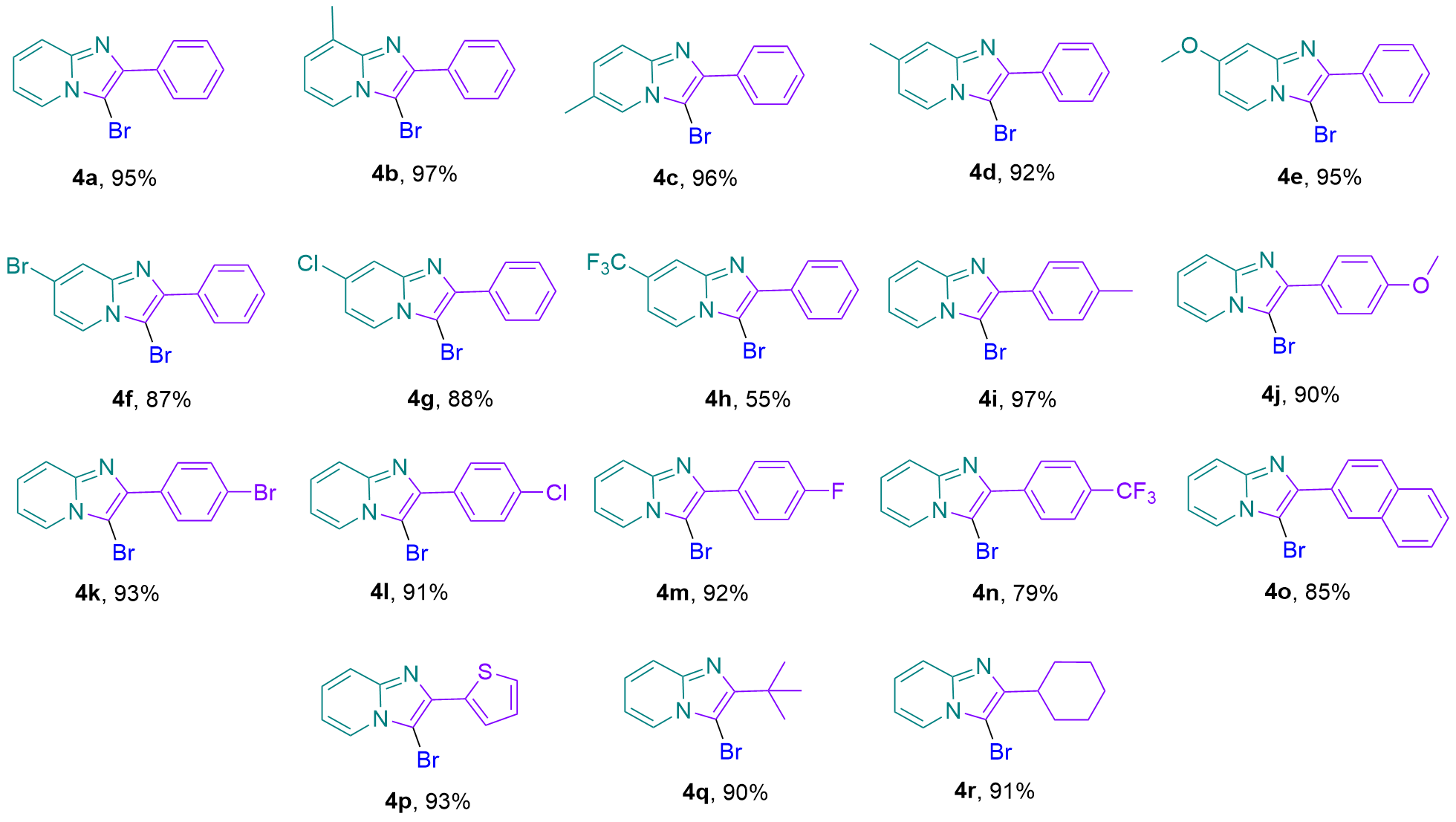 |
a Reaction conditions: 1 (0.2 mmol), 2 (0.22 mmol), KBr (0.6 mmol, 71.4 mg), K2S2O8 (0.4 mmol, 108.0 mg), CH3CN/H2O (V/V=1/1) (2.0 mL), under air for 6 h at 65 ℃. b Isolated yield. |
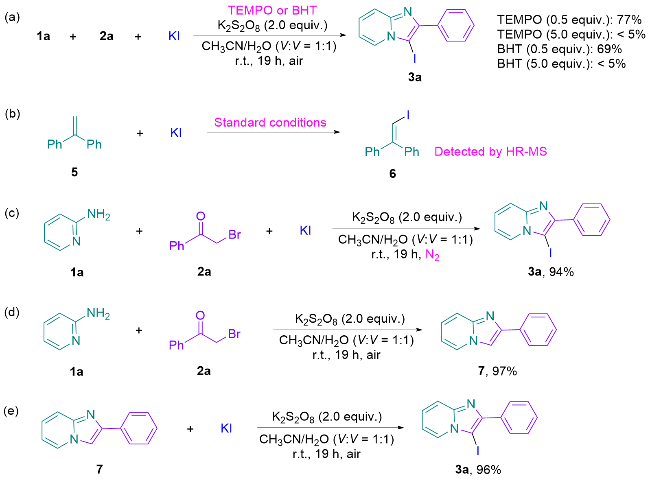
To further explore the plausible mechanism of this one-pot iodination reaction, a series of control experiments were conducted (Scheme 2). Upon introducing radical inhibitor 2,2,6,6-tetramethylpiperidin-1-oxyl (TEMPO) or 2,6-diisopropyl-4-methylphenol (BHT) into the reaction system, the iodination was significantly suppressed, indicating the involvement of a radical pathway (Scheme 2a). Furthermore, under the standard conditions of the reaction system, the free radical scavenger ethen-1,1-diyldiene (5) was added. Subsequently, through high-resolution mass spectrometry (HRMS) analysis, compound 6 was detected in the mixture (Scheme 2b). This result confirms the generation of I• in the reaction system. When the reaction was performed under a nitrogen atmosphere, the yield of product 3a remained essentially identical to that under air, confirming that atmospheric oxygen has no significant effect on the reaction (Scheme 2c). Further experiments revealed that: (i) in contrast, omitting KI under standard conditions afforded 2-phenylimidazo[1,2-a]pyridine (7) in 97% yield (Scheme 2d); and (ii) substituting 1a and 2a with 7 as the reactant under standard conditions still yielded the desired iodinated product 3a in 96% yield (Scheme 2e). These results collectively demonstrate that the one-pot iodination proceeds via a two-step pathway: 1a first reacts with 2a to generate the intermediate 2-phenylimidazo[1,2-a]pyridine (7), which then undergoes iodination at the C3 position with KI to afford the final product.
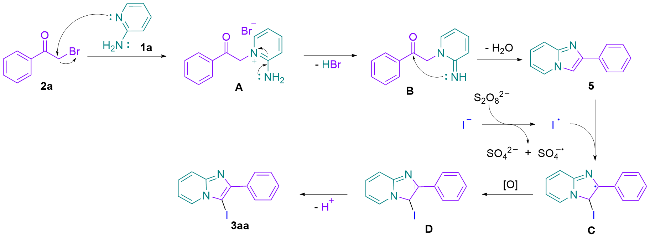
On the basis of the above experimental findings and previous research,[34,37,40-46] a plausible reaction mechanism (Scheme 3) is proposed as follows: Initially, substrate 2a engages in a nucleophilic attack on 1a, culminating in the formation of pyridinium intermediate A. Subsequently, intermediate A eliminates one molecule of hydrogen bromide (HBr) to be converted into intermediate B; intermediate B further undergoes an intramolecular nucleophilic reaction, releasing one molecule of water (H2O) while being transformed into intermediate 5. Concurrently, iodide ion (I⁻) is oxidized by K2S2O8 to generate iodine radical (I•). Then, I• promptly partakes in an electrophilic addition reaction with intermediate 5 at the C3 position, giving rise to radical intermediate C. Intermediate C undergoes further oxidation to form the neutral carbocation intermediate D, which ultimately produces the target product 3aa via a deprotonation process.


3 Conclusions
In summary, we have successfully developed a transition-metal-free one-pot multi-step reaction for the synthesis of 3-iodoimidazo[1,2-a]pyridine derivatives, employing 2-aminopyridines, formyl methyl bromides, and KI as starting materials. This protocol exhibits several significant merits: Firstly, it eliminates the need for transition metals, thereby reducing environmental burden and lowering production costs. Secondly, the reaction proceeds under mild conditions (room temperature, air atmosphere), simplifying operational procedures and minimizing energy consumption. hirdly, KI functions as a green, stable, and cost-effective iodinating reagent, overcoming the limitations of traditional iodinating agents such as iodine. Substrate scope investigations reveal that this method demonstrates excellent compatibility with diverse 2-aminopyridine and formyl methyl bromide derivatives, including those bearing electron-donating groups (EDGs), electron-with-drawing groups (EWGs), and heteroaromatic substituents, affording target products in moderate to high yields (56%~95%). Mechanistic studies confirm a two-step pathway involving the formation of an imidazo[1,2-a]-pyridine intermediate followed by C3-iodination, with a radical mechanism participating in the iodination step. Furthermore, this strategy can be extended to the synthesis of 3-bromoimidazo[1,2-a]pyridines by substituting KI with KBr, thereby further expanding its applicability. Given the significance of halogenated imidazo[1,2-a]pyridines in medicinal chemistry and materials science, this efficient, green, and versatile method provides a valuable tool for the synthesis of related compounds and holds substantial potential for practical applications in drug discovery and functional material development.
4 Experimental section
4.1 General information
1H NMR and 13C NMR spectra were recorded on a Bruker DPX-400 spectrometer with CDCl3 as the solvent and trimethylsilyl (TMS) as an internal standard. High resolution mass spectra (HRMS) were ensured on an Aglient 7250 & JEOL-JMS-T100LP (electrosprayioniza- tion, ESI). Melting points were measured using a WC-1 microscopic apparatus and are uncorrected. All solvents were used directly without further purification. dichloromethane (DCM), ethyl acetate (EA), and hexane were used for column chromatography. The commercials were obtained from commercial sources and used as-received without further purification unless otherwise noted.
4.2 Typical procedure for the products
4.2.1 Synthesis and comprehensive characterization of compounds 3
A 10 mL reaction tube equipped with a magnetic stir bar was charged with 1 (0.2 mmol), 2 (0.22 mmol): KI (0.6 mmol, 99.6 mg), K2S2O8 (0.4 mmol, 108.0 mg), and CH3CN/H2O (V∶V=1∶1, 2 mL). The resulting mixture was stirred under air at room temperature for 19 h. Upon completion, DCM (20 mL) was added to the reaction system, which was extracted with H2O (20 mL), and the aqueous layer was extracted with DCM (10 mL×2). The combined organic layer was dried over anhydrous Na2SO4 and filtered. After evaporation of the solvent under vacuum, the residue was purified by column chromatography on silica gel (200~300 mesh) using DCM- EA as an eluent to afford the pure products 3.
3-Iodo-2-phenylimidazo[1,2-a]pyridine (3a): White solid, m.p. 142~143 ℃ (lit.[13] m.p. 140~142 ℃); 1H NMR (400 MHz, CDCl3) δ: 8.19 (d, J=6.9 Hz, 1H), 8.06~8.04 (m, 2H), 7.61 (d, J=9.0 Hz, 1H), 7.49~7.46 (m, 2H), 7.41~7.37 (m, 1H), 7.26~7.21 (m, 1H), 6.89 (td, J=6.9, 1.1 Hz, 1H); 13C NMR (100 MHz, CDCl3) δ: 148.06, 147.97, 133.48, 128.63, 128.43, 128.41, 126.59, 125.74, 117.56, 113.59, 59.73.
3-Iodo-8-methyl-2-phenylimidazo[1,2-a]pyridine (3b): White solid, m.p. 120~121 ℃ (lit.[13] m.p. 133~135 ℃); 1H NMR (400 MHz, CDCl3) δ: 8.05 (t, J=7.3 Hz, 3H), 7.47 (t, J=7.5 Hz, 2H), 7.37 (t, J=7.3 Hz, 1H), 7.02 (d, J=6.8 Hz, 1H), 6.80 (t, J=6.9 Hz, 1H), 2.66 (s, 3H); 13C NMR (100 MHz, CDCl3) δ: 148.42, 147.61, 133.85, 128.75, 128.40, 128.25, 127.59, 124.45, 124.38, 113.12, 60.11, 16.68.
3-Iodo-6-methyl-2-phenylimidazo[1,2-a]pyridine (3c): White solid, m.p. 127~128 ℃ (lit.[13] m.p. 106~108 ℃); 1H NMR (400 MHz, CDCl3) δ: 8.07~8.04 (m, 2H), 7.98 (s, 1H), 7.52~7.45 (m, 3H), 7.4~7.36 (m, 1H), 7.09 (dd, J=9.1, 1.4 Hz, 1H), 2.38 (s, 3H); 13C NMR (100 MHz, CDCl3) δ: 147.73, 147.18, 133.72, 128.77, 128.50, 128.36, 128.25, 124.31, 123.05, 116.93, 59.09, 18.41.
3-Iodo-7-methyl-2-phenylimidazo[1,2-a]pyridine (3d): White solid, m.p. 155~156 ℃ (lit.[13] m.p. 156~161 ℃); 1H NMR (400 MHz, CDCl3) δ: 8.05 (d, J=8.0 Hz, 3H), 7.47 (t, J=7.4 Hz, 2H), 7.39~7.36 (m, 2H), 6.71 (dd, J=7.0, 1.4 Hz, 1H), 2.42 (s, 3H); 13C NMR (100 MHz, CDCl3) δ: 148.40, 147.74, 136.73, 133.71, 128.48, 128.36, 128.25, 125.66, 116.00, 115.80, 58.31, 21.32.
3-Iodo-7-methoxy-2-phenylimidazo[1,2-a]pyridine (3e): White solid, m.p. 130~132 ℃; 1H NMR (400 MHz, CDCl3) δ: 8.01~8.04 (m, 2H), 7.99 (d, J=7.5 Hz, 1H), 7.46 (t, J=7.4 Hz, 2H), 7.36 (t, J=7.4 Hz, 1H), 6.90 (d, J=2.4 Hz, 1H), 6.60 (dd, J=7.5, 2.5 Hz, 1H), 3.86 (s, 3H); 13C NMR (100 MHz, CDCl3) δ: 158.72, 149.13, 147.68, 133.70, 128.34, 128.25, 128.17, 126.83, 108.10, 94.86, 56.77, 55.73.
7-Bromo-3-iodo-2-phenylimidazo[1,2-a]pyridine (3f): White solid, m.p. 167~168 ℃; 1H NMR (400 MHz, CDCl3) δ: 8.00 (dd, J=7.3, 0.4 Hz, 1H), 7.97~7.95 (m, 2H), 7.73 (d, J=1.3 Hz, 1H), 7.43~7.39 (m, 2H), 7.35~7.31 (m, 1H), 6.94 (dd, J=7.3, 1.9 Hz, 1H); 13C NMR (100 MHz, CDCl3) δ: 148.91, 148.04, 133.12, 128.66, 128.53, 128.46, 126.79, 119.71, 119.41, 117.07, 59.84. HRMS (ESI) calcd for C13H8BrIN2 [M+H]+ 398.8988, found 398.8989.
7-Chloro-3-iodo-2-phenylimidazo[1,2-a]pyridine (3g): White solid, m.p. 147~148 ℃ (lit.[34] m.p. 150 ℃); 1H NMR (400 MHz, CDCl3) δ: 8.11 (d, J=7.3 Hz, 1H), 8.04~8.02 (m, 2H), 7.62 (d, J=1.7 Hz, 1H), 7.5~7.46 (m, 2H), 7.42~7.38 (m, 1H), 6.88 (dd, J=7.3, 2.0 Hz, 1H); 13C NMR (100 MHz, CDCl3) δ: 149.06, 147.61, 133.16, 132.15, 128.64, 128.50, 128.46, 126.81, 116.32, 114.75, 59.68.
3-Iodo-2-phenyl-7-(trifluoromethyl)imidazo[1,2-a]pyri- dine (3h):[27] White solid, m.p. 142~144 ℃; 1H NMR (400 MHz, CDCl3) δ: 8.34 (d, J=7.2 Hz, 1H), 8.07~8.05 (m, 2H), 7.94 (s, 1H), 7.50 (t, J=7.1 Hz, 2H), 7.45~7.41 (m, 1H), 7.10 (dd, J=7.2, 1.5 Hz, 1H); 13C NMR (100 MHz, CDCl3) δ: 150.25, 146.33, 132.90, 128.90, 128.61, 128.54, 127.52 (q, JC-F=34.4 Hz), 127.36, 123.22 (q, JC-F=272.6 Hz), 115.46 (q, JC-F=5.0 Hz), 109.09 (q, JC-F=3.0 Hz), 61.93; 19F NMR (376.5 MHz, CDCl3) δ: -63.43.
3-Iodo-2-(p-tolyl)imidazo[1,2-a]pyridine (3i): White solid, m.p. 139~140 ℃ (lit.[13] m.p. 140~144 ℃); 1H NMR (400 MHz, CDCl3) δ: 8.17 (d, J=6.9 Hz, 1H), 7.96 (d, J=8.2 Hz, 2H), 7.59 (d, J=9.0 Hz, 1H), 7.28 (d, J=8.0 Hz, 2H), 7.23~7.19 (m, 1H), 6.89~6.85 (m, 1H), 2.41 (s, 3H); 13C NMR (100 MHz, CDCl3) δ: 148.08, 148.06, 138.26, 130.67, 129.14, 128.44, 126.49, 125.53, 117.47, 113.12, 59.37, 21.43.
3-Iodo-2-(4-methoxyphenyl)imidazo[1,2-a]pyridine(3j): White solid, m.p. 124~125 ℃ (lit.[14] m.p. 126~131 ℃); 1H NMR (400 MHz, CDCl3) δ: 8.19 (d, J=7.0 Hz, 1H), 8.03~7.99 (m, 2H), 7.58 (d, J=9.0 Hz, 1H), 7.25~7.21 (m, 1H), 7.03~7.00 (m, 2H), 6.91~6.88 (m, 1H), 3.86 (s, 3H); 13C NMR (100 MHz, CDCl3) δ: 159.83, 148.03, 147.90, 129.84, 126.48, 126.05, 125.52, 117.34, 113.84, 113.08, 58.85, 55.35.
2-(4-Bromophenyl)-3-iodoimidazo[1,2-a]pyridine(3k): White solid, m.p. 145~146 ℃ (lit.[14] m.p. 145~148 ℃); 1H NMR (400 MHz, CDCl3) δ: 8.21 (d, J=6.9 Hz, 1H), 7.97~7.95 (m, 2H), 7.62~7.59 (m, 3H), 7.29~7.25 (m, 1H), 6.95~6.92 (m, 1H); 13C NMR (100 MHz, CDCl3) δ: 148.18, 146.91, 132.52, 131.57, 130.04, 126.59, 125.92, 122.65, 117.64, 113.43, 59.62.
2-(4-Chlorophenyl)-3-iodoimidazo[1,2-a]pyridine(3l): White solid, m.p. 118~119 ℃ (lit.[13] m.p. 140~144 ℃); 1H NMR (400 MHz, CDCl3) δ: 8.17 (d, J=6.9 Hz, 1H), 8.01 (d, J=8.4 Hz, 2H), 7.59 (d, J=9.0 Hz, 1H), 7.44 (d, J=8.4 Hz, 2H), 7.24 (t, J=7.9 Hz, 1H), 6.90 (t, J=6.8 Hz, 1H); 13C NMR (100 MHz, CDCl3) δ: 148.13, 146.85, 134.30, 132.10, 129.74, 128.61, 126.56, 125.85, 117.60, 113.37, 59.65.
2-(4-Fluorophenyl)-3-iodoimidazo[1,2-a]pyridine(3m): White solid, m.p. 150~151 ℃ (lit.[13] m.p. 147~151 ℃); 1H NMR (400 MHz, CDCl3) δ: 8.19 (d, J=6.9 Hz, 1H), 8.06~8.02 (m, 2H), 7.60 (d, J=9.0 Hz, 1H), 7.27~7.23 (m, 1H), 7.2~7.14 (m, 2H), 6.93~6.90 (m, 1H); 13C NMR (100 MHz, CDCl3) δ: 162.90 (d, JC-F=248.0 Hz), 148.12, 147.23, 130.34 (d, JC-F=8.1 Hz), 129.73 (d, JC-F=3.0 Hz), 126.55, 125.75, 117.56, 115.38 (d, JC-F=21.4 Hz), 113.29, 59.34; 19F NMR (376.5 MHz, CDCl3) δ: -113.24.
3-Iodo-2-(4-(trifluoromethyl)phenyl)imidazo[1,2-a]-pyridine (3n):[14] White solid, m.p. 133~135 ℃; 1H NMR (400 MHz, CDCl3) δ: 8.22~8.2 (m, 3H), 7.73 (d, J=8.2 Hz, 2H), 7.62 (d, J=9.0 Hz, 1H), 7.29~7.25 (m, 1H), 6.95~6.91 (m, 1H); 13C NMR (100 MHz, CDCl3) δ: 148.26, 146.46, 137.17, 130.09 (q, JC-F=32.3 Hz), 128.66, 126.64, 126.06, 125.32 (q, JC-F=3.7 Hz), 124.25 (q, JC-F=272.3 Hz), 117.8, 113.57, 60.21; 19F NMR (376.5 MHz, CDCl3) δ: -62.48.
3-Iodo-2-(naphthalen-2-yl)imidazo[1,2-a]pyridine(3o): White solid, m.p. 140~141 ℃ (lit.[14] m.p. 140~143 ℃); 1H NMR (400 MHz, CDCl3) δ: 8.56 (s, 1H), 8.22~8.19 (m, 2H), 7.94 (d, J=8.5 Hz, 2H), 7.88~7.85 (m, 1H), 7.64 (d, J=9.0 Hz, 1H), 7.52~7.47 (m, 2H), 7.27~7.22 (m, 1H), 6.90 (t, J=6.9 Hz, 1H); 13C NMR (100 MHz, CDCl3) δ: 148.25, 147.96, 133.29, 133.22, 131.01, 128.51, 128.02, 127.86, 127.75, 126.59, 126.41, 126.26, 125.74, 117.62, 113.29, 59.92.
3-Iodo-2-(thiophen-2-yl)imidazo[1,2-a]pyridine (3p): White solid, m.p. 118~119 ℃ (lit.[32] m.p. 106~108 ℃); 1H NMR (400 MHz, CDCl3): δ 8.14 (d, J=6.9 Hz, 1H), 7.95~7.94 (m, 1H), 7.58 (d, J=9.0 Hz, 1H), 7.39 (d, J=5.0 Hz, 1H), 7.23 (t, J=6.8 Hz, 1H), 7.16~7.14 (m, 1H), 6.88 (t, J=6.8 Hz, 1H); 13C NMR (100 MHz, CDCl3) δ: 147.81, 143.45, 136.58, 127.63, 126.39, 126.31, 125.90, 125.76, 117.33, 113.31, 58.52.
2-(tert-Butyl)-3-iodoimidazo[1,2-a]pyridine (3q): White solid, m.p. 48~49 ℃; 1H NMR (400 MHz, CDCl3) δ: 8.21 (d, J=6.9 Hz, 1H), 7.57 (d, J=9.0 Hz, 1H), 7.19 (t, J=7.4 Hz, 1H), 6.87 (t, J=6.8 Hz, 1H), 1.56 (s, 9H); 13C NMR (100 MHz, CDCl3) δ: 156.30, 146.28, 125.77, 124.72, 117.19, 112.82, 56.81, 33.33, 30.2. HRMS (ESI) calcd for C11H14IN2 [M+H]+ 301.0196, found 301.0194.
2-Cyclohexyl-3-iodoimidazo[1,2-a]pyridine (3r): White solid, m.p. 55~57 ℃; 1H NMR (400 MHz, CDCl3) δ: 8.13 (d, J=6.9 Hz, 1H), 7.56 (d, J=9.0 Hz, 1H), 7.25~7.21 (m, 1H), 6.93~6.89 (m, 1H), 2.87~2.80 (m, 1H), 1.90~1.87 (m, 4H), 1.79~1.76 (m, 2H), 1.49~1.26 (m, 4H); 13C NMR (100 MHz, CDCl3) δ: 154.63, 147.50, 126.05, 125.26, 116.92, 113.02, 60.57, 38.04, 32.27, 26.59, 25.92. HRMS (ESI) calcd for C13H16IN2 [M+H]+ 327.0353, found 327.0354.
4.2.2 Synthesis and comprehensive characterization of compounds 4
A 10 mL reaction tube equipped with a magnetic stir bar was charged with 1 (0.2 mmol), 2 (0.22 mmol), KBr (0.6 mmol, 71.4 mg), K2S2O8 (0.4 mmol, 108.0 mg), and CH3CN/H2O (V∶V=1∶1, 2 mL). The resulting mixture was stirred under air at 65 ℃ for 6 h. Upon completion, DCM (20 mL) was added to the reaction system, which was extracted with H2O (20 mL), and the aqueous layer was extracted with DCM (10 mL×2). The combined organic layer was dried over anhydrous Na2SO4 and filtered. After evaporation of the solvent under vacuum, the residue was purified by column chromatography on silica gel (200~300 mesh) using DCM-EA as an eluent to afford the pure products 4.
3-Bromo-2-phenylimidazo[1,2-a]pyridine (4a): White solid, m.p. 84~85 ℃ (lit.[13] m.p. 88~89 ℃); 1H NMR (400 MHz, CDCl3) δ: 8.16~8.11 (m, 3H), 7.63 (d, J=9.1 Hz, 1H), 7.48 (t, J=7.4 Hz, 2H), 7.38 (t, J=7.4 Hz, 1H), 7.26~7.22 (m, 1H), 6.90 (t, J=6.8 Hz, 1H); 13C NMR (100 MHz, CDCl3) δ: 145.46, 142.66, 132.85, 128.51, 128.35, 127.94, 125.18, 123.99, 117.62, 113.11, 91.77.
3-Bromo-8-methyl-2-phenylimidazo[1,2-a]pyridine(4b): White solid, m.p. 102~103 ℃ (lit.[13] m.p. 80~82 ℃); 1H NMR (400 MHz, CDCl3) δ: 8.12 (d, J=7.4 Hz, 2H), 8.03 (d, J=6.8 Hz, 1H), 7.48 (t, J=7.5 Hz, 2H), 7.38 (t, J=7.3 Hz, 1H), 7.04 (d, J=6.8 Hz, 1H), 6.83 (t, J=6.9 Hz, 1H), 2.67 (s, 3H); 13C NMR (100 MHz, CDCl3) δ: 145.81, 142.24, 133.15, 128.49, 128.18, 128.10, 127.69, 123.90, 121.87, 113.07, 92.01, 16.61.
3-Bromo-6-methyl-2-phenylimidazo[1,2-a]pyridine(4c): White solid, m.p. 79~80 ℃ (lit.[13] m.p. 110~112 ℃); 1H NMR (400 MHz, CDCl3) δ: 8.13~8.10 (m, 2H), 7.91 (s, 1H), 7.53~7.44 (m, 3H), 7.38~7.35 (m, 1H), 7.06 (dd, J=9.2, 1.4 Hz, 1H), 2.35 (s, 3H); 13C NMR (100 MHz, CDCl3) δ: 144.51, 142.36, 133.05, 128.44, 128.29, 128.16, 127.82, 122.92, 121.65, 116.91, 91.26, 18.35.
3-Bromo-7-methyl-2-phenylimidazo[1,2-a]pyridine(4d): White solid, m.p. 95~96 ℃ (lit.[13] m.p. 98~101 ℃); 1H NMR (400 MHz, CDCl3) δ: 8.11 (d, J=7.4 Hz, 2H), 8.02 (d, J=7.3 Hz, 1H), 7.49~7.45 (m, 2H), 7.38~7.35 (m, 2H), 6.73 (dd, J=6.9, 1.0 Hz, 1H), 2.41 (s, 3H); 13C NMR (100 MHz, CDCl3) δ: 147.32, 145.77, 136.35, 132.95, 128.46, 128.20, 127.84, 123.14, 115.97, 115.75, 90.88, 21.36.
3-Bromo-7-methoxy-2-phenylimidazo[1,2-a]pyridine(4e): White solid, m.p. 101~102 ℃; 1H NMR (400 MHz, CDCl3) δ: 8.02 (d, J=7.6 Hz, 2H), 7.91 (d, J=7.5 Hz, 1H), 7.39 (t, J=7.5 Hz, 2H), 7.3 (t, J=7.3 Hz, 1H), 6.90 (s, 1H), 6.58 (dd, J=7.4, 1.9 Hz, 1H), 3.81 (s, 3H); 13C NMR (100 MHz, CDCl3) δ: 158.83, 146.46, 141.43, 132.37, 128.52, 128.31, 127.66, 124.47, 108.50, 94.67, 90.18, 55.85.
3,7-Dibromo-2-phenylimidazo[1,2-a]pyridine (4f): Whi- te solid, m.p. 137~138 ℃ (lit.[47] m.p. 155 ℃); 1H NMR (400 MHz, CDCl3) δ: 8.1~8.07 (m 2H), 8.02 (dd, J=7.2, 0.6 Hz, 1H), 7.82~7.81 (m, 1H), 7.5~7.46 (m, 2H), 7.42~7.37 (m, 1H), 7.01 (dd, J=7.3, 1.9 Hz, 1H); 13C NMR (100 MHz, CDCl3) δ: 145.38, 143.36, 132.30, 128.66, 128.59, 127.92, 124.27, 119.74, 119.09, 117.09, 92.21.
3-Bromo-7-chloro-2-phenylimidazo[1,2-a]pyridine (4g): White solid, m.p. 127~128 ℃ (lit.[34] m.p. 169 ℃); 1H NMR (400 MHz, CDCl3) δ: 8.10~8.08 (m, 3H), 7.64 (d, J=1.6 Hz, 1H), 7.50~7.46 (m, 2H), 7.42~7.38 (m, 1H), 6.91 (dd, J=7.3, 2.0 Hz, 1H); 13C NMR (100 MHz, CDCl3) δ: 145.02, 143.52, 132.31, 131.89, 128.66, 128.59, 127.91, 124.31, 116.38, 114.84, 92.10.
3-Bromo-2-phenyl-7-(trifluoromethyl)imidazo[1,2-a]pyridine (4h):[48] White solid, m.p. 135~136 ℃; 1H NMR (400 MHz, CDCl3) δ: 8.26 (d, J=7.2 Hz, 1H), 8.12 (d, J=7.7 Hz, 2H), 7.95 (s, 1H), 7.49 (t, J=7.5 Hz, 2H), 7.42 (t, J=7.0 Hz, 1H), 7.09 (d, J=7.1 Hz, 1H); 13C NMR (100 MHz, CDCl3) δ: 144.95, 143.59, 132.18, 128.87, 128.62, 127.98, 127.02 (q, JC-F=34.4 Hz), 124.78, 123.24 (q, JC-F=272.0 Hz), 115.59 (q, JC-F=4.9 Hz), 108.98 (q, JC-F=2.7 Hz), 93.72; 19F NMR (376.5 MHz, CDCl3) δ: -63.48.
3-Bromo-2-(p-tolyl)imidazo[1,2-a]pyridine (4i): White solid, m.p. 108~109 ℃ (lit.[13] m.p. 104~106 ℃); 1H NMR (400 MHz, CDCl3) δ: 8.16 (d, J=6.8 Hz, 1H), 8.02 (d, J=8.1 Hz, 2H), 7.63 (d, J=9.0 Hz, 1H), 7.29 (d, J=7.0 Hz, 2H), 7.24 (t, J=6.2 Hz, 1H), 6.91 (t, J=6.8 Hz, 1H), 2.41 (s, 3H); 13C NMR (100 MHz, CDCl3) δ: 145.38, 142.73, 138.28, 129.91, 129.24, 127.83, 125.12, 123.95, 117.50, 113.05, 91.48, 21.38.
3-Bromo-2-(4-methoxyphenyl)imidazo[1,2-a]pyridine(4j): White solid, m.p. 96~97 ℃ (lit.[14] m.p. 92~94 ℃); 1H NMR (400 MHz, CDCl3) δ: 8.16 (d, J=6.9 Hz, 1H), 8.09~8.06 (m, 2H), 7.62 (d, J=9.1 Hz, 1H), 7.28~7.23 (m, 1H), 7.19~7.13 (m, 2H), 6.94~6.90 (m, 1H); 13C NMR (100 MHz, CDCl3) δ: 159.79, 145.33, 142.49, 129.24, 125.30, 125.12, 123.91, 117.36, 113.96, 113.02, 91.01, 55.35.
3-Bromo-2-(4-bromophenyl)imidazo[1,2-a]pyridine(4k): White solid, m.p. 134~135 ℃ (lit.[14] m.p. 158~160 ℃); 1H NMR (400 MHz, CDCl3) δ: 8.13 (d, J=6.9 Hz, 1H), 8.01 (d, J=8.5 Hz, 2H), 7.62~7.57 (m, 3H), 7.27~7.23 (m, 1H), 6.91 (t, J=6.8 Hz, 1H); 13C NMR (100 MHz, CDCl3) δ: 145.49, 141.89, 131.86, 131.64, 129.36, 125.39, 123.99, 122.53, 117.66, 113.26, 91.82.
3-Bromo-2-(4-chlorophenyl)imidazo[1,2-a]pyridine(4l): White solid, m.p. 126~127 ℃ (lit.[13] m.p. 141~144 ℃); 1H NMR (400 MHz, CDCl3) δ: 8.14 (d, J=6.9 Hz, 1H), 8.08~8.06 (m, 2H), 7.61 (d, J=9.1 Hz, 1H), 7.43 (d, J=8.6 Hz, 2H), 7.27~7.23 (m, 1H), 6.94~6.90 (m, 1H); 13C NMR (100 MHz, CDCl3) δ: 145.48, 141.54, 134.25, 131.39, 129.09, 128.70, 125.38, 123.99, 117.64, 113.25, 91.80.
3-Bromo-2-(4-fluorophenyl)imidazo[1,2-a]pyridine(4m): White solid, m.p. 116~117 ℃ (lit.[13] m.p. 110 ℃); 1H NMR (400 MHz, CDCl3) δ: 8.16~8.08 (m, 3H), 7.62 (d, J=9.1 Hz, 1H), 7.28~7.23 (m, 1H), 7.19~7.13 (m, 2H), 6.92 (t, J=6.8 Hz, 1H); 13C NMR (100 MHz, CDCl3) δ: 162.90 (d, JC-F=248.0 Hz), 147.55, 145.44, 141.92, 129.70 (d, JC-F=8.1 Hz), 125.31, 124.00, 117.57, 115.49 (d, JC-F=21.7 Hz), 113.18, 91.48; 19F NMR (376.5 MHz, CDCl3) δ: -113.17.
3-Bromo-2-(4-(trifluoromethyl)phenyl)imidazo[1,2-a]pyridine (4n): White solid, m.p. 119~120 ℃ (lit.[14] m.p. 120~122 ℃); 1H NMR (400 MHz, CDCl3) δ: 8.26 (d, J=8.1 Hz, 2H), 8.16 (d, J=6.9 Hz, 1H), 7.74~7.71 (m, 2H), 7.64 (d, J=9.1 Hz, 1H), 7.30~7.25 (m, 1H), 6.96~6.92 (m, 1H); 13C NMR (100 MHz, CDCl3) δ: 145.60, 141.09, 136.41, 130.00 (q, JC-F=32.5 Hz), 127.98, 125.64, 125.41 (q, JC-F=3.7 Hz), 124.24 (q, JC-F=272.0 Hz), 124.07, 117.81, 113.46, 92.53; 19F NMR (376.5 MHz, CDCl3) δ: -62.55.
3-Bromo-2-(naphthalen-2-yl)imidazo[1,2-a]pyridine(4o): White solid, m.p. 92~93 ℃ (lit.[14] m.p. 84~86 ℃); 1H NMR (400 MHz, CDCl3) δ: 8.62 (s, 1H), 8.27 (dd, J=8.6, 1.8 Hz, 1H), 8.17~8.15 (m, 1H), 7.95~7.92 (m, 2H), 7.86~7.84 (m, 1H), 7.67 (d, J=9.0 Hz, 1H), 7.51~7.47 (m, 2H), 7.27~7.23 (m, 1H), 6.92~6.89 (m, 1H); 13C NMR (100 MHz, CDCl3) δ: 145.53, 142.52, 133.38, 133.18, 130.21, 128.55, 128.12, 127.72, 127.25, 126.42, 126.29, 125.54, 125.37, 124.01, 117.58, 113.22, 92.15.
3-Bromo-2-(thiophen-2-yl)imidazo[1,2-a]pyridine(4p):[47] White solid, m.p. 83~84 ℃; 1H NMR (400 MHz, CDCl3) δ: 8.12 (d, J=6.9 Hz, 1H), 7.87 (dd, J=3.7, 1.0 Hz, 1H), 7.62 (d, J=9.1 Hz, 1H), 7.40 (dd, J=5.0, 1.0 Hz, 1H), 7.27~7.23 (m, 1H), 7.17~7.14 (m, 1H), 6.94~6.91 (m, 1H); 13C NMR (100 MHz, CDCl3) δ: 145.38, 138.50, 135.87, 127.72, 126.23, 125.61, 125.42, 123.83, 117.39, 113.23, 90.85.
3-Bromo-2-(tert-butyl)imidazo[1,2-a]pyridine (4q):[49] White oil. 1H NMR (400 MHz, CDCl3) δ: 8.12 (d, J=6.9 Hz, 1H), 7.6 (d, J=9.0 Hz, 1H), 7.21~7.17 (m, 1H), 6.89~6.86 (m, 1H), 1.53 (s, 9H); 13C NMR (100 MHz, CDCl3) δ: 151.95, 143.87, 124.16, 123.31, 117.26, 112.67, 90.12, 33.16, 29.77.
3-Bromo-2-cyclohexylimidazo[1,2-a]pyridine (4r): White solid, m.p. 38~40 ℃; 1H NMR (400 MHz, CDCl3) δ: 8.07 (d, J=6.8 Hz, 1H), 7.59 (d, J=9.1 Hz, 1H), 7.22~7.17 (m, 1H), 6.90~6.86 (m, 1H), 2.91~2.83 (m, 1H), 1.91~1.87 (m, 4H), 1.80~1.74 (m, 2H), 1.49~1.31 (m, 4H); 13C NMR (100 MHz, CDCl3): δ 149.86, 145.08, 124.21, 123.52, 117.22, 112.61, 91.51, 36.99, 32.02, 26.58, 25.95. HRMS (ESI) calcd for C13H15BrN2 [M+H]+ 279.0491, found 279.0490.
Supporting Information Copies of 1H NMR, 13C NMR and 19F NMR spectra of the products 3a~3r and 4a~4r, HRMS spectra of 6. The Supporting Information is available free of charge via the Internet at http://sioc-journal.cn.
(Lu, Y.)