


1 Introduction
The O-methylation of carboxylic acids is a key transformation in organic synthesis with broad applications in medicinal chemistry, natural product synthesis, and materials science.[1] Carboxylic acid methyl esters serve not only as protecting groups to suppress undesired side reactions but also as intermediates with improved physicochemical properties, thereby enhancing their utility in drug development and beyond. Moreover, they are widely used as versatile building blocks for the construction and modification of complex molecular architectures.[2]
A variety of strategies have been developed for this transformation.[3] The most common industrial method is Fischer esterification, which employs methanol as both solvent and methylating agent under strongly acidic conditions (e.g., H2SO4, TsOH). Although effective, these conditions are incompatible with acid-sensitive functionalities, limiting substrate scope. Alternatively, coupling reagents such as dicyclohexylcarbodiimide (DCC) and 1-ethyl-3-(3- dimethylaminopropyl)carbodiimide (EDC) enable methylation under neutral to mildly basic conditions. While milder and more selective, these methods often suffer from the high cost of reagents and laborious purification. Another widely applied strategy involves the generation of carboxylate salts, followed by methylation with electrophiles, such as methyl iodide,[4] dimethyl sulfate,[5] or dimethyl carbonate.[6] Despite their efficiency, the toxicity and side reactivity of these electrophiles raise significant safety and practicality concerns.
Among methylating agents, diazomethane (CH2N2) is particularly notable.[7] It reacts rapidly with carboxylic acids under mild conditions, delivering methyl esters in nearly quantitative yields. The reaction is additive-free, with only nitrogen generated as a benign byproduct, and simple handling is required, making it especially valuable for the selective derivatization of complex natural products, proteins, nucleic acids, and other bioactive molecules.[8] Beyond esterification, diazomethane also serves as a versatile C1 synthon, enabling diverse bond-forming reactions, such as [1+2] cycloaddition, insertion, and the Arndt-Eistert homologation, thereby securing an irreplaceable role in complex molecule synthesis.[9] Although trimethylsilyl azide (TMSN3) has been explored as an alternative, its lower reactivity and higher cost prevent it from serving as a practical substitute for diazomethane.[10]
Despite these advantages, diazomethane is notoriously unstable and hazardous. Its sensitivity to heat, shock, metals, and oxidants renders it highly explosive, while its volatile and carcinogenic vapors further compromise safety.[11] These intrinsic risks have restricted its widespread adoption. Traditionally, diazomethane is obtained from N-meth- yl-N-nitroso precursors, such as N-methyl-N-nitrosourea (MNU),[12] N-methyl-N'-nitro-N-nitrosoguanidine (MNN- G),[13] and N-methyl-N-nitrosobenzenesulfonamide (Diazald)[14] under basic conditions, followed by distillationScheme 1a.[15] However, the distillation step is the most dangerous part of the process, with numerous explosion accidents reported.[16] Accordingly, the development of safer and more practical methods for diazomethane generation remains a long- standing goal.
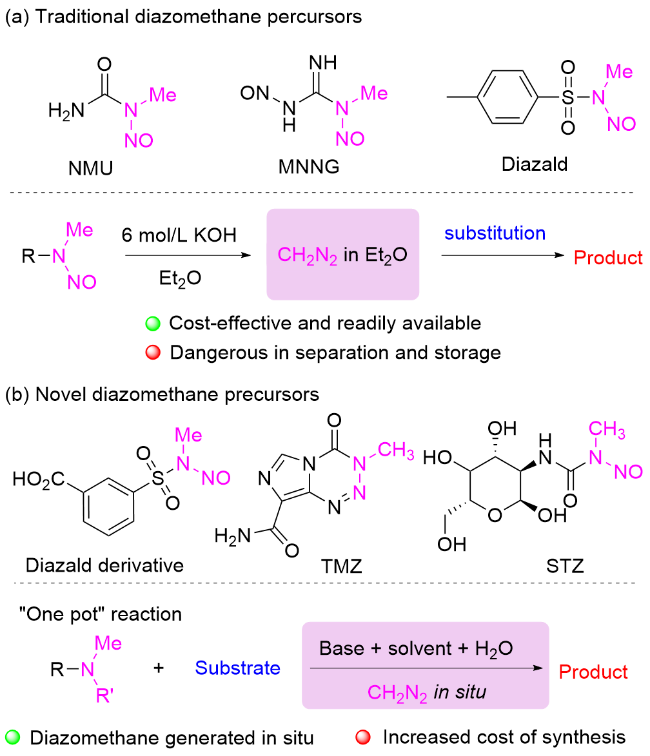
Recent advances in flow chemistry have provided one solution,[17] where diazomethane is generated and consumed in situ within microreactors, mitigating risks associated with storage and handling. For example, Kappe and co-workers demonstrated continuous separation of diazomethane from complex mixtures using Teflon AF-2400 tube, enabling diverse downstream transformations. Nevertheless, the high cost of flow equipment has hindered its broader use.
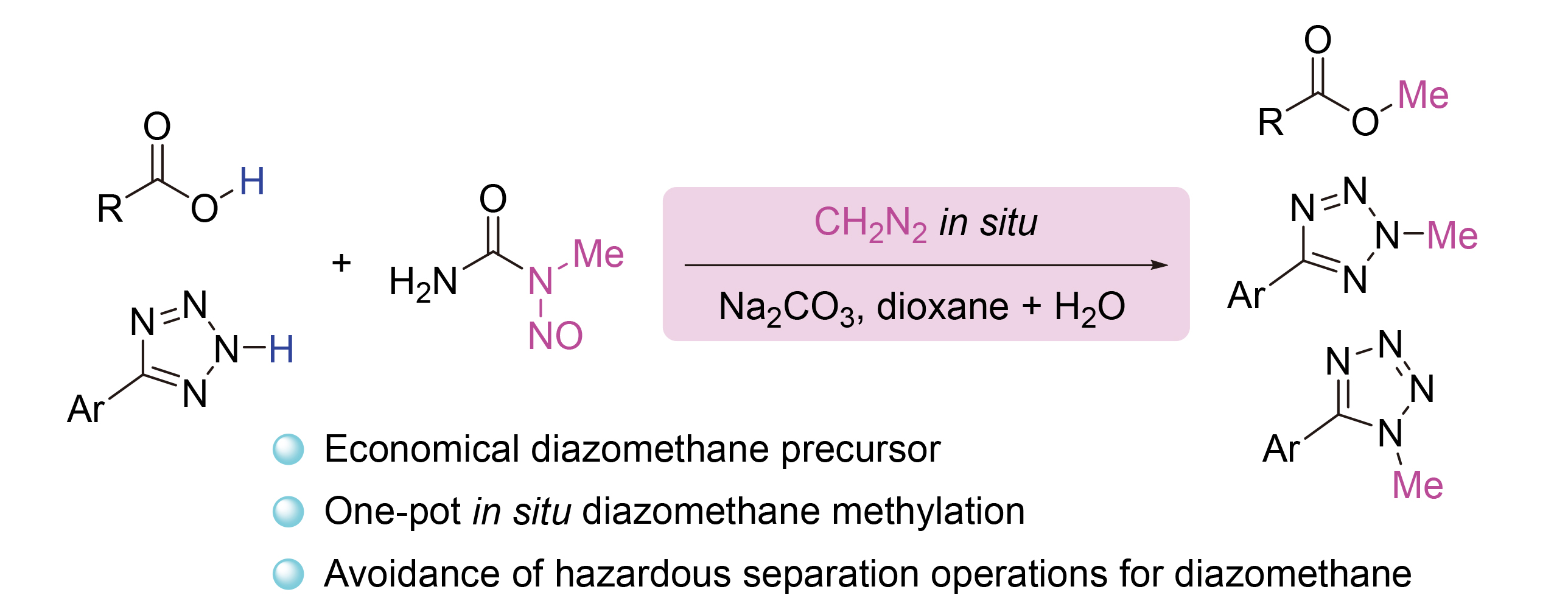
In parallel, one-pot synthesis has emerged as a practical strategy that offers notable advantages in efficiency and safety for organic transformations. This is particularly true for reactions involving the in situ generation of highly reactive or hazardous intermediates.[18] By producing diazomethane in situ from precursors directly in the reaction mixture, this strategy eliminates the need for isolation and specialized apparatus, requiring only standard glassware while offering greater safety and operational simplicity. Carreira and co-workers pioneered a water-soluble Diazald derivative that generated diazomethane in situ in aqueous KOH, enabling olefin cyclopropanation.[19a] Subsequently, Hergenrother and Liu employed temozolomide (TMZ)[19b] and streptozotocin (STZ)[19c] as DNA-alkylating drug to generate diazomethane in situ, achieving efficient methylation of carboxylic acid derivativesScheme 1b. Although highly effective, these precursors are structurally complex and costly to prepare, limiting their scalability. In contrast, traditional precursors remain attractive due to their proven stability, high reactivity, low cost, and established large-scale availability. Motivated by these considerations, we set out to develop an economical and practical one-pot diazomethane generation strategy based on traditional precursors, aiming to achieve safe and efficient methylation of carboxylic acids and thereby enhance the synthetic utility of this transformation.
2 Results and discussion
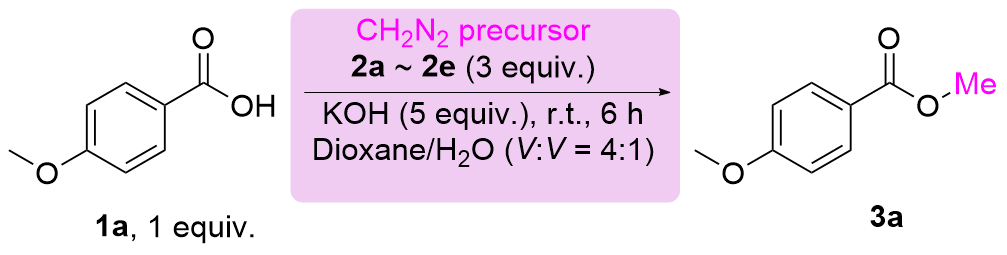
Building on our previous work in diazo compound synthesis[20] and a comprehensive literature survey,[21] p- methoxybenzoic acid (1a) was selected as the model substrate for optimization (Table 1). Initial trials employed a 1,4-dioxane/H2O (V∶V=4∶1) solvent system with KOH (5 equiv.) as base. A systematic comparison of common diazomethane precursors revealed that NMU and MNNG delivered the desired methyl ester in moderate yields (43% and 26%), whereas Diazald and STZ were inefficient (<20%), and TMZ was essentially inactive. The low efficiency observed for the commercially available diazomethane precursor Diazald may be attributed to the strong electron-withdrawing propriety of the sulfonyl group, which significantly stabilizes its N—NO bond and raises the activation barrier for decomposition. Consequently, it fails to efficiently release CH2N2 under the present reaction conditions. Among these, NMU (2a) displayed the most promising reactivity, likely due to its relatively weak N—NO bond. Importantly, NMU is readily obtained from inexpensive N-methylurea via a straightforward nitrosation,[22] further highlighting its practical advantages.
Table 1 Screening of diazomethane precursorsa |
| Entry | CH2N2 precursor | Yieldb/% |
|---|---|---|
| 1 | NMU | 43 |
| 2 | MNNG | 26 |
| 3 | Diazald | 17 |
| 4 | STZ | 12 |
| 5 | TMZ | Trace |
a Reaction conditions: 1a (0.5 mmol, 1 equiv.), 2a~2e (1.5 mmol, 3 equiv.), KOH (5.0 equiv.) in 2.5 mL of dioxane/H2O (V∶V=4∶1) at room temperature for 6 h. b Isolated yields. |
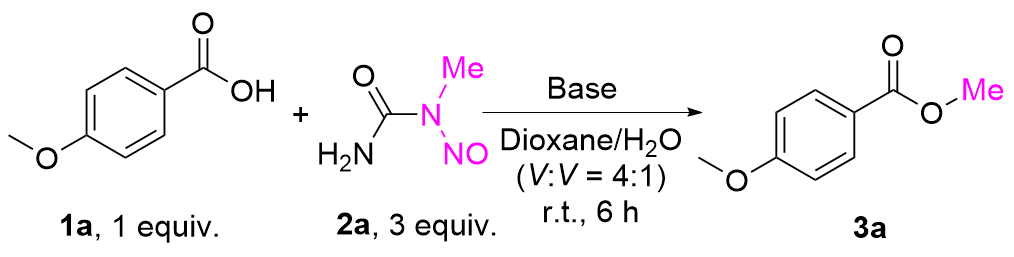
The influence of bases and solvents was next examined (Table 2). Strong inorganic bases (KOH, NaOH) afforded low yields (43%~37%, Entries 1, 2), likely owing to uncontrolled diazomethane release and ester hydrolysis. In contrast, weak base salts, such as NaHCO3, Na2CO3, K2CO3, and K3PO4 promoted efficiently the reaction, with Na2CO3 providing the highest yield (87%, Entry 4). Organic bases (Entries 7, 8) were largely ineffective, and in the absence of base only trace product formed (Entry 9), confirming its essential role in precursor activation. Solvent screening further underscored the importance of the reaction medium. The use of mixed solvents, such as MeCN/ H2O, tetrahydrofuran (THF)/H2O, and biphasic dichloromethane (DCM)/H2O resulted in diminished efficiency (Entries 10~12). The inferior yields observed in Entries 13~15 further confirm that employing a single solvent, either organic or aqueous, would be unfavorable to the reaction performance. Furthermore, changing the dioxane/ H2O ratio from 4∶1 to 1∶1 significantly lowered the product yield (Entry 16). Further fine-tuning of the stoichiometry revealed that decreasing the amount of Na2CO3 to 2 equiv. unexpectedly increased the yield to 98% (Entries 17, 18). Similarly, reducing the NMU loading to 2 equiv retained high efficiency (Entry 19). The influence of reaction time was also examined, shortening it to 1~2 h led to a markedly lower yield (Entries 20, 21), while extending it to 12 h did not further improve the outcome (Entry 22). Thus, the optimal conditions were established as NMU (2 equiv.) and Na2CO3 (2 equiv.) in 1,4-dioxane/H2O (V∶V=4∶1) at room temperature for 6 h.
Table 2 Optimization of reaction conditionsa |
| Entry | Base (Dosage/equiv.) | Solvent | Yieldb/% |
|---|---|---|---|
| 1 | KOH (5) | Dioxane/H2O | 43 |
| 2 | NaOH (5) | Dioxane/H2O | 37 |
| 3 | NaHCO3 (5) | Dioxane/H2O | 82 |
| 4 | Na2CO3 (5) | Dioxane/H2O | 87 |
| 5 | K2CO3 (5) | Dioxane/H2O | 83 |
| 6 | K3PO4 (5) | Dioxane/H2O | 79 |
| 7 | Et3N (5) | Dioxane/H2O | 10 |
| 8 | DBU (5) | Dioxane/H2O | 23 |
| 9 | None | Dioxane/H2O | |
| 10 | Na2CO3 (5) | CH3CN/H2O | 52 |
| 11 | Na2CO3 (5) | THF/H2O | 35 |
| 12 | Na2CO3 (5) | CH2Cl2/H2O | 21 |
| 13 | Na2CO3 (5) | CH2Cl2 | 8 |
| 14 | Na2CO3 (5) | Dioxane | 48 |
| 15 | Na2CO3 (5) | H2O | 6 |
| 16c | Na2CO3 (5) | Dioxane/H2O | 65 |
| 17 | Na2CO3 (3) | Dioxane/H2O | 91 |
| 18 | Na2CO3 (2) | Dioxane/H2O | 98 |
| 19d | Na2CO3 (2) | Dioxane/H2O | 98 |
| 20e | Na2CO3 (2) | Dioxane/H2O | 40 |
| 21f | Na2CO3 (2) | Dioxane/H2O | 53 |
| 22g | Na2CO3 (2) | Dioxane/H2O | 98 |
a Reaction conditions: 1a (0.5 mmol, 1 equiv.), 2a (1.5 mmol, 3 equiv.), and base (5.0 equiv.) in solvent (2.5 mL) at room temperature for 6 h. b Isolated yields. c Dioxane/H2O (V∶V=1∶1). d 2 equiv. of NMU. e 1 h. f 2 h. g 12 h. |
With these conditions in hand, the substrate scope was evaluated (Table 3). Aromatic acids bearing electron-dona- ting, electron-withdrawing, or sterically demanding substituents (1a~1g) were efficiently methylated (up to 98% yield). Conjugated and formyl-substituted substrates (1h~1i) reacted cleanly without [2+1] byproducts, while naphthoic and heteroaromatic acids (1j~1l) afforded moderate to good yields. Terephthalic acid (1m) underwent smooth double methylation. The method also exhibited excellent chemoselectivity: phenolic (1n) and amino-con- taining substrates (1o, 1p) gave exclusive esterification products without O- or N-methylation. Aliphatic acids, including linear, branched, and amino acid derivatives, were also well tolerated (77%~94%, 1q~1t). These results demonstrate that the protocol is broadly applicable to aromatic, heteroaromatic, and aliphatic acids with excellent functional group tolerance.
Table 3 Substrate scope of the carboxylic acids |

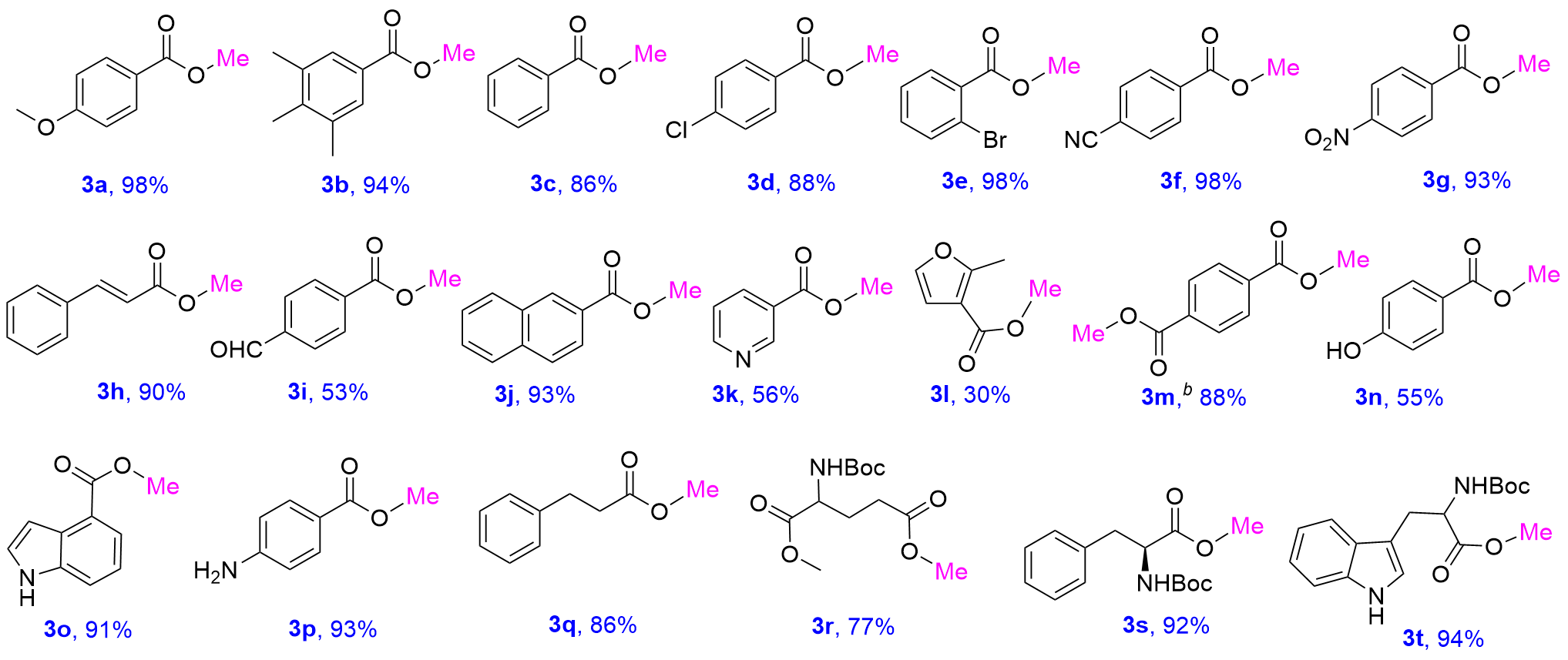 |
a Reaction conditions: 1 (0.5 mmol, 1 equiv.), 2a (1.0 mmol, 2 equiv.) and Na2CO3 (2.0 equiv.) in 2.5 mL of dioxane/H2O (V∶V=4∶1) at room temperature for 6 h. b 1m (0.5 mmol, 1 equiv.), 2a (2.0 mmol, 4 equiv.), and Na2CO3 (3.0 equiv.) in 3.0 mL of dioxane/H2O (V∶V=4∶1) at room temperature for 6 h. |
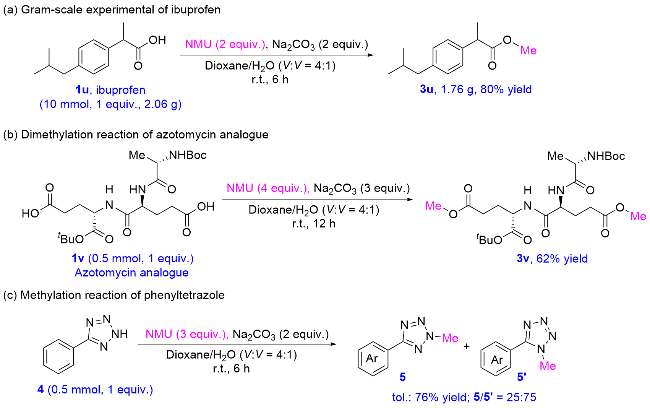
To probe scalability and synthetic utility, gram-scale methylation of ibuprofen (1u, 10 mmol) was carried out, affording 1.76 g of ester 3u in 80% yield (Scheme 2, a). Notably, the method was also compatible with natural antitumor peptides. An azotomycin analogue 1v underwent efficient dimethylation to give 3v in 62% yield (Scheme 2, b). Given the structural analogy between tetrazoles and carboxylic acids,[23] this method was further extended to tetrazole derivatives. Phenyltetrazole 4 underwent smooth conversion to regioisomeric N-methylated products 5/5' in 76% combined yield (Scheme 2, c), providing a rare, operationally simple approach to tetrazole functionalization without hazardous methylating agents.
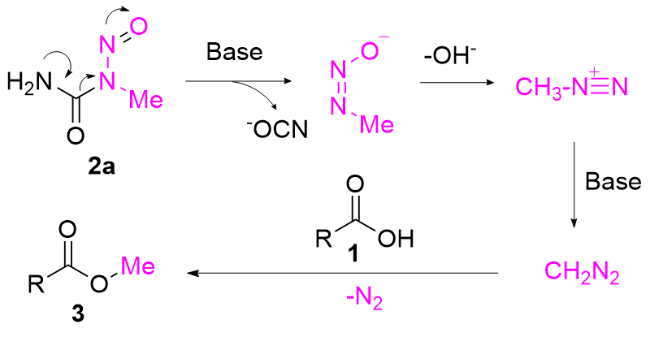
According to the decomposition mechanism of N-methyl- N-nitrosourea (MNU) under basic conditions,[12b] the following reaction pathway was proposed (Scheme 3). In the presence of a base, the carbamoyl group of MNU (2a) undergoes deprotonation, leading to the cleavage of the carbon-nitrogen (C—N) bond and generating the highly reactive electrophilic methyl diazonium ion (Me-N2⁺). This ion is subsequently neutralized by OH-, losing a proton to form neutral diazomethane (CH2N2), which subsequently reacts with carboxylic acids 1 to yield methylated products 3.


3 Conclusions
In summary, a one-pot in situ diazomethane-enabled chemoselective methylation strategy employing commercially available NMU as the precursor was developed. The protocol, employing Na2CO3 in a 1,4-dioxane/H2O system at room temperature, enables efficient methylation of a wide range of carboxylic acids and tetrazoles with excellent yields and chemoselectivity. The method demonstrates broad substrate scope, outstanding functional group tolerance, and scalability to gram scale, including pharmaceutical and peptide substrates. Moreover, its extension to tetrazole N-methylation offers a valuable alternative to hazardous classical methods. Overall, this work provides a safe, operationally simple, and broadly applicable platform for harnessing diazomethane chemistry in modern synthesis, with promising implications for medicinal chemistry and beyond.
4 Experimental section
4.1 General information
All purchased reagents were used without further purification. Thin-layer chromatography (TLC) was performed on precoated GF254 silica gel plates (Qingdao Marine Chemical Inc.) and compounds were visualized with a UV light at 254 nm. Flash chromatography separations were carried out using silica gel (200~300 mesh, Qingdao Marine Chemical Inc.).
Nuclear magnetic resonance (NMR) spectroscopies were recorded at 400 for 1H NMR spectroscopy, 101 for 13C NMR spectroscopy (decoupled), and 376 MHz for 19F NMR spectroscopy (decoupled), respectively. Chemical shifts were reported with Me4Si as internal standard and CHCl3 as external standard, respectively. High resolution mass spectrometry (HRMS) spectra were obtained on a Bruker mior OTOF-QII instrument. Melting points were measured on an SGW X-4A digital melting point apparatus and are uncorrected.
4.2 General procedure
4.2.1 Preparation of 1-methyl-N-nitrosourea (NMU)
N-Methylurea (14.8 g, 200 mmol) was dissolved in 120 mL of water. Sodium nitrite (15.2 g, 220 mmol) was added, and the mixture was cooled to 0 ℃ using an ice bath. Conc. HCl (26.7 mL, 0.26 mol) was then added dropwise over a 1-hour period. The reaction mixture was stirred at 0 ℃ for an additional 30 min, after which the precipitate was collected by filtration, washed with water, and dried under vacuum. N-Methyl-N-nitrosourea was obtained as a light beige powder, which was deemed sufficiently pure for subsequent reactions. The product was stored at -28 ℃.[20a]
4.2.2 General procedure for the synthesis of methyl esters
A 10 mL tube equipped with a stirring bar and capped with a rubber septum were charged with carboxylic acid substrate 1 (1.0 equiv., 0.5 mmol), NMU (2a, 2 equiv., 1.0 mmol), and Na2CO3 (2 equiv., 1.0 mmol). 2.5 mL of 1,4-dioxane/H2O (V∶V=4∶1) was transferred into the tube. The resulting mixture was stirred under an air atmosphere at ambient temperature. After 6 h, the mixture was quenched with sat. NH4Cl solution and extracted with ethyl acetate (20 mL×3). The combined extracts were washed with sat. Na2CO3 solution and brine, dried over anhydrous Na2SO4 and concentrated in vacuo. Purification by silica gel column chromatography using ethyl acetate/petroleum ether as eluent gave the pure product 3.
Methyl 4-methoxybenzoate (3a):[18] Colorless oil (petroleum ether/ethyl acetate, V∶V=10∶1, Rf=0.6), 81.4 mg, 98% yield. 1H NMR (400 MHz, CDCl3) δ: 8.02~7.94 (m, 2H), 6.95~6.86 (m, 2H), 3.87 (s, 3H), 3.84 (s, 3H); 13C NMR (101 MHz, CDCl3) δ: 166.8, 163.3, 131.5, 122.5, 113.5, 55.4, 51.8.
Methyl 2,4,6-trimethylbenzoate (3b):[24] Colorless oil (petroleum ether/ethyl acetate, V∶V=100∶1, Rf=0.6), 83.8 mg, 94% yield. 1H NMR (400 MHz, CDCl3) δ: 6.89~6.82 (m, 2H), 3.90 (s, 3H), 2.29 (s, 6H), 2.28 (s, 3H); 13C NMR (101 MHz, CDCl3) δ: 170.5, 139.2, 135.1, 130.8, 128.3, 51.7, 21.0, 19.7.
Methyl benzoate (3c):[18] Colorless oil (petroleum ether/ethyl acetate, V∶V=10∶1, Rf=0.6), 58.8 mg, 86% yield. 1H NMR (400 MHz, CDCl3) δ: 8.08~8.00 (m, 2H), 7.60~7.51 (m, 1H), 7.48~7.39 (m, 2H), 3.92 (s, 3H); 13C NMR (101 MHz, CDCl3) δ: 167.1, 132.9, 130.1, 129.5, 128.3, 52.1.
Methyl 4-chlorobenzoate (3d):[19] White solid (petroleum ether/ethyl acetate, V∶V=10∶1, Rf=0.6), 75.1 mg, 88% yield. m.p. 142~144 ℃; 1H NMR (400 MHz, CDCl3) δ: 8.01~7.92 (m, 2H), 7.45~7.37 (m, 2H), 3.91 (s, 3H); 13C NMR (101 MHz, CDCl3) δ: 166.2, 139.3, 130.9, 128.7, 128.6, 52.2.
Methyl 2-bromobenzoate (3e): [25] Colorless oil (petroleum ether/ethyl acetate, V∶V=10∶1, Rf=0.6), 105.4 mg, 98% yield. 1H NMR (400 MHz, CDCl3) δ: 7.82~7.75 (m, 1H), 7.69~7.63 (m, 1H), 7.40~7.29 (m, 2H), 3.93 (s, 3H); 13C NMR (101 MHz, CDCl3) δ: 166.6, 134.3, 132.5, 132.1, 131.3, 127.1, 121.6, 52.5.
Methyl 4-cyanobenzoate (3f):[26] White solid (petroleum ether/ethyl acetate, V∶V=5∶1, Rf=0.5), 79.0 mg, 98% yield. m.p. 38~40 ℃; 1H NMR (400 MHz, CDCl3) δ: 8.18~8.08 (m, 2H), 7.79~ 7.69 (m, 2H), 3.96 (s, 3H); 13C NMR (101 MHz, CDCl3) δ: 165.4, 133.9, 132.2, 130.0, 117.9, 116.3, 52.7.
Methyl 4-nitrobenzoate (3g):[27] Yellow solid (petroleum ether/ethyl acetate, V∶V=5∶1, Rf=0.6), 84.2 mg, 93% yield. m.p. 98~100 ℃; 1H NMR (400 MHz, CDCl3) δ: 8.33~8.25 (m, 2H), 8.25~8.17 (m, 2H), 3.98 (s, 3H); 13C NMR (101 MHz, CDCl3) δ: 165.1, 150.5, 135.5, 130.7, 123.5, 52.8.
Methyl cinnamate (3h):[27] Colorless oil (petroleum ether/ethyl acetate, V∶V=10∶1, Rf=0.6), 73.0 mg, 90% yield. 1H NMR (400 MHz, CDCl3) δ: 7.70 (d, J=16.0 Hz, 1H), 7.55~7.49 (m, 2H), 7.41~7.36 (m, 3H), 6.44 (d, J=16.0 Hz, 1H), 3.81 (s, 3H); 13C NMR (101 MHz, CDCl3) δ: 167.4, 144.8, 134.3, 130.2, 128.8, 128.0, 117.7, 51.6.
Methyl 4-formylbenzoate (3i):[16] White solid (petroleum ether/ethyl acetate, V∶V=10∶1, Rf=0.4), 54.2 mg, 66% yield. m.p. 58~60 ℃; 1H NMR (400 MHz, CDCl3) δ: 10.09 (s, 1H), 8.21~8.14 (m, 2H), 7.98~7.91 (m, 2H), 3.95 (s, 3H); 13C NMR (101 MHz, CDCl3) δ: 191.6, 166.0, 139.1, 135.0, 130.1, 129.4, 52.7.
Methyl 2-naphthoate (3j):[28] White solid (petroleum ether/ethyl acetate, V∶V=10∶1, Rf=0.6), 86.6 mg, 93% yield. m.p. 73~75 ℃; 1H NMR (400 MHz, CDCl3) δ: 8.95~8.92 (m, 1H), 8.21~8.19 (m, 1H), 8.04~8.01 (m, 1H), 7.90~7.88 (m, 1H), 7.65~7.61 (m, 1H), 7.56~7.48 (m, 2H), 4.01 (s, 3H); 13C NMR (101 MHz, CDCl3) δ: 168.0, 133.8, 133.3, 131.3, 130.2, 128.5, 127.7, 127.1, 126.2, 125.8, 124.5, 52.1.
Methyl nicotinate (3k):[16] Colorless oil (petroleum ether/ethyl acetate, V∶V=5∶1, Rf=0.4), 38.4 mg, 56% yield. 1H NMR (400 MHz, CDCl3) δ: 9.18~9.17 (m, 1H), 8.73~8.72 (m, 1H), 8.26~8.23 (m, 1H), 7.36~7.22 (m, 1H), 3.91 (s, 3H); 13C NMR (101 MHz, CDCl3) δ: 165.6, 153.3, 150.8, 136.9, 125.9, 123.2, 52.3.
Methyl 2-methylfuran-3-carboxylate (3l):[29] Colorless oil (petroleum ether/ethyl acetate, V∶V=10∶1, Rf=0.4), 44.1 mg, 63% yield. 1H NMR (400 MHz, CDCl3) δ: 7.22 (d, J=2.0 Hz, 1H), 6.63 (d, J=2.0 Hz, 1H), 3.82 (s, 3H), 2.57 (s, 3H); 13C NMR (101 MHz, CDCl3) δ: 164.5, 159.3, 140.3, 113.2, 110.6, 51.3, 13.7.
Dimethyl terephthalate (3m):[30] White solid (petroleum ether/ethyl acetate, V∶V=10∶1, Rf=0.4), 73.8 mg, 76% yield. m.p. 138~140 ℃; 1H NMR (400 MHz, CDCl3) δ: 8.06 (s, 4H), 3.91 (s, 6H); 13C NMR (101 MHz, CDCl3) δ: 166.2, 133.9, 129.5, 52.4.
Methyl 4-hydroxybenzoate (3n):[18] White solid (petroleum ether/ethyl acetate, V∶V=5∶1, Rf=0.6), 57.1 mg, 75% yield. m.p. 124~126 ℃; 1H NMR (400 MHz, CDCl3) δ: 8.01~7.89 (m, 2H), 6.93~ 6.84 (m, 2H), 6.57 (s, 1H), 3.90 (s, 3H); 13C NMR (101 MHz, CDCl3) δ: 167.5, 160.3, 131.9, 122.2, 115.3, 52.1.
Methyl 1H-indole-4-carboxylate (3o):[31] White solid (petroleum ether/ethyl acetate, V∶V=3∶1, Rf=0.6), 79.7 mg, 91% yield. m.p. 72~74 ℃; 1H NMR (400 MHz, CDCl3) δ: 8.71 (s, 1H), 7.94 (d, J=7.5, 1H), 7.60~7.57 (m, 1H), 7.33 (t, J=2.8 Hz, 1H), 7.25 (d, J=7.7 Hz, 1H), 7.22~7.19 (m, 1H), 4.01 (s, 3H); 13C NMR (101 MHz, CDCl3) δ: 168.3, 136.6, 127.3, 126.4, 123.3, 121.3, 121.0, 116.1, 103.6, 51.7.
Methyl 4-aminobenzoate (3p):[19] White solid (petroleum ether/ethyl acetate, V∶V=3∶1, Rf=0.6), 70.3 mg, 93% yield. m.p. 113~115 ℃; 1H NMR (400 MHz, CDCl3) δ: 7.99~7.72 (m, 2H), 6.74~ 6.52 (m, 2H), 4.05 (brs, 2H), 3.85 (s, 3H); 13C NMR (101 MHz, CDCl3) δ: 167.1, 150.8, 131.6, 119.7, 113.8, 51.6.
Methyl 3-phenylpropanoate (3q):[32] Colorless oil (petroleum ether/ethyl acetate, V∶V=10∶1, Rf=0.6), 70.6 mg, 86% yield. 1H NMR (400 MHz, CDCl3) δ: 7.33~7.26 (m, 2H), 7.23~7.19 (m, 3H), 3.68 (s, 3H), 2.96 (t, J=7.8 Hz, 2H), 2.68~2.61 (m, 2H); 13C NMR (101 MHz, CDCl3) δ: 173.3, 140.5, 128.5, 128.2, 126.2, 51.6, 35.7, 30.9.
Dimethyl (tert-butoxycarbonyl)-L-glutamate (3r):[33] Colorless oil (petroleum ether/ethyl acetate, V∶V=6∶1, Rf=0.5), 106.0 mg, 77% yield. 1H NMR (400 MHz, CDCl3) δ: 5.24~5.07 (m, 1H), 4.41~4.23 (m, 1H), 3.71 (s, 3H), 3.64 (s, 3H), 2.47~2.29 (m, 2H), 2.16~2.12 (m, 1H), 1.97~1.85 (m, 1H), 1.40 (s, 9H); 13C NMR (101 MHz, CDCl3) δ: 173.1, 172.6, 155.3, 79.9, 52.8, 52.3, 51.7, 30.0, 28.2, 27.7.
Methyl (tert-butoxycarbonyl)-L-phenylalaninate (3s):[27] White solid (petroleum ether/ethyl acetate, V∶V=6∶1, Rf=0.3), 128.5 mg, 92% yield. m.p. 38~40 ℃; 1H NMR (400 MHz, CDCl3) δ: 7.31~7.26 (m, 2H), 7.25~7.20 (m, 1H), 7.16~7.08 (m, 2H), 4.97 (d, J=8.3 Hz, 1H), 4.57 (dt, J=8.4, 6.0 Hz, 1H), 3.69 (s, 3H), 3.13~3.02 (m, 2H), 1.40 (s, 9H); 13C NMR (101 MHz, CDCl3) δ: 172.3, 155.0, 136.0, 129.3, 128.5, 127.0, 79.9, 54.4, 52.2, 38.3, 28.3.
Methyl (tert-butoxycarbonyl)-L-tryptophanate (3t):[34] White solid (petroleum ether/ethyl acetate, V∶V=5∶1, Rf=0.5), 149.6 mg, 94% yield. m.p. 135~137 ℃; 1H NMR (400 MHz, CDCl3) δ: 8.22 (s, 1H), 7.55 (d, J=7.9 Hz, 1H), 7.34 (d, J=8.1 Hz, 1H), 7.22~7.16 (m, 1H), 7.14~7.08 (m, 1H), 6.98 (d, J=2.4 Hz, 1H), 5.09 (d, J=8.2 Hz, 1H), 4.67~4.63 (m, 1H), 3.68 (s, 3H), 3.30~3.28 (m, 2H), 1.43 (s, 9H); 13C NMR (101 MHz, CDCl3) δ: 172.8, 155.2, 136.1, 127.6, 122.7, 122.1, 119.6, 118.7, 111.2, 110.1, 79.8, 54.2, 52.2, 28.3, 27.9.
Methyl 2-(4-isobutylphenyl)propanoate (3u):[35] White solid (petroleum ether/ethyl acetate, V∶V=5∶1, Rf=0.5), 1.76 g, 80% yield. m.p. 112~114 ℃; 1H NMR (400 MHz, CDCl3) δ: 7.23~7.17 (m, 2H), 7.13~7.06 (m, 2H), 3.71 (q, J=7.2 Hz, 1H), 3.66 (s, 3H), 2.45 (d, J=7.1 Hz, 2H), 1.89~1.80 (m, 1H), 1.49 (d, J=7.2 Hz, 3H), 0.92 (s, 3H), 0.90 (s, 3H); 13C NMR (101 MHz, CDCl3) δ: 175.2, 140.5, 137.7, 129.3, 127.1, 51.9, 45.0, 30.1, 22.4, 18.6.
1-(tert-Butyl) 5-methyl ((S)-2-((S)-2-((tert-butoxycarbo- nyl)amino)propanamido)-5-methoxy-5-oxopentanoyl)-L-glutamate (3v): White solid (petroleum ether/ethyl acetate, V∶V=1∶1, Rf=0.3), 164.7 mg, 62% yield, m.p. 135~137 ℃; 7.28 (d, J=7.8 Hz, 1H), 7.18 (d, J=7.9 Hz, 1H), 5.33 (d, J=7.3 Hz, 1H), 4.59~4.54 (m, 1H), 4.47~4.42 (m, 1H), 4.20 (t, J=7.2 Hz, 1H), 3.67 (d, J=3.6 Hz, 6H), 2.55~1.44 (m, 2H), 2.42~2.31 (m, 2H), 2.23~2.12 (m, 2H), 2.03~1.94 (m, 2H), 1.47 (s, 9H), 1.44 (s, 9H), 1.36 (d, J=7.1 Hz, 3H); 13C NMR (101 MHz, CDCl3) δ: 173.8, 173.2, 172. 9, 170.7, 170.3, 155.4, 82.3, 79.9, 52.2, 52.1, 51.7, 51.7, 50.2, 29.9, 28.2, 27.8, 27.7, 27.1, 18.3; HRMS calcd for C24H42N3O10 [M+H]+ 532.2870, found 532.2870.
4.2.3 Methylation of 5-phenyltetrazole
A 10 mL tube equipped with a stirring bar and capped with a rubber septum were charged with 5-phenyl-2H-tetra- zole 4 (1.0 equiv., 0.5 mmol), NMU (3 equiv., 1.5 mmol), and Na2CO3 (3 equiv., 1.5 mmol). 2.5 mL of mixture solvent dioxane/H2O (V∶V=4∶1) was transferred into the tube. The resulting mixture was stirred under an air atmosphere at ambient temperature. After 6 h the mixture was quenched with sat. NH4Cl solution and extracted with ethyl acetate (20 mL×3). The combined extracts were washed with sat. Na2CO3 solution and brine, dried over anhydrous Na2SO4 and concentrated in vacuo. Purification by silica gel column chromatography using ethyl acetate/petroleum ether as eluent gave 2-methyl-5-phenyl-2H-tetrazole (5) and 1-methyl-5-phenyl-1H-tetrazole (5').[36] White solid (petro- leum ether/ethyl acetate, V∶V=5∶1, Rf=0.2), 60.83 mg, 76% yield. Major product (5a'): 1H NMR (400 MHz, CDCl3) δ: 7.77~7.66 (m, 2H), 7.57~7.53 (m, 3H), 4.15 (s, 3H); 13C NMR (101 MHz, CDCl3) δ: 154.4, 131.2, 129.2, 128.6, 123.6, 35.0. Minor product (5a): 1H NMR (400 MHz, CDCl3) δ: 8.12~7.94 (m, 2H), 7.40~7.36 (m, 3H), 4.27 (s, 3H); 13C NMR (101 MHz, CDCl3) δ: 165.1, 130.2, 128.8, 127.3, 126.7, 39.3.
Supporting Information 1H NMR and 13C NMR spectroscopy. The Supporting Information is available free of charge via the Internet at http://sioc-journal.cn.
(Zhao, C.)