


1 Introduction
Like organophosphorus compounds, organosulfur compounds are prepared in the industry using the traditional methods that often not only suffer from lack of efficacy but also have safety and environmental concerns.[1] Currently, we are working on a project aiming to find alternative “safer and greener” processes to replace these old ones for the preparation of the industrially important organophosphorus compounds [R3P, (RO)3P, (RO)3P(O), etc.][2] and sulfur compounds [RSH, R2S, (RS)2, etc.].[2a,3]
Thiophenol (PhSH) is one of the most popular organosulfur compounds and widely used in the industry.[4] It is a key intermediate for the preparation of pharmaceuticals (Scheme 1A).[5-8] As one of the suppliers of PhSH, thousands of tons of PhSH are prepared every year. As reported in the literature, PhSH can be prepared by the gas phase reaction of PhCl with the high toxic H2S (Scheme 1B).[9] This reaction requires harsh conditions. We are currently investigating an alternative approach for the synthesis of PhSH using benzene and elemental sulfur,[10] which we consider to be a more environmentally friendly route. Although not satisfied at this time, this reaction can generate a mixture of phenyl sulfur (PhxSy, x, y=1 or 2) compounds, including PhSH. Since Ph2S could react with S8 to give (PhS)2,[11] we propose that an efficient and economical process for converting (PhS)2 into PhSH would achieve our design on thiophenol synthesis from benzene and S8 (Scheme 1C).
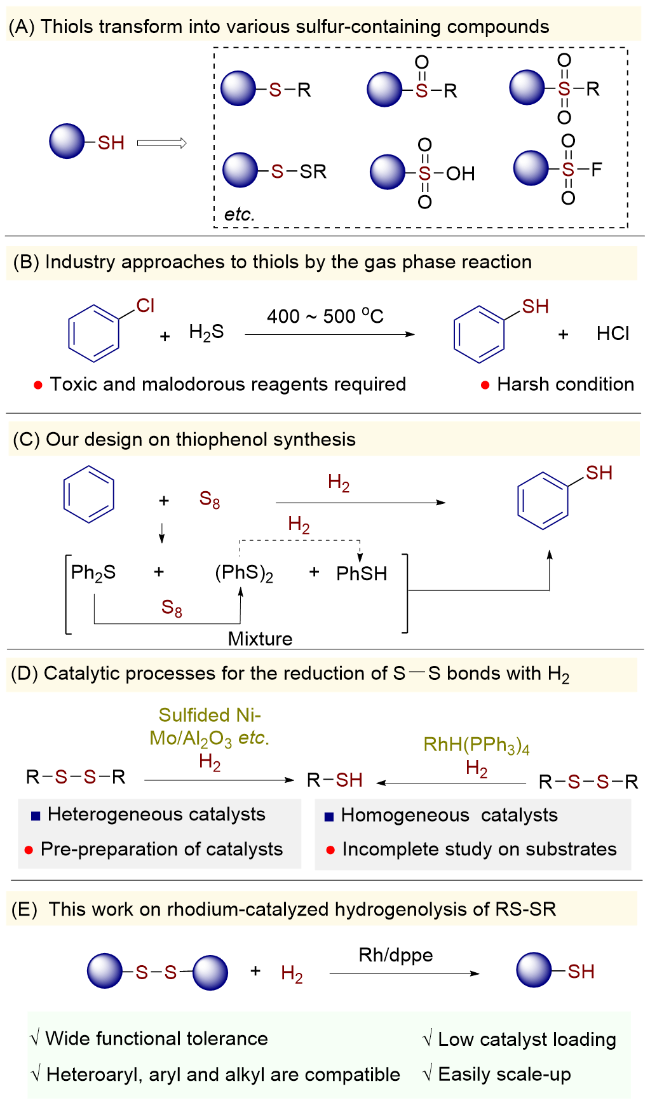
A lot of methods employing organic reducing agents have been reported for the conversion of disulfides to thiols.[12-15] The drawbacks of these processes include the stoichiometric waste and difficult for product separation. Thus, we believe that catalytic hydrogenolysis of (PhS)2 with hydrogen can satisfy our goal on thiophenol synthesis though the known difficulties associated with hydrogenating sulfur-containing compounds. The challenges include strong poisoning of transition metal catalysts and the formation of metal sulfides which irreversibly deactivate the catalyst.[16] Previous studies have shown that heterogeneous catalysts could hydrogenate (PhS)2 to PhSH with H2 (Scheme 1D, left).[17] But these methods require the pre- preparation of catalysts. In the domain of homogeneous catalysis, Yamaguchi et al.[18] disclosed a novel Rh(P- Ph3)4H catalyzed hydrogenation of (RS)2 to RSH (Scheme 1D, right), diaryl sulfides with electron-donating groups were investigated, while PhSH and diaryl sulfides with electron-withdrawing groups were not examined. Despite the incomplete investigation on substrates, this work inspired us to study a rhodium-catalyzed hydrogenation of Ph2S2 to PhSH with H2 (Scheme 1E).
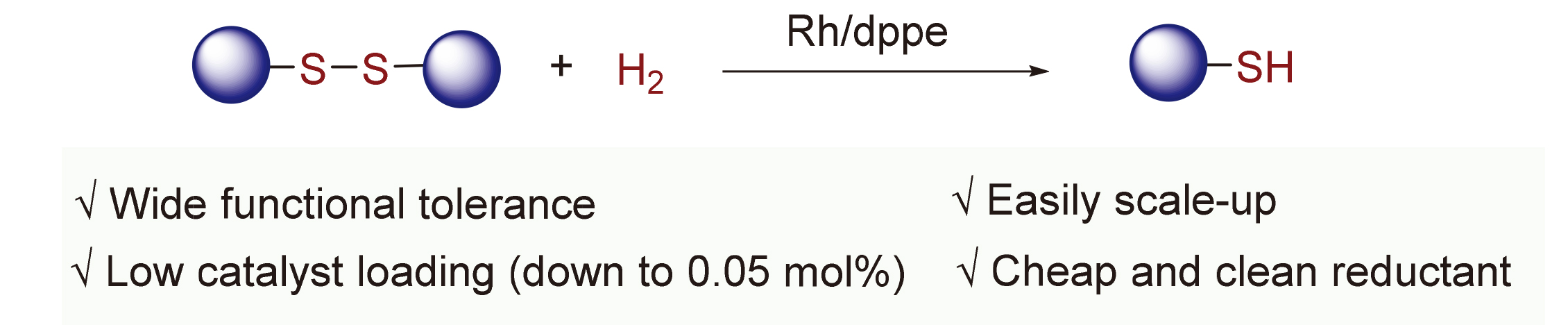
With this motivation, we developed an efficient hydrogenolysis of R2S2 to RSH with hydrogen catalyzed by Rh2(COD)2Cl2. This practical method also can be carried out at a large scale with a loading of rhodium catalysts down to 0.05 mol%. And the catalyst system can be recycled without diminishing the catalytic activity. Besides, this hydrogenolysis reaction is quite general, various disulfides including dialkyl disulfide can be converted to the corresponding thiols in satisfactory yields. Functional groups like hydroxyl, amino, ester, cyano were compatible.
2 Results and discussion
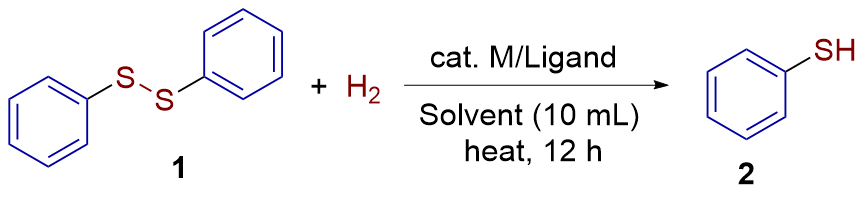
Our investigation was commenced with the reaction of diphenyl disulfide 1 with 2.0 MPa of H2 in toluene at 120 ℃. Firstly, 5 mol% Rh(PPh3)3Cl was used, to our delight, thiophenol 2 was obtained in a yield of 84%. When platinum, palladium and nickel were used, this hydrogenolysis of diphenyl disulfides 1 was inefficient (Table 1, Entries 1~4). To reduce the cost, the catalyst loading was decreased. When the loading was decreased from 5 mol% to 1 mol%, 79% thiophenol 2 can be detected by gas chromatography, further decreased to 0.1%, only 20% 2 was observed (Entries 1, 5 and 9). To enhance the catalytic activity of rhodium, 0.1 mol% triphenylphosphine was added, and the yield of 2 was improved to 30% (Entry 10). But increasing the amount of ligand from 0.1 mol% to 0.3 mol% has no effect on the yield of 2 (Entry 11). Changing the pressure of hydrogen to 3.0 MPa, the efficiency has not improved (Entry 8). Raising the temperature to 150 ℃ has little influence on this reaction. Yet decreasing temperature to 120 ℃, the yield of 2 could be reduced by 9% (Entries 5, 6 and 7). To realize hydrogenation of diphenyl disulfide with a low loading of rhodium catalysts, Rh2(COD)2Cl2 was used to explore the influence of ligand. The results showed that the choice of a suitable phosphine ligand was pivotal for this transformation, only 6% 2 was detected by gas chromatography in absence of ligand (Entry 12). When PPh3 was used, only 8% 2 was detected (Entry 13). Further ligand screening revealed that 1,2-bis-(diphenyl-phosphino)ethane (dppe) was the best ligand for this rhodium catalytic system, affording the desired product in nearly quantitative yield (Entries 14~18). Adjusting the pressure of hydrogen to 1 MPa, the yield of 2 was down to 90% (Entry 19). Other rhodium catalysts such as Ru(OAc)3 and RuCl3 were also investigated (Entries 20 and 21). Subsequent studies on the impact of different solvents showed that toluene was the most efficient solvent for this reaction. To our surprise, suitable solvents included tetrahydrofuran (THF), N,N-dimethylformamide (DMF) and p-xylene (Entries 22, 23, 27). This reaction could be carried out in water, although the yield was lower than those in other organic solvent (Entry 24). Increasing toluene from 10 mL to 30 mL, 98% of 2 was obtained. It showed that decreasing the concentration of reactants will not affect the conversion of diphenyl disulfide (Entry 29). Control experiments showed that the reaction would not occur without catalyst (Entry 30). After screening several parameters carefully, the optimal conditions for the reductive cleavage of the S—S bond were identified: diphenyl disulfide 1 (2.3 mmol, 500 mg) and H₂ (2.0 MPa) reacted in toluene (10 mL) at 120 ℃ for 12 h in the presence of Rh2(COD)2Cl2 (0.05 mol%) and dppe (0.15 mol%). These conditions afforded the desired product 2 in the best yield (Entry 15).
Table 1 Optimization on reaction conditionsa |
| Entry | Ligand (mol%) | Cat. (mol%) | Solvent | Yieldb/% |
|---|---|---|---|---|
| 1 | — | Rh-1 (5.0) | PhMe | 84 |
| 2 | — | Pt(PPh3)4 (5.0) | PhMe | N.R. |
| 3 | — | Pd(PPh3)4 (5.0) | PhMe | 33 |
| 4 | — | Ni(PPh3)4 (5.0) | PhMe | 8 |
| 5 | — | Rh-1 (1) | PhMe | 79 |
| 6c | — | Rh-1 (1) | PhMe | 75 |
| 7d | — | Rh-1 (1) | PhMe | 70 |
| 8e | — | Rh-1 (1) | PhMe | 76 |
| 9 | — | Rh-1 (0.1) | PhMe | 20 |
| 10 | PPh3 (0.1) | Rh-1 (0.1) | PhMe | 30 |
| 11 | PPh3 (0.3) | Rh-1 (0.1) | PhMe | 30 |
| 12 | — | Rh-2 (0.05) | PhMe | 6 |
| 13 | PPh3 (0.15) | Rh-2 (0.05) | PhMe | 8 |
| 14 | dppm (0.15) | Rh-2 (0.05) | PhMe | 84 |
| 15 | dppe (0.15) | Rh-2 (0.05) | PhMe | 99 (93f) |
| 16 | dppf (0.15) | Rh-2 (0.05) | PhMe | 23 |
| 17 | dpph (0.15) | Rh-2 (0.05) | PhMe | 60 |
| 18 | PCy3 (0.15) | Rh-2 (0.05) | PhMe | 30 |
| 19g | dppe (0.15) | Rh-2 (0.05) | PhMe | 90 |
| 20 | dppe (0.15) | Ru(OAc)3 (0.05) | PhMe | 82 |
| 21 | dppe (0.15) | RuCl3 (0.05) | PhMe | 80 |
| 22 | dppe (0.15) | Rh-2 (0.05) | THF | 97 |
| 23 | dppe (0.15) | Rh-2 (0.05) | DMF | 95 |
| 24 | dppe (0.15) | Rh-2 (0.05) | H2O | 70 |
| 25 | dppe (0.15) | Rh-2 (0.05) | PhC2H5 | 34 |
| 26 | dppe (0.15) | Rh-2 (0.05) | PhCN | 88 |
| 27 | dppe (0.15) | Rh-2 (0.05) | p-Xylene | 97 |
| 28 | dppe (0.15) | Rh-2 (0.05) | PhCl | 71 |
| 29h | dppe (0.15) | Rh-2 (0.05) | PhMe | 98 |
| 30 | dppe (0.15) | — | PhMe | N.R. |
a Reaction conditions: 1 (500 mg, 2.3 mmol), cat., ligand, solvent (10 mL), and H2 (2.0 MPa), 120 ℃, 12 h. b Calculated yields of were estimated by GC using dodecane as internal standard. c At 150 ℃. d At 100 ℃. e 3.0 MPa of H2. f Isolated yield. g 1.0 MPa of H2. h 30 mL of PhMe. Rh-1=Rh(PPh3)3Cl. Rh-2=Rh2(COD)2Cl2. N.R.=No reaction. |
With the optimal conditions in hand, we began to explore its synthetic value. A gram-scale synthesis by employing 9.2 mmol of diphenyl disulfides 1 (2000 mg) could also be accomplished smoothly. GC analysis indicated full consumption of the starting material. Analytically pure product 2 was obtained in 93% through a short silica gel column using hexane as the eluent. Notably, even on a larger scale, the yield remained consistent with the smaller-scale (2.3 mmol) reaction (Scheme 2, A).
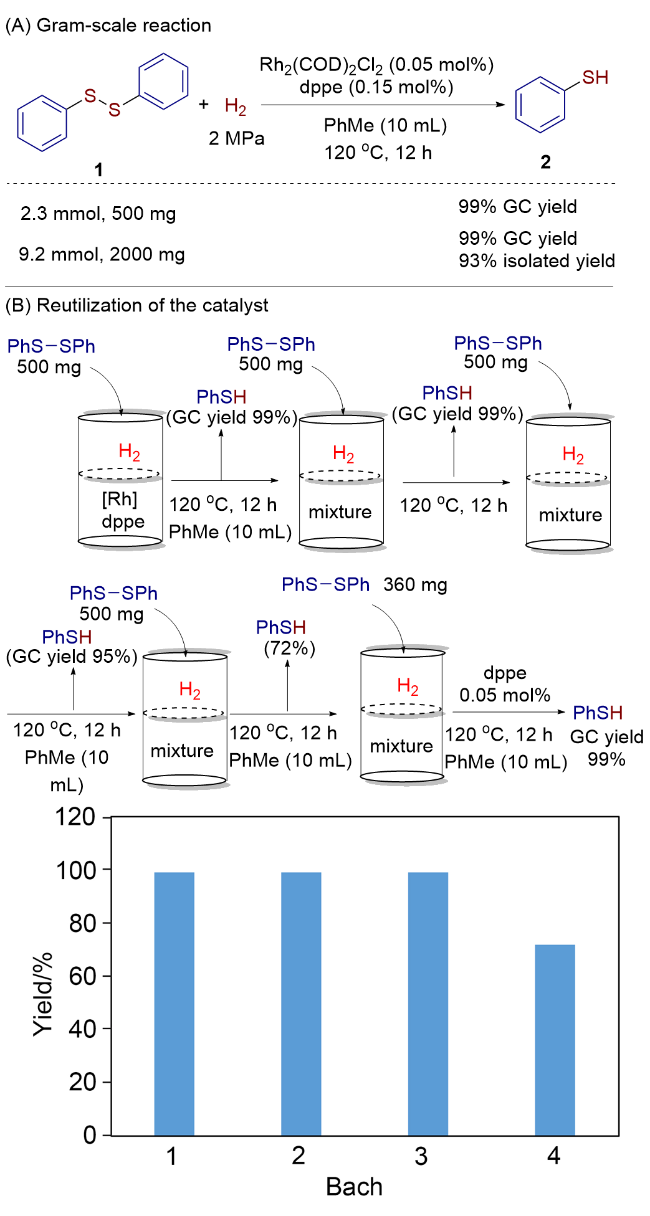
This new catalyst also exhibited excellent reactivity, in the same reactor, diphenyl disulfide 1 was continuously added in batches, each batch of 1 can be converted into thiophenol 2 with a satisfactory yield (Scheme 2, B). For the first time 1 (500 mg, 2.3 mmol), Rh2(COD)2Cl2 (0.5 mg, 0.05 mol%) and dppe (1.2 mg, 0.05 mol%) were dissolved in dry toluene (10 mL) under 2 MPa of H2 at 120 ℃ for 12 h, 1 was completely converted into product 2 and the hydrogenation product was obtained quantitatively confirmed by GC. Then 1 was added to the mixture again and the reaction solution was charged with H2. After 12 h, 1 was completely transformed into 2. Repeated the above operation process for the third time, 95% of 2 was obtained. For the fourth time, 28% of 1 remained according to the GC analysis and 72% of 2 could be detected. Due to the lone pair of electrons on the sulfur atom in thiophenol, it can act as a σ-donor to coordinate with the rhodium center, forming a Rh—SR bond. After three cycles, thiophenol was not separated from the reaction mixture, resulting in a significant accumulation of thiophenol in the solution. This led to deactivation of the rhodium catalyst. To stabilize the rhodium catalyst, an additional 0.05 mol% dppe was introduced and 360 mg of 1 was added again. All of diphenyl disulfide 1 was transformed into thiophenol. It could be seen that this powerful synthetic approach has great potential in industrial production.
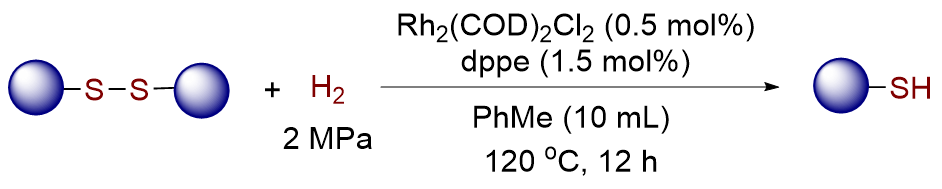
After that, our attention was turned to investigating the applicability of this hydrogenolysis reaction, and the scope of disulfides was examined (Table 2). Both diaryl and dialkyl disulfides can be reduced to give the desired products. The electron effect of the para-position on diphenyldisulfide has little impact on the reaction. Benzediphenyl disulfides with electron-rich or withdrawing groups (such as MeO, COOMe and CN) at the para-position effectively reacted smoothly to afford their corresponding thiols in good to excellent yields (3, 7, 8). Of note, Halogen-substituted diphenyl sulfides including F, Cl, and Br, were tolerated (4, 5, 6). Importantly, substrates bearing Cl, and Br functionality provide an additional handle for further elaboration. Unprotected OH and NH2 were also compatible. The reactions of 4,4'-dihydroxydiphenyl disulfide and 4,4'-dithiodianiline were proceeded successfully in moderate yields (9, 10). The steric hindrance on the benzene ring inhibits the hydrogenation reaction (11~16). When methyl substituted at the ortho-position of the phenyl ring in diphenyl disulfide, only 30% 2-methylbenzene- thiol (13) was detected by gas chromatography, and nearly 70% di-o-tolyl disulphide remained. Besides, ortho-substi- tuted substrates with COOH and NO2 also failed to transform into corresponding thiophenol (12, 14). Yet, methyl- 2-thio-salicylate could be isolated with a yield of 70% (15). 2-Naphthaly disulfide and 2-pyridyl disulfide were well tolerant, providing 17 and 18 in 67% and 57% yields. Next, our attention was turned to the synthesis of alkyl mercaptan. Gratifyingly, aliphatic disulfides were also reduced successfully (19~22). Di-Boc-cystamine can also be reduced to give 21 in moderate yield.
Table 2 Substrate scope for hydrogenolysis of disulfides |


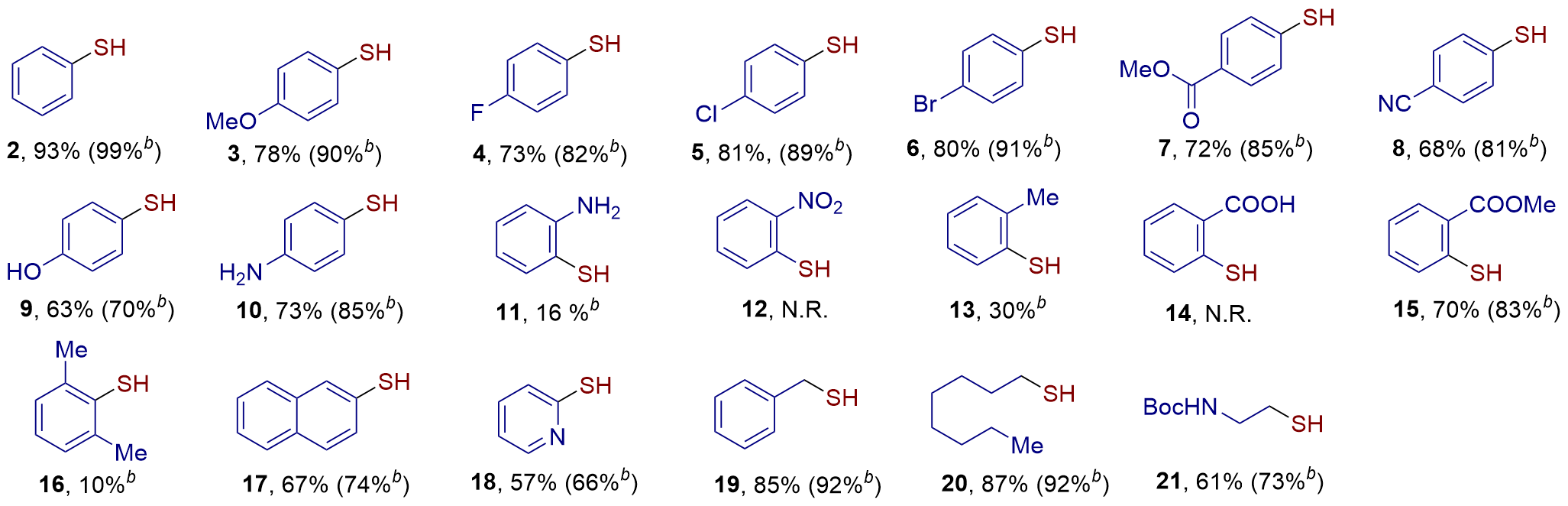 |
a All reactions were conducted on 1.0 mmol scale and the yields were isolated yields. b GC yield. |
Mechanistically,[18-19] we believe that the reaction should initiate via the oxidative addition of rhodium(I) into S—S bond to form a high-valent rhodium(III) intermediate. This species undergoes the exchange reaction with H2 to generate a hydridorhodium(III) complex, which subsequently affords the thiol product via reductive elimination.
3 Conclusions
In summary, an efficient Rh-catalyzed hydrogenolysis of disulfides with H2 was developed. This reaction can be conducted at a low loading of catalyst (down to 0.05 mol%). This transformation exhibits a broad substrate scope and good functional-group tolerance. Naphthyl, 2-pyridyl, hydroxyl, amino, cyano substituted on the benzene ring as well as halogen are compatible. Aliphatic mercaptans including 2-(Boc-amino)ethanethiol could be obtained in decent yield. The reaction is easily conducted in gram-scales, and the catalyst system can be reused several times.
4 Experimental section
4.1 General information
1H NMR and 13C NMR spectra were recorded on Bruker Avance 400, 500 or 600 MHz spectrometer with CDCl3 as the solvent and TMS as an internal standard. Chemical shifts were reported downfield relative to CDCl3 (δH 7.26, δC 77.16). GC detection was conducted on an Agilent 8890 GC system. GC-MS detection was conducted on a Shima- dzu GCMS-QP 2020 NX instrument. All reagents were obtained from commercial sources and used without further purification unless otherwise indicated. Silica gel for column chromatography was purchased from Qingdao Haiyang Chemical Co., Ltd. HPLC (recycle GPC) method for isolation was performed on a Japan Analytical Industry LC-5060P2 instrument. The HPLC was a recycling preparative HPLC (Gel permeation chromatography) with two columns (JAIGEL-2.5HR Plus and JAlGEL2HR Plus). The products were purified by the same conditions: CHCl3 was used as eluent, and flow rate was 10.0 mL/min.
4.2 General procedure for the hydrogenation of RS—SR to RSH
In a glovebox filled with nitrogen, a reactor equipped with a magnetic bar were added RS—SR (1.0 mmol), Rh2(cod)2Cl2 (0.5 mol%, 2.5 mg), dppe (1.5 mol%, 6.0 mg) and toluene (10.0 mL). After stirring for 30 min, the reactor was transferred into an autoclave and taken out of the glovebox, then 2 MPa of H2 was charged. The reaction mixture was stirred at 120 ℃ for 12 h. After the reaction, autoclave reactor was cooled to ambient temperature and the pressure was carefully released in a well-ventilated fume hood. After that, the resulting mixture was concentrated under vacuum. The crude residue was purified by flash column chromatography [ethyl acetate (EA)/hexane] to afford the product, some of which required further purification by HPLC (recycle GPC).
Benzenethiol (2):[20a] Eluted by hexane, 93% yield (204.9 mg), colorless oil. 1H NMR (500 MHz, CDCl3) δ: 7.30~7.26 (m, 2H), 7.23 (dd, J=8.5, 6.8 Hz, 2H), 7.17~7.12 (m, 1H), 3.44 (s, 1H); 13C NMR (126 MHz, CDCl3) δ: 130.9, 129.6, 129.2, 125.8.
4-Methoxybenzenethiol (3):[20a] Eluted by hexane and then purified through HPLC to afford the pure product in 78% yield (218.7 mg), colorless oil. 1H NMR (600 MHz, CDCl3) 1H NMR (600 MHz, CDCl3) δ: 7.28~7.23 (m, 2H), 6.84~6.78 (m, 2H), 3.77 (s, 3H), 3.39 (s, 1H); 13C NMR (151 MHz, CDCl3) δ: 158.6, 132.4, 119.9, 114.8, 55.3.
4-Fluorobenzenethiol (4):[21] Eluted by hexane and then purified through HPLC to afford the pure product in 73% yield (187.1 mg), colorless oil. 1H NMR (500 MHz, CDCl3) δ: 7.30~7.26 (m, 2H), 6.94 (t, J=8.7 Hz, 2H), 3.43 (s, 1H); 13C NMR (126 MHz, CDCl3) δ: 161.7 (d, J=245.7 Hz), 132.1 (d, J=7.9 Hz), 125.1 (d, J=3.5 Hz), 116.3 (d, J=22.1 Hz); 19F NMR (471 MHz, CDCl3) δ: -116.54.
4-Chlorobenzenethiol (5):[20a-20b] Eluted by hexane and then purified through HPLC to afford the pure product in 81% yield (234.3 mg), white solid. m.p. 52~54 ℃(lit.[20b] 51~53 ℃); 1H NMR (600 MHz, CDCl3) δ: 7.22~7.19 (m, 4H), 3.44 (s, H); 13C NMR (151 MHz, CDCl3) δ: 131.9, 130.9, 129.3, 129.3.
4-Bromobenzenethiol (6):[20a,20c] Eluted by hexane and then purified through HPLC to afford the pure product in 80% yield (302.5 mg), white solid. m.p. 71~73℃(lit.[20c] 70.2~70.6 ℃); 1H NMR (600 MHz, CDCl3) δ: 7.35 (dd, J=8.4, 1.5 Hz, 2H), 7.14 (dd, J=8.4, 1.4 Hz, 2H), 3.44 (s, 1H); 13C NMR (151 MHz, CDCl3) δ: 132.2, 131.2, 130.0, 119.6.
Methyl 4-mercaptobenzoate (7):[22] Eluted by hexane/ EA (V∶V=50∶1), and then purified through HPLC to afford the pure product in 72% yield (242.2 mg), white solid. m.p. 51~53 ℃ (lit.[22b] 55~56 ℃); 1H NMR (600 MHz, CDCl3) δ: 7.88 (d, J=8.5 Hz, 2H), 7.28 (d, J=8.5 Hz, 2H), 3.89 (s, 4H), 3.60 (s, 1H); 13C NMR (151 MHz, CDCl3) δ: 166.8, 138.5, 130.4, 128.3, 127.3, 52.2.
4-Mercaptobenzonitrile (8):[23] Eluted by hexane and then purified through HPLC to afford the pure product in 68% yield (183.8 mg), colorless oil. 1H NMR (600 MHz, CDCl3) δ: 7.5 (d, J=8.1 Hz, 2H), 7.3 (d, J=8.0 Hz, 2H), 3.7 (s, 1H); 13C NMR (151 MHz, CDCl3) δ: 139.3, 132.6, 128.8, 118.7, 108.9.
4-Mercaptophenol (9):[23] Eluted by hexane/EA (V∶V=3∶1), 63% yield (159.1 mg), colorless oil. 1H NMR (400 MHz, CDCl3) δ: 7.16~7.11 (m, 2H), 6.65~6.63 (m, 2H), 4.88 (s, 1H), 3.27 (s, 1H); 13C NMR (101 MHz, CDCl3) δ: 154.5, 132.8, 120.2, 116.3.
4-Aminobenzenethiol (10):[24] Eluted by heaxane/EA (V∶V=2∶1) and then purified through HPLC to afford the pure product 73% yield (182.8 mg), yellow solid. m.p. 44~46 ℃ (lit.[24b] 45.7 ℃); 1H NMR (400 MHz, CDCl3) δ: 7.16 (dd, J=8.3,4.0 Hz, 2H), 6.58 (dd, J=8.4, 4.2 Hz, 2H), 3.57 (s, 2H), 3.32 (s, 1H); 13C NMR (101 MHz, CDCl3) δ: 145.5, 133.1, 116.4, 115.9.
Methyl 2-mercaptobenzoate (15):[20a] Eluted by hexane/EA (V∶V=50∶1), and then purified through HPLC to afford the pure product in 70% yield (235.5 mg), colorless oil. 1H NMR (500 MHz, CDCl3) δ: 8.04~7.98 (m, 1H), 7.35~7.28 (m, 2H), 7.15 (s, 1H), 4.70 (s, 1H), 3.92 (s, 3H); 13C NMR (126 MHz, CDCl3); 13C NMR (126 MHz, CDCl3) δ: 167.3, 138.4, 132.6, 131.8, 131.0, 126.0, 124. 8, 52.4.
Naphthalene-2-thiol (17):[23] Eluted by hexane/EA (V∶V=50∶1), and then purified through HPLC to afford the pure product in 67% yield (214.7 mg) as a white solid. 1H NMR (600 MHz, CDCl3) δ: 7.79~7.76 (m, 2H), 7.71 (dd, J=10.6, 8.3 Hz, 2H), 7.47 (t, J=7.6 Hz, 1H), 7.45~7.40 (m, 1H), 7.35 (dd, J=8.5, 1.9 Hz, 1H), 3.60 (s, 1H); 13C NMR (151 MHz, CDCl3) δ: 134.0, 131.6, 128.8, 128.3, 128.0, 127.9, 127.4, 126.9, 126.8, 125.7.
Pyridine-2-thiol (18):[22a-22d] Eluted by hexane/EA (V∶ V=5∶1), 57% yield (126.7 mg), yellow solid. m.p. 127~129 ℃(lit.[20d] 127~128 ℃); 1H NMR (500 MHz, CDCl3) δ: 13.93 (s, 1H), 7.61~7.54 (m, 2H), 7.40 (ddd, J=8.7, 7.0, 1.8 Hz, 1H), 6.82~6.75 (m, 1H); 13C NMR (126 MHz, CDCl3) δ: 177.1, 138.0, 136.9, 134.0, 114.1.
Phenylmethanethiol (19):[20a] Eluted by hexane, and then purified through HPLC to afford the pure product in 85% yield (211.2 mg), colorless oil. 1H NMR (600 MHz, CDCl3) δ: 7.4~7.3 (m, 4H), 7.3~7.3 (m, 1H), 3.8 (dd, J=7.6, 3.3 Hz, 2H), 1.8~ 1.8 (m, 1H); 13C NMR (151 MHz, CDCl3) δ: 141.2, 128.7, 128.1, 127.1, 29.0.
Octane-1-thiol (20):[18] Purified by HPLC directly to afford the pure product in 87% yield (254.6 mg), colorless oil. 1H NMR (500 MHz, CDCl3) δ: 2.51 (q, J=7.4 Hz, 2H), 1.60 (p, J=7.3 Hz, 2H), 1.41~1.34 (m, 2H), 1.34~1.29 (m, 2H), 1.29~1.20 (m, 7H), 0.88 (t, J=6.9 Hz, 3H); 13C NMR (126 MHz, CDCl3) δ: 34.2, 31.9, 29.3, 29.2, 28.5, 24.8, 22.8, 14.2.
tert-Butyl (2-mercaptoethyl)carbamate (21):[24] Purified by HPLC directly to afford the pure product in 61% yield (216.3 mg), colorless oil. 1H NMR (500 MHz, CDCl3) δ: 4.95 (s, 1H), 3.28 (t, J=6.6 Hz, 2H), 2.62 (dt, J=8.1, 6.1 Hz, 2H), 1.43 (s, 9H); 13C NMR (126 MHz, CDCl3) δ: 155.9, 79.7, 43.7, 28.5, 25.2.
4.3 General procedure for the gram-scale reaction of 1a with H2
In a glovebox filled with nitrogen, a reactor equipped with a magnetic bar were added PhS—SPh (9.2 mol, 2000 mg), Rh2(cod)2Cl2 (0.05 mol%, 2.3 mg), dppe (0.15 mol%, 5.5 mg) and toluene (10.0 mL). After stirring for 30 min, the reactor was transferred into an autoclave and taken out of the glovebox, then 2 MPa of H2 was charged. The reaction mixture was stirred at 120 ℃ for 12 h. After the reaction, autoclave reactor was cooled to ambient temperature and the pressure was carefully released in a well-ven- tilated fume hood. After that, the resulting mixture was concentrated under vacuum. The crude residue was purified by flash column chromatography (using hexane) to afford the product in 93% yield.
Supporting Information 1H NMR and 13C NMR spectra of compounds 2~21. The Supporting Information is available free of charge via the Internet at http://sioc- journal.cn.
(Zhao, C.)