



1 Introduction
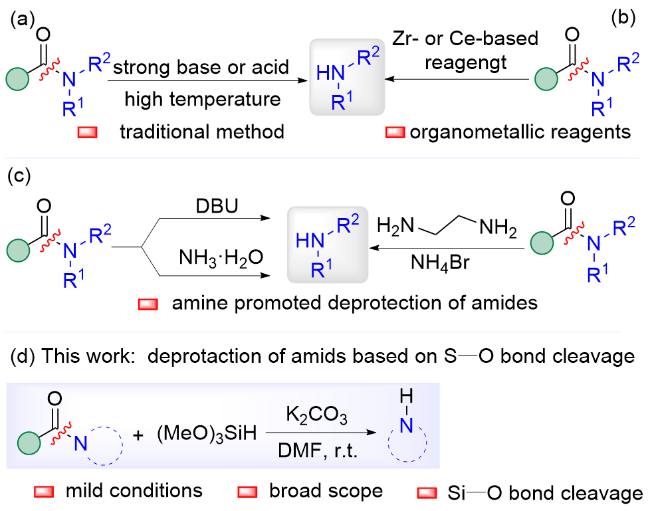
The amino group serves as a fundamental building block in a diverse array of compounds, spanning from natural products and pharmaceuticals to synthetic organic materials.[1] The inherently high reactivity and susceptibility to oxidation of the amino group pose a persistent challenge, making its protection and deprotection a central focus of research.[2] The acyl group is among the most commonly employed protecting groups, owing to the facile preparation and high stability of amides. Acylated amines serve as important precursors in total synthesis and are also widely used in the asymmetric hydrogenation and functionalization of enamides.[3] Despite considerable progress in deprotection methods, the inert nature of the amide bond means that strategies for its removal under mild conditions remain a challenge and continue to be a focus of extensive research.
A fundamental requirement for a protecting group is the facile reversibility of its installation. However, the high stability of the amide bond necessitates traditional deprotection methods that rely on harsh conditions, such as strong acids or bases at elevated temperatures (Scheme 1a).[4] While this stability is advantageous, it paradoxically restricts the broad applicability of acyl protecting groups. Consequently, the development of mild deprotection methods is of critical importance. To circumvent this limitation, novel strategies have been progressively developed.[5] Notably, in 2014, Bhat et al.[6] reported a deacylation method promoted by Cp2ZrHCl (Scheme 1b). Subsequently, in 2015, Huang’s group[7] described a protocol for amide bond cleavage based on the synergistic action of CeCl3 and Grignard reagents (Scheme 1b). However, the reliance on moisture- and oxygen-sensitive organometallic reagents, which are difficult to handle and store, limits the functional group tolerance of this method. Furthermore, the use of metals raises environmental concerns. In recent years, alternative deprotection strategies via amine-promoted transamidation have been developed, utilizing amines such as 1,5-diazabicyclo[5.4.0]- undecen-5-ene (DBU),[8] ethylenediamine,[9] and aqueous ammonia[10] (Scheme 1c). The Si—H bond of (MeO)3SiH is highly reactive, and can serve as a key intermediate for functional silanes in adhesives and coatings, and as a hydro-reduction reagent.[11] In contrast, the cleavage of its Si—O bond has rarely been explored. To address the need for a green and practical amide deprotection method, we have developed a general strategy that utilizes the base-promoted cleavage of the Si—O bond in silanes (Scheme 1d). This process generates an oxygen nucleophile which efficiently deprotects N-acylindoles type compounds. This method operates under mild conditions, employs inexpensive reagents, exhibits broad functional group tolerance, and thus provides a sustainable alternative for removing acyl protecting groups.
2 Results and discussion
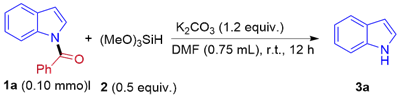
To test the feasibility of this Si—O bond cleavage promoted deprotection of amides, we started the investigation by using N-benzoylindole (1a) and (MeO)3SiH (2) as template substrate to explore the reaction conditions (Table 1). When the reaction of 1a with trimethoxysilane was conducted using K2CO3 as the base in N,N-dimethyl- formamide (DMF) at room temperature for 12 h, the deacylated product 3a was obtained in 95% yield (Entry 1). Control experiments were performed in the absence of either K2CO3 or (MeO)3SiH resulted in no reaction, de- monstrating that both components are indispensable for driving the reaction forward (Entries 2 and 3). Changing trimethoxysilane to triethoxysilane afforded the product with a comparable yield (Entry 4). The yield decreased to 67% when tetraethyl orthosilicate was used as nucleophile (Entry 5). Notably, increasing the loading of tetraethyl orthosilicate from 0.5 equiv. to 2.0 equiv. restored the yield to 94% (Entry 6). The reaction failed to proceed with diphenylsilane (Ph2SiH2) or triethylsilane (Et3SiH) serving as the nucleophile (Entries 7 and 8). When using NaHCO3, KHCO3 and Na2CO3 as base, no deacylated product was observed (Entries 9~11). In contrast, the use of a stronger base (Cs2CO3) afforded product 3a in 94% yield (Entry 12). These results indicate that the cleavage of the Si—O bond proceeds inefficiently in the presence of a weak base. The reaction failed to proceed in toluene, with the starting material 1a being fully recovered (Entry 13). Substitution of DMF with ethyl acetate, dichloromethane, or tetrahydrofuran led to a significant decrease in reactivity, yielding only 5%~15% of the product (Entries 14~16), suggesting that a solvent of high polarity is crucial for this transformation. When the volume of DMF was reduced from 0.75 mL to 0.50 mL, product 3a was obtained in 90% yield (Entry 17). Consequently, the optimal conditions were established as follows: 1a (1.0 equiv.), (MeO)3SiH (0.5 equiv.) and K2CO3 (1.2 equiv.) in DMF (0.13 mol/L), stirred at room temperature for 12 h.
Table 1 Condition optimizationa |
| Entry | Deviation from standard conditions | Yieldb/% |
|---|---|---|
| 1 | None | 95 (90)c |
| 2 | w/o silane | N.R. |
| 3 | w/o K2CO3 | N.R. |
| 4 | (EtO)3SiH instead of (MeO)3SiH | 93 |
| 5 | (EtO)4Si instead of (MeO)3SiH | 67 |
| 6 | 2.0 equiv. of (EtO)4Si instead of (MeO)3SiH | 94 |
| 7 | Ph2SiH2 instead of (MeO)3SiH | N.R. |
| 8 | Et3SiH instead of (MeO)3SiH | N.R. |
| 9 | NaHCO3 instead of K2CO3 | N.R. |
| 10 | KHCO3 instead of K2CO3 | N.R. |
| 11 | Na2CO3 instead of K2CO3 | N.R. |
| 12 | CsCO3 instead of K2CO3 | 94 |
| 13 | Toluene instead of DMF | N.R. |
| 14 | Ethyl acetate instead of DMF | 6 |
| 15 | CH2Cl2 instead of DMF | 5 |
| 16 | THF instead of DMF | 15 |
| 17 | 0.50 mL of DMF | 90 |
a Reaction conditions: 1a (0.10 mmol), 2 (0.05 mmol), K2CO3 (0.12 mmol), DMF (0.75 mL), room temperature. b Yields were determined by gas phase chromatography (GC) using n-dodecane as internal standard. c Isolated yield was shown in parentheses. |
With the optimized conditions in hand, we turned to evaluate the scope of deprotection of amides based on Si—O bond cleavage. The results are summarized in Table 2. In general, a diverse range of N-acylindole type amides bearing various functional groups underwent deacylation efficiently under standard conditions (3a~ 3y). N-Benzoylindoles featuring methyl at the 4-, 5-, 6-, or 7-positions of indole afforded the deprotected products 3b~3e in 88%~93% yields. Substrates with electron- withdrawing bromo substituents at these same positions reacted smoothly, delivering the target products 3f~3i in 90%~93% yields. High reactivity was also maintained with other halogen atoms (F, Cl, I), as evidenced by the successful conversion of the corresponding N-benzoyl- indoles to 3j~3l. Substrates bearing strongly electron- withdrawing groups, such as cyano, ester, formyl and nitro functionalities, demonstrated excellent reactivity under the standard conditions, providing products 3m~ 3p in 85%~92% yields. The presence of a 6-methoxy, electron-donating substituent, was well tolerated, yielding 3q in 90%. Silyl ether-substituted N-acyl indoles can be smoothly converted to the product 3r in 92% yield. This reaction is also applicable to alkynyl substrates, with trimethylsilyl-protected alkyne being smoothly converted to 5-ethynylindole (3s) under standard conditions. Bpin- substituted substrate was also well tolerated in the reaction, affording product 3t in 84% yield. Notably, tryptamine protected with a pivaloyl group underwent selective deprotection on the indole nitrogen to furnish 3u in 89% yield. Furthermore, the methodology extends beyond indoles to other nitrogen-containing heterocycles. Deacylation proceeded efficiently for acyl-protected carbazole (3v), pyrazole (3w), pyrrole (3x), and imidazole (3y). Additionally, indoles protected with cyclohexanecarbonyl and pivaloyl groups also exhibited excellent reactivity, delivering 3a in 90% and 94% yields, respectively.
Table 2 Substrate scopea |

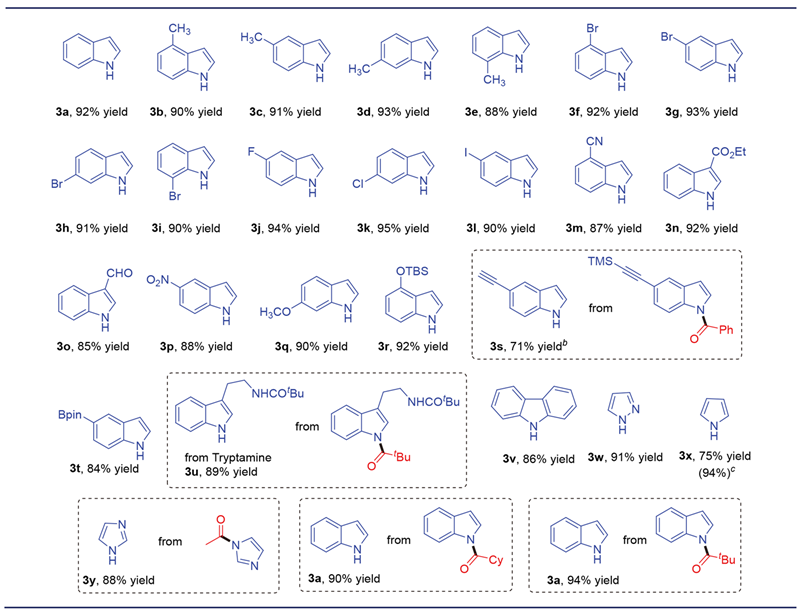 |
a Reaction conditions: 1 (0.20 mmol), 2 (0.10 mmol, 0.5 equiv.), K2CO3 (0.24 mmol, 1.2 equiv.), DMF (1.5 mL), room temperature. b 1.0 equiv. (MeO)3SiH was used. c GC yield was shown in parentheses. |
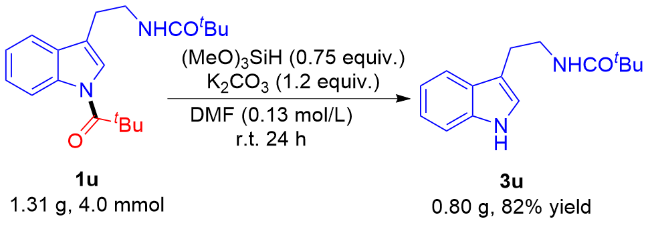
To demonstrate the synthetic potential of this method, we carried out a gram-scale experiment using 1u as substrate, delivering 3u in 82% yield (Scheme 2).
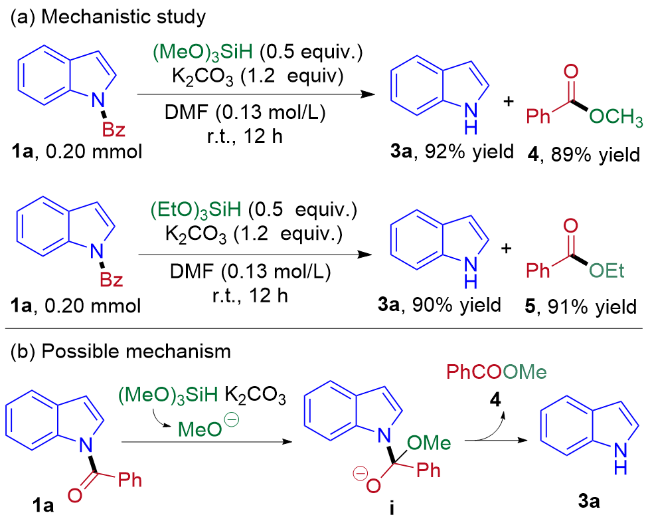
To gain some insight into the reaction, mechanistic experiments were carried out (Scheme 3a). The formation of methyl benzoate was observed from the reaction of N- benzoylindole with (MeO)3SiH, whereas ethyl benzoate was identified when (EtO)3SiH was employed. Based on the experimental results and literature precedence,[12] a plau- sible mechanism is proposed and depicted in Scheme 3b. Under the promotion of a base, the cleavage of Si—O bond in (MeO)3SiH generates a methoxide anion. This methoxide anion then attacks the amide bond, leading to the formation of intermediate i. Subsequently, intermediate i undergoes an intramolecular elimination, affording the deacylated product along with methyl benzoate.


3 Conclusions
In summary, a deacylation reaction of N-acyl indole type amides based on Si—O bond cleavage has been developed. A diverse range of acyl-protected indoles, carbazole, pyrrole, imidazole, and pyrazole underwent deacylation to afford the corresponding free amines in excellent yields. This strategy features mild reaction conditions, broad functional group tolerance, and operational simplicity, providing a green and practical method for efficient removal of amide protecting groups. Furthermore, this reaction demonstrates that Si—O bond cleavage, promoted by a base, can generate oxygen-centered nucleophiles.
4 Experimental section
4.1 General information
All reagents and solvents were obtained from commercial suppliers, with solvents specifically sourced from Titan Scientific. Thin-layer chromatography (TLC) was conducted using silica gel GF254-precoated plastic plates. Flash column chromatography was performed with 300~400 mesh silica gel. ¹H NMR and ¹³C NMR spectra were recorded on a Bruker spectrometer at 400 MHz and 101 MHz, respectively.
4.2 General procedure for the synthesis of acylated amine (1)
N-Acyl amides 1v and 1y were purchased from Titan Scientific. Following literature procedures, the other N-acyl amides were obtained through the condensation of their respective amines with the requisite acyl chlorides. [13]
To an oven-dried flask charged with a solution of amine (1.0 equiv., 10.0 mmol) and Et3N (2.5 equiv., 25 mmol, 3.5 mL) in dry dichloromethane (DCM) (20.0 mL) was added 4-dimethylaminopyridine (DMAP) (1.0 mmol, 0.1 equiv., 0.12 g). Upon complete dropwise addition of the acyl chloride (15 mmol) via syringe, the reaction was stirred under N2 protection for overnight. The mixture was diluted with CH2Cl2 and washed with water and brine. The organic phase was dried over anhydrous Na2SO4, filtered, and purified by flash chromatography to afford the desired product.
(1H-Indol-1-yl)(phenyl)methanone (1a): White solid (1.40 g, 62% yield). 1H NMR (400 MHz, CDCl3) δ: 8.42 (d, J=8.1 Hz, 1H), 7.78~7.71 (m, 2H), 7.65~7.56 (m, 2H), 7.58~7.50 (m, 2H), 7.43~7.36 (m, 1H), 7.34 (dd, J=7.5, 1.2 Hz, 1H), 7.31 (d, J=3.7 Hz, 1H), 6.62 (d, J=3.7 Hz, 1H); 13C NMR (101 MHz, CDCl3) δ: 168.8, 136.2, 134.7, 132.0, 130.9, 129.3, 128.7, 127.7, 125.0, 124.1, 121.0, 116.5, 108.7. HRMS (ESI-TOF) calcd for C15H12NO [M+H+] 222.0914, found 222.0914.
(4-Methyl-1H-indol-1-yl)(phenyl)methanone (1b): Whi- te solid (1.75 g, 75% yield). 1H NMR (400 MHz, CDCl3) δ: 8.26 (d, J=8.3 Hz, 1H), 7.79~7.70 (m, 2H), 7.67~7.58 (m, 1H), 7.54 (t, J=7.3 Hz, 2H), 7.36~7.27 (m, 2H), 7.14 (d, J=7.3 Hz, 1H), 6.67 (d, J=3.8 Hz, 1H), 2.57 (s, 3H); 13C NMR (101 MHz, CDCl3) δ: 168.8, 135.9, 134.8, 131.9, 130.5, 130.4, 129.3, 128.7, 127.1, 125.1, 124.5, 114.0, 107.0, 18.6. HRMS (ESI-TOF) calcd for C16H14NO [M+H+] 236.1070, found 236.1064.
(5-Methyl-1H-indol-1-yl)(phenyl)methanone (1c): Whi- te solid (1.58 g, 68% yield). 1H NMR (400 MHz, CDCl3) δ: 8.26 (d, J=8.4 Hz, 1H), 7.74~7.66 (m, 2H), 7.60~7.54 (m, 1H), 7.54~7.45 (m, 2H), 7.41~7.33 (m, 1H), 7.23 (d, J=3.8 Hz, 1H), 7.18 (dd, J=8.4, 1.7 Hz, 1H), 6.51 (dd, J=3.8, 0.7 Hz, 1H), 2.45 (s, 3H); 13C NMR (101 MHz, CDCl3) δ: 168.6, 134.8, 134.4, 133.6, 131.8, 131.2, 129.2, 128.6, 127.7, 126.3, 120.9, 116.1, 108.5, 21.5. HRMS (ESI-TOF) calcd for C16H14NO [M+H+] 236.1070, found 236.1066.
(6-Methyl-1H-indol-1-yl)(phenyl)methanone (1d): Colorless oi (1.90 g, 81% yield). 1H NMR (400 MHz, CDCl3) δ: 8.28 (s, 1H), 7.76~7.70 (m, 2H), 7.63~7.57 (m, 1H), 7.56~7.46 (m, 3H), 7.21 (d, J=3.8 Hz, 1H), 7.18~7.13 (m, 1H), 6.56 (d, J=3.8 Hz, 1H), 2.52 (s, 3H); 13C NMR (101 MHz, CDCl3) δ: 168.9, 136.6, 135.2, 134.9, 131.9, 129.2, 128.7, 128.6, 127.2, 125.5, 120.5, 116.8, 108.6, 22.0. HRMS (ESI-TOF) calcd for C16H14NO [M+H+] 236.1070, found 236.1065.
(7-Methyl-1H-indol-1-yl)(phenyl)methanone (1e): Whi- te solid (1.81 g, 77% yield). 1H NMR (400 MHz, CDCl3) δ: 7.96~7.88 (m, 2H), 7.68~7.61 (m, 1H), 7.53 (dd, J=8.4, 7.0 Hz, 2H), 7.46 (d, J=7.6 Hz, 1H), 7.28~7.15 (m, 3H), 6.58 (d, J=3.7 Hz, 1H), 2.48 (s, 3H); 13C NMR (101 MHz, CDCl3) δ: 167.8, 135.9, 134.2, 133.2, 132.1, 130.6, 129.2, 128.9, 127.6, 126.2, 124.1, 118.8, 107.9, 21.8. HR- MS (ESI-TOF) calcd for C16H14NO [M+H+] 236.1070, found 236.1067.
(4-Bromo-1H-indol-1-yl)(phenyl)methanone (1f): White solid (2.16 g, 72% yield). 1H NMR (400 MHz, CDCl3) δ: 8.34 (d, J=8.3 Hz, 1H), 7.76~7.67 (m, 2H), 7.65~7.57 (m, 1H), 7.53 (dd, J=8.3, 6.8 Hz, 2H), 7.47 (d, J=7.9 Hz, 1H), 7.35 (d, J=3.8 Hz, 1H), 7.23 (t, J=7.9 Hz, 1H), 6.68 (d, J=3.8 Hz, 1H); 13C NMR (101 MHz, CDCl3) δ: 168.8, 136.5, 134.2, 132.3, 131.5, 129.38, 128.8, 128.3, 126.9, 126.0, 115.5, 114.7, 108.4. HRMS (ESI-TOF) calcd for C15H11BrNO [M+H+] 300.0019, found 300.0013.
(5-Bromo-1H-indol-1-yl)(phenyl)methanone (1g): Whi- te solid (2.34 g, 78% yield). 1H NMR (400 MHz, CDCl3) δ: 8.28 (d, J=8.8 Hz, 1H), 7.78~7.68 (m, 3H), 7.65~7.59 (m, 1H), 7.53 (t, J=7.5 Hz, 2H), 7.47 (dd, J=8.8, 2.0 Hz, 1H), 7.31 (d, J=3.8 Hz, 1H), 6.55 (d, J=3.8 Hz, 1H); 13C NMR (101 MHz, CDCl3) δ: 168.6, 134.9, 134.2, 132.6, 132.3, 129.3, 128.8, 128.8, 127.8, 123.7, 117.9, 117.3, 107.8. HRMS (ESI-TOF) calcd for C15H11BrNO [M+H+] 300.0019, found 300.0015.
(6-Bromo-1H-indol-1-yl)(phenyl)methanone (1h): Whi- te solid (2.07 g, 69% yield). 1H NMR (400 MHz, CDCl3) δ: 8.63 (s, 1H), 7.76~7.66 (m, 2H), 7.65~7.57 (m, 1H), 7.52 (t, J=7.6 Hz, 2H), 7.47~7.39 (m, 2H), 7.26 (d, J=3.8 Hz, 1H), 6.56 (d, J=3.8 Hz, 1H); 13C NMR (101 MHz, CDCl3) δ: 168.6, 136.8, 134.2, 132.3, 129.7, 129.3, 128.8, 128.2, 127.3, 122.0, 119.7, 118.8, 108.3. HRMS (ESI- TOF) calcd for C15H11BrNO [M+H+] 300.0019, found 300.0012.
(7-Bromo-1H-indol-1-yl)(phenyl)methanone (1i): Yellow oil (1.74 g, 58% yield). 1H NMR (400 MHz, CDCl3) δ: 7.98~7.90 (m, 2H), 7.70~7.62 (m, 1H), 7.62~7.49 (m, 4H), 7.28 (d, J=3.6 Hz, 1H), 7.17 (t, J=7.8 Hz, 1H), 6.61 (d, J=3.6 Hz, 1H); 13C NMR (101 MHz, CDCl3) δ: 166.7, 135.3, 134.3, 133.6, 133.5, 130.6, 129.8, 129.6, 128.9, 124.7, 120.3, 108.6, 107.2. HRMS (ESI-TOF) calcd for C15H11BrNO [M+H+] 300.0019, found 300.0015.
(5-Fluoro-1H-indol-1-yl)(phenyl)methanone (1j): White solid (1.96 g, 82% yield). 1H NMR (400 MHz, CDCl3) δ: 8.38 (dd, J=9.1, 4.7 Hz, 1H), 7.77~7.67 (m, 2H), 7.63~7.57 (m, 1H), 7.52 (t, J=7.4 Hz, 2H), 7.32 (d, J=3.7 Hz, 1H), 7.24 (dd, J=8.7, 2.6 Hz, 1H), 7.10 (td, J=9.1, 2.6 Hz, 1H), 6.56 (d, J=3.7 Hz, 1H); 13C NMR (101 MHz, CDCl3) δ: 168.6, 159.9 (d, J=241.4 Hz), 134.4, 132.5, 132.1, 131.9 (d, J=10.1 Hz), 129.3, 129.2, 128.8, 117.6 (d, J=9.2 Hz), 112.8 (d, J=25.0 Hz), 108.3 (d, J=3.9 Hz), 106.5 (d, J=23.9 Hz); 19F NMR (377 MHz, CDCl3) δ: -118.8 (m). HRMS (ESI-TOF) calcd for C15H11FNO [M+H+] 240.0819, found 240.0814.
(6-Chloro-1H-indol-1-yl)(phenyl)methanone (1k): White solid (1.86 g, 73% yield). 1H NMR (400 MHz, CDCl3) δ: 8.48 (s, 1H), 7.79~7.66 (m, 2H), 7.66~7.58 (m, 1H), 7.58~7.45 (m, 3H), 7.34~7.26 (m, 2H), 6.58 (d, J=3.8 Hz, 1H); 13C NMR (101 MHz, CDCl3) δ: 168.7, 136.5, 134.2, 132.2, 131.0, 129.3, 128.8, 128.3, 124.6, 121.6, 116.8, 108.3. HRMS (ESI-TOF) calcd for C15H11Cl- NO [M+H+] 250.0863, found 250.0858.
(5-Iodo-1H-indol-1-yl)(phenyl)methanone (1l): White solid (2.11 g, 61% yield). 1H NMR (400 MHz, CDCl3) δ: 8.15 (d, J=8.7 Hz, 1H), 7.94 (d, J=1.8 Hz, 1H), 7.76~7.68 (m, 2H), 7.67~7.58 (m, 2H), 7.53 (t, J=7.5 Hz, 2H), 7.30~7.21 (m, 1H), 6.53 (d, J=3.8 Hz, 1H); 13C NMR (101 MHz, CDCl3) δ: 168.7, 135.5, 134.3, 133.6, 133.2, 132.3, 129.9, 129.3, 128.8, 128.5, 118.3, 107.6, 88.2. HRMS (ESI-TOF) calcd for C15H11INO [M+H+] 347.9880, found 347.9887.
1-Benzoyl-1H-indole-4-carbonitrile (1m): White solid (1.18 g, 48% yield). 1H NMR (400 MHz, CDCl3) δ: 8.64 (d, J=8.4 Hz, 1H), 7.79~7.71 (m, 2H), 7.70~7.61 (m, 2H), 7.57 (t, J=7.5 Hz, 2H), 7.50 (d, J=3.7 Hz, 1H), 7.45 (t, J=8.0 Hz, 1H), 6.85 (d, J=3.7 Hz, 1H); 13C NMR (101 MHz, CDCl3) δ: 168.6, 136.0, 133.1, 132.73, 132.67, 130.2, 129.5, 129.0, 128.5, 125.0, 121.1, 117.8, 106.6, 104.0. HRMS (ESI-TOF) calcd for C16H11N2O [M+H+] 247.0866, found 247.0863.
Ethyl 1-benzoyl-1H-indole-3-carboxylate (1n): White solid (2.28 g, 78% yield). 1H NMR (400 MHz, CDCl3) δ: 8.45~8.32 (m, 1H), 8.26~8.14 (m, 1H), 8.00 (s, 1H), 7.83~7.71 (m, 2H), 7.71~7.61 (m, 1H), 7.57 (t, J=7.8 Hz, 2H), 7.52~7.36 (m, 2H), 4.40 (q, J=7.1 Hz, 2H), 1.41 (t, J=7.1 Hz, 3H); 13C NMR (101 MHz, CDCl3) δ: 168.8, 164.2, 136.6, 133.6, 133.5, 132.8, 129.6, 129.0, 127.8, 125.8, 125.1, 121.9, 116.3, 113.8, 60.6, 14.5. HRMS (ESI-TOF) calcd for C18H16NO3 [M+H+] 294.1125, found 294.1119.
1-Benzoyl-1H-indole-3-carbaldehyde (1o): White solid (1.77 g, 71% yield). 1H NMR (400 MHz, CDCl3) δ: 10.05 (s, 1H), 8.36~8.24 (m, 2H), 7.94 (s, 1H), 7.83~7.72 (m, 2H), 7.72~7.65 (m, 1H), 7.64~7.54 (m, 2H), 7.50~7.38 (m, 2H); 13C NMR (101 MHz, CDCl3) δ: 185.7, 168.6, 137.6, 137.0, 133.2, 133.1, 129.6, 129.1, 126.7, 126.4, 125.7, 122.3, 122.2, 116.2. HRMS (ESI-TOF) calcd for C16H12NO2 [M+H+] 250.0863, found 250.0858.
(5-Nitro-1H-indol-1-yl)(phenyl)methanone (1p): White solid (0.85 g, 32% yield). 1H NMR (400 MHz, CDCl3) δ: 8.01 (d, J=8.3 Hz, 1H), 7.72 (d, J=7.0 Hz, 2H), 7.58 (t, J=7.5 Hz, 1H), 7.50 (t, J=7.5 Hz, 2H), 7.22 (t, J=8.0 Hz, 1H), 7.18 (d, J=3.8 Hz, 1H), 6.74 (d, J=8.0 Hz, 1H), 6.66 (d, J=3.8 Hz, 1H), 1.05 (s, 9H), 0.25 (s, 6H); 13C NMR (101 MHz, CDCl3) δ: 168.9, 148.8, 137.8, 134.8, 131.9, 129.3, 128.7, 126.3, 125.9, 124.1, 113.6, 110.1, 106.1, 25.9, 18.4, -4.2. HRMS (ESI-TOF) calcd for C15- H11N2O3 [M+H+] 267.0764, found 267.0763.
(6-Methoxy-1H-indol-1-yl)(phenyl)methanone (1q): White solid (1.41 g, 56% yield). 1H NMR (400 MHz, CDCl3) δ: 8.31 (d, J=9.0 Hz, 1H), 7.76~7.68 (m, 2H), 7.62~7.56 (m, 1H), 7.56~7.48 (m, 2H), 7.28~7.23 (m, 1H), 7.06 (d, J=2.5 Hz, 1H), 6.99 (dd, J=9.0, 2.6 Hz, 1H), 6.53 (dd, J=3.7, 0.7 Hz, 1H), 3.87 (s, 3H); 13C NMR (101 MHz, CDCl3) δ: 168.5, 156.9, 134.8, 131.92, 131.87, 130.9, 129.2, 128.7, 128.4, 117.3, 113.5, 108.6, 103.8, 55.8. HRMS (ESI-TOF) calcd for C16H14NO2 [M+H+] 252.1020, found 252.1014.
(4-((tert-Butyldimethylsilyl)oxy)-1H-indol-1-yl)-(phen- yl)methanone (1r): Colorless oil (2.63 g, 75% yield). 1H NMR (400 MHz, CDCl3) δ: 8.31 (d, J=9.0 Hz, 1H), 7.76~7.68 (m, 2H), 7.62~7.56 (m, 1H), 7.56~7.48 (m, 2H), 7.28~7.23 (m, 1H), 7.06 (d, J=2.5 Hz, 1H), 6.99 (dd, J=9.0, 2.6 Hz, 1H), 6.53 (dd, J=3.7, 0.7 Hz, 1H), 3.87 (s, 3H); 13C NMR (101 MHz, CDCl3) δ: 168.5, 156.9, 134.8, 131.92, 131.87, 130.9, 129.2, 128.7, 128.4, 117.3, 113.5, 108.6, 103.8, 55.8. HRMS (ESI-TOF) calcd for C21H26NO2Si [M+H+] 352.1728, found 352.1728.
Phenyl(5-((trimethylsilyl)ethynyl)-1H-indol-1-yl)-methanone (1s): White solid (1.83 g, 58% yield). 1H NMR (400 MHz, CDCl3) δ: 8.33 (d, J=8.6 Hz, 1H), 7.73 (d, J=7.9 Hz, 3H), 7.65~7.58 (m, 1H), 7.57~7.46 (m, 3H), 7.31 (dd, J=3.8, 1.0 Hz, 1H), 6.57 (d, J=3.8 Hz, 1H), 0.28 (s, 9H); 13C NMR (101 MHz, CDCl3) δ: 168.7, 135.8, 134.4, 132.2, 130.7, 129.3, 128.9, 128.8, 128.6, 124.9, 118.7, 116.4, 108.4, 105.8, 93.2. HRMS (ESI-TOF) calcd for C20H20NOSi [M+H+] 318.1309, found 318.1309.
Phenyl(5-(4,4,5,5-tetramethyl-1,3,2-dioxaborolan-2-yl)-1H-indol-1-yl)methanone (1t): White solid (2.19 g, 63% yield). 1H NMR (400 MHz, CDCl3) δ: 8.37 (d, J=8.3 Hz, 1H), 8.11 (s, 1H), 7.84 (d, J=8.3 Hz, 1H), 7.74 (d, J=7.4 Hz, 2H), 7.60 (t, J=7.2 Hz, 1H), 7.52 (t, J=7.5 Hz, 2H), 7.29 (d, J=3.7 Hz, 1H), 6.62 (d, J=3.7 Hz, 1H), 1.38 (s, 12H); 13C NMR (101 MHz, CDCl3) δ: 168.8, 138.1, 134.6, 132.0, 131.3, 130.5, 129.3, 128.7, 128.2, 127.7, 124.2, 115.7, 108.8, 83.9, 25.0. HRMS (ESI-TOF) calcd for C21- H23BNO3 [M+H+] 348.1766, found 348.1766.
N-(2-(1-Pivaloyl-1H-indol-3-yl)ethyl)pivalamide (1u): 2.5 equiv. of pivaloyl chloride and 3.5 equiv. of Et3N were used. White solid (1.40 g, 43% yield). 1H NMR (400 MHz, CDCl3) δ: 8.52 (d, J=8.3 Hz, 1H), 7.61~7.48 (m, 2H), 7.36 (ddd, J=8.3, 7.4, 1.2 Hz, 1H), 7.29 (td, J=7.4, 1.2 Hz, 1H), 5.74 (brs, 1H), 3.62 (q, J=6.7 Hz, 2H), 2.95 (t, J=6.7 Hz, 2H), 1.51 (s, 9H), 1.15 (s, 9H); 13C NMR (101 MHz, CDCl3) δ: 178.7, 177.0, 137.5, 129.4, 125.61, 123.6, 123.1, 118.8, 118.6, 117.8, 41.3, 39.2, 38.8, 28.8, 27.7, 25.5. HRMS (ESI-TOF) calcd for C20H29N2O2 [M+H+] 329.2224, found 329.2218.
Phenyl(1H-pyrazol-1-yl)methanone (1w): Colorless liquid (1.07 g, 62% yield). 1H NMR (400 MHz, CDCl3) δ: 8.44 (d, J=2.9 Hz, 1H), 8.17~8.10 (m, 2H), 7.80 (d, J=1.5 Hz, 1H), 7.66~7.58 (m, 1H), 7.55~7.48 (m, 2H), 6.52 (dd, J=2.9, 1.5 Hz, 1H); 13C NMR (101 MHz, CDCl3) δ: 166.5, 144.6, 133.1, 131.62, 131.58, 130.5, 128.2, 109.5. HRMS (ESI-TOF) calcd for C10H9N2O [M+H+] 173.0710, found 173.0709.
Phenyl(1H-pyrrol-1-yl)methanone (1x): Yellow liquid (0.99 g, 58% yield). 1H NMR (400 MHz, CDCl3) δ: 7.78~7.71 (m, 2H), 7.63~7.57 (m, 1H), 7.54~7.47 (m, 2H), 7.33~7.27 (m, 2H), 6.39~6.32 (m, 2H); 13C NMR (101 MHz, Chloroform-d) δ: 167.8, 133.4, 132.3, 129.6, 128.6, 121.4, 113.2. HRMS (ESI-TOF) calcd for C11H10NO [M+H+] 172.0757, found 172.0754.
Cyclohexyl(1H-indol-1-yl)methanone (1z): White solid (1.09 g, 48% yield). 1H NMR (400 MHz, CDCl3) δ: 8.49 (d, J=8.3 Hz, 1H), 7.55 (d, J=7.7 Hz, 1H), 7.50 (d, J=3.8 Hz, 1H), 7.41~7.30 (m, 1H), 7.29~7.23 (m, 1H), 6.63 (d, J=3.8 Hz, 1H), 3.00 (tt, J=11.7, 3.4 Hz, 1H), 2.10~1.96 (m, 2H), 1.89 (dt, J=11.7, 2.9 Hz, 2H), 1.80~1.63 (m, 3H), 1.50~1.24 (m, 3H); 13C NMR (101 MHz, CDCl3) δ: 175.0, 135.9, 130.5, 125.2, 124.7, 123.7, 120.8, 117.0, 109.0, 43.9, 29.7, 25.88, 25.79. HRMS (ESI-TOF) calcd for C15H18NO [M+H+] 228.1383, found 228.1379.
1-(1H-Indol-1-yl)-2,2-dimethylpropan-1-one (1aa): White solid (1.20 g, 60% yield). 1H NMR (400 MHz, CDCl3) δ: 8.51 (d, J=8.2 Hz, 1H), 7.72 (d, J=3.8 Hz, 1H), 7.58~7.52 (m, 1H), 7.34 (ddd, J=8.5, 7.2, 1.4 Hz, 1H), 7.29~7.22 (m, 1H), 6.61 (d, J=3.9 Hz, 1H), 1.52 (s, 10H); 13C NMR (101 MHz, CDCl3) δ: 177.2, 136.9, 129.5, 125.8, 125.2, 123.7, 120.6, 117.5, 108.4, 41.4, 28.8. HR- MS (ESI-TOF) calcd for C13H16NO [M+H+] 202.1227, found 202.1224.
4.3 General procedure for the deacylation
To a sealed tube (10 mL) were added acylated amine (0.20 mmol, 1.0 equiv.), K2CO3 (0.24 mmol, 33.2 mg, 1.2 equiv.), DMF (1.5 mL) and (MeO)3SiH (0.10 mmol, 13 μL, 0.5 equiv.). Then the tube was sealed and stirred at room temperature for 12 h. The mixture was extracted with EtOAc (5.0 mL×3). The combined organic extracts were washed with brine, dried over anhydrous Na2SO₄, and concentrated under reduced pressure. The crude product was purified by flash column chromatography on silica gel (Eluent: V(petroleum ether)∶V(EtOAc)=100∶1 to 50∶1, gradient) to afford the desired product 3.
1H-Indole (3a):[10] White solid, 21.4 mg, 92% yield (from 1a); 21.0 mg, 90% yield (from 1v); 22.1 mg, 94% yield (from 1w). 1H NMR (400 MHz, CDCl3) δ: 8.04 (brs, 1H), 7.76 (d, J=7.9 Hz, 1H), 7.43 (dd, J=8.1, 1.0 Hz, 1H), 7.33~7.27 (m, 1H), 7.26~7.20 (m, 2H), 6.65 (s, 1H).
4-Methyl-1H-indole (3b):[10] White foam (23.7 mg, 90% yield). 1H NMR (400 MHz, CDCl3) δ: 8.03 (brs, 1H), 7.36~7.25 (m, 2H), 7.23 (dd, J=3.3, 2.5 Hz, 1H), 7.16~7.08 (m, 1H), 6.93~6.59 (m, 1H), 2.74 (s, 3H).
5-Methyl-1H-indole (3c):[10] White solid (23.9 mg, 91% yield). 1H NMR (400 MHz, CDCl3) δ: 7.96 (brs, 1H), 7.50 (d, J=0.8 Hz, 1H), 7.30 (d, J=8.3 Hz, 1H), 7.16 (t, J=2.8 Hz, 1H), 7.09 (dd, J=8.3, 1.6 Hz, 1H), 6.55~6.51 (m, 1H), 2.51 (s, 3H).
6-Methyl-1H-indole (3d):[10] Yellow oil (24.5 mg, 93% yield). 1H NMR (400 MHz, CDCl3) δ: 7.89 (brs, 1H), 7.61 (d, J=8.1 Hz, 1H), 7.18 (s, 1H), 7.12 (t, J=2.8 Hz, 1H), 7.04 (d, J=8.1 Hz, 1H), 6.60~6.52 (m, 1H), 2.54 (s, 3H).
7-Methyl-1H-indole (3e):[14] Grey solid, 23.0 mg, 88% yield. 1H NMR (400 MHz, CDCl3) δ: 8.03 (brs, 1H), 7.56 (d, J=7.7 Hz, 1H), 7.21 (t, J=2.8 Hz, 1H), 7.10 (t, J=7.4 Hz, 1H), 7.08~7.02 (m, 1H), 6.61 (dd, J=3.2, 2.0 Hz, 1H), 2.53 (s, 3H).
4-Bromo-1H-indole (3f):[15] Yellow oil (36.1 mg, 92% yield). 1H NMR (400 MHz, CDCl3) δ: 8.29 (brs, 1H), 7.33 (dd, J=7.9, 3.1 Hz, 2H), 7.23 (t, J=2.9 Hz, 1H), 7.08 (t, J=7.9 Hz, 1H), 6.64 (t, J=2.8 Hz, 1H).
5-Bromo-1H-indole (3g):[10] White solid (36.6 mg, 93% yield). 1H NMR (400 MHz, CDCl3) δ: 8.20 (brs, 1H), 7.80 (d, J=1.6 Hz, 1H), 7.33~7.27 (m, 2H), 7.24 (t, J=2.8 Hz, 1H), 6.53 (t, J=2.7 Hz, 1H).
6-Bromo-1H-indole (3h):[10] Yellow solid (35.6 mg, 91% yield). 1H NMR (400 MHz, CDCl3) δ: 8.14 (s, 1H), 7.55 (s, 1H), 7.51 (d, J=8.4 Hz, 1H), 7.23 (dd, J=8.5, 1.7 Hz, 1H), 7.18 (dd, J=3.2, 2.3 Hz, 1H), 6.54 (ddd, J=3.1, 2.1, 1.0 Hz, 1H).
7-Bromo-1H-indole (3i):[16] White solid (35.2 mg, 90% yield). 1H NMR (400 MHz, CDCl3) δ: 8.31 (brs, 1H), 7.66 (d, J=7.9 Hz, 1H), 7.43 (d, J=7.6 Hz, 1H), 7.25~7.22 (m, 1H), 7.07 (t, J=7.7 Hz, 1H), 6.69 (dd, J=3.2, 2.2 Hz, 1H).
5-Fluoro-1H-indole (3j):[14] Grey solid (35.2 mg, 90% yield). 1H NMR (400 MHz, CDCl3) δ: 8.14 (brs, 1H), 7.34~7.27 (m, 2H), 7.25 (t, J=2.9 Hz, 1H), 6.96 (td, J=9.1, 2.5 Hz, 1H), 6.53 (t, J=2.7 Hz, 1H); 19F NMR (377 MHz, Chloroform-d) δ: -124.95 (m).
6-Chloro-1H-indole (3k):[15] Brown solid (28.7 mg, 95% yield). 1H NMR (400 MHz, CDCl3) δ: 8.13 (brs, 1H), 7.55 (d, J=8.4 Hz, 1H), 7.39 (s, 1H), 7.19 (t, J=2.8 Hz, 1H), 7.10 (dd, J=8.4, 1.9 Hz, 1H), 6.59~6.51 (m, 1H).
5-Iodo-1H-indole (3l):[17] White solid (43.8 mg, 90% yield). 1H NMR (400 MHz, CDCl3) δ: 8.17 (brs, 1H), 7.99 (s, 1H), 7.45 (dd, J=8.5, 1.7 Hz, 1H), 7.22~7.11 (m, 2H), 6.49 (t, J=2.8 Hz, 1H).
1H-Indole-4-carbonitrile (3m):[18] White solid (24.7 mg, 87% yield). 1H NMR (400 MHz, CDCl3) δ: 8.66 (brs, 1H), 7.65 (d, J=8.2 Hz, 1H), 7.49 (d, J=7.2 Hz, 1H), 7.41 (t, J=2.9 Hz, 1H), 7.24 (dd, J=8.2, 7.4 Hz, 1H), 6.80~6.74 (m, 1H).
Ethyl 1H-indole-3-carboxylate (3n):[19] White solid (34.5 mg, 92% yield). 1H NMR (400 MHz, CDCl3) δ: 8.90 (brs, 1H), 8.29~8.18 (m, 1H), 7.94 (d, J=3.0 Hz, 1H), 7.50~7.41 (m, 1H), 7.35~7.24 (m, 2H), 4.44 (q, J=7.1 Hz, 2H), 1.46 (t, J=7.1 Hz, 3H).
1H-Indole-3-carbaldehyde (3o):[20] White solid (24.5 mg, 85% yield). 1H NMR (400 MHz, CDCl3) δ: 10.08 (s, 1H), 8.76 (brs, 1H), 8.38~8.29 (m, 1H), 7.86 (d, J=3.0 Hz, 1H), 7.48~7.42 (m, 1H), 7.38~7.29 (m, 2H).
5-Nitro-1H-indole (3p):[18] White solid (28.4 mg, 88% yield). 1H NMR (400 MHz, CDCl3) δ: 8.69 (brs, 1H), 8.63~8.52 (m, 1H), 8.20~8.05 (m, 1H), 7.45 (d, J=9.0 Hz, 1H), 7.39 (t, J=2.9 Hz, 1H), 6.73 (s, 1H).
6-Methoxy-1H-indole (3q):[10] White solid (26.8 mg, 90% yield). 1H NMR (400 MHz, CDCl3) δ: 8.06 (brs, 1H), 7.28 (d, J=8.8 Hz, 1H), 7.17 (t, J=2.8 Hz, 1H), 7.15 (d, J=2.5 Hz, 1H), 6.90 (dd, J=8.8, 2.5 Hz, 1H), 6.55~6.47 (m, 1H), 3.89 (s, 3H).
4-((tert-Butyldimethylsilyl)oxy)-1H-indole (3r): White solid (45.3 mg, 92% yield). 1H NMR (400 MHz, CDCl3) δ: 8.05 (brs, 1H), 7.10~6.99 (m, 3H), 6.64~6.59 (m, 1H), 6.57 (d, J=7.2 Hz, 1H), 1.10 (s, 9H), 0.27 (s, 6H); 13C NMR (101 MHz, CDCl3) δ: 149.2, 137.9, 122.8, 122.7, 121.8, 108.8, 104.8, 100.4, 25.9, 18.4, -4.2. HRMS (ESI- TOF) calcd for C14H22NOSi [M+H+] 248.1465, found 248.1465.
5-Ethynyl-1H-indole (3s): White solid (20.0 mg, 71% yield). 1H NMR (400 MHz, CDCl3) δ: 8.19 (s, 1H), 7.85 (s, 1H), 7.40~7.30 (m, 2H), 7.23 (t, J=2.7 Hz, 1H), 6.55 (t, J=2.7 Hz, 1H), 3.01 (s, 1H). HRMS (ESI-TOF) calcd for C10H8N [M+H+] 142.0651, found 142.0653.
5-(4,4,5,5-Tetramethyl-1,3,2-dioxaborolan-2-yl)-1H-indole (3t):[19] White solid (40.7 mg, 84% yield). 1H NMR (400 MHz, CDCl3) δ: 8.29 (brs, 1H), 8.24 (s, 1H), 7.68 (d, J=8.2 Hz, 1H), 7.36 (d, J=8.2 Hz, 1H), 7.18~7.12 (m, 1H), 6.62~6.53 (m, 1H), 1.40 (s, 12H).
N-(2-(1H-Indol-3-yl)ethyl)pivalamide (3u): White solid (43.1 mg, 89% yield). 1H NMR (400 MHz, CDCl3) δ: 8.46 (brs, 1H), 7.63 (d, J=7.9 Hz, 1H), 7.38 (d, J=8.1 Hz, 1H), 7.24 (ddd, J=8.2, 7.0, 1.2 Hz, 1H), 7.17~7.09 (m, 1H), 7.01~7.18 (m, 1H), 5.77 (brs, 1H), 3.60 (q, J=6.6 Hz, 2H), 2.99 (t, J=6.6 Hz, 1H), 1.14 (s, 9H); 13C NMR (101 MHz, CDCl3) δ: 178.6, 136.6, 127.4, 122.21, 122.18, 119.5, 118.8, 113.1, 111.4, 40.0, 38.8, 27.7, 25.4. HRMS (ESI-TOF) calcd for C15H21N2O [M+H+] 245.1649, found 245.1644.
9H-Carbazole (3v):[21] Yellow solid (28.9 mg, 86% yield). 1H NMR (400 MHz, CDCl3) δ: 8.12 (dd, J=7.8, 0.9 Hz, 2H), 8.07 (brs, 1H), 7.49~7.42 (m, 4H), 7.30~7.25 (m, 2H).
1H-Pyrazole (3w):[22] White solid (12.4 mg, 91% yield). 1H NMR (400 MHz, CDCl3) δ: 12.92 (s, 1H), 7.67 (d, J=2.3 Hz, 2H), 6.38 (t, J=2.1 Hz, 1H).
1H-Pyrrole (3x):[23] Colorless liquid (10.0 mg, 75% yield). 1H NMR (400 MHz, CDCl3) δ: 8.24 (s, 1H), 6.91 (q, J=2.2 Hz, 2H), 6.41 (q, J=2.2 Hz, 2H).
1H-Imidazole (3y):[24] White solid (11.2 mg, 88% yield). 1H NMR (400 MHz, CDCl3) δ: 12.54 (s, 1H), 7.75 (d, J=1.2 Hz, 1H), 7.15 (d, J=1.2 Hz, 2H).
4.4 General procedure for gram scale experiment
To a sealed tube (100 mL) were added 1u (4.0 mmol, 1.31 g, 1.0 equiv.), K2CO3 (4.8 mmol, 0.66 g, 1.2 equiv.), DMF (30.0 mL) and (MeO)3SiH (3.0 mmol, 0.39 mL, 0.75 equiv.). Then the tube was sealed and stirred at room temperature for 24 h. The reaction mixture was extracted with EtOAc (50.0 mL×3). Then the combined organic phase was washed with brine, dried over anhydrous Na2SO4, and concentrated under reduced pressure. The residue was purified by column chromatography on silica gel using V(pe- troleum ether)∶V(EtOAc)=10∶1 to 5∶1 as eluent to afford the desired product 3u (White solid, 0.80 g, 82% yield).
4.5 General procedure for mechanistic experiment
To a sealed tube (10 mL) were added 1a (0.20 mmol, 44.2 mg, 1.0 equiv.), K2CO3 (0.24 mmol, 33.2 mg, 1.2 equiv.), DMF (1.5 mL) and (MeO)3SiH (0.10 mmol, 13 μL, 0.5 equiv.). The tube was sealed and the mixture was stirred at room temperature for 12 h. Upon completion, the reaction mixture was extracted with EtOAc (5.0 mL×3). The combined organic extracts were washed with brine, dried over anhydrous Na2SO4, and concentrated under reduced pressure. The crude product was purified by flash column chromatography on silica gel (Eluent: V(petroleum ether)∶V(EtOAc)=100∶1 to 50∶1, gradient) to afford the desired product 4 (colorless oil, 24.2 mg, 89% yield).[25] 1H NMR (400 MHz, Chloroform-d) δ: 8.03 (dd, J=8.3, 1.5 Hz, 2H), 7.57~7.50 (m, 1H), 7.42 (dd, J=8.4, 7.1 Hz, 2H), 3.90 (s, 3H).
A 10 mL sealed tube was charged with 1a (0.20 mmol, 44.2 mg, 1.0 equiv.), K2CO3 (0.24 mmol, 33.2 mg, 1.2 equiv.), DMF (1.5 mL), and (EtO)3SiH (0.10 mmol, 18 μL, 0.5 equiv.). The tube was sealed and the mixture was stirred at room temperature for 12 h. Upon completion, the reaction mixture was extracted with EtOAc (5.0 mL×3). The combined organic extracts were washed with brine, dried over anhydrous Na2SO4, and concentrated under reduced pressure. The crude product was purified by flash column chromatography on silica gel (Eluent: V(petroleum ether)∶V(EtOAc)=100∶1 to 50∶1, gradient) to afford the desired product 5 (colorless oil, 27.0 mg, 91% yield). 1H NMR (400 MHz, Chloroform-d) δ: 8.05 (d, J=7.8 Hz, 2H), 7.53 (t, J=7.1 Hz, 1H), 7.42 (t, J=7.8 Hz, 2H), 4.37 (q, J=7.1 Hz, 2H), 1.39 (t, J=7.1 Hz, 3H).
Supporting Information NMR spectra of products 1a~1z, 1aa, 3a~3y, 4 and 5. The Supporting Information is available free of charge via the Internet at http://sioc-journal.cn/.
(Lu, Y.)