



1 Introduction
Acyl silanes represent a unique class of carbonyl compounds in which the carbonyl carbon is directly bonded to a silicon atom.[1] Despite their structural resemblance to aldehydes and ketones, acyl silanes exhibit significantly reduced reactivity in common transformations such as esterification, oxidation, condensation, reduction, coupling, and isomerization reactions. This attenuated reactivity is attributed to the distinctive electronic and steric properties imparted by the silyl group. The larger atomic radius and lower electronegativity of silicon compared to carbon result in polarized Si—C and Si—H bonds, endowing organosilicon compounds with distinctive chemical behavior that diverges from that of conventional organic analogues.
α-Silyl alcohols, featuring a silicon atom at the alpha position to the hydroxyl group, are valuable synthetic intermediates with broad applications across multiple disciplines. In medicinal chemistry, they serve as key pharmacophores in bioactive molecules or metabolic stabilizers via silicon-based bioisosterism.[2] In materials science, these compounds act as monomers for functional silicon-based polymers or surface-modifying agents.[3] Synthetic organic chemistry leverages α-silyl alcohols as precursors to highly reactive alkoxycarbanion intermediates, enabling the construction of C—C and C—heteroatom bonds. Furthermore, enantiomerically enriched α-silyl alcohols, accessible via asymmetric reduction, serve as chiral building blocks for the synthesis of optically active compounds and play essential roles in stereocontrolled C—C bond-forming reactions and rearrangement processes.
2 Results and discussion
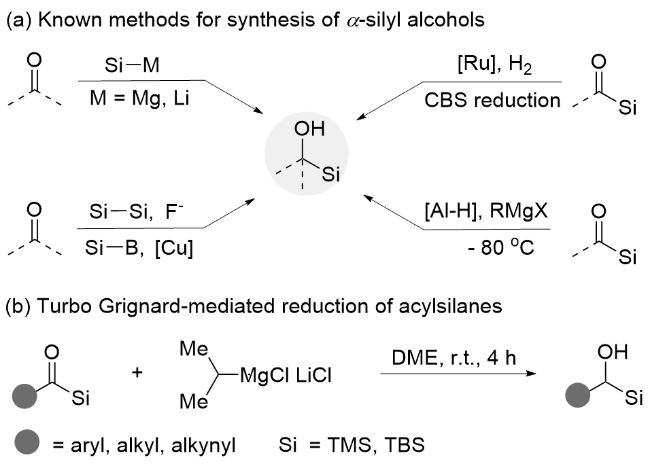
For the synthesis of α-silyl alcohols, conventional approaches rely on the nucleophilic addition of silylmetallic reagents to carbonyl compounds, though their use is often limited by challenging preparation and high basicity (Scheme 1a).[4] Alternative strategies include the in-situ generation of silyl anions via fluoride-induced Si—Si bond cleavage and copper-catalyzed silylation of aldehydes using Si—B reagents (Scheme 1a).[5] A critical route involves the reduction of acyl silanes. Established methods comprise ruthenium-catalyzed asymmetric hydrogenation, hydride- or borane-based reductions (e.g., NaBH4, frequently combined with Lewis acids like CeCl3), and chiral oxazaborolidine catalysts (e.g., CBS-borane) (Scheme 1a).[6] Organometallic reagents—such as organolithium, Grignard, organozinc, and hydride reagents—have also been used under cryogenic conditions (e.g., -80 ℃, inert atmosphere, prolonged time) (Scheme 1a).[7] Nevertheless, these methods often suffer from narrow substrate scope, poor functional group compatibility, high cost, and operational complexity. Thus, there remains a significant demand for developing mild, efficient, and general catalytic systems to reduce acyl silanes to α-silyl alcohols under practical and scalable conditions. This study aimed to identify a suitable reducing agent for the carbonyl group in acyl silanes to afford α-silyl alcohols (Scheme 1b).
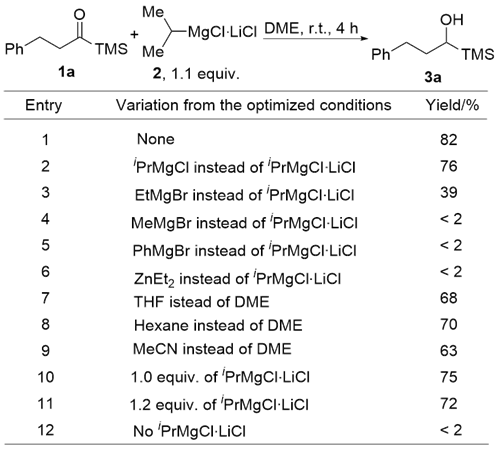
After a period of experimentation (Table 1), we found that Turbo Grignard (iPrMgCl∙LiCl, 2) could reduce 3-phenyl-1-(trimethylsilyl)propan-1-one (1a) at room temperature in dimethoxyethane (DME) within 4 h, yielding the target product (3a) with an isolated yield of 82% (Table 1, Entry 1).[8] Isopropylmagnesium chloride without lithium chloride also reduced 1a, albeit with a slightly lower yield of 76% (Table 1, Entry 2). Ethylmagnesium bromide can be obtained in a yield of 39% as 3a (Table 1, Entry 3). In contrast, methylmagnesium halide, phenylmagnesium reagents and diethylzinc cannot reduce the acyl silane under these conditions (Table 1, Entries 4~6). The former may require additional Lewis acid catalysis, while the latter likely lacks β-hydrogen atoms (see mechanism). When the solvent was switched to tetrahydrofuran (THF), hexane, or acetonitrile (MeCN), the reaction yields decreased (Table 1, Entries 7~9, 63%~70%). Reducing or increasing the amount of Turbo Grignard also led to diminished yields (Table 1, Entries 10~11, 72%~75%). Control experiments confirmed that Turbo Grignard is essential for the reaction (Table 1, Entry 12).
Table 1 Condition optimization |
 |
After obtaining the optimized conditions, we proceeded with substrate scope expansion (Table 2). First, the influence of the dimethyl-tert-butylsilyl (TBS) substituent on the reaction was investigated. We found that under the same conditions, alkyl-substituted TBS acylsilanes reacted with significantly higher efficiency compared to TMS acylsilanes (95% vs 82%, 3a~3b). When the alkyl substituent was replaced by aryl or alkynyl groups, TBS-sub- stituted acylsilanes were also more readily reduced than their TMS-substituted counterparts (3c, 3e vs 3d, 3f).
Table 2 Substrate scope for the reactiona |

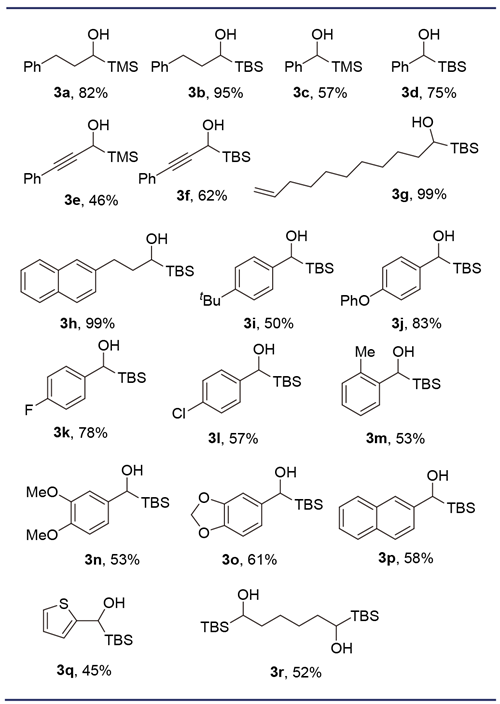 |
a Reaction conditions: 1 (0.2 mmol), 2 (0.22 mmol, 1.0 equiv.), 4 h under N2. |
Subsequently, we focused specifically on the reduction of TBS-substituted acylsilanes. In general, alkyl-substi- tuted acylsilanes exhibited higher reaction efficiency than aryl acylsilanes (3g~3h vs 3i~3q). The yields for alkyl- substituted acylsilanes were nearly quantitative (3g~3h). The reactivity of substituted aryl acylsilanes as substrates was then explored (3i~3q). The results showed that the reduction of (p-phenoxy)phenyl and p-fluorobenzoyl silanes using Turbo Grignard reagent afforded high yields (3j~3k). For aryl rings bearing other substituents—including para-, ortho-, and multi-substituted groups—the corresponding reduction products (3i, 3l~3o) were obtained in moderate yields. The reaction was also applicable to acylsilanes containing naphthalene and thiophene rings (3p~3q). Finally, the reduction of a diacylsilane was examined. Using two equivalents of Turbo Grignard reagent, both carbonyl groups were reduced, yielding the target product 3r in 52% yield.
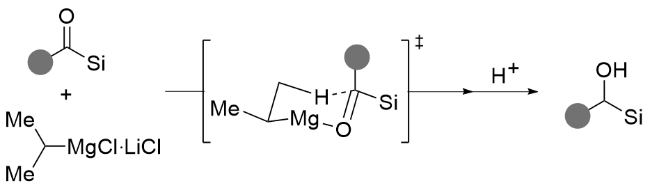
Based on the experimental results and relevant literature, the following mechanism was proposed: The Turbo Grignard reagent coordinates with the carbonyl group of the acylsilane, followed by a β-hydride transfer from the magnesium center to the carbonyl carbon of the acylsilane. This process leads to the reduction of the C=O bond, yielding the corresponding α-silyl alcohol. The hydrogen atom in the α-silyl alcohol product originates from the workup procedure during the reaction. This mechanism not only aligns with the observed experimental data, but also highlights the unique reactivity of Turbo Grignard reagents in facilitating such transformations under mild conditions (Scheme 2).


3 Conclusions
In summary, our findings demonstrate that the Turbo Grignard reagent effectively reduces acylsilanes to α-silyl alcohols at room temperature. This method employs readily available and commercially accessible Turbo Grignard as the reducing reagent, while exhibiting a broad substrate scope and good functional group tolerance. Given these advantages, the protocol holds considerable promise for widespread application in organic synthesis, offering a practical and efficient approach to accessing valuable α-silyl alcohol derivatives.
4 Experimental section
4.1 General information
All the chemicals were purchased from commercial suppliers, including Energy Chemical, Bidepharm, Macklin, Leyan, Adamas, and Heowns. These reagents were directly used without further purification. Acylsilanes were prepared based on reported procedures.[6] Reactions were monitored by Thin Layer Chromatography (TLC) using UV light (254/365 nm) for detection. Products were purified by column chromatography, which was carried out on 200~300 mesh of silica gel purchased from Qingdao Haiyang Chemical Industry Co., or was carried out on 100~200 mesh of neutral aluminum oxide purchased from Tianjin Kemiou Chemical Industry Co. All the 1H NMR, 13C NMR, and 19F NMR spectra were recorded on a Bruker Avance 400 MHz spectrometer operating at 400 MHz, 101 MHz, and 377 MHz, respectively. All NMR spectra were recorded in CDCl3 at room temperature (20±3 ℃). High-resolution mass spectra (HRMS) were obtained via electrospray ionization (ESI) mode using a UPLC G2-XS Qtof mass spectrometer, or via an electrospray ionization (ESI) mode using a Thermo Scientific Q Exactive Combined Quadrupole Orbitrap Mass Spectrometer.
4.2 General procedure for the preparation of Acylsilanes
To a stirred solution of 1,3-dithiane (1.0 equiv.) in THF (20 mL) at -30 ℃ was added n-BuLi (1.2 equiv.) dropwise. The resulting mixture was kept for 2 h, then it was cooled to -78 ℃, TMSCl or TBSCl (1.2 equiv.) was added into the reaction mixture, and it was kept for another 1 h at -78 ℃. The mixture was quenched with saturated aqueous NH4Cl (50 mL), and extracted with methyl tert-butyl ether (50 mL×3). The combined organic phase was washed with brine (100 mL) and dried over MgSO4. The crude mixture was filtered through plug of silica using CH2Cl2 as an eluent to give 2-(trimethylsilyl)-1,3-dithiane as a colorless solid. To a stirred solution of 2-(trimethyl- silyl)-1,3-dithiane in the combined solvent (THF/H2O, V/ V=4/1) was added CaCO3 (8.0 equiv.) and I2 (6.0 equiv.) at 0 ℃. The mixture was kept for 1.5 h at room temperature, then quenched with saturated Na2S2O3 (9 mL). The mixture filtered through a pad of silica gel, and washed by CH2Cl2 (15 mL). Then the solution was washed with water (20 mL) and brine (20 mL), dried over MgSO4, and concentrated. The residue was purified by flash chromatography to afford product.
4.3 General procedure for the reduction of acyl- silanes
Under a nitrogen atmosphere within a glovebox, a dry 10 mL reaction tube equipped with a magnetic stir bar was charged with acylsilane 1 (0.2 mmol), isopropyl magnesium chloride lithium chloride complex 2 (0.22 mmol, 1.1 equiv.), and ethylene glycol dimethyl ether (2 mL) as the solvent. The reaction tube was then sealed, removed from the glovebox, and stirred at room temperature for 4 h. Upon completion, the solvent was removed under reduced pressure. The crude product was purified by thin-layer chromatography or silica gel column chromatography to afford the target product 3.
3-Phenyl-1-(trimethylsilyl)propan-1-ol (3a): Green oil, 82%. 1H NMR (400 MHz, CDCl3) δ: 7.33~7.27 (m, 2H), 7.25~7.18 (m, 3H), 3.39~3.30 (m, 1H), 3.00~2.90 (m, 1H), 2.72~2.63 (m, 1H), 1.89~1.80 (m, 2H), 0.05 (s, 9H); 13C NMR (101 MHz, CDCl3) δ: 142.39, 128.63, 128.56, 125.95, 65.62, 35.49, 33.45, -3.87. HRMS (ESI) calcd for C12H20NaOSi [M+Na]+ 231.1176, found 231.1154.
1-(tert-Butyldimethylsilyl)-3-phenylpropan-1-ol (3b):[6c] White oil, 95%. 1H NMR (400 MHz, CDCl3) δ: 7.33~7.28 (m, 2H), 7.24~7.18 (m, 3H), 3.56~3.51 (m, 1H), 3.01~2.93 (m, 1H), 2.70~2.62 (m, 1H), 1.91~1.83 (m, 2H), 0.95 (s, 9H), 0.03 (s, 3H), -0.03 (s, 3H); 13C NMR (101 MHz, CDCl3) δ: 142.39, 128.62, 128.56, 125.95, 64.17, 36.54, 33.59, 27.18, 16.89, -7.42, -8.45.
Phenyl(trimethylsilyl)methanol (3c):[2d] Yellow oil, 57%. 1H NMR (400 MHz, CDCl3) δ: 7.33~7.29 (m, 2H), 7.21~7.16 (m, 3H), 4.53 (s, 1H), 0.02 (s, 9H); 13C NMR (101 MHz, CDCl3) δ: 144.38, 128.29, 125.94, 125.04, 70.74, -4.00.
(tert-Butyldimethylsilyl)(phenyl)methanol (3d): Yellow oil, 75%. 1H NMR (400 MHz, CDCl3) δ: 7.33~7.28 (m, 2H), 7.24~7.16 (m, 3H), 4.68 (s, 1H), 0.97 (s, 9H), 0.01 (s, 3H), -0.19 (s, 3H); 13C NMR (101 MHz, CDCl3) δ: 145.00, 128.28, 126.05, 125.63, 69.15, 27.11, 17.26, -7.11, -9.28. HRMS (ESI) calcd for C13H23OSi [M+H]+ 223.1518, found 223.1515.
3-Phenyl-1-(trimethylsilyl)prop-2-yn-1-ol (3e): Pale yellow oil, 46%. 1H NMR (400 MHz, CDCl3) δ: 7.42~7.39 (m, 2H), 7.31~7.28 (m, 3H), 4.31 (s, 1H), 0.21 (s, 9H); 13C NMR (101 MHz, CDCl3) δ: 131.63, 128.40, 128.11, 123.56, 89.89, 87.97, 57.02, -3.99. HRMS (ESI) calcd for C12H17OSi [M+H]+ 205.1049, found 205.1056.
1-(tert-Butyldimethylsilyl)-3-phenylprop-2-yn-1-ol (3f): Yellow oil, 62%. 1H NMR (400 MHz, CDCl3) δ: 7.42~7.37 (m, 2H), 7.32~7.28 (m, 3H), 4.45 (s, 1H), 1.02 (s, 9H), 0.17 (s, 3H), 0.16 (s, 3H); 13C NMR (101 MHz, CDCl3) δ: 131.50, 128.42, 128.10, 123.60, 90.61, 88.29, 55.35, 27.07, 17.25, -7.64, -8.27. HRMS (ESI) calcd for C15H23OSi [M+H]+ 247.1518, found 247.1519.
1-(tert-Butyldimethylsilyl)undec-10-en-1-ol (3g):[6a] Colorless oil, 99%. 1H NMR (400 MHz, CDCl3) δ: 5.86~5.76 (m, 1H), 5.02~4.91 (m, 2H), 3.50~3.44 (m, 1H), 1.54~1.25 (m, 16H), 0.94 (s, 9H), 0.01 (s, 3H), -0.05 (s, 3H); 13C NMR (101 MHz, CDCl3) δ: 139.37, 114.25, 64.60, 34.53, 33.95, 29.74, 29.66, 29.62, 29.27, 29.07, 27.19, 26.99, 16.91, -7.38, -8.46.
1-(tert-Butyldimethylsilyl)-3-(naphthalen-2-yl)propan-1-ol (3h):[6a] Colorless oil, 99%. 1H NMR (400 MHz, CDCl3) δ: 7.85~7.78 (m, 3H), 7.68 (s, 1H), 7.50~7.37 (m, 3H), 3.61~3.56 (m, 1H), 3.18~3.10 (m, 1H), 2.88~2.80 (m, 1H), 2.00~1.92 (m, 2H), 0.97 (s, 9H), 0.05 (s, 3H), -0.01 (s, 3H); 13C NMR (101 MHz, CDCl3) δ: 139.90, 133.80, 132.13, 128.13, 127.75, 127.53, 127.46, 126.61, 126.05, 125.27, 64.13, 36.38, 33.67, 27.19, 16.90, -7.41, -8.42.
(4-(tert-Butyl)phenyl)(tert-butyldimethylsilyl)methanol (3i): White solid, 50%, m.p. 81.3 ℃; 1H NMR (400 MHz, CDCl3) δ: 7.35~7.31 (m, 2H), 7.17~7.13 (m, 2H), 4.66 (s, 1H), 1.32 (s, 9H), 0.97 (s, 9H), 0.02 (s, 3H), -0.19 (s, 3H); 13C NMR (101 MHz, CDCl3) δ: 148.98, 141.88, 125.42, 125.16, 68.91, 34.54, 31.56, 27.12, 17.24, -7.08, -9.23. HRMS (ESI) calcd for C17H30OSiNa [M+Na]+ 301.1964, found 301.1956.
(tert-Butyldimethylsilyl)(4-phenoxyphenyl)methanol (3j):[6c] Colorless oil, 83%. 1H NMR (400 MHz, CDCl3) δ: 7.36~7.30 (m, 2H), 7.21~7.18 (m, 2H), 7.12~7.07 (m, 1H), 7.01~6.96 (m, 4H), 4.67 (s, 1H), 0.98 (s, 9H), 0.03 (s, 3H), -0.17 (s, 3H); 13C NMR (101 MHz, CDCl3) δ: 157.69, 155.36, 140.01, 129.82, 126.98, 123.12, 119.02, 118.64, 68.63, 27.10, 17.23, -7.13, -9.18.
(tert-Butyldimethylsilyl)(4-fluorophenyl)methanol (3k):[6c] Yellow oil, 78%. 1H NMR (400 MHz, CDCl3) δ: 7.19~7.15 (m, 2H), 7.02~6.96 (m, 2H), 4.66 (s, 1H), 0.96 (s, 9H), 0.00 (s, 3H), -0.21 (s, 3H); 13C NMR (101 MHz, CDCl3) δ: 161.41 (d, J=243.7 Hz), 140.65 (d, J=3.0 Hz), 127.02 (d, J=7.9 Hz), 115.09 (d, J=21.2 Hz), 68.48, 27.08, 17.20, -7.18, -9.32. 19F NMR (377 MHz, CDCl3) δ: -117.34.
(tert-Butyldimethylsilyl)(4-chlorophenyl)methanol (3l):[6c] Colorless oil, 57%. 1H NMR (400 MHz, CDCl3) δ: 7.28 (d, J=2.0 Hz, 2H), 7.15 (d, J=8.6 Hz, 2H), 4.67 (s, 1H), 0.96 (s, 9H), -0.01 (s, 3H), -0.20 (s, 3H); 13C NMR (101 MHz, CDCl3) δ: 143.54, 131.53, 128.39, 126.86, 68.58, 27.11, 17.25, -7.10, -9.38.
(tert-Butyldimethylsilyl)(o-tolyl)methanol (3m):[6c] Colorless oil, 53%. 1H NMR (400 MHz, CDCl3) δ: 7.41 (d, J=7.3 Hz, 1H), 7.25~7.20 (m, 1H), 7.12~7.07 (m, 2H), 4.99 (s, 1H), 2.24 (s, 3H), 1.04 (s, 9H), 0.07 (s, 3H), -0.32 (s, 3H); 13C NMR (101 MHz, CDCl3) δ: 143.41, 133.05, 130.22, 126.31, 125.94, 125.78, 63.90, 27.11, 19.95, 17.25, -6.87, -9.60.
(tert-Butyldimethylsilyl)(3,4-dimethoxyphenyl)me-thanol (3n): White solid, 53%, m.p. 95.1 ℃; 1H NMR (400 MHz, CDCl3) δ: 6.81~6.77 (m, 2H), 6.73~6.69 (m, 1H), 4.59 (s, 1H), 3.85 (d, J=2.9 Hz, 6H), 0.95 (s, 9H), 0.01 (s, 3H), -0.20 (s, 3H); 13C NMR (101 MHz, CDCl3) δ: 148.94, 147.40, 137.65, 117.68, 111.09, 109.31, 68.78, 56.02, 55.92, 27.09, 17.19, -7.13, -9.05. HRMS (ESI) calcd for C15H26O3SiNa [M+Na]+ 305.1549, found 305.1544.
Benzo[d][1,3]dioxol-5-yl(tert-butyldimethylsilyl)me- thanol (3o): Yellow oil 61%. 1H NMR (400 MHz, CDCl3) δ: 6.83~6.79 (m, 2H), 6.70~6.65 (m, 1H), 5.91 (d, J=1.8 Hz, 1H), 5.90 (d, J=1.8 Hz, 1H), 4.82 (s, 1H), 0.98 (s, 9H), 0.06 (s, 3H), -0.17 (s, 3H); 13C NMR (101 MHz, CDCl3) δ: 146.98, 143.01, 127.04, 121.85, 119.62, 106.39, 100.61, 63.31, 26.99, 17.24, -7.43, -8.96. HRMS (ESI) calcd for C14H22O3NaSi [M+Na]+ 289.1237, found 289.1236.
(tert-Butyldimethylsilyl)(naphthalen-2-yl)methanol (3p): Yellow solid, 58%, m.p. 72.5 ℃. 1H NMR (400 MHz, CDCl3) δ: 7.83~7.77 (m, 3H), 7.68 (s, 1H), 7.49~7.41 (m, 2H), 7.36~7.33 (m, 1H), 4.86 (s, 1H), 1.02 (s, 9H), 0.05 (s, 3H), -0.16 (s, 3H); 13C NMR (101 MHz, CDCl3) δ: 142.75, 133.63, 132.28, 127.79, 127.75, 127.73, 126.16, 125.29, 124.82, 123.32, 69.31, 27.16, 17.35, -6.90, -9.25. HRMS (ESI) calcd for C17H25OSi [M+H]+ 273.1675, found 273.1671.
(tert-Butyldimethylsilyl)(thiophen-2-yl)methanol (3q):[7a] Yellow oil, 45%. 1H NMR (400 MHz, CDCl3) δ: 7.18~7.15 (m, 1H), 6.95 (dd, J=5.1, 3.4 Hz, 1H), 6.84~6.82 (m, 1H), 4.91 (s, 1H), 0.94 (s, 9H), 0.12 (s, 3H), -0.09 (s, 3H); 13C NMR (101 MHz, CDCl3) δ: 148.97, 126.86, 123.49, 122.59, 64.88, 26.97, 17.20, -7.45, -8.77.
1,6-Bis(tert-butyldimethylsilyl)hexane-1,6-diol (3r): Yellow oil 52%. 1H NMR (400 MHz, CDCl3) δ: 3.53~3.46 (m, 2H), 1.59~1.27 (m, 8H), 0.94 (s, 18H), 0.01 (s, 6H), -0.05 (s, 6H); 13C NMR (101 MHz, CDCl3) δ: 64.53, 64.26, 34.43, 34.34, 27.19, 26.86, 26.48, 16.90, -7.40, -8.47. HRMS (ESI) calcd for C18H43O2Si2 [M+H]+ 347.2802, found 347.2821.
Supporting Information The 1H NMR, 13C NMR spectra of compounds 3a~3r. The Supporting Information is available free of charge via the Internet at http://sioc-journal.cn.
(Lu, Y.)