


1 Introduction
The Nozaki-Hiyama-Kishi (NHK) reaction, developed in the late 1970s and 1980s, stands as a landmark methodology in synthetic chemistry.[1-4] Recognized for its powerful ability to forge C—C bonds under mild conditions, it has been widely adopted in both synthetic methodology development and complex natural product synthesis.[1-4] The origin of this reaction can be traced back to 1977, when Nozaki, Hiyama, and co-workers[5] disclosed the chromium(II)-mediated carbonyl addition of allyl halides. Subsequent expansions to alkenyl[6] and alkynyl[7] halides followed in 1983 and 1985, respectively. A pivotal turn towards catalysis occurred in 1986, when Kishi and co- workers[8] demonstrated the beneficial effect of nickel(II) and palladium(II) co-catalysts on chromium(II)-mediated couplings. Independently, Takai and co-workers[9] reported similar results using alkenyl triflates under nickel(II) catalysis. Further key developments included the cobalt-cata- lyzed preparation of alkyl chromium reagents by Utimoto and Takai in 1989,[10] and a seminal breakthrough by Fürstner and co-workers[11-12] in 1996. Their work introduced a truly catalytic NHK reaction by employing manganese powder to regenerate Cr(II) from the Cr(III) waste, dramatically reducing the stoichiometric chromium burden. The field reached another milestone in 1999 when Umani-Ronchi, Cozzi, and co-workers[13] reported the first catalytic enantioselective NHK reaction using a chiral salen ligand. This spurred extensive research into asymmetric variants, expanding the reaction’s utility for stereocontrolled synthesis.[3-4,14-25]
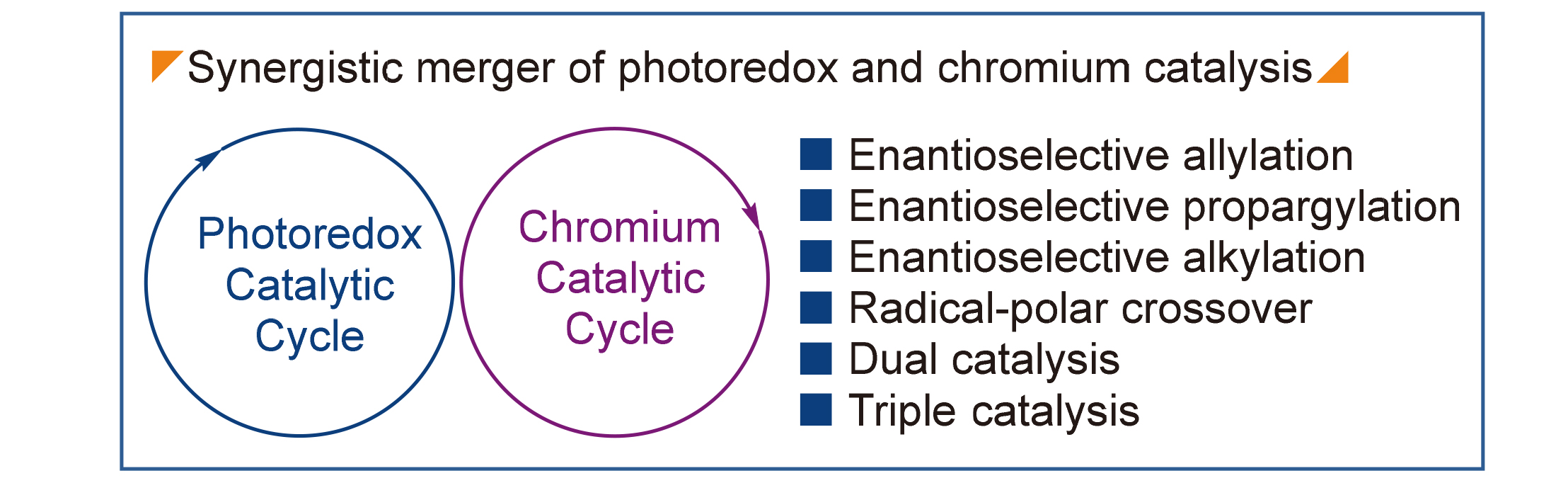
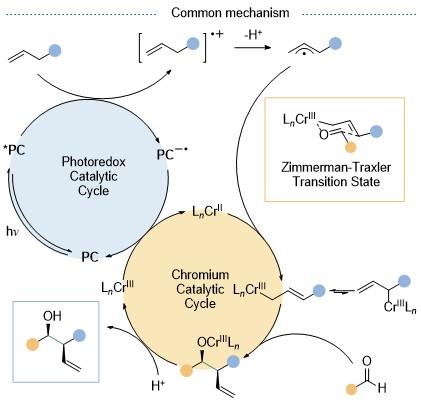
Despite its synthetic power, the classical NHK reaction has been persistently hampered by the generation of stoichiometric chromium waste. This limitation has driven the search for more sustainable, catalytic methods to generate the key radical and organochromium intermediates. In this context, photoredox catalysis[26-30] and electrosynthesis[31] have emerged as two principal, modern strategies. Pioneering electrochemical NHK reactions were reported by Grigg,[32] Tanaka,[33] and Durandetti[34-35] with a significant expansion in scope and application demonstrated by Baran, Reisman, and co-workers[36] in 2024, revitalizing interest in the electrochemical approach. Concurrently with advances in electrosynthesis, the rapid evolution of photoredox catalysis has opened a new, synergistic pathway. The pioneering studies by Glorius[37] and Kanai[38] marked the beginning of research into dual photoredox/chromium catalysis for NHK-type reactions. This innovative paradigm merges two catalytic cycles: a photoredox cycle generates radicals under visible-light irradiation, and a chromium cycle captures these radicals and directs their enantioselective addition to electrophiles (Figure 1). In a typical mechanism, the excited photocatalyst oxidizes a radical precursor (e.g., via C—H, C—Si, or C—C bond cleavage). The resulting radical is intercepted by a Cr(II) species to form an organochromium(III) intermediate. Addition to an aldehyde via a Zimmerman-Traxler-type transition state followed by hydrolysis delivers the product and Cr(III). A final comproportionation step between Cr(III) and the reduced photocatalyst regenerates both catalysts, closing the catalytic loops.[39] The employment of chiral ligands enables the enantioselectivity in these transformations.
While recent reviews have touched on related areas,[40-44] this review focuses specifically on the burgeoning field of enantioselective transformations enabled by dual photoredox and chromium catalysis. We will highlight the most significant recent advances, analyze the mechanistic principles underpinning this synergy, and outline future challenges and opportunities in this rapidly developing area of sustainable asymmetric synthesis.
2 Dual photoredox/chromium-catalyzed allylic radical involved transformations
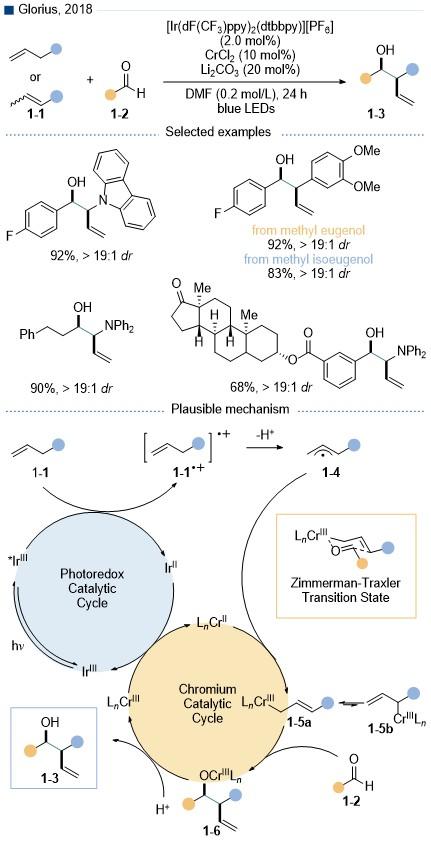
In 2018, Glorius and co-workers[37] reported the first redox-neutral, catalytic NHK-type allylation of aldehydes, enabled by synergistic photoredox and chromium catalysis (Scheme 1). This seminal work established a new paradigm by elegantly replacing the stoichiometric Cr(II) and external reductants of the classical NHK reaction. The system employed [Ir(dF(CF3)ppy)2(dtbbpy)]PF6 as the photoredox catalyst and a low-valent Cr(II) species as the allylation catalyst. Under visible-light irradiation, the protocol proved broadly applicable to various allyl arenes, heteroarenes, β-methyl styrenes, and allyl-diarylamines. Mechanistically, the excited-state photocatalyst (*Ir(III)) oxidizes an electron-rich allyl arene (1-1), generating a radical cation. Subsequent deprotonation (facilitated by Li2CO3) yields an allyl radical (1-4), which is captured by LnCr(II) to form organochromium(III) intermediates 1-5a/ 1-5b. The diastereoselective addition of these species to aldehyde (1-2) proceeds through a Zimmerman-Traxler- type transition state, ultimately delivering the anti-homo- allylic alcohol 1-3 after hydrolysis. The cycles are closed by comproportionation between the Cr(III) byproduct and the reduced Ir(II) species, regenerating both catalysts. This work was transformative, demonstrating that a fully catalytic, redox-neutral NHK process was achievable by merg- ing photoredox and chromium cycles.
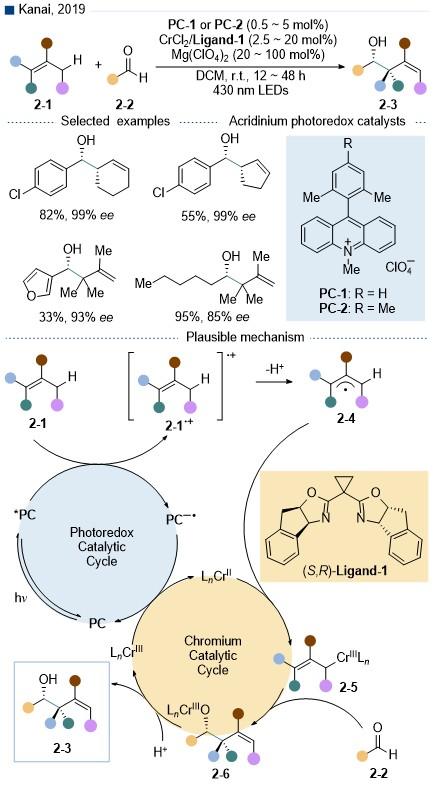
Meanwhile, Kanai, Mitsunuma and co-workers[38] achi- eved a significant leap in early 2019 by reporting the first enantioselective version of this transformation, directly functionalizing allylic C—H bonds (Scheme 2). Their system introduced two critical innovations. First, it replaced the precious-metal photoredox catalyst with an organic acridinium salt (PC-1 or PC-2), enhancing sustainability and reducing cost. Second, and most importantly, it employed a chiral bioxazoline (BOX) ligand ((S,R)-Ligand- 1) on chromium to enforce enantioselectivity. This allowed for the highly enantioselective allylation of both aromatic and aliphatic aldehydes using simple, unactivated alkenes as the allylic radical precursors. The mechanism mirrors the Glorius paradigm but incorporates stereocontrol: photoredox-catalyzed oxidation of the alkene generates an allylic radical, which is intercepted by a chiral Cr(II) complex. The resulting enantiodefined organochromium(III) species then adds to the aldehyde, with the chiral ligand dictating the face of attack. While the reaction required an excess of the alkene, it represented a monumental advance by unifying direct C—H functionalization, asymmetric catalysis, and redox-neutral photocatalysis into a single, powerful operation.
In 2020, Kanai, Mitsunuma, and co-workers[45] reported an advanced asymmetric allylation of aldehydes using inert alkenes, ingeniously enabled by introducing a hydrogen atom transfer (HAT) catalyst (Scheme 3, top). This work addressed a key limitation of their earlier system,[38] wherein electron-deficient alkenes—owing to their high oxidation potentials—were poor substrates, leading to low yields. As discussed previously, a HAT catalyst can circumvent this kinetic hurdle by generating the key allylic radical via an alternative pathway. In this implementation, they employed a thiophosphoric imide (TPI) as the efficient HAT mediator. Mechanistic studies revealed a sequence beginning with the oxidation of TPI by the photoexcited acridinium catalyst (PC-3), generating a sulfur- centered radical. This radical then abstracts a hydrogen atom from the alkene to furnish the crucial allyl radical. Subsequent capture by a chiral Cr(II) complex forms the organochromium(III) intermediate, which undergoes diastereoselective addition to the aldehyde. Hydrolysis of the resulting chromium alkoxide releases the desired branched homoallylic alcohol product (3-3) and a Cr(III) species, closing the catalytic cycle.
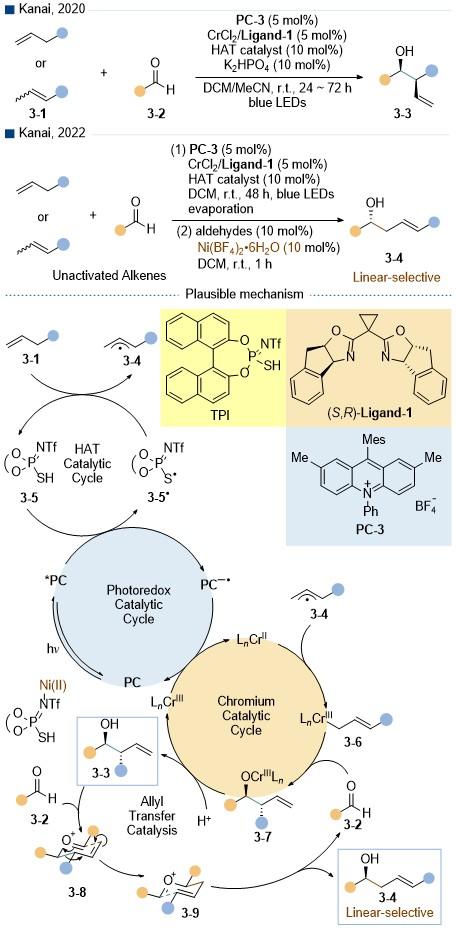
Building upon this platform, the Kanai group[46] achie- ved a significant refinement in 2022. By introducing Ni(BF4)2•6H2O as an additional co-catalyst, they could selectively steer the reaction toward the linear regioisomer (Scheme 3, bottom). This divergence in selectivity stems from an in-situ acetal formation/isomerization pathway. The initially formed branched chromium alkoxide intermediate is intercepted by the nickel/TPI system to form a cyclic acetal. This intermediate then undergoes isomerization via a favorable six-membered chair transition state before hydrolysis, ultimately delivering the linear product (3-4). Previous work from the same group established that the synergistic combination of a nickel catalyst and a thiophosphoric acid derivative dramatically accelerates acetal formation from aldehydes and alcohols.[47] In this quadruple catalytic system, both Ni(II) and TPI are essential for this diversion step. Spectroscopic studies (IR and 31P NMR) confirmed that Ni(II) coordinates to TPI, enhancing its Brønsted acidity and thus its catalytic efficacy in acetal formation. A key feature across both systems is the use of the indane-BOX ligand ((S,R)-Ligand-1) on chromium, which effectively imparts high enantiocontrol throughout these complex catalytic cascades.
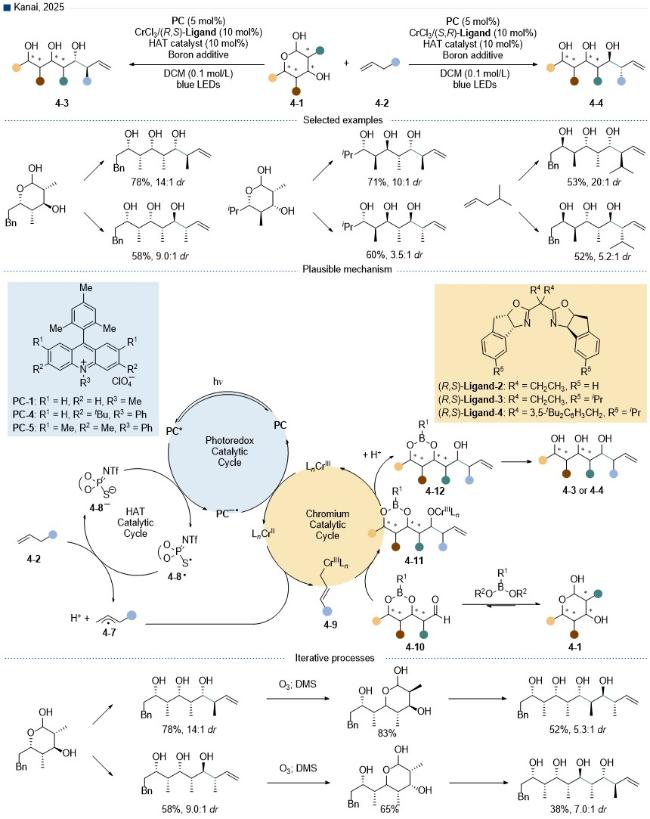
Recently, Kanai and Mitsunuma[48] showcased the synthetic power of this platform by applying it to the stereodivergent synthesis of polypropionate motifs (Scheme 4). In an exceptionally elegant design, they employed cyclic hemiacetal aldols (4-1) as starting materials, eliminating the need for multi-step preparation of pre-functionalized carbon units and pre-protection of hydroxy groups, thereby dramatically improving step economy. The core transformation involves the allylation of these hemiacetals with simple 1-butene as the homologation unit. Critically, the stereochemistry at the newly formed stereocenters is catalyst-controlled, not substrate-controlled. The reaction proceeds through a Zimmerman-Traxler-type transition state, where the absolute configuration of the chiral chromium catalyst dictates the facial selectivity of the allyl addition to the hemiacetal-derived aldehyde. By simply employing pseudo-enantiomeric forms of the chiral ligand, they could selectively access multiple diastereomers of the polypropionate chain from a single starting material. This work represents a paradigm shift from traditional substrate-con- trolled polyketide synthesis, demonstrating the potential of dual photoredox/chromium catalysis for the programmable, stereodivergent assembly of complex acyclic architectures.
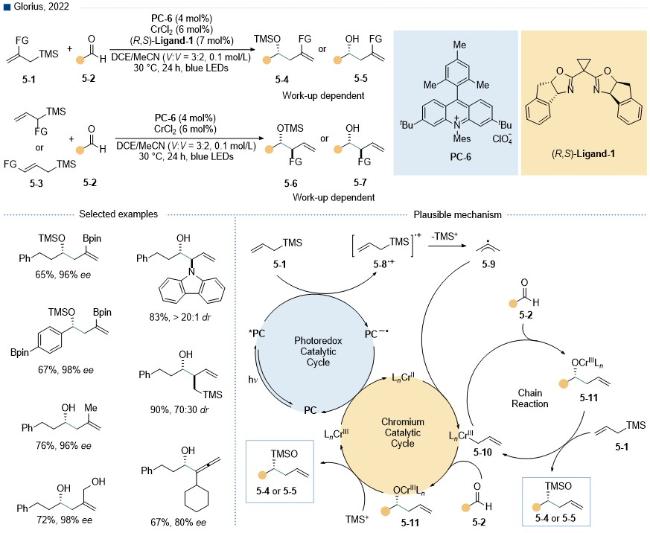
Beyond allylic C—H activation, alternative methods for generating allylic radicals have been successfully integrated into this catalytic manifold. For instance, allylsilanes, classic reagents in the nucleophilic Hosomi-Sakurai reaction, can serve as efficient radical precursors upon single- electron oxidation.[49] However, the classical ionic Hosomi-Sakurai mechanism proceeds through an open, acyclic transition state, rendering enantiocontrol exceptionally challenging. In 2022, Glorius and co-workers[50] elegantly addressed this limitation by reporting an asymmetric variant enabled by dual photoredox/chromium catalysis (Sche-me 5). They demonstrated that allylsilanes could be employed for the highly stereoselective synthesis of (protected) homoallylic alcohols from aldehydes. The authors proposed that the success hinges on the reaction proceeding through a tight, cyclic Zimmerman-Traxler-type transition state imposed by the chiral chromium catalyst, rather than the open transition state of the classical process. This shift in mechanism is crucial for effective enantioinduction. The trimethylsilyl (TMS) group in the product is labile under the reaction conditions, facilitating easy deprotection to the free homoallylic alcohol. Mechanistically, this system diverges from previous allylation protocols: the authors’ comprehensive mechanistic investigation, suppor- ted by a high quantum yield (Φ=6.8 with ligand; Φ=15.8 without ligand) and density functional theory (DFT) cal-culations, suggests a chain process is operative. In this pathway, the alkoxide product (5-10) can participate in a chain-transfer step with the allylsilane (5-1 or 5-3), regenerating the key chromium (III) intermediate (5-11) and contributing to the high efficiency observed.
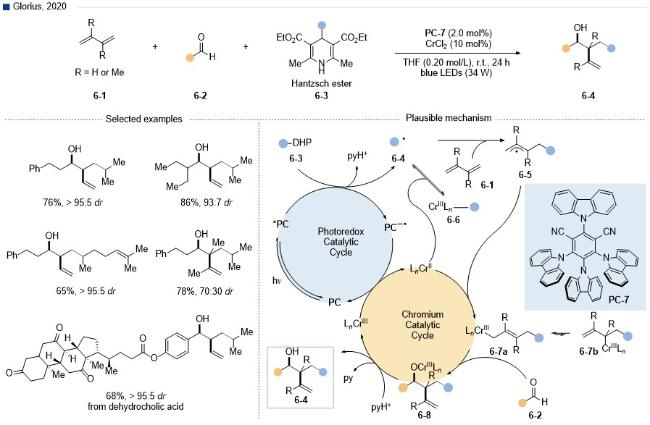
In 2020, Glorius and co-workers[51] introduced a pio-neering strategy for the three-component 1,4-dialkylation of 1,3-dienes, marking the first such transformation enabled by dual photoredox and chromium catalysis (Scheme 6). This work elegantly circumvented the persistent challenge of directly oxidizing electron-deficient alkenes by employing a 1,3-diene (6-1) as a radical relay. Rather than attempting the difficult C—H abstraction from a poor radical precursor, the method generates an alkyl radical that first adds to the diene, creating a new, more stabilized allylic radical perfectly poised for chromium capture. The proposed mechanism begins with the photoexcited organic photocatalyst 4-CzIPN* (PC-7*) oxidizing a Hantzsch ester derivative (6-3), generating an electrophilic alkyl radical (6-4). This radical adds regioselectively to a 1,3- diene, forming a resonance-stabilized allyl radical (6-5). A critical design element is the reversibility of the competing direct interception of the initial alkyl radical by Cr(II) to form the inactive Cr(III) salts (6-6). This reversibility allows the system to favor the pathway leading to the allyl radical. This key species is then captured by a chiral Cr(II) complex, and the resulting allylchromium(III) intermediate adds enantioselectively to an aldehyde. The catalytic cycles are closed via comproportionation between the Cr(III) byproduct and the reduced photocatalyst. The reaction exhibited broad scope and high enantioselectivity when using a bisoxazoline ligand, successfully constructing challenging all-carbon quaternary stereocenters in an enantioselective fashion. This work stands out as a masterful example of solving a fundamental reactivity problem through strategic substrate design, unlocking a novel and powerful three-component coupling paradigm. Building upon this three-component radical relay platform, Shi and co-wor- kers[52] recently reported an advance that broadens the scope of accessible alkyl radical precursors. Their strategy replaces the requirement for pre-synthesized 4-alkyl Hant- zsch esters with the more versatile and readily available N-hydroxyphthalimide (NHPI) esters. In this system, a simple, unsubstituted Hantzsch ester serves as a stoichiometric terminal reductant. This elegant modification circumvents the need to prepare structurally complex Hant-zsch ester derivatives, thereby streamlining substrate synthesis and enhancing the practical utility of the overall transformation.
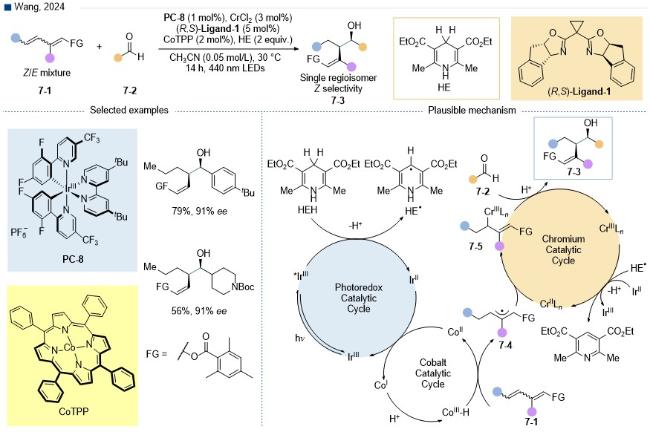
In 2024, Wang and co-workers[53] reported a significant advancement with the development of a triple catalytic system for the stereoselective allylation of aldehydes (Scheme 7). Their innovative strategy introduces a cobalt catalytic cycle that directly generates allyl radicals from functionalized 1,3-dienes bearing acyloxy or amide groups, moving beyond the traditional paradigm of allylic C—H bond activation. This method is distinguished by its excellent regio- and stereoselectivity, delivering the 3,4-addition product in near-quantitative yield—a result that aligns perfectly with computational modeling of the key transition state. A notable feature is the stereoconvergent nature of the transformation: regardless of the geometry of the starting diene, the reaction proceeds with high selectivity to furnish the Z-configured alkene in the product. This outcome is rationalized by a chair-like six-membered Zimmerman-Traxler-type transition state, which dictates both the regiochemistry and the alkene geometry. The authors further demonstrated the potential for asymmetric synthesis by employing chiral bisoxazoline ligands, achieving high enantioselectivity and thereby expanding the utility of this triple catalytic platform for accessing enantioenriched homoallylic alcohol architectures.
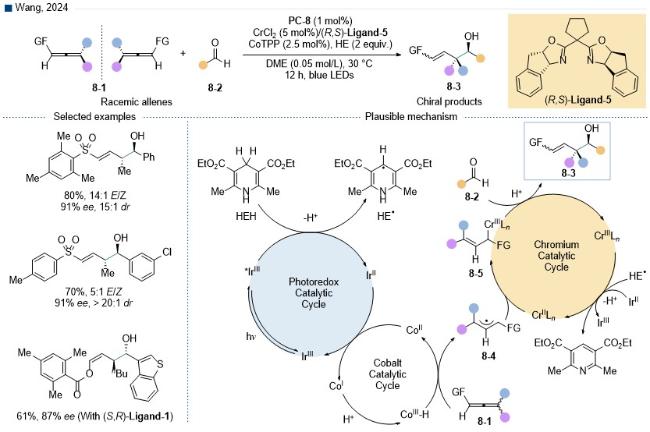
In 2025, they[54] continued to broaden the scope of such a triple catalysis system by the functionalization of racemic allenes in enantioconvergent reductive couplings with aldehydes (Scheme 8). Mechanistically, the transformation utilizes the steric pressure of the sulfonyl group to control the formation of a Zimmerman-Traxler-type transition state and hence the stereochemical outcome. In addition, the flexibility of the system is demonstrated by the easily tunable preparation of both E- and Z-alkene products, thus offering a general approach to deriving well-defined vinyl sulfone scaffolds from racemic substrates.
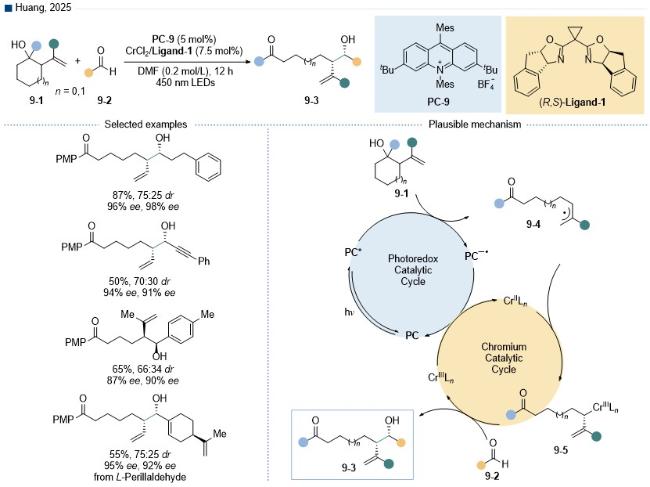
In 2025, our group[55] reported a novel strategy for the enantioselective, site-specific remote alkylation of aldehydes via the activation of unstrained C—C bonds in cyclic alcohols (Scheme 9). This work represents a notable example of achieving enantioselective radical transformations through the selective homolytic cleavage of a C—C σ-bond in a non-strained ring system, a significant challenge in chemical synthesis. Mechanistic investigations support a pathway initiated by a proton-coupled electron transfer (PCET) process that facilitates the ring-opening of the cyclic alcohol substrate. We propose that the chiral bisoxazoline ligand may serve a dual function: not only directing stereocontrol but also acting as a weak base to promote this critical PCET step. The resulting distal alkyl radical is then efficiently channeled into a classic chiral chromium catalytic cycle. Capture by the Cr(II) catalyst generates an organochromium(III) species, which undergoes highly stereoselective addition to an aldehyde via a Zimmerman-Traxler-type transition state, ultimately deli-vering the remote-homoallylic alcohol product with excellent enantioselectivity (the two enantiomeric excess values represent the enantioselectivity for major products and minor products, respectively). This methodology merges the power of redox-mediated C—C bond activation with the precision of asymmetric chromium catalysis, opening a distinct pathway for the stereocontrolled functionalization of robust aliphatic systems.
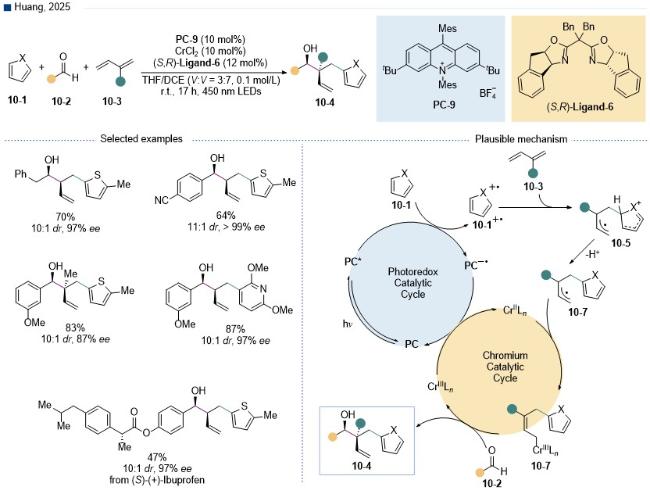
Complementing these advancements, our group[56] recently reported a photoredox/chromium-catalyzed enantioselective radical-polar crossover reaction for three-com- ponent coupling (Scheme 10). This method directly engages 1,3-dienes via C—H functionalization of (hetero)- aromatics, with a chiral bisoxazoline ligand ((S,R)-Ligand- 6) providing excellent stereocontrol. The reaction exhibits broad generality. A wide range of both aliphatic and aromatic aldehydes participated efficiently. Furthermore, the aryl radical precursor scope is notably extensive, encompassing electron-rich arenes as well as medicinally relevant heterocycles, such as thiophenes, pyridines, and pyrroles. This compatibility was demonstrated using substrates derived from complex natural products and drug molecules, underscoring the method’s potential for late-stage functionalization and the rapid assembly of enantioenriched, densely functionalized scaffolds.
In 2025, the three-component strategy has been further generalized through novel mechanistic design. Glorius, Qi and co-workers[57] reported a significant expansion of the substrate scope enabled by a delayed radical-polar crossover mechanism (Scheme 11). While previous three-com- ponent NHK-type reactions were largely confined to bulky alkyl radical precursors, this work successfully integrated organoboron and organosilicon reagents as versatile radical sources. Furthermore, it introduced epoxides as practical aldehyde equivalents. Under the reaction conditions, the epoxide undergoes in-situ isomerization to release the corresponding aldehyde, a valuable adaptation given the greater commercial availability and stability of many epoxides compared to their aldehyde counterparts. Control experiments further confirmed that the isomerization only occurs under irradiation and is promoted by the PC-6, supporting a photo-induced rearrangement mechanism. This design directly addresses a fundamental chemoselectivity challenge: The direct addition of a transient alkyl radical to an aldehyde is often unproductive, leading to side reactions. The incorporation of a 1,3-diene enforces a delayed crossover;[58] the radical first adds to the diene, and the resulting stabilized allylic radical is the species cap-tured by chromium for the subsequent carbonyl addition. To further demonstrate the synthetic utility, the authors conducted enatioselective variant of the protocol with (S,R)-Ligand-1 as a chiral ligand. Computational studies provided key insights into the solvent effect on this process. The calculations revealed that the rate-determining carbonyl insertion step is significantly slower in MeCN than in tetrahydrofuran (THF). This slower rate in MeCN diminishes the overall reaction efficiency and chemoselectivity, rationalizing the observed superior performance of THF as the optimal solvent and underscoring the delicate kinetic balancing required for successful three-component coupling.
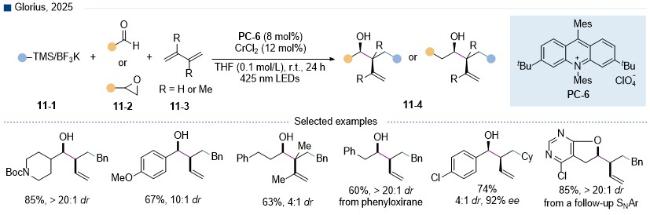
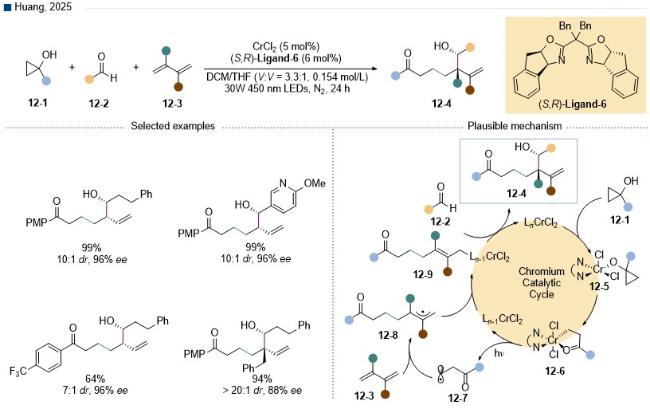
Recently, our group[59] expanded the three-component coupling platform by utilizing strained cyclopropanols as novel radical precursors, enabling efficient access to chiral homoallylic alcohols with high enantioselectivity (Scheme 12). The inherent ring strain of the cyclopropanol provides a strong thermodynamic driving force for ring-opening upon activation, cleanly generating a distal β-ketoalkyl radical. A key distinction of this method is its independence from an exogenous photocatalyst. Instead, mechanistic and DFT studies support an inner-sphere chromium- mediated pathway. The proposed mechanism begins with the coordination and oxidation of cyclopropanol (12-1) to an alkoxychromium(III) species. This intermediate undergoes a β-carbon elimination to form chromium homoenolate. A pivotal photochemical step then occurs: visible- light irradiation of 12-6 promotes it to an excited state, triggering homolytic cleavage to liberate the key alkyl radical (12-7) and regenerate a Cr(II) species. Radical 12-7 adds to 1,3-diene, and the resulting allylic radical is captured by the Cr(II) catalyst, entering the standard asymmetric chromium cycle to furnish the final product (12-4). This system demonstrates broad applicability. A wide range of aldehydes—including both electron-rich and electron-deficient aromatic and aliphatic derivatives, as well as those derived from complex natural products—participated effectively under the mild conditions. The high enantioselectivity is attributed to a carefully optimized chiral bisoxazoline ligand. DFT calculations further rationalized the substrate specificity: the reaction failed with the less- strained cyclobutanol analog due to a significantly higher energy barrier (approximately twice as high) for the crucial β-carbon elimination transition state compared to the cyclopropanol system.
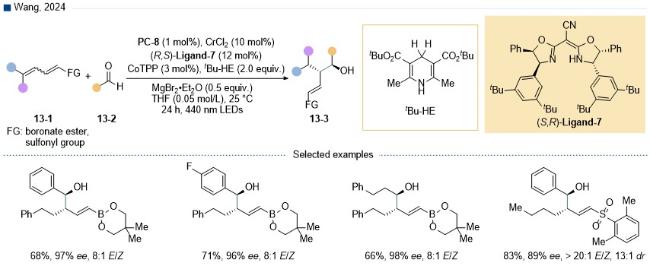
In 2025, Wang and co-workers[60] reported another article to exhibit the practicality of the photoredox/Cr/Co triple catalysis system to achieve homoallylic alcohol (Scheme 13). In this work, the boronate ester and sulfonyl- substituted internal 1,3-dienes were further explored. The synergistic photoredox, chromium, and cobalt catalytic system operates via a regioselective cobalt-mediated hydrogen atom transfer (MHAT) to generate an allylic radical, which subsequently undergoes a radical-polar crossover upon capture by a chiral chromium complex. The resulting transformation is notable for its high fidelity, delivering products with excellent regio-, diastereo- and enantiocontrol while simultaneously establishing an E-confi- gured alkene geometry from isomeric diene mixtures. The steric hinderance of the substituents is critical for the conformation of the Zimmerman-Traxler-type transition state and hence the overall stereochemical outcome of the product.
3 Dual photoredox/chromium-catalyzed propargylic radical involved transforma- tions
We have demonstrated so far that dual chromium/photo- redox catalysis has found significant applications in Nozaki-Hiyama-Kishi and Hosomi-Sakurai series reactions,among others. Researchers have expanded the range of reactants and effectively controlled asymmetry with high selectivity. Similarly, carbonyl propargylation is also crucial in carbon-carbon bond formation reactions. Given its importance, and drawing on earlier three-component reactions where dienes are attacked to form radical species interacting with the corresponding chromium reactant, several methods for generating propargylic radicals using chromium/photoredox catalysis to achieve a carbonyl propargylation have been reported.[61-63]
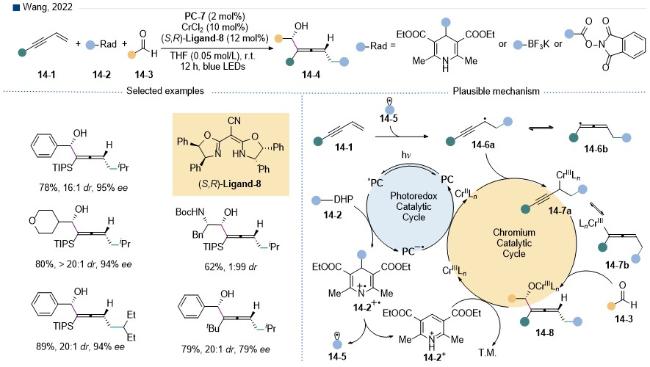
In 2022, Wang and co-workers[64] achieved a significant breakthrough by applying dual photoredox/chromium catalysis to the asymmetric three-component 1,4-dialkylation of 1,3-enynes, marking the catalytic enantioselective synthesis of chiral allenols via this synergistic platform (Scheme 14). The success of this transformation hinges on the delicate control of the equilibrium between allenyl and propargyl radicals, coupled with the judicious selection of radical precursors to sustain catalytic turnover. Their proposed mechanism, supported by mechanistic studies, proceeds as follows: Photoexcited 4-CzIPN (PC-7) oxidizes a Hantzsch ester derivative, generating a stabilized alkyl radical. This radical adds across the 1,3-enyne, establishing a rapid equilibrium between the allenyl radical (14-6b) and the propargyl radical (14-6a). Both radical isomers are intercepted by a chiral Cr(II) complex LnCr(II), forming the corresponding organochromium(III) intermediates 14- 7b (allenyl-Cr) and 14-7a (propargyl-Cr). Kinetic analysis suggests that the interconversion between them is faster than the subsequent nucleophilic addition to aldehyde 14-3, rendering the carbonyl addition the rate-determining step. Consequently, the regioselectivity (allenyl vs. propargyl addition) is governed by the relative energies of the competing Zimmerman-Traxler-type transition states leading to products. Scope investigations revealed that steric effects dominate the regiochemical outcome. Bulky acetylenic substituents on the enyne create significant steric encumbrance, favoring addition via the propargyl chromium species over the allenyl isomer in the Zimmerman-Traxler-type transition state. The chiral ligand concurrently ensures high enantioselectivity in this key bond- forming event. Following the addition, protonation of the chromium alkoxide releases the final chiral allenol product and regenerates Cr(III) species, closing the catalytic cycle. This work elegantly demonstrates how radical equilibria can be coupled with stereodefined transition metal capture to access novel and challenging chiral architectures.
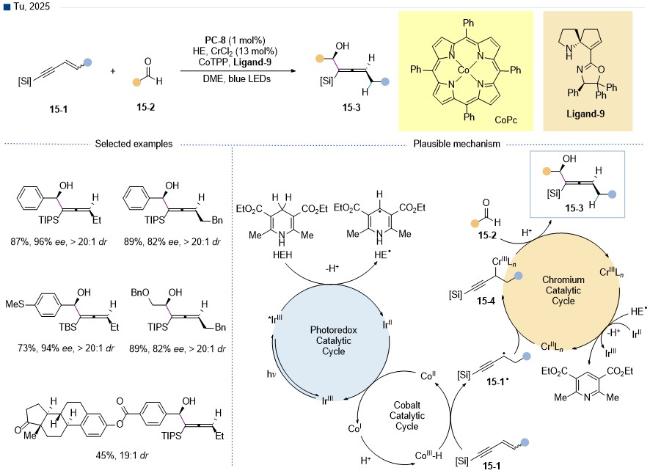
In 2025, Tu, Zhang, and co-workers[65] reported an elegant triple catalytic system integrating iridium photoredox, cobalt-hydride, and chiral chromium catalysis to achieve a highly selective 1,4-allenylation of aldehydes (Scheme 15). The protocol employs a custom-designed spirocyclic- pyrrolidine-oxazoline (SPD-oxazoline) ligand (Ligand-9) on chromium, enabling excellent enantioselectivity across a broad range of substrates. Mechanistic studies support a synergistic three-cycle pathway comprising distinct photoredox, cobalt-hydride, and chromium cycles. In the photoredox cycle, photoexcited *Ir(III) oxidizes a Hantzsch ester to generate radical and reduced Ir(II). Subsequent deprotonation and single-electron transfer yield a pyridinium species. Concurrently, Ir(II) serves as a reductant in both the cobalt and chromium cycles, reducing Co(II) to Co(I) and Cr(III) to Cr(II). Within the cobalt-hydride cycle, Co(I) is protonated to form a key Co(III)-H intermediate, which undergoes a metal-hydride hydrogen atom transfer (MHAT) with a 1,3-enyne (15-1), producing the pivotal propargyl radical while regenerating Co(II). This radical then enters the chiral chromium cycle, where it is captured by Cr(II) to form an enantiodefined propargylchromium (III) intermediate (15-4). This nucleophile adds to an aldehyde, and hydrolysis releases the chiral allene product along with Cr(III), which is finally reduced back to Cr(II) by Ir(II) to close the catalytic loop. This orchestrated integration of three catalytic manifolds demonstrates how radical generation (Co), stereocontrol (Cr and chiral ligands), and redox mediation (Ir) can be unified to enable a challenging, fully catalytic asymmetric transformation.
4 Dual photoredox/chromium-catalyzed alkylic radical involved transformations
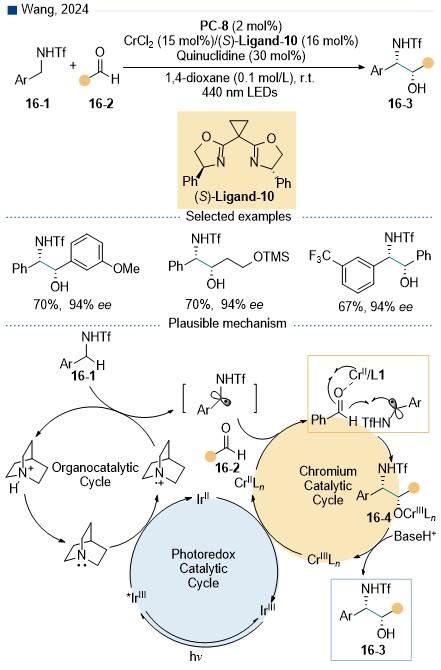
Alkylation extends beyond the established allylation and propargylation reaction series, particularly challenging due to the difficulty in activating normal, non-functionalized C—H bonds to form radicals and organometallic reactants.[66] In 2024, Wang and co-workers[67] achieved a significant advance in the asymmetric synthesis of chiral 1,2-amino alcohols via a dual photoredox/chromium catalysis strategy (Scheme 16). The authors innovatively employed quinuclidine as a hydrogen atom transfer (HAT) catalyst. More importantly, they extended stereocontrol beyond allylation and propargylation, demonstrating—for the first time in this catalytic system—highly enantioselective alkyl radical addition to aldehydes using a tailored chiral ligand. Mechanistic investigations support the following plausible pathway. Photoexcitation of an Ir(III) photocatalyst generates its excited state, which is reductively quenched by quinuclidine to produce Ir(II) and a quinuclidinium radical cation. This radical cation selectively abstracts a hydrogen atom from α-amino C—H bonds, forming an α-amino radical—a selectivity rationalized by DFT calculations. Unlike previously discussed radical-polar crossover mechanisms, their evidence suggests a distinct pathway: the α-amino radical adds directly to an aldehyde pre-coordinated with a chiral Cr(II) complex, forming intermediate 16-4. This direct addition bypasses the high-energy barrier associated with the twisted four-membered-ring transition state typical of radical capture by Cr(II). The authors computationally evaluated four possible transition states (to give (S,S), (S,R), (R,S), (R,R) stereoisomers respectively) for this addition to elucidate the stereochemical outcome, with experimental results aligning perfectly with theoretical predictions. Finally, an acid-base reaction between intermediate 16-4 and quinuclidine cleaves the Cr—O bond, releasing the chiral 1,2- amino alcohol product (16-3) and regenerating quinuclidine. The resulting Cr(III) species is reduced by Ir(II) back to active Cr(II), closing both catalytic cycles.


5 Conclusions and outlook
This review has chronicled the rapid evolution of dual photoredox/chromium catalysis as a powerful and sustainable platform for asymmetric synthesis. By merging light- driven radical generation with the stereochemical precision of chiral chromium complexes, this synergy has effectively addressed long-standing limitations of the classic Nozaki-Hiyama-Kishi reaction—namely, its stoichiometric chromium waste and narrow scope—ushering in a new era of efficient, redox-neutral asymmetric synthesis.
Looking forward, the field is poised for significant growth along several exciting trajectories. (1) Mechanistic depth: Advanced spectroscopic and computational studies will be crucial to fully elucidate reactive intermediates, particularly short-lived chromium species and radical- capture events, enabling more rational catalyst and ligand design. (2) Substrate and reaction blueprint expansion: Future work will likely focus on expanding the toolkit of radical precursors (e.g., from abundant feedstocks via C—H, C—O, or C—N activation) and electrophiles beyond aldehydes, while developing novel reaction manifolds such as desymmetrizations, annulations, and dearomative functionalizations. (3) Synthetic application and complexity: The ultimate test and promise of these methods lie in their application to the streamlined synthesis of complex targets. We anticipate their increasing use in the late-stage diversification of pharmaceuticals and the concise total synthesis of natural products, where precise, late-stage C—H functionalization is paramount. (4) Sustainability and catalyst design: Continued development of earth-abundant photocatalysts and the design of more robust, selective, and readily accessible chiral chromium ligands will enhance the sustainability and practical adoption of these methods.
In summary, the merger of photoredox and chromium catalysis has matured from a conceptual novelty into a robust and transformative synthetic paradigm. As mechanistic understanding deepens and the reaction portfolio broadens, this platform is set to become an indispensable tool for the concise and stereocontrolled assembly of molecular complexity, pushing the boundaries of sustainable asymmetric synthesis.
(Cheng, F.)