


1 Introduction
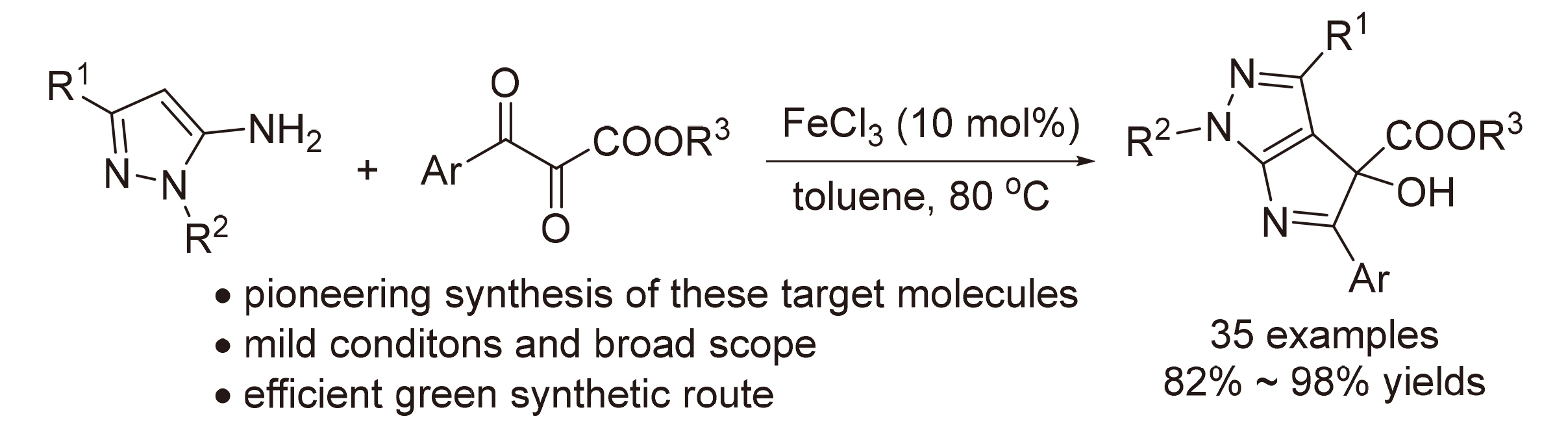
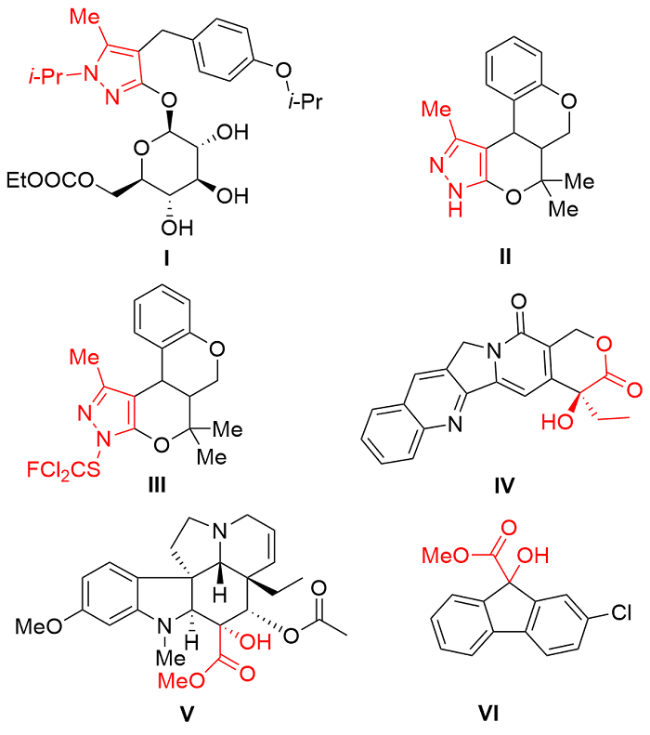
Pyrazole scaffolds and tertiary alcohol ester moieties are prevalent structural motifs in natural products and pharmaceuticals, underpinning their biological activities (Figure 1).[1] Consequently, the development of effective synthetic methods to construct small molecules bearing these units represents a high priority in organic chemistry. For example, Remogliflozin etabonate I[2] is an inhibitor of SGLT II for the treatment of type II diabetes. Both tetrahyopyrano[2,3-c]pyrazole II and its analogue III serve as fungicides.[3] Isolated from the seeds or root bark of the deciduous tree Camptotheca acuminata, camptothecin IV functions as a potent topoisomerase inhibitor.[4] Vindoline V, an alkaloid isolated from the leaves of Catharanthus roseus, acts as a weak inhibitor of tubulin polymerization, thereby disrupting microtubule dynamics.[5] Morphactin VI functions as a synthetic plant growth regulator by suppressing the biosynthesis of endogenous auxins.[6] Given the importance of both pyrazole scaffold and tertiary alcohol ester motifs, we envisioned developing a green and efficient method for the direct synthesis of compounds simultaneously incorporating these structural units. Our preliminary literature survey revealed that synthetic approaches to such hybrid compounds remain unexplored to date.[7] Therefore, designing and implementing an effective synthetic route for this class of molecules presents a significant challenge. As a continuation of our interest in the development of Lewis acids in constructing bioactive heterocycles,[8] herein we report an efficient green synthetic route for the construction of heterocyclic pyrazolone derivatives bearing pyrazole scaffolds and tertiary alcohol ester moieties with 5-aminopyrazole[9] and 2,3-diketo- ester[10] catalyzed by FeCl3.[11]
2 Results and discussion
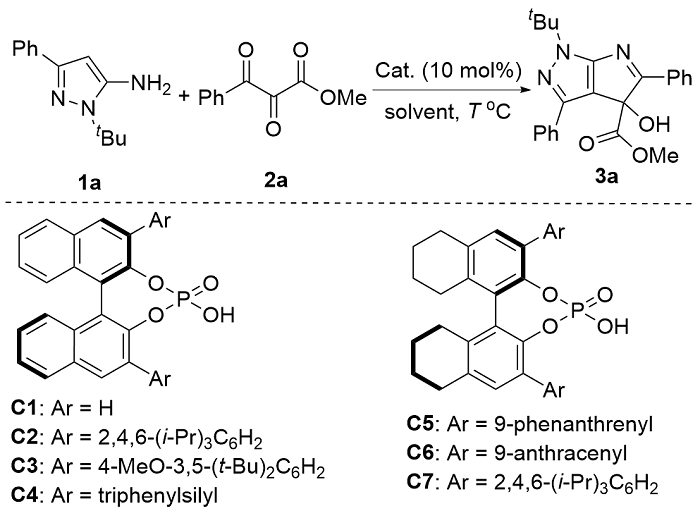
As shown in Table 1, to initiate our studies, 5-amino- pyrazole 1a and 2,3-diketoester 2a were chosen as model substrates to react in the presence of 10 mol% of C1 in dichloromethane (DCM) at room temperature. Gratifyingly, the heterocyclic compound 3a was obtained in 80% yield without ee (Table 1, Entry 1). Encouraged by the result, multiple chiral phosphoric acids were evaluated in an attempt to enhance the yield and ee (Entries 2~7). All the selected chiral phosphoric acids were effective in the reactions, and the results uncovered that C4 was optimal (Entry 4, 82% yield). Contrary to our expectations, enantioselectivity was completely absent (0%) in all reaction products. It may be due to low substrate-catalyst compatibility, failing to form an effective chiral environment. Additionally, in an effort to develop low-cost catalysts for yield improvement, a systematic screening and optimization of Lewis acid catalysts (Sc(OTf)3, Yb(OTf)3, ZnCl2) was performed. The reactions went smoothly, providing the target product 3a in 60%~82% yields (Entries 8~10). Next, we investigated the earth-abundant metal iron catalysts and found that FeCl3 displayed excellent catalytic performance, affording 3a in 84% yield (Entry 11). Subsequent screening of various organic solvents for FeCl3- catalyzed reactions revealed that toluene was superior, affording an 86% yield of 3a. In addition, by increasing the reaction temperature, product 3a was smoothly obtained (80 ℃, 95% yield) with a reaction time reduction from 24 h to 2 h. Subsequently, using acetic acid as the catalyst and toluene as the solvent, the reaction proceeded at 80 ℃ to afford the product in an excellent yield of 92%. Notably, substitution of toluene with water as the solvent enabled efficient reaction progression, delivering product 3a with a maintained yield of 86% (Table 1, Entry 18). Finally, the reaction did not proceed smoothly without ferric chloride as a catalyst (Table 1, Entry 19).
Table 1 Optimization of reaction conditionsa |
| Entry | Catalyst | Solvent | Time/h | T/℃ | Yield b/% | ee c/% |
|---|---|---|---|---|---|---|
| 1 | C1 | DCM | 36 | 25 | 80 | 0 |
| 2 | C2 | DCM | 36 | 25 | 69 | 0 |
| 3 | C3 | DCM | 36 | 25 | 74 | 0 |
| 4 | C4 | DCM | 36 | 25 | 82 | 0 |
| 5 | C5 | DCM | 36 | 25 | 71 | 0 |
| 6 | C6 | DCM | 36 | 25 | 77 | 0 |
| 7 | C7 | DCM | 36 | 25 | 64 | 0 |
| 8 | Sc(OTf)3 | DCM | 30 | 25 | 82 | — |
| 9 | Yb(OTf)3 | DCM | 30 | 25 | 76 | — |
| 10 | ZnCl2 | DCM | 30 | 25 | 60 | — |
| 11 | FeCl3 | DCM | 30 | 25 | 84 | — |
| 12 | FeCl3 | THF | 30 | 25 | 72 | — |
| 13 | FeCl3 | Chlorobenzene | 24 | 25 | 75 | — |
| 14 | FeCl3 | Toluene | 24 | 25 | 86 | — |
| 15 | FeCl3 | Toluene | 12 | 50 | 89 | — |
| 16 | FeCl3 | Toluene | 2 | 80 | 95 | — |
| 17 | CH3COOH | Toluene | 2 | 80 | 92 | — |
| 18 | FeCl3 | H2O | 6 | 80 | 86 | — |
| 19 | — | Toluene | 2 | 80 | 0 | — |
a Reaction conditions: 1a (0.10 mmol), 2a (0.12 mmol), Cat. (10 mol%), solvent (1.0 mL). b Isolated yields. c Determined by chiral HPLC analysis. |
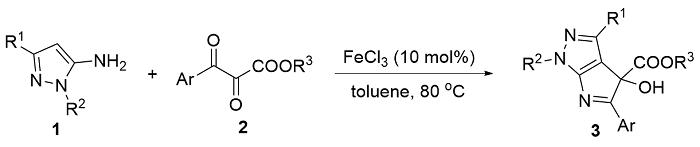
The substrate generality was systematically evaluated under the standardized conditions. The structure of 3a was confirmed by single-crystal X-ray diffraction analysis (Table 2), and the configurations of other products were assigned by analogy. A variety of 5-aminopyrazoles 1 were employed to test the generality of this Friedel-Craft-type alkylation/cyclization process (Table 2). Initially, 5-amino- pyrazole 1 with electron-donating groups such as methoxyl on the phenyl rings was evaluated, affording an excellent yield for product 3b (92%). Moreover, the introduction of electron-withdrawing groups such as F and Cl on the phenyl rings afforded the corresponding products 3c~3e in 88%~93% yields. 5-Aminopyrazole bearing hetero-aro- matic substituent could afford the desired products 3f~3g (89%~90% yields). In addition, various substituted aromatic rings on the nitrogen of 5-aminopyrazoles (electron-donating substituted phenyl ring or electron-with- drawing substituted phenyl ring) reacted with 2,3-diketo-ester 2a to afford the desired products 3h~3u in 86%~98% yields. Furthermore, the replacement of N-t-Bu with i-Pr or Bn of 3-phenyl-5-aminopyrazole has no influence on the outcome of the reaction, affording the corresponding products 3v~3w in good yields (87%~89%). Finally, the replacement of N—H with tert-butyl, benzyl, or 4-bromophenyl of 3-methyl-5-aminopyrazole afforded the corresponding products 3x~3z in good yields (82%~88%). Further examination of the substrate scope of 2,3-diketoesters 2 were conducted (Table 2). Firstly, 2,3-diketoesters 2 with electron-donating substituted phenyl ring or electron-withdrawing groups on the phenyl rings afforded the corresponding products 4a~4e in 84%~93% yields. The low yield of 4e may be due to the ortho effect of the starting material. 2,3-Diketoesters 2 bearing naphthyl or hetero-aromatic substituents could afford the desired products 4f~4h (85%~93% yields). Additionally, the conversion of the methyl ester to the ethyl ester proceeded smoothly, affording product 4i in excellent yield (94%).
Table 2 Substrate scope of 5-aminopyrazoles 1 and 2,3-diketoesters 2a |
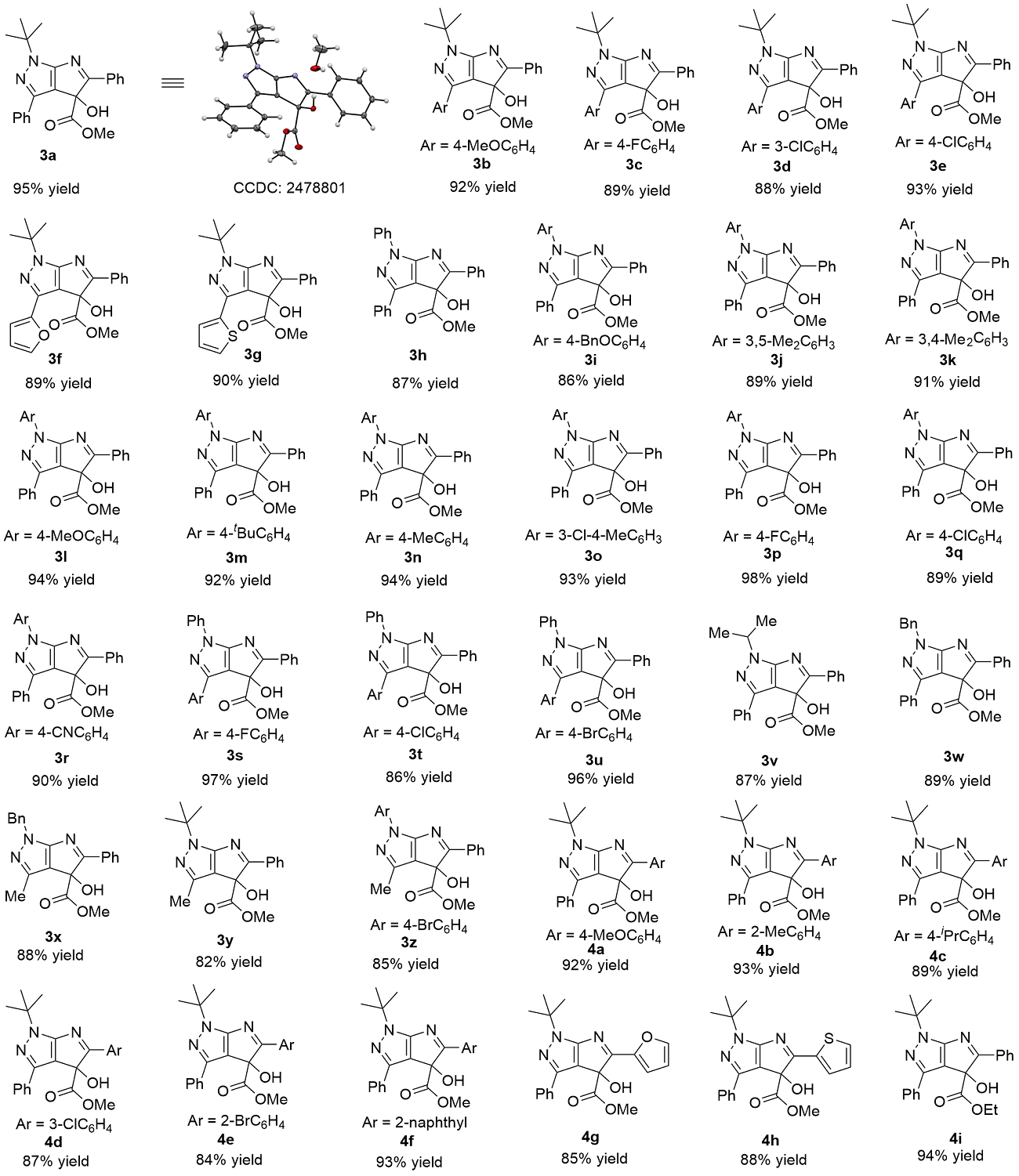 |
a Reaction conditions: 1 (0.10 mmol), 2 (0.12 mmol), FeCl3 (10 mol %), toluene (1.0 mL), 80 ℃. Isolated yields. |
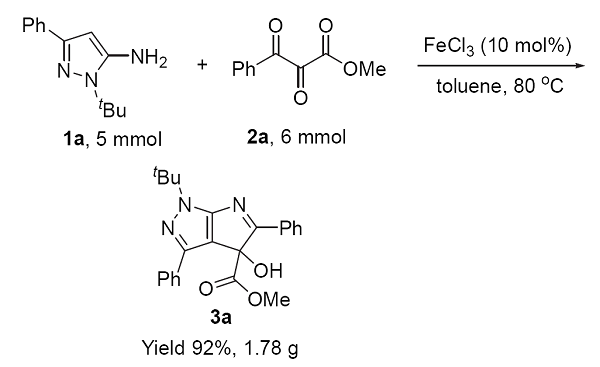
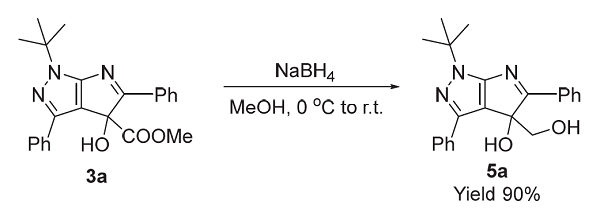
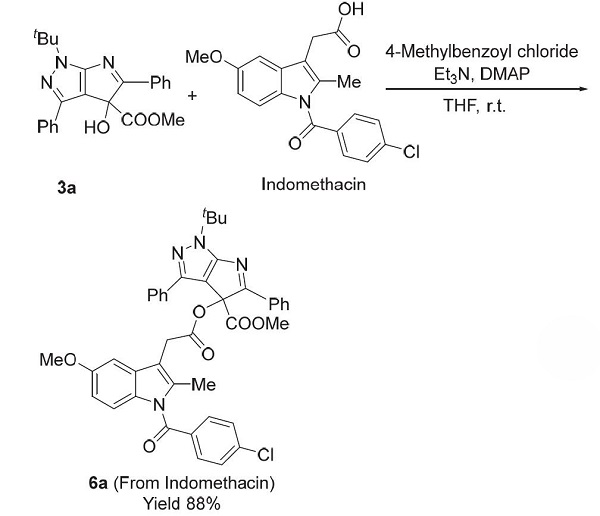
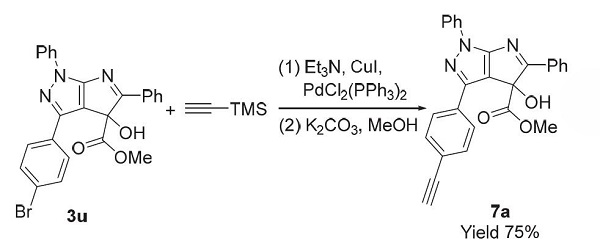
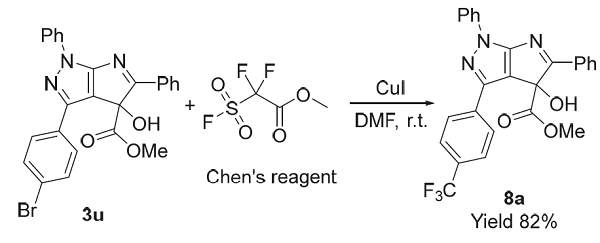
To illustrate the practicality of the established procedure, a gram-scale reaction of 2,3-diketoester 2a (6 mmol) with 5-aminopyrazole 1a (5 mmol) was conducted in the presence of 10 mol% FeCl3 as catalyst in toluene under 80 ℃ using an oil bath (Eq. 1). Fortunately, the reaction proceeded smoothly to afford 3a in 92% yield (1.78 g). Next, 3a could be easily transferred to 5a via reduction reaction with NaBH4 in 90% yield (Eq. 2). Moreover, the esterification reaction between 3a and indomethacin to afford the product 6a in 88% yield was performed, confirming the practical utility of product (Eq. 3). And then 3u could be easily transferred to 7a via Sonogashira coupling reaction in 75% yield (Eq. 4). Finally, using Chen Qingyun’s reagent, the bromine in bromobenzene was successfully replaced with a trifluoromethyl group, achieving an 82% yield of product 8a (Eq. 5).
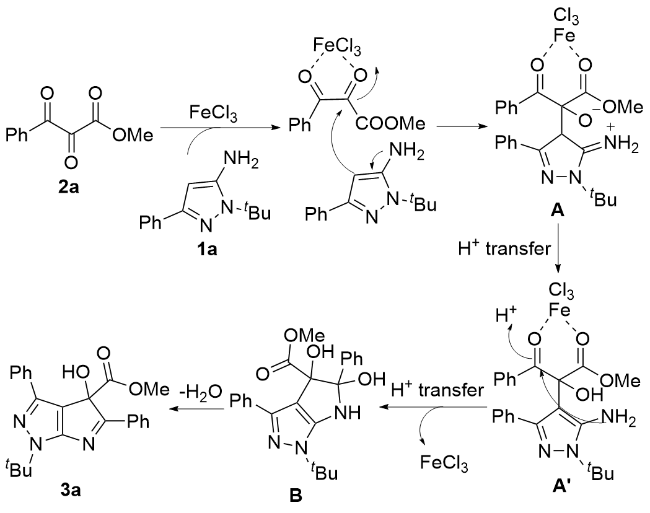
To elucidate the reaction process, a hypothetical mechanism was proposed as illustrated in Scheme 1. Firstly, ferric chloride coordinated with the carbonyl groups of substrate 2a to activate the substrate. Subsequently, 1a underwent a nucleophilic addition reaction with the carbonyl group of 2a, yielding intermediate A, which then underwent tautomerization to form A'. Following this, the intramolecular amino group of A' attacked the carbonyl group through proton migration to generate compound B, with the concomitant released of ferric chloride. Finally, compound B underwent dehydration upon heating to afford the target compound 3a.


3 Conclusions
In summary, a green synthetic approach has been developed for constructing heterocyclic compounds containing both pyrazole scaffolds and tertiary alcohol ester moieties by using FeCl3 catalysis in toluene. The method demonstrated broad substrate scope, high functional group tolerance and easy operation, achieving yields of 82%~98%. The high efficiency of this protocol under aqueous conditions highlights its environmental advantages while maintaining synthetic versatility for bioactive heterocycles. Furthermore, the amplification experiment and synthetic transformations of the adducts including modifications of marketed drugs further highlighted their practicalities.
4 Experimental section
4.1 General information
All reactions were performed in Schlenk tubes at room temperature using oven-dried glassware. Commercially obtained reagents were used without further purification, unless otherwise noted. Dry 1,2-dichloroethane (DCE) and tetrahydrofuran (THF) were obtained from solvent distillation machine (Vigor VSPS-5) and stored under argon over 4 Å type molecular sieves. Toluene was distilled freshly before use over sodium and benzophenone. Dichloromethane (DCM) was distilled from CaH2. Methanol and CHCl3 were used without further purification. The water used in this reaction is analytical-grade purified water. Reactions were checked by thin-layer chromatography (TLC) analysis and plates were visualized with short-wave UV light (254 nm). The 1H NMR, 13C NMR and 19F NMR spectra were obtained in DMSO-d6 using a Bruker-BioSpin AVANCE III HD NMR spectrometer at 400, 100 and 376 MHz, respectively. Chemical shifts are reported relative to the residual solvent peak. High-resolution mass spectra (HRMS) were recorded on a Bruker Impact II UHR TOF LC/MS mass spectrometry. Crystal structure data were collected on a SuperNova, Dual, Cu at zero, Atlas diffractometer.
4.2 Synthesis of compounds 1a~1z
According to existing synthetic literature [12], the detailed experimental procedures are as follows. Aryl formyl acetonitrile (1.0 equiv.) was dissolved into EtOH (0.3 mol/L relative to aryl formyl acetonitrile), then hydrazine monohydrochloride (2.0 equiv.) was added. The reaction was heated to reflux using an oil bath overnight until consumption of the aryl formyl acetonitrile (monitored by TLC). A saturated solution of NaHCO3 (aq.) was added and the aqueous phase was extracted with DCM (100 mL×3). The organic mixture was dried by Na2SO4 and concentrated under reduced pressure. The concentrate was purified by silica gel flash chromatography to afford 1a~1z.
4.3 Synthesis of compounds 2a~2h
According to existing synthetic literature [10b], the detailed experimental procedures are as follows. To a dried 100-mL round-bottom flask were added NaH (2.2 g, 56 mmol), dimethyl carbonate (3.6 g, 40 mmol) and toluene (20 mL) under nitrogen. After the mixture was heated to reflux using an oil bath, a solution of acetophenone (20 mmol) in toluene (10 mL) was added dropwise over 30 min. After the evolution of hydrogen ceased (15~20 min), the reaction was cooled down to room temperature. Glacial acetic acid (6 mL) was added dropwise and a heavy pasty solid separated. Ice-cold water was slowly added until the solid was dissolved completely. Then, the reaction system was dilute with 200 mL of EtOAc. The organic layer was separated, washed with water (20 mL) and brine (20 mL) and dried over Na2SO4. After the solvent was evaporated, the residue was purified by flash chromatography on silica gel with EtOAc/hexanes (V∶V=1∶3) as eluent to give the desired aryl β-ketoesters in 90%~100% yields. Aryl β-ketoesters (2.0 g, 11.1 mmol) were added to a solution of 2,2,6,6-tetramethylpiperidin-1-oxyl (TEMPO, 2.6 g, 16.6 mmol) in CH3CN (20.0 mL) at room temperature. and the mixture was stirred for 5 min. Subsequently, 2,3-dichloro- 5,6-dicyano-1,4-benzoquinone (DDQ, 3.8 g, 16.6 mmol) was added to the mixture, and stirring was continued under identical conditions until the reaction completion, as monitored by TLC. After the solvent was evaporated, the residue was purified by flash chromatography on silica gel to give the desired 2a~2h.
4.4 Synthesis of compounds 3 or 4
To an oven-dried 10 mL Schlenk tube equipped with a stir bar, FeCl3 (1.6 mg, 0.01 mmol, 10 mol%) and 1 (0.1 mmol, 1.0 equiv.) along with 2 (0.12 mmol, 1.2 equiv.) were added in toluene (1.0 mL) sequentially. The reaction mixture was stirred at 80 °C in an oil bath until substrate 1 was fully consumed (monitored by TLC, 2~6 h). The solution was directly purified by silica gel column chromato- graphy [V(PE)∶V(EtOAc)=10∶1~5∶1] to afford 3 or 4.
Methyl 1-(tert-butyl)-4-hydroxy-3,5-diphenyl-1,4-dihy- dropyrrolo[2,3-c]pyrazole-4-carboxylate (3a): Light yellow solid, 37.0 mg, 95% yield. m.p. 143.4~144.7 ℃; 1H NMR (400 MHz, DMSO-d6) δ: 8.13~8.07 (m, 2H), 7.92 (d, J=7.6 Hz, 2H), 7.58~7.53 (m, 3H), 7.44 (t, J=7.6 Hz, 2H), 7.33 (t, J=7.2 Hz, 1H), 7.26 (s, 1H), 3.48 (s, 3H), 1.77 (s, 9H); 13C NMR (100 MHz, DMSO-d6) δ: 182.1, 169.7, 160.3, 141.9, 132.3, 132.0, 131.3, 128.9, 128.6, 128.1, 127.9, 125.9, 116.2, 81.3, 59.8, 29.5; HRMS (ESI- TOF) calcd for C23H24N3O3 [M+H]+ 390.1812, found 390.1811.
Methyl 1-(tert-butyl)-4-hydroxy-3-(4-methoxyphenyl)- 5-phenyl-1,4-dihydropyrrolo[2,3-c]pyrazole-4-carboxylate (3b): Light yellow solid, 38.6 mg, 92% yield. m.p. 162.5~163.8 ℃; 1H NMR (400 MHz, DMSO-d6) δ: 8.06 (d, J=7.8 Hz, 2H), 7.82 (d, J=8.6 Hz, 2H), 7.54 (q, J=6.7, 6.3 Hz, 3H), 7.18 (s, 1H), 7.00 (d, J=8.7 Hz, 2H), 3.80 (s, 3H), 3.48 (s, 3H), 1.75 (s, 9H); 13C NMR (100 MHz, DMSO-d6) δ: 182.4, 170.2, 160.6, 159.6, 142.3, 132.4, 131.8, 129.4, 128.5, 127.7, 125.4, 115.9, 114.5, 81.6, 60.0, 55.6, 53.2, 30.0; HRMS (ESI-TOF) calcd for C24H26N3O4 [M+H]+ 420.1918, found 420.1911.
Methyl 1-(tert-butyl)-3-(4-fluorophenyl)-4-hydroxy-5- phenyl-1,4-dihydropyrrolo[2,3-c]pyrazole-4-carboxylate (3c). Light yellow solid, 36.3 mg, 89% yield. m.p. 73.4~75.0 ℃; 1H NMR (400 MHz, DMSO-d6) δ: 8.09~8.04 (m, 2H), 7.91 (dd, J=8.7, 5.6 Hz, 2H), 7.60~7.52 (m, 3H), 7.31~7.25 (m, 3H), 3.48 (s, 3H), 1.75 (s, 9H); 13C NMR (100 MHz, DMSO-d6) δ: 182.2, 169.6, 161.9 (d, 1JFC=243.3 Hz), 160.3, 140.9, 132.0, 131.2, 129.0, 128.9 (d, 2JFC=3.0 Hz),128.1, 127.9, 127.8, 115.9, 115.7, 115.5, 81.2, 59.8, 52.8, 29.5; 19F NMR (376 MHz, DMSO-d6) δ: –113.8; HRMS (ESI-TOF) calcd for C23H23FN3O3 [M+H]+ 408.1718, found 408.1751.
Methyl 1-(tert-butyl)-3-(3-chlorophenyl)-4-hydroxy-5- phenyl-1,4-dihydropyrrolo[2,3-c]pyrazole-4-carboxylate (3d): Light yellow solid, 37.3 mg, 88% yield. m.p. 94.3~96.0 ℃; 1H NMR (400 MHz, DMSO-d6) δ: 8.11~8.05 (m, 2H), 7.94~7.90 (m, 1H), 7.84 (d, J=7.8 Hz, 1H), 7.61~7.52 (m, 3H), 7.48 (t, J=7.9 Hz, 1H), 7.41~7.38 (m, 1H), 7.32 (s, 1H), 3.50 (s, 3H), 1.76 (s, 9H); 13C NMR (100 MHz, DMSO-d6) δ: 182.5, 169.5, 160.4, 140.5, 134.3, 133.5, 132.1, 131.1, 130.6, 129.0, 128.2, 127.8, 125.4, 124.4, 116.5, 81.2, 60.1, 52.8, 29.5; HRMS (ESI-TOF) calcd for C23H23ClN3O3 [M+H]+ 424.1422, found 424.1423.
Methyl 1-(tert-butyl)-3-(4-chlorophenyl)-4-hydroxy-5- phenyl-1,4-dihydropyrrolo[2,3-c]pyrazole-4-carboxylate (3e): Light yellow solid, 39.4 mg, 93% yield. m.p. 140.8~142.0 ℃; 1H NMR (400 MHz, DMSO-d6) δ: 8.09~8.04 (m, 2H), 7.89 (dd, J=10.2, 3.0 Hz, 2H), 7.60~7.51 (m, 5H), 7.30 (d, J=4.4 Hz, 1H), 3.49 (s, 3H), 1.76 (s, 9H); 13C NMR (100 MHz, DMSO~d6) δ: 182.3, 169.6, 160.4, 140.7, 132.5, 132.1, 131.2, 129.0, 128.7, 128.2, 127.5, 116.3, 81.2, 60.0, 52.8, 29.5; HRMS (ESI-TOF) calcd for C23H23ClN3O3 [M+H]+ 424.1422, found 424.1418.
Methyl 1-(tert-butyl)-3-(furan-2-yl)-4-hydroxy-5-phen- yl-1,4-dihydropyrrolo[2,3-c]pyrazole-4-carboxylate (3f): Light yellow solid, 33.8 mg, 89% yield. m.p. 151.5~153.0 ℃; 1H NMR (400 MHz, DMSO-d6) δ: 8.05 (dd, J=8.1, 1.5 Hz, 2H), 7.72 (dd, J=1.7, 0.7 Hz, 1H), 7.59~7.51 (m, 3H), 7.12 (s, 1H), 6.71 (dd, J=3.3, 0.7 Hz, 1H), 6.61 (dd, J=3.3, 1.8 Hz, 1H), 3.53 (s, 3H), 1.73 (s, 9H); 13C NMR (100 MHz, DMSO-d6) δ: 182.5, 169.6, 159.9, 147.2, 142.7, 134.1, 132.1, 131.1, 129.0, 128.2, 115.2, 111.6, 108.5, 80.9, 59.9, 52.8, 29.5; HRMS (ESI-TOF) calcd for C21H22N3O4 [M+H]+ 380.1605, found 380.1598.
Methyl 1-(tert-butyl)-4-hydroxy-5-phenyl-3-(thiophen- 2-yl)-1,4-dihydropyrrolo[2,3-c]pyrazole-4-carboxylate (3g): Light yellow solid, 35.6 mg, 90% yield. m.p. 79.1~80.3 ℃; 1H NMR (400 MHz, DMSO-d6) δ: 8.07~8.02 (m, 2H), 7.60~7.51 (m, 3H), 7.49 (dd, J=5.0, 1.0 Hz, 1H), 7.40 (dd, J=3.5, 1.0 Hz, 1H), 7.18 (s, 1H), 7.14 (dd, J=5.0, 3.6 Hz, 1H), 3.52 (s, 3H), 1.72 (s, 9H); 13C NMR (100 MHz, DMSO-d6) δ: 182.4, 169.6, 160.0, 137.6, 135.2, 132.1, 131.1, 129.0, 128.2, 127.7, 126.2, 125.5, 115.1, 81.0, 59.8, 52.8, 29.5; HRMS (ESI-TOF) calcd for C21H22N3O3S [M+H]+ 396.1376, found 396.1375.
Methyl 4-hydroxy-1,3,5-triphenyl-1,4-dihydropyrrolo- [2,3-c]pyrazole-4-carboxylate (3h): Light yellow solid, 35.6 mg, 87% yield. m.p. 190.1~191.2 ℃; 1H NMR (400 MHz, DMSO-d6) δ: 8.28~8.19 (m, 4H), 8.11~8.02 (m, 2H), 7.66~7.58 (m, 5H), 7.58~7.49 (m, 3H), 7.45~7.40 (m, 2H), 3.52 (s, 3H). 13C NMR (100 MHz, Chloroform-d) δ 184.8, 169.2, 144.7, 138.3, 132.7, 131.3, 130.9, 129.8, 129.1, 128.9, 128.5, 126.8, 126.3, 119.1, 118.0, 81.9, 53.0; HRMS (ESI-TOF) calcd for C25H20N3O3 [M+H]+ 410.1499, found 410.1494.
Methyl 1-(4-(benzyloxy)phenyl)-4-hydroxy-3,5-di- phenyl-1,4-dihydropyrrolo[2,3-c]pyrazole-4-carboxylate (3i): Light yellow solid, 44.3 mg, 86% yield. m.p. 189.4~190.6 ℃; 1H NMR (400 MHz, DMSO-d6) δ: 8.18~8.13 (m, 2H), 8.13~8.08 (m, 2H), 8.00~7.96 (m, 2H), 7.64~7.56 (m, 3H), 7.50 (t, J=8.3 Hz, 4H), 7.46~7.39 (m, 4H), 7.38~7.34 (m, 1H), 7.29~7.25 (m, 2H), 5.21 (s, 2H), 3.50 (s, 3H); 13C NMR (100 MHz, DMSO-d6) δ: 184.5, 169.3, 159.9, 157.0, 144.2, 136.8, 132.6, 131.8, 131.4, 130.9, 129.1, 128.8, 128.7, 128.5, 128.4, 128.0, 127.8, 126.2, 120.7, 117.4, 115.7, 81.9, 69.6, 52.9; HRMS (ESI-TOF) calcd for C32H26N3O4 [M+H]+ 516.1918, found 516.1913.
Methyl 1-(3,5-dimethylphenyl)-4-hydroxy-3,5-diphenyl- 1,4-dihydropyrrolo[2,3-c]pyrazole-4-carboxylate (3j): Li- ght yellow solid, 38.9 mg, 89% yield. m.p. 125.5~127.4 ℃; 1H NMR (400 MHz, DMSO-d6) δ: 8.06~8.02 (m, 2H), 7.95~7.92 (m, 2H), 7.59~7.44 (m, 6H), 7.43~7.34 (m, 2H), 7.30 (s, 1H), 7.24 (d, J=8.1 Hz, 1H), 3.52 (s, 3H), 2.40 (s, 3H), 2.29 (s, 3H); 13C NMR (100 MHz, DMSO-d6) δ: 169.5, 144.4, 138.7, 134.4, 133.3, 132.4, 131.8, 131.7, 131.0, 129.0, 128.8, 128.5, 128.3, 127.3, 126.4, 126.1, 115.8, 82.6, 52.9, 20.7, 17.8; HRMS (ESI- TOF) calcd for C27H24N3O3 [M+H]+ 438.1812, found 438.1808.
Methyl 1-(3,4-dimethylphenyl)-4-hydroxy-3,5-diphenyl- 1,4-dihydropyrrolo[2,3-c]pyrazole-4-carboxylate (3k): Li- ght yellow solid, 39.8 mg, 91% yield. m.p. 130.7~132.1 ℃; 1H NMR (400 MHz, DMSO-d6) δ: 8.18~8.13 (m, 2H), 8.02~7.96 (m, 3H), 7.92 (dd, J=8.1, 2.2 Hz, 1H), 7.65~7.56 (m, 3H), 7.52~7.45 (m, 3H), 7.39 (dd, J=17.4, 7.8 Hz, 2H), 3.50 (s, 3H), 2.38 (s, 3H), 2.30 (s, 3H); 13C NMR (100 MHz, DMSO-d6) δ: 184.5, 169.3, 160.2, 144.3, 137.8, 136.2, 130.5, 129.2, 128.9, 128.5, 126.3, 120.1, 117.6, 116.6, 81.8, 53.0, 19.8, 19.0; HRMS (ESI-TOF) calcd for C27H24N3O3 [M+H]+ 438.1812, found 438.1810.
Methyl 4-hydroxy-1-(4-methoxyphenyl)-3,5-diphenyl- 1,4-dihydropyrrolo[2,3-c]pyrazole-4-carboxylate (3l): Li- ght yellow solid, 41.3 mg, 94% yield. m.p. 194.6~195.1 ℃; 1H NMR (400 MHz, DMSO-d6) δ: 8.16 (d, J=7.4 Hz, 2H), 8.11 (d, J=8.8 Hz, 2H), 7.99 (d, J=7.6 Hz, 2H), 7.64~7.56 (m, 3H), 7.50 (t, J=7.5 Hz, 3H), 7.43~7.38 (m, 1H), 7.19 (d, J=9.1 Hz, 2H), 3.85 (s, 3H), 3.51 (s, 3H); 13C NMR (100 MHz, DMSO-d6) δ: 184.9, 169.8, 160.4, 158.5, 144.7, 133.0, 132.1, 131.9, 131.4, 129.6, 129.3, 128.9, 126.7, 121.2, 117.9, 115.3, 82.4, 55.9, 53.4; HRMS (ESI-TOF) calcd for C26H22N3O4 [M+H]+ 440.1605, found 440.1600.
Methyl 1-(4-(tert-butyl)phenyl)-4-hydroxy-3,5-diphen- yl-1,4-dihydropyrrolo[2,3-c]pyrazole-4-carboxylate (3m): Light yellow solid, 42.8 mg, 92% yield. m.p. 214.7~216.4 ℃; 1H NMR (400 MHz, DMSO-d6) δ: 8.16 (d, J=6.9 Hz, 2H), 8.10 (d, J=8.7 Hz, 2H), 7.99 (d, J=7.4 Hz, 2H), 7.66~7.57 (m, 5H), 7.53~7.47 (m, 3H), 7.42 (d, J=7.3 Hz, 1H), 3.50 (s, 3H), 1.36 (s, 9H); 13C NMR (100 MHz, DMSO-d6) δ: 184.6, 169.3, 160.3, 149.5, 144.5, 135.8, 132.6, 131.4, 130.9, 129.1, 128.9, 128.4, 126.4, 126.2, 119.1, 117.6, 81.9, 53.0, 34.4, 31.1; HRMS (ESI- TOF) calcd for C29H28N3O3 [M+H]+ 466.2125, found 466.2118.
Methyl 4-hydroxy-3,5-diphenyl-1-(p-tolyl)-1,4-dihydro- pyrrolo[2,3-c]pyrazole-4-carboxylate (3n): Light yellow solid, 39.8 mg, 94% yield. m.p. 209.4~210.1 ℃; 1H NMR (400 MHz, DMSO-d6) δ: 8.17 (dd, J=7.8, 1.1 Hz, 2H), 8.10 (d, J=8.4 Hz, 2H), 8.02~7.98 (m, 2H), 7.66~7.57 (m, 3H), 7.50 (t, J=7.2 Hz, 2H), 7.47 (s, 1H), 7.43 (dd, J=7.2, 3.3 Hz, 3H), 3.51 (s, 3H), 2.40 (s, 3H); 13C NMR (100 MHz, DMSO-d6) δ: 184.6, 169.2, 160.2, 144.4, 136.2, 132.6, 131.4, 130.9, 130.1, 129.1, 128.8, 128.8, 128.4, 126.3, 119.0, 117.7, 81.8, 53.0, 20.6; HRMS (ESI-TOF) calcd for C26H22N3O3 [M+H]+ 424.1656, found 424.1648.
Methyl 1-(3-chloro-4-methylphenyl)-4-hydroxy-3,5-di- phenyl-1,4-dihydropyrrolo[2,3-c]pyrazole-4-carboxylate (3o): Light yellow solid, 42.6 mg, 93% yield. m.p. 195.0~196.8 ℃; 1H NMR (400 MHz, DMSO-d6) δ: 8.23 (d, J=2.2 Hz, 1H), 8.18 (s, 1H), 8.16 (d, J=1.6 Hz, 1H), 8.14 (dd, J=8.3, 2.2 Hz, 1H), 8.02~7.99 (m, 2H), 7.65~7.58 (m, 4H), 7.54~7.49 (m, 3H), 7.45~7.40 (m, 1H), 3.51 (s, 3H), 2.41 (s, 3H); 13C NMR (100 MHz, DMSO-d6) δ: 185.2, 169.1, 160.4, 145.0, 137.2, 134.1, 133.9, 132.9, 132.3, 131.1, 130.8, 129.2, 128.9, 128.5, 126.4, 118.9, 118.1, 117.5, 81.9, 53.1, 19.2; HRMS (ESI-TOF) calcd for C26H21ClN3O3 [M+H]+ 458.1266, found 458.1259.
Methyl 1-(4-fluorophenyl)-4-hydroxy-3,5-diphenyl-1,4- dihydropyrrolo[2,3-c]pyrazole-4-carboxylate (3p): Light yellow solid, 41.9 mg, 98% yield. m.p. 145.4~147.1 ℃; 1H NMR (400 MHz, DMSO-d6) δ: 8.26 (dd, J=8.7, 4.4 Hz, 2H), 8.19 (d, J=6.9 Hz, 2H), 8.02~8.00 (m, 2H), 7.67~7.57 (m, 3H), 7.57~7.45 (m, 5H), 7.42 (t, J=7.3 Hz, 1H), 3.51 (s, 3H); 13C NMR (100 MHz, DMSO-d6) δ: 185.0, 169.2, 160.5 (t, 1JFC=242.4 Hz), 144.8, 134.7 (d, 2JFC=2.6 Hz), 132.8, 131.2, 130.9, 129.2, 128.9 (d, 3JFC=4.5 Hz), 128.9, 126.3, 121.2, 121.1, 117.8, 116.7, 116.5, 82.0, 53.0; 19F NMR (376 MHz, DMSO-d6) δ: –115.34; HRMS (ESI-TOF) calcd for C25H19FN3O3 [M+H]+ 428.1405, found 428.1400.
Methyl 1-(4-chlorophenyl)-4-hydroxy-3,5-diphenyl-1,4- dihydropyrrolo[2,3-c]pyrazole-4-carboxylate (3q): Light yellow solid, 39.5 mg, 89% yield. m.p. 141.4~143.0 ℃; 1H NMR (400 MHz, DMSO-d6) δ: 8.16 (d, J=7.43 Hz, 2H), 8.11 (d, J=8.86 Hz, 2H), 7.99 (d, J=7.64 Hz, 2H), 7.64~7.57 (m, 3H), 7.50 (t, J=7.52 Hz, 3H), 7.42~7.38 (m, 1H), 7.21~7.17 (m, 2H), 3.85 (s, 3H); 13C NMR (100 MHz, DMSO-d6) δ: 184.6, 169.3, 160.2, 147.2, 144.5, 136.2, 132.6, 131.4, 130.9, 129.1, 128.9, 128.4, 127.5, 126.2, 119.4, 117.6, 81.9, 53.0, 33.1, 23.8; HRMS (ESI-TOF) calcd for C25H19ClN3O3 [M+H]+ 444.1109, found 444.1110.
Methyl 3-(4-chlorophenyl)-4-hydroxy-1,5-diphenyl-1,4- dihydropyrrolo[2,3-c]pyrazole-4-carboxylate (3r): Light yellow solid, 39.1 mg, 90% yield. m.p. 131.8~132.0 ℃; 1H NMR (400 MHz, DMSO-d6) δ: 8.22 (d, J=7.7 Hz, 2H), 8.20~8.13 (m, 2H), 8.01 (d, J=8.5 Hz, 2H), 7.68~7.54 (m, 8H), 7.42 (t, J=7.4 Hz, 1H), 3.52 (s, 3H); 13C NMR (100 MHz, DMSO-d6) δ: 185.0, 169.1, 160.5, 143.5, 138.1, 133.5, 132.8, 130.8, 130.2, 129.8, 129.2, 129.0, 128.5, 128.0, 127.0, 119.2, 117.9, 81.8, 53.1; HRMS (ESI-TOF) calcd for C26H19N4O3 [M+H]+ 435.1452, found 435.1450.
Methyl 3-(4-fluorophenyl)-4-hydroxy-1,5-diphenyl-1,4- dihydropyrrolo[2,3-c]pyrazole-4-carboxylate (3s): Light yellow solid, 41.5 mg, 97% yield. m.p. 186.3~187.4 ℃; 1H NMR (400 MHz, DMSO-d6) δ: 8.23 (d, J=8.0 Hz, 2H), 8.18 (d, J=7.1 Hz, 2H), 8.05 (dd, J=8.3, 5.6 Hz, 2H), 7.62 (dt, J=14.0, 7.4 Hz, 5H), 7.55 (s, 1H), 7.39 (dt, J=17.7, 8.1 Hz, 3H), 3.52 (s, 3H); 13C NMR (100 MHz, DMSO-d6) δ: 184.9, 169.2, 163.7, 162.5 (d, 1JFC=244.6 Hz), 160.4, 143.7, 138.2, 132.7, 130.9, 129.8, 129.2, 128.4 (t, 2JFC=14.8 Hz), 127.9 (d, 3JFC=2.9 Hz), 126.9, 119.1, 117.6, 116.0, 115.8, 81.8, 53.0; 19F NMR (376 MHz, DMSO-d6) δ: –112.4; HRMS (ESI-TOF) calcd for C25H19FN3O3 [M+H]+ 428.1405, found 428.1399.
Methyl 3-(4-chlorophenyl)-4-hydroxy-1,5-diphenyl-1,4- dihydropyrrolo[2,3-c]pyrazole-4-carboxylate (3t): Light yellow solid, 38.2 mg, 86% yield. m.p. 173.3~175.4 ℃; 1H NMR (400 MHz, DMSO-d6) δ: 8.24~8.15 (m, 4H), 8.01 (d, J=8.5 Hz, 2H), 7.66~7.54 (m, 8H), 7.42 (t, J=7.4 Hz, 1H), 3.52 (s, 3H); 13C NMR (100 MHz, DMSO-d6) δ: 185.0, 169.1, 160.5, 143.5, 138.1, 133.5, 132.8, 130.8, 130.2, 129.8, 129.2, 129.0, 128.5, 128.0, 127.0, 119.2, 117.9, 81.8, 53.1; HRMS (ESI-TOF) calcd for C25H19Cl- N3O3 [M+H]+ 444.1109, found 444.1104.
Methyl 3-(4-bromophenyl)-4-hydroxy-1,5-diphenyl-1,4- dihydropyrrolo[3-c]pyrazole-4-carboxylate (3u): Light yellow solid, 46.9 mg, 96% yield. m.p. 211.5~213.0 ℃; 1H NMR (400 MHz, DMSO-d6) δ: 8.22 (d, J=8.0 Hz, 2H), 8.17 (d, J=7.2 Hz, 2H), 7.94 (d, J=8.4 Hz, 2H), 7.73 (d, J=8.4 Hz, 2H), 7.69~7.57 (m, 5H), 7.56 (s, 1H), 7.42 (t, J=7.4 Hz, 1H), 3.51 (s, 3H); 13C NMR (100 MHz, DMSO-d6) δ: 185.0, 169.0, 160.5, 143.6, 138.1, 132.8, 131.9, 130.8, 130.5, 129.8, 129.2, 128.5, 128.2, 127.0, 122.2, 119.2, 117.9, 81.8, 53.1; HRMS (ESI-TOF) calcd for C25H19BrN3O3 [M+H]+ 488.0604, found 488.0598.
Methyl 4-hydroxy-1-isopropyl-3,5-diphenyl-1,4-dihy- dropyrrolo[2,3-c]pyrazole-4-carboxylate (3v): Light yellow solid, 32.7 mg, 87% yield. m.p. 192.1~193.9 ℃; 1H NMR (400 MHz, DMSO-d6) δ: 8.06 (d, J=6.9 Hz, 2H), 7.86 (d, J=7.4 Hz, 2H), 7.60~7.52 (m, 3H), 7.43 (t, J=7.6 Hz, 2H), 7.33 (t, J=7.3 Hz, 1H), 7.26 (s, 1H), 4.79 (p, J=6.7 Hz, 1H), 3.47 (s, 3H), 1.60 (dd, J=6.6, 2.5 Hz, 6H); 13C NMR (100 MHz, DMSO-d6) δ: 182.9, 169.7, 160.2, 142.9, 132.2, 132.1, 131.2, 129.0, 128.6, 128.1, 128.0, 125.9, 115.3, 81.8, 52.8, 51.7, 22.4; HRMS (ESI- TOF) calcd for C22H22N3O3 [M+H]+ 376.1656, found 376.1650.
Methyl 1-benzyl-4-hydroxy-3,5-diphenyl-1,4-dihydro- pyrrolo[2,3-c]pyrazole-4-carboxylate (3w): Light yellow solid, 37.7 mg, 89% yield. m.p. 131.5~133.2 ℃; 1H NMR (400 MHz, DMSO-d6) δ: 8.11~8.06 (m, 2H), 7.87 (d, J=7.3 Hz, 2H), 7.62~7.53 (m, 3H), 7.46~7.38 (m, 6H), 7.36~7.29 (m, 3H), 5.53 (q, J=15.4 Hz, 2H), 3.48 (s, 3H); 13C NMR (100 MHz, DMSO-d6) δ: 183.8, 169.5, 161.5, 136.8, 132.3, 131.9, 131.1, 129.0, 128.7, 128.2, 127.8, 127.7, 125.9, 115.3, 82.7, 52.8, 52.1; HRMS (ESI-TOF) calcd for C26H22N3O3 [M+H]+ 424.1656, found 424.1649.
Methyl 1-benzyl-4-hydroxy-3-methyl-5-phenyl-1,4-dihydropyrrolo[2,3-c]pyrazole-4-carboxylate (3x): Light yellow solid, 31.8 mg, 88% yield. m.p. 159.0~161.2 ℃; 1H NMR (400 MHz, DMSO-d6) δ: 8.04 (d, J=7.4 Hz, 2H), 7.60~7.56 (m, 2H), 7.42 (t, J=7.7 Hz, 2H), 7.30 ~7.27 (m, 2H), 7.25~7.21 (m, 1H), 7.00 (d, J=7.1 Hz, 2H), 5.11~4.98 (m, 2H), 3.73 (s, 3H), 1.75 (s, 3H); 13C NMR (100 MHz, DMSO-d6) δ: 195.2, 172.0, 144.6, 144.0, 138.0, 133.7, 133.2, 129.8, 128.3, 128.1, 126.9, 126.7, 96.4, 82.5, 52.4, 13.7; HRMS (ESI-TOF) calcd for C21H20N3O3 [M+H]+ 362.1499, found 362.1491.
Methyl 1-(tert-butyl)-4-hydroxy-3-methyl-5-phenyl-1,4- dihydropyrrolo[2,3-c]pyrazole-4-carboxylate (3y): Light yellow solid, 26.8 mg, 82% yield. m.p. 176.3~177.7 ℃; 1H NMR (400 MHz, DMSO-d6) δ: 7.99~7.97 (m, 1H), 7.96 (d, J=1.7 Hz, 1H), 7.63~7.37 (m, 4H), 3.56 (s, 3H), 2.12 (s, 3H), 1.65 (s, 9H); 13C NMR (100 MHz, DMSO-d6) δ: 181.7, 170.6, 159.2, 139.0, 131.7, 131.4, 128.8, 128.2, 117.0, 80.3, 59.0, 52.6, 29.6, 12.8; HRMS (ESI-TOF) calcd for C18H22N3O3 [M+H]+ 328.1656, found 328.1651.
Methyl 1-(4-bromophenyl)-4-hydroxy-3-methyl-5- phenyl-1,4-dihydropyrrolo[2,3-c]pyrazole-4-carboxylate (3z): Light yellow solid, 36.2 mg, 85% yield. m.p. 176.3~177.7 ℃; 1H NMR (400 MHz, DMSO-d6) δ: 8.10~8.02 (m, 4H), 7.78~7.73 (m, 2H), 7.63~7.54 (m, 3H), 7.43 (s, 1H), 3.59 (s, 3H), 2.24 (s, 3H); 13C NMR (100 MHz, DMSO-d6) δ: 184.7, 169.8, 159.5, 137.5, 130.9, 129.0, 128.5, 120.4, 119.3, 118.5, 81.0, 52.9, 12.8; HRMS (ESI- TOF) calcd for C20H17BrN3O3 [M+H]+ 426.0448, found 426.0440.
Methyl 1-(tert-butyl)-4-hydroxy-5-(4-methoxyphenyl)- 3-phenyl-1,4-dihydropyrrolo[2,3-c]pyrazole-4-carboxylate (4a): Light yellow solid, 38.6 mg, 92% yield. m.p. 170.1~171.1 ℃; 1H NMR (400 MHz, DMSO-d6) δ: 8.05 (d, J=8.9 Hz, 2H), 7.89 (d, J=7.5 Hz, 2H), 7.43 (t, J=7.5 Hz, 2H), 7.32 (t, J=7.3 Hz, 1H), 7.18 (s, 1H), 7.11 (d, J=8.8 Hz, 2H), 3.86 (s, 3H), 3.48 (s, 3H), 1.76 (s, 9H); 13C NMR (100 MHz, DMSO-d6) δ: 181.8, 169.9, 162.3, 160.7, 141.7, 132.5, 130.1, 128.6, 127.8, 125.9, 123.9, 115.8, 114.5, 81.1, 59.6, 55.5, 52.7, 29.5; HRMS (ESI-TOF) calcd for C24H26N3O4 [M+H]+ 420.1918, found 420.1909.
Methyl 1-(tert-butyl)-4-hydroxy-3-phenyl-5-(o-tolyl)- 1,4-dihydropyrrolo[2,3-c]pyrazole-4-carboxylate (4b): Li- ght yellow solid, 37.5 mg, 93% yield). m.p. 133.7~135.6 ℃; 1H NMR (400 MHz, DMSO-d6) δ: 7.88 (d, J=7.0 Hz, 3H), 7.44~7.39 (m, 4H), 7.33 (dt, J=14.3, 7.4 Hz, 2H), 7.20~7.17 (m, 1H), 3.47 (s, 3H), 2.68 (s, 3H), 1.75 (s, 9H); 13C NMR (100 MHz, DMSO-d6) δ: 182.8, 169.8, 160.5, 141.8, 139.9, 132.4, 132.3, 130.8, 130.1, 130.0, 128.6, 127.9, 125.9, 115.2, 82.7, 59.6, 52.7, 23.5; HRMS (ESI-TOF) calcd for C24H26N3O3 [M+H]+ 404.1969, found 404.1963.
Methyl 1-(tert-butyl)-4-hydroxy-5-(4-isopropylphenyl)- 3-phenyl-1,4-dihydropyrrolo[2,3-c] pyrazole-4-carboxylate (4c): Light yellow solid, 38.4 mg, 89% yield. m.p. 165.6~166.4 ℃; 1H NMR (400 MHz, DMSO-d6) δ: 7.99 (d, J=7.8 Hz, 2H), 7.88 (d, J=7.4 Hz, 2H), 7.43 (t, J=7.2 Hz, 4H), 7.32 (t, J=7.3 Hz, 1H), 7.17 (s, 1H), 3.48 (s, 3H), 2.96 (p, J=6.9 Hz, 1H), 1.75 (s, 9H), 1.24 (d, J=6.9 Hz, 6H); 13C NMR (100 MHz, DMSO-d6) δ: 182.2, 169.8, 160.5, 152.8, 141.8, 132.4, 129.0, 128.6, 128.3, 127.9, 126.9, 125.9, 116.0, 81.2, 59.7, 52.7, 33.6, 23.5; HRMS (ESI-TOF) calcd for C26H30N3O3 [M+H]+ 432.2282, found 432.2274.
Methyl 1-(tert-butyl)-5-(3-chlorophenyl)-4-hydroxy-3- phenyl-1,4-dihydropyrrolo[2,3-c]pyrazole-4-carboxylate (4d): Light yellow solid, 36.9 mg, 87% yield. m.p. 156.3~158.2 ℃; 1H NMR (400 MHz, DMSO-d6) δ: 8.06 (t, J=1.7 Hz, 1H), 8.00 (dt, J=7.7, 1.1 Hz, 1H), 7.89~7.86 (m, 2H), 7.66 (ddd, J=8.0, 2.0, 1.0 Hz, 1H), 7.59 (t, J=7.8 Hz, 1H), 7.43 (t, J=7.4 Hz, 2H), 7.36 (s, 1H), 7.35~7.31 (m, 1H), 3.49 (s, 3H), 1.75 (s, 9H); 13C NMR (100 MHz, DMSO-d6) δ: 180.5, 169.4, 159.8, 142.0, 133.7, 133.1, 132.1, 131.7, 131.0, 128.6, 128.0, 127.2, 126.6, 125.9, 116.4, 81.3, 60.0, 52.9, 29.5; HRMS (ESI-TOF) calcd for C23H23ClN3O3 [M+H]+ 424.1422, found 424.1423.
Methyl 5-(2-bromophenyl)-1-(tert-butyl)-4-hydroxy-3- phenyl-1,4-dihydropyrrolo[2,3-c]pyrazole-4-carboxylate (4e): Light yellow solid, 39.3 mg, 84% yield. m.p. 57.2~54.6 ℃; 1H NMR (400 MHz, DMSO-d6) δ: 7.89 (dd, J=7.8, 1.6 Hz, 1H), 7.87~7.83 (m, 3H), 7.54 (td, J=6.4, 1.1 Hz, 1H), 7.46~7.40 (m, 3H), 7.36~7.31 (m, 1H), 7.30 (s, 1H), 3.50 (s, 3H), 1.75 (s, 9H); 13C NMR (100 MHz, Chloroform-d) δ: 180.3, 169.1, 159.8, 142.0, 135.1, 132.2, 132.0, 131.4, 130.8, 128.6, 128.0, 127.6, 125.8, 122.0, 115.6, 83.1, 59.8, 52.8, 29.5; HRMS (ESI-TOF) calcd for C23H23BrN3O3 [M+H]+ 468.0917, found 468.0913.
Methyl 1-(tert-butyl)-4-hydroxy-5-(naphthalen-2-yl)-3- phenyl-1,4-dihydropyrrolo[2,3-c]pyrazole-4-carboxylate (4f): Light yellow solid, 40.9 mg, 93% yield. m.p. 87.6~88.0 ℃; 1H NMR (400 MHz, DMSO-d6) δ: 8.60 (s, 1H), 8.23 (dd, J=8.7, 1.6 Hz, 1H), 8.07~7.98 (m, 3H), 7.96~7.91 (m, 2H), 7.67~7.60 (m, 2H), 7.45 (t, J=7.6 Hz, 2H), 7.39 (s, 1H), 7.34 (t, J=7.3 Hz, 1H), 3.48 (s, 3H), 1.79 (s, 9H); 13C NMR (100 MHz, DMSO-d6) δ: 182.0, 169.8, 141.9, 134.4, 132.4, 132.3, 129.2, 129.2, 128.8, 128.6, 128.3, 128.0, 127.8, 127.1, 125.9, 124.2, 116.4, 81.4, 59.8, 52.8, 29.6; HRMS (ESI-TOF) calcd for C27H26N3O3 [M+H]+ 440.1969, found 440.1963.
Methyl 1-(tert-butyl)-5-(furan-2-yl)-4-hydroxy-3-phen- yl-1,4-dihydropyrrolo[2,3-c]pyrazole-4-carboxylate (4g): Light yellow solid, 32.3 mg, 85% yield. m.p. 87.7~88.6 ℃; 1H NMR (400 MHz, DMSO-d6) δ: 8.05 (d, J=1.4 Hz, 1H), 7.87~7.83 (m, 2H), 7.42 (t, J=7.6 Hz, 2H), 7.32 (t, J=7.4 Hz, 1H), 7.21 (d, J=3.3 Hz, 1H), 7.19 (s, 1H), 6.77 (dd, J=3.6, 1.8 Hz, 1H), 3.51 (s, 3H), 1.72 (s, 9H); 13C NMR (100 MHz, DMSO-d6) δ: 172.7, 169.4, 161.0, 147.7, 146.5, 141.8, 132.3, 128.7, 128.0, 125.9, 118.0, 113.1, 81.0, 59.8, 52.9, 29.5; HRMS (ESI-TOF) calcd for C21H22N3O4 [M+H]+ 380.1605, found 380.1607.
Methyl 1-(tert-butyl)-4-hydroxy-3-phenyl-5-(thiophen- 2-yl)-1,4-dihydropyrrolo[2,3-c]pyrazole-4-carboxylate (4h): Light yellow solid, 34.8 mg, 88% yield. m.p. 134.5~135.0 ℃; 1H NMR (400 MHz, DMSO-d6) δ: 7.92 (d, J=5.0 Hz, 1H), 7.88~7.86 (m, 2H), 7.77~7.73 (m, 1H), 7.43 (t, J=7.6 Hz, 2H), 7.34~7.26 (m, 3H), 3.50 (s, 3H), 1.73 (s, 9H); 13C NMR (100 MHz, DMSO-d6) δ: 177.5, 169.6, 160.6, 141.9, 135.2, 132.8, 132.4, 132.3, 129.0, 128.7, 128.0, 125.9, 115.7, 81.5, 59.8, 52.9, 29.5; HRMS (ESI-TOF) calcd for C21H22N3O3S [M+H]+ 396.1376, found 396.1374.
Ethyl 1-(tert-butyl)-4-hydroxy-3,5-diphenyl-1,4-dihy- dropyrrolo[2,3-c]pyrazole-4-carboxylate (4i): Light yellow solid, 37.9 mg, 94% yield. m.p. 157.5~158.0 ℃; 1H NMR (400 MHz, DMSO-d6) δ: 8.09 (dd, J=7.9, 1.7 Hz, 2H), 7.93~7.85 (m, 2H), 7.64~7.51 (m, 3H), 7.43 (t, J=7.6 Hz, 2H), 7.33 (td, J=6.4, 3.3 Hz, 1H), 7.21 (s, 1H), 4.09~4.01 (m, 1H), 3.97~3.89 (m, 1H), 1.76 (s, 9H), 0.83 (t, J=7.0 Hz, 3H); 13C NMR (100 MHz, DMSO-d6) δ: 182.3, 169.1, 160.3, 141.9, 132.3, 131.9, 131.3, 128.8, 128.5, 128.2, 127.9, 125.9, 116.3, 81.5, 61.3, 59.7, 29.5, 13.7; HRMS (ESI-TOF) calcd for C24H26N3O3 [M+H]+ 404.1969, found 404.1963.
4.5 Gram-scale experiments
To an oven-dried 25 mL Schlenk tube equipped with a stir bar, FeCl3 (81.1 mg, 0.5 mmol, 10 mol%) was added along with 2a (6 mmol, 1.2 equiv.) and 1a (5 mmol, 1.0 equiv.) in toluene (10.0 mL). The reaction was stirring at 80 ℃ until consumption of 1a (monitored by TLC, 10 h). The solution was directly purified by silica gel column chromatography [V(PE)∶V(EtOAc)=5∶1] to afford 3a (yellow solid, 1.78 g, 92% yield).
4.6 Synthetic transformation of the product 5a
NaBH4 (8.5 mg, 0.225 mmol) was added to a stirred solution of 3a (112.0 mg, 0.3 mmol) in MeOH (3 mL) at 0 °C. After stirring for 30 min at room temperature, the reaction was quenched with water (10 mL). The mixture was extracted with CH2Cl2 (10 mL×3). The combined organic layers were washed with brine (20 mL), dried over anhydrous MgSO4, and concentrated under reduced pressure. The crude residue was purified by column chromatography using hexane/ethyl acetate (V∶V=3∶1) to obtain 1-(tert- butyl)-4-(hydroxymethyl)-3,5-diphenyl-1,4-dihydropyrro- lo[2,3-c]pyrazol-4-ol (5a), white solid, 32.5 mg, 90% yield. m.p. 113.5~114.2 ℃; 1H NMR (400 MHz, DMSO- d6) δ: 11.70 (s, 1H), 7.69 (d, J=7.3 Hz, 2H), 7.60 (d, J=7.7 Hz, 2H), 7.49~7.38 (m, 5H), 7.31 (t, J=7.2 Hz, 1H), 3.46 (s, 3H), 1.67 (s, 9H); 13C NMR (100 MHz, DMSO-d6) δ: 164.8, 142.1, 140.9, 138.2, 134.7, 132.2, 130.0, 128.5, 127.7, 127.4, 126.8, 112.5, 101.0, 58.0, 50.2, 28.7; HRMS (ESI-TOF) calcd for C22H24N3O2 [M+H]+ 362.1863, found 362.1868.
4.7 Synthetic transformation of the product 6a
3a (37.3 mg, 0.1 mmol), p-toluoyl chloride (15.4 mg, 0.1 mmol) and 4-dimethylaminopyridine (DMAP) (3.1 mg, 0.025 mmol) were dissolved in THF (1 mL). After stirring for 1 h, acid (35.7 mg, 0.1 mmol) and Et3N (20.2 mg, 0.2 mmol) were added to the reaction mixture. Upon completion of the reaction as monitored by TLC, the reaction was quenched with water, and the product was extracted with an organic solvent. The combined organic layers were dried over MgSO4 and filtered. After concentration under reduced pressure, the residue was purified by flash column chromatography [V(hexane)∶V(EtOAc)=5∶1] to afford methyl 1-(tert-butyl)-4-((3-(1-(4-chlorobenzoyl)-6-meth- oxy-2-methyl-1H-indol-3-yl)propanoyl)oxy)-3,5-diphenyl-1,4-dihydropyrrolo[2,3-c]pyrazole-4-carboxylate (6a), Light yellow solid, 64.2 mg, 88% yield. m.p. 111.1~111.5 ℃; 1H NMR (400 MHz, DMSO-d6) δ: 7.84~7.77 (m, 2H), 7.69~7.67 (m, 2H), 7.60 (d, J=8.4 Hz, 2H), 7.56~7.51 (m, 3H), 7.42~7.35 (m, 2H), 7.30~7.25 (m, 3H), 7.00~6.95 (m, 1H), 6.90 (d, J=2.2 Hz, 1H), 6.72 (dd, J=9.0, 2.5 Hz, 1H), 3.86 (d, J=3.8 Hz, 1H), 3.63 (s, 3H), 3.51 (s, 3H), 2.04 (s, 3H), 1.75 (s, 1H), 1.73 (s, 9H); 13C NMR (100 MHz, DMSO-d6) δ: 177.5, 167.8, 167.2, 165.6, 155.6, 141.7, 137.8, 133.9, 131.6, 131.1, 130.3, 130.2, 130.1, 129.2, 129.1, 128.8, 128.2, 127.2, 125.4, 114.6, 111.8, 111.4, 101.4, 60.2, 55.2, 53.8, 29.5, 29.4, 13.1; HRMS (ESI-TOF) calcd for C42H38ClN4O6 [M+H]+ 729.2474, found 729.2478.
4.8 Synthetic transformation of the product 7a
PdCl2(PPh3)2 (1.4 mg, 0.002 mmol), CuI (0.4 mg, 0.002 mmol) and 3u (48.8 mg, 0.1 mmol) in Et3N (3 mL) were dissolved in a Schlenk flask. The reaction mixture was heated under reflux with stirring for 3 h, then cooled to 25 °C. The suspension was filtered through a pad of Celite/silica gel, and the filter cake was washed with Et2O. The combined filtrate was concentrated under reduced pressure. The obtained residue was treated with solid K2CO3 pellets (27.6 mg, 0.2 mmol) in MeOH at 0 °C for 1 h. The reaction system was quenched with aqueous HCl (1 mol/L). The mixture was extracted with CH2Cl2 (10 mL× 3). The combined organic layers were washed with saturated brine, dried over anhydrous Na2SO4, and filtered. The filtrate was concentrated under reduced pressure. The crude product was purified by silica gel column chromatography using hexanes/ethyl acetate (V∶V=5∶1) to obtain methyl 3-(4-ethynylphenyl)-4-hydroxy-1,5-diphen- yl-1,4-dihydropyrrolo[2,3-c]pyrazole-4-carboxylate (7a), Light yellow solid, 32.5 mg, 75% yield. m.p. 204.7~204.9 ℃; 1H NMR (400 MHz, DMSO-d6) δ: 8.24~8.19 (m, 2H), 8.17~8.15 (m, 2H), 8.01~7.91 (m, 2H), 7.79~7.69 (m, 2H), 7.66~7.56 (m, 6H), 7.45~7.38 (m, 1H), 3.51 (s, 3H), 0.26 (s, 1H); 13C NMR (100 MHz, DMSO-d6) δ: 185.0, 169.1, 160.5, 143.6, 138.1, 132.8, 131.9, 130.8, 130.5, 129.8, 129.2, 128.5, 128.2, 127.0, 122.2, 119.2, 117.9, 81.8, 53.1; HRMS (ESI-TOF) calcd for C27H20N3O3 [M+H]+ 434.1499, found 434.1496.
4.9 Synthetic transformation of the product 8a
3u (48.8 mg, 0.1 mmol), methyl 2,2-difluoro-2-(fluoro- sulfonyl) acetate (38.4 mg, 0.2 mmol) and CuI (3.8 mg, 0.2 mmol) were dissolved in N,N-dimethylformamide (DMF, 1 mL). The reaction was monitored by TLC and found to be complete after 6 h, then quenched with water. The mixture was extracted with EtOAc. The combined organic layers were dried over anhydrous Na2SO4 and filtered. Following concentration under reduced pressure, the crude residue was purified by flash column chromatography using hexanes/ ethyl acetate (V∶V=5∶1) to give methyl 4-hydroxy-1,5- diphenyl-3-(4-(trifluoromethyl)-phenyl)-1,4-dihydropyrro- lo[2,3-c]pyrazole-4-carboxylate (8a): Light yellow solid, 39.2 mg, 82% yield. m.p. 194.7~195.0 ℃; 1H NMR (400 MHz, DMSO-d6) δ: 8.24~8.20 (m, 2H), 8.18~8.14 (m, 2H), 7.95~7.92 (m, 2H), 7.74~7.70 (m, 2H), 7.65~7.56 (m, 6H), 7.42 (t, J=7.4 Hz, 1H), 3.51 (s, 3H); 13C NMR (100 MHz, DMSO-d6) δ: 185.0, 169.1, 160.5, 143.6, 138.1, 132.8, 131.9, 130.7 (d, J=29.3 Hz), 129.8, 129.2, 128.6, 128.3, 127.0, 122.2, 119.2, 117.9, 81.8, 53.1; 19F NMR (376 MHz, DMSO-d6) δ: –73.4; HRMS (ESI-TOF) calcd for C26H19F3N3O3 [M+H]+ 478.1373, found 478.1377.
Supporting Information Single crystal X-ray structure analysis of 3a, conditional screening of chiral catalysts, the 1H NMR, 13C NMR and HPLC spectrum of products and so on. The Supporting Information is available free of charge via the Internet at http://sioc-journal.cn.
(Cheng, F.)