


1 Introduction
Organophosphorus compounds (OPCs) are broadly defined as compounds that incorporate phosphorus-carbon (P—C) bonds, as well as phosphoric acid derivatives bearing organic substituents, such as phosphonates (with P— O—C linkages) and phosphonamides (containing P—N—C bonds).[1] OPCs play crucial roles in organic synthesis,[2-5] materials chemistry,[6-7] pharmaceutical chemistry,[8-11] and other fields. Compared to P-hetero bonds formation which could be conveniently accessed by nucleophilic substitution reactions of heteroatom nucleophile with halogenated OPCs,[12] P—C bond construction seems to be more challenging, and methodologies for P—C bonds construction have garnered increasing attention.[13-14] Traditional P—C bond formation relies on a multi-step sequence: the initial chlorination of white phosphorus (P4) to generate PCl3, subsequent conversion to dialkyl phosphites, and final P—C bond construction via hydrophosphination. Notable advancements have been achieved in the direct synthesis of OPCs from P4,[15-21] contemporary research on hydrophosphination predominantly focuses on pentavalent phosphorus oxides.[22-32] The direct construction of P—C bonds using trivalent phosphine hydrides remains rarely reported.[33-39] Transition metal catalysis has been proven powerful for OPCs synthesis especially for P—C(sp2) bond formation.[40-49] However, for the construction of P—C(sp3) bond, radical approaches would be more efficient due to the easy generation of phosphorus radical and high reactivity of the open-shell organophosphorus radical species.[50-59]
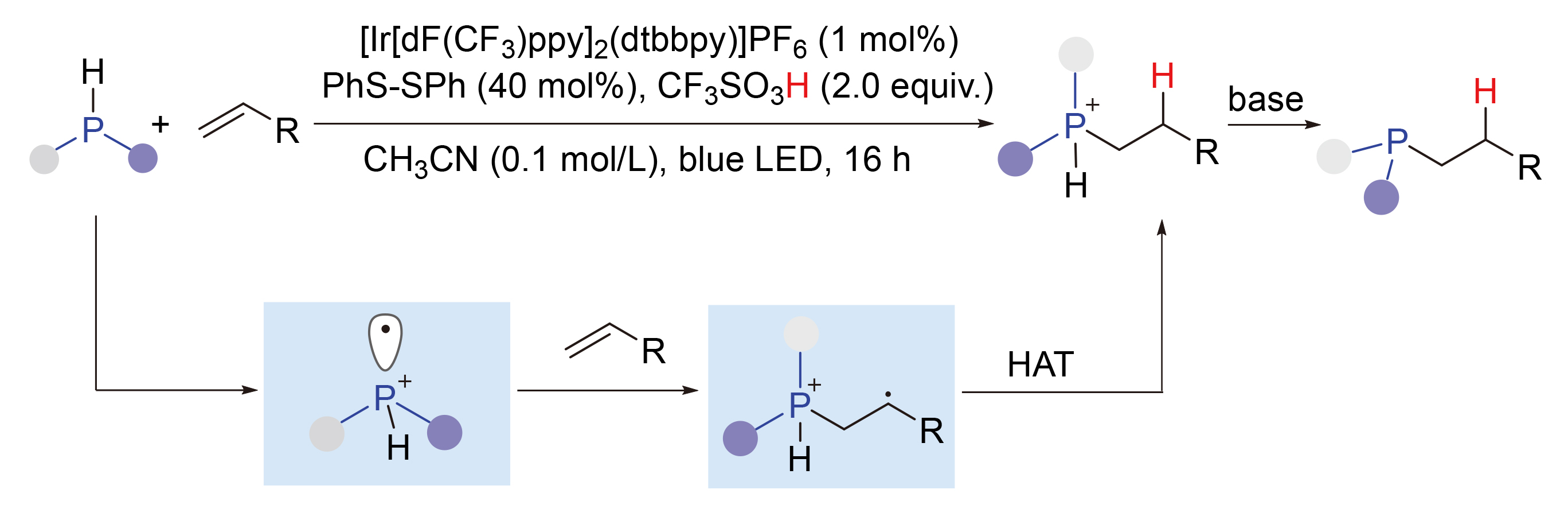
Hydrophosphination serves as an atom-economical approach to construct P—C bonds, allowing the preparation of OPCs via addition of P—H bonds to unsaturated substrates such as olefins or alkynes.[60-64] Although several strategies have been developed for olefin hydrophosphination, most rely on the nucleophilic addition of trivalent H-phosphines to Michael acceptors or proceed through transition-metal complex intermediates.[35-38] In contrast, the direct radical addition between H-phosphine molecules and olefins is a well-established and highly efficient route for forming P—C(sp3) bonds, which is believed to proceed via a phosphinyl radical intermediate.[65-67] Recently, we reported a photocatalytic method for the straightforward synthesis of phosphonium salts through radical hydrophosphoniumylation of alkenes under acidic conditions. According to our density functional theory (DFT) calculations, a highly reactive phosphine radical cation (PRC) generated in situ adds to unactivated alkenes in a kinetically barrierless manner to form the P—C(sp3) bond, followed by a hydrogen atom transfer (HAT) step to furnish the phosphonium salt product. This reaction offers a notable alternative and complement to existing synthetic routes to phosphonium salts (Scheme 1a).[68] We therefore questioned whether a H-substituted phosphine radical cation, once generated, could react with unsaturated systems through a similar mechanism to afford protonated trivalent phosphine intermediates. Subsequent deprotonation would then deliver the corresponding trivalent phosphine products (Scheme 1b).
2 Results and discussion
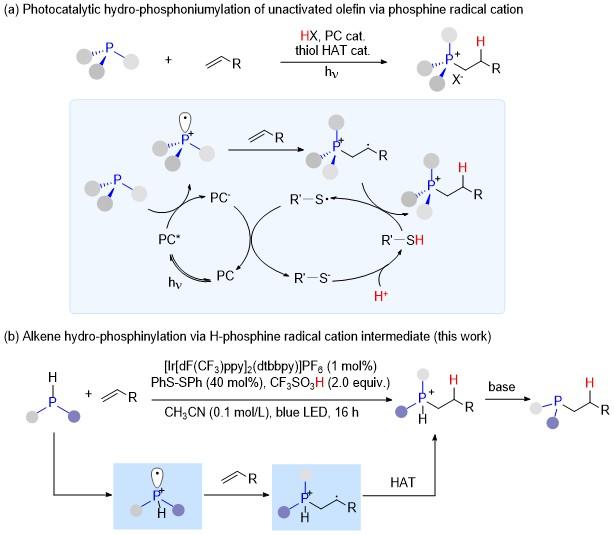
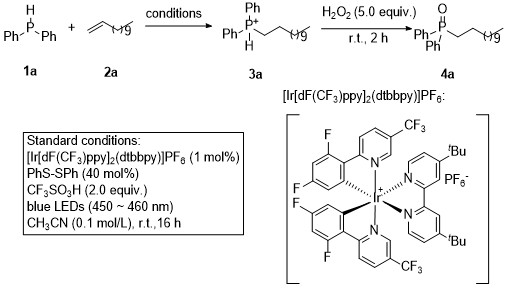
We first selected diphenylphosphine (1a) and 1-dode- cene (2a) as model substrates to optimize the reaction conditions (Table 1). Using 1 mol% photocatalyst [Ir[dF(CF3)- ppy]2(dtbbpy)]PF6, 2.0 equiv. of CF3SO3H as an additive, and 40 mol% PhS-SPh as the HAT reagent, the reaction in acetonitrile under blue LED irradiation at room temperature provided the desired hydrophosphination oxidation product 4a in 89% yield as determined by 31P NMR analysis (Entry 1). In contrast, when 2,4,6-trimethylphenyl thiol was employed as the HAT catalyst instead of PhS-SPh, the yield decreased significantly to 31% (Entry 2). Reducing the amount of CF3SO3H to 1.0 equiv. or replacing it with weaker acids such as acetic acid or trifluoroacetic acid, led to lower yields (Entries 3~5). Decreasing the loading of 2a from 3.0 equiv. to 1.5 equiv. similarly reduced the yield to 39% (Entry 6). Other photocatalysts, including Ir(ppy)3, 4-CzIPN, and Eosin Y, proved less effective than [Ir[dF- (CF3)ppy]2(dtbbpy)]PF6, resulting in diminished yields (Entries 7~9). Acetonitrile was identified as the optimal solvent, outperforming alternatives such as dichloroethane (DCE), N,N-dimethylformamide (DMF), and tetrahydrofuran (THF) (Entries 10~12). Finally, control experiments confirmed that both visible light and the photocatalyst are essential for the reaction to proceed efficiently (Entries 13, 14).
Table 1 Optimization of reaction conditionsa |
| Entry | Variation from the “standard conditions” | Yieldb/% |
|---|---|---|
| 1 | None | 89 |
| 2 | 2,4,6-Trimethylbenzenethiol in place of PhS-SPh | 31 |
| 3 | CF3SO3H (1.0 equiv.) was used | 60 |
| 4 | CH3COOH (1.0 equiv.) in place of CF3SO3H | 23 |
| 5 | CF3COOH (1.0 equiv.) in place of CF3SO3H | 26 |
| 6 | 2a (1.5 equiv.) was used | 39 |
| 7 | Ir(ppy)3 in place of [Ir[dF(CF3)ppy]2(dtbbpy)]PF6 | 22 |
| 8 | 4-CzIPN in place of [Ir[dF(CF3)ppy]2(dtbbpy)]PF6 | 12 |
| 9 | Eosin Y in place of [Ir[dF(CF3)ppy]2(dtbbpy)]PF6 | 3 |
| 10 | DCE in place of CH3CN | 49 |
| 11 | DMF in place of CH3CN | 41 |
| 12 | THF in place of CH3CN | 14 |
| 13 | Without [Ir[dF(CF3)ppy]2(dtbbpy)]PF6 | 5 |
| 14 | Without light | 0 |
a Reaction conditions: 1a (0.2 mmol), 2a (0.6 mmol), [Ir[dF(CF3)ppy]2(dtbbpy)]PF6 (1 mol%), PhS-SPh (40 mol%), CF3SO3H (0.4 mmol) and CH3CN (2.0 mL). b Reaction yields were determined by crude 31P NMR analysis with 1a as the limiting reagent, with triphenyl phosphine oxide as the internal standard. |
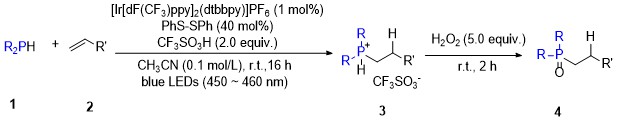
Under the optimized reaction conditions, the substrate scope of the alkene hydrophosphination reaction was next investigated (Table 2). Variations at the alkene C(2) position demonstrated that both primary and secondary alkyl substituents were compatible, furnishing the corresponding products 4b and 4c in 91% and 75% yields. Phenyloxy group was also tolerated under the photo catalytic condition, delivering product 4d in 81% yield, indicating that electron-rich substituent does not impede the radical addition process. Olefins bearing aromatic substituents (4e) reacted smoothly in 83% yield, highlighting the compatibility of π-extended systems. Likewise, substrates containing ester groups (4f) and carboxyl groups (4g), afforded the corresponding tertiary phosphine products in good to excellent yields (73%, 95%). These results underscore the method’s robustness to electron-withdrawing carbonyl functionalities. In addition, olefins bearing sulfone substituents provided product 4h in 83% yields. Notably, sensitive functional group like cyano (4i) was also compatible under the photochemical conditions, delivering the desired products in 65% yields. These examples further highlight the mild conditions of the reaction and its applicability to late-stage functionalization. Heterocyclic substituted olefins also participated successfully in this transformation. Nitrogen-containing heterocycles afforded products 4j in 51% yields. Furthermore, strained bicyclic olefins such as norbornene were suitable substrates, providing product 4k in 55% yield. This result illustrates the capacity of the reaction to engage rigid and sterically constrained frameworks. Additionally, the reaction employing dicyclohexylphosphine proceeded efficiently, affording product 4l in 75% yields.
Table 2 Substrate scope of 1 and 2a,b |
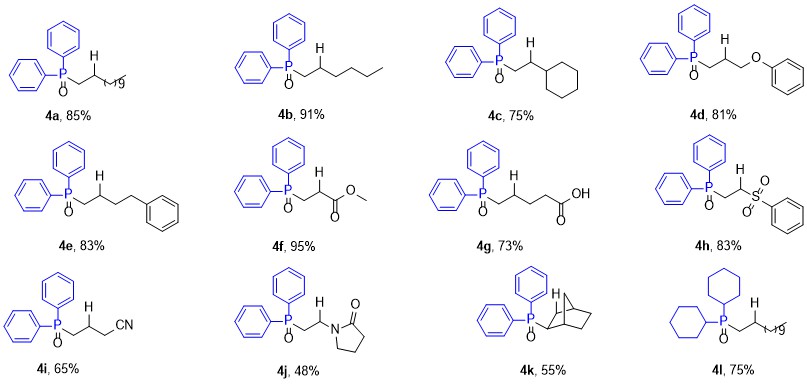 |
a The reaction was performed on a 0.2 mmol scale (1∶2=3∶1). b Isolated yield. |
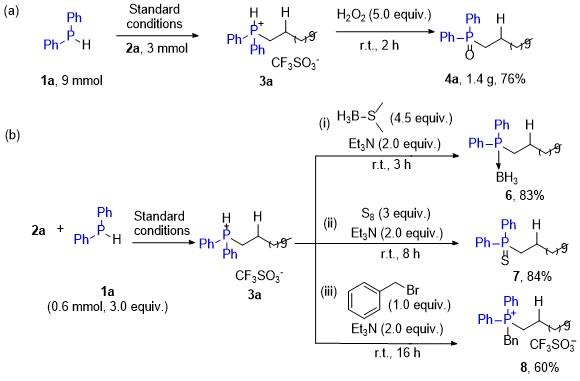
Subsequently, gram-scale reactions employing 9 mmol of 1a and 3 mmol of 2a were performed to verify the synthetic practicality of this photo-induced hydrophosphination strategy. Gratifyingly, the target product 4a could be isolated in a satisfactory yield of 76%, highlighting the scalability of this protocol (Scheme 2a). Moreover, the synthetic transformations of the protonated trivalent phosphine were investigated via a one-pot two-step procedure. As illustrated in Scheme 2b, the corresponding borane adduct and sulfide products 6 and 7 can be readily prepared. Additionally, 3a can react with benzyl bromide to furnish the corresponding quaternary phosphonium salts 8. These results clearly demonstrate the promising synthetic application potential of the developed photo-induced hydrophosphination strategy.
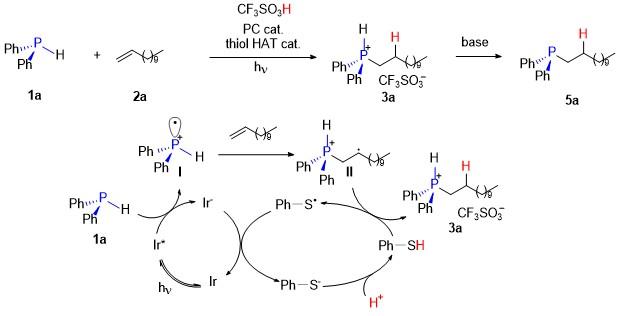
On the basis of our previous work[68] and relevant litera-ture reports,[69-70] a plausible reaction mechanism was proposed involving the addition of phosphine radical cations to carbon-carbon double bonds as the key step (Scheme 3). To validate this hypothesis, the reaction process was monitored by 31P NMR spectroscopy, which confirmed the formation of protonated trivalent phosphine intermediate 3a. Meanwhile, the characteristic signals of the deprotonated trivalent phosphorus species 5a were also observed.


3 Conclusions
In conclusion, a novel visible-light-promoted hydropho- sphination of unactivated alkenes was developed, providing efficient access to a series of tertiary phosphine deriva-tives with moderate to excellent yields (48%~95%). The reaction proceeds under mild conditions and tolerates a wide range of functional groups, demonstrating its synthetic utility in organophosphorus chemistry. Based on prior mechanistic studies, a radical pathway is proposed, in which the key step is the addition of a phosphine radical cation (PRC), generated via single-electron oxidation of the trivalent phosphine under the photo catalytic condition, across the carbon-carbon double bond.
4 Experimental section
4.1 General information
All reagents were purchased from commercial sources and used without further purification. 1H NMR, 13C NMR, 11B NMR, 19F NMR and 31P NMR spectra were recorded on a Bruker Avance™ Neo 500 spectrometer in deuterated solvents containing TMS as an internal reference standard. Reaction mixture was monitored by thin-layer chromatography (TLC) using silica gel-coated TLC plates. Purification by flash column chromatography was performed over SiO2 (silica gel 300~400 mesh).
4.2 General procedure for the synthesis of products 4a~4k
In a 10 mL Schlenk tube equipped with a magnetic stir bar were added [Ir[dF(CF3)ppy]2(dtbbpy)]PF6 (1 mol%), PhS-SPh (40 mol%), 1a (0.6 mmol, 3.0 equiv.), 2 (0.2 mmol, 1.0 equiv.), CF3SO3H (0.4 mmol, 2.0 equiv.) and CH3CN (2 mL) under argon flow. The mixture was then stirred and irradiated with blue LED (450~460 nm) for 16 h at room temperature. After the reaction, hydrogen peroxide (0.4 mL, 30% aq.) was added to the system, and the mixture was stirred at room temperature for an additional 2 h. For hydrolysis-sensitive substrates, neutralization should be performed prior to oxidation. Subsequently, the reaction mixture was concentrated, diluted with dichloromethane, washed with water, and dried over anhydrous sodium sulfate. The resulting residue was then purified by column chromatography on silica gel (petroleum ether/ethyl acetate, V∶V=2∶1 to 1∶5) to afford the final product 4a~4k.
Dodecyldiphenylphosphine oxide (4a): Yellow solid, 62.9 mg, 85% yield. m.p. 67~68 ℃; 1H NMR (500 MHz, Chloroform-d) δ: 7.77~7.70 (m, 4H), 7.54~7.41 (m, 6H), 2.30~2.19 (m, 2H), 1.65~1.56 (m, 2H), 1.38 (p, J=7.2 Hz, 2H), 1.34~1.17 (m, 16H), 0.87 (t, J=6.9 Hz, 3H); 13C NMR (126 MHz, Chloroform-d) δ: 133.1 (d, J=97.4 Hz), 131.7 (d, J=2.8 Hz), 130.8 (d, J=9.2 Hz), 128.6 (d, J=11.6 Hz), 31.9, 31.0 (d, J=14.6 Hz), 30.0, 29.6, 29.6, 29.4, 29.4 (d, J=4.4 Hz), 29.1, 22.7, 21.4, 21.4, 14.1; 31P NMR (202 MHz, Chloroform-d) δ: 32.8; HRMS calcd for C24- H36OP [M+H]+ 371.2499, found 371.2492.
Hexyldiphenylphosphine oxide (4b): Yellow solid, 52.1 mg, 91% yield. m.p. 59~60 ℃; 1H NMR (500 MHz, Chloroform-d) δ: 7.78~7.70 (m, 4H), 7.53~7.42 (m, 6H), 2.30~2.21 (m, 2H), 1.66~1.57 (m, 2H), 1.39 (p, J=7.2 Hz, 2H), 1.31~1.20 (m, 4H), 0.87~0.82 (m, 3H); 13C NMR (126 MHz, Chloroform-d) δ: 133.2 (d, J=97.7 Hz), 131.6 (d, J=2.7 Hz), 130.8 (d, J=9.2 Hz), 128.6 (d, J=11.5 Hz), 31.3, 30.7 (d, J=14.6 Hz), 29.7 (d, J=72.0 Hz), 22.4, 21.4 (d, J=3.8 Hz), 14.0; 31P NMR (202 MHz, Chloroform-d) δ: 32.7; HRMS calcd for C18H24OP [M+ H]+ 287.1560, found 287.1557.
(2-Cyclohexylethyl)diphenylphosphine oxide (4c): White solid, 46.8 mg, 75% yield. m.p. 90~91 ℃; 1H NMR (500 MHz, Chloroform-d) δ: 7.76~7.70 (m, 4H), 7.52~7.47 (m, 2H), 7.46~7.41 (m, 4H), 2.28~2.20 (m, 2H), 1.71~1.59 (m, 5H), 1.53~1.44 (m, 2H), 1.26~1.05 (m, 4H), 0.88~0.78 (m, 2H); 13C NMR (126 MHz, Chloroform-d) δ: 133.1 (d, J=97.7 Hz), 131.6 (d, J=2.5 Hz), 130.8 (d, J=9.2 Hz), 128.6 (d, J=11.5 Hz), 32.7, 28.5 (d, J=3.8 Hz), 27.4, 26.9, 26.5, 26.2; 31P NMR (202 MHz, Chloroform-d) δ: 33.4; HRMS calcd for C20H26OP [M+ H]+ 313.1716, found 313.1709.
(3-Phenoxypropyl)diphenylphosphine oxide (4d): White solid, 54.5 mg, 81% yield. m.p. 101~102 ℃; 1H NMR (500 MHz, Chloroform-d) δ: 7.77~7.70 (m, 4H), 7.38 (t, J=7.5 Hz, 2H), 7.30~7.21 (m, 4H), 7.18 (t, J=7.9 Hz, 2H), 6.87 (t, J=7.3 Hz, 1H), 6.66 (d, J=8.1 Hz, 2H), 3.66 (t, J=5.8 Hz, 2H), 2.73~2.65 (m, 2H), 1.95~1.82 (m, 2H); 13C NMR (126 MHz, Chloroform-d) δ: 158.6, 131.9, 131.6, 131.1 (d, J=9.6 Hz), 129.3, 128.7 (d, J=11.9 Hz), 120.6, 114.4, 67.3 (d, J=15.7 Hz), 26.2 (d, J=74.2 Hz), 21.6 (d, J=3.3 Hz); 31P NMR (202 MHz, Chloroform-d) δ: 35.5; HRMS calcd for C21H22O2P [M+H]+ 337.1352, found 337.1348.
Diphenyl(4-phenylbutyl)phosphine oxide (4e): White solid, 55.5 mg, 83% yield. m.p. 97~99 ℃; 1H NMR (500 MHz, Chloroform-d) δ: 7.75~7.68 (m, 4H), 7.53~7.49 (m, 2H), 7.48~7.42 (m, 4H), 7.26~7.21 (m, 2H), 7.17~7.13 (m, 1H), 7.12~7.08 (m, 2H), 2.58 (t, J=7.4 Hz, 2H), 2.31~2.24 (m, 2H), 1.79~1.61 (m, 4H); 13C NMR (126 MHz, Chloroform-d) δ: 141.9, 133.3, 132.6, 131.7 (d, J=2.8 Hz), 130.8 (d, J=9.4 Hz), 128.7 (d, J=11.5 Hz), 128.3, 125.8, 35.4, 32.7 (d, J=14.4 Hz), 29.6 (d, J=71.4 Hz), 21.2; 31P NMR (202 MHz, Chloroform-d) δ: 32.6; HRMS calcd for C22H24OP [M+H]+ 335.1560, found 335.1552.
Methyl 4-(diphenylphosphoryl)butanoate (4f): White solid, 57.4 mg, 95% yield. m.p.76~77 ℃; 1H NMR (500 MHz, Chloroform-d) δ: 7.78~7.72 (m, 4H), 7.56~7.45 (m, 6H), 3.63 (s, 3H), 2.65~2.59 (m, 4H); 13C NMR (126 MHz, Chloroform-d) δ: 132.9, 132.7, 131.1, 129.7, 52.1, 33.8, 26.1, 18.8; 31P NMR (202 MHz, Chloroform-d) δ: 31.8; HRMS calcd for C16H18O3P [M+H]+ 289.0988, found 289.0986.
5-(Diphenylphosphoryl)pentanoic acid (4g): White solid, 44.1 mg, 73% yield. m.p. 140~142 ℃; 1H NMR (500 MHz, Chloroform-d) δ: 9.78 (s, 1H), 7.74~7.66 (m, 4H), 7.53~7.42 (m, 6H), 2.32 (t, J=6.8 Hz, 4H), 1.77~1.59 (m, 4H); 13C NMR (126 MHz, Chloroform-d) δ: 176.0, 132.1 (d, J=2.6 Hz), 131.3, 130.8 (d, J=9.6 Hz), 128.8 (d, J=11.8 Hz), 33.7, 29.0 (d, J=71.7 Hz), 26.1 (d, J=15.2 Hz), 20.9 (d, J=3.8 Hz); 31P NMR (202 MHz, Chloroform-d) δ: 35.4; HRMS calcd for C17H20O3P [M+H]+ 303.1145, found 303.1142.
Diphenyl(2-(phenylsulfonyl)ethyl)phosphine oxide (4h): White solid, 61.4 mg, 83% yield. m.p. 172~174 ℃; 1H NMR (500 MHz, Chloroform-d) δ: 7.88~7.84 (m, 2H), 7.7~7.65 (m, 5H), 7.57~7.53 (m, 4H), 7.49~7.43 (m, 4H), 3.32~3.23 (m, 2H), 2.73~2.65 (m, 2H); 13C NMR (126 MHz, Chloroform-d) δ: 138.3, 134.1, 132.5, 130.8 (d, J=9.2 Hz), 129.5, 129.1, 129.0, 128.1, 49.3, 23.2 (d, J=69.7 Hz); 31P NMR (202 MHz, Chloroform-d) δ: 30.5; HRMS calcd for C20H20O3PS [M+H]+ 371.0866, found 371.0860.
4-(Diphenylphosphoryl)butanenitrile (4i): White solid, 35.0 mg, 65% yield. m.p. 99~100 ℃; 1H NMR (500 MHz, Chloroform-d) δ: 7.79~7.71 (m, 4H), 7.56 (t, J=7.4 Hz, 2H), 7.53~7.47 (m, 4H), 2.52 (t, J=6.8 Hz, 2H), 2.48~2.38 (m, 2H), 2.06~1.96 (m, 2H); 13C NMR (126 MHz, Methanol-d4) δ: 136.2, 135.3 (d, J=100.4 Hz), 134.4 (d, J=9.8 Hz), 132.7 (d, J=11.9 Hz), 122.9, 35.6 (d, J=69.2 Hz), 22.7, 14.1; 31P NMR (202 MHz, CDCl3) δ: 32.7; HRMS calcd for C16H17NOP [M+H]+ 270.1043, found 270.1035.
1-(2-(Diphenylphosphoryl)ethyl)pyrrolidin-2-one (4j): White solid, 35.8 mg, 48% yield. m.p. 125~127 ℃; 1H NMR (500 MHz, Chloroform-d) δ: 7.91~7.84 (m, 4H), 7.55~7.43 (m, 6H), 5.23~5.17 (m, 1H), 3.67~3.46 (m, 2H), 2.30~2.19 (m, 1H), 2.03~1.80 (m, 2H), 1.68~1.58 (m, 1H), 1.44~1.36 (m, 3H); 13C NMR (126 MHz, Chloroform-d) δ: 174.8 (d, J=3.3 Hz), 132.1 (dd, J=5.3, 2.8 Hz), 130.8 (t, J=9.1 Hz), 128.8 (d, J=11.5 Hz), 128.5 (d, J=11.8 Hz), 45.9 (d, J=78.2 Hz), 44.4, 30.4, 18.2, 11.1 (d, J=2.0 Hz); 31P NMR (202 MHz, CDCl3) δ: 33.2; HRMS calcd for C18H21NO2P [M+H]+ 314.1305, found 314.1299.
Bicyclo[2.2.1]hept-2-yldiphenylphosphine oxide (4k): Colorless oil, 32.6 mg, 55% yield. 1H NMR (500 MHz, Chloroform-d) δ: 7.84~7.77 (m, 2H), 7.76~7.70 (m, 2H), 7.52~7.37 (m, 6H), 2.49 (d, J=8.7 Hz, 1H), 2.35 (s, 1H), 2.28 (t, J=8.1 Hz, 1H), 1.99~1.81 (m, 2H), 1.61~1.55 (m, 2H), 1.43~1.17 (m, 4H); 13C NMR (126 MHz, Chloroform-d) δ: 131.4 (d, J=2.5 Hz), 131.3 (d, J=2.7 Hz), 131.0 (t, J=8.6 Hz), 128.5 (dd, J=12.8, 11.2 Hz), 40.0 (d, J=73.0 Hz), 38.2, 37.3, 36.4 (d, J=2.9 Hz), 32.1 (d, J=14.9 Hz), 31.5 (d, J=4.5 Hz), 28.7; 31P NMR (202 MHz, CDCl3) δ: 34.0; HRMS calcd for C19H22OP [M+H]+ 297.1403, found 297.1398.
4.3 Procedure for the synthesis of 4l
In a 10 mL Schlenk tube equipped with a magnetic stir bar were added [Ir[dF(CF3)ppy]2(dtbbpy)]PF6 (1 mol%), PhS-SPh (40 mol%), dicyclohexylphosphine (0.6 mmol, 3.0 equiv.), 2a (0.2 mmol, 1.0 equiv.), CF3SO3H (0.4 mmol, 2.0 equiv.) and CH3CN (2 mL) under argon flow. The mixture was then stirred and irradiated with blue LED (450~460 nm) for 16 h at room temperature. After the reaction, hydrogen peroxide (0.4 mL, 30% aq.) was added to the system, and the mixture was stirred at room temperature for an additional 2 h. Subsequently, the reaction mixture was concentrated, diluted with dichloromethane, washed with water, and dried over anhydrous sodium sulfate. The resulting residue was purified by column chromatography on silica gel (DCM/MeOH, V∶V=20∶1) to afford the final product 4l, white solid, 57.4 mg, 75%. m.p. 119~120 ℃; 1H NMR (500 MHz, Chloroform-d) δ: 6.74 (d, J=3.5 Hz, 1H), 5.87 (d, J=3.4 Hz, 1H), 2.04~1.96 (m, 4H), 1.95~1.67 (m, 20H), 1.53~1.40 (m, 7H), 1.38~1.19 (m, 14H); 13C NMR (126 MHz, Chloroform-d) δ: 35.5, 34.7 (d, J=64.3 Hz), 31.9, 29.6, 26.2, 26.1, 26.1, 26.1, 25.9, 25.7 (d, J=1.8 Hz), 25.5, 24.9, 24.9, 24.5, 24.2, 22.7; 31P NMR (202 MHz, CDCl3) δ: 49.8; HRMS calcd for C24H48OP [M+H]+ 383.3438, found 383.3433.
4.4 Procedures for the synthesis of 6~8
In a 10 mL Schlenk tube equipped with a magnetic stir bar were added [Ir[dF(CF3)ppy]2(dtbbpy)]PF6 (1 mol%), PhS-SPh (40 mol%), diphenylphosphine (0.6 mmol, 3.0 equiv.), 1-dodecene (0.2 mmol, 1.0 equiv.), CF3SO3H (0.4 mmol, 2.0 equiv.) and CH3CN (2 mL) under argon flow. The mixture was then stirred and irradiated with blue LED (450~460 nm) for 16 h at room temperature. After the reaction, triethylamine (0.4 mmol, 2.0 equiv.) was added to the system under argon flow, and the mixture was stirred at room temperature for another 30 min. Subsequently, borane-dimethyl sulfide complex (0.45 mL, 2 mol/L) was added and stirred at room temperature for 3 h. After the reaction finished, the mixture was concentrated and purified by silica gel column chromatography (petroleum ether/ethyl acetate, V∶V=20∶1) to obtain the final pro- duct 6, colorless oil, 61.1 mg, 83%. 1H NMR (500 MHz, Chloroform-d) δ: 7.73~7.61 (m, 4H), 7.51~7.38 (m, 6H), 2.23~2.13 (m, 2H), 1.59~1.16 (m, 23H), 0.87 (t, J=6.9 Hz, 3H); 11B NMR (160 MHz, Chloroform-d) δ: -38.8~-42.8 (m); 13C NMR (126 MHz, Chloroform-d) δ: 132.1 (d, J=8.9 Hz), 131.1 (d, J=2.3 Hz), 129.8 (d, J=54.7 Hz), 128.8 (d, J=9.7 Hz), 31.9, 31.2 (d, J=13.8 Hz), 29.6, 29.5, 29.4, 29.3, 29.0, 25.8, 25.5, 23.0, 22.7, 14.2; 31P NMR (202 MHz, Chloroform-d) δ: 15.9 (d, J=68.8 Hz); HRMS calcd for C24H39BP [M+H]+ 369.2877, found 369.2872.
In a 10 mL Schlenk tube equipped with a magnetic stir bar were added [Ir[dF(CF3)ppy]2(dtbbpy)]PF6 (1 mol%), PhS-SPh (40 mol%), diphenylphosphine (0.6 mmol, 3.0 equiv.), 1-dodecene (0.2 mmol, 1.0 equiv.), CF3SO3H (0.4 mmol, 2.0 equiv.) and CH3CN (2 mL) under argon flow. The mixture was then stirred and irradiated with blue LED (450~460 nm) for 16 h at room temperature. After the reaction, triethylamine (0.4 mmol, 2.0 equiv.) was added to the system under argon flow, and the mixture was stirred at room temperature for another 30 min. Subsequently, sulfur powder (0.6 mmol, 3.0 equiv.) was added and stirred at room temperature for 8 h. After the reaction finished, the mixture was concentrated and purified by silica gel column chromatography (petroleum ether/ethyl acetate, V∶V=20∶1) to obtain the final product 7, white solid, 64.2 mg, 84%. m.p. 45~47 ℃; 1H NMR (500 MHz, Chloroform-d) δ: 7.86~7.78 (m, 4H), 7.52~7.38 (m, 6H), 2.48~2.39 (m, 2H), 1.66~1.56 (m, 2H), 1.52~1.41 (m, 2H), 1.42~1.16 (m, 16H), 0.87 (t, J=7.0 Hz, 3H); 13C NMR (126 MHz, Chloroform-d) δ: 133.0 (d, J=79.5 Hz), 131.4 (d, J=2.8 Hz), 131.1 (d, J=10.1 Hz), 128.6 (d, J=12.0 Hz), 32.6 (d, J=56.5 Hz), 31.9, 30.7 (d, J=16.5 Hz), 29.6, 29.6, 29.4, 29.3, 29.1, 22.7, 22.2, 22.1, 14.1; 31P NMR (202 MHz, Chloroform-d) δ: 42.7; HRMS calcd for C24H36PS [M+H]+ 387.2270, found 387.2267.
In a 10 mL Schlenk tube equipped with a magnetic stir bar were added [Ir[dF(CF3)ppy]2(dtbbpy)]PF6 (1 mol%), PhS-SPh (40 mol%), diphenylphosphine (0.6 mmol, 3.0 equiv.), 1-dodecene (0.2 mmol, 1.0 equiv.), CF3SO3H (0.4 mmol, 2.0 equiv.) and CH3CN (2 mL) under argon flow. The mixture was then stirred and irradiated with blue LED (450~460 nm) for 16 h at room temperature. After the reaction, triethylamine (0.4 mmol, 2.0 equiv.) was added to the system under argon flow, and the mixture was stirred at room temperature for another 30 min. Subsequently, benzyl bromide (0.2 mmol, 1.0 equiv) was added and stirred at room temperature for 16 h. After the reaction finished, the mixture was concentrated and purified by silica gel column chromatography (DCM/MeOH, V∶V=20∶1) to obtain the final product 8, yellow solid, 71.3 mg, 60%. m.p. 135~137 ℃; 1H NMR (500 MHz, Chloroform-d) δ: 7.79~7.74 (m, 2H), 7.71~7.61 (m, 8H), 7.23~7.17 (m, 1H), 7.15~7.10 (m, 2H), 6.91~6.87 (m, 2H), 4.40 (d, J=14.5 Hz, 2H), 2.83~2.73 (m, 2H), 1.42~1.18 (m, 20H), 0.87 (t, J=6.9 Hz, 3H); 13C NMR (126 MHz, Chloroform-d) δ: 134.9 (d, J=2.8 Hz), 133.4 (d, J=8.7 Hz), 130.5 (d, J=5.5 Hz), 130.2 (d, J=12.4 Hz), 129.0 (d, J=3.7 Hz), 128.4 (d, J=3.7 Hz), 127.0 (d, J=8.3 Hz), 116.9 (d, J=82.7 Hz), 31.9, 30.4 (d, J=15.2 Hz), 30.1, 29.7, 29.5, 29.4, 29.3, 29.2, 28.8, 22.7, 21.8 (d, J=4.6 Hz), 20.0 (d, J=49.6 Hz), 14.1; 19F NMR (470 MHz, Chloroform-d) δ: -78.2; 31P NMR (202 MHz, Chloroform-d) δ: 26.8; HRMS calcd for C31H42P [M-CF3SO3-]+ 445.3019, found 445.3014.
Supporting Information Characterization data, and copies of 1H NMR, 13C NMR, 19F NMR and 31P NMR spectra. The Supporting Information is available free of charge via the Internet at http://sioc-journal.cn.
(Zhao, C.)