1 热催化策略转化乙二醇合成乙醇酸
1.1 均相催化体系
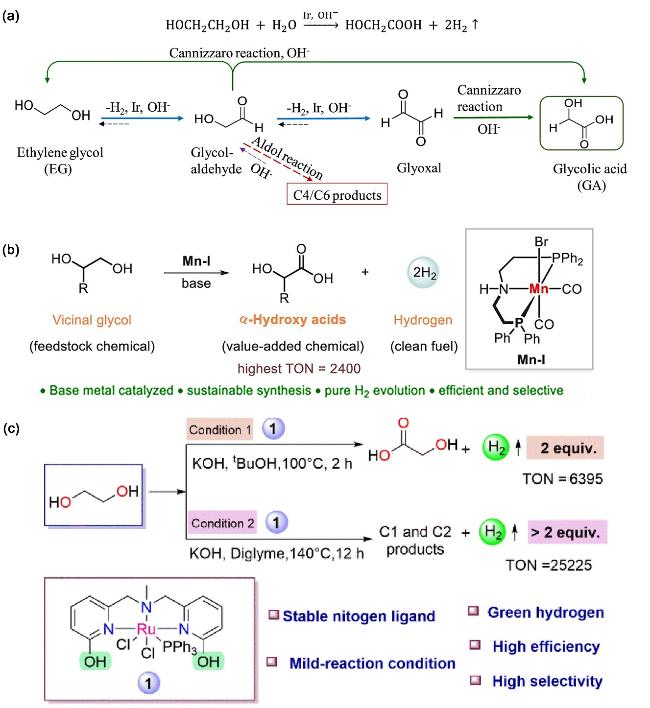
图2 (a)均相[Cp*Ir(bpyO)]OH-催化乙二醇转化合成乙醇酸的示意图[20]; (b)均相Mn(I)钳形配合物催化乙二醇转化合成乙醇酸的示意图[21]; (c)均相NNN型Ru配合物催化乙二醇转化合成乙醇酸的示意图[22]Figure 2 (a) Schematic representation of homogeneous [Cp*Ir(bpyO)]OH- catalysis for the conversion of ethylene glycol to glycolic acid[20]; (b) schematic representation of homogeneous Mn(I) pincer complex catalysis for the conversion of ethylene glycol to glycolic acid[21]; (c) schematic representation of homogeneous NNN-type Ru complex catalysis for the conversion of ethylene glycol to glycolic acid[22] |
1.2 非均相催化体系
1.2.1 Pt基催化剂
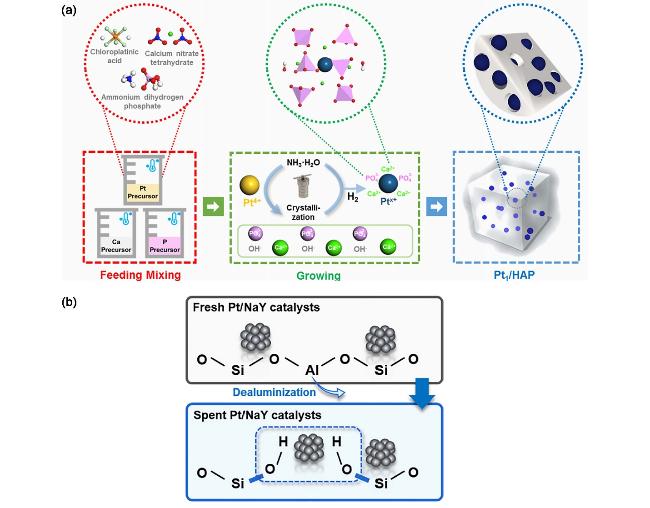
1.2.2 Au基催化剂

1.2.3 其他金属基催化剂
1.3 热催化策略小结
表1 热催化策略转化乙二醇合成乙醇酸的催化体系比较Table 1 Comparison of catalytic systems for the conversion of ethylene glycol to glycolic acid via thermocatalytic strategies |
| Catalytic system | Catalyst | Alkaline condition | Reaction condition | EG conversion/% | GA selectivity/% | Ref. |
|---|---|---|---|---|---|---|
| Homogeneous | [Cp*Ir(bpyO)]OH- | Yes | 100.0 ℃, 12.0 h | 100.0 | — | [20] |
| [HN(C2H4PPh2)2]Mn(CO)2Br | Yes | 140.0 ℃, 12.0 h | 100.0 | 96.0 | [21] | |
| NNN-Ru | Yes | 100.0 ℃, 2.0 h | 100.0 | 94.0 | [22] | |
| Heterogeneous | PtMn/MCM-41 (In-70) | No | 60.0 ℃, 8.0 h | 92.1 | 93.8 | [23] |
| Pt1/HAP | Yes | 50.0 ℃, 16.0 h | 79.1 | 98.3 | [24] | |
| Pt/CS | Yes | 70.0 ℃, 2.0 h | 87.3 | 93.0 | [25] | |
| Pt/NaY | No | 70.0 ℃, 2.0 h | 89.6 | 91.3 | [26] | |
| PtB@Cᵏ | Yes | 140.0 ℃, 3.0 h | 77.4 | 72.6 | [27] | |
| Pt-Fe/CeO2 | Yes | 70.0 ℃, 4.0 h | 100.0 | 62.0 | [28] | |
| Pt/Sn-Beta | No | 70.0 ℃, 2.0 h | 90.0 | 81.0 | [29] | |
| Commercial Pt/C | No | 30.0 ℃, 0.5 h | 60.0 | >90.0 | [30] | |
| Au/C | Yes | 70.0 ℃, 1.0 h | — | 98.0 | [31] | |
| 2.78Au/Al2O3I | Yes | 70.0 ℃ | — | >95.0 | [32] | |
| 2.6Au/Al2O3 (D) | Yes | 76.0 ℃ | — | >95.0 | [33] | |
| AuPt/CeO2 | Yes | 70.0 ℃ | ≥90.0 | 90.0 | [34] | |
| Au/NiO | Yes | 130.0 ℃, 3.0 h | ≈100.0 | 87.6 | [35] | |
| Ni3Sn/CeZrO2 | Yes | 270.0 ℃, 2.0 h | 68.0 | — | [36] | |
| Cu/CNF | Yes | 180.0 ℃, 15.0 h | 76.0 | 97.0 | [37] |
2. 电催化策略转化乙二醇合成乙醇酸
2.1 Pd基催化剂
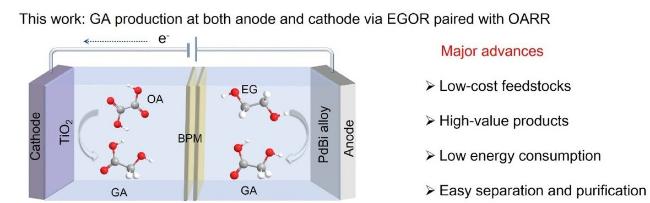
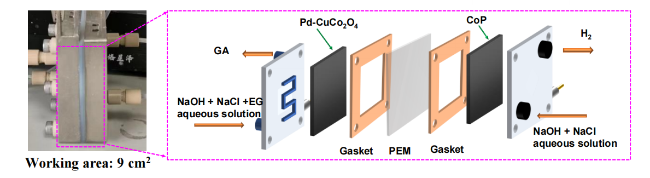
2.2 Pt基催化剂
2.3 其他金属基催化剂
2.4 电催化策略小结
表2 电催化策略转化乙二醇合成乙醇酸的催化体系比较Table 2 Comparison of catalytic systems for the conversion of EG to GA via electrocatalysis strategies |
| Catalyst | Reaction condition | Working electrode potential/ (V vs. RHE) | FE/% | GA selectivity/% | Ref. |
|---|---|---|---|---|---|
| Pd1Ag1 NPs | 1.0 mol/L KOH, 1.0 mol/L EG | 0.85/50 mA/mg Pd | — | 97.0/0.75 V vs. RHE | [38] |
| PdSb bimeallene | 1.0 mol/L KOH, 0.1 mol/L EG | 0.60/10 mA/cm2 | — | — | [39] |
| PdSn metallene | 4.0 mol/L KOH, 2.3 mol/L EG | 0.90/100 mA/cm2 | 92.5/0.97 V vs. RHE | — | [40] |
| PdCu MCs | 1 mol/L KOH, strongly alkaline hydrolysate of PET | — | 93.6/0.83 V vs. RHE | — | [41] |
| PdBi/NF | 1.0 mol/L KOH, 0.5 mol/L EG | — | >99.0 | — | [42] |
| PdAgPt/Co | 3.0 mol/L KOH, 2.0 mol/L EG | — | — | 93.6/200 A/m2 | [43] |
| Pd-CuCo2O4 | 1.0 mol/L NaOH, 0.5 mol/L NaCl, 1.0 mol/L EG | 0.80/200 mA/cm2 | 96.1/0.90 V vs. RHE | — | [44] |
| Pd/Ni(OH)2/NF | 1.0 mol/L KOH, 1.0 mol/L EG | 0.53/10 mA/cm2 | 94.2/1.20 V vs. RHE | — | [45] |
| Pd/a-Fe2O3 | 1.0 mol/L KOH, 0.5 mol/L EG | 0.85/6.83 A/mg Pd | — | 93.8/6.83 A/mg Pd | [46] |
| Pd-CoCr2O4 | 5.0 mol/L NaOH, 2.0 mol/L EG | 1.25/290 mA/cm2 | — | 94.5/1.25 V vs. RHE | [47] |
| Pd/NiMoO4/NF | 1.0 mol/L NaOH, 1.0 mol/L EG | 0.79/100 mA/cm2 | 95.7/1.00 V vs. RHE | — | [48] |
| Pd-Co3O4/NF | 1.0 mol/L KOH, 1.0 mol/L EG | 0.72/100 mA/cm2 | 93.1/0.90 V vs. RHE | — | [49] |
| Pd-Ni(OH)2/NF | 1.0 mol/L KOH, 1.0 mol/L EG | 0.69/100 mA/cm2 | 94.1/1.00 V vs. RHE | 91.6/1.00 V vs. RHE | [50] |
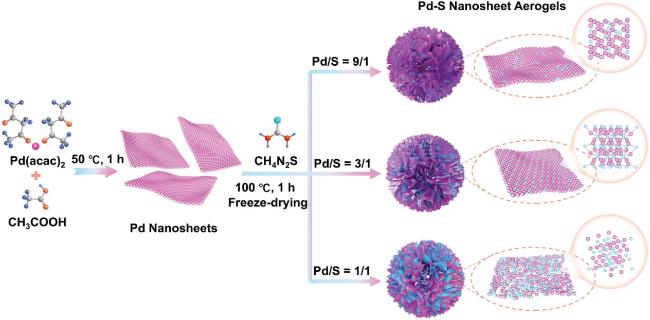
| Pd3S NAs | 1.0 mol/L KOH, 0.5 mol/L EG | — | 83.6/0.87 V vs. RHE | — | [51] |
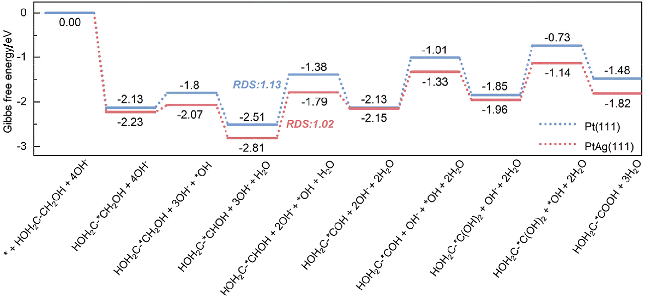
| PtAg/NF | 1.0 mol/L KOH, 1.0 mol/L EG | 0.80/264 mA/cm2 | 95.7/0.70 V vs. RHE | — | [52] |
| Pt-Ni(OH)2/NF | 1.0 mol/L KOH, 1.0 mol/L EG | 0.61/100 mA/cm2 | 90.1/0.80 V vs. RHE | — | [53] |
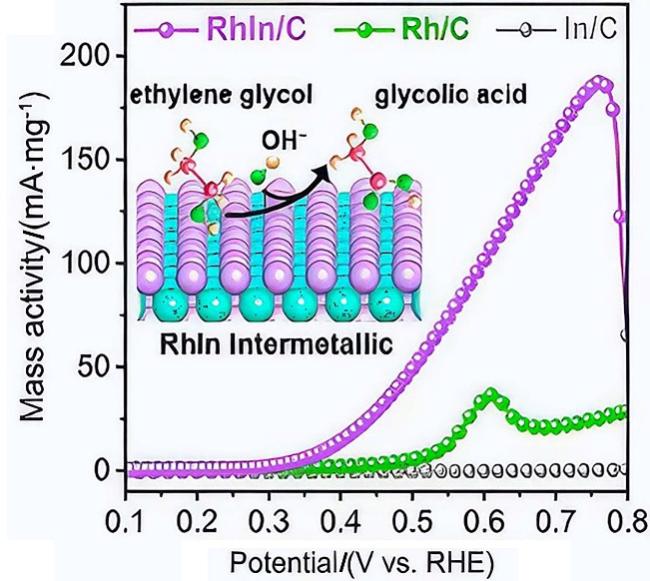
| RhIn/C | 3.0 mol/L KOH, 0.3 mol/L EG | — | 75.4/0.65 V vs. RHE | 85.0/0.65 V vs. RHE | [54] |
| Co-Ni/CP | 1.0 mol/L KOH, 1.0 mol/L EG | — | 91/1.4 V vs. RHE | 96.3/150 mA/cm2 | [55] |
| CoO/CFP | 1.0 mol/L KOH, 0.1 mol/L EG | 1.39/10 mA/cm2 | — | — | [56] |
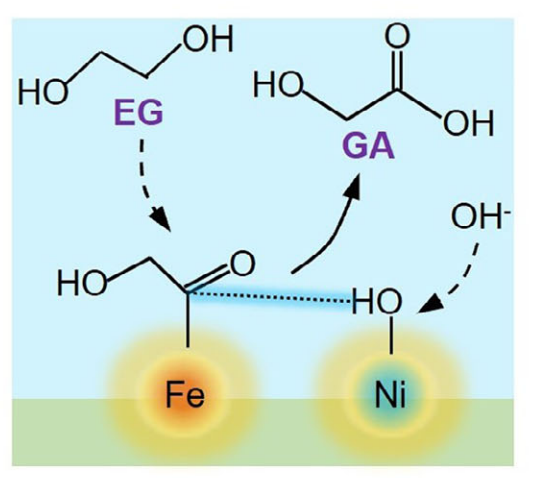
| Ni1-Fe1-N-C | 1.0 mol/L KOH, 1.0 mol/L EG | 0.77/100 mA/cm2 | >90.0/50~500 C | >90.0/500 C | [57] |
3 光催化策略转化乙二醇合成乙醇酸
表3 光催化策略转化乙二醇合成乙醇酸的催化体系比较Table 3 Comparison of catalytic systems for the conversion of EG to GA via photocatalytic strategies |
| Catalyst type | Catalyst | Reaction conditions | Light source | EG conversion/% | GA yield/% | Ref. |
|---|---|---|---|---|---|---|
| Non-metallic photocatalyst | CPDs-CN | Vacuum, 1.0 mol/L KOH | Xenon lamp | — | — | [62] |
| B-g-C3N4NT | Argon, 0.1 mol/L NaOH | Xenon lamp | 7.8 | — | [63] | |
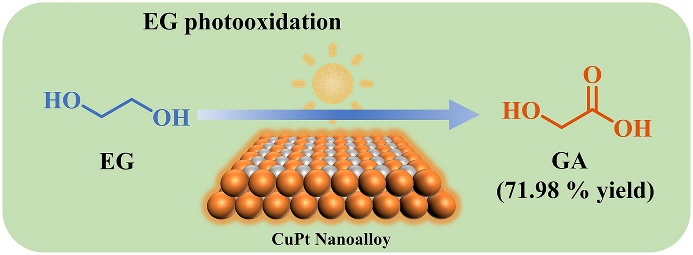
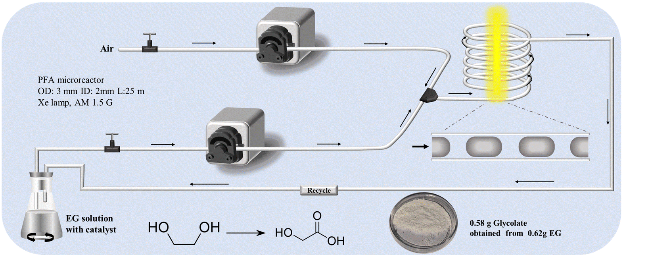
| Metallic photocatalyst | Cu-Pt/ZrO2 | Air, alkali-free | Visible light | 94.8 | 72.0 | [64] |
| Au-Pt/ZrO2 | Air, alkali-free | Xenon lamp | — | 76.9 | [65] |
3.1 非金属催化剂
3.2 金属催化剂
4 酶催化策略转化乙二醇合成乙醇酸
4.1 静息细胞催化体系
4.2 活细胞催化体系
4.3 酶催化策略小结
表4 酶催化策略转化乙二醇合成乙醇酸的催化体系比较Table 4 Comparison of catalytic systems for the conversion of EG to GA via enzymatic catalytic strategies |
| Catalytic system | Microorganism species | Reaction condition | Coenzyme and concentration | EG bioconversion efficiency/% | GA concentration/ (g•L-1) | Ref. |
|---|---|---|---|---|---|---|
| Resting cell | Gluconobacter oxydans NL71 | 30 ℃, pH=5.0 | 1 g/L D-sorbitol | — | 74.3 | [69] |
| Gluconobacter oxydans NL71 | 30 ℃, pH=5.5~6.5 | 1 g/L D-sorbitol | — | — | [70] | |
| Gluconobacter oxydans CCT 0552 | 28 ℃, pH=5.5~6.5 | 1 g/L mannitol | 97.3 | 94.2 | [71] | |
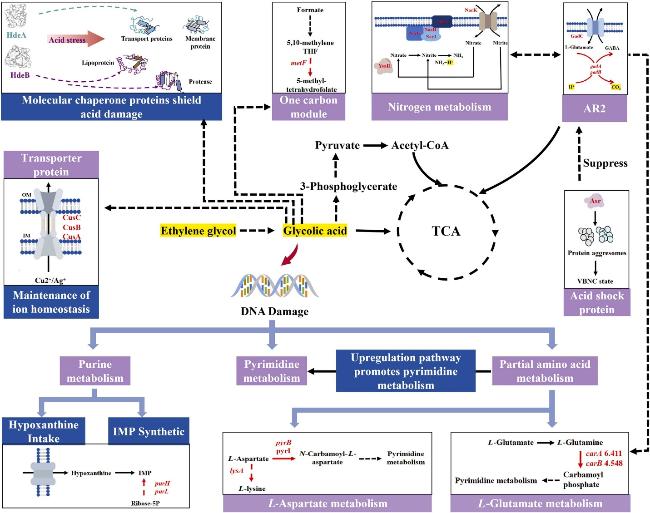
| Living cell | Escherichia coli YF2G*GA3 | 37 ℃, pH≈7.0 | — | — | 11.0 | [72] |
5 总结与展望
5.1 总结
表5 四种催化策略的总结对比Table 5 Comparative summary of the four catalytic strategies |
| Catalytic trategy | Reaction conditions | Scope of application | Technical maturity | Limitations |
|---|---|---|---|---|
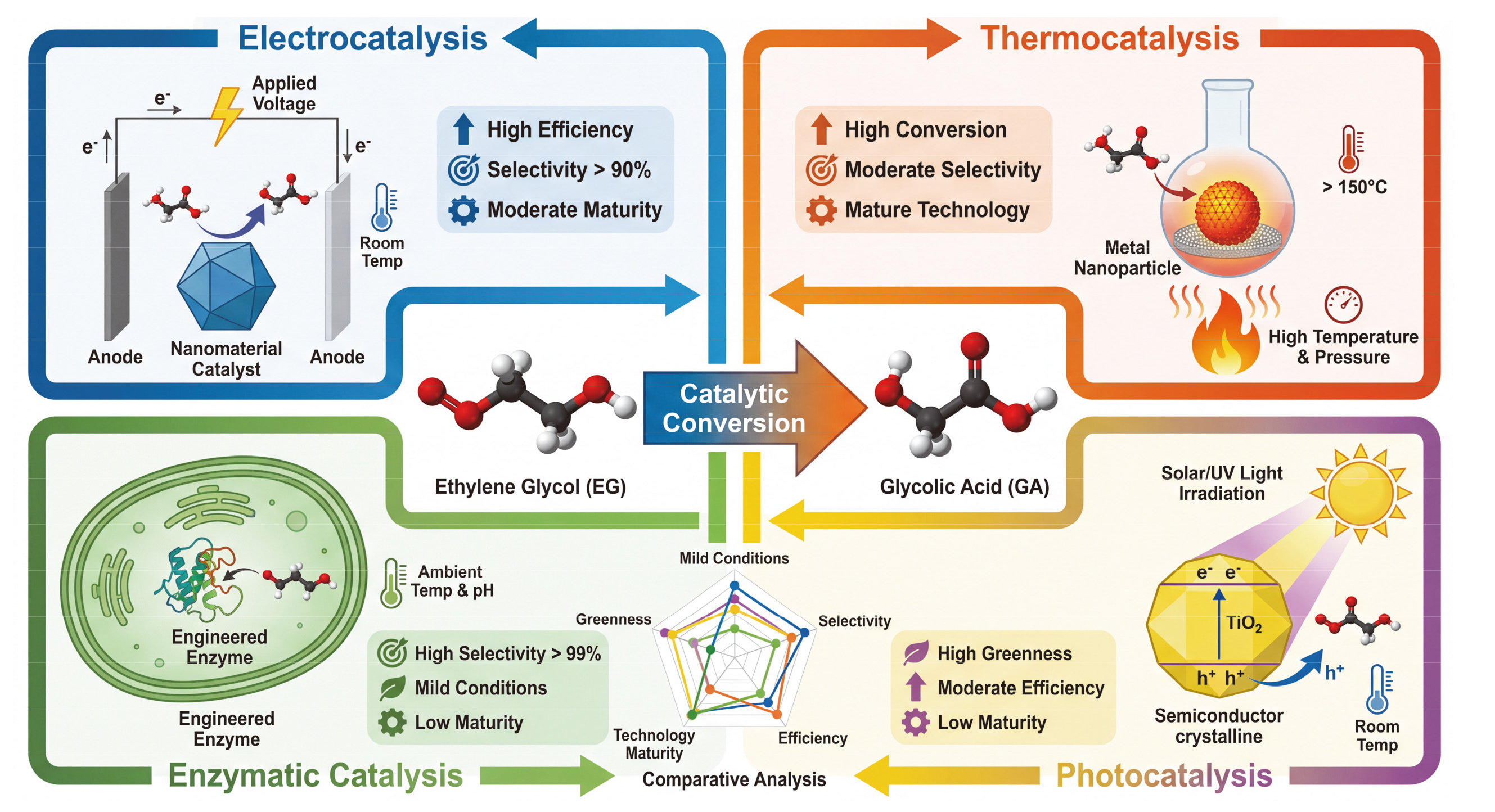
| Thermal catalysis | Harsh reaction conditions involving high temperature, high pressure, and O2 as the oxidant; alkaline media and noble-metal-based catalytic systems are commonly employed. | Suitable for the large-scale selective conversion of high- concentration ethylene glycol feedstocks, with a balance bet- ween conversion efficiency and space-time yield. | Currently the mainstream industrial route for converting ethy- lene glycol to glycolic acid, with a high level of technological maturity. | High energy consumption and severe side reactions; catalysts are prone to deactivation due to coking or leaching of active components. |
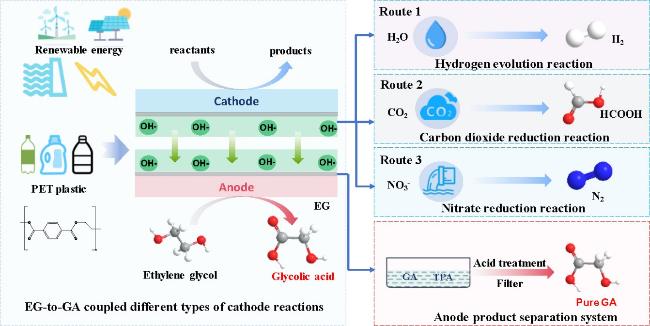
| Electrocatalysis | Operates under ambient tem- perature and pressure, typically using alkaline media and noble-metal-based catalysts. | Green and mild reaction conditions with potential integration with renewable energy sources such as solar and wind power. Different cathodic reactions can also be flexibly coupled to enable process intensification and diversified product generation (Figure 13).[80] | At a critical stage of transition from pilot- scale demonstration to industrialization. Sma- ll-scale production has been validated, showing promising prospects for practical application. | Insufficient long-term catalyst stability; metal leaching and agglomeration may occur at high potentials. The achievable current density remains to be improved, and overall energy consumption requires further optimization. The relatively high cost of electrode fabrication also limits large-scale deployment. |
| Photocatalysis | Driven by simulated or natural sunlight under ambient temperature and pressure. Semiconductor photocatalysts serve as the core catalytic materials, without the need for externally added oxidants. | Green and mild reaction conditions, suitable for the low-car- bon selective conversion of low-concentration ethylene glycol feed-stocks. | At the laboratory re- search stage. | Semiconductor materials generally have a narrow light-absorption range and low solar-energy utilization efficiency. Rapid recombination of photogenerated charge carriers leads to relatively low quantum efficiency. The overall reaction rate is relatively slow, making large-scale application challenging. |
| Enzymatic catalysis | Operates under ambient temperature and pressure and mild physiological conditions (pH 6~8, 25~40 °C), without the need for externally added oxidants. | Suitable for the synthesis of high-purity glycolic acid, offering excellent selectivity and substrate specificity. | At the laboratory re- search and small- scale production stages. | Enzyme stability is highly sensitive to temperature, pH, and substrate concentration, and enzymes are prone to deactivation during long- term operation. Low substrate tolerance limits the treatment of high- concentration ethylene glycol feedstocks. The overall reaction rate is relatively slow, and catalytic efficiency requires further improvement. |