有机化学 ›› 2026, Vol. 46 ›› Issue (8): 2969-2987.DOI: 10.6023/cjoc202601006 上一篇 下一篇
综述与进展
吴蕊, 武治权, 张娟, 高文超, 王英雄*( ), 常宏宏*()
收稿日期:2026-01-05
修回日期:2026-03-18
发布日期:2026-05-13
基金资助:
Rui Wu, Zhiquan Wu, Juan Zhang, Wenchao Gao, Yingxiong Wang*(), Honghong Chang*()
Received:2026-01-05
Revised:2026-03-18
Published:2026-05-13
Contact:
*E-mail: wangyingxiong@tyut.edu.cn; changhonghong@tyut.edu.cn
Supported by:文章分享
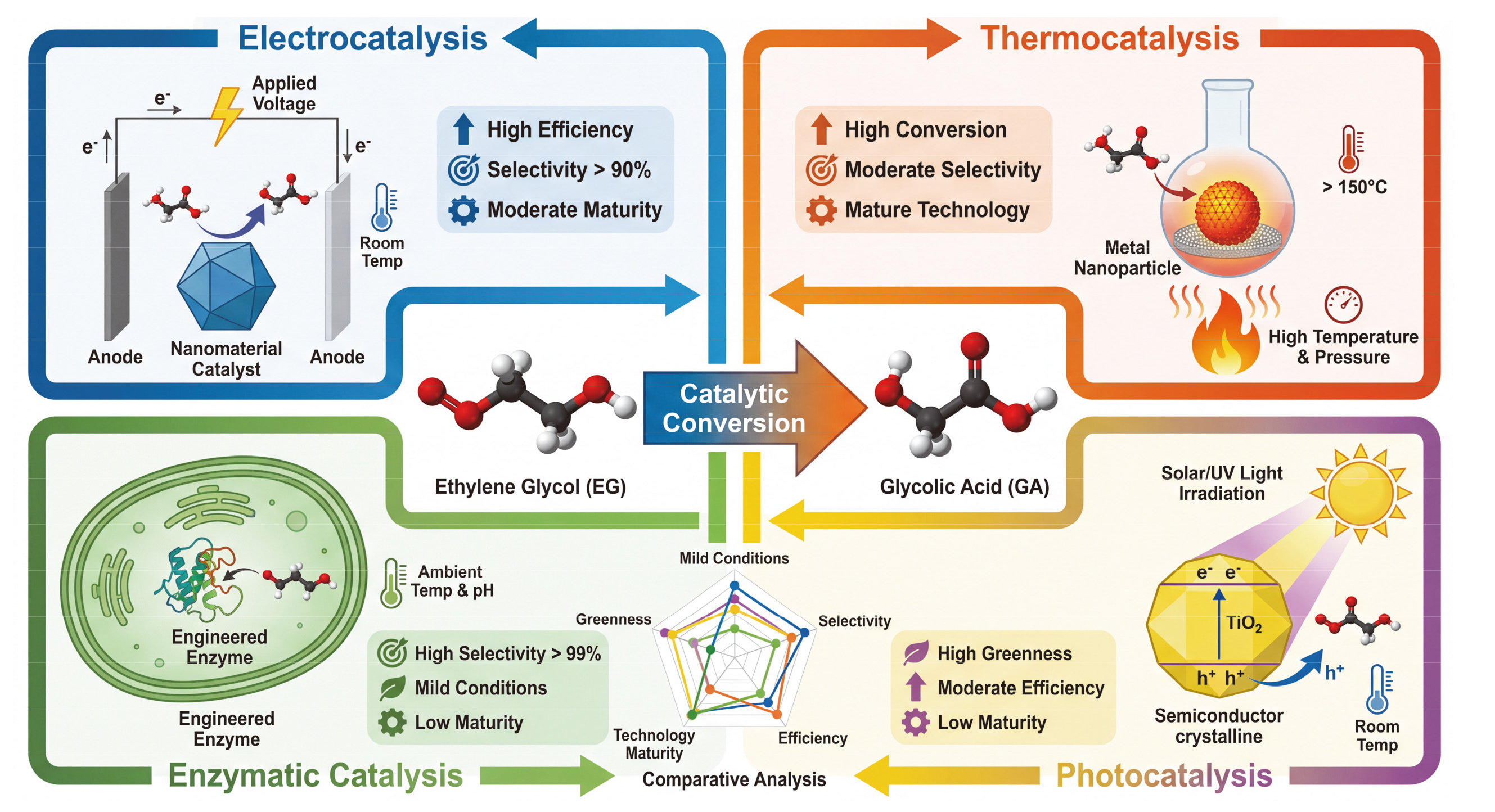
乙二醇(EG)作为聚对苯二甲酸乙二醇酯(PET)的关键裂解产物, 来源广泛且产量巨大, 但其自身附加值较低. 在当前塑料污染加剧与碳资源浪费的双重挑战下, 将PET衍生的乙二醇高效定向转化为高附加值化学品乙醇酸(GA), 已成为推动塑料“化学升级再造”与构建循环经济体系的重要路径. 然而, 传统乙醇酸合成工艺普遍存在反应条件苛刻、流程复杂、环境负荷高及原子经济性低等问题, 难以满足绿色化工发展的迫切需求, 亟需发展高效、可持续的新型催化策略. 此文系统综述了近年热催化、电催化、光催化及酶催化四种主流策略在乙二醇选择性氧化合成乙醇酸领域的研究进展; 重点梳理了各类催化体系中核心催化剂的设计思路及调控策略、关键性能指标及工艺优化方向, 并对不同的催化策略进行了对比分析, 深入剖析了各技术路线的独特优势与当前面临的核心挑战. 在此基础上, 结合当前研究瓶颈, 对未来发展趋势进行了展望, 提出突破单一催化模式的局限, 构建热-电、光-电等多场协同催化体系, 依托人工智能技术辅助催化剂的理性设计与反应路径的精准预测, 聚焦单金属催化剂的活性位点调控及金属有机催化剂的配体修饰与结构优化, 增强其与反应体系的适配性与稳定性. 通过多能量输入耦合与反应路径的精准调控, 有望实现乙二醇转化率、乙醇酸选择性与工艺经济性的协同突破.
吴蕊, 武治权, 张娟, 高文超, 王英雄, 常宏宏. 乙二醇选择性催化氧化合成乙醇酸的研究进展[J]. 有机化学, 2026, 46(8): 2969-2987.
Rui Wu, Zhiquan Wu, Juan Zhang, Wenchao Gao, Yingxiong Wang, Honghong Chang. Research Progress in the Selective Catalytic Oxidation of Ethylene Glycol to Glycolic Acid[J]. Chinese Journal of Organic Chemistry, 2026, 46(8): 2969-2987.
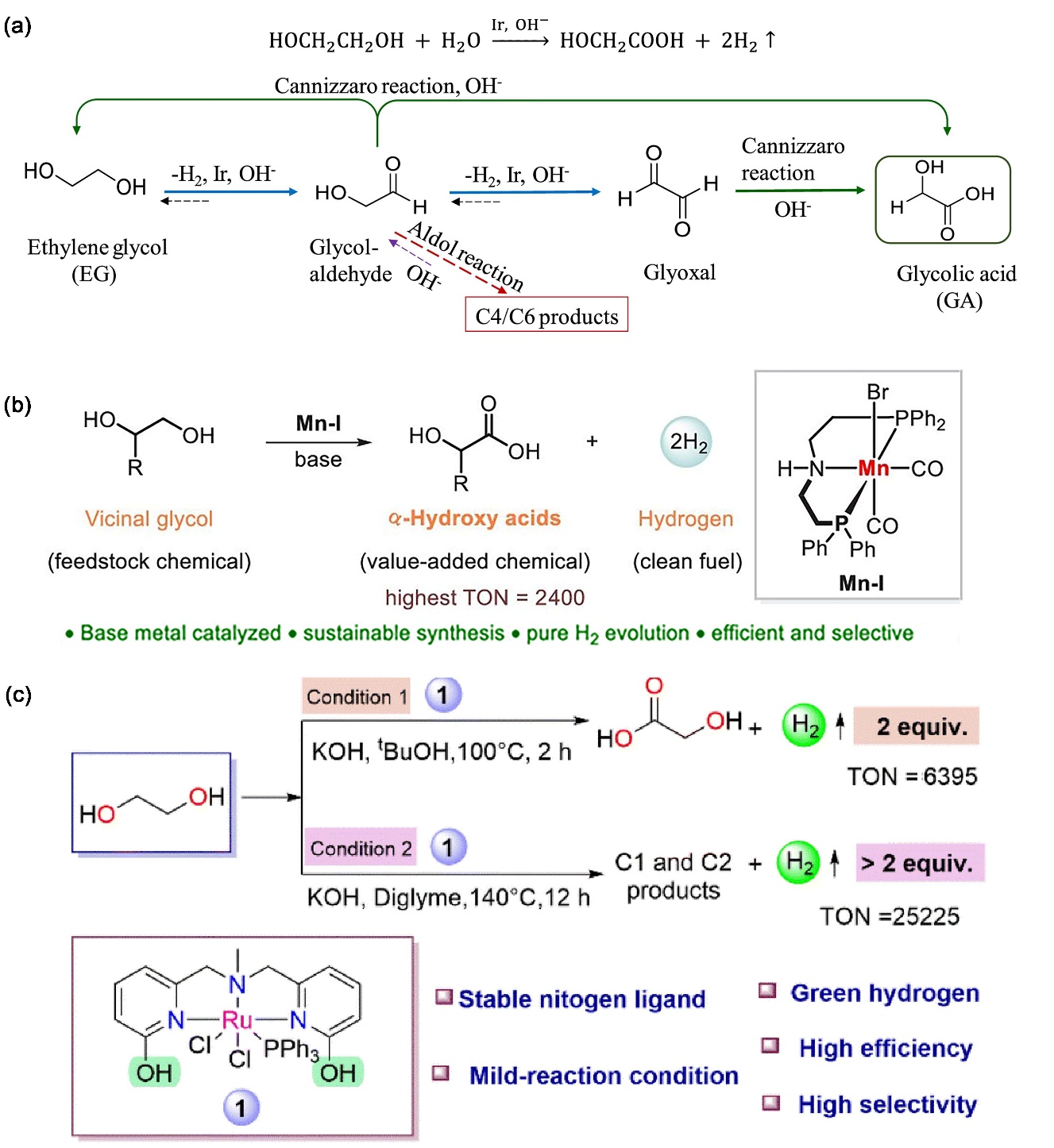
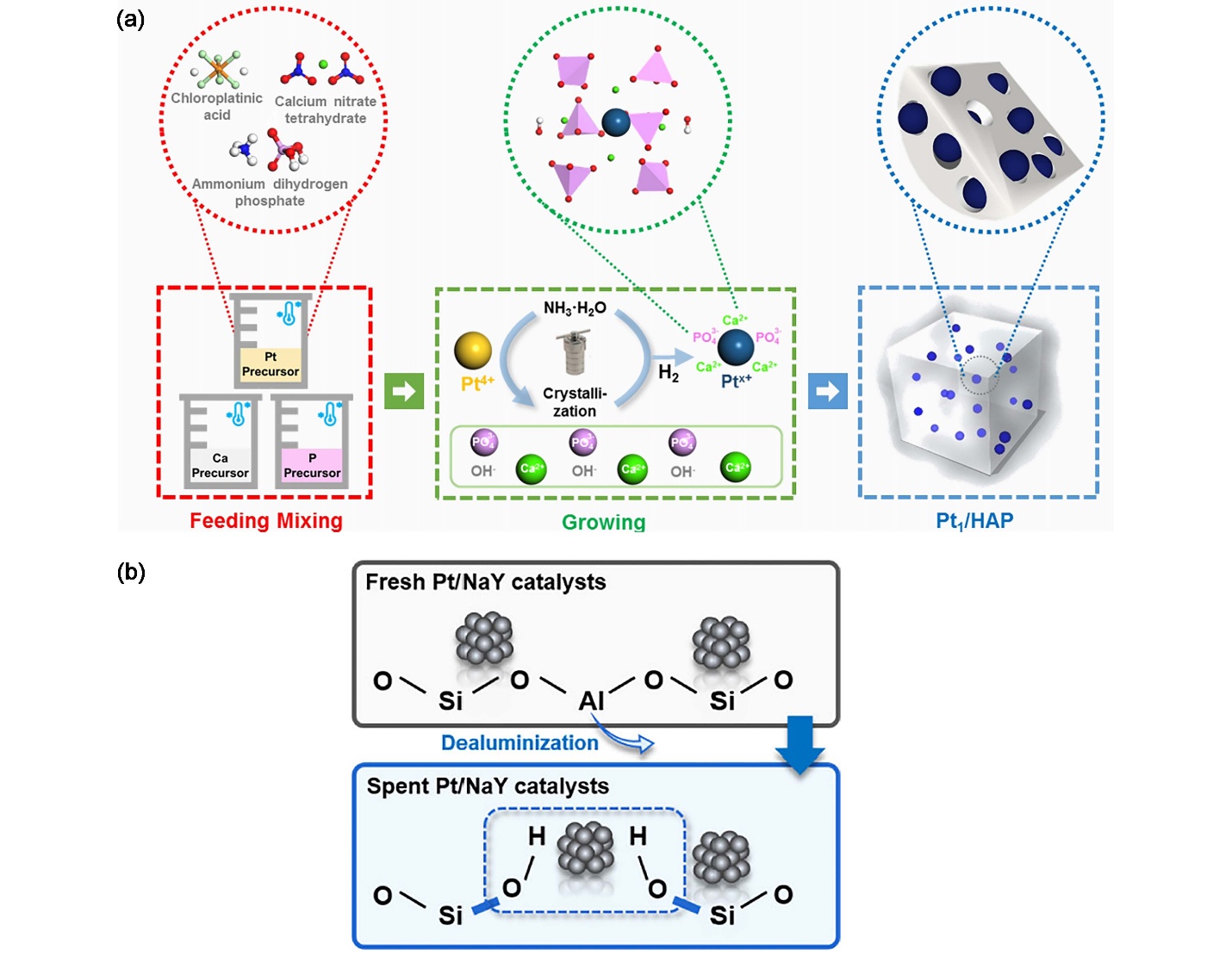


| Catalytic system | Catalyst | Alkaline condition | Reaction condition | EG conversion/% | GA selectivity/% | Ref. |
|---|---|---|---|---|---|---|
| Homogeneous | [Cp*Ir(bpyO)]OH- | Yes | 100.0 ℃, 12.0 h | 100.0 | — | [ |
| [HN(C2H4PPh2)2]Mn(CO)2Br | Yes | 140.0 ℃, 12.0 h | 100.0 | 96.0 | [ | |
| NNN-Ru | Yes | 100.0 ℃, 2.0 h | 100.0 | 94.0 | [ | |
| Heterogeneous | PtMn/MCM-41 (In-70) | No | 60.0 ℃, 8.0 h | 92.1 | 93.8 | [ |
| Pt1/HAP | Yes | 50.0 ℃, 16.0 h | 79.1 | 98.3 | [ | |
| Pt/CS | Yes | 70.0 ℃, 2.0 h | 87.3 | 93.0 | [ | |
| Pt/NaY | No | 70.0 ℃, 2.0 h | 89.6 | 91.3 | [ | |
| PtB@Cᵏ | Yes | 140.0 ℃, 3.0 h | 77.4 | 72.6 | [ | |
| Pt-Fe/CeO2 | Yes | 70.0 ℃, 4.0 h | 100.0 | 62.0 | [ | |
| Pt/Sn-Beta | No | 70.0 ℃, 2.0 h | 90.0 | 81.0 | [ | |
| Commercial Pt/C | No | 30.0 ℃, 0.5 h | 60.0 | >90.0 | [ | |
| Au/C | Yes | 70.0 ℃, 1.0 h | — | 98.0 | [ | |
| 2.78Au/Al2O3I | Yes | 70.0 ℃ | — | >95.0 | [ | |
| 2.6Au/Al2O3 (D) | Yes | 76.0 ℃ | — | >95.0 | [ | |
| AuPt/CeO2 | Yes | 70.0 ℃ | ≥90.0 | 90.0 | [ | |
| Au/NiO | Yes | 130.0 ℃, 3.0 h | ≈100.0 | 87.6 | [ | |
| Ni3Sn/CeZrO2 | Yes | 270.0 ℃, 2.0 h | 68.0 | — | [ | |
| Cu/CNF | Yes | 180.0 ℃, 15.0 h | 76.0 | 97.0 | [ |
| Catalytic system | Catalyst | Alkaline condition | Reaction condition | EG conversion/% | GA selectivity/% | Ref. |
|---|---|---|---|---|---|---|
| Homogeneous | [Cp*Ir(bpyO)]OH- | Yes | 100.0 ℃, 12.0 h | 100.0 | — | [ |
| [HN(C2H4PPh2)2]Mn(CO)2Br | Yes | 140.0 ℃, 12.0 h | 100.0 | 96.0 | [ | |
| NNN-Ru | Yes | 100.0 ℃, 2.0 h | 100.0 | 94.0 | [ | |
| Heterogeneous | PtMn/MCM-41 (In-70) | No | 60.0 ℃, 8.0 h | 92.1 | 93.8 | [ |
| Pt1/HAP | Yes | 50.0 ℃, 16.0 h | 79.1 | 98.3 | [ | |
| Pt/CS | Yes | 70.0 ℃, 2.0 h | 87.3 | 93.0 | [ | |
| Pt/NaY | No | 70.0 ℃, 2.0 h | 89.6 | 91.3 | [ | |
| PtB@Cᵏ | Yes | 140.0 ℃, 3.0 h | 77.4 | 72.6 | [ | |
| Pt-Fe/CeO2 | Yes | 70.0 ℃, 4.0 h | 100.0 | 62.0 | [ | |
| Pt/Sn-Beta | No | 70.0 ℃, 2.0 h | 90.0 | 81.0 | [ | |
| Commercial Pt/C | No | 30.0 ℃, 0.5 h | 60.0 | >90.0 | [ | |
| Au/C | Yes | 70.0 ℃, 1.0 h | — | 98.0 | [ | |
| 2.78Au/Al2O3I | Yes | 70.0 ℃ | — | >95.0 | [ | |
| 2.6Au/Al2O3 (D) | Yes | 76.0 ℃ | — | >95.0 | [ | |
| AuPt/CeO2 | Yes | 70.0 ℃ | ≥90.0 | 90.0 | [ | |
| Au/NiO | Yes | 130.0 ℃, 3.0 h | ≈100.0 | 87.6 | [ | |
| Ni3Sn/CeZrO2 | Yes | 270.0 ℃, 2.0 h | 68.0 | — | [ | |
| Cu/CNF | Yes | 180.0 ℃, 15.0 h | 76.0 | 97.0 | [ |
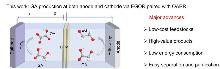
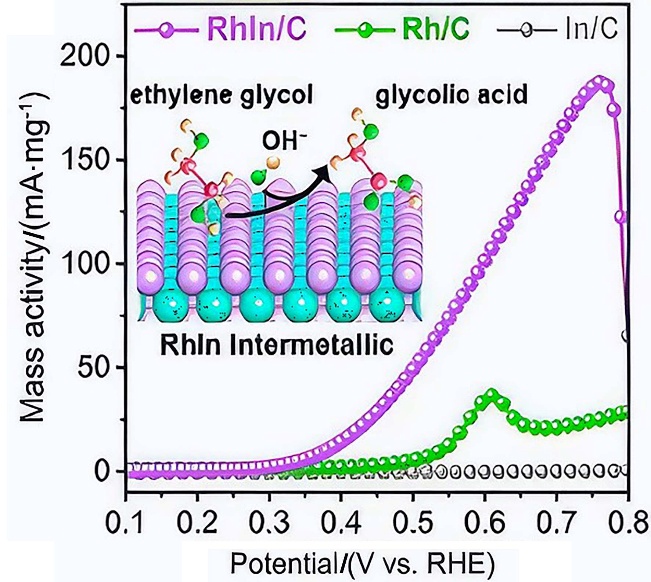
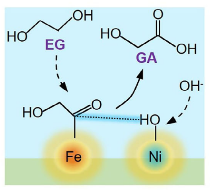
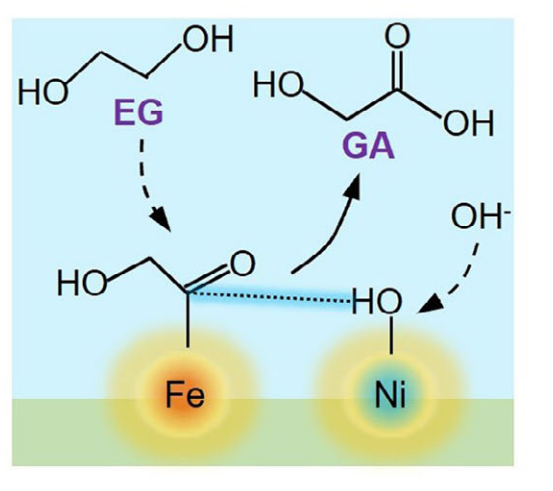
| Catalyst | Reaction condition | Working electrode potential/ (V vs. RHE) | FE/% | GA selectivity/% | Ref. |
|---|---|---|---|---|---|
| Pd1Ag1 NPs | 1.0 mol/L KOH, 1.0 mol/L EG | 0.85/50 mA/mg Pd | — | 97.0/0.75 V vs. RHE | [ |
| PdSb bimeallene | 1.0 mol/L KOH, 0.1 mol/L EG | 0.60/10 mA/cm2 | — | — | [ |
| PdSn metallene | 4.0 mol/L KOH, 2.3 mol/L EG | 0.90/100 mA/cm2 | 92.5/0.97 V vs. RHE | — | [ |
| PdCu MCs | 1 mol/L KOH, strongly alkaline hydrolysate of PET | — | 93.6/0.83 V vs. RHE | — | [ |
| PdBi/NF | 1.0 mol/L KOH, 0.5 mol/L EG | — | >99.0 | — | [ |
| PdAgPt/Co | 3.0 mol/L KOH, 2.0 mol/L EG | — | — | 93.6/200 A/m2 | [ |
| Pd-CuCo2O4 | 1.0 mol/L NaOH, 0.5 mol/L NaCl, 1.0 mol/L EG | 0.80/200 mA/cm2 | 96.1/0.90 V vs. RHE | — | [ |
| Pd/Ni(OH)2/NF | 1.0 mol/L KOH, 1.0 mol/L EG | 0.53/10 mA/cm2 | 94.2/1.20 V vs. RHE | — | [ |
| Pd/a-Fe2O3 | 1.0 mol/L KOH, 0.5 mol/L EG | 0.85/6.83 A/mg Pd | — | 93.8/6.83 A/mg Pd | [ |
| Pd-CoCr2O4 | 5.0 mol/L NaOH, 2.0 mol/L EG | 1.25/290 mA/cm2 | — | 94.5/1.25 V vs. RHE | [ |
| Pd/NiMoO4/NF | 1.0 mol/L NaOH, 1.0 mol/L EG | 0.79/100 mA/cm2 | 95.7/1.00 V vs. RHE | — | [ |
| Pd-Co3O4/NF | 1.0 mol/L KOH, 1.0 mol/L EG | 0.72/100 mA/cm2 | 93.1/0.90 V vs. RHE | — | [ |
| Pd-Ni(OH)2/NF | 1.0 mol/L KOH, 1.0 mol/L EG | 0.69/100 mA/cm2 | 94.1/1.00 V vs. RHE | 91.6/1.00 V vs. RHE | [ |
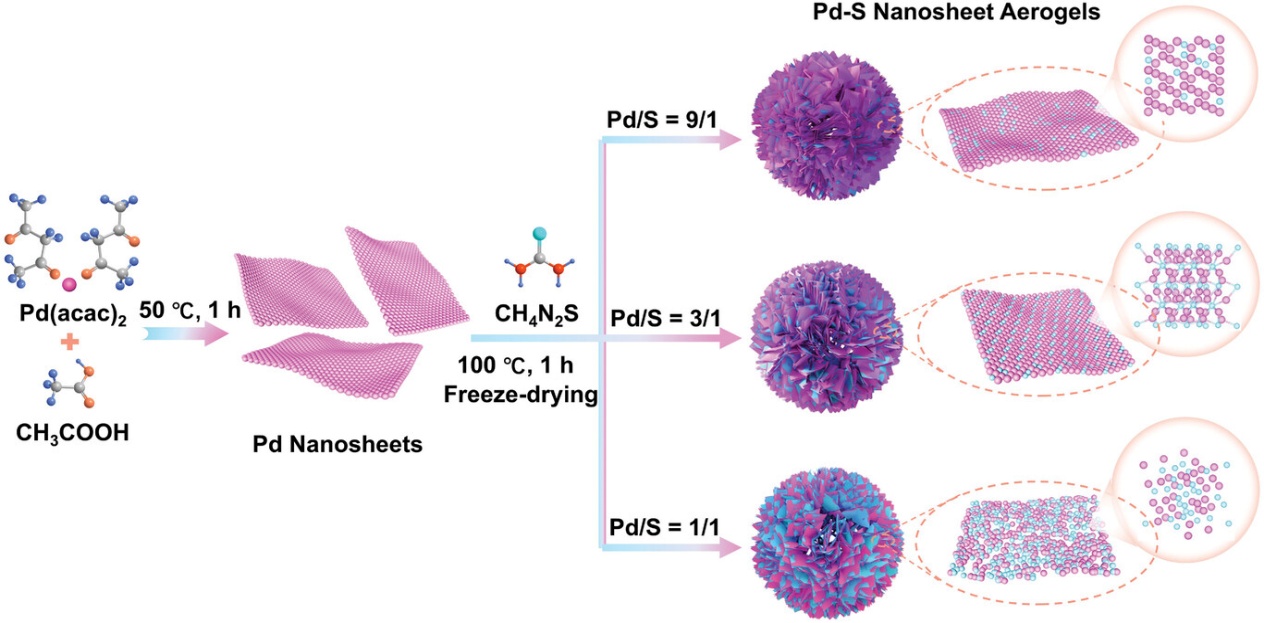
| Pd3S NAs | 1.0 mol/L KOH, 0.5 mol/L EG | — | 83.6/0.87 V vs. RHE | — | [ |
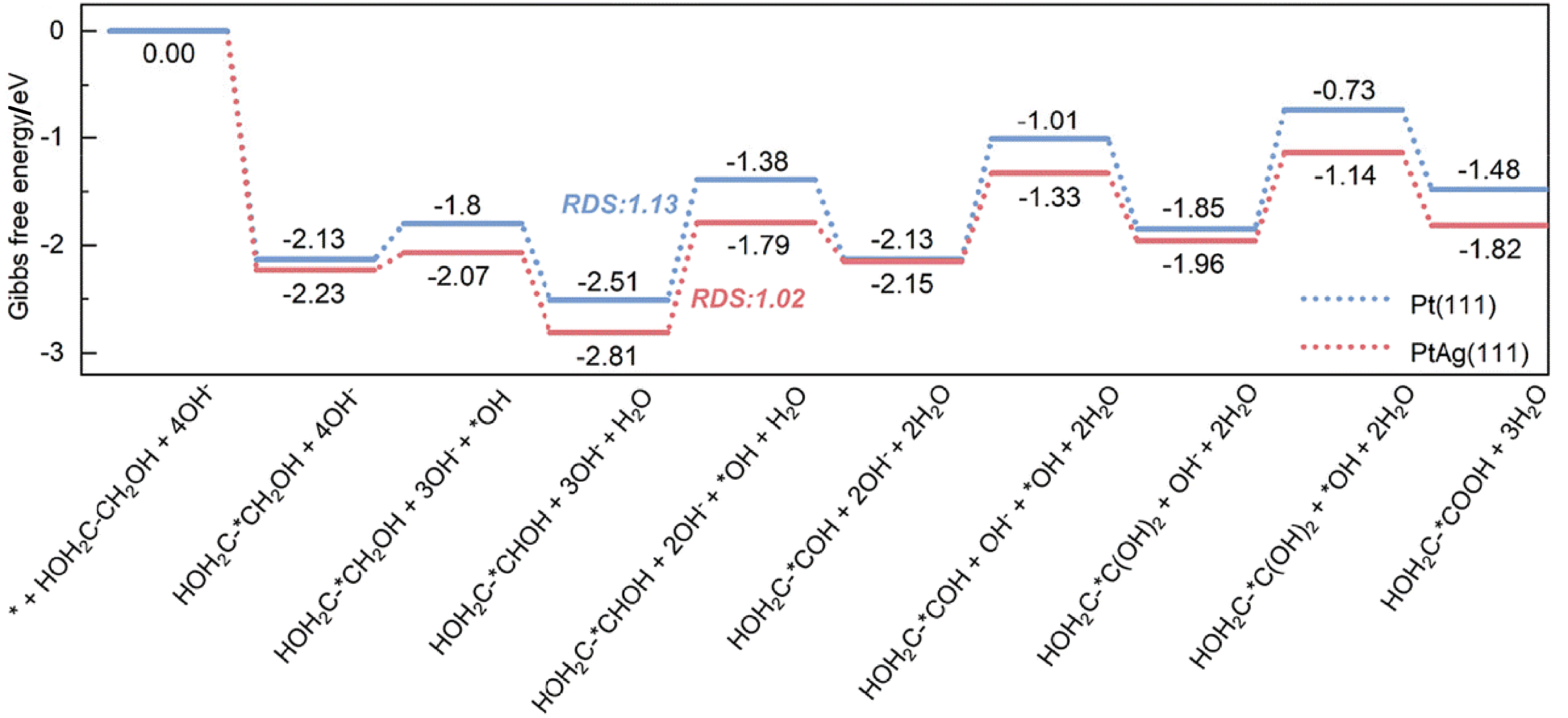
| PtAg/NF | 1.0 mol/L KOH, 1.0 mol/L EG | 0.80/264 mA/cm2 | 95.7/0.70 V vs. RHE | — | [ |
| Pt-Ni(OH)2/NF | 1.0 mol/L KOH, 1.0 mol/L EG | 0.61/100 mA/cm2 | 90.1/0.80 V vs. RHE | — | [ |
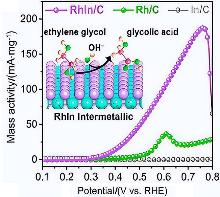
| RhIn/C | 3.0 mol/L KOH, 0.3 mol/L EG | — | 75.4/0.65 V vs. RHE | 85.0/0.65 V vs. RHE | [ |
| Co-Ni/CP | 1.0 mol/L KOH, 1.0 mol/L EG | — | 91/1.4 V vs. RHE | 96.3/150 mA/cm2 | [ |
| CoO/CFP | 1.0 mol/L KOH, 0.1 mol/L EG | 1.39/10 mA/cm2 | — | — | [ |
| Ni1-Fe1-N-C | 1.0 mol/L KOH, 1.0 mol/L EG | 0.77/100 mA/cm2 | >90.0/50~500 C | >90.0/500 C | [ |
| Catalyst | Reaction condition | Working electrode potential/ (V vs. RHE) | FE/% | GA selectivity/% | Ref. |
|---|---|---|---|---|---|
| Pd1Ag1 NPs | 1.0 mol/L KOH, 1.0 mol/L EG | 0.85/50 mA/mg Pd | — | 97.0/0.75 V vs. RHE | [ |
| PdSb bimeallene | 1.0 mol/L KOH, 0.1 mol/L EG | 0.60/10 mA/cm2 | — | — | [ |
| PdSn metallene | 4.0 mol/L KOH, 2.3 mol/L EG | 0.90/100 mA/cm2 | 92.5/0.97 V vs. RHE | — | [ |
| PdCu MCs | 1 mol/L KOH, strongly alkaline hydrolysate of PET | — | 93.6/0.83 V vs. RHE | — | [ |
| PdBi/NF | 1.0 mol/L KOH, 0.5 mol/L EG | — | >99.0 | — | [ |
| PdAgPt/Co | 3.0 mol/L KOH, 2.0 mol/L EG | — | — | 93.6/200 A/m2 | [ |
| Pd-CuCo2O4 | 1.0 mol/L NaOH, 0.5 mol/L NaCl, 1.0 mol/L EG | 0.80/200 mA/cm2 | 96.1/0.90 V vs. RHE | — | [ |
| Pd/Ni(OH)2/NF | 1.0 mol/L KOH, 1.0 mol/L EG | 0.53/10 mA/cm2 | 94.2/1.20 V vs. RHE | — | [ |
| Pd/a-Fe2O3 | 1.0 mol/L KOH, 0.5 mol/L EG | 0.85/6.83 A/mg Pd | — | 93.8/6.83 A/mg Pd | [ |
| Pd-CoCr2O4 | 5.0 mol/L NaOH, 2.0 mol/L EG | 1.25/290 mA/cm2 | — | 94.5/1.25 V vs. RHE | [ |
| Pd/NiMoO4/NF | 1.0 mol/L NaOH, 1.0 mol/L EG | 0.79/100 mA/cm2 | 95.7/1.00 V vs. RHE | — | [ |
| Pd-Co3O4/NF | 1.0 mol/L KOH, 1.0 mol/L EG | 0.72/100 mA/cm2 | 93.1/0.90 V vs. RHE | — | [ |
| Pd-Ni(OH)2/NF | 1.0 mol/L KOH, 1.0 mol/L EG | 0.69/100 mA/cm2 | 94.1/1.00 V vs. RHE | 91.6/1.00 V vs. RHE | [ |
| Pd3S NAs | 1.0 mol/L KOH, 0.5 mol/L EG | — | 83.6/0.87 V vs. RHE | — | [ |
| PtAg/NF | 1.0 mol/L KOH, 1.0 mol/L EG | 0.80/264 mA/cm2 | 95.7/0.70 V vs. RHE | — | [ |
| Pt-Ni(OH)2/NF | 1.0 mol/L KOH, 1.0 mol/L EG | 0.61/100 mA/cm2 | 90.1/0.80 V vs. RHE | — | [ |
| RhIn/C | 3.0 mol/L KOH, 0.3 mol/L EG | — | 75.4/0.65 V vs. RHE | 85.0/0.65 V vs. RHE | [ |
| Co-Ni/CP | 1.0 mol/L KOH, 1.0 mol/L EG | — | 91/1.4 V vs. RHE | 96.3/150 mA/cm2 | [ |
| CoO/CFP | 1.0 mol/L KOH, 0.1 mol/L EG | 1.39/10 mA/cm2 | — | — | [ |
| Ni1-Fe1-N-C | 1.0 mol/L KOH, 1.0 mol/L EG | 0.77/100 mA/cm2 | >90.0/50~500 C | >90.0/500 C | [ |
| Catalyst type | Catalyst | Reaction conditions | Light source | EG conversion/% | GA yield/% | Ref. |
|---|---|---|---|---|---|---|
| Non-metallic photocatalyst | CPDs-CN | Vacuum, 1.0 mol/L KOH | Xenon lamp | — | — | [ |
| B-g-C3N4NT | Argon, 0.1 mol/L NaOH | Xenon lamp | 7.8 | — | [ | |
| Metallic photocatalyst | Cu-Pt/ZrO2 | Air, alkali-free | Visible light | 94.8 | 72.0 | [ |
| Au-Pt/ZrO2 | Air, alkali-free | Xenon lamp | — | 76.9 | [ |
| Catalyst type | Catalyst | Reaction conditions | Light source | EG conversion/% | GA yield/% | Ref. |
|---|---|---|---|---|---|---|
| Non-metallic photocatalyst | CPDs-CN | Vacuum, 1.0 mol/L KOH | Xenon lamp | — | — | [ |
| B-g-C3N4NT | Argon, 0.1 mol/L NaOH | Xenon lamp | 7.8 | — | [ | |
| Metallic photocatalyst | Cu-Pt/ZrO2 | Air, alkali-free | Visible light | 94.8 | 72.0 | [ |
| Au-Pt/ZrO2 | Air, alkali-free | Xenon lamp | — | 76.9 | [ |
| Catalytic system | Microorganism species | Reaction condition | Coenzyme and concentration | EG bioconversion efficiency/% | GA concentration/ (g•L-1) | Ref. |
|---|---|---|---|---|---|---|
| Resting cell | Gluconobacter oxydans NL71 | 30 ℃, pH=5.0 | 1 g/L D-sorbitol | — | 74.3 | [ |
| Gluconobacter oxydans NL71 | 30 ℃, pH=5.5~6.5 | 1 g/L D-sorbitol | — | — | [ | |
| Gluconobacter oxydans CCT 0552 | 28 ℃, pH=5.5~6.5 | 1 g/L mannitol | 97.3 | 94.2 | [ | |
| Living cell | Escherichia coli YF2G*GA3 | 37 ℃, pH≈7.0 | — | — | 11.0 | [ |
| Catalytic system | Microorganism species | Reaction condition | Coenzyme and concentration | EG bioconversion efficiency/% | GA concentration/ (g•L-1) | Ref. |
|---|---|---|---|---|---|---|
| Resting cell | Gluconobacter oxydans NL71 | 30 ℃, pH=5.0 | 1 g/L D-sorbitol | — | 74.3 | [ |
| Gluconobacter oxydans NL71 | 30 ℃, pH=5.5~6.5 | 1 g/L D-sorbitol | — | — | [ | |
| Gluconobacter oxydans CCT 0552 | 28 ℃, pH=5.5~6.5 | 1 g/L mannitol | 97.3 | 94.2 | [ | |
| Living cell | Escherichia coli YF2G*GA3 | 37 ℃, pH≈7.0 | — | — | 11.0 | [ |
| Catalytic trategy | Reaction conditions | Scope of application | Technical maturity | Limitations |
|---|---|---|---|---|
| Thermal catalysis | Harsh reaction conditions involving high temperature, high pressure, and O2 as the oxidant; alkaline media and noble-metal-based catalytic systems are commonly employed. | Suitable for the large-scale selective conversion of high- concentration ethylene glycol feedstocks, with a balance bet- ween conversion efficiency and space-time yield. | Currently the mainstream industrial route for converting ethy- lene glycol to glycolic acid, with a high level of technological maturity. | High energy consumption and severe side reactions; catalysts are prone to deactivation due to coking or leaching of active components. |
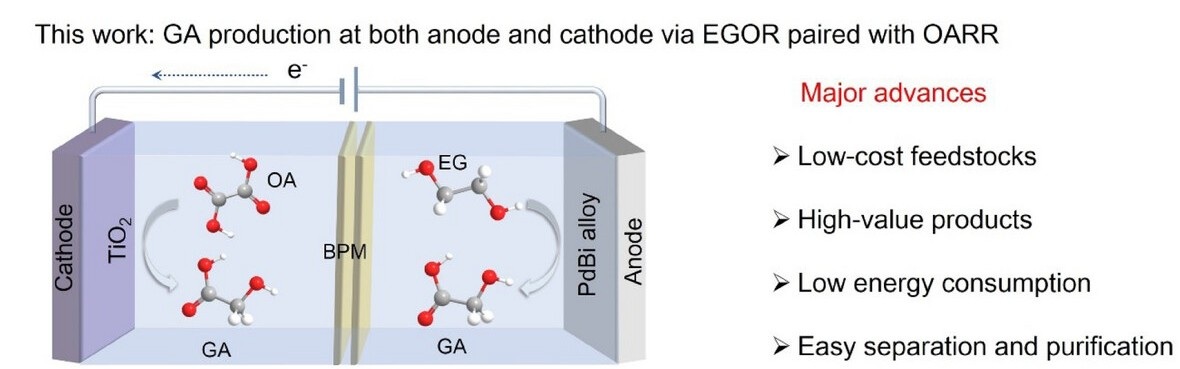
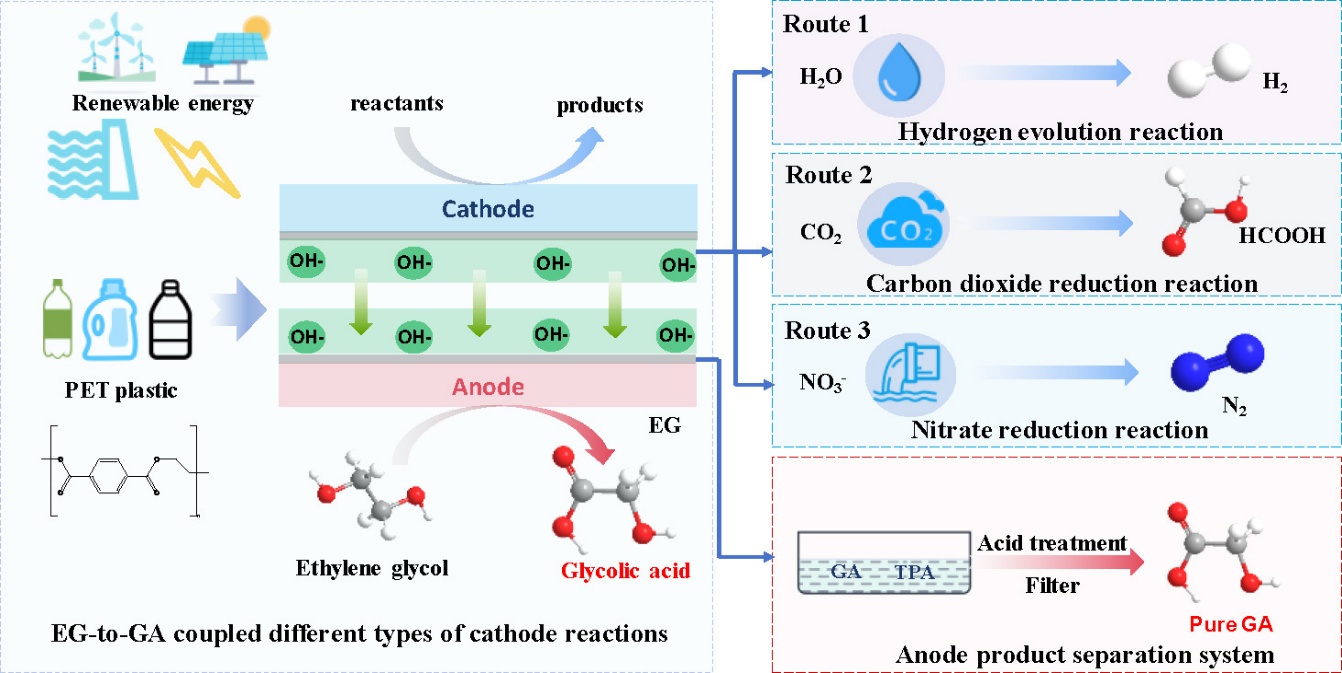
| Electrocatalysis | Operates under ambient tem- perature and pressure, typically using alkaline media and noble-metal-based catalysts. | Green and mild reaction conditions with potential integration with renewable energy sources such as solar and wind power. Different cathodic reactions can also be flexibly coupled to enable process intensification and diversified product generation ( | At a critical stage of transition from pilot- scale demonstration to industrialization. Sma- ll-scale production has been validated, showing promising prospects for practical application. | Insufficient long-term catalyst stability; metal leaching and agglomeration may occur at high potentials. The achievable current density remains to be improved, and overall energy consumption requires further optimization. The relatively high cost of electrode fabrication also limits large-scale deployment. |
| Photocatalysis | Driven by simulated or natural sunlight under ambient temperature and pressure. Semiconductor photocatalysts serve as the core catalytic materials, without the need for externally added oxidants. | Green and mild reaction conditions, suitable for the low-car- bon selective conversion of low-concentration ethylene glycol feed-stocks. | At the laboratory re- search stage. | Semiconductor materials generally have a narrow light-absorption range and low solar-energy utilization efficiency. Rapid recombination of photogenerated charge carriers leads to relatively low quantum efficiency. The overall reaction rate is relatively slow, making large-scale application challenging. |
| Enzymatic catalysis | Operates under ambient temperature and pressure and mild physiological conditions (pH 6~8, 25~40 °C), without the need for externally added oxidants. | Suitable for the synthesis of high-purity glycolic acid, offering excellent selectivity and substrate specificity. | At the laboratory re- search and small- scale production stages. | Enzyme stability is highly sensitive to temperature, pH, and substrate concentration, and enzymes are prone to deactivation during long- term operation. Low substrate tolerance limits the treatment of high- concentration ethylene glycol feedstocks. The overall reaction rate is relatively slow, and catalytic efficiency requires further improvement. |
| Catalytic trategy | Reaction conditions | Scope of application | Technical maturity | Limitations |
|---|---|---|---|---|
| Thermal catalysis | Harsh reaction conditions involving high temperature, high pressure, and O2 as the oxidant; alkaline media and noble-metal-based catalytic systems are commonly employed. | Suitable for the large-scale selective conversion of high- concentration ethylene glycol feedstocks, with a balance bet- ween conversion efficiency and space-time yield. | Currently the mainstream industrial route for converting ethy- lene glycol to glycolic acid, with a high level of technological maturity. | High energy consumption and severe side reactions; catalysts are prone to deactivation due to coking or leaching of active components. |
| Electrocatalysis | Operates under ambient tem- perature and pressure, typically using alkaline media and noble-metal-based catalysts. | Green and mild reaction conditions with potential integration with renewable energy sources such as solar and wind power. Different cathodic reactions can also be flexibly coupled to enable process intensification and diversified product generation ( | At a critical stage of transition from pilot- scale demonstration to industrialization. Sma- ll-scale production has been validated, showing promising prospects for practical application. | Insufficient long-term catalyst stability; metal leaching and agglomeration may occur at high potentials. The achievable current density remains to be improved, and overall energy consumption requires further optimization. The relatively high cost of electrode fabrication also limits large-scale deployment. |
| Photocatalysis | Driven by simulated or natural sunlight under ambient temperature and pressure. Semiconductor photocatalysts serve as the core catalytic materials, without the need for externally added oxidants. | Green and mild reaction conditions, suitable for the low-car- bon selective conversion of low-concentration ethylene glycol feed-stocks. | At the laboratory re- search stage. | Semiconductor materials generally have a narrow light-absorption range and low solar-energy utilization efficiency. Rapid recombination of photogenerated charge carriers leads to relatively low quantum efficiency. The overall reaction rate is relatively slow, making large-scale application challenging. |
| Enzymatic catalysis | Operates under ambient temperature and pressure and mild physiological conditions (pH 6~8, 25~40 °C), without the need for externally added oxidants. | Suitable for the synthesis of high-purity glycolic acid, offering excellent selectivity and substrate specificity. | At the laboratory re- search and small- scale production stages. | Enzyme stability is highly sensitive to temperature, pH, and substrate concentration, and enzymes are prone to deactivation during long- term operation. Low substrate tolerance limits the treatment of high- concentration ethylene glycol feedstocks. The overall reaction rate is relatively slow, and catalytic efficiency requires further improvement. |
| [1] |
|
| [2] |
|
|
(张亦伟, 陈艺林, 方霄龙, 袁友珠, 朱红平, 有机化学, 2017, 37, 2275.)
|
|
| [3] |
|
| [4] |
|
| [5] |
|
| [6] |
|
|
(方霄龙, 段宁, 章敏, 李斌, 有机化学, 2020, 40, 2692.)
|
|
| [7] |
|
| [8] |
|
| [9] |
|
|
(郭琛龙, 彭正奇, 姜冰雪, 吴正凯, 王德良, 王青月, 郑杰元,
|
|
| [10] |
|
| [11] |
|
| [12] |
|
| [13] |
|
| [14] |
|
| [15] |
|
| [16] |
|
|
(程金宇, 李晓敏, 刘佳, 高聪, 刘立明, 生物工程学报, 2025, 41, 1959.)
|
|
| [17] |
|
|
(江甜, 刘华伟, 天然气化工, 2022, 47, 15.)
|
|
| [18] |
|
| [19] |
|
| [20] |
|
| [21] |
|
| [22] |
|
| [23] |
|
| [24] |
|
| [25] |
|
| [26] |
|
| [27] |
|
| [28] |
|
| [29] |
|
| [30] |
|
| [31] |
|
| [32] |
|
| [33] |
|
| [34] |
|
| [35] |
|
| [36] |
|
| [37] |
|
| [38] |
|
| [39] |
|
| [40] |
|
| [41] |
|
| [42] |
|
| [43] |
|
| [44] |
|
| [45] |
|
| [46] |
|
| [47] |
|
| [48] |
|
| [49] |
|
| [50] |
|
| [51] |
|
| [52] |
|
| [53] |
|
| [54] |
|
| [55] |
|
| [56] |
|
| [57] |
|
| [58] |
|
| [59] |
|
| [60] |
|
| [61] |
|
| [62] |
|
| [63] |
|
| [64] |
|
| [65] |
|
| [66] |
|
| [67] |
|
| [68] |
|
| [69] |
|
| [70] |
|
| [71] |
|
| [72] |
|
| [73] |
|
| [74] |
|
| [75] |
|
| [76] |
|
| [77] |
|
| [78] |
|
| [79] |
|
| [1] | 冯亚栋, 毕寺恒, 唐明清, 吴养洁, 皮超. 紫外光驱动的芳香醛与邻氨基苯甲酰胺构建喹唑啉酮化合物[J]. 有机化学, 2026, 46(8): 3114-3122. |
| [2] | 王力卓, 刘馨忆, 宋戈洋, 石晓莉, 薛东. 光激发丰产金属镍催化卤代芳烃与磺酰胺的C(sp2)—N偶联反应[J]. 有机化学, 2026, 46(7): 2835-2852. |
| [3] | 陈安, 王泽艺, 李万梅, 徐骏. 光驱动一步法合成双碳取代双环[1.1.1]戊烷研究进展[J]. 有机化学, 2026, 46(6): 2177-2192. |
| [4] | 许颖, 杨美琳, 崔大鹏, 于淼, 刘颖杰. 脱氟反应的研究进展[J]. 有机化学, 2026, 46(5): 1962-1983. |
| [5] | 赵子鸣, 郑剑峰, 黄培强. 光催化的由亚胺合成胺的研究进展[J]. 有机化学, 2026, 46(5): 1984-2001. |
| [6] | 戴乐薇, 王建玲, 邹东. 芳胺对位C(sp2)—H键官能团化研究进展[J]. 有机化学, 2026, 46(5): 1813-1844. |
| [7] | 程熹, 李雅琳, 吴鹏, 苏敏, 张梓轩, 焦民均, 刘雪粉, 罗书平. 蒽醌光敏剂设计合成与光催化C(sp3)—H氧化反应性能研究[J]. 有机化学, 2026, 46(5): 2104-2111. |
| [8] | 侯馨怡, 史同同, 李泽江, 董庆昊, 孙凯, 王薪. 可见光诱导的磷酰化环化合成磷酰基取代的吲哚并二氮䓬[J]. 有机化学, 2026, 46(4): 1776-1787. |
| [9] | 郑婧斐, 吕琪妍, 孙凯, 陈晓岚, 屈凌波, 王金泉, 於兵. 自由基介导的6-氮杂尿嘧啶官能团化研究进展[J]. 有机化学, 2026, 46(4): 1603-1620. |
| [10] | 赵雨晴, 朱先进, 石凌宇, 魏鸣宇, 徐紫涵, 石永佳, 李旭锋, 杨道山. 环硫鎓盐开环官能化反应的研究进展[J]. 有机化学, 2026, 46(4): 1572-1602. |
| [11] | 张皓然, 贾均松, 俞琼, 吴宇, 李玉龙, 舒伟. 可见光催化烯烃的氢胺化和氢(磺)酰胺化反应[J]. 有机化学, 2026, 46(4): 1166-1180. |
| [12] | 杨珊, 陈亚苏, 朱晨. 自由基介导的官能团迁移-环化构建含氮稠杂芳烃[J]. 有机化学, 2026, 46(4): 1739-1749. |
| [13] | 卢琳玉, 亓雨彤, 张庭珲, 金胜男, 曹中艳, 张洪伟. 自由基介导烯烃的1,2,n-三官能团化反应研究进展[J]. 有机化学, 2026, 46(4): 1540-1559. |
| [14] | 唐玉青, 杨紫娴, 杨兵, 王毅, 杜炳南. 球磨条件下机械力驱动的自由基反应研究进展[J]. 有机化学, 2026, 46(4): 1111-1145. |
| [15] | 董建洋, 薛东. 自由基途径的[1.1.1]螺桨烷官能化研究进展[J]. 有机化学, 2026, 46(4): 1464-1480. |
| 阅读次数 | ||||||
|
全文 |
|
|||||
|
摘要 |
|
|||||


