


1 Introduction
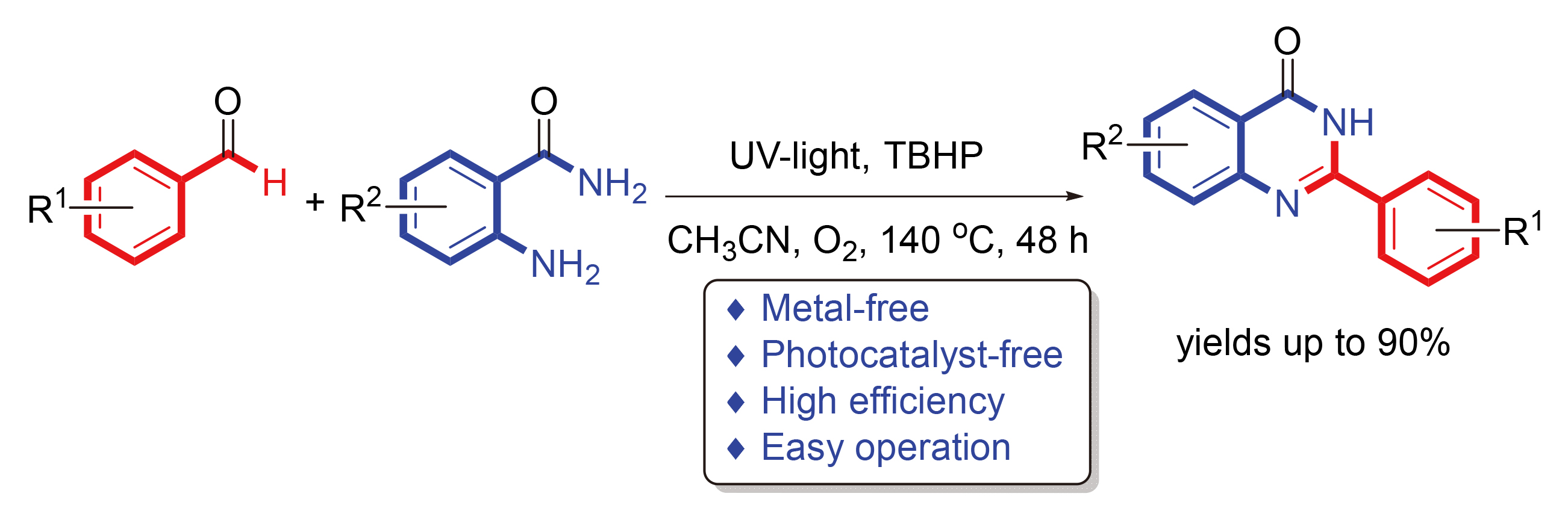
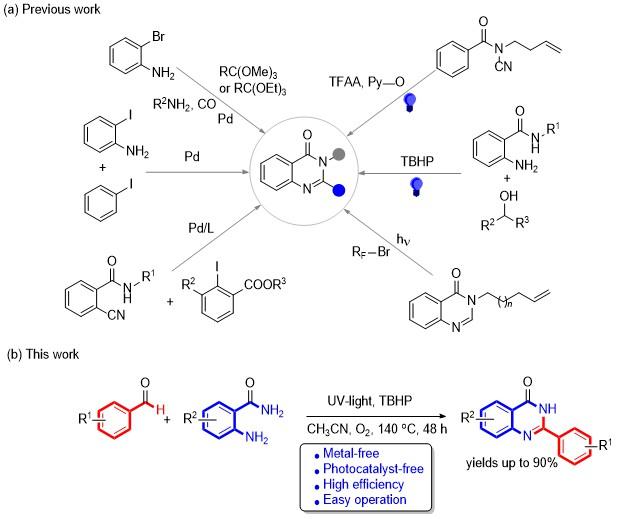
Quinazolinones constitute an important class of nitrogen-containing heterocycles that display a broad spectrum of biological and pharmacological activities, including antitumor, antibacterial, anti-inflammatory, and antiviral effects.[1] In addition to their pharmaceutical relevance, quinazolinone derivatives have found widespread applications in agrochemicals and materials science.[2] Consequently, there has been growing interest in the development of synthetic methodologies for quinazolinones. Classical approaches to quinazolinones typically rely on cyclocondensation reactions of o-aminobenzoic acids with amide-type substrates, exemplified by the Niementowski reaction.[3] Recently, transition-metal-catalyzed C—H activation and related catalytic transformations have emerged as powerful alternatives.[4] For instance, Wu and co- workers[5] reported a palladium-catalyzed four-component carbonylative coupling protocol to access diverse 4(3H)- quinazolinones in a concise and convergent manner from 2-bromoanilines, trimethyl orthoformate, and amines under carbon monoxide. Zhu and co-workers[6] developed a Pd- catalyzed imidoylative cycloamidation of N-alkyl-2-iso- cyanobenzamides with 2,6-disubstituted aryl iodides, furnishing axially chiral 2-arylquinazolinones with good yields and high atroposelectivities. In 2024, Das and co- workers[7] disclosed a heterogeneous Pd/C-catalyzed, one- step four-component double carbonylation cascade to synthesize 2-arylquinazolinones from 2-iodoanilines and aryl iodides. In parallel, photoinduced radical processes have emerged as attractive platforms for quinazolinone synthesis because of their operational simplicity and potential sustainability advantages. For example, Le and co- workers[8] developed a visible-light-induced tandem strategy to construct quinazolinones using in situ formed aldehydes under photocatalyst-free conditions at room temperature. Hu and co-workers[9] reported a photosensitizer-free radical cascade to access CF3-containing polycyclic quina-zolinones under visible-light irradiation. Similarly, Yu and co-workers[10] described a photo-triggered self-catalyzed fluoroalkylation/cyclization of unactivated alkenes to afford quinazolinones bearing CF2R group. Despite these advances (Scheme 1, a), the development of greener, more efficient, and simpler methodologies for quinazolinone synthesis remains highly desirable. As part of our continuing interest in green and straightforward strategies for the synthesis and functionalization of quinazolinones,[11] we herein report a photocatalyst-free, metal-free radical coupling/cyclization between aryl aldehydes and anthranilamides enabled by UV irradiation and tert-butyl hydroperoxide (TBHP) (Scheme 1, b). This protocol exhibits broad substituent tolerance on both aromatic components and provides a practical and environmentally benign approach to 2-arylquinazolinones of potential pharmaceutical interest, while avoiding transition metals and external photocatalysts.
2 Results and discussion
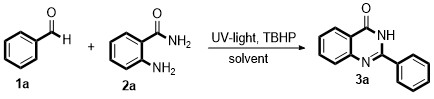
Initially, benzaldehyde (1a) and 2-aminobenzamide (2a) were chosen as model substrates to optimize the reaction conditions (Table 1). To our delight, under UV-light irradiation (λmax=365 nm, 100 W) in O2, using CH3CN as the solvent and t-BuOOH (2.0 equiv.) as the radical initiator, 2-phenylquinazolin-4(3H)-one (3a) was obtained as the main product in 25% yield at 120 ℃ (Table 1, Entry 1). Only trace of 3a was obtained when the reaction was carried out without UV-light (Table 1, Entry 2). In the pre-sence of air and nitrogen, the yield of 3a was reduced to 12% and trace amounts, respectively, highlighting the crucial role of O2 in promoting the reaction (Table 1, Entries 3, 4). When the UV-light wavelength was changed to 254 nm, the reaction did not proceed effectively (Table 1, Entry 5). Increasing the UV-light power to 200, 250, 300 and 400 W resulted in yields of 28%, 33%, 32%, and 30%, respectively (Table 1, Entries 6~9). The reaction did not proceed without the addition of a radical initiato (Table 1, Entry 10). Other radical initiators, including di-tert-butyl peroxide (DTBP), benzoyl peroxide (BPO), tert-butyl peroxide (TBPO), tert-butyl perbenzoate (TBPB), and benzoyl peroxide (BP), were also ineffective in improving the yield (Table 1, Entries 11~15). Various other solvents, such as methanol, dichloroethylene (DCE), dimethylformamide (DMF), dimethyl sulfoxide (DMSO), and toluene, did not significantly enhance the yield either (Table 1, Entries 16~20). Through further optimization of reaction temperature, it was found that increasing the temperature to 140 ℃ improved the yield of 3a to 78% (Table 1, Entry 24 vs Entries 21~23). However, no further improvement was observed at higher temperatures (Table 1, Entries 25, 26). When the reaction time is adjusted to 48 h, the yield of 3a was increased to 90% (Table 1, Entry 31). Longer or shorter reaction times resulted in decreased yields (Table 1, Entry 31 vs Entries 27~30 and 32). Based on the results, the optimal reaction conditions were identified as follows: CH3CN solvent, 140 ℃, t-BuOOH (TBHP, 2.0 equiv.) radical initiator, UV-light (λmax=365 nm, 250 W), O2, 48 h (Table 1, Entry 31).
Table 1 Optimization of reaction conditionsa |
| Entry | λmax/nm | P/W | Initiator (Dosage/equiv.) | Solvent | T/℃ | t/h | Yieldb/% |
|---|---|---|---|---|---|---|---|
| 1 | 365 | 100 | TBHP (2.0) | CH3CN | 120 | 24 | 25 |
| 2 | — | — | TBHP (2.0) | CH3CN | 120 | 24 | Trace |
| 3c | 365 | 100 | TBHP (2.0) | CH3CN | 120 | 24 | 12 |
| 4d | 365 | 100 | TBHP (2.0) | CH3CN | 120 | 24 | Trace |
| 5 | 254 | 100 | TBHP (2.0) | CH3CN | 120 | 24 | Trace |
| 6 | 365 | 200 | TBHP (2.0) | CH3CN | 120 | 24 | 28 |
| 7 | 365 | 250 | TBHP (2.0) | CH3CN | 120 | 24 | 33 |
| 8 | 365 | 300 | TBHP (2.0) | CH3CN | 120 | 24 | 32 |
| 9 | 365 | 400 | TBHP (2.0) | CH3CN | 120 | 24 | 30 |
| 10 | 365 | 250 | — | CH3CN | 120 | 24 | nd |
| 11 | 365 | 250 | DTBP (2.0) | CH3CN | 120 | 24 | nd |
| 12 | 365 | 250 | BPO (2.0) | CH3CN | 120 | 24 | nd |
| 13 | 365 | 250 | TBPO (2.0) | CH3CN | 120 | 24 | nd |
| 14 | 365 | 250 | TBPB (2.0) | CH3CN | 120 | 24 | 21 |
| 15 | 365 | 250 | BP (2.0) | CH3CN | 120 | 24 | 10 |
| 16 | 365 | 250 | TBHP (2.0) | CH3OH | 120 | 24 | nd |
| 17 | 365 | 250 | TBHP (2.0) | DCE | 120 | 24 | 18 |
| 18 | 365 | 250 | TBHP (2.0) | DMF | 120 | 24 | Trace |
| 19 | 365 | 250 | TBHP (2.0) | DMSO | 120 | 24 | nd |
| 20 | 365 | 250 | TBHP (2.0) | Toluene | 120 | 24 | 16 |
| 21 | 365 | 250 | TBHP (2.0) | CH3CN | 100 | 24 | Trace |
| 22 | 365 | 250 | TBHP (2.0) | CH3CN | 110 | 24 | 30 |
| 23 | 365 | 250 | TBHP (2.0) | CH3CN | 130 | 24 | 56 |
| 24 | 365 | 250 | TBHP (2.0) | CH3CN | 140 | 24 | 78 |
| 25 | 365 | 250 | TBHP (2.0) | CH3CN | 150 | 24 | 75 |
| 26 | 365 | 250 | TBHP (2.0) | CH3CN | 160 | 24 | 70 |
| 27 | 365 | 250 | TBHP (2.0) | CH3CN | 140 | 18 | 55 |
| 28 | 365 | 250 | TBHP (2.0) | CH3CN | 140 | 30 | 82 |
| 29 | 365 | 250 | TBHP (2.0) | CH3CN | 140 | 36 | 85 |
| 30 | 365 | 250 | TBHP (2.0) | CH3CN | 140 | 42 | 87 |
| 31 | 365 | 250 | TBHP (2.0) | CH3CN | 140 | 48 | 90 |
| 32 | 365 | 250 | TBHP (2.0) | CH3CN | 140 | 54 | 89 |
a Reaction conditions: 1a (0.30 mmol), 2a (0.1 mmol), TBHP (70% solution in ethyl acetate), solvent (2.0 mL), O2. nd=not detected. b Isolated yields. c Air. d N2. |
Under the optimized reaction conditions, the scope of substrates was investigated and the results were shown in Table 2. o-Aminobenzamide with various substituents, such as methyl, fluorine, isopropyl, and methoxy, reacted smoothly with benzaldehyde to give the desired products (3b~3f) in moderate to good yields (72%~88%), which showed that the electron-withdrawing group (F) on o-aminobenzamide has a slight effect on the reaction, while the electron-donating group (methoxy) has almost no effect on the reaction. Meanwhile, the methyl group at either the 6-position or the 7-position of anthranilamide has little effect on the reaction. Benzaldehydes with methyl group at the ortho-, meta-, and para-position provided the corresponding products 3g~3i in 82%, 88% and 90% yields, respectively, which indicated that the steric effects of these substituents had a minimal influence on the transformation. Halogen substituted benzaldehyde (F, Cl, Br) at the 2- or 4-position provided the corresponding products 3j~3m in the yields ranging from 65% to 74%, which supports the possibility of further transformations of the quinazolinone products. Additionally, other groups, such as t-butyl, methoxy and N,N-dimethyl at the 4-position of benzaldehyde were well tolerated and gave the corresponding products (3n~3p) in 72%~82% yields. Furthermore, 1-naphthaldehyde and anthracene-9-carbalde- hyde were also react with o-aminobenzamide (2a) to provide the corresponding products 3q and 3r in 70% and 65% yields, respectively.
Table 2 Scope of substratesa,b |
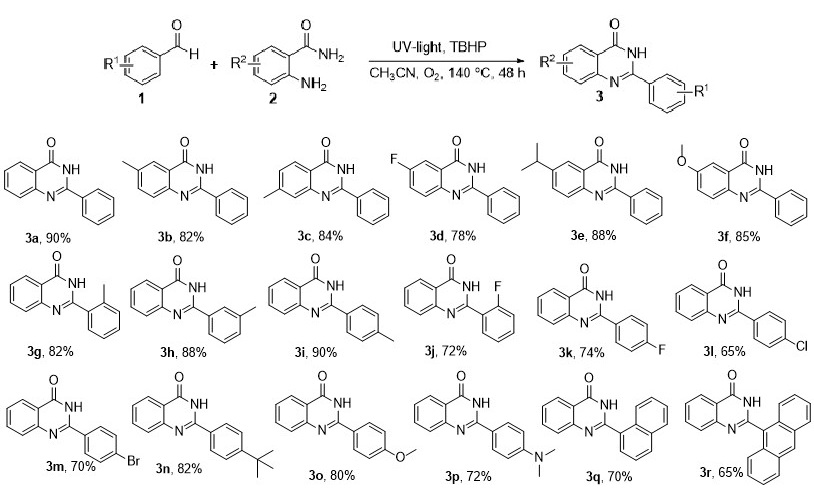 |
a Reaction conditions: 1 (0.30 mmol), 2 (0.1 mmol), UV-light (365 nm, 250 W), TBHP (2.0 equiv), solvent (2.0 mL), O2, 48 h. b Isolated yields. |
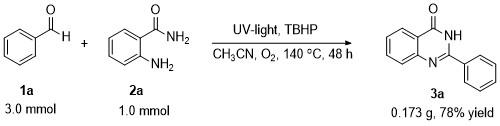
To demonstrate the practicality of the reaction, a 1.0 mmol-scale synthesis of compound 3a was performed. By using 3.0 mmol (0.318 g) of benzaldehyde (1a) and 1.0 mmol (0.136 g) of 2-aminobenzamide (2a), the corresponding product 3a was obtained in 78% (0.173 g) yield (Scheme 2), demonstrating the scalability of this reaction.
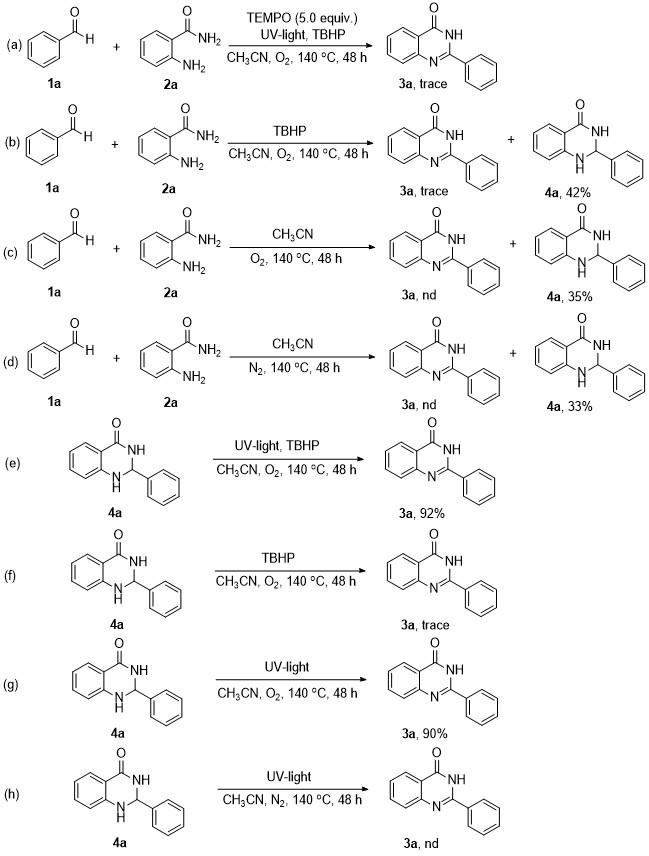
To elucidate the reaction mechanism, control experiments were carried out (Scheme 3). When 2,2,6,6-tetra- methylpiperidinooxy (TEMPO, 5.0 equiv.), a radical scavenger, was introduced under standard conditions, only trace amounts of the target product 3a was detected by gas chromatography (GC), confirming that the reaction proceeds via a radical pathway (Scheme 3, a). Additionally, in the absence of UV irradiation, the desired product 3a was not obtained, whereas the non-aromatized intermediate 4a was isolated in 42% yield, suggesting that 4a serves as a key intermediate in this reaction (Scheme 3, b). When either TBHP or oxygen was omitted from the reaction sys-tem, product 3a was still not formed, and the yields of 4a were 35% and 33%, respectively (Scheme 3, c and d). These results indicate that UV light, TBHP, and oxygen are all essential for the smooth progress of the overall reaction. When the presumed intermediate, 2-phenyl-2,3-dihy- droquinazolin-4(1H)-one (4a), was treated under standard conditions, the target product 3a was obtained in 92% yield, indicating that 4a is a key intermediate in the reaction (Scheme 3, e). Regarding the transformation of 4a to 3a, the reaction failed to proceed in the absence of either UV light or oxygen. In contrast, the conversion proceeded efficiently under UV irradiation in the presence of oxygen but without TBHP (Scheme 3, f, g and h), demonstrating that oxygen is indispensable for the dehydrogenative aromatization of 4a under UV light.
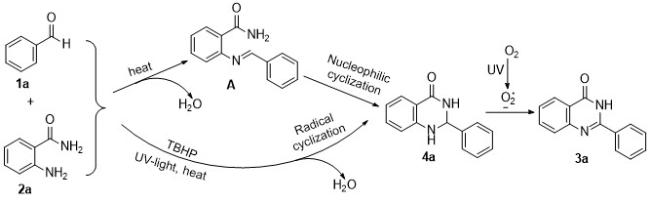
Based on the control experiments, the references and our previous work,[12] a plausible reaction mechanism was proposed as shown in Scheme 4. The formation of 2-phen- ylquinazolin-4(3H)-one (3a) may proceed through two distinct cyclization pathways starting from benzaldehyde (1a) and 2-aminobenzamide (2a), both converging at the common dihydroquinazolinone intermediate 4a, which subsequently undergoes oxidative aromatization to afford the final product. Under thermal conditions, condensation of 1a and 2a initially gives the Schiff base intermediate A. Subsequent intramolecular nucleophilic attack of the amide nitrogen on the imine carbon leads to cyclization, thereby furnishing intermediate 4a. Alternatively, under UV irradiation in the presence of TBHP, benzaldehyde (1a) undergoes oxidation and then reacts with 2-aminobenzamide (2a) to form the same intermediate 4a through a radical cyclization pathway. Subsequently, upon exposure to UV light in the presence of molecular oxygen, intermediate 4a undergoes oxidative dehydrogenative aromatization to furnish the fully aromatic quinazolinone product 3a.


3 Conclusions
In summary, we have developed a metal-free, UV-light- driven between aryl aldehydes and anthranilamides for the efficient synthesis of 2-arylquinazolinones. This transformation proceeds smoothly under ultraviolet irradiation without the need for any external photocatalyst. Notably, the protocol exhibits broad functional-group tolerance, accommodating both electron-donating and electron- withdrawing substituents on the aromatic rings with good efficiency. Overall, this method offers a simple and greener approach to access 2-arylquinazolinones with potential pharmaceutical relevance, while avoiding the use of transition-metal catalysts and photocatalysts. Further studies aimed at expanding the synthetic applications are currently underway in our laboratory.
4 Experimental section
4.1 General experimental information
All manipulations were conducted using standard Schlenk techniques under oxygen atmosphere. Unless otherwise stated, all commercial materials and solvents were used as received without further purification. 1H NMR and 13C NMR spectra were recorded on a Bruker 400 MHz spectrometer (1H NMR 400 MHz, 13C NMR 100 MHz) using Chloroform-d and DMSO-d6 as the solvent and tetramethylsilane (TMS) as the internal standard at room temperature. Chemical shifts are reported relative to tetramethylsilane (TMS) with the solvent resonance as the internal standard (Chloroform-d: δH 7.26, δC 77.2; DMSO-d6: δH 2.50, δC 39.5). Column chromatography was performed on silica gel (70~230 mesh ASTM) using the specified eluents. Thin-layer chromatography (TLC) was performed on silica gel 60 F254 plates (4 cm×15 cm, 0.2 mm thickness).
4.2 Experimental method
In a 20 mL oven-dried Schlenk tub, 1 (0.30 mmol), 2 (0.10 mmol), and TBHP (0.20 mmol) were added, followed by the addition of toluene (2.0 mL). The resulting mixture was stirred in an oil bath at 140 ℃ under UV- light (λmax=365 nm, 250 W) in an oxygen atmosphere for 48 h. The reaction was monitored by TLC. After the reaction was completed, the solution was quenched with 10.0 mL of H2O, then extracted with ethyl acetate (10.0 mL×3). The combined organic phases were washed with saturated sodium bicarbonate solution, dried over anhydrous sodium sulfate, filtered, and evaporated under reduced pressure. The crude product was purified by column chromatography on silica gel using an eluent of petroleum ether/ethyl acetate with a volume ratio changing from 10∶1 to 2∶1 to obtain the desired product 3.
2-Phenylquinazolin-4(3H)-one (3a):[11a] Eluent: petroleum ether/ethyl acetate (V∶V=5∶1). White solid, yield 90% (20.0 mg). 1H NMR (400 MHz, DMSO-d6) δ: 12.52 (s, 1H), 8.14~8.18 (m, 3H), 7.81~7.83 (m, 1H), 7.72~7.75 (m, 1H), 7.62~7.45 (m, 4H); 13C NMR (100 MHz, DMSO-d6) δ: 162.7, 152.8, 149.2, 135.1, 133.2, 131.9, 129.1, 128.2, 128.0, 127.0, 126.3, 121.5.
6-Methyl-2-phenylquinazolin-4(3H)-one (3b):[11a] Eluent: petroleum ether/ethyl acetate (V∶V=10∶1). White oil, yield 82% (19.4 mg). 1H NMR (400 MHz, DMSO-d6) δ: 12.45 (s, 1H), 8.15 (dd, J=7.8, 1.6 Hz, 2H), 8.03~7.86 (m, 1H), 7.64 (d, J=1.9 Hz, 2H), 7.54 (dt, J=8.6, 6.5 Hz, 3H), 2.45 (s, 3H); 13C NMR (100 MHz, DMSO-d6) δ: 162.6, 151.9, 147.2, 136.8, 136.4, 133.3, 131.7, 129.1, 128.1, 127.9, 125.7, 121.2, 21.3.
7-Methyl-2-phenylquinazolin-4(3H)-one (3c):[11a] Eluent: petroleum ether/ethyl acetate (V∶V=10∶1). White oil, yield 84% (19.8 mg). 1H NMR (400 MHz, DMSO-d6) δ: 12.42 (s, 1H), 8.34~8.12 (m, 2H), 8.03 (d, J=8.1 Hz, 1H), 7.69~7.48 (m, 4H), 7.33 (dd, J=8.1, 1.6 Hz, 1H), 2.53~2.37 (m, 4H); 13C NMR (100 MHz, DMSO-d6) δ: 162.6, 152.8, 149.3, 145.5, 133.3, 131.8, 129.1, 128.5, 128.2, 127.6, 126.2, 119.1, 21.8.
6-Fluoro-2-phenylquinazolin-4(3H)-one (3d):[11a] Eluent: petroleum ether/ethyl acetate (V∶V=10∶1). White oil, yield 78% (18.7 mg). 1H NMR (400 MHz, DMSO-d6) δ: 12.64 (s, 1H), 8.47~8.00 (m, 2H), 7.86~7.78 (m, 2H), 7.71 (td, J=8.7, 3.0 Hz, 1H), 7.62~7.44 (m, 3H); 13C NMR (100 MHz, DMSO-d6) δ: 162.1, 161.7, 159.2, 152.3, 146.1, 133.0, 131.9, 130.8 (d, J=8.3 Hz), 129.1, 128.2, 123.5 (d, J=24.1 Hz), 122.7 (d, J=8.2 Hz), 111.0 (d, J=23.3 Hz).
6-Isopropyl-2-phenylquinazolin-4(3H)-one (3e):[11a] Eluent: petroleum ether/ethyl acetate (V∶V=10∶1). White solid, yield 88% (23.2 mg). 1H NMR (400 MHz, DMSO-d6) δ: 12.47 (s, 1H), 8.23~8.08 (m, 2H), 8.05~7.95 (m, 1H), 7.78~7.40 (m, 5H), 3.06 (p, J=6.9 Hz, 1H), 1.26 (d, J=6.9 Hz, 6H); 13C NMR (100 MHz, DMSO-d6) δ: 162.8, 152.0, 147.5, 134.0, 133.2, 131.7, 129.0, 128.2, 128.1, 128.0, 127.0, 122.8, 121.2, 33.7, 24.2.
6-Methoxy-2-phenylquinazolin-4(3H)-one (3f):[1j] Eluent: petroleum ether/ethyl acetate (V∶V=2∶1). White solid, yield 85% (21.4 mg). 1H NMR (400 MHz, DMSO- d6) δ: 12.52 (s, 1H), 8.17 (dd, J=8.0, 1.7 Hz, 3H), 7.72 (s, 1H), 7.60~7.52 (m, 4H), 7.45 (dd, J=8.9, 3.0 Hz, 1H), 3.90 (s, 3H); 13C NMR (100 MHz, DMSO-d6) δ: 162.5, 158.2, 150.6, 143.7, 133.2, 131.5, 129.7, 129.0, 128.0, 124.6, 122.2, 106.3, 56.1.
2-(o-Tolyl)quinazolin-4(3H)-one (3g):[11a] Eluent: petroleum ether/ethyl acetate (V∶V=5∶1). White solid, yield 82% (19.4 mg). 1H NMR (400 MHz, DMSO-d6) δ: 12.43 (s, 1H), 8.15 (dd, J=8.0, 1.6 Hz, 1H), 7.82 (ddd, J=8.5, 7.0, 1.6 Hz, 1H), 7.67 (dd, J=8.3, 1.1 Hz, 1H), 7.57~7.46 (m, 2H), 7.42 (td, J=7.5, 1.5 Hz, 1H), 7.37~7.27 (m, 2H), 2.37 (s, 3H); 13C NMR (100 MHz, DMSO-d6) δ: 162.3, 154.9, 149.2, 136.6, 134.9, 134.7, 131.0, 130.4, 129.6, 127.8, 127.1, 126.3, 126.2, 121.4, 20.0.
2-(m-Tolyl)quinazolin-4(3H)-one (3h):[11a] Eluent: petroleum ether/ethyl acetate (V∶V=5∶1). White solid, yield 88% (20.7 mg). 1H NMR (400 MHz, DMSO-d6) δ: 12.46 (s, 1H), 8.14 (dd, J=7.9, 1.6 Hz, 1H), 8.01 (d, J=2.0 Hz, 1H), 7.96 (dd, J=7.2, 1.9 Hz, 1H), 7.82 (ddd, J=8.5, 7.0, 1.6 Hz, 1H), 7.73 (dd, J=8.1, 1.2 Hz, 1H), 7.51 (ddd, J=8.1, 7.0, 1.2 Hz, 1H), 7.46~7.34 (m, 2H), 2.40 (s, 3H); 13C NMR (100 MHz, DMSO-d6) δ: 162.7, 152.9, 149.2, 138.4, 135.1, 133.1, 132.5, 129.0, 128.8, 128.0, 127.0, 126.3, 125.4, 121.4, 21.4.
2-(p-Tolyl)quinazolin-4(3H)-one (3i):[11a] Eluent: petroleum ether/ethyl acetate (V∶V=5∶1). White solid, yield 90% (21.2 mg). 1H NMR (400 MHz, DMSO-d6) δ: 8.15 (dd, J=7.9, 1.5 Hz, 1H), 8.12~8.01 (m, 2H), 7.83 (ddd, J=8.4, 7.1, 1.6 Hz, 1H), 7.73 (dd, J=8.3, 1.1 Hz, 1H), 7.51 (ddd, J=8.1, 7.0, 1.2 Hz, 1H), 7.36 (d, J=8.1 Hz, 2H), 2.40 (s, 4H); 13C NMR (100 MHz, DMSO-d6) δ: 162.8, 152.8, 141.9, 135.0, 130.3, 129.7, 128.2, 127.8, 126.9, 126.3, 121.3, 21.5.
2-(2-Fluorophenyl)quinazolin-4(3H)-one (3j):[1h] Eluent: petroleum ether/ethyl acetate (V∶V=10∶1). White solid, yield 72% (17.3 mg). 1H NMR (400 MHz, DMSO-d6) δ: 12.59 (s, 1H), 8.18 (dd, J=8.0, 1.5 Hz, 1H), 7.86 (t, J=7.6 Hz, 1H), 7.79 (t, J=7.7 Hz, 1H), 7.74 (d, J=8.0 Hz, 1H), 7.60 (dt, J=19.0, 7.1 Hz, 2H), 7.44~7.33 (m, 2H); 13C NMR (100 MHz, DMSO-d6) δ: 161.9, 150.4, 149.1, 135.1, 133.3 (d, J=8.5 Hz), 131.49 (d, J=2.2 Hz), 128.0, 127.5, 126.3, 125.1 (d, J=3.4 Hz), 122.7 (d, J=13.0 Hz), 121.6, 116.6 (d, J=21.3 Hz).
2-(4-Fluorophenyl)quinazolin-4(3H)-one (3k):[11a] Eluent: petroleum ether/ethyl acetate (V∶V=10∶1). White solid, yield 74% (17.8 mg). 1H NMR (400 MHz, DMSO- d6) δ: 8.26 (dd, J=9.0, 5.4 Hz, 2H), 8.16 (dd, J=7.9, 1.5 Hz, 1H), 7.84 (ddd, J=8.4, 7.1, 1.6 Hz, 1H), 7.74 (dd, J=8.2, 1.1 Hz, 1H), 7.53 (ddd, J=8.1, 7.1, 1.2 Hz, 1H), 7.40 (t, J=8.9 Hz, 2H); 13C NMR (100 MHz, DMSO-d6) δ: 165.7, 163.3, 162.7, 151.9, 149.0, 135.1, 130.8 (d, J=9.0 Hz), 129.7 (d, J=2.9 Hz), 127.8, 127.1, 126.3, 121.3, 116.1 (d, J=21.9 Hz).
2-(4-Chlorophenyl)quinazolin-4(3H)-one (3l):[11a] Eluent: petroleum ether/ethyl acetate (V∶V=10∶1). White solid, yield: 65% (16.6 mg). 1H NMR (400 MHz, DMSO- d6) δ: 8.20 (d, J=8.6 Hz, 2H), 8.16 (d, J=9.3 Hz, 1H), 7.89~7.80 (m, 1H), 7.74 (d, J=7.9 Hz, 1H), 7.62 (d, J=8.6 Hz, 2H), 7.54 (t, J=7.0 Hz, 1H). 13C NMR (100 MHz, DMSO-d6) δ: 162.7, 151.8, 149.0, 136.8, 135.1, 132.0, 130.1, 129.1, 127.9, 127.2, 126.3, 121.4.
2-(4-Bromophenyl)quinazolin-4(3H)-one (3m):[11a] Eluent: petroleum ether/ethyl acetate (V∶V=2∶1). White solid, yield 70% (21.1 mg). 1H NMR (400 MHz, DMSO- d6) δ: 12.62 (s, 1H), 8.14 (tt, J=9.3, 2.0 Hz, 3H), 7.85 (ddd, J=8.5, 7.1, 1.6 Hz, 1H), 7.81~7.70 (m, 3H), 7.54 (ddd, J=8.1, 7.1, 1.2 Hz, 1H); 13C NMR (100 MHz, DMSO-d6) δ: 162.6, 151.9, 149.0, 135.1, 132.4, 132.1, 130.37, 128.0, 127.3, 126.3, 125.7, 121.5.
2-(4-(tert-Butyl)phenyl)quinazolin-4(3H)-one (3n):[1g] Eluent: petroleum ether/ethyl acetate (V∶V=5∶1). white solid, yield 82% (22.8 mg). 1H NMR (400 MHz, DMSO- d6) δ: 12.50 (s, 1H), 8.31~8.06 (m, 3H), 7.83 (ddd, J=8.5, 7.1, 1.6 Hz, 1H), 7.73 (dd, J=8.3, 1.1 Hz, 1H), 7.60~7.46 (m, 3H), 1.32 (s, 9H); 13C NMR (100 MHz, DMSO- d6) δ: 162.7, 154.8, 152.62, 149.3, 135.0, 130.4, 128.0, 127.9, 126.9, 126.3, 125.9, 121.4, 35.1, 31.4.
2-(4-Methoxyphenyl)quinazolin-4(3H)-one (3o):[11a] Eluent: petroleum ether/ethyl acetate (V∶V=2∶1). white solid, yield 80% (20.2 mg). 1H NMR (400 MHz, DMSO- d6) δ: 12.42 (s, 1H), 8.17 (dd, J=24.3, 8.8 Hz, 3H), 7.82 (t, J=8.3 Hz, 1H), 7.71 (d, J=8.0 Hz, 1H), 7.49 (t, J=7.5 Hz, 1H), 7.10 (d, J=8.9 Hz, 2H), 3.86 (s, 3H); 13C NMR (100 MHz, DMSO-d6) δ: 162.3, 135.0, 129.9, 128.7, 127.7, 126.6, 126.3, 125.3, 121.1, 117.5, 114.5, 114.1, 55.9.
2-(4-(Dimethylamino)phenyl)quinazolin-4(3H)-one (3p):[1g] Eluent: petroleum ether/ethyl acetate (V∶V=2∶1). White solid, yield 72% (19.1 mg). 1H NMR (400 MHz, DMSO-d6) δ: 12.19 (s, 1H), 8.11 (td, J=7.7, 1.8 Hz, 3H), 7.77 (ddd, J=8.5, 7.1, 1.6 Hz, 1H), 7.65 (dd, J=8.3, 1.1 Hz, 1H), 7.42 (ddd, J=8.1, 7.1, 1.2 Hz, 1H), 6.96~6.61 (m, 2H), 3.01 (s, 6H); 13C NMR (100 MHz, DMSO-d6) δ: 162.9, 152.7, 134.9, 129.3, 127.3, 126.3, 125.9, 120.8, 119.2, 111.7, 40.1.
2-(Naphthalen-1-yl)quinazolin-4(3H)-one (3q):[1g] Eluent: petroleum ether/ethyl acetate (V∶V=5∶1). white solid, yield: 70% (19.0 mg). 1H NMR (400 MHz, DMSO- d6) δ: 12.68 (s, 1H), 8.23 (dd, J=7.9, 1.5 Hz, 1H), 8.20~8.15 (m, 1H), 8.15~8.10 (m, 1H), 8.09~8.01 (m, 1H), 7.88 (ddd, J=8.5, 7.1, 1.6 Hz, 1H), 7.81 (dd, J=7.1, 1.3 Hz, 1H), 7.74 (dd, J=8.2, 1.1 Hz, 1H), 7.69~ 7.53 (m, 4H); 13C NMR (100 MHz, DMSO-d6) δ: 162.3, 154.5, 148.8, 135.0, 133.6, 132.2, 130.9, 130.7, 128.8, 128.2, 127.9, 127.5, 127.3, 126.8, 126.3, 125.7, 125.6, 121.7.
2-(Anthracen-9-yl)quinazolin-4(3H)-one (3r):[1i] Eluent: petroleum ether/ethyl acetate (V∶V=5∶1). white solid, yield 65% (20.9 mg). 1H NMR (400 MHz, Chloroform-d) δ: 9.75 (s, 1H), 8.58 (s, 1H), 8.34 (d, J=7.9 Hz, 1H), 8.04 (dd, J=6.8, 3.4 Hz, 2H), 7.93~7.79 (m, 3H), 7.62 (ddd, J=8.0, 5.5, 2.3 Hz, 1H), 7.53~7.44 (m, 4H), 7.28 (d, J=1.4 Hz, 1H); 13C NMR (100 MHz, Chloroform-d) δ: 162.1, 152.1, 149.0, 135.1, 131.1, 129.9, 129.6, 128.8, 128.1, 127.6, 127.5, 127.1, 126.6, 125.7, 124.5, 121.3.
4.3 Procedure for the synthesis of product 3a on a 1.0 mmol scale
To a oven-dried Schlenk tube, 1a (318.0 mg, 3.0 mmol), 2a (136.0 mg, 1.0 mmol), and TBHP (180.0 mg, 2.0 mmol) were added, followed by the addition of 10.0 mL of CH3CN. The resulting mixture was stirred in an oil bath at 140 ℃ under UV-light (λmax=365 nm, 250 W) in an oxygen atmosphere for 48 h. The reaction was monitored by TLC. The solution was quenched with 60.0 mL of H2O, then extracted with ethyl acetate (20.0 mL×3). The combined organic phases were washed with saturated sodium bicarbonate solution, dried over anhydrous sodium sulfate, filtered, and evaporated under reduced pressure. The crude product was purified by column chromatography on silica gel using petroleum ether/ethyl acetate (V∶V=5∶1) eluent to obtain the desired product 3a (173.0 mg, 78% yield).
Supporting Information 1H NMR and 13C NMR spectra of compounds 3a~3r. The Supporting Information is available free of charge via the Internet at http://sioc- journal.cn.
(Zhao, C.)