


1 Introduction
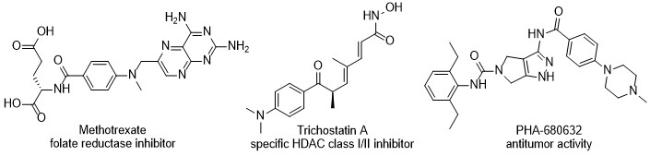
Aniline derivatives serve as essential structural scaffolds in the pharmaceutical, agrochemical, and materials science domains (Figure 1).[1-3] Among these derivatives, acylated anilines can serve as versatile building blocks for the synthesis of various important heterocyclic compounds,[4-5] while difluoroalkylated anilines act as bioisosteres, offering unique advantages in improving metabolic stability and lipophilicity.[6-11] Traditional method for alkylation and acylation of anilines, the Friedel-Crafts reaction, is often constrained by the stoichiometric amounts of strong Lewis acids and the protection of amino group, typically affording ortho-products or ortho/para mixtures.[12-14] Thus, achieving para-selective difluoroalkylation and acylation remains a challenging endeavor.
To address these limitations, several protocols were devised. Lewis acid catalysis[15-17] and σ-activation[18-19] strate- gies were applied to achieve para-selective difluoroalkylation (Scheme 1, A). Besides these thermal reactions, several visible-light-mediated photoredox catalysis protocols were devised (Scheme 1, B).[20-23] In contrast to rapid develop-ment of difluoroalkylation, para-acylation of anilines is premature. Several thermal versions of these reactions employing aromatic ketones,[24] benzyl alcohols,[25] toluene[26] and sulfoxonium ylides[27-28] as acylating reagents were devised for para-acylation of anilines (Scheme 1, C). These approaches required elevated temperatures and prolonged reaction times. Notably, the group of Song[29-36] has recently achieved a series of progresses in difluorocarbene chemistry, offering new strategies for the defluorinative acylation process under mild conditions.
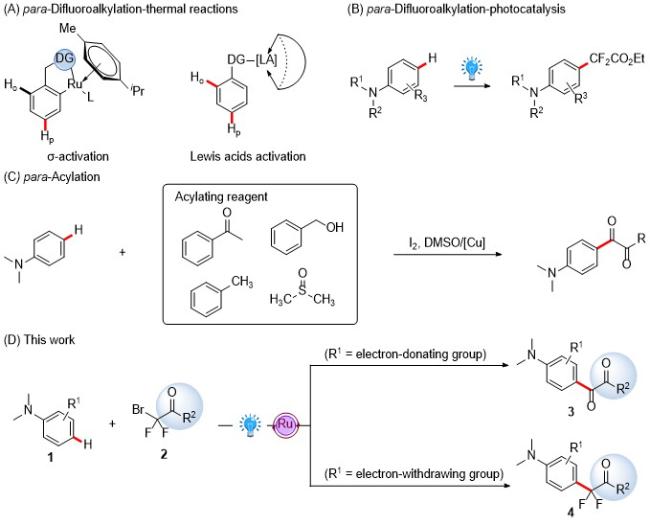
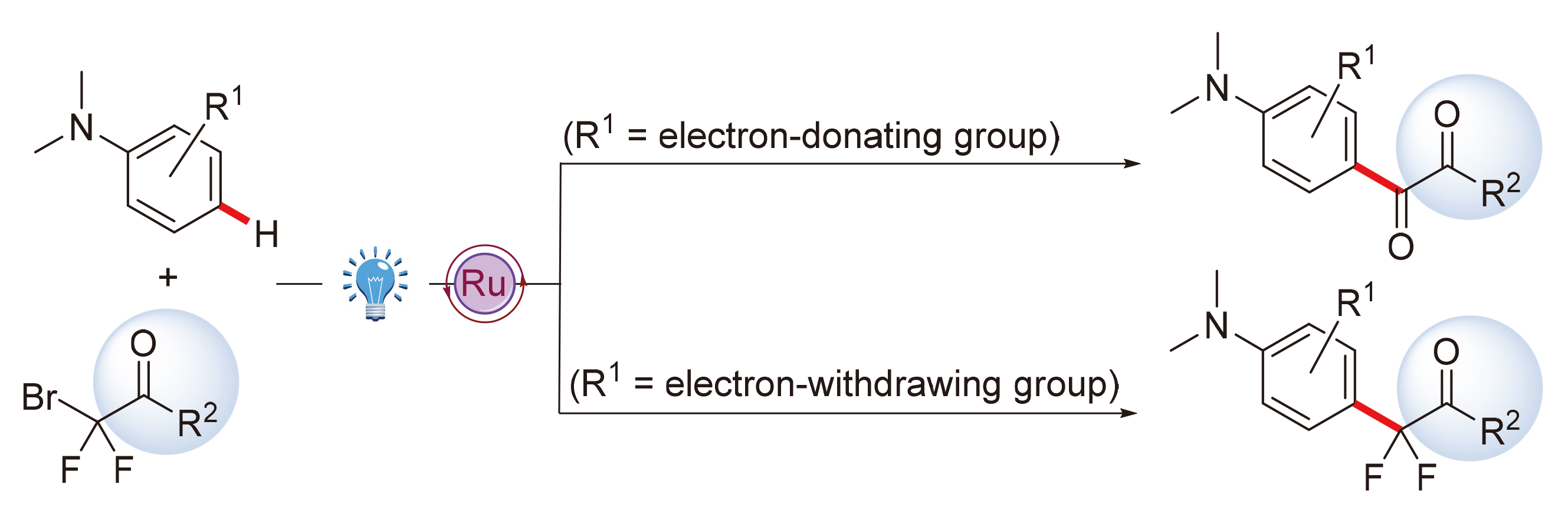
Consistent with our interest in remote C—H functionalization,[37-44] herein, we report an efficient para-C—H acylation and difluoroalkylation of aniline derivatives (Sche- me 1, D). Compared with the aforementioned existing methods, this work exhibits distinct advantages including mild reaction conditions and short reaction times. The mild reactions were induced by ruthenium catalysis with good functional group tolerance, which enabled the late-stage functionalization of complicated molecules. The reaction direction towards acylation and difluoroalkylation might be controlled by the electronic nature of the anilines. Mechanism investigation revealed that Ru(0) species initiated the catalytic cycle.
2 Results and discussion
Our study was commenced by investigating the reaction of N,N-diethylaniline 1a with ethyl bromodifluoroacetate 2a (Table 1). Gratifyingly, the catalytic system with [Ru- Cl2(p-cymene)]2 (5.0 mol%) and K2CO3 (0.4 mmol, 2.0 equiv.) in N,N-dimethylformamide (DMF) successfully afforded 3a in 60% isolated yield (Table 1, Entry 1). The reaction vanished in the absence of either light or the ruthenium catalyst, indicating the crucial role of the photocatalyst and light (Table 1, Entry 2). Inert gas protection was also required, indicating a plausible radical pathway (Table 1, Entry 3). Replacing ruthenium catalysts with RuCl3 or [RuCl2(benzene)]2 provided lower yields (Table 1, Entries 4 and 5). Notably, Ru3(CO)12 afforded 57% yield and shortened the reaction time to 2 h (Table 1, Entries 6 and 7). Thus, both Ru3(CO)12 and [RuCl2(p-cymene)]2 could be optimal catalysts. Further investigation of bases and temperature revealed that K2CO3 and 60 ℃ were optimal condition (Table 1, Entries 8 and 9 vs Entry 1).
Table 1 Optimization of the reaction conditionsa |

| Entry | Deviation from the standard conditions | Yieldb/% |
|---|---|---|
| 1 | None | 60 |
| 2 | Without light irradiation or [RuCl2(p-cymene)]2 | 0 |
| 3 | Without Ar | 0 |
| 4 | RuCl3 instead of [RuCl2(p-cymene)]2 | 13 |
| 5 | [RuCl2(benzene)]2 instead of [RuCl2(p-cymene)]2 | 44 |
| 6c | Ru3(CO)12 instead of [RuCl2(p-cymene)]2 | 57 |
| 7c | 2 h instead of 8 h | 57 |
| 8 | Cs2CO3, Na2CO3 instead of K2CO3 | 18, 43 |
| 9 | 25 or 40 ℃ instead of 60 ℃ | 39, 43 |
a Standard conditions: 1a (0.2 mmol, 1.0 equiv.), 2a (3.0 equiv.), K2CO3 (2.0 equiv.), [RuCl2(p-cymene)]2 (5.0 mol%), DMF (1.0 mL), 40 W 390 nm LEDs, 60 ℃, 8 h, Ar. b Isolated yields. c 5.0 mol% Ru3(CO)12 as catalyst. |
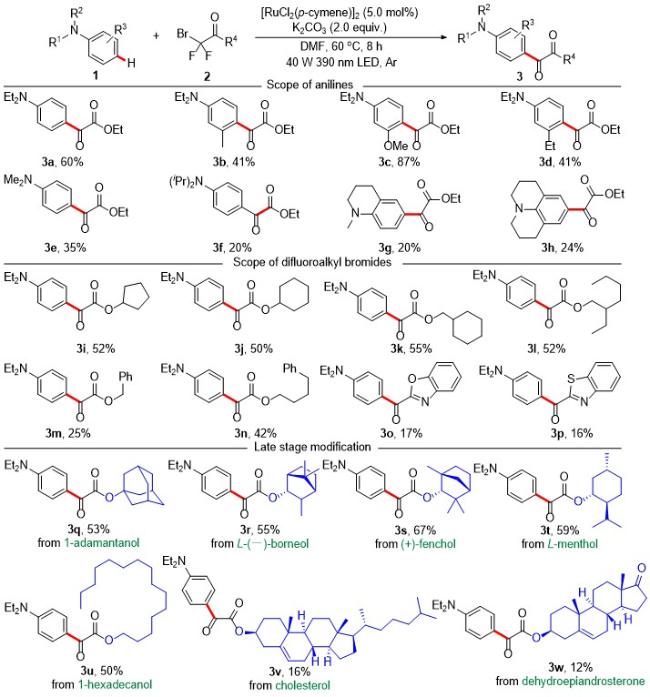
With the optimized conditions, the generality of this para-C—H acylation was explored (Scheme 2). meta-Sub- stituted anilines with electron donating groups were well- tolerated, affording the desired products (3a~3d) in 41%~87% yields. Either increasing or reducing the steric hindrance on amino group decreased the reaction efficiency (3e and 3f). Tetrahydroquinoline and julolidine, common in fluorescent dyes and bioactive drugs,[45-55] were also viable substrates, underscoring the method applicability (3g and 3h). Diverse difluoroalkyl bromides were next evaluated (3i~3p). Various α-difluorobromo esters were accessible to para-C—H acylation of anilines. Notably, medicinally relevant heterocycles such as benzoxazole and benzothiazole also underwent successful acylation. Inspired by the good functional group compatibility, this protocol was applied to the late-stage functionalization of natural products and bioactive molecules. α-Difluorobromoesters derived from 1-adamantanol (3q), monoterpenoid compounds (3r~3t), cetyl alcohol (3u), and steroids (3v, 3w) were shown to be compatible with our system. More specifically, sensitive functional groups such as alkenes (3v and 3w) and ketone (3w) were tolerated.
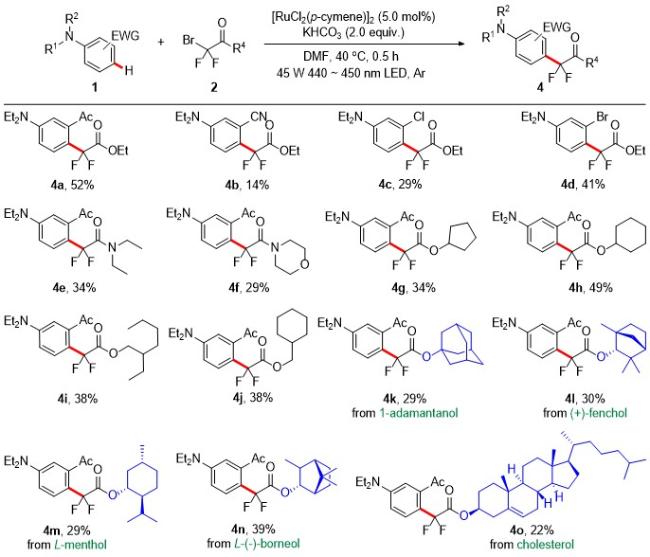
During the investigation of substrate scope, 1i with electron-withdrawing group at meta-site surprisingly afforded the para-difluoroalkylated aniline derivative 4a (Table 2, Entry 2). Therefore, optimization of the para-difluoro- alkylation was carried out (Table 2). After tedious screening of various factors, the desired product 4a could be obtained in 52% yield using 45 W 440~450 nm LED as light source and KHCO3 as the base at 40 ℃ for 0.5 h (Table 2, Entry 1). Similar to para-C—H acylation, Ru catalysts, light and inert gas protection are crucial, indicating the same radical pathway (Table 2, Entries 3 and 4). Among different ruthenium catalysts, Ru3(CO)12 afforded the same yield with [RuCl2(p-cymene)]2 (Table 2, Entry 7 vs Entries 5 and 6). Subsequent screening identified 40 ℃ and KHCO3 with 0.5 h as the optimal combination (Table 2, Entries 8~10).
Table 2 Optimization of the reaction conditionsa |

| Entry | Deviation from the standard conditions | Yieldb/% 4a |
|---|---|---|
| 1 | None | 52 |
| 2c | Standard condition in Table 1 | 28 |
| 3 | Without light irradiation or [RuCl2(p-cymene)]2 | 0 |
| 4 | Without Ar | 0 |
| 5 | RuCl3 instead of [RuCl2(p-cymene)]2 | 20 |
| 6 | [RuCl2(benzene)]2 instead of [RuCl2(p-cymene)]2 | 39 |
| 7 | Ru3(CO)12 instead of [RuCl2(p-cymene)]2 | 52 |
| 8 | 30 min or 1 h instead of 2 h | 52, 52 |
| 9 | 25 or 60 ℃ instead of 40 ℃ | 41, 27 |
| 10 | Cs2CO3, Na2CO3 instead of KHCO3 | 42, 46 |
aStandard conditions: 1i (0.2 mmol, 1.0 equiv), 2a (3.0 equiv), KHCO3 (2.0 equiv), [RuCl2(p-cymene)]2 (5.0 mol%), DMF (1.0 mL), 45 W 440~450 nm LEDs, 40 ℃, 0.5 h, Ar. cK2CO3 (2.0 equiv.), 40 W 390 nm LEDs, 60 ℃, 8 h, Ar. b Isolated yields. |
With the optimized reaction conditions in hand, the scope of N,N-disubstituted anilines and difluoromethyl bromides was explored (Scheme 3). Substrates containing electron- withdrawing groups at the meta position were tolerated and afforded the corresponding products in 14%~41% yields (4a~4d). The low yields of 3 and 4 can be attributed to the decomposition of these products. Both α-difluorobromo amides and esters were accessible to para-C—H acylation of anilines (4e~4j). Furthermore, the protocol could be extended to the late-stage functionalization of natural product derivatives. Alkyl bromides derived from natural products such as 1-adamantanol (4k), monoterpenoid com- pounds (4l~4n), and steroids (4o) were all viable substrates, demonstrating its utility.
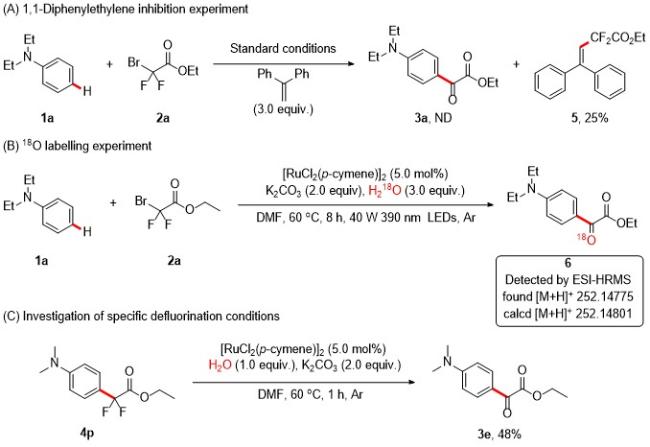
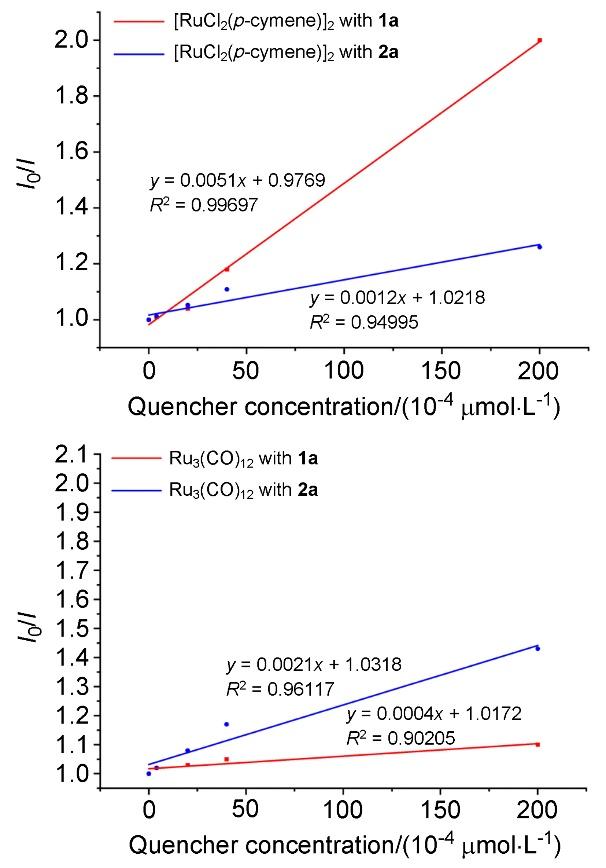
To explore the mechanism, a series of control experiments were carried out. The radical scavenger 2,2,6,6-tetra- methylpiperidinooxy (TEMPO) and 1,1-diphenylethylene completely inhibited the reaction, providing adduct 5. Furthermore, addition of 18O-labeled H2O resulted in the detection of 18O in 3a, indicating that the carbonyl oxygen of 3a would be from H2O either in the environment or in situ generated in the reaction (Scheme 4B). To further elucidate substituent effect of anilines on carbonylation vs difluoroalkylation, the difluoroalkylation product 4a to para-car- bonylation conditions was subjected. The absence of acylated product 3a indicates that the reaction time is unrelated and the electronic nature of the substrates would be crucial to control and suppress the hydrolysis of difluoromethyl group. To further evaluate the plausible pathway of para- acylation, difluoroalkyl compound 4p was synthesized following a literature method[56] and completed its separation by preparative chromatography within 20 min. Notably, 4p is decomposed under the conventional column chromatography. When treated with one equivalent of water, 4p decomposed rapidly to give defluorinated acylation product 3e (Scheme 4C). These results further demonstrate the in situ generated water caused the conversion of 4p to 3e. To determine how the Ru complex triggers the redox cycle, Stern-Volmer experiments were conducted among the Ru catalysts and substrates (Figure 2). Notably, N,N- diethylaniline 1a quenched [RuCl2(p-cymene)]2 more efficiently than ethyl bromodifluoroacetate 2a, indicating that the reduction of [RuCl2(p-cymene)]2 with 1a would trigger the redox catalytic cycle with generation of low valence ruthenium species. Further Stern-Volmer experiments of effective Ru(0) catalyst, Ru3(CO)12, with 1a and 2a support this result: 2a exhibited better efficiency to quench Ru3(CO)12 than 1a. Therefore, Ru(0) can be considered as a plausible intermediate generated from reduction of [RuCl2- (p-cymene)]2 and initiate the redox cycle.
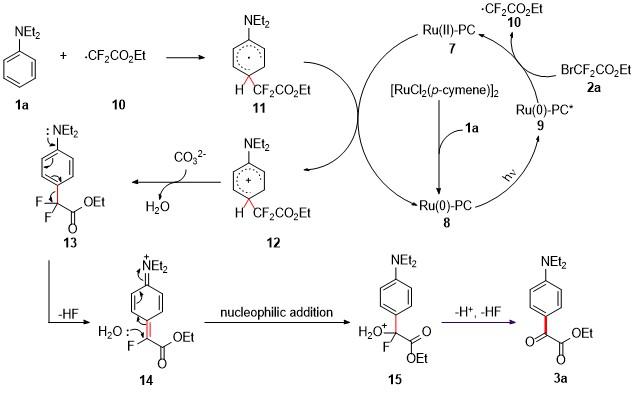
Based on the experimental results and previous reports,[57-58] a possible reaction mechanism is proposed (Scheme 5). Under visible light irradiation, the reduction of [RuCl2(p-cymene)]2 with 1a occurs to afford Ru(0) species 8, which is excited by irradiation and reduces 2a to generate radical 10, which adds to 1a to form 11. 11 is oxidized by Ru(II) species 7 to generate the Ru(0) catalytic species 8 and 12. 12 undergoes deprotonation to yield difluoroalkylated product 13. 13 undergoes defluorination to generate intermediate 14 with extra stabilization from the electron- donating group on aniline substrates. 14 may undergo nucleophilic addition with H2O, followed by a second defluo- rination to afford the target product 3a.


3 Conclusions
A visible light-mediated ruthenium-catalyzed protocol for the para-acylation and difluoroalkylation of aniline derivatives was developed. This mild photochemical method enables the late-stage functionalization of natural products and bioactive molecules. 18O labeling experiments revealed in situ generated water provided the oxygen of carbonyl group in acylation. Further mechanism investigation indicates Ru(0) species initiated catalytic cycle.
4 Experimental section
4.1 General experimental information
Unless otherwise noted, all reagents were obtained from commercial suppliers (Adamas-beta, Energy Chemical and Innochem) and used without further purification. The meta- substituted aniline substrates[59-60] and difluoroalkyl bromides[61-70] were prepared according to previously described procedures. DMF was dried over calcium hydride and freshly distilled under air. The reaction product was isolated by column chromatography on a silica gel (236~400 mesh) column using petroleum ether (PE) with a boiling range from 60 to 90 ℃ and EtOAc. NMR spectra were performed on a Bruker NMR spectrometers ULTRASHIELD 400 series. 1H NMR, 13C NMR and 19F NMR spectra were recorded at 400, 101, and 376 MHz, respectively, using CDCl3 as solvent. Tetramethylsilane was used as the internal stan- dard for 1H NMR and 13C NMR, and trifluoroacetic acid (δ -76.55) was used as an external reference for 19F NMR spectra. HRMS was performed on an Agilent Technologies 6200 series TOF/6500 series Q-TOF under the conditions of electrospray ionization (ESI) in positive mode. Unless otherwise noted, all reagents were weighed and handled in air, and all reactions were carried out in argon.
4.2 General procedure for para-C—H acylation
To an oven-dried Schlenk tube (10 mL) was added 1 (0.2 mmol, 1.0 equiv.), 2 (0.6 mmol, 3.0 equiv.), [RuCl2(p- cymene)]2 (5.0 mol%), K2CO3 (0.4 mmol, 2.0 equiv.), and DMF (1.0 mL). The reaction vessel was sealed, and the Schlenk tube was subjected to three cycles of evacuation and backfilling with argon. The reaction mixture was then stirred for 8 h under irradiation with visible light (40 W purple light, Kessil PR160-390 nm) while maintaining the temperature at 60 ℃ (using two purple LEDs, with the reaction tube positioned 4.0 cm from the bulb). After completion, 10 mL of water and 10 mL of ethyl acetate were added to the reaction mixture. The organic phase was separated, washed with saturated brine, dried over anhydrous Na2SO4, filtered through a silica gel plug, and concentrated in vacuo. The crude reaction mixture was purified on silica gel using petroleum ether (PE)/EtOAc (V∶V=9∶1) as the eluent to afford the desired product.
Ethyl 2-(4-(diethylamino)phenyl)-2-oxoacetate (3a): Yellow oil, 60% yield, 29.7 mg. 1H NMR (400 MHz, CDCl3) δ: 7.92~7.84 (m, 2H), 6.64 (d, J=9.1 Hz, 2H), 4.41 (q, J=7.1 Hz, 2H), 3.45 (q, J=7.1 Hz, 4H), 1.41 (t, J=7.2 Hz, 3H), 1.22 (t, J=7.1 Hz, 6H); 13C NMR (101 MHz, CDCl3) δ: 183.9, 165.1, 152.5, 132.8, 119.5, 110.5, 77.4, 77.1, 76.8, 61.7, 44.7, 14.2, 12.5; HRMS (ESI) calcd for C14H20NO3 [M+H]+ 250.1438, found 250.1440. The data is in agreement with literature.[21]
Ethyl 2-(4-(diethylamino)-2-methylphenyl)-2-oxoacetate (3b): Yellow oil, 41% yield, 21.6 mg. 1H NMR (400 MHz, CDCl3) δ: 7.47 (d, J=8.8 Hz, 1H), 6.40 (dd, J=12.8, 4.0 Hz, 2H), 4.32 (q, J=7.2 Hz, 2H), 3.35 (q, J=7.1 Hz, 4H), 2.55 (s, 3H), 1.32 (t, J=7.2 Hz, 3H), 1.13 (t, J=7.1 Hz, 6H); 13C NMR (101 MHz, CDCl3) δ: 185.7, 165.9, 151.0, 144.6, 135.8, 117.3, 113.6, 107.4, 77.0, 76.6, 76.3, 61.2, 44.1, 22.8, 13.8, 12.1; HRMS (ESI) calcd for C15H22NO3 [M+H]+ 264.1594, found 264.1591.
Ethyl 2-(4-(diethylamino)-2-methoxyphenyl)-2-oxoace- tate (3c): Yellow oil, 87% yield, 45.6 mg. 1H NMR (400 MHz, CDCl3) δ: 7.81 (d, J=9.1 Hz, 1H), 6.32 (d, J=9.1 Hz, 1H), 5.99 (s, 1H), 4.35 (q, J=7.1 Hz, 2H), 3.83 (s, 3H), 3.43 (q, J=7.1 Hz, 4H), 1.37 (t, J=7.2 Hz, 3H), 1.21 (t, J=7.2 Hz, 6H); 13C NMR (101 MHz, CDCl3) δ: 183.2, 166.7, 162.6, 154.0, 132.3, 109.6, 104.8, 92.1, 77.0, 76.7, 76.4, 60.8, 55.2, 44.5, 13.8, 12.1; HRMS (ESI) calcd for C15H22NO4 [M+H]+ 280.1543, found 280.1539.
Ethyl 2-(4-(diethylamino)-2-ethylphenyl)-2-oxoacetate (3d): Yellow oil, 41% yield, 22.6 mg. 1H NMR (400 MHz, CDCl3) δ: 7.45 (d, J=8.6 Hz, 1H), 6.40 (d, J=8.6 Hz, 2H), 4.32 (q, J=7.1 Hz, 2H), 3.36 (q, J=7.1 Hz, 4H), 2.95 (q, J=7.4 Hz, 2H), 1.32 (t, J=7.1 Hz, 3H), 1.15 (q, J=7.7, 7.3 Hz, 9H); 13C NMR (101 MHz, CDCl3) δ: 184.9, 165.3, 150.6, 150.2, 135.6, 115.9, 111.6, 106.8, 76.4, 76.0, 75.7, 60.5, 43.6, 27.6, 14.2, 13.2, 11.5; HRMS (ESI) calcd for C16H24NO3 [M+H]+ 278.1751, found 278.1752.
Ethyl 2-(4-(dimethylamino)phenyl)-2-oxoacetate (3e): Yellow oil, 35% yield, 15.6 mg. 1H NMR (400 MHz, CDCl3) δ: 7.94~7.87 (m, 2H), 6.69~6.63 (m, 2H), 4.41 (q, J=7.1 Hz, 2H), 3.10 (s, 6H), 1.41 (t, J=7.1 Hz, 3H); 13C NMR (101 MHz, CDCl3) δ: 184.2, 165.0, 154.5, 132.5, 120.2, 110.9, 77.4, 77.1, 76.7, 61.8, 40.1, 14.2; HRMS (ESI) calcd for C12H16NO3 [M+H]+ 222.1125, found 222.1121. The data is in agreement with literature.[71]
Ethyl 2-(4-(diisopropylamino)phenyl)-2-oxoacetate (3f): Yellow oil, 20% yield, 11.2 mg. 1H NMR (400 MHz, CDCl3) δ: 7.77 (d, J=8.79 Hz, 2H), 6.73 (d, J=8.81 Hz, 2H), 4.33 (q, J=7.10 Hz, 2H), 3.94 (hept, J=7.00 Hz, 2H), 1.33 (t, J=7.18 Hz, 3H), 1.26 (d, J=6.88 Hz, 12H); 13C NMR (101 MHz, CDCl3) δ: 183.9, 165.1, 153.2, 132.1, 119.8, 113.8, 77.4, 77.0, 76.7, 61.7, 47.8, 20.8, 14.2; HRMS (ESI) calcd for C16H24NO3 [M+H]+ 278.1751, found 278.1753.
Ethyl 2-(1-methyl-1,2,3,4-tetrahydroquinolin-6-yl)-2- oxoacetate (3g): Yellow oil, 20% yield, 10.0 mg. 1H NMR (400 MHz, CDCl3) δ: 7.66 (dd, J=8.8, 2.2 Hz, 1H), 7.53 (d, J=2.5 Hz, 1H), 6.44 (d, J=8.8 Hz, 1H), 4.33 (q, J=7.1 Hz, 2H), 3.32 (t, J=5.8 Hz, 2H), 2.94 (s, 3H), 2.69 (t, J=6.3 Hz, 2H), 1.89 (p, J=6.1 Hz, 2H), 1.33 (t, J=7.1 Hz, 3H); 13C NMR (101 MHz, CDCl3) δ: 184.1, 165.2, 151.6, 131.6, 130.6, 121.8, 119.8, 109.3, 77.4, 77.1, 76.7, 61.7, 51.3, 38.8, 27.7, 21.5, 14.2; HRMS (ESI) calcd for C14H18- NO3 [M+H]+ 248.1281, found 248.1283.
(Ethyl 2-oxo-2-(2,3,6,7-tetrahydro-1H,5H-pyrido[3,2,1- ij]quinolin-9-yl)acetate (3h): Yellow oil, 24% yield, 13.1 mg. 1H NMR (400 MHz, CDCl3) δ: 7.38 (s, 2H), 4.32 (q, J=7.12 Hz, 2H), 3.23 (t, J=5.86 Hz, 4H), 2.67 (t, J=6.37 Hz, 4H), 1.87 (p, J=5.98 Hz, 4H), 1.32 (t, J=7.23 Hz, 3H); 13C NMR (101 MHz, CDCl3) δ: 183.9, 165.4, 148.4, 129.8, 120.2, 118.8, 77.4, 77.0, 76.7, 61.6, 50.1, 27.7, 21.2, 14.2; HRMS (ESI) calcd for C16H20NO3 [M+H]+ 274.1438, found 274.1441.
Cyclopentyl 2-(4-(diethylamino)phenyl)-2-oxoacetate (3i): Yellow oil, 52% yield, 30.3 mg. 1H NMR (400 MHz, CDCl3) δ: 7.76 (d, J=8.68 Hz, 2H), 6.55 (d, J=8.74 Hz, 2H), 5.36 (tt, J=6.26, 2.98 Hz, 1H), 3.36 (q, J=7.06 Hz, 4H), 1.89 (dq, J=13.70, 7.24, 6.72 Hz, 2H), 1.78 (d, J=16.67 Hz, 2H), 1.69 (tt, J=8.05, 3.42 Hz, 2H), 1.56 (p, J=5.27, 4.76 Hz, 2H), 1.13 (t, J=7.11 Hz, 6H); 13C NMR (101 MHz, CDCl3) δ: 184.4, 165.3, 152.4, 132.7, 119.6, 110.5, 78.9, 77.4, 77.1, 76.8, 44.7, 32.7, 23.8, 12.5; HRMS (ESI) calcd for C17H24NO3 [M+H]+ 290.1751, found 290.1755.
Cyclohexyl 2-(4-(diethylamino)phenyl)-2-oxoacetate (3j): Yellow oil, 50% yield, 30.2 mg. 1H NMR (400 MHz, CDCl3) δ: 7.77 (d, J=8.66 Hz, 2H), 6.56 (d, J=8.68 Hz, 2H), 4.97 (tt, J=9.50, 4.03 Hz, 1H), 3.36 (q, J=7.21 Hz, 4H), 1.92 (d, J=7.38 Hz, 2H), 1.71 (dd, J=9.32, 4.70 Hz, 2H), 1.50 (t, J=9.74 Hz, 3H), 1.34 (q, J=10.26 Hz, 2H), 1.22 (t, J=12.03 Hz, 1H), 1.13 (t, J=7.14 Hz, 6H); 13C NMR (101 MHz, CDCl3) δ: 184.4, 165.0, 152.4, 132.7, 119.6, 110.5, 77.4, 77.1, 76.8, 74.7, 44.7, 31.5, 25.3, 23.7, 12.5. HRMS (ESI) calcd for C18H26NO3 [M+H]+ 304.1907, found 304.1902.
Cyclohexylmethyl 2-(4-(diethylamino)phenyl)-2-oxo-acetate (3k): Yellow oil, 55% yield, 34.8 mg. 1H NMR (400 MHz, CDCl3) δ: 7.78 (d, J=8.69 Hz, 2H), 6.56 (d, J=8.75 Hz, 2H), 4.08 (d, J=6.18 Hz, 2H), 3.36 (q, J=7.07 Hz, 4H), 1.75~1.64 (m, 5H), 1.62~1.56 (m, 1H), 1.13 (t, J=7.17 Hz, 9H), 0.95 (tt, J=13.58, 6.66 Hz, 2H); 13C NMR (101 MHz, CDCl3) δ: 184.1, 165.4, 152.5, 132.8, 119.6, 110.5, 77.4, 77.1, 76.8, 70.6, 44.7, 37.0, 29.6, 26.3, 25.6, 12.5; HRMS (ESI) calcd for C19H28NO3 [M+H]+ 318.2064, found 318.2065.
2-Ethylhexyl 2-(4-(diethylamino)phenyl)-2-oxoacetate (3l): Yellow oil, 52% yield, 34.8 mg. 1H NMR (400 MHz, CDCl3) δ: 7.85 (d, J=9.11 Hz, 2H), 6.64 (d, J=9.15 Hz, 2H), 4.27 (dd, J=5.93, 2.54 Hz, 2H), 3.44 (q, J=7.12 Hz, 4H), 1.70 (q, J=6.08 Hz, 1H), 1.44~1.39 (m, 2H), 1.35~1.27 (m, 6H), 1.21 (t, J=7.07 Hz, 6H), 0.91 (dt, J=9.37, 6.79 Hz, 6H); 13C NMR (101 MHz, CDCl3) δ: 184.1, 165.6, 152.5, 132.7, 119.6, 110.5, 77.4, 77.0, 76.7, 68.0, 44.7, 38.8, 30.3, 28.9, 23.6, 22.9, 14.0, 12.5, 10.9; HRMS (ESI) calcd for C20H32NO3 [M+H]+ 334.2377, found 334.2379.
Benzyl 2-(4-(diethylamino)phenyl)-2-oxoacetate (3m): Yellow oil, 25% yield, 15.8 mg. 1H NMR (400 MHz, CDCl3) δ: 7.83 (d, J=8.7 Hz, 2H), 7.44 (d, J=7.2 Hz, 2H), 7.41~7.33 (m, 3H), 6.61 (d, J=8.7 Hz, 2H), 5.38 (s, 2H), 3.43 (q, J=7.1 Hz, 4H), 1.20 (t, J=7.1 Hz, 6H); 13C NMR (101 MHz, CDCl3) δ: 183.4, 164.9, 152.5, 135.1, 132.8, 128.6, 128.5, 128.5, 119.6, 110.5, 77.4, 77.0, 76.7, 67.2, 44.7, 12.5; HRMS (ESI) calcd for C19H22NO3 [M+H]+ 312.1594, found 312.1591.
3-Phenylpropyl 2-(4-(diethylamino)phenyl)-2-oxoace- tate (3n): Yellow oil, 42% yield, 28.2 mg. 1H NMR (400 MHz, CDCl3) δ: 7.81 (d, J=8.68 Hz, 2H), 7.23 (t, J=7.49 Hz, 2H), 7.14 (q, J=5.02, 4.37 Hz, 3H), 6.58 (d, J=8.73 Hz, 2H), 4.29 (t, J=6.51 Hz, 2H), 3.38 (q, J=7.09 Hz, 4H), 2.69 (t, J=7.70 Hz, 2H), 2.03 (p, J=6.93 Hz, 2H), 1.15 (t, J=7.14 Hz, 6H); 13C NMR (101 MHz, CDCl3) δ: 183.8, 165.3, 152.5, 140.9, 132.8, 128.5, 128.4, 126.1, 119.5, 110.5, 77.4, 77.1, 76.8, 64.9, 44.8, 32.0, 30.1, 12.5; HRMS (ESI) calcd for C22H28NO3 [M+H]+ 354.2064, found 354.2066.
Benzo[d]oxazol-2-yl(4-(diethylamino)phenyl)methan- one (3o): Yellow oil, 17% yield, 10.0 mg. 1H NMR (400 MHz, CDCl3) δ: 8.45 (d, J=8.78 Hz, 2H), 7.85 (d, J=7.79 Hz, 1H), 7.63 (d, J=8.12 Hz, 1H), 7.41 (dt, J=18.01, 7.91 Hz, 2H), 6.65 (d, J=8.87 Hz, 2H), 3.41 (q, J=7.10 Hz, 4H), 1.17 (t, J=7.09 Hz, 6H); 13C NMR (101 MHz, CDCl3) δ: 177.4, 158.4, 152.3, 150.3, 140.9, 133.9, 127.5, 125.3, 122.3, 121.9, 111.7, 110.5, 77.4, 77.0, 76.7, 44.8, 12.6; HRMS (ESI) calcd for C18H19N2O2 [M+H]+ 295.1441, found 295.1446.
Benzo[d]thiazol-2-yl(4-(diethylamino)phenyl)methan- one (3p): Yellow oil, 16% yield, 9.8 mg. 1H NMR (400 MHz, CDCl3) δ: 8.52 (d, J=8.76 Hz, 2H), 8.14 (d, J=8.12 Hz, 1H), 7.93 (d, J=7.83 Hz, 1H), 7.49 (t, J=7.62 Hz, 1H), 7.43 (t, J=7.59 Hz, 1H), 6.66 (d, J=8.76 Hz, 2H), 3.41 (q, J=7.09 Hz, 4H), 1.17 (t, J=7.08 Hz, 6H); 13C NMR (101 MHz, CDCl3) δ: 181.8, 169.5, 154.0, 152.1, 136.7, 134.2, 126.8, 126.5, 125.2, 122.1, 121.7, 110.5, 77.4, 77.0, 76.7, 44.7, 12.6; HRMS (ESI) calcd for C18H19N2OS [M+H]+ 311.1213, found 311.1215.
(3S,5S,7S)-Adamantan-1-yl 2-(4-(diethylamino)phenyl)-2-oxoacetate (3q): Yellow oil, 53% yield, 37.6 mg. 1H NMR (400 MHz, CDCl3) δ: 7.88~7.77 (m, 2H), 6.63 (d, J=8.70 Hz, 2H), 3.42 (q, J=7.12 Hz, 4H), 2.27 (s, 6H), 2.22 (s, 3H), 1.72 (d, J=13.74 Hz, 6H), 1.24~1.15 (m, 6H); 13C NMR (101 MHz, CDCl3) δ: 184.6, 164.8, 152.2, 132.7, 119.5, 110.5, 83.9, 77.4, 77.1, 76.8, 44.7, 41.4, 36.1, 31.0, 12.5; HRMS (ESI) calcd for C22H30NO3 [M+H]+ 356.2220, found 356.2223.
(1S,2R,4S)-1,7,7-Trimethylbicyclo[2.2.1]heptan-2-yl 2-(4-(diethylamino)phenyl)-2-oxoacetate (3r): Yellow oil, 55% yield, 38.9 mg. 1H NMR (400 MHz, CDCl3) δ: 7.84 (d, J=8.6 Hz, 2H), 6.65 (d, J=8.7 Hz, 2H), 5.18 (dd, J=10.0, 3.0 Hz, 1H), 3.45 (q, J=7.2 Hz, 4H), 2.47 (ddd, J=14.0, 9.2, 4.5 Hz, 1H), 1.97 (ddd, J=14.8, 10.3, 4.2 Hz, 1H), 1.82~1.69 (m, 2H), 1.29 (d, J=10.5 Hz, 2H), 1.22 (t, J=7.1 Hz, 6H), 1.01~0.84 (m, 10H); 13C NMR (101 MHz, CDCl3) δ: 184.4, 166.0, 152.4, 132.7, 119.6, 110.5, 81.8, 77.4, 77.1, 76.7, 49.1, 48.1, 44.9, 44.7, 36.6, 28.0, 27.0, 19.7, 18.9, 13.7,12.5; HRMS (ESI) calcd for C22H32NO3 [M+H]+ 358.2377, found 358.2374.
(1R,2R,4S)-1,3,3-Trimethylbicyclo[2.2.1]heptan-2-yl 2-(4-(diethylamino)phenyl)-2-oxoacetate (3s): Yellow oil, 67% yield, 47.7 mg. 1H NMR (400 MHz, CDCl3) δ: 7.86 (d, J=8.7 Hz, 2H), 6.65 (d, J=8.7 Hz, 2H), 4.63 (d, J=2.0 Hz, 1H), 3.44 (q, J=7.1 Hz, 4H), 1.88~1.56 (m, 5H), 1.50~1.42 (m, 1H), 1.26~1.17 (m, 10H), 1.14 (s, 3H), 1.10~1.05 (m, 1H), 0.91 (s, 3H); 13C NMR (101 MHz, CDCl3) δ: 184.4, 166.1, 152.4, 132.7, 119.6, 110.5, 88.0, 77.4, 77.1, 76.8, 48.5, 48.3, 44.7, 41.4, 39.7, 29.8, 26.5, 25.8, 20.4, 19.5, 12.5; HRMS (ESI) calcd for C22H32NO3 [M+H]+ 358.2377, found 358.2373.
(1R,2S,5R)-2-Isopropyl-5-methylcyclohexyl 2-(4-(diethyl-amino)phenyl)-2-oxoacetate (3t): Yellow oil, 59% yield, 41.8 mg. 1H NMR (400 MHz, CDCl3) δ: 7.76 (d, J=8.6 Hz, 2H), 6.56 (d, J=8.7 Hz, 2H), 4.89 (td, J=11.0, 4.3 Hz, 1H), 3.37 (q, J=7.1 Hz, 4H), 2.15 - 2.06 (m, 1H), 1.97~1.85 (m, 1H), 1.64 (d, J=11.9 Hz, 2H), 1.45 (dt, J=23.9, 11.1 Hz, 2H), 1.14 (t, J=7.2 Hz, 6H), 1.10~0.96 (m, 2H), 0.87 (d, J=6.4 Hz, 3H), 0.82 (d, J=6.7 Hz, 4H), 0.76 (d, J=6.9 Hz, 3H); 13C NMR (101 MHz, CDCl3) δ: 184.0, 164.8, 152.0, 132.2, 119.1, 110.1, 77.0, 76.7, 76.3, 75.7, 46.4, 44.3, 40.2, 33.7, 31.1, 25.6, 22.9, 21.6, 20.3, 15.7, 12.1; HRMS (ESI) calcd for C22H34NO3 [M+H]+ 360.2533, found 360.2531.
Hexadecyl 2-(4-(diethylamino)phenyl)-2-oxoacetate (3u): Yellow oil, 50% yield, 45.0 mg. 1H NMR (400 MHz, CDCl3) δ: 7.79 (d, J=8.68 Hz, 2H), 6.56 (d, J=8.75 Hz, 2H), 4.26 (t, J=6.76 Hz, 2H), 3.37 (q, J=7.07 Hz, 4H), 1.68 (p, J=6.99 Hz, 2H), 1.32 (t, J=7.92 Hz, 2H), 1.18 (s, 24H), 1.14 (t, J=6.98 Hz, 6H), 0.80 (t, J=6.62 Hz, 3H); 13C NMR (101 MHz, CDCl3) δ: 184.0, 165.3, 152.5, 132.8, 119.6, 110.5, 77.4, 77.1, 76.7, 65.8, 44.7, 31.9, 29.7, 29.7, 29.6, 29.5, 29.4, 29.2, 28.5, 25.8, 22.7, 14.1, 12.5; HRMS (ESI) calcd for C27H46NO3 [M+H]+ 432.3472, found 432.3477.
(3R,8R,9R,10S,13S,14R,17S)-10,13-Dimethyl-17-((S)-6-methylheptan-2-yl)-2,3,4,7,8,9,10,11,12,13,14,15,16,17-tetradecahydro-1H-cyclopenta[a]phenanthren-3-yl 2-(4-(diethylamino)phenyl)-2-oxoacetate (3v): Yellow oil, 16% yield, 18.5 mg. 1H NMR (400 MHz, CDCl3) δ: 7.86 (d, J=8.7 Hz, 2H), 6.64 (d, J=8.7 Hz, 2H), 5.43 (d, J=5.0 Hz, 1H), 4.90 (dtd, J=12.6, 8.7, 4.7 Hz, 1H), 3.44 (q, J=7.1 Hz, 4H), 2.48 (d, J=8.2 Hz, 2H), 2.11~1.68 (m, 7H), 1.63~1.41 (m, 7H), 1.36 (dd, J=14.0, 7.4 Hz, 3H), 1.22 (t, J=7.1 Hz, 8H), 1.15~1.07 (m, 4H), 1.01 (d, J=12.3 Hz, 6H), 0.92 (d, J=6.4 Hz, 3H), 0.87 (d, J=6.5 Hz, 6H), 0.68 (s, 3H); 13C NMR (101 MHz, CDCl3) δ: 184.2, 164.8, 152.4, 139.3, 132.8, 123.1, 119.6, 110.5, 77.4, 77.1, 76.7, 75.8, 56.7, 56.1, 50.0, 44.7, 42.3, 39.7, 39.5, 37.9, 37.0, 36.6, 36.2, 35.8, 31.9, 31.8, 28.3, 28.0, 27.7, 24.3, 23.8, 22.9, 22.6, 21.0, 19.3, 18.7, 12.5, 11.9; HRMS (ESI) calcd for C39H60NO3 [M+H]+ 590.4568, found 590.4566.
(3R,8R,9S,10R,13S,14S)-10,13-Dimethyl-17-oxo-2,3,4,7,8,9,10,11,12,13,14,15,16,17-tetradecahydro-1H-cyclopenta-[a]phenanthren-3-yl 2-(4-(diethylamino)phenyl)-2-oxo-acetate (3w): Yellow oil, 12% yield, 12.1 mg. 1H NMR (400 MHz, CDCl3) δ: 7.86 (d, J=8.6 Hz, 2H), 6.64 (d, J=8.7 Hz, 2H), 5.47 (d, J=5.1 Hz, 1H), 4.91 (dd, J=11.0, 6.2 Hz, 1H), 3.45 (q, J=7.1 Hz, 4H), 2.48 (dd, J=25.2, 7.7 Hz, 3H), 2.13 (dd, J=11.7, 6.9 Hz, 2H), 2.06 (d, J=4.4 Hz, 1H), 1.97~1.90 (m, 2H), 1.86 (d, J=12.7 Hz, 1H), 1.80~1.65 (m, 4H), 1.59~1.48 (m, 2H), 1.36~1.29 (m, 2H), 1.22 (t, J=7.1 Hz, 7H), 1.06 (s, 4H), 0.89 (s, 3H); 13C NMR (101 MHz, CDCl3) δ: 184.1, 164.7, 152.4, 139.6, 132.8, 122.3, 119.6, 110.5, 77.4, 77.0, 76.7, 75.5, 51.7, 50.1, 47.5, 44.7, 37.9, 36.9, 36.8, 35.9, 31.5, 31.4, 30.8, 27.6, 21.9, 20.3, 19.4, 14.2, 13.6, 12.5; HRMS (ESI) calcd for C31H42NO4 [M+H]+ 492.3108, found 492.3104.
4.3 General procedure for para-C—H difluoroalkylation
To an oven-dried Schlenk tube (10 mL) were added 1 (0.2 mmol, 1.0 equiv.), 2 (0.6 mmol, 3.0 equiv.), [RuCl2(p- cymene)]2 (5.0 mol%), KHCO3 (0.4 mmol, 2.0 equiv.), and DMF (1.0 mL). The reaction vessel was sealed, and the Schlenk tube was subjected to three cycles of evacuation and backfilling with argon. The reaction mixture was then stirred for 0.5 h under irradiation with visible light (45 W Taobao 440~450 nm LEDs) while maintaining the temperature at 40 ℃ (using two blue LEDs, with the reaction tube positioned 4.0 cm from the bulb). After completion, 10 mL of water and 10 mL of ethyl acetate were added to the reaction mixture. The organic phase was separated, washed with saturated brine, dried over anhydrous Na2SO4, filtered through a silica gel plug, and concentrated in vacuo. The crude reaction mixture was purified on silica gel using petroleum ether (PE)/EtOAc (V∶V=9∶1 unless otherwise stated) as the eluent to afford the desired product.
Ethyl 2-(2-acetyl-4-(diethylamino)phenyl)-2,2-difluoro-acetate (4a): Yellow oil, 52% yield, 30.2 mg. 1H NMR (400 MHz, CDCl3) δ: 7.61 (d, J=8.8 Hz, 1H), 6.94 (d, J=2.7 Hz, 1H), 6.77 (dd, J=8.9, 2.7 Hz, 1H), 4.35 (q, J=7.2 Hz, 2H), 3.42 (q, J=7.1 Hz, 4H), 2.57 (s, 3H), 1.36 (t, J=7.1 Hz, 3H), 1.23~1.17 (m, 6H); 13C NMR (101 MHz, CDCl3) δ: 201.0, 164.1 (t, J=35.2 Hz), 148.9, 138.0 (t, J=3.2 Hz), 128.5 (t, J=10.1 Hz), 117.3 (t, J=24.2 Hz), 114.2 (t, J=252.5 Hz), 113.0, 112.1, 77.5, 77.1, 76.8, 62.5, 44.5, 28.4, 28.4, 13.9, 12.4; 19F NMR (376 MHz, CDCl3) δ: -97.44; HRMS (ESI) calcd for C16H22F2NO3 [M+H]+ 314.1562, found 314.1559.
Ethyl 2-(2-cyano-4-(diethylamino)phenyl)-2,2-difluoro-acetate (4b): Yellow oil, 14% yield, 8.5 mg. 1H NMR (400 MHz, CDCl3) δ: 7.40 (d, J=9.05 Hz, 1H), 6.85 (d, J=2.80 Hz, 1H), 6.72 (dd, J=9.08, 2.76 Hz, 1H), 4.28 (q, J=7.14 Hz, 2H), 3.32 (q, J=7.11 Hz, 4H), 1.29 (t, J=7.13 Hz, 3H), 1.12 (t, J=7.09 Hz, 6H); 13C NMR (101 MHz, CDCl3) δ:163.7 (t, J=35.6 Hz), 148.9, 128.4 (t, J=7.1 Hz), 120.2 (t, J=26.3 Hz), 117.4, 116.5, 115.5, 114.0, 111.3 (t, J=252.5 Hz), 77.4, 77.1, 76.8, 63.5, 44.6, 14.0, 12.3; 19F NMR (376 MHz, CDCl3) δ: -99.7; HRMS (ESI) calcd for C15H19F2N2O2 [M+H]+ 297.1409, found 297.1411.
Ethyl 2-(2-chloro-4-(diethylamino)phenyl)-2,2-difluoro-acetate (4c): Yellow oil, 29% yield, 18.0 mg. 1H NMR (400 MHz, CDCl3) δ: 7.48 (d, J=9.1 Hz, 1H), 6.61 (s, 1H), 6.55 (dd, J=8.9, 2.6 Hz, 1H), 4.35 (q, J=7.1 Hz, 2H), 3.36 (q, J=7.2 Hz, 4H), 1.33 (t, J=7.1 Hz, 3H), 1.17 (t, J=7.2 Hz, 6H); 13C NMR (101 MHz, CDCl3) δ: 164.1 (t, J=35.3 Hz) 150.1, 133.0 (t, J=5.0 Hz), 128.2 (t, J=8.2 Hz), 116.5, 113.1 (t, J=252.5 Hz), 112.3 (d, J=6.1 Hz), 108.9 (d, J=3.6 Hz) 77.4, 77.0, 76.7, 63.1, 44.4, 13.9, 12.4; 19F NMR (376 MHz, CDCl3) δ: -99.72; HRMS (ESI) calcd for C14H19ClF2NO2 [M+H]+ 306.1067, found 306.1069.
Ethyl 2-(2-bromo-4-(diethylamino)phenyl)-2,2-difluoro-acetate (4d): Yellow oil, 41% yield, 28.6 mg. 1H NMR (400 MHz, CDCl3) δ: 7.40 (d, J=8.94 Hz, 1H), 6.75 (d, J=2.57 Hz, 1H), 6.52 (dd, J=8.92, 2.60 Hz, 1H), 4.28 (q, J=7.10 Hz, 2H), 3.28 (q, J=7.10 Hz, 4H), 1.27 (t, J=7.20 Hz, 3H), 1.10 (t, J=7.08 Hz, 6H); 13C NMR (101 MHz, CDCl3) δ: 163.0 (t, J=35.4 Hz), 149.0, 127.4 (t, J=8.6 Hz), 120.4 (t, J=4.3 Hz), 117.2, 114.7 (d, J=4.5 Hz), 112.6 (t, J=252.5 Hz), 108.3, 76.3, 76.0, 75.7, 62.1, 43.4, 12.9, 11.3; 19F NMR (376 MHz, CDCl3) δ: -99.1; HRMS (ESI) calcd for C14H19BrF2NO2 [M+H]+ 350.0562, found 350.0559.
2-(2-Acetyl-4-(diethylamino)phenyl)-N,N-diethyl-2,2-difluoroacetamide (4e): Yellow oil, 34% yield, 23.4 mg. 1H NMR (400 MHz, CDCl3) δ: 7.29 (d, J=8.91 Hz, 1H), 6.60 (d, J=7.02 Hz, 2H), 3.38~3.26 (m, 8H), 2.48 (s, 3H), 1.10 (td, J=7.26, 4.78 Hz, 12H); 13C NMR (101 MHz, CDCl3) δ: 202.1, 162.1 (t, J=30.3 Hz), 147.7, 139.3 (t, J=2.4 Hz), 127.0 (t, J=8.4 Hz), 118.8, 117.3, 116.4, 116.3 (t, J=252.5 Hz), 116.1 (t, J=25.3 Hz), 115.9, 113.8, 111.0, 109.2, 76.3, 76.0, 75.7, 43.4, 41.2, 40.8, 29.2, 13.0, 11.4, 11.2; 19F NMR (376 MHz, CDCl3) δ: -89.0; HRMS (ESI) calcd for C18H27F2N2O2 [M+H]+ 341.2035, found 341.2038.
2-(2-Acetyl-4-(diethylamino)phenyl)-2,2-difluoro-1-morpholinoethan-1-one (4f): Yellow oil, 29% yield, 20.5 mg. 1H NMR (400 MHz, CDCl3) δ: 7.31 (d, J=8.69 Hz, 1H), 6.69~6.58 (m, 2H), 3.69~3.53 (m, 8H), 3.32 (q, J=7.09 Hz, 4H), 2.48 (s, 3H), 1.11 (t, J=7.07 Hz, 6H); 13C NMR (101 MHz, CDCl3) δ: 201.8, 161.5 (t, J=30.8 Hz), 147.8, 139.0 (t, J=2.9 Hz), 127.0 (t, J=8.6 Hz), 116.3 (t, J=252.5 Hz), 115.6 (t, J=24.8 Hz), 111.1, 109.6, 76.3, 76.0, 75.7, 65.7, 65.6, 45.6, 43.4, 42.6, 29.1, 11.4; 19F NMR (376 MHz, CDCl3) δ: -88.8; HRMS (ESI) calcd for C18H25F2N2O3 [M+H]+ 355.1828, found 355.1823.
Cyclopentyl 2-(2-acetyl-4-(diethylamino)phenyl)-2,2-difluoroacetate (4g): Yellow oil, 34% yield, 24.1 mg. 1H NMR (400 MHz, CDCl3) δ: 7.50 (d, J=8.87 Hz, 1H), 6.82 (d, J=2.70 Hz, 1H), 6.68 (dd, J=8.87, 2.73 Hz, 1H), 5.24 (tt, J=5.80, 3.39 Hz, 1H), 3.34 (q, J=7.08 Hz, 4H), 2.49 (s, 3H), 1.87~1.76 (m, 4H), 1.64 (tt, J=8.18, 3.46 Hz, 2H), 1.50 (h, J=7.28, 6.75 Hz, 2H), 1.13 (t, J=7.07 Hz, 6H); 13C NMR (101 MHz, CDCl3) δ: 200.1, 162.8 (t, J=35.0 Hz), 147.7, 137.3 (t, J=3.1 Hz), 127.5 (t, J=10.0 Hz), 116.4 (t, J=24.4 Hz), 113.2 (t, J=257.6 Hz), 111.9, 110.7, 78.7, 76.3, 76.0, 75.7, 43.4, 31.3, 27.6, 22.7, 11.4; 19F NMR (376 MHz, CDCl3) δ: -97.3; HRMS (ESI) calcd for C19H26F2NO3 [M+H]+ 354.1875, found 354.1877.
Cyclohexyl 2-(2-acetyl-4-(diethylamino)phenyl)-2,2-di- fluoroacetate (4h): Eluent: PE/EtOAc (V∶V=20∶1); Yellow oil, 49% yield, 35.9 mg. 1H NMR (400 MHz, CDCl3) δ: 7.51 (d, J=8.90 Hz, 1H), 6.82 (d, J=2.71 Hz, 1H), 6.68 (dd, J=8.89, 2.72 Hz, 1H), 4.85 (tt, J=8.96, 3.97 Hz, 1H), 3.34 (q, J=7.08 Hz, 4H), 2.49 (s, 3H), 1.85 (dq, J=13.58, 4.22 Hz, 2H), 1.63 (dq, J=14.31, 4.54 Hz, 2H), 1.46 (td, J=13.24, 12.55, 8.67 Hz, 3H), 1.30 (tq, J=9.71, 3.33 Hz, 2H), 1.22~1.18 (m, 1H), 1.13 (t, J=7.08 Hz, 6H); 13C NMR (101 MHz, CDCl3) δ: 200.1, 162.5 (t, J=35.0 Hz), 147.7, 137.3 (t, J=3.5 Hz), 127.5 (t, J=9.8 Hz), 116.5 (t, J=24.3 Hz), 113.2 (t, J=247.5 Hz), 111.9, 110.7, 76.4, 76.0, 75.7, 74.2, 43.4, 30.1, 27.6, 24.2, 22.5, 11.4; 19F NMR (376 MHz, CDCl3) δ: -97.2; HRMS (ESI) calcd for C20H28F2NO3 [M+H]+ 368.2032, found 368.2029.
2-Ethylhexyl 2-(2-acetyl-4-(diethylamino)phenyl)-2,2-difluoroacetate (4i): Eluent: PE/EtOAc (V∶V=2∶1); Yellow oil, 38% yield, 30.1 mg. 1H NMR (400 MHz, CDCl3) δ: 7.57 (d, J=8.87 Hz, 1H), 6.89 (d, J=2.68 Hz, 1H), 6.74 (dd, J=8.82, 2.65 Hz, 1H), 4.15 (d, J=6.00 Hz, 2H), 3.40 (q, J=7.06 Hz, 4H), 2.54 (s, 3H), 1.30 (p, J=7.04 Hz, 3H), 1.25~1.15 (m, 12H), 0.87~0.80 (m, 6H); 13C NMR (101 MHz, CDCl3) δ: 200.0, 163.2 (t, J=35.4 Hz), 147.7, 137.2 (t, J=3.1 Hz), 127.5 (t, J=9.9 Hz), 123.7, 113.2 (t, J=247.5 Hz), 111.9, 110.8, 76.3, 76.0, 75.7, 67.8, 43.5, 37.4, 29.2, 27.7, 27.5, 22.6, 21.9, 13.0, 11.3, 9.9; 19F NMR (376 MHz, CDCl3) δ: -97.5; HRMS (ESI) calcd for C22H34F2NO3 [M+H]+ 398.2501, found 398.2503.
Cyclohexylmethyl 2-(2-acetyl-4-(diethylamino)phenyl)-2,2-difluoroacetate (4j): Yellow oil, 38% yield, 29.8 mg. 1H NMR (400 MHz, CDCl3) δ: 7.52 (d, J=8.86 Hz, 1H), 6.84 (d, J=2.73 Hz, 1H), 6.69 (dd, J=8.91, 2.72 Hz, 1H), 4.00 (d, J=6.36 Hz, 2H), 3.34 (q, J=7.11 Hz, 4H), 2.49 (s, 3H), 1.68~1.58 (m, 6H), 1.13 (t, J=7.06 Hz, 8H), 0.90 (ddd, J=21.44, 11.66, 5.33 Hz, 3H); 13C NMR (101 MHz, CDCl3) δ: 200.1, 163.2 (t, J=35.2 Hz), 147.8, 137.1 (t, J=3.3 Hz), 127.5 (t, J=9.9 Hz), 116.4 (t, J=24.2 Hz), 113.2 (t, J=247.5 Hz), 111.9, 110.9, 76.4, 76.0, 75.7, 70.3, 43.5, 35.7, 28.4, 27.5, 25.3, 24.5, 11.3; 19F NMR (376 MHz, CDCl3) δ: -97.2; HRMS (ESI) calcd for C21H30F2NO3 [M+H]+ 382.2188, found 382.2184.
(3S,5S,7S)-Adamantan-1-yl 2-(2-acetyl-4-(diethylami-no)phenyl)-2,2-difluoroacetate (4k): Yellow oil, 29% yield, 24.8 mg. 1H NMR (400 MHz, CDCl3) δ: 7.48 (d, J=8.85 Hz, 1H), 6.78 (s, 1H), 6.66 (d, J=8.86 Hz, 1H), 3.33 (q, J=7.04 Hz, 4H), 2.50 (s, 3H), 2.13 (s, 10H), 1.59 (d, J=4.97 Hz, 6H), 1.12 (t, J=7.04 Hz, 6H); 13C NMR (101 MHz, CDCl3) δ: 200.4, 161.6 (t, J=34.2 Hz), 147.7, 137.8 (t, J=5.1 Hz), 127.5 (t, J=9.5 Hz), 116.6 (t, J=24.8 Hz), 113.2 (t, J=252.5 Hz), 111.7, 110.3, 82.7, 76.3, 76.0, 75.7, 43.4, 39.9, 35.1, 29.9, 27.9, 11.4; 19F NMR (376 MHz, CDCl3) δ: -97.1; HRMS (ESI) calcd for C24H32F2NO3 [M+H]+ 420.2345, found 420.2341.
(1R,2R,4S)-1,3,3-Trimethylbicyclo[2.2.1]heptan-2-yl 2-(2-acetyl-4-(diethylamino)phenyl)-2,2-difluoroacetate (4l): Eluent: PE/EtOAc (V∶V=20∶1); Yellow oil, 30% yield, 25.3 mg. 1H NMR (400 MHz, CDCl3) δ: 7.51 (d, J=8.84 Hz, 1H), 6.79 (d, J=2.67 Hz, 1H), 6.68 (dd, J=9.00, 2.62 Hz, 1H), 4.41 (s, 1H), 3.34 (q, J=7.05 Hz, 4H), 2.48 (s, 3H), 1.63 (d, J=3.69 Hz, 1H), 1.58~1.49 (m, 3H), 1.33 (tt, J=10.09, 3.94 Hz, 1H), 1.11 (q, J=7.10 Hz, 7H), 1.04 (s, 3H), 0.97 (s, 4H), 0.69 (s, 3H); 13C NMR (101 MHz, CDCl3) δ: 200.1, 163.4 (t, J=35.4 Hz), 147.7, 137.6 (t, J=5.1 Hz), 127.5 (t, J=9.6 Hz), 116.4 (t, J=24.3 Hz), 113.4 (t, J=252.5 Hz), 111.8, 110.3, 87.2, 76.3, 76.0, 75.7, 47.5, 47.2, 43.5, 40.3, 38.6, 28.6, 27.8, 25.3, 24.7, 18.9, 18.1, 11.3; 19F NMR (376 MHz, CDCl3) δ: -97.1, -97.1; HRMS (ESI) calcd for C24H34F2NO3 [M+H]+ 422.2501, found 422.2504.
(1R,2S,5R)-2-Isopropyl-5-methylcyclohexyl 2-(2-acetyl-4-(diethylamino)phenyl)-2,2-difluoroacetate (4m): Eluent: PE/EtOAc (V∶V=20∶1); Yellow oil, 29% yield, 24.3 mg. 1H NMR (400 MHz, CDCl3) δ: 7.50 (d, J=8.85 Hz, 1H), 6.82 (d, J=2.72 Hz, 1H), 6.68 (dd, J=8.89, 2.66 Hz, 1H), 4.73 (td, J=10.93, 4.34 Hz, 1H), 3.34 (q, J=7.06 Hz, 4H), 2.48 (s, 3H), 2.09 (dt, J=12.08, 4.20 Hz, 1H), 1.81 (pd, J=7.07, 2.58 Hz, 1H), 1.60 (dd, J=12.86, 3.73 Hz, 2H), 1.48~1.32 (m, 2H), 1.13 (t, J=7.04 Hz, 6H), 1.06~0.96 (m, 2H), 0.84 (d, J=6.39 Hz, 4H), 0.78 (d, J=6.86 Hz, 3H), 0.68 (d, J=6.95 Hz, 3H); 13C NMR (101 MHz, CDCl3) δ: 199.9, 163.0, 162.6 (t, J=35.2 Hz), 162.3, 147.7, 137.3 (t, J=3.3 Hz), 127.5 (t, J=9.6 Hz), 116.4 (t, J=24.4 Hz), 113.3 (t, J=252.5 Hz), 111.8, 110.7, 76.3, 76.0, 75.9, 75.7, 45.8, 43.5, 39.0, 33.1, 30.4, 27.6, 24.9, 22.4, 21.0, 19.6, 15.2, 11.4; 19F NMR (376 MHz, CDCl3) δ: -97.0, -97.3; HRMS (ESI) calcd for C24H36F2NO3 [M+H]+ 424.2658, found 424.2654.
(1S,2R,4S)-3,7,7-Trimethylbicyclo[2.2.1]heptan-2-yl 2- (2-acetyl-4-(diethylamino)phenyl)-2,2-difluoroacetate (4n): Eluent: PE/EtOAc (V∶V=2∶1); Yellow oil, 39% yield, 32.7 mg. 1H NMR (400 MHz, CDCl3) δ: 7.52 (d, J=8.86 Hz, 1H), 6.82 (d, J=2.70 Hz, 1H), 6.69 (dd, J=8.82, 2.70 Hz, 1H), 4.96~4.86 (m, 1H), 3.35 (q, J=7.03 Hz, 4H), 2.49 (s, 3H), 2.30 (ddt, J=13.92, 8.90, 4.12 Hz, 1H), 1.76~1.52 (m, 4H), 1.13 (t, J=7.07 Hz, 7H), 0.86~0.75 (m, 10H); 13C NMR (101 MHz, CDCl3) δ: 200.0, 163.2 (t, J=35.2 Hz), 147.7, 137.4 (t, J=3.1 Hz), 127.5 (t, J=9.9 Hz), 116.5 (t, J=24.4 Hz), 113.3 (t, J=247.5 Hz), 111.9, 110.6, 81.4, 76.3, 76.0, 75.7, 48.0, 46.9, 43.8, 43.5, 34.9, 27.7, 26.8, 25.8, 18.6, 17.9, 12.3, 11.4; 19F NMR (376 MHz, CDCl3) δ: -97.4, -97.4; HRMS (ESI) calcd for C24H34- F2NO3 [M+H]+ 422.2501, found 422.2503.
(3S,8S,9S,10R,13R,14S,17R)-10,13-Dimethyl-17-((R)-6-methylheptan-2-yl)-2,3,4,7,8,9,10,11,12,13,14,15,16,17-tetradecahydro-1H-cyclopenta[a]phenanthren-3-yl 2-(2- acetyl-4-(diethylamino)phenyl)-2,2-difluoroacetate (4o): Eluent: PE/EtOAc (V∶V=20∶1); Yellow oil, 22% yield, 29.3 mg. 1H NMR (400 MHz, CDCl3) δ: 7.53 (d, J=8.84 Hz, 1H), 6.86 (s, 1H), 6.70 (d, J=8.98 Hz, 1H), 5.32 (d, J=5.01 Hz, 1H), 4.70 (dt, J=17.07, 8.15 Hz, 1H), 3.35 (q, J=7.09 Hz, 4H), 2.49 (s, 3H), 2.37 (d, J=8.07 Hz, 2H), 2.00~1.72 (m, 6H), 1.64 (d, J=12.84 Hz, 1H), 1.45 (ddt, J=32.88, 12.71, 4.60 Hz, 7H), 1.30~1.23 (m, 3H), 1.13 (t, J=7.01 Hz, 7H), 1.08~1.02 (m, 4H), 0.95 (s, 6H), 0.84 (d, J=6.38 Hz, 3H), 0.79 (d, J=6.63 Hz, 6H), 0.60 (s, 3H); 13C NMR (101 MHz, CDCl3) δ: 201.0, 163.5 (t, J=34.7 Hz), 148.8, 140.8, 139.5, 138.2 (t, J=3.1 Hz), 128.6 (t, J=9.7 Hz), 122.9, 121.7, 117.5 (t, J=24.1 Hz), 114.3 (t, J=242.4 Hz), 112.9, 111.9, 77.4, 77.0, 76.7, 76.5, 71.8, 56.7, 56.1, 50.0, 44.5, 42.3, 39.7, 39.5, 37.6, 36.9, 36.6, 36.2, 35.8, 31.9, 31.9, 28.6, 28.2, 28.0, 27.4, 24.3, 23.8, 22.8, 22.6, 21.0, 19.4, 18.7, 12.4, 11.9; 19F NMR (376 MHz, CDCl3) δ: -97.2; HRMS (ESI) calcd for C41H62F2NO3 [M+H]+ 654.4692, found 654.4689.
Supporting Information Detailed copies of 1H NMR, 13C NMR and 19F NMR spectra of compounds 1d, 1e, 1i~1o, 2b~2o, 4p and 5. The Supporting Information is available free of charge via the Internet at http://sioc-journal.cn.
(Zhao, C.)