


1 Introduction
Late-stage chemical modification of peptides offers privileged synthetic handles for facile diversifying the peptide libraries,[1-7] by avoiding potential racemization issues often encountered in the conventional stepwise assembly of individual amino acid units.[8] To date, numerous approaches have been advanced for peptide modification, with most centering on side-chain transformations. In contrast, only limited examples of direct stereocontrol on the peptide backbone α-carbons have been unveiled. This could be attributed to the fact that the synthetic methods for stereoselective preparation of amino acid derivatives are often unsuitable for equivalent peptide late-stage functionalization. The challenges may also arise from the increased structural complexity of peptides, rendering preparation of peptide substrates (e.g., electrophiles and nucleophiles) and stereo- and site-selective modifications more difficult.[9-10] This context has been manifested in methods of preparation of chiral amino acid derivatives based upon transition-metal-catalyzed asymmetric cross-coupling reactions. For instance, glycinyl α-C-electrophiles have been successfully engaged in Fu’s Ni-catalyzed enantioselective α-alkylation of α-chologylcine C(sp3)—Cl bonds with alkyl zinc reagents,[11] and Chen’s cobalt-catalyzed NHK reaction of imino esters with vinyl iodides affording chiral α-alkyl and vinyl amino esters in high ees,[12] respectively (Scheme 1a). These methods have not been extended to peptide backbone modification, likely due to the difficulty of preparation of bench-stable peptide α-C—Cl and imino electrophiles.[13] Similarly, Rh-catalyzed amination of thermally labile carbenes with amines has been well-esta- blished for the preparation of chiral amino esters (Scheme 1a),[14] but has not been implemented in peptide manipulation, possibly due to the challenge of preparation of peptidyl carbene substrates. In contrast, a successful implication of Cu-catalyzed oxidative α-C(sp3)—H hydrogen atom transfer (HAT) alkylation of aryl-protected glycinyl esters has been extended to peptide N-terminal C(sp3)—H bond functionalization (Scheme 1b).[15-16] However, this protocol has not been applied to peptide internal α-carbon modifications. Finally, internal (acetamido)acrylamide-containing peptides have served as substrates for a Rh-catalyzed asymmetric hydrogenation and Co-catalyzed stereoselective 1,4-arylboronic addition hydrogenation, providing α- alkylated internal peptide motifs in high diastereoselectivities (Scheme 1c).[17-19] However, these two protocols are not suitable for preparation of peptidyl α-vinyl/aryl congeners, and stereodivergent preparation of the peptide diastereomers is not successful.
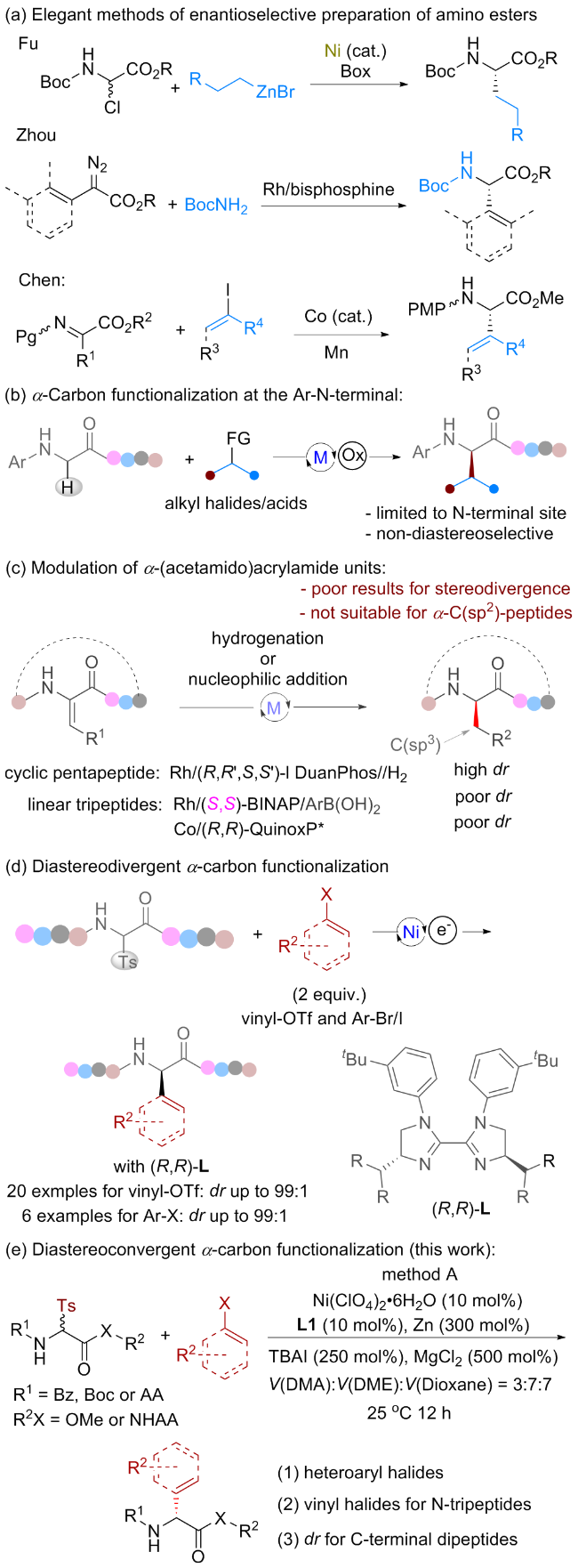
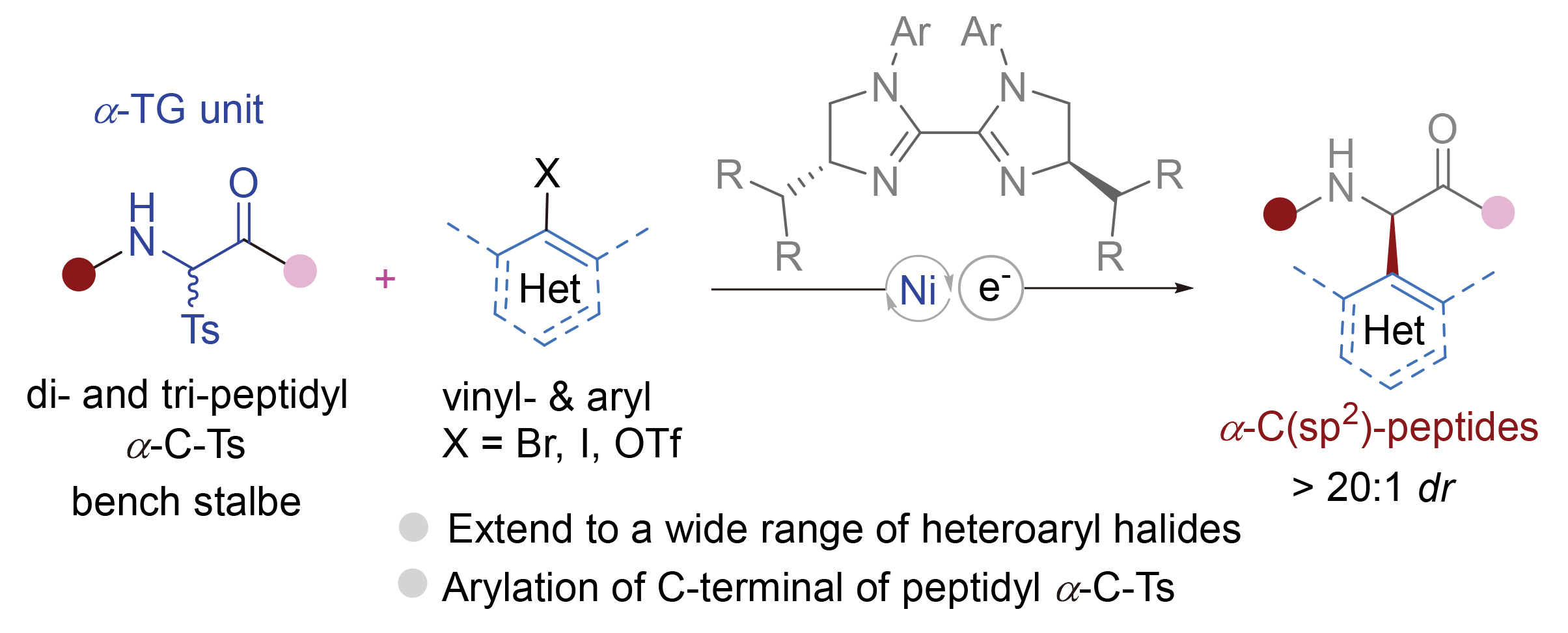
To address the challenge[20-21] of late-stage modulation of peptide backbones, in particularly the internal sites of peptides, we[22] recently advanced a stereodivergent approach to peptidyl α-C-vinyl/aryl modifications based on Ni-catalyzed reductive asymmetric cross-coupling platform. A key point of the method emphasizes the successful development of peptidyl α-C-Ts (Ts=tosyl) electrophiles by imbedding α-C-Ts-glycine (TsG) as a versatile amino acid electrophile unit into peptide backbones, which possess sufficient stability for bench-handling, while maintain satisfactory reactivity for reductive cross-coupling. This method accommodates a wide range of linear and cyclic vinyl halides and triflates, including more challenging internal linear α-vinyl triflates as the coupling partners. In addition, the scope of aryl halides and heteroaryl halides has also been briefly investigated (Scheme 1d).
Herein, a more detailed investigation into the α-arylation of peptidyl α-C-Ts substrates is presented via coupling with an extensive library of heteroaryl halides under the established Ni-catalyzed asymmetric reductive coupling framework. In particular, the scope of aryl halides and heteroaryl halides for the coupling with di- and tripeptidyl electrophiles at different carbon sites has been intensively explored. More importantly, arylation of dipeptides α-C-Ts at the C-terminals was performed for the first time, although the low drs required further improvement. Thus, the present work considerably expands the substrate scope of our previously developed method, which may inspire more endeavors for development of more exciting methods to this important field.
2 Results and discussion
The compatibility of aryl halides under previously established standard reaction conditions was further investigated, through their coupling reactions with N-Bz-pro- tected a diastereomeric mixture of α-tosyl-Gly-L-Ala methyl ester (Bz-TsG-L-Ala-CO2Me, 1a). The coupling of methyl 3-bromobenzoate with 1a gave product 2 in 83% yield and >20∶1 dr, which is comparable to that of methyl 4-bromobenzoate in our previous study (83% yield, >99∶1 dr) (Table 1). However, methyl 2-bromobenz- oate did not give a meaningful yield of the desired product 3. The relative configuration of the products was assigned based upon our previous X-ray single crystal structure of a cyclohexyl substituted Bz-N-R-CyHex-L-Ala-Me.[22] As observed before, electron-neutral and electron-rich arenes generally require iodide to be the leaving group. As such, 2-naphthyl, 4-chloro, 4-methoxy, 3-benzo[b,d]furyl, 2- (9H-carbazolyl) iodides effectively delivered products 4~7 in good yields and high drs, respectively. Next, a number of heteroaryl bromides (electron-deficient arenes) and iodides (electron-rich arenes) were found suitable for the coupling with 1a, giving products 9~16 in 42%~86% yields and >20∶1 drs. The heteroarenes comprised 5- indolyl (9), 5-benzothiophenyl (10), 3-thiophenyl (11), and 2-substituted cyano (12), 2-methoxy (13) and 2-fluoro- 5-pyridyl (14), as well as 2-PhO (15) and 2-F-pyrimidyl (16) halides. Finally, additional study was performed by testing the suitability of (Boc-L-Val-TsG-CO2Me, 1b) featuring an α-C-Ts unit at the C-terminal glycine ester. While its coupling with methyl 4-iodobenzate (17), 3-bromo- benzo[b,d]furane (18), N-Boc-protected 5-iodoindole (19), 5-bromo-2-fluoro- pyridine (20) and 5-iodobenzothiophene (21) gave the products 17~21 in moderate yields, the drs were low (ca. 2∶1). The stereochemistry of the major diastereomers of 17~21 was determined by comparison of 1H NMR spectra of a diastereomeric mixture obtained from the coupling of 1b with bromobenzene under the standard coupling conditions, with the optically pure samples of the isolated diastereomers prepared from their commercial amino acid precursors. These results clearly suggest that peptide C-terminal containing a TsG unit capped with an ester group was critically responsible for the low diastereoselectivities. Regarding the dr control at the C-terminals, the steric hindrance on the right side of the carbonyl group is very important for the dr value. Since NH is directly attached to the carbonyl carbon and is bigger than O, it provides better dr control for amide than esters.
Table 1 Reaction scope for C(sp2)-electrophiles coupling with peptide α-C-Ts electrophilesa |



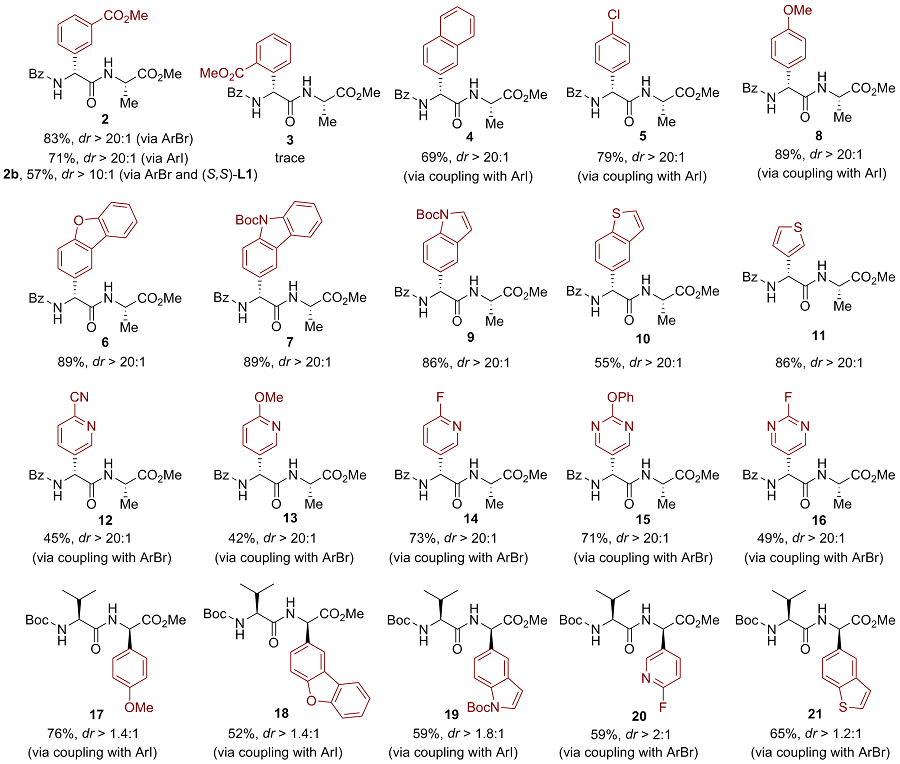 |
a Unless otherwise noted, standard method with ligand (R,R)-L1 for coupling of 1.7 equiv. of a peptide with ArX in DMA/DME/1,4-dioxane (V∶V∶V=3∶7∶7) using Ni(ClO4)2•6H2O and 5 equiv. of MgCl2. The product yields are isolated; dr was determined by 1H NMR analysis. DMA=N,N-dimethyl- acetamide, DME=1,2-dimethoxyethylene. |
Next, investigation was carried out on the suitability of the coupling of tripeptides containing α-C-Ts on the N- terminal and internal TsG units with a number of heteroaryl halides. The coupling of Boc-N-TsG-L-Lys(Cbz)-L-Tyr (Bn)-OMe with Ac-protected 6-iodoindole and Boc-pro- tected 2-iodo-9H- carbazole proceeded smoothly, producing 22 and 23 in good yields and >20∶1 drs (Table 2). Likewise, the coupling of tripeptides bearing internal TsG unit was satisfactory by using N-Ph- and N-Boc-protected 5-iodo-9H-carbazole (24~25), 5-iodo-benzofurane (26), N-Boc- and N-Piv, N-Ac-protected 5-iodoindole (27~29), and 2-fluoro-5-bromopyridine (30) as the coupling partners. The yields of products 24~30 ranged from 45% to 79% with drs>20∶1 except for a 10∶1 for 29. Finally, further investigation was performed on a few tripeptides bearing N-α-C-Ts unit for the coupling with cyclohexyl triflate. These peptides were Bz-N-TsG-L-Met-L-Phe- OMe (1c), Bz-N-TsG-L-Val-L-Phe-OMe (1d), and Bz-N- TsG-L-Gly-L-Phe-OMe (1e), with which the coupling products 31~33 were generated in moderate to good yields. In contrast to the unexpected low dr for 31 (8∶1), the products 32 and 33 were obtained in high drs, possibly due to the unexpected coordination of thioether with the catalyst within 1c.
Table 2 Scope of N-terminal and internal TsG-tripeptidesa |
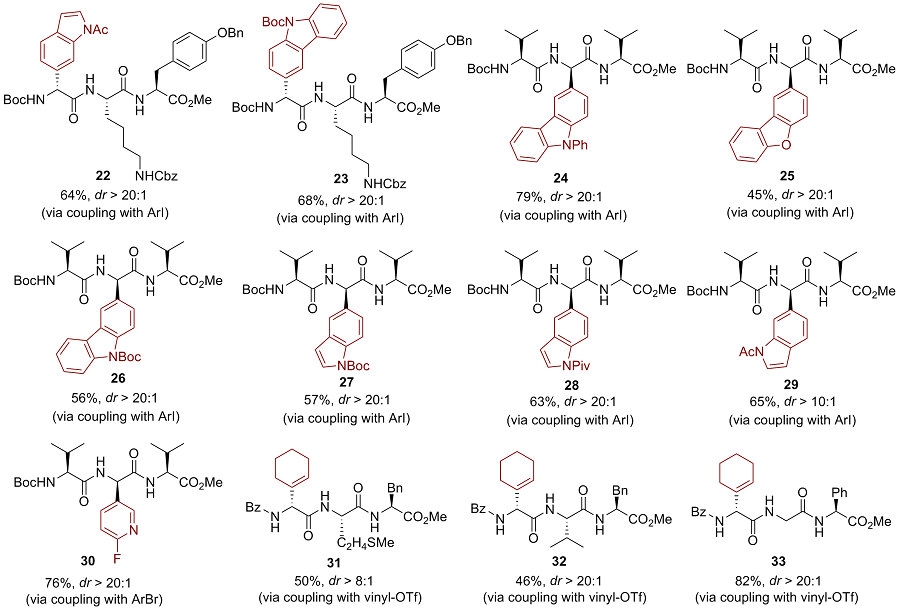 |
a Unless otherwise noted, standard method with ligand (R,R)-L1 for coupling of a peptide with 2 equiv. of vinyl-X, or 1.7 equiv. of peptide with ArX in DMA/DME/1,4-dioxane (V∶V∶V=3∶7∶7). The product yield was isolated; dr was determined by 1H NMR analysis. For vinyl electrophile couplings, Ni(BF4)2•6H2O was used; for aryl bromide couplings, Ni(ClO4)2•6H2O was used. |
3 Conclusions
This work further illustrates the potency of Ni-catalyzed asymmetric reductive coupling of peptidyl α-C-Ts electro- philes with the C(sp2)-halides/triflates to achieve diastereoselective arylation and vinylation of peptides. The substrate scope of this method was considerably expanded to a variety of heteroaryl halides by coupling with a set of di- and tripeptides. The modification at the α-carbons of C-terminal TsG units of peptides represents a rare example of this purpose. The present work not only enriches the library of peptides, but may advocate future methodology development for solving issues of the peptide backbone modulation based on transition-metal catalyzed cross-cou- pling chemistry.
4 Experimental section
4.1 Instruments and reagents
NMR spectra were recorded on a Bruker Avance NEO 400 MHz spectrometer at STP. Accurate mass HRMS data were obtained using a Waters Synapt XS QTof spectrometer equipped with ESI ion source. Melting points were determined on a WRX-4 melting point apparatus. Unless otherwise mentioned, all reactions were performed under a nitrogen atmosphere using anhydrous solvents in oven- dried tubes. Extra dry solvent (99%, with molecular sieves, water≤5.0×10⁻⁵ by K.F.) was purchased from Energy Chemical, China. Deuterated solvents were used as received (CDCl3 from J&K Co., China). Unless otherwise noted, all other reagents and starting materials were purchased from commercial sources and used without further purification.
4.2 Procedure of the standard method
To an oven-dried Schlenk tube (10 mL) were charged with the α-TsG-containing peptides (0.17 mmol, 170 mol%), Zn (0.30 mmol, 300 mol%), the electrophile RX (0.10 mmol, 100 mol%, if it is a solid), and appropriate ligand (0.01 mmol, 10 mol%). Then the tube was transferred into a glove box under N2 atmosphere, to which Ni(ClO4)2•6H2O (0.01 mmol, 10 mol%), MgCl2 (0.5 mmol, 500 mol%), and tetrabutyl ammonium iodide (TBAI) (0.25 mmol, 250 mol%) were added. The tube was capped with a rubber septum and moved out of glove box. Following this, 0.2 mL of N,N-dimethylacetamide (DMA), 0.47 mL of 1,2-dime- thoxyethylene (DME) and 0.47 mL of 1,4-dioxane were added, followed by addition of RX (if the electrophile is a liquid, 0.10 mmol, 100 mol%) via syringes. The resulting mixture was allowed to stir at 25 ℃ for 12 h. Then the reaction mixture was directly loaded onto a silica gel column without work-up. The residue in the reaction vessel was rinsed with a small amount of dichloromethane (DCM) or eluent. The desired products 2a~33 were provided via flash column chromatography.
Methyl 3-((R)-1-benzamido-2-(((S)-1-methoxy-1-oxo- propan-2-yl)amino)-2-oxoethyl)benzoate (2a): White solid, 33.2 mg, 83% yield. m.p. 206~209 ℃; 1H NMR (400 MHz, CDCl3) δ: 8.17~8.16 (m, 1H), 7.96~7.93 (m, 1H), 7.84~7.82 (m, 2H), 7.75~7.66 (m, 2H), 7.55~7.46 (m, 1H), 7.45~7.39 (m, 2H), 7.38~7.31 (m, 1H), 7.17 (d, J=7.5 Hz, 1H), 5.93 (d, J=6.7 Hz, 1H), 4.61~4.49 (m, 1H), 3.85 (s, 3H), 3.69 (s, 3H), 1.30 (d, J=7.2 Hz, 3H); 13C NMR (101 MHz, CDCl3) δ: 173.0, 169.5, 166.9, 166.7, 138.8, 133.7, 132.0, 132.0, 130.9, 129.6, 129.1, 128.7, 128.4, 127.4, 57.0, 52.7, 52.3, 48.6, 17.9; HRMS (ESI- TOF) calcd for C21H22N2O6Na [M+Na]+ 421.1376, found 421.1375.
Methyl 3-((S)-1-benzamido-2-(((S)-1-methoxy-1-oxo- propan-2-yl)amino)-2-oxoethyl)benzoate (2b): White solid, 22.6 mg, 57% yield. m.p. 200~203 ℃; 1H NMR (400 MHz, CDCl3) δ: 8.16 (d, J=1.9 Hz, 1H), 8.00~7.93 (m, 1H), 7.87~7.78 (m, 2H), 7.73~7.65 (m, 2H), 7.55~7.46 (m, 1H), 7.45~7.37 (m, 3H), 6.89 (d, J=7.3 Hz, 1H), 5.88 (d, J=6.8 Hz, 1H), 4.62~4.50 (m, 1H), 3.87 (s, 3H), 3.64 (s, 3H), 1.39 (d, J=7.2 Hz, 3H); 13C NMR (101 MHz, CDCl3) δ: 172.7, 169.3, 166.9, 166.7, 138.4, 133.7, 132.2, 132.1, 131.0, 129.8, 129.2, 128.7, 128.6, 127.4, 57.0, 52.6, 52.3, 48.7, 18.1; HRMS (ESI-TOF) calcd for C21H22N2- O6Na [M+Na]+ 421.1376, found 421.1373.
Methyl ((R)-2-benzamido-2-(naphthalen-2-yl)acetyl)-L- alaninate (4): White solid, 26.9 mg, 69% yield. m.p. 201~204 ℃; 1H NMR (400 MHz, CDCl3) δ: 8.00~7.95 (m, 1H), 7.86~7.82 (m, 2H), 7.79~7.69 (m, 4H), 7.57~7.54 (m, 1H), 7.51~7.47 (m, 1H), 7.46~7.39 (m, 4H), 6.94 (d, J=7.5 Hz, 1H), 6.01 (d, J=6.7 Hz, 1H), 4.64~4.52 (m, 1H), 3.70 (s, 3H), 1.29 (d, J=7.1 Hz, 3H); 13C NMR (101 MHz, CDCl3) δ: 173.0, 169.8, 166.9, 135.5, 133.9, 133.4, 133.3, 131.9, 129.2, 128.7, 128.3, 127.8, 127.4, 127.1, 126.5, 124.6, 57.6, 52.7, 48.6, 18.0; HRMS (ESI-TOF) calcd for C23H22N2O4Na [M+Na]+ 413.1477, found 413.1479.
Methyl ((R)-2-benzamido-2-(4-chlorophenyl)acetyl)-L- alaninate (5): White solid, 29.7 mg, 79% yield. m.p. 210~213 ℃; 1H NMR (400 MHz, CDCl3) δ: 7.82~7.78 (m, 2H), 7.64 (d, J=6.7 Hz, 1H), 7.52~7.46 (m, 1H), 7.43~7.38 (m, 4H), 7.27~7.23 (m, 2H), 7.10 (d, J=7.5 Hz, 1H), 5.83 (d, J=6.7 Hz, 1H), 4.60~4.47 (m, 1H), 3.67 (s, 3H), 1.30 (d, J=7.2 Hz, 3H); 13C NMR (101 MHz, CDCl3) δ: 173.0, 169.5, 167.0, 136.7, 134.4, 133.7, 132.1, 129.2, 128.7, 127.3, 56.7, 52.7, 48.6, 18.0; HRMS (ESI-TOF) calcd for C19H19ClN2O4Na [M+Na]+ 397.0931, found 397.0934.
Methyl ((R)-2-benzamido-2-(dibenzo[b,d]furan-2- yl)acetyl)-L-alaninate (6): White solid, 38.4 mg, 89% yield. m.p. 223~226 ℃; 1H NMR (400 MHz, CDCl3) δ: 8.12 (m, 1H), 7.89~7.80 (m, 3H), 7.70~7.67 (m, 1H), 7.62~7.58 (m, 1H), 7.54~7.48 (m, 1H), 7.47~7.36 (m, 5H), 7.22~7.17 (m, 2H), 6.09 (d, J=6.7 Hz, 1H), 4.63~4.52 (m, 1H), 3.69 (s, 3H), 1.30 (d, J=7.2 Hz, 3H); 13C NMR (101 MHz, CDCl3) δ: 173.0, 170.2, 166.9 156.6, 156.0, 133.9, 133.0, 132.0, 128.7, 127.5, 127.4, 126.2, 124.9, 123.9, 122.8, 120.9, 120.1, 112.2, 111.7, 57.3, 52.6, 48.6, 17.9; HRMS (ESI-TOF) calcd for C25H22N2O5Na [M+Na]+ 453.1426, found 453.1428.
tert-Butyl 3-((R)-1-benzamido-2-(((S)-1-methoxy-1-oxopropan-2-yl)amino)-2-oxoethyl)-9H-carbazole-9-car-boxylate (7): White solid, 47.0 mg, 89% yield. m.p. 192~194 ℃; 1H NMR (400 MHz, CDCl3) δ: 8.18~8.07 (m, 3H), 7.98~7.86 (m, 3H), 7.65~7.57 (m, 1H), 7.55~7.49 (m, 2H), 7.47~7.39 (m, 3H), 7.36~7.30 (m, 1H), 7.09~7.04 (m, 1H), 6.24 (d, J=6.8 Hz, 1H), 4.60~4.49 (m, 1H), 3.68 (s, 3H), 1.71 (s, 9H), 1.29 (d, J=7.2 Hz, 3H); 13C NMR (101 MHz, CDCl3) δ: 173.1, 170.3, 167.0, 150.8, 138.6, 138.3, 134.0, 133.1, 131.9, 128.7, 127.4, 127.1, 126.2, 125.4, 125.2, 122.7, 119.5, 119.2, 116.7, 116.0, 83.9, 57.3, 52.6, 48.5, 28.4, 17.9; HRMS (ESI-TOF) calcd for C30H32N3O6 [M+H]+ 530.2291, found 530.2292.
Methyl ((R)-2-benzamido-2-(4-methoxyphenyl)acetyl)- L-alaninate (8): White solid, 33.0 mg, 89% yield. m.p. 215~218 ℃; 1H NMR (400 MHz, CDCl3) δ: 7.83~7.79 (m, 2H), 7.55 (d, J=6.6 Hz, 1H), 7.52~7.46 (m, 1H), 7.43~7.38 (m, 4H), 6.88~6.82 (m, 2H), 6.73 (d, J=7.5 Hz, 1H), 5.72 (d, J=6.6 Hz, 1H), 4.63~4.51 (m, 1H), 3.77 (s, 3H), 3.71 (s, 3H), 1.32 (d, J=7.2 Hz, 3H); 13C NMR (101 MHz, CDCl3) δ: 173.0, 170.1, 166.7, 159.7, 134.0, 131.9, 130.3, 128.8, 128.6, 127.3, 114.5, 56.9, 55.4, 52.7, 48.5, 18.1; HRMS (ESI-TOF) calcd for C20H22- N2O5Na [M+Na]+ 393.1426, found 393.1428.
tert-Butyl 6-((R)-1-benzamido-2-(((S)-1-methoxy-1-oxopropan-2-yl)amino)-2-oxoethyl)-1H-indole-1-carbox- ylate (9): White solid, 41.4 mg, 86% yield. m.p. 131~134 ℃; 1H NMR (400 MHz, CDCl3) δ: 8.06 (d, J=8.7 Hz, 1H), 7.86~7.79 (m, 2H), 7.74~7.67 (m, 2H), 7.56 (d, J=3.7 Hz, 1H), 7.53~7.45 (m, 1H), 7.44~7.38 (m, 3H), 6.95 (d, J=7.5 Hz, 1H), 6.45 (d, J=3.7 Hz, 1H), 5.93 (d, J=6.7 Hz, 1H), 4.62~4.50 (m, 1H), 3.69 (s, 3H), 1.64 (s, 9H), 1.28 (d, J=7.2 Hz, 3H); 13C NMR (101 MHz, CDCl3) δ: 173.0, 170.2, 166.7, 149.7, 135.0, 134.0, 132.6, 131.8, 131.0, 128.6, 127.3, 126.7, 123.3, 120.3, 115.8, 107.5, 84.0, 57.4, 52.6, 48.5, 28.3, 18.0; HRMS (ESI-TOF) calcd for C26H30N3O6 [M+H]+ 480.2135, found 480.2136.
Methyl ((R)-2-benzamido-2-(benzo[b]thiophen-5-yl)- acetyl)-L-alaninate (10): White solid, 21.8 mg, 55% yield. m.p. 194~197 ℃; 1H NMR (400 MHz, CDCl3) δ: 7.98~7.94 (m, 1H), 7.85~7.81 (m, 3H), 7.68 (d, J=6.4 Hz, 1H), 7.53~7.47 (m, 1H), 7.46~7.39 (m, 4H), 7.26 (d, J=0.8 Hz, 1H), 6.67 (d, J=7.3 Hz, 1H), 5.88 (d, J=6.4 Hz, 1H), 4.64~ 4.53 (m, 1H), 3.72 (s, 3H), 1.30 (d, J=7.2 Hz, 3H); 13C NMR (101 MHz, CDCl3) δ: 173.0, 169.9, 166.8, 140.1, 139.9, 134.4, 133.9, 131.9, 128.7, 127.5, 127.3, 124.1, 123.4, 123.3, 123.0, 57.6, 52.7, 48.6, 18.1; HRMS (ESI-TOF) calcd for C21H20N2O4SNa [M+Na]+ 419.1041, found 419.1043.
Methyl ((R)-2-benzamido-2-(thiophen-3-yl)acetyl)-L- alaninate (11): White solid, 29.8 mg, 86% yield. m.p. 146~148 ℃; 1H NMR (400 MHz, CDCl3) δ: 7.83~7.79 (m, 2H), 7.53~7.47 (m, 2H), 7.44~7.37 (m, 3H), 7.29~7.26 (m, 1H), 7.15~7.11 (m, 2H), 6.00 (d, J=7.2 Hz, 1H), 4.65~4.53 (m, 1H), 3.70 (s, 3H), 1.37 (d, J=7.2 Hz, 3H); 13C NMR (101 MHz, CDCl3) δ: 173.0, 169.5, 166.9, 138.3, 133.8, 132.0, 128.7, 127.3, 126.8, 126.4, 123.7, 53.2, 52.6, 48.6, 18.1; HRMS (ESI-TOF) calcd for C17H18N2O4SNa [M+Na]+ 369.0885, found 369.0888.
Methyl ((R)-2-benzamido-2-(6-cyanopyridin-3-yl)ace- tyl)-L-alaninate (12): White solid, 16.6 mg, 45% yield. m.p. 207~210 ℃; 1H NMR (400 MHz, CDCl3) δ: 8.86~8.84 (m, 1H), 7.97 (dd, J=8.1, 2.3 Hz, 1H), 7.83~7.79 (m, 2H), 7.72 (d, J=6.7 Hz, 1H), 7.67~7.63 (m, 1H), 7.58~7.53 (m, 1H), 7.48~7.43 (m, 2H), 7.30 (d, J=7.5 Hz, 1H), 5.97 (d, J=6.7 Hz, 1H), 4.62~4.50 (m, 1H), 3.72 (s, 3H), 1.35 (d, J=7.1 Hz, 3H); 13C NMR (101 MHz, CDCl3) δ: 172.9, 168.1, 167.3, 150.3, 137.7, 135.9, 133.7, 132.9, 132.6, 128.9, 128.6, 127.4, 116.9, 55.0, 52.9, 48.8, 17.9; HRMS (ESI-TOF) calcd for C19H19N4O4 [M+H]+ 367.1406, found 367.1409.
Methyl ((R)-2-benzamido-2-(6-methoxypyridin-3-yl)- acetyl)-L-alaninate (13): White solid, 15.6 mg, 42% yield. m.p. 193~196 ℃; 1H NMR (400 MHz, CDCl3) δ: 8.31~8.26 (m, 1H), 7.84~7.77 (m, 2H), 7.66 (dd, J=8.6, 2.5 Hz, 1H), 7.60 (d, J=6.7 Hz, 1H), 7.52~7.48 (m, 1H), 7.43~7.36 (m, 2H), 7.05 (d, J=7.4 Hz, 1H), 6.69 (d, J=8.6 Hz, 1H), 5.81 (d, J=6.7 Hz, 1H), 4.63~4.51 (m, 1H), 3.89 (s, 3H), 3.71 (s, 3H), 1.34 (d, J=7.2 Hz, 3H); 13C NMR (101 MHz, CDCl3) δ: 173.0, 169.5, 166.9, 164.2, 146.3, 137.6, 133.6, 132.1, 128.7, 127.3, 126.8, 111.4, 54.6, 53.7, 52.7, 48.6, 18.1; HRMS (ESI-TOF) calcd for C19H22N3O5 [M+H]+372.1559, found 372.1561.
Methyl ((R)-2-benzamido-2-(6-fluoropyridin-3-yl)-ace- tyl)-L-alaninate (14): White solid, 26.3 mg, 73% yield. m.p. 183~186 ℃; 1H NMR (400 MHz, CDCl3) δ: 8.36~8.34 (m, 1H), 7.94~7.88 (m, 1H), 7.82~7.78 (m, 2H), 7.76 (d, J=7.0 Hz, 1H), 7.56~7.49 (m, 2H), 7.45~7.38 (m, 2H), 6.85 (dd, J=8.5, 2.9 Hz, 1H), 5.99 (d, J=6.9 Hz, 1H), 4.59~4.49 (m, 1H), 3.68 (s, 3H), 1.32 (d, J=7.3 Hz, 3H); 13C NMR (101 MHz, CDCl3) δ: 172.9, 169.1, 167.2, 163.5 (d, J=240.7 Hz), 146.9 (d, J=15.1 Hz), 140.2 (d, J=8.1 Hz), 133.2, 132.3, 131.9 (d, J=4.7 Hz), 128.8, 127.3, 109.9 (d, J=37.5 Hz), 54.2, 52.7, 48.6, 17.9; 19F NMR (376 MHz, CDCl3) δ: -68.23; HRMS (ESI-TOF) calcd for C18H18FN3O4Na [M+Na]+ 382.1179, found 382.1182.
Methyl ((R)-2-benzamido-2-(2-phenoxypyrimidin-5-yl)- acetyl)-L-alaninate (15): White solid, 31.0 mg, 71% yield. m.p. 200~203 ℃; 1H NMR (400 MHz, CDCl3) δ: 8.67 (s, 2H), 7.82~7.77 (m, 2H), 7.74 (d, J=6.9 Hz, 1H), 7.54~7.48 (m, 2H), 7.44~7.36 (m, 4H), 7.26~7.21 (m, 1H), 7.19~7.15 (m, 2H), 5.96 (d, J=6.9 Hz, 1H), 4.59~4.51 (m, 1H), 3.69 (s, 3H), 1.35 (d, J=7.2 Hz, 3H); 13C NMR (101 MHz, CDCl3) δ: 172.9, 168.6, 167.4, 165.3, 159.0, 152.9, 133.1, 132.4, 129.8, 128.8, 127.3, 126.6, 125.7, 121.8, 52.8, 52.6, 48.7, 17.9; HRMS (ESI-TOF) calcd for C23H23N4O5 [M+H]+ 435.1668, found 435.1672.
Methyl ((R)-2-benzamido-2-(2-fluoropyrimidin-5-yl)- acetyl)-L-alaninate (16): White solid, 17.6 mg, 49% yield. m.p. 195~198 ℃; 1H NMR (400 MHz, CDCl3) δ: 8.78 (d, J=1.5 Hz, 2H), 7.85~7.77 (m, 2H), 7.72 (d, J=6.8 Hz, 1H), 7.57~7.51 (m, 1H), 7.47~7.41 (m, 2H), 7.33 (d, J=7.5 Hz, 1H), 5.97 (d, J=6.8 Hz, 1H), 4.58 (p, J=7.2 Hz, 1H), 3.72 (s, 3H), 1.37 (d, J=7.2 Hz, 3H); 13C NMR (101 MHz, CDCl3) δ: 173.0, 168.2 167.5, 162.9 (d, J=221.7 Hz), 160.4, 160.3, 132.8, 132.6, 130.2 (d, J=5.5 Hz), 128.9, 127.4, 52.9, 52.5 (d, J=2.1 Hz), 48.7, 18.0; 19F NMR (376 MHz, CDCl3) δ: -45.19; HRMS (ESI-TOF) calcd for C17H17FN4O4Na [M+Na]+ 383.1132, found 383.1135.
Methyl (R)-2-((S)-2-((tert-butoxycarbonyl)amino)-3-me- thylbutanamido)-2-(4-methoxyphenyl)acetate (17): White solid, 30.1 mg, 76% yield. m.p. 152~154 ℃; Major isomer: 1H NMR (400 MHz, CDCl3) δ: 7.79 (d, J=8.0 Hz, 2H), 7.52~7.40 (m, 1H), 7.34 (d, J=2.3 Hz, 2H), 5.94 (d, J=9.9 Hz, 1H), 5.05 (d, J=8.9 Hz, 1H), 4.09~3.99 (m, 1H), 3.82 (s, 3H), 2.43 (s, 3H), 2.14~2.06 (m, 1H), 1.46 (s, 9H), 0.93~0.88 (m, 3H), 0.79 (d, J=6.8 Hz, 3H); 13C NMR (101 MHz, CDCl3) δ: 171.5, 163.8, 155.9, 146.0, 133.9, 130.0, 129.5, 80.5, 71.6, 59.4, 53.9, 30.6, 28.4, 21.9, 19.4, 17.1. Minor isomer: 1H NMR (400 MHz, CDCl3) δ: 7.79 (d, J=8.0 Hz, 2H), 7.52~7.40 (m, 1H), 7.34 (d, J=2.3 Hz, 2H), 5.91 (d, J=13.1 Hz, 1H), 4.91 (d, J=8.4 Hz, 1H), 4.09~3.99 (m, 1H), 3.82 (s, 3H), 2.43 (s, 3H), 2.14~2.06 (m, 1H), 1.44 (s, 9H), 0.93~0.88 (m, 3H), 0.85 (d, J=6.8 Hz, 3H); 13C NMR (101 MHz, CDCl3) δ: 171.3, 163.8, 155.8, 146.0, 133.9, 130.0, 129.5, 80.3, 71.5, 59.9, 53.9, 30.4, 28.4, 21.9, 19.3, 17.5; HRMS (ESI-TOF) calcd for C20H30N2O6Na [M+Na]+ 417.2002, found 417.2007.
Methyl (R)-2-((S)-2-((tert-butoxycarbonyl)amino)-3-me- thylbutanamido)-2-(dibenzo[b,d]furan-2-yl)acetate (18): White solid, 23.6 mg, 52% yield. m.p. 163~166 ℃; Major isomer: 1H NMR (400 MHz, CDCl3) δ: 7.97~7.92 (m, 2H), 7.57~7.51 (m, 2H), 7.49~7.42 (m, 2H), 7.38~7.32 (m, 1H), 7.10 (d, J=6.4 Hz, 1H), 5.69 (d, J=6.1 Hz, 1H), 5.09~5.00 (m, 1H), 4.05~3.98 (m, 1H), 3.74 (s, 3H), 2.22~2.13 (m, 1H), 1.44 (s, 9H), 1.00 (d, J=6.7 Hz, 1H), 0.91 (d, J=6.5 Hz, 3H), 0.87 (d, J=6.8 Hz, 2H); 13C NMR (101 MHz, CDCl3) δ: 171.4, 171.4, 171.2, 156.8, 156.2, 131.1, 127.7, 126.4, 125.0, 123.9, 123.1, 121.0, 120.0, 112.3, 111.9, 80.2, 59.9, 56.6, 53.1, 30.9, 28.4, 19.4, 17.6. Minor isomer: 1H NMR (400 MHz, CDCl3) δ: 7.97~7.92 (m, 2H), 7.57~7.51 (m, 2H), 7.49~7.42 (m, 2H), 7.38~7.32 (m, 1H), 7.06 (d, J=6.8 Hz, 1H), 5.69 (d, J=6.1 Hz, 1H), 5.09~5.00 (m, 1H), 4.05~3.98 (m, 1H), 3.74 (s, 3H), 2.22~2.13 (m, 1H), 1.41 (s, 9H), 1.00 (d, J=6.7 Hz, 1H), 0.91 (d, J=6.5 Hz, 3H), 0.87 (d, J=6.8 Hz, 2H); 13C NMR (101 MHz, CDCl3) δ: 171.4, 171.4, 171.2, 156.8, 156.2, 131.1, 127.7, 126.4, 125.0, 123.9, 123.1, 121.0, 120.0, 112.3, 111.9, 80.2, 59.9, 56.6, 53.1, 31.0, 28.40, 19.4, 17.6; HRMS (ESI-TOF) calcd for C25H30N3O6Na [M+Na]+ 477.2002, found 477.2003.
tert-Butyl 5-((4R,7S)-7-isopropyl-11,11-dimethyl-3,6,9- trioxo-2,10-dioxa-5,8-diazadodecan-4-yl)-1H-indole-1-carboxylate (19): White solid, 29.7 mg, 59% yield. m.p. 105~109 ℃; Major isomer: 1H NMR (400 MHz, CDCl3) δ: 8.11 (d, J=8.6 Hz, 1H), 7.60 (d, J=3.7 Hz, 1H), 7.57~7.54 (m, 1H), 7.30~7.27 (m, 1H), 6.97 (d, J=6.9 Hz, 1H), 6.54 (d, J=3.7 Hz, 1H), 5.66~5.57 (m, 1H), 5.07~5.00 (m, 1H), 4.07~3.92 (m, 1H), 3.71 (s, 3H), 2.21~2.10 (m, 1H), 1.66 (s, 9H), 1.42 (s, 9H), 0.99 (d, J=6.8 Hz, 1H), 0.92~0.84 (m, 5H); 13C NMR (101 MHz, CDCl3) δ: 171.5, 171.1, 156.0, 149.7, 135.2, 131.1, 130.7, 126.9, 123.3, 120.2, 115.8, 107.4, 84.1, 80.0, 59.8, 56.7, 52.9, 31.0, 28.4, 28.3, 19.4, 17.6. Minor isomer: 1H NMR (400 MHz, CDCl3) δ: 8.11 (d, J=8.6 Hz, 1H), 7.60 (d, J=3.7 Hz, 1H), 7.57~7.54 (m, 1H), 7.30~7.27 (m, 1H), 6.91 (d, J=6.8 Hz, 1H), 6.54 (d, J=3.7 Hz, 1H), 5.66~5.57 (m, 1H), 5.07~5.00 (m, 1H), 4.07~3.92 (m, 1H), 3.71 (s, 3H), 2.21~2.10 (m, 1H), 1.66 (s, 9H), 1.43 (s, 9H), 0.99 (d, J=6.8 Hz, 1H), 0.92~0.84 (m, 5H); 13C NMR (101 MHz, CDCl3) δ: 171.5, 171.0, 156.0, 149.7, 135.2, 131.1, 130.7, 126.9, 123.3, 120.1, 115.8, 107.4, 84.1, 80.0, 59.8, 56.7, 52.9, 31.1, 28.4, 28.3, 19.4, 17.9; HRMS (ESI-TOF) calcd for C26H37N3O7Na [M+Na]+ 526.2529, found 526.2531.
Methyl (R)-2-((S)-2-((tert-butoxycarbonyl)amino)-3-me- thylbutanamido)-2-(6-fluoropyridin-3-yl)acetate (20): White solid, 22.8 mg, 59% yield. m.p. 121~124 ℃; Major isomer: 1H NMR (400 MHz, CDCl3) δ: 8.24~8.22 (m, 1H), 7.82~7.76 (m, 1H), 7.25~7.22 (m, 1H), 6.93~6.88 (m, 1H), 5.59 (d, J=6.7 Hz, 1H), 5.02~4.96 (m, 1H), 4.01~3.91 (m, 1H), 3.75 (s, 3H), 2.19~2.09 (m, 1H), 1.42 (s, 9H), 0.96 (d, J=6.8 Hz, 1H), 0.92~0.88 (m, 3H), 0.87 (d, J=6.8 Hz, 2H); 13C NMR (101 MHz, CDCl3) δ: 171.4, 170.2, 163.6 (d, J=240.9 Hz), 156.1, 146.9 (d, J=15.3 Hz), 140.2, 130.4, 110.0 (d, J=37.7 Hz), 80.4, 60.2, 53.7, 53.4, 30.7, 28.4, 19.4, 17.7; 19F NMR (376 MHz, CDCl3) δ: -68.14. Minor isomer: 1H NMR (400 MHz, CDCl3) δ: 8.24~8.22 (m, 1H), 7.82~7.76 (m, 1H), 7.25~7.22 (m, 1H), 6.93~6.88 (m, 1H), 5.59 (d, J=6.7 Hz, 1H), 5.02~4.96 (m, 1H), 4.01~3.91 (m, 1H), 3.75 (s, 3H), 2.19~2.09 (m, 1H), 1.43 (s, 9H), 0.96 (d, J=6.8 Hz, 1H), 0.92~0.88 (m, 3H), 0.87 (d, J=6.8 Hz, 2H); 13C NMR (101 MHz, CDCl3) δ: 171.4, 170.3, 163.6 (d, J=240.9 Hz), 156.1, 146.9 (d, J=15.3 Hz), 140.2, 130.5, 109.9 (d, J=37.8 Hz), 80.4, 60.2, 53.7, 53.4, 30.5, 28.4, 19.4, 18.0; 19F NMR (376 MHz, CDCl3) δ: -67.98; HRMS (ESI-TOF) calcd for C18H26FN3O5Na [M+Na]+ 406.1754, found 406.1757.
Methyl (R)-2-(benzo[b]thiophen-5-yl)-2-((S)-2-((tert-bu- toxycarbonyl)amino)-3-methylbutanamido)acetate (21): White solid, 27.5 mg, 65% yield. m.p. 144~147 ℃; Major isomer: 1H NMR (400 MHz, CDCl3) δ: 7.87~7.80 (m, 2H), 7.49~7.45 (m, 1H), 7.34~7.28 (m, 2H), 7.09 (d, J=6.9 Hz, 1H), 5.65 (d, J=6.7 Hz, 1H), 5.06 (d, J=8.8 Hz, 1H), 4.10~3.92 (m, 1H), 3.71 (s, 3H), 2.20~2.10 (m, 1H), 1.41 (s, 9H), 0.98 (d, J=6.8 Hz, 1H), 0.94~0.83 (m, 5H); 13C NMR (101 MHz, CDCl3) δ: 171.4, 171.2, 156.0, 140.1, 132.6, 127.7, 124.0, 123.3, 123.2, 122.7, 122.6, 80.2, 59.8, 56.6, 53.0, 30.9, 28.4, 19.4, 17.6. Minor isomer: 1H NMR (400 MHz, CDCl3) δ: 7.87~7.80 (m, 2H), 7.49~7.45 (m, 1H), 7.34~7.28 (m, 2H), 7.05 (d, J=7.0 Hz, 1H), 5.65 (d, J=6.7 Hz, 1H), 5.06 (d, J=8.8 Hz, 1H), 4.10~3.92 (m, 1H), 3.72 (s, 3H), 2.20~2.10 (m, 1H), 1.43 (s, 9H), 0.98 (d, J=6.8 Hz, 1H), 0.94~0.83 (m, 5H); 13C NMR (101 MHz, CDCl3) δ: 171.3, 171.1, 156.0, 140.1, 132.6, 127.7, 124.0, 123.3, 123.2, 122.7, 122.6, 80.2, 59.8, 56.6, 53.0, 31.0, 28.4, 19.4, 17.9; HRMS (ESI-TOF) calcd for C21H28N2O5SNa [M+Na]+ 443.1617, found 443.1618.
Methyl (6R,9S,12S)-6-(1-acetyl-1H-indol-6-yl)-12-(4- (benzyloxy)benzyl)-9-(4-(((benzyloxy)carbonyl)amino)- butyl)-2,2-dimethyl-4,7,10-trioxo-3-oxa-5,8,11-triazatri-decan-13-oate (22): White solid, 55.0 mg, 64% yield. m.p. 163~165 ℃; 1H NMR (400 MHz, CDCl3) δ: 8.48 (s, 1H), 7.50 (d, J=8.1 Hz, 1H), 7.45~7.28 (m, 12H), 6.97 (d, J=8.2 Hz, 2H), 6.83 (d, J=8.2 Hz, 2H), 6.72 (d, J=8.0 Hz, 2H), 6.55 (d, J=3.8 Hz, 1H), 5.90 (d, J=6.5 Hz, 1H), 5.38~5.30 (m, 1H), 5.12~5.05 (m, 1H), 5.04 (s, 2H), 4.98 (s, 2H), 4.77~4.68 (m, 1H), 4.52~4.41 (m, 1H), 3.62 (s, 3H), 3.03~2.82 (m, 4H), 2.53 (s, 3H), 1.73~1.62 (m, 1H), 1.53~1.45 (m, 1H), 1.39 (s, 9H), 1.26 (s, 2H), 1.06~0.97 (m, 2H); 13C NMR (101 MHz, CDCl3) δ: 171.9, 170.9, 170.5, 168.8, 158.0, 156.5, 155.2, 137.1, 136.8, 135.7, 130.6, 130.3, 128.7, 128.6, 128.2, 128.1, 128.0, 127.7, 126.2, 122.9, 121.5, 115.6, 115.0, 108.9, 80.2, 70.0, 66.6, 59.3, 53.6, 52.9, 52.4, 40.5, 36.9, 29.8, 29.1, 28.4, 23.9, 21.9; HRMS (ESI-TOF) calcd for C48H56- N5O10 [M+H]+ 862.4027, found 862.4026.
tert-Butyl 3-((9S,12R)-9-(((S)-3-(4-(benzyloxy)phenyl)- 1-methoxy-1-oxopropan-2-yl)carbamoyl)-16,16-dimethyl-3,11,14-trioxo-1-phenyl-2,15-dioxa-4,10,13-triazaheptade-can-12-yl)-9H-carbazole-9-carboxylate (23): White solid, 66.0 mg, 68% yield. m.p. 177~181 ℃; 1H NMR (400 MHz, CDCl3) δ: 8.29~8.24 (m, 2H), 8.01~7.98 (m, 1H), 7.93 (d, J=7.7 Hz, 1H), 7.48~7.43 (m, 2H), 7.42~7.27 (m, 11H), 6.97 (d, J=8.2 Hz, 2H), 6.85 (d, J=8.4 Hz, 2H), 6.63~6.49 (m, 2H), 5.83 (d, J=6.0 Hz, 1H), 5.35~5.28 (m, 1H), 5.03 (s, 2H), 4.98 (s, 2H), 4.88~4.82 (m, 1H), 4.79~4.71 (m, 1H), 4.47~4.35 (m, 1H), 3.64 (s, 3H), 3.06~2.81 (m, 4H), 1.73 (s, 9H), 1.70 (d, J=5.1 Hz, 2H), 1.41 (s, 9H), 1.28~1.25 (m, 2H), 1.07~0.96 (m, 2H); 13C NMR (101 MHz, CDCl3) δ: 171.9, 170.9, 170.5, 158.1, 156.6, 155.2, 151.0, 138.9, 138.5, 137.0, 136.8, 130.3, 128.7, 128.6, 128.2, 128.2, 128.1, 127.7, 127.6, 126.4, 126.2, 125.3, 123.3, 119.9, 118.7, 117.0, 116.4, 115.1, 84.3, 80.4, 70.1, 66.7, 59.1, 53.6, 52.9, 52.5, 40.3, 36.9, 29.8, 29.2, 28.5, 28.4, 21.7; HRMS (ESI-TOF) calcd for C55H64N5O11 [M+H]+ 970.4602, found 970.4604.
Methyl ((R)-2-((S)-2-((tert-butoxycarbonyl)amino)-3- methylbutanamido)-2-(9-phenyl-9H-carbazol-3-yl)acetyl)-L-valinate (24): White solid, 49.9 mg, 79% yield. m.p. 190~193 ℃; 1H NMR (400 MHz, CDCl3) δ: 8.22~8.20 (m, 1H), 7.60 (d, J=7.5 Hz, 2H), 7.55~7.36 (m, 4H), 7.34~7.28 (m, 4H), 7.27~7.23 (m, 1H), 7.19 (d, J=8.5 Hz, 1H), 7.03~6.95 (m, 1H), 6.18 (d, J=7.1 Hz, 1H), 5.68 (d, J=9.0 Hz, 1H), 4.62~4.54 (m, 1H), 4.18~4.10 (m, 1H), 3.76 (s, 3H), 2.19~2.09 (m, 1H), 2.02~1.91 (m, 1H), 1.46 (s, 9H), 0.94 (d, J=6.6 Hz, 3H), 0.91 (d, J=6.6 Hz 3H), 0.62 (d, J=6.8 Hz, 3H), 0.59 (d, J=6.8 Hz 3H); 13C NMR (101 MHz, CDCl3) δ: 172.4, 171.2, 170.6, 156.0, 141.0, 140.5, 137.5, 130.0, 129.8, 127.4, 127.0, 126.0, 124.8, 123.5, 123.1, 120.2, 119.9, 119.8, 110.0, 109.6, 79.7, 60.2, 57.2, 57.0, 52.4, 31.7, 28.5, 19.4, 18.8, 18.1, 17.6; HRMS (ESI-TOF) calcd for C36H45N4O6 [M+H]+ 629.3339, found 629.3339.
Methyl ((R)-2-((S)-2-((tert-butoxycarbonyl)amino)-3- methylbutanamido)-2-(dibenzo[b,d]furan-2-yl)acetyl)-L-valinate (25): White solid, 25.0 mg, 45% yield. m.p. 172~175 ℃; 1H NMR (400 MHz, CDCl3) δ: 8.00~7.99 (m, 1H), 7.62 (d, J=7.0 Hz, 1H), 7.50~7.46 (m, 1H), 7.38~7.28 (m, 5H), 7.13~7.06 (m, 1H), 6.13 (d, J=7.1 Hz, 1H), 5.67 (d, J=9.0 Hz, 1H), 4.61~4.51 (m, 1H), 4.16~4.09 (m, 1H), 3.75 (s, 3H), 2.19~2.08 (m, 1H), 2.04~1.93 (m, 1H), 1.46 (s, 9H), 0.94 (d, J=6.4 Hz, 3H), 0.91 (d, J=6.4 Hz, 3H), 0.59 (d, J=6.8 Hz, 6H); 13C NMR (101 MHz, CDCl3) δ: 172.4, 171.5, 170.2, 156.4, 156.0, 155.8, 133.1, 127.2, 125.7, 124.5, 123.7, 122.6, 120.4, 120.1, 111.8, 111.5, 79.8, 60.2, 57.1, 56.6, 52.4, 31.8, 31.6, 28.5, 19.4, 18.8, 18.0, 17.4; HRMS (ESI-TOF) calcd for C30H39N3O7Na [M+Na]+ 576.2686, found 576.2687.
tert-Butyl 2-((4S,10S)-4,10-diisopropyl-14,14-dimethyl- 3,6,9,12-tetraoxo-2,13-dioxa-5,8,11-triazapentadecan-7-yl)-9H-carbazole-9-carboxylate (26): White solid, 36.7 mg, 56% yield. m.p. 143~145 ℃; 1H NMR (400 MHz, CDCl3) δ: 8.05~7.91 (m, 3H), 7.73 (d, J=7.2 Hz, 1H), 7.62 (d, J=9.2 Hz, 1H), 7.50 (dd, J=8.7, 1.9 Hz, 1H), 7.22 (d, J=7.9 Hz, 1H), 7.02~6.87 (m, 2H), 6.31 (d, J=7.2 Hz, 1H), 5.92 (d, J=9.2 Hz, 1H), 4.61~4.51 (m, 1H), 4.24~4.11 (m, 1H), 3.76 (s, 3H), 2.19~2.10 (m, 1H), 1.97~1.90 (m, 1H), 1.71 (s, 9H), 1.47 (s, 9H), 0.98 (d, J=5.0 Hz, 3H), 0.97 (d, J=5.0 Hz, 3H), 0.55 (d, J=6.9 Hz, 3H), 0.53 (d, J=6.6 Hz, 3H); 13C NMR (101 MHz, CDCl3) δ: 172.5, 171.5, 170.4, 156.0, 150.7, 138.4, 138.2, 133.3, 126.8, 125.8, 125.1, 125.0, 122.4, 119.4, 119.0, 116.3, 115.7, 83.7, 79.6, 60.4, 57.0, 56.5, 52.4, 31.9, 29.8, 28.5, 28.5, 19.4, 18.7, 18.2, 17.4; HRMS (ESI-TOF) calcd for C35H49N4O8 [M+H]+ 653.3550, found 653.3553.
tert-Butyl 5-((4S,10S)-4,10-diisopropyl-14,14-dimethyl- 3,6,9,12-tetraoxo-2,13-dioxa-5,8,11-triazapentadecan-7-yl)-1H-indole-1-carboxylate (27): White solid, 34.3 mg, 57% yield. m.p. 134~137 ℃; 1H NMR (400 MHz, CDCl3) δ: 8.02 (d, J=8.6 Hz, 1H), 7.58~7.56 (m, 1H), 7.53 (d, J=3.8 Hz, 1H), 7.37 (d, J=6.6 Hz, 1H), 7.29 (dd, J=8.6, 1.8 Hz, 1H), 6.66 (d, J=8.9 Hz, 1H), 6.39 (d, J=3.7 Hz, 1H), 5.74 (d, J=6.7 Hz, 1H), 5.31 (d, J=8.9 Hz, 1H), 4.55~4.50 (m, 1H), 4.09~4.01 (m, 1H), 3.73 (s, 3H), 2.12~2.05 (m, 1H), 2.04~1.97 (m, 1H), 1.64 (s, 9H), 1.42 (s, 9H), 0.89~0.81 (m, 6H), 0.67 (d, J=6.8 Hz, 3H), 0.62 (d, J=6.9 Hz, 3H); 13C NMR (101 MHz, CDCl3) δ: 172.2, 171.1, 170.1, 155.9, 149.7, 135.1, 132.5, 130.9, 126.6, 123.2, 120.2, 115.7, 107.4, 83.9, 79.8, 59.9, 57.3, 57.2, 52.4, 31.6, 31.5, 28.4, 28.3, 19.3, 18.9, 17.8, 17.6; HRMS (ESI-TOF) calcd for C31H47N4O8 [M+H]+ 603.3394, found 603.3394.
Methyl (2-((S)-2-((tert-butoxycarbonyl)amino)-3-me- thylbutanamido)-2-(1-pivaloyl-1H-indol-5-yl)acetyl)-L-va- linate (28): White solid, 37.2 mg, 63% yield. m.p. 144~146 ℃; 1H NMR (400 MHz, CDCl3) δ: 8.41 (d, J=8.7 Hz, 1H), 7.70 (d, J=3.8 Hz, 1H), 7.61~7.58 (m, 1H), 7.38~7.30 (m, 2H), 6.58 (d, J=9.0 Hz, 1H), 6.48 (d, J=3.8 Hz, 1H), 5.70 (d, J=6.6 Hz, 1H), 5.31~5.24 (m, 1H), 4.57~4.49 (m, 1H), 4.07~3.97 (m, 1H), 3.72 (s, 3H), 2.11~2.00 (m, 2H), 1.49 (s, 9H), 1.42 (s, 9H), 0.86~0.80 (m, 6H), 0.68 (d, J=6.8 Hz, 3H), 0.63 (d, J=6.9 Hz, 3H); 13C NMR (101 MHz, CDCl3) δ: 177.1, 172.1, 171.1, 170.0, 155.9, 136.6, 133.4, 129.8, 126.4, 124.0, 119.9, 117.9, 108.4, 79.8, 59.9, 57.4, 57.3, 52.4, 41.3, 31.6, 31.5, 28.8, 28.4, 19.3, 18.9, 17.8, 17.6; HRMS (ESI-TOF) calcd for C31H47N4O7 [M+H]+ 587.3445, found 587.3445.
Methyl (2-(1-acetyl-1H-indol-6-yl)-2-(2-((tert-butoxy- carbonyl)amino)-3-methylbutanamido)acetyl)valinate (29): White solid, 35.3 mg, 65% yield. m.p. 181~183 ℃; 1H NMR (400 MHz, CDCl3) δ: 8.47~8.38 (m, 1H), 7.45~7.38 (m, 3H), 7.28~7.25 (m, 1H), 6.87~6.75 (m, 1H), 6.55 (d, J=3.7 Hz, 1H), 5.77 (d, J=6.5 Hz, 1H), 5.44~5.34 (m, 1H), 4.54~4.48 (m, 1H), 4.09~4.02 (m, 1H), 3.73 (s, 3H), 2.47 (s, 3H), 2.13~2.06 (m, 1H), 2.04~1.94 (m, 1H), 1.42 (s, 9H), 0.90 (d, J=6.9 Hz, 3H), 0.86 (d, J=6.8 Hz, 3H), 0.65~0.60 (m, 6H); 13C NMR (101 MHz, CDCl3) δ: 172.2, 171.2, 169.9, 168.3, 155.9, 135.5, 135.3, 130.5, 126.1, 122.3, 121.4, 115.7, 108.7, 79.7, 59.9, 57.6, 57.3, 52.4, 31.6, 31.6, 28.4, 24.1, 19.4, 18.8, 17.8, 17.6; HRMS (ESI-TOF) calcd for C28H41N4O7 [M+H]+ 545.2975, found 545.2979.
Methyl (2-((S)-2-((tert-butoxycarbonyl)amino)-3-me- thylbutanamido)-2-(6-fluoropyridin-3-yl)acetyl)-L-valinate (30): White solid, 36.6 mg, 76% yield. m.p. 167~171 ℃; 1H NMR (400 MHz, CDCl3) δ: 8.26~8.24 (m, 1H), 7.85~7.79 (m, 1H), 7.67~7.59 (m, 1H), 7.36 (d, J=8.9 Hz, 1H), 6.82 (dd, J=8.5, 2.9 Hz, 1H), 5.86 (d, J=7.0 Hz, 1H), 5.47 (d, J=8.7 Hz, 1H), 4.57~4.51 (m, 1H), 4.14~4.03 (m, 1H), 3.75 (s, 3H), 2.10~2.03 (m, 2H), 1.43 (s, 9H), 0.88 (d, J=3.0 Hz, 3H), 0.86 (d, J=3.1 Hz, 3H), 0.71 (d, J=5.0 Hz, 3H), 0.70 (d, J=5.1 Hz, 3H); 13C NMR (101 MHz, CDCl3) δ: 172.4, 171.9, 169.1, 163.4 (d, J=240.6 Hz), 156.1, 146.8 (d, J=15.1 Hz), 139.9 (d, J=8.0 Hz), 132.1, 109.7 (d, J=37.7 Hz), 80.1, 60.0, 57.4, 53.9, 52.5, 31.5, 31.2, 28.4, 19.4, 18.9, 17.9, 17.7; 19F NMR (376 MHz, CDCl3) δ: -68.31; HRMS (ESI-TOF) calcd for C23H35FN4O6Na [M+Na]+ 505.2438, found 505.2440.
Methyl ((R)-2-benzamido-2-(cyclohex-1-en-1-yl)acetyl)-L-methionyl-L-phenylalaninate (31): White solid, 27.5 mg, 50% yield. m.p. 200~203 ℃; 1H NMR (400 MHz, CDCl3) δ: 7.85~7.79 (m, 2H), 7.54~7.47 (m, 1H), 7.46~7.39 (m, 2H), 7.31~7.21 (m, 4H), 7.16~7.05 (m, 3H), 6.88 (s, 1H), 5.95 (s, 1H), 5.08 (d, J=6.6 Hz, 1H), 4.83 (q, J=7.4 Hz, 1H), 4.63 (q, J=6.9 Hz, 1H), 3.69 (s, 3H), 3.17 (dd, J=14.0, 5.5 Hz, 1H), 3.02 (dd, J=13.9, 7.4 Hz, 1H), 2.39 (h, J=14.1, 7.3 Hz, 1H), 2.33~2.23 (m, 1H), 2.09~2.03 (m, 2H), 2.00 (s, 3H), 1.99~1.84 (m, 4H), 1.61~1.46 (m, 4H); 13C NMR (101 MHz, CDCl3) δ: 171.8, 170.4, 170.3, 167.2, 135.9, 134.1, 131.9, 129.3, 129.3, 128.8, 128.7, 128.6, 127.3, 60.1, 53.5, 52.5, 52.5, 37.9, 31.2, 30.0, 25.3, 24.5, 22.4, 22.0, 15.3; HRMS (ESI-TOF) calcd for C30H38N3O5 [M+H]+ 552.2532, found 552.2531.
Methyl ((R)-2-benzamido-2-(cyclohex-1-en-1-yl)acetyl)-L-valyl-L-phenylalaninate (32): White solid, 24.0 mg, 46% yield. m.p. 205~207 ℃; 1H NMR (400 MHz, CDCl3) δ: 7.88~7.82 (m, 2H), 7.55~7.49 (m, 1H), 7.48~7.42 (m, 2H), 7.34 (d, J=6.2 Hz, 1H), 7.25~7.22 (m, 2H), 7.21~7.18 (m, 1H), 7.10~7.05 (m, 2H), 6.49 (d, J=8.6 Hz, 1H), 6.38 (d, J=7.9 Hz, 1H), 6.07~6.01 (m, 1H), 5.02 (d, J=6.2 Hz, 1H), 4.85 (q, J=6.7 Hz, 1H), 4.23 (dd, J=8.7, 6.4 Hz, 1H), 3.71 (s, 3H), 3.15 (dd, J=14.0, 5.6 Hz, 1H), 3.06 (dd, J=13.9, 6.7 Hz, 1H), 2.16~2.00 (m, 4H), 1.86 (d, J=5.5 Hz, 1H), 1.64~1.55 (m, 4H), 0.91 (d, J=6.8 Hz, 3H), 0.85 (d, J=6.8 Hz, 3H); 13C NMR (101 MHz, CDCl3) δ: 171.8, 170.3, 170.1, 166.8, 135.6, 134.7, 134.2, 131.8, 129.3, 128.8, 128.8, 128.7, 127.4, 127.3, 60.3, 58.6, 53.2, 52.6, 37.9, 31.0, 25.3, 24.1, 22.5, 22.1, 19.3, 17.8; HRMS (ESI-TOF) calcd for C22H31N2O4 [M+H]+ 520.2811, found 520.2797.
Methyl (S)-2-(2-((R)-2-benzamido-2-(cyclohex-1-en-1- yl)acetamido)acetamido)-2-phenylacetate (33): White solid, 38.0 mg, 82% yield. m.p. 210~213 ℃; 1H NMR (400 MHz, CDCl3) δ: 7.76 (d, J=7.9 Hz, 2H), 7.70 (d, J=7.2 Hz, 1H), 7.46 (t, J=7.0 Hz, 1H), 7.37 (d, J=7.3 Hz, 2H), 7.35~7.25 (m, 6H), 7.22 (t, J=4.9 Hz, 1H), 5.95 (s, 1H), 5.56 (d, J=7.2 Hz, 1H), 5.17 (d, J=6.9 Hz, 1H), 4.08 (qd, J=17.0, 5.2 Hz, 2H), 3.64 (s, 3H), 2.11~1.93 (m, 4H), 1.64~1.45 (m, 4H); 13C NMR (101 MHz, CDCl3) δ: 171.2, 171.0, 168.2, 167.1, 136.1, 134.0, 134.0, 131.7, 129.1, 128.7, 128.5, 127.9, 127.4, 127.4, 59.7, 56.6, 52.9, 43.4, 25.2, 24.6, 22.5, 22.0; HRMS (ESI-TOF) calcd for C30H38N3O5 [M+H]+ 464.2185, found 464.2187.
Supporting Information The 1H NMR and 13C NMR spectra of compounds 2a~33. The Supporting Information is available free of charge via the Internet at http://sioc-journal.cn.
(Cheng, F.)