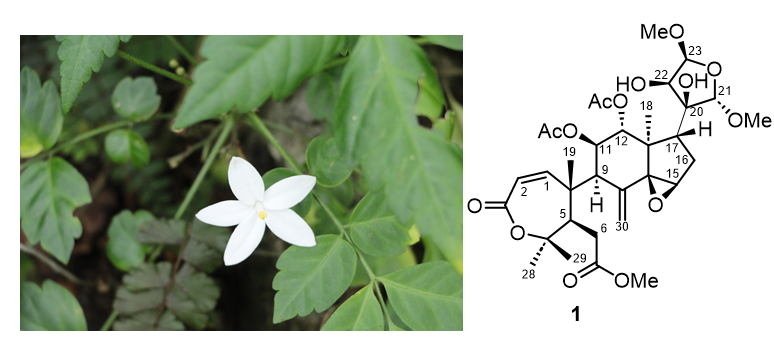
本研究旨在对传统药用植物矮陀陀(楝科)进行系统的化学成分研究,以期发现结构新颖的柠檬苦素类化合物,并评价其生物活性.采用色谱分离技术从其地上部分95%乙醇提取物中分离得到单体化合物;运用核磁共振(NMR)、高分辨质谱(HRESIMS)等波谱学方法并结合含时密度泛函理论计算电子圆二色谱(TDDFT-ECD)进行结构鉴定;通过CCK-8法和Griess法分别评价其体外细胞毒性与抗炎活性.结果分离并鉴定出一个新的柠檬苦素,命名为munropin K(1),其结构特征为具有prieurianin型骨架及一个独特的C-17位20,22-二羟基-21,23-二甲氧基-四氢呋喃环侧链.活性测试表明,该化合物在80 μmol/L浓度下对多种人源肿瘤细胞株(A549、HepG2、MCF-7、HCT116)及LPS诱导的RAW 264.7巨噬细胞炎症模型均未表现出显著活性.本研究丰富了对地黄连属植物化学多样性的认识,为基于该新型骨架的后续结构修饰与活性探索提供了化合物基础.
羊学荣
,
李健星
,
柏田良树
,
田中直伸
,
李典鹏
. 矮陀陀中一个新的prieurianin型柠檬苦素类化合物[J]. 有机化学, 2026
: 202604025
.
DOI: 10.6023/cjoc202604025
This study aimed to investigate the chemical components of the traditional medicinal plant Munronia pinnata (Meliaceae). We sought to discover new limonoids and evaluate their biological activities. Compounds were isolated from the plant's aerial parts using 95% ethanol and chromatographic techniques. Their structures were identified by NMR and HRESIMS analysis, along with time-dependent density functional theory-electronic circular dichroism (TDDFT-ECD) computations. Cytotoxicity was tested with the CCK-8 assay, and anti-inflammatory activity was measured using the Griess method. A new limonoid, named munropin K (1), was obtained. Its structure features a prieurianin-type skeleton with a unique side chain at C-17. This side chain is a 20,22-dihydroxy-21,23-dimethoxytetrahydrofuran. At 80 µM, the compound showed no significant activity against several human cancer cell lines. These cell lines included A549, HepG2, MCF-7, and HCT116. It also did not show activity in an LPS-induced RAW 264.7 macrophage inflammation model. The research expands the known chemical diversity of the Munronia genus. It provides a chemical basis for future studies on structure modification and activity exploration of this new skeleton.
[1] Qi S. H.; Wu D. G.; Chen L.; Ma Y. B.; Luo X. D.J. Agric.Food Chem. 2003, 51, 6949-6952.
[2] Wang G.Q.Compilation of China Medicinal Herbal; People's Medical Publishing House: Beijing, China, 1975; Vol. 2, p. 1081 (in Chinese).
(王光清,《中国药用植物志》,北京:人民卫生出版社,1975, 第2卷,第1081页.)
[3] Guangxi Institute of Botany. Flora of Guangxi: Volume 3 Spermatophyta; Guangxi Science & Technology Publishing House: Nanning, China, 2011; p. 333 (in Chinese).
(广西植物研究所,《广西植物志:第三卷种子植物》,南宁:广西科学技术出版社, 2011, 第333页.)
[4] Su L.; Huang L. Z.; Cai Y.J. Youjiang Med. Univ. Natl. 2021, 43, 741-745 (in Chinese).
(苏玲, 黄丽贞, 蔡毅, 右江民族医学院学报, 2021, 43, 741-745.)
[5] Huang M. H.; Zhang Y. M.; Li J.; Shao F.; Yang M.; Zhang, P. Z. Chin. Tradit. Herb. Drugs,2017, 48, 1240-1249.
(黄美华, 张亚梅, 李菁, 邵峰, 杨明, 张普照.中草药, 2017, 48, 1240-1249.)
[6] Li X. L.; He Q. X.; Zhang F. L.; Zhao Y. L.; Liu K. C.; Jiang, S. P. Nat. Prod. Bioprospect.2012, 2, 76-80.
[7] Qi S. H.; Chen L.; Wu D. G.; Ma Y. B.; Luo X. D.Tetrahedron 2003, 59, 4193-4199.
[8] Ge Y. H.; Zhang J. X.; Mu S. Z.; Chen Y.; Yan F. M.; Lu Y.; Hao X. J. Tetrahedron2012, 68, 566-572.
[9] Yan Y.; Zhang J. X.; Huang T.; Mao X. Y.; Gu W.; He H. P.; Di Y. T.; Li S. L.; Chen D. Z.; Zhang Y.; Hao, X. J. J. Nat. Prod.2015, 78, 811-821.
[10] Zhang H. P.; Bao G. H.; Wang H. B.; Qin, G. W. Nat. Prod. Res.2004, 18, 415-419.
[11] Yan Y.; Tang L.; Hu J.; Wang J.; Adelakun T.A.; Yang D.; Di Y.; Zhang Y.; Hao, X. Pestic. Biochem. Physiol.2018, 146, 13-18.
[12] Lin B. D.; Chen H. D.; Lin J.; Zhang S.; Wu Y.; Dong L.; Yue J. M. Phytochemistry,2010, 71, 1596-1601.
[13] Yang X. R.; Tanaka N.; Tsuji D.; Lu F. L.; Yan X. J.; Itoh K.; Li D. P.; Kashiwada Y. Tetrahedron2019, 75, 130779.
[14] Liu P. Y.; Wei Y. L.; Song J. R.; Yan X. J.; Lu F. L.; Cheng Y. Y.; Yang X. R.; Li, D. P. Chin. J. Org. Chem.2024, 44, 1348-1356 (in Chinese).
(刘培源,韦玉璐,宋静茹,严小捷,卢凤来,陈月圆,羊学荣,李典鹏.有机化学, 2024, 44, 1348-1356.)
[15] Yang X. R.; Liu P. Y.; Wei Y. L.; Song J. R.; Yan X. J.; Jiang X. H.; Li J. X.; Li X. Q.; Li D. P.; Lu F. L. Molecules2023, 28, 6839.
[16] Li J.H.; Li Y.; An F.L.; Zhou, M.M. Luo J.; Jian K.L.; Luo J.; Kong L.Y. Tetrahedron2016, 72, 7481-7487.
[17] Sybyl Software, version X 2.0; Tripos Associates Inc.: St. Louis, MO, 2013.
[18] Neese, F. The ORCA program system, Wiley Interdiscip. Rev.: Comput. Mol. Sci.2012, 2, 73-78.
[19] Stephens P. J.; Harada N. ECD cotton effect approximated by the Gaussian curve and other methods. Chirality2010, 22, 229-233.