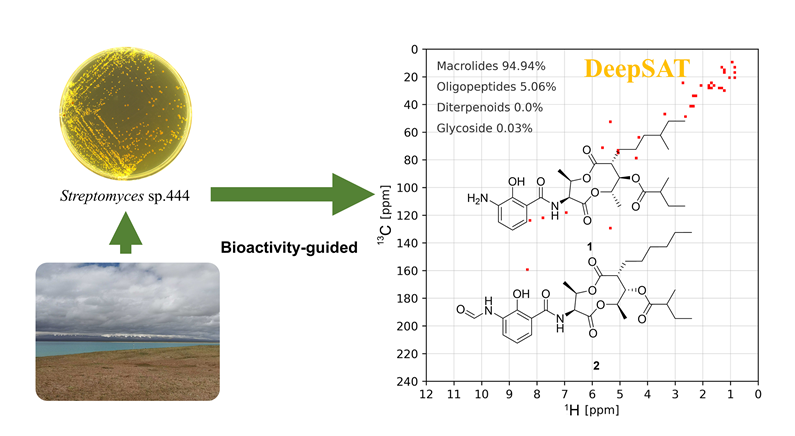
运用DeepSAT预测和活性引导的方法对一株分离自青海可可西里的链霉菌(Streptomyces sp. 444)抗真菌活性成分进行研究,从中发现了两个新的抗霉素类化合物,去甲酰抗霉素A10a (1)、抗霉素A1c (2)和两个已知的抗霉素类化合物,抗霉素A3a (3)、抗霉素A8a (4)。通过高分辨质谱(HR-ESI-MS)、核磁共振技术(NMR)和NMR计算确定了新化合物的结构。微量肉汤稀释法测试表明4个化合物均表现出抗真菌活性,其中化合物2最强,对白色念珠菌Candida albicans ATCC 10231和新型隐球菌Cryptococcus neoformans H99的最低抑菌浓度MIC值分别为4和8 μg/mL。
安俊榴
,
徐吉祥
,
庞昆
,
杨信怡
,
孙承航
,
袁丽杰
. 可可西里来源链霉菌444的抗真菌活性成分研究[J]. 有机化学, 0
: 202604020
-202604020
.
DOI: 10.6023/cjoc202604020
Activity-guided and DeepSAT analyses on the antifungal constituents of Streptomyces sp. 444, isolated from the Hoh Xil region, led to the discovery of two new antimycin analogs, deformyl-antimycin A10a (1) and antimycin A1c (2), along with two known analogs, antimycin A3a (3) and antimycin A8a (4). The structures of these antimycin analogs were elucidated by high-resolution electrospray ionization mass spectroscopy (HR-ESI-MS), nuclear magnetic resonance (NMR), and NMR calculations. Bioassay indicated that compounds 1-4 exhibited antifungal activity. The MIC values of compound 2 against Candida albicans ATCC 10231 and Cryptococcus neoformans H99, determined by the broth microdilution method, were 4 and 8 μg/mL, respectively.
[1] Newman D. J.; Cragg G. M.J. Nat. Prod. 2020, 83(3): 770-803.
[2] Butler M. S.; Capon R. J.; Blaskovich M. A.T.; Henderson, I. R.Nat. Prod. Rep. 2025.
[3] Yang J.; Wang J.; Liu M.; Zhou X.; Feng D.; Jiang H.; Liu X.; Chen L.; Wang Y.Chin. J. Nat. Med. 2025, 23, 1047.
[4] Genilloud O.Nat. Prod. Rep. 2017, 34, 1203.
[5] Carolus H.; Pierson S.; Lagrou K.; Van Dijck, P.J. Fungi. 2020, 6.
[6] Howard K. C.; Dennis E. K.; Watt D. S.; Garneau-Tsodikova, S.Chem. Soc. Rev. 2020, 49, 2426.
[7] Huo R.; Shi D.; Zi G.; Cai L.; Liu L.J. Agric. Food. Chem. 2025, 73, 26793.
[8] Kim H. W.; Zhang C.; Reher R.; Wang M.; Alexander K. L.; Nothias L. F.; Han Y. K.; Shin H.; Lee K. Y.; Lee K. H.; Kim M. J.; Dorrestein P. C.; Gerwick W. H.; Cottrell G. W. J. Cheminf. 2023, 15, 71.
[9] Park W. H.Chem. Biol. Interact. 2025, 422, 111805.
[10] Wang F.; Fu S. N.; Bao Y. X.; Yang Y.; Shen H. F.; Lin B. R.; Zhou G. X.Nat. Prod. Res. 2017, 31, 1819.
[11] Li W.; Ding L.; Li J.; Wen H.; Liu Y.; Tan S.; Yan X.; Shi Y.; Lin W.; Lin H. W.; He S.J. Agric. Food. Chem. 2022, 70, 8309.
[12] Hosotani N.; Kumagai K.; Nakagawa H.; Shimatani T.; Saji I.J. Antibiot. 2005, 58, 460.
[13] Jensen, F. J. Chem. Theory. Comput. 2006, 2, 1360.
[14] Kanehara R.; Shirakawa K.; Sakashita H.; Oinuma Y.; Ohta S.; Okazaki M.; Tanaka K.; Tonouchi A.; Hashimoto M. J. Nat. Prod. 2026, 89, 584.
[15] Barrow C. J.; Oleynek J. J.; Marinelli V.; Sun H. H.; Kaplita P.; Sedlock D. M.; Gillum A. M.; Chadwick C. C.; Cooper R.J. Antibiot. 1997, 50, 729.
[16] Tsai Y.-H.; Amichetti M.; Zanardi M. M.; Grimson R.; Daranas A. H.; Sarotti A. M.Org. Lett. 2022, 24, 7487.
[17] Mbeng Obame, R. B.; Gallard, S.; Gibert, S.; Gallard, J.-F.; Ferron, S.; Séon-Méniel, B.; Bernadat, G.; Beniddir, M. A.; Le Pogam, P.J. Nat. Prod. 2025, 88, 935.
[18] Wang F.; Chen F.; Zheng X.-H.; Lin B.-R.; Zhou G.-X.Chin. J. Antibiot. 2017, 42(11): 932-939 (in chinese)
(王帆, 陈芳, 郑新恒, 林壁润, 周光雄, 中国抗生素杂志, 2017, 42(11): 932-939.)
[19] Xie Y.; Wang W.-J.; Shen K.-L.Chin J Appl Clin Pediatr. 2023, 38(4): 266-270 (in Chinese)
(谢淦, 王文建, 申昆玲, 中华实用儿科临床杂志, 2023, 38(4): 266-270.)
[20] Wang X.-Y.; Liu R.-S.; Zhong H.Cent South Pharm. 2023, 21(6): 1403-1411 (in Chinese)
(王曦悦, 刘润松, 仲华, 王彦, 中南药学, 2023, 21(6): 1403-1411.)
[21] Chemical Computing Group. Molecular Operating Environment (MOE), ver.2019.01; Montreal, Quebec, Canada.
[22] Halgren T.A.J. Comput. Chem. 1996, 17: 490-519
[23] Jin T.-Y., Li P.-L., Wang C.-L., Tang X.-L., Cheng M.-M., Zong Y., Luo L.-Z., Ou H.-L., Liu K.-C. and Li G.-Q.Chin. J. Chem. 2021, 39: 2588-2598
[24] Tian L, Molclus program, Version 1.13, http://www.keinsci.com/research/molclus.html
[25] Lu T.; Chen Q.Comput. Theor. Chem. 2021, 1200, 113249.
[26] Jensen F.J. Chem. Theory. Comput. 2006, 2, 1360
[27] Barbara D.A.; Gary W. P.;Philippe D.; Jeff F.; Mahmoud A. G.; Kimberly E. H.; Denise H.; Nicole M. H. Laura K.; Shawn R. L.; Luis O.; Audrey N. S.; Nathan P. W.; Adrian M. Z.; CLSI supplement M27. Clinical and Laboratory Standards In-stitute (CLSI). Wayne, PA; 2017, pp. 7~17.
[28] Weber M.; Dékány M.; Nagyné A. N.; Felegyi-Tóth, C. A.; Suratno, S.; Krámos, B.; Bodó, E.; Béni, Z.; Ványolós, A. J. Nat. Prod. 2025, 88, 644.