

Chinese Journal of Organic Chemistry ›› 2025, Vol. 45 ›› Issue (5): 1569-1590.DOI: 10.6023/cjoc202407049 Previous Articles Next Articles
REVIEWS
洪洋a,b, 邓红平a,*( )
)
收稿日期:2024-07-31
修回日期:2024-09-11
发布日期:2024-11-08
基金资助:
Yang Honga,b, Hongping Denga,*()
Received:2024-07-31
Revised:2024-09-11
Published:2024-11-08
Contact:
* E-mail: Supported by:Share
Yang Hong, Hongping Deng. Research Progress on Photocatalyzed Protic C(sp3)—HFunctionalization[J]. Chinese Journal of Organic Chemistry, 2025, 45(5): 1569-1590.




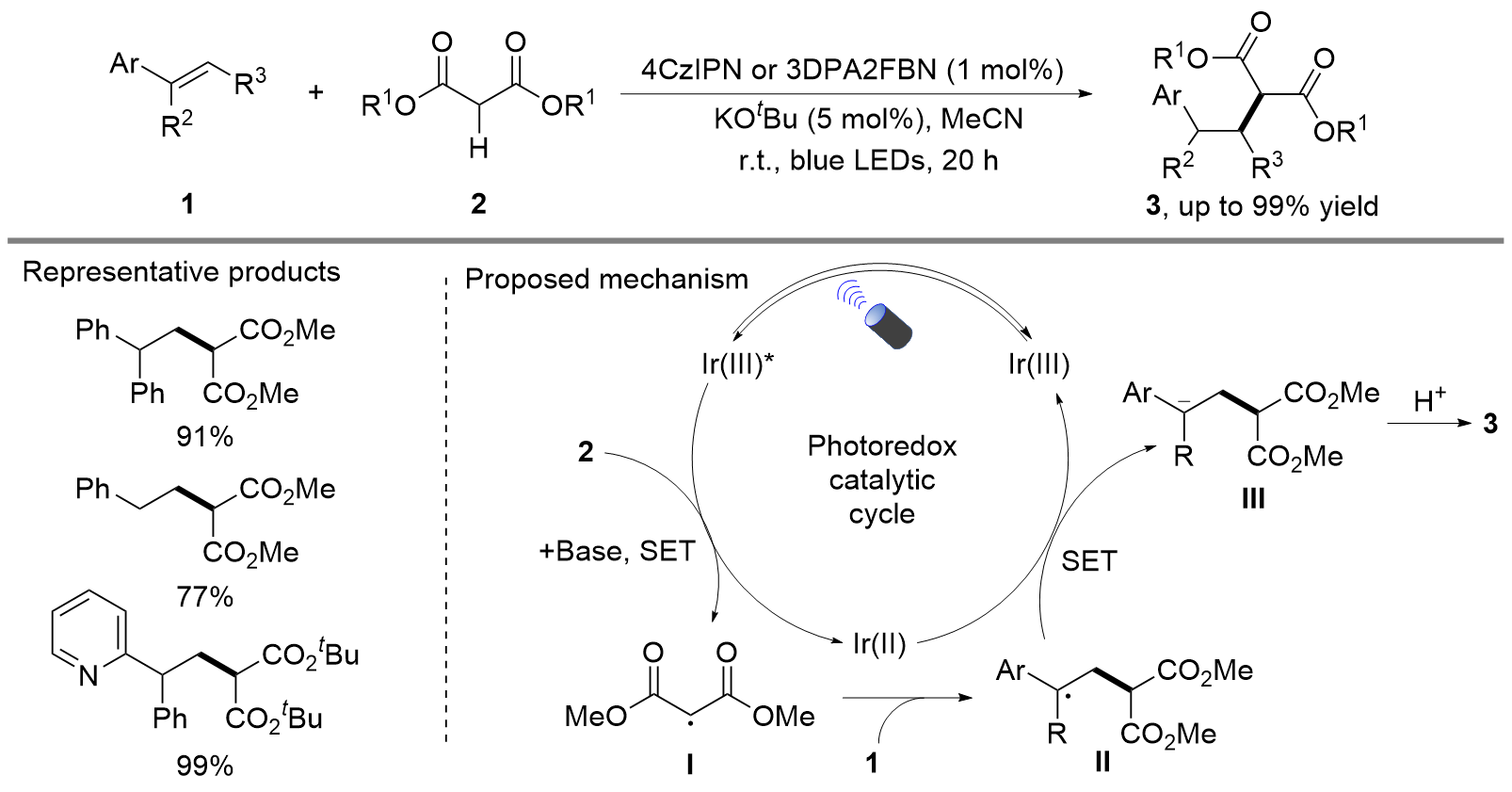

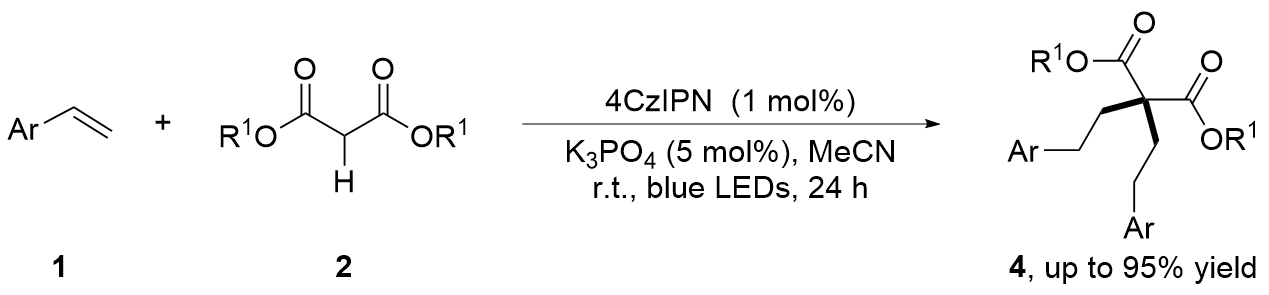


















| [1] |
(a)
|
|
(b)
|
|
| [2] |
|
| [3] |
(a)
|
|
(b)
|
|
| [4] |
|
| [5] |
doi: 10.1038/s41570-021-00284-3 pmid: 37118440 |
| [6] |
(a)
|
|
(b)
|
|
|
(c)
|
|
|
(d)
|
|
|
(e)
|
|
| [7] |
|
| [8] |
(a)
|
|
(b)
|
|
|
(c)
|
|
|
(d)
|
|
| [9] |
(a)
|
|
(b)
|
|
|
(c)
|
|
|
(d)
|
|
|
(e)
|
|
|
(f)
|
|
| [10] |
|
| [11] |
(a)
|
|
(b)
|
|
|
(c)
|
|
| [12] |
|
| [13] |
|
| [14] |
|
| [15] |
|
| [16] |
|
| [17] |
doi: 10.1021/jacs.3c07436 pmid: 37846890 |
| [18] |
|
| [19] |
|
| [20] |
|
| [21] |
|
| [22] |
|
| [23] |
|
| [24] |
|
| [25] |
|
| [26] |
|
| [27] |
|
| [28] |
|
| [29] |
doi: 10.1039/d3sc06476j pmid: 38487219 |
| [30] |
|
| [31] |
|
| [32] |
(a)
|
|
(b)
|
|
| [33] |
|
| [34] |
|
| [35] |
|
| [36] |
doi: 10.1038/nchem.2797 pmid: 29064486 |
| [37] |
|
| [38] |
|
| [39] |
|
| [40] |
|
| [41] |
|
| [42] |
|
| [43] |
|
| [44] |
|
| [1] | Genwei Gao, Zhen Li, Yan Li, Xi Lu. Recent Progress on the Construction of C(sp2)—C(sp3) Bonds via Photoredox/Nickel Dual Catalysis [J]. Chinese Journal of Organic Chemistry, 2025, 45(6): 1905-1919. |
| [2] | Hui Li, Ablimit Abdukader, Lei Zhou. Radical Denitrogenative Ring Opening of N-Benzyl-benzotriazoles for the Synthesis of 6-Substituted Phenanthridines under Visible Light Conditions [J]. Chinese Journal of Organic Chemistry, 2025, 45(5): 1770-1777. |
| [3] | Chen Li, Yi Jiao, Xiaoran Shi, Yiqiang Yang, Shouyun Yu. Photoredox-Catalyzed C-Glycosylation Reactions [J]. Chinese Journal of Organic Chemistry, 2025, 45(5): 1423-1459. |
| [4] | Feng Lin, Yan Zhang, Ming Wu, Huiyan Liu, Wen-Juan Hao, Bo Jiang. Visible-Light-Induced Annulative Acylative Difunctionalization of 1,6-Enynes for Accessing 1-Indanones [J]. Chinese Journal of Organic Chemistry, 2025, 45(5): 1729-1738. |
| [5] | Jiabin Shen, Chao Shen, Pengfei Zhang. Synthesis of Nafimidone Derivatives by Visible-Light-Induced α-C—H Functionalization of Carbonyl [J]. Chinese Journal of Organic Chemistry, 2025, 45(2): 677-685. |
| [6] | Yanhua Fu, Chang Xu, Chao Zhang, Yisha Wang, Gaofeng Feng. Visible-Light Induced Iron-Catalyzed Hydroxymethylation of N-Heterocycles [J]. Chinese Journal of Organic Chemistry, 2024, 44(7): 2265-2273. |
| [7] | Wenduo Li, Na'na Wei, Nan Feng. Boryl Radical-Promoted Synthesis of Biaryls and Benzylcarboxylic Acids Methyl Ester via C—C Bond Formation Reactions [J]. Chinese Journal of Organic Chemistry, 2024, 44(6): 1853-1861. |
| [8] | Xiangxue Cao, Yahui Jia, Shiji Yin, Liang Xu, Yu Wei, Huanhuan Song. Visible-Light-Induced C—C Bond Cleavage of Dihydroquinazolinones with Trifluoromethyl-Substituted Olefins Defluorinated Alkylation Reactions [J]. Chinese Journal of Organic Chemistry, 2024, 44(5): 1549-1557. |
| [9] | Jiyu Liu, Shengyu Li, Kuan Chen, Yin Zhu, Yuan Zhang. Triphenylamine-Based Ordered Mesoporous Polymer as a Metal-Free Photocatalyst for Oxidation of Thiols to Disulfide [J]. Chinese Journal of Organic Chemistry, 2024, 44(2): 605-612. |
| [10] | Hui Xu, Huixian Jiang, Lei Kan, Pei Xu, Xu Zhu. Visible-Light-Induced Selective Hydrocarboxylation of Alkynes with Formate [J]. Chinese Journal of Organic Chemistry, 2024, 44(10): 3241-3248. |
| [11] | Hong'en Tong, Hongyu Guo, Rong Zhou. Progress on Visible-Light Promoted Addition Reactions of Inert C—H Bonds to Carbonyls [J]. Chinese Journal of Organic Chemistry, 2024, 44(1): 54-69. |
| [12] | Yu Zhao, Kai Zhang, Yubin Bai, Yantu Zhang, Shihui Shi. A Metal-Free Photocatalytic Hydrosilylation of Alkenes Using Bromide Salt as a Hydrogen Atom Transfer Reagent [J]. Chinese Journal of Organic Chemistry, 2023, 43(8): 2837-2847. |
| [13] | Zhentao Pan, Tong Liu, Yongmin Ma, Jianbo Yan, Ya-Jun Wang. Construction of Quinazolin(thi)ones by Brønsted Acid/Visible-Light Photoredox Relay Catalysis [J]. Chinese Journal of Organic Chemistry, 2022, 42(9): 2823-2831. |
| [14] | Yadong Li, Pengju Wu, Zhiyong Yang. Synthesis of 2-Aryl Benzoxazoles from Benzoxazoles and α-Ketoic Acids by Photoredox Catalysis [J]. Chinese Journal of Organic Chemistry, 2022, 42(6): 1770-1777. |
| [15] | Tianyi Sun, Yifan Zhang, Yuanjie Meng, Yi Wang, Qifeng Zhu, Yuxin Jiang, Shihui Liu. Photoredox-Copper Dual-Catalyzed Site-Selective O-Alkylation of Glycosides [J]. Chinese Journal of Organic Chemistry, 2022, 42(5): 1414-1422. |
| Viewed | ||||||
|
Full text |
|
|||||
|
Abstract |
|
|||||
