

Chinese Journal of Organic Chemistry ›› 2026, Vol. 46 ›› Issue (10): 4023-4033.DOI: 10.6023/cjoc202604042 Previous Articles Next Articles
ARTICLES
张雪玥a, 李丹a, 苗金玲b, 李德利a, 刘广宁b, 蒋绪川a,*( ), 聂永a,*()
收稿日期:2026-04-27
修回日期:2026-06-08
发布日期:2026-07-06
通讯作者:
蒋绪川, 聂永
基金资助:
Xueyue Zhanga, Dan Lia, Jinling Miaob, Deli Lia, Guangning Liub, Xuchuan Jianga,*(), Yong Niea,*()
Received:2026-04-27
Revised:2026-06-08
Published:2026-07-06
Contact:
Xuchuan Jiang, Yong Nie
Supported by:Share
Xueyue Zhang, Dan Li, Jinling Miao, Deli Li, Guangning Liu, Xuchuan Jiang, Yong Nie. Synthesis and Emission Properties of Unsymmetric Biphenyl-Based Thermally Activated Delayed Fluorescence Compounds[J]. Chinese Journal of Organic Chemistry, 2026, 46(10): 4023-4033.
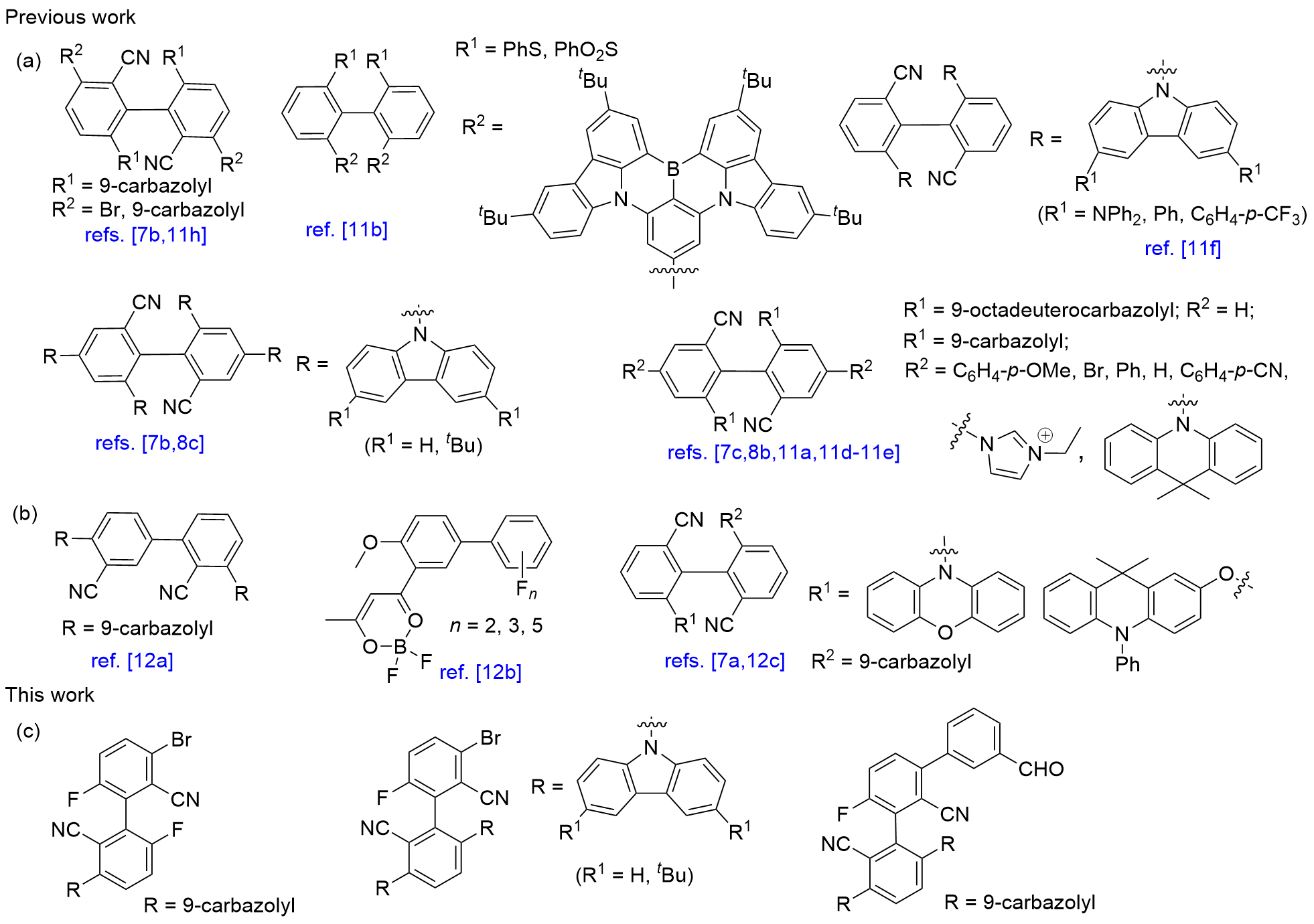
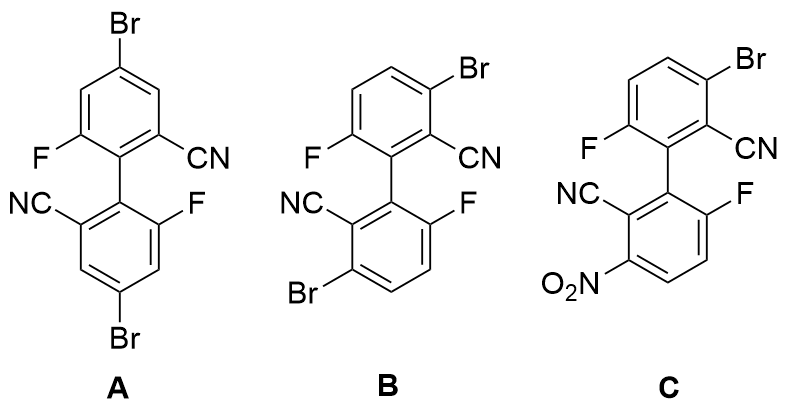

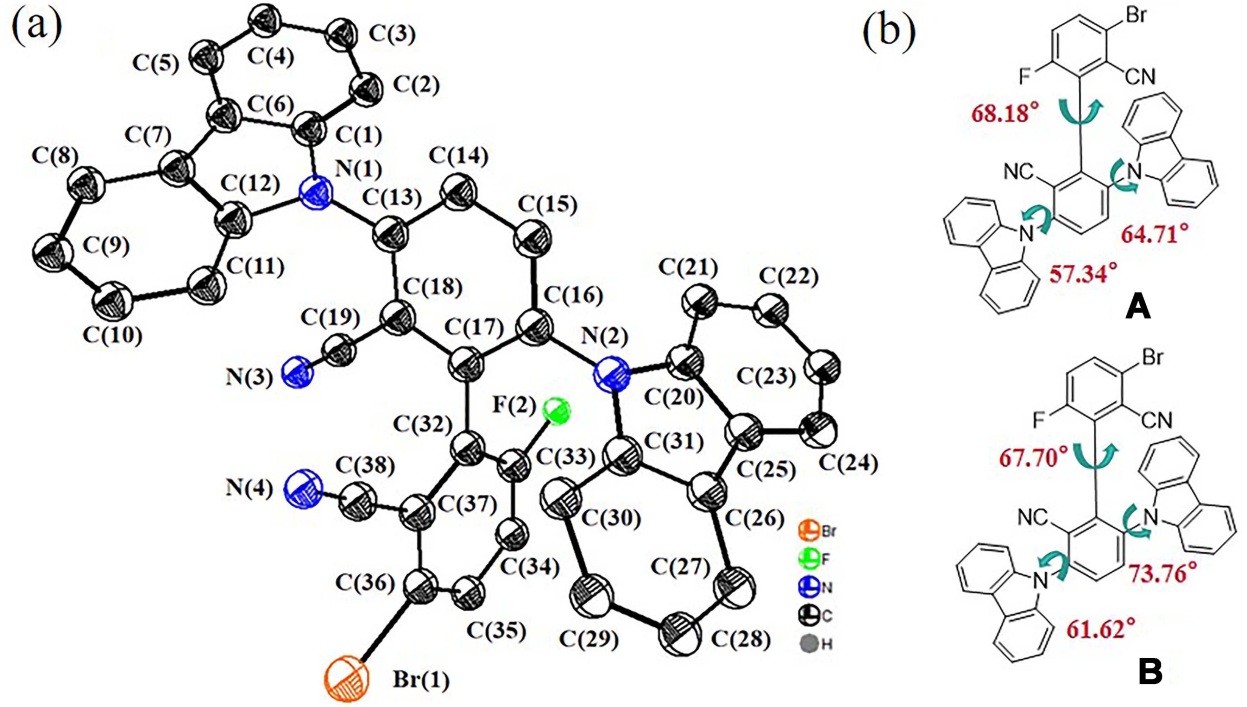
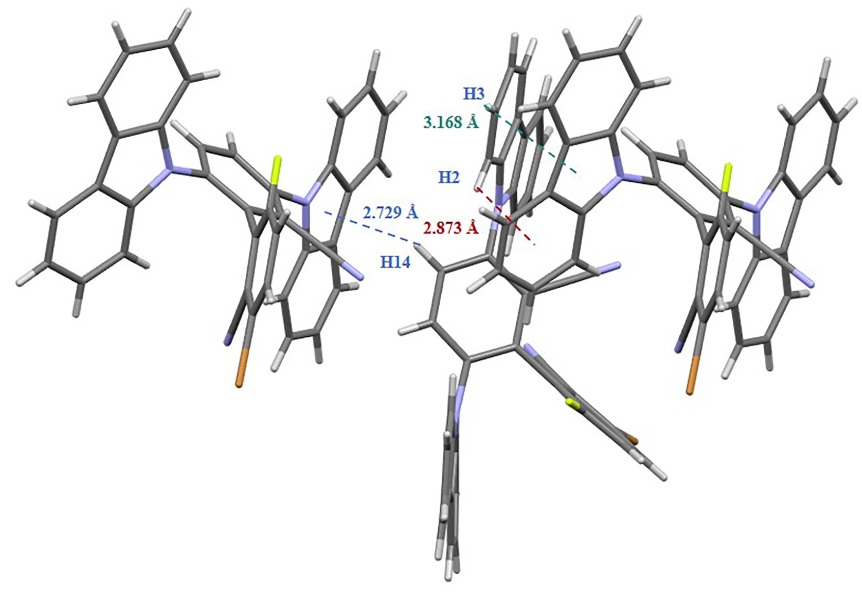
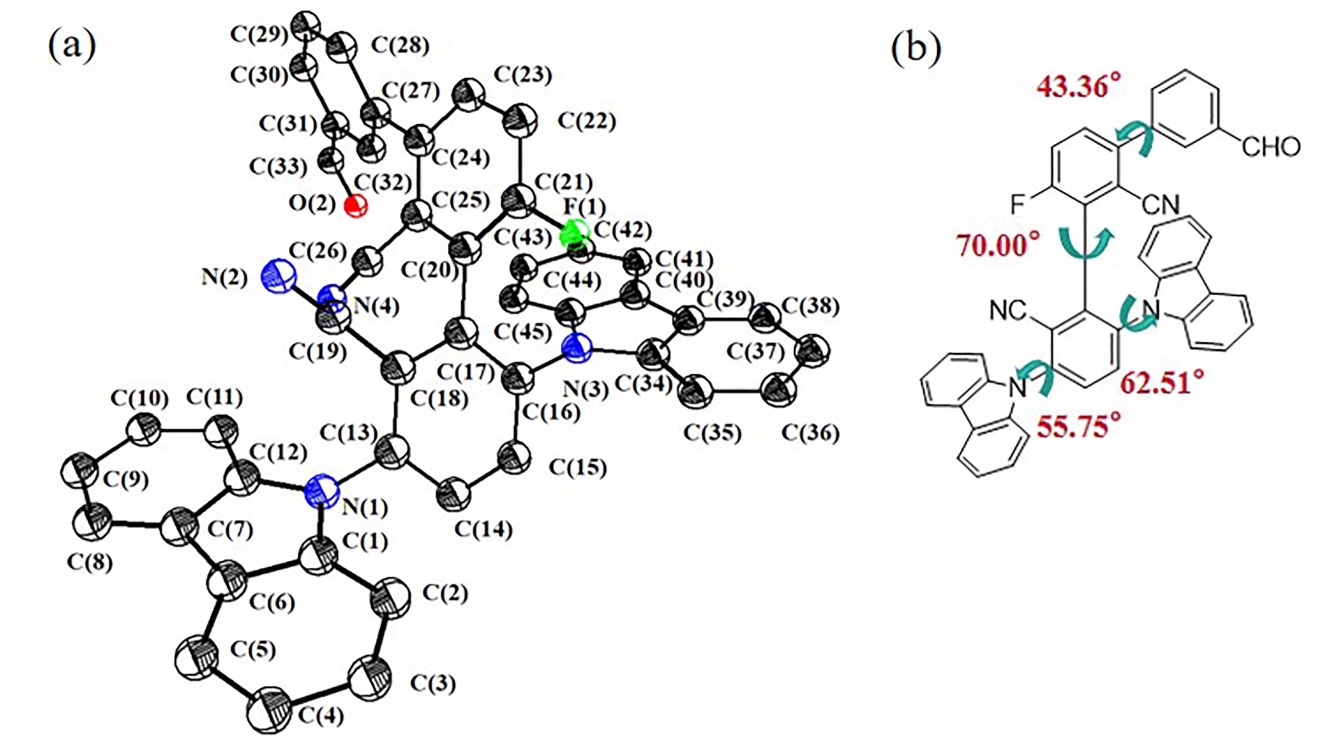
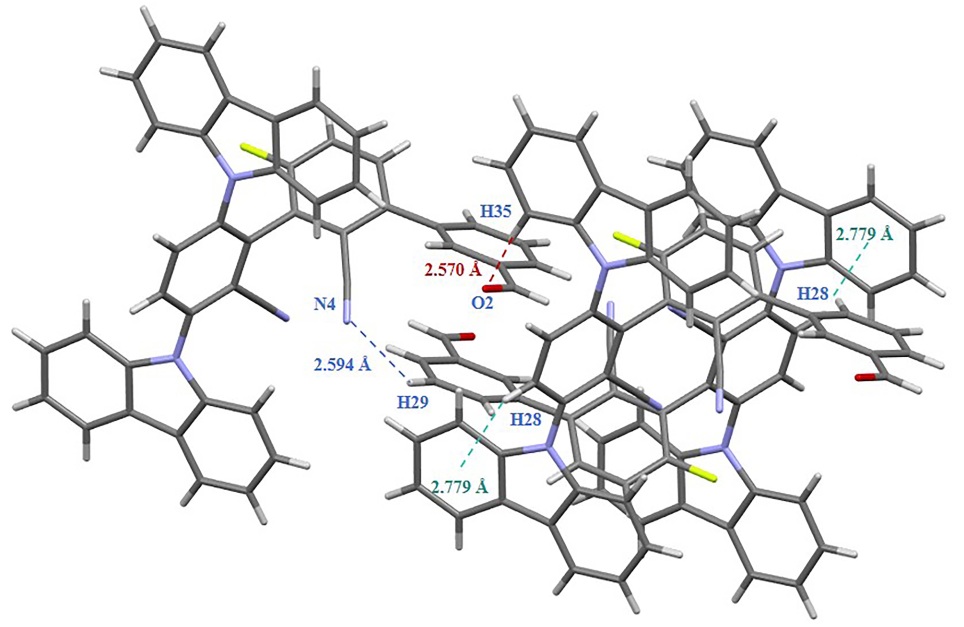
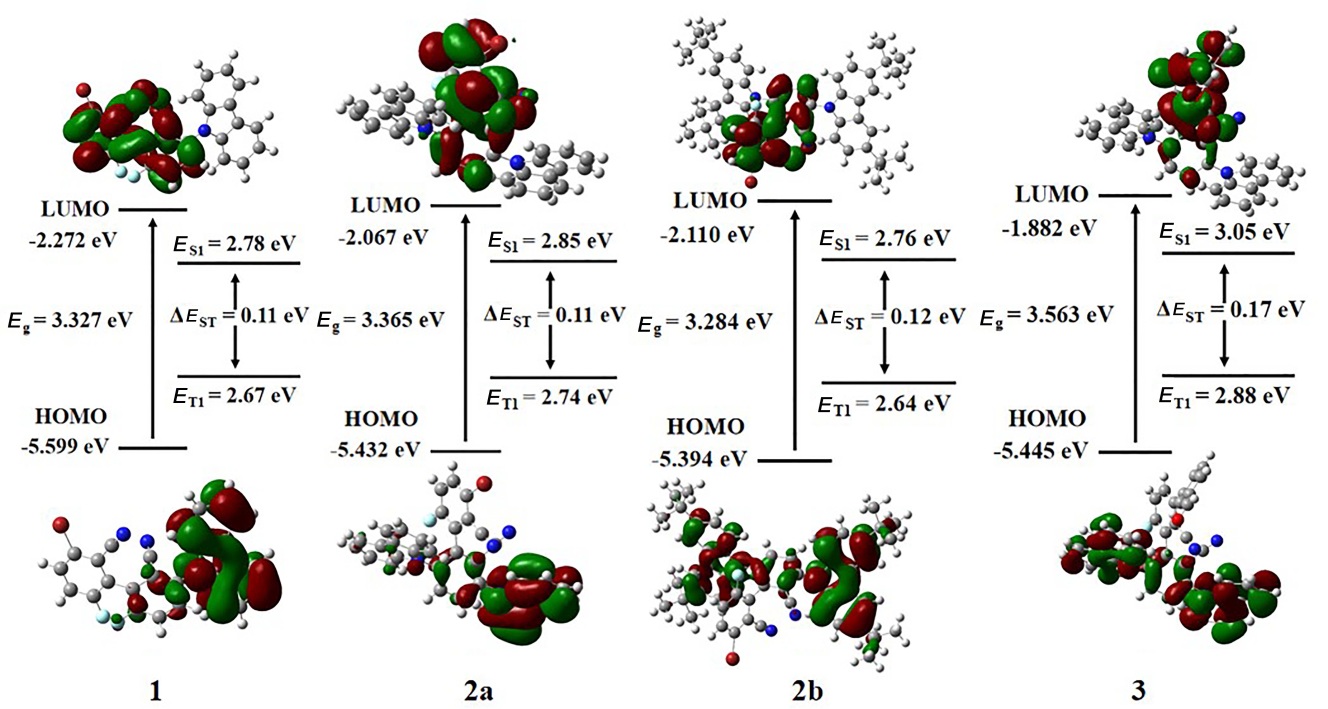
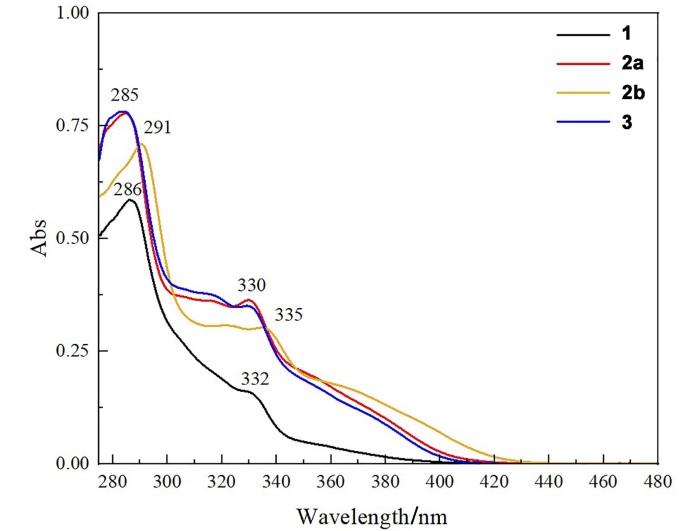
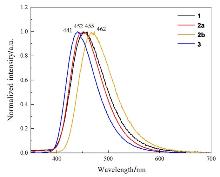
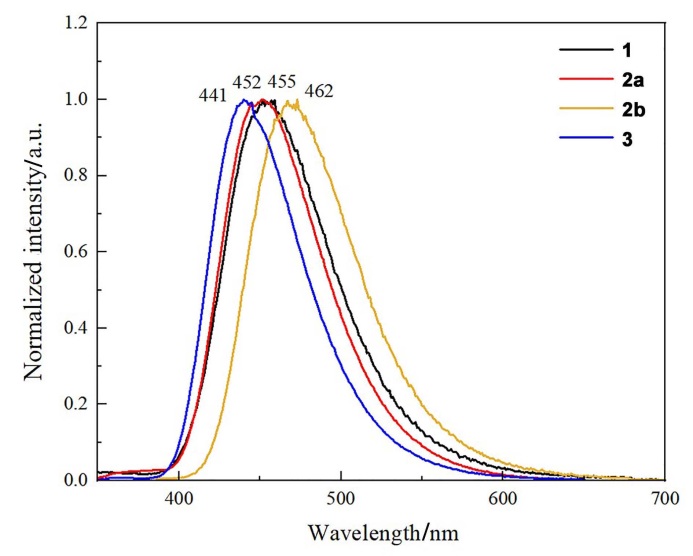
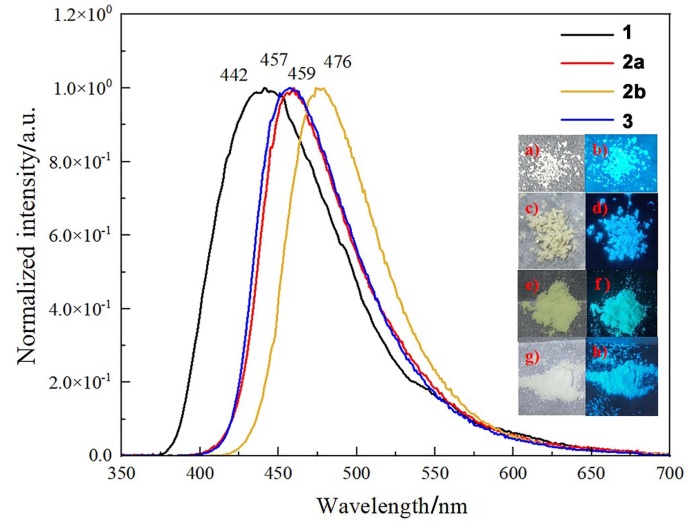
| Compd. | λabsa/nm | λema/nm | FWHMa/nm | λemb/nm | FWHMb/nm | λemc/nm | FWHMc/nm | Φb | τPF/nsc | τDFc/µs | kRISCc,d/s-1 |
|---|---|---|---|---|---|---|---|---|---|---|---|
| 1 | 286, 332 | 455 | 74 | 442 | 93 | 454 | 80 | 26% | 7.0 | 17.3 | 4.2×10⁵ |
| 2a | 285, 330 | 452 | 72 | 459 | 69 | 451 | 76 | 34% | 5.9 | 29.5 | 3.4×10⁵ |
| 2b | 291, 335 | 462 | 76 | 476 | 68 | 469 | 83 | 59% | 8.6 | 12.4 | 2.4×10⁵ |
| 3 | 285, 330 | 441 | 66 | 457 | 72 | 439 | 76 | 43% | 8.4 | 14.9 | 1.0×10⁵ |
| Solvent | 1 | 2a | 2b | 3 |
|---|---|---|---|---|
| Hexane | 427 | 432 | 454 | 428 |
| Toluene | 455 | 452 | 462 | 441 |
| Tetrahydrofuran | 484 | 470 | 494 | 458 |
| Ethyl acetate | 483 | 468 | 498 | 457 |
| Dichloromethane | 486 | 475 | 508 | 462 |
| Acetonitrile | 518 | 506 | 540 | 488 |
| Solvent | 1 | 2a | 2b | 3 |
|---|---|---|---|---|
| Hexane | 427 | 432 | 454 | 428 |
| Toluene | 455 | 452 | 462 | 441 |
| Tetrahydrofuran | 484 | 470 | 494 | 458 |
| Ethyl acetate | 483 | 468 | 498 | 457 |
| Dichloromethane | 486 | 475 | 508 | 462 |
| Acetonitrile | 518 | 506 | 540 | 488 |
| [1] |
(a)
doi: 10.1039/d1cp01185e pmid: 34231592 |
|
(b)
doi: 10.1016/j.pmatsci.2021.100914 pmid: 34231592 |
|
| [2] |
doi: 10.1063/1.98799 |
| [3] |
doi: 10.1038/nature11687 |
| [4] |
(a)
doi: 10.1021/acs.chemrev.3c00755 |
|
(b)
doi: 10.1002/adfm.v28.43 |
|
| [5] |
doi: 10.1002/anie.v60.38 |
| [6] |
|
|
(谭继华, 霍延平, 蔡宁, 季少民, 李宗志, 张力, 有机化学, 2017, 37, 2457.)
doi: 10.6023/cjoc201704015 |
|
| [7] |
(a)
doi: 10.1002/advs.v7.15 |
|
(b)
doi: 10.1002/anie.v59.9 |
|
|
(c)
|
|
| [8] |
(a)
doi: 10.1002/advs.v11.23 |
|
(b)
doi: 10.1016/j.cej.2023.142123 |
|
|
(c)
doi: 10.1039/D0CC03822A |
|
|
(d)
doi: 10.6023/cjoc202208023 |
|
|
(杨晓东, 郑小康, 董海亮, 孙静, 王华, 有机化学, 2023, 43, 1292.)
doi: 10.6023/cjoc202208023 |
|
| [9] |
(a)
doi: 10.3390/cryst11080900 |
|
(b)
doi: 10.1002/cjoc.v41.15 |
|
| [10] |
(a)
doi: 10.1039/C9CS00680J pmid: 26967372 |
|
(b)
pmid: 26967372 |
|
|
(c)
doi: 10.1021/jacs.6b00850 pmid: 26967372 |
|
| [11] |
(a)
|
|
(b)
doi: 10.1002/adfm.v35.1 |
|
|
(c)
|
|
|
(d)
doi: 10.1007/s40843-023-2551-y |
|
|
(e)
doi: 10.1016/j.cej.2023.143508 |
|
|
(f)
doi: 10.1007/s11426-024-2017-8 |
|
|
(g)
doi: 10.1002/adom.v9.20 |
|
|
(h)
doi: 10.1515/znb-2025-0004 |
|
| [12] |
(a)
doi: 10.1021/acsmacrolett.4c00818 |
|
(b)
|
|
|
(c)
|
|
| [13] |
doi: 10.1021/ol2001478 pmid: 21341714 |
| [14] |
doi: 10.1039/D1MH01404H |
| [15] |
doi: 10.1021/acs.joc.7b00328 pmid: 28452490 |
| [16] |
doi: 10.1016/j.bioorg.2011.10.003 pmid: 22100142 |
| [17] |
|
| [18] |
doi: 10.1039/D2QO01383E |
| [19] |
doi: 10.1039/c2cc31468a |
| [20] |
(a)
doi: 10.1016/j.molstruc.2024.138478 |
|
(b)
|
|
| [21] |
doi: 10.1038/srep24313 |
| [1] | Chongyu Shi, Jiayi Chen, Zheyun Lü, Jicheng Shu, Yingqi Zhang, Jianqun Liu. Study on Biphonyl Lignans and Their Biological Activities from Magnolia officinalis [J]. Chinese Journal of Organic Chemistry, 2026, 46(6): 2337-2345. |
| [2] | Yitao Yan, Yinglu Chen, Hanxian Hu, Jun Wu. Synthesis and Herbicidal Activity of Di-substituted Pyrimidine-Biphenyls and Study of Molecular Mode of Action [J]. Chinese Journal of Organic Chemistry, 2025, 45(1): 358-366. |
| [3] | Yuehua Zhang, Fei Nie, Lu Zhou, Xiaofeng Wang, Yuan Liu, Yanping Huo, Wencheng Chen, Zujin Zhao. Synthesis and Optoelectronic Studies of Thermally Activated Delayed Fluorescence Materials Based on Benzothiazolyl Ketones [J]. Chinese Journal of Organic Chemistry, 2023, 43(11): 3876-3887. |
| [4] | Peng Pan, Qiyang Yuan, Shihui Liu, Jianhong Zhao, Yongqiang Zhang. Research of Quinuclidine-Promoted C—H Silylation of Electron- Deficient Nitrogen Heteroarenes [J]. Chinese Journal of Organic Chemistry, 2022, 42(4): 1136-1145. |
| [5] | Yunshuai Huang, Xiaohui Jin, Fenglian Zhang, Yifeng Wang. 4-Dimethylaminopyridine-Boryl Radical Promoted Regioselective Radical Hydroboration of Electron-Deficient Alkenes [J]. Chinese Journal of Organic Chemistry, 2021, 41(5): 1957-1967. |
| [6] | Feng Liu, Jie Dai, Xu Cheng. Aryl-Iodide-Mediated Electrochemical Aziridination of Electron-Deficient Alkenes [J]. Chinese Journal of Organic Chemistry, 2021, 41(10): 4014-4020. |
| [7] | Ke Cuilian, Xu Weiping, Liu Da, Liu Yan, Maruoka Keiji. Chiral Resolution of Biphenol and Asymmetric Alkylation under Phase Transfer Catalysis [J]. Chinese Journal of Organic Chemistry, 2020, 40(7): 1955-1966. |
| [8] | Yu Haihong, Zhou Shengchao, Guo Tingting, Liang Zhuo, Chen Huabin, Dai Weikai, Song Mingxia. Synthesis and Antimicrobial Activity Evaluation of Aminoguanidine Derivatives Containing a Biphenyl Moiety [J]. Chin. J. Org. Chem., 2019, 39(5): 1497-1502. |
| [9] | Ai Feng, Xie Zongbo, Jiang Guofang, Ji Jiujian, Le Zhanggao. Benzylic C(sp3)-H Functionalization Reaction of 2-Methylazaarenes in Ionic Liquid Aqueous Solution [J]. Chin. J. Org. Chem., 2018, 38(8): 2174-2181. |
| [10] | Tan Jiaxi, Guo Ye, Zeng Fei, Chen Guanrong, Xie Longyong, He Weimin. Synthesis of Sterically Hindered and Electron-Deficient Secondary Amides from Unactivated Carboxylic Acids and Isothiocyanates [J]. Chin. J. Org. Chem., 2018, 38(7): 1740-1748. |
| [11] | Zhang Jiayong, Abudukeremu Munira, Miao Zhiwei. Research Progress of Organophosphine-Catalyzed Annulation Reaction of Electron-Deficient Alkynoates or Ynones [J]. Chin. J. Org. Chem., 2017, 37(11): 2859-2872. |
| [12] | Li Zhen, Duan Weiliang. Recent Advances in the Asymmetric Conjugate Addition Reactions of Phosphorus Nucleophiles to Electron-Deficient Alkenes [J]. Chin. J. Org. Chem., 2016, 36(8): 1805-1813. |
| [13] | Zheng Yueyou, Xie Qionglin, Wang Bingxi. Synthesis and Photophysical and Electrochemical Properties of 10-Methyl-10H-phenothiazine-5,5-dioxide Derivatives [J]. Chin. J. Org. Chem., 2016, 36(4): 803-811. |
| [14] | Xiao Shiji, Yu Rundong, Xu Delin, Zhang Maosheng. A New Biphenylpropanoid from Hawk Tea [J]. Chin. J. Org. Chem., 2016, 36(12): 2986-2988. |
| [15] | Zhao Xiaoxia, Chang Honghong, Li Xing, Wei Wenlong. Nanoparticles Pd-Catalyzed Highly Efficient Suzuki Cross-Coupling Reaction [J]. Chin. J. Org. Chem., 2015, 35(8): 1650-1656. |
| Viewed | ||||||
|
Full text |
|
|||||
|
Abstract |
|
|||||
