

Chinese Journal of Organic Chemistry ›› 2025, Vol. 45 ›› Issue (12): 4298-4314.DOI: 10.6023/cjoc202504026 Previous Articles Next Articles
REVIEWS
邢德悦†, 王阳†, 房亭轩, 解瑞俊, 李潇, 贾慧劼*( ), 竺宁*()
收稿日期:2025-04-14
修回日期:2025-07-11
发布日期:2025-08-26
通讯作者:
贾慧劼, 竺宁
作者简介:† 共同第一作者
基金资助:
Deyue Xing, Yang Wang, Tingxuan Fang, Ruijun Xie, Xiao Li, Huijie Jia*(), Ning Zhu*()
Received:2025-04-14
Revised:2025-07-11
Published:2025-08-26
Contact:
Huijie Jia, Ning Zhu
About author:† These authors contributed equally to this work
Supported by:Share
Deyue Xing, Yang Wang, Tingxuan Fang, Ruijun Xie, Xiao Li, Huijie Jia, Ning Zhu. Progress in the Synthesis of Benzothiazole-2-ones[J]. Chinese Journal of Organic Chemistry, 2025, 45(12): 4298-4314.
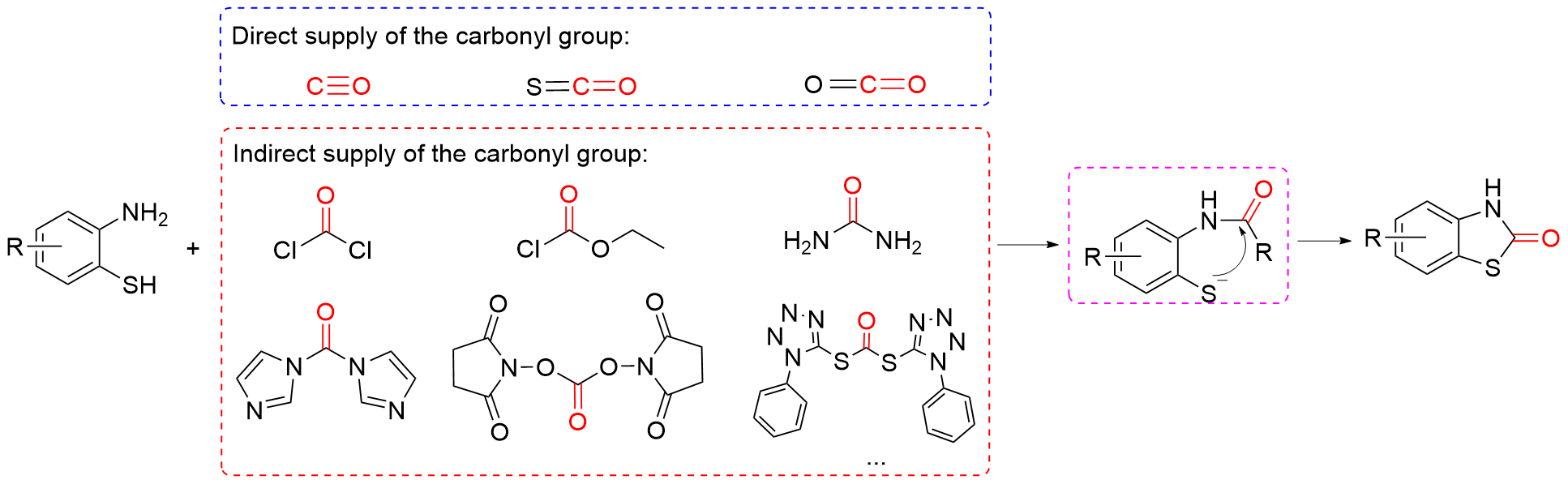




| Structure | Molecular weight | State of matter at room temperature | Carbonylation mechanism | Mass ratio of carbonyl groups in the reagent |
|---|---|---|---|---|
| | 27.99 | Gas | CO undergoes in-situ conversion to COS/Se for participation in subsequent reactions or engages in direct reactions mediated by metal catalysis | 100% |
| | 43.99 | Gas | The carbonyl group is attacked by a nucleophile to form an amide or ester, which then participates in subsequent reactions | 63.6% |
| | 59.97 | Gas | The thiocarbonyl group is attacked by an amine nucleophile, forming thiocarbamate intermediates that subsequently engage in further reactions | 46.7% |
| | 97.93 | Gas | The acyl chloride is attacked by an amine nucleophile, forming carbamyl chloride that subsequently engage in further reactions | 28.6% |
| | 293.80 | Solid | Triphosgene cleaves into 3 equiv. of phosgene, which then participate in the reaction | 28.6% |
| | 65.99 | Gas | The acyl fluoride is attacked by an amine nucleophile, forming carbamyl fluoride that subsequently engage in further reactions | 42.4% |
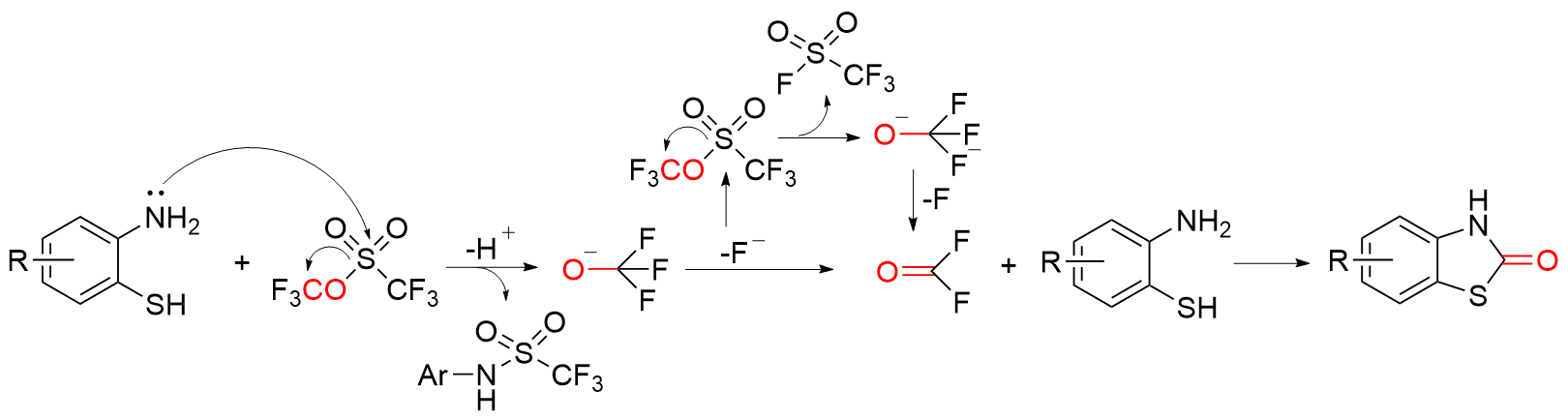
| | 217.95 | Gas | The O—S bond cleavage yielded OCF3 and F, generating acyl fluoride, which then participated in the reaction | 12.8% |
| | 108.00 | Liquid | The acyl chloride is attacked by an amine nucleophile, forming carbamate that subsequently engage in further reactions | 25.9% |
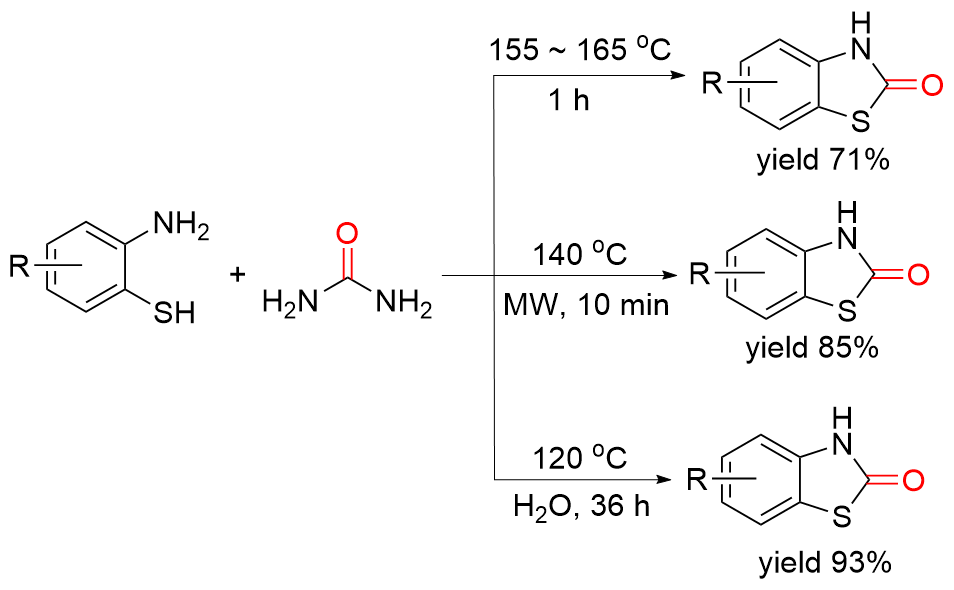
| | 60.03 | Solid | The urea is attacked by an amine nucleophile, forming another urea that subsequently engage in further reactions | 46.6% |
| | 256.03 | Solid | The electron-withdrawing inductive effect reduces the conjugation of the ester bond, facilitating the cleavage of the C—O bond to yield the carbonyl group | 11.0% |
| | 382.04 | Solid | The conjugation effect of the aromatic ring reduces the conjugation of the C—S bond in the thioester, promoting the cleavage of the C—S bond to form the carbonyl group | 7.4% |
| | 162.05 | Solid | The conjugation effect of the aromatic ring reduces the bond energy of the C—N bond in the amide, facilitating the cleavage of the C—N bond to yield the carbonyl group | 17.2% |
| | 283.98 | Liquid | The conjugation effect of the double bond facilitates the cleavage of the C—N bond in the amide, while the conjugation effect of the aromatic ring reduces the conjugation of the ester bond, promoting the cleavage of both the C—N and C—O bonds to yield the carbonyl group | 9.8% |
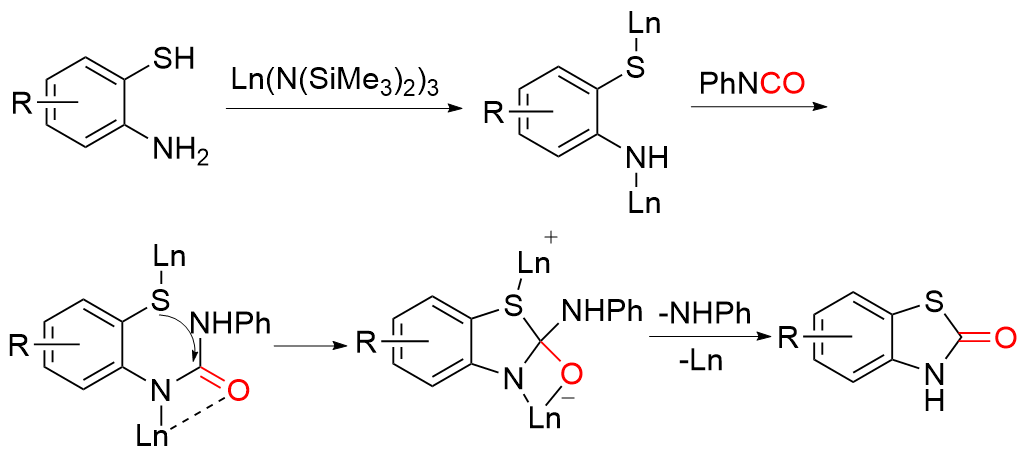
| | 119.04 | Liquid | The carbon atom in isocyanate, influenced by the electron-withdrawing inductive effects of both the oxygen and nitrogen atoms, is highly susceptible to nucleophilic attack, leading to the formation of urea or carbamate | 23.5% |
| Structure | Molecular weight | State of matter at room temperature | Carbonylation mechanism | Mass ratio of carbonyl groups in the reagent |
|---|---|---|---|---|
| | 27.99 | Gas | CO undergoes in-situ conversion to COS/Se for participation in subsequent reactions or engages in direct reactions mediated by metal catalysis | 100% |
| | 43.99 | Gas | The carbonyl group is attacked by a nucleophile to form an amide or ester, which then participates in subsequent reactions | 63.6% |
| | 59.97 | Gas | The thiocarbonyl group is attacked by an amine nucleophile, forming thiocarbamate intermediates that subsequently engage in further reactions | 46.7% |
| | 97.93 | Gas | The acyl chloride is attacked by an amine nucleophile, forming carbamyl chloride that subsequently engage in further reactions | 28.6% |
| | 293.80 | Solid | Triphosgene cleaves into 3 equiv. of phosgene, which then participate in the reaction | 28.6% |
| | 65.99 | Gas | The acyl fluoride is attacked by an amine nucleophile, forming carbamyl fluoride that subsequently engage in further reactions | 42.4% |
| | 217.95 | Gas | The O—S bond cleavage yielded OCF3 and F, generating acyl fluoride, which then participated in the reaction | 12.8% |
| | 108.00 | Liquid | The acyl chloride is attacked by an amine nucleophile, forming carbamate that subsequently engage in further reactions | 25.9% |
| | 60.03 | Solid | The urea is attacked by an amine nucleophile, forming another urea that subsequently engage in further reactions | 46.6% |
| | 256.03 | Solid | The electron-withdrawing inductive effect reduces the conjugation of the ester bond, facilitating the cleavage of the C—O bond to yield the carbonyl group | 11.0% |
| | 382.04 | Solid | The conjugation effect of the aromatic ring reduces the conjugation of the C—S bond in the thioester, promoting the cleavage of the C—S bond to form the carbonyl group | 7.4% |
| | 162.05 | Solid | The conjugation effect of the aromatic ring reduces the bond energy of the C—N bond in the amide, facilitating the cleavage of the C—N bond to yield the carbonyl group | 17.2% |
| | 283.98 | Liquid | The conjugation effect of the double bond facilitates the cleavage of the C—N bond in the amide, while the conjugation effect of the aromatic ring reduces the conjugation of the ester bond, promoting the cleavage of both the C—N and C—O bonds to yield the carbonyl group | 9.8% |
| | 119.04 | Liquid | The carbon atom in isocyanate, influenced by the electron-withdrawing inductive effects of both the oxygen and nitrogen atoms, is highly susceptible to nucleophilic attack, leading to the formation of urea or carbamate | 23.5% |




| [5] |
pmid: 3759941 |
| [6] |
doi: 10.3906/kim-1912-55 pmid: 33488213 |
| [7] |
pmid: 9544213 |
| [8] |
pmid: 16209513 |
| [9] |
doi: 10.1246/bcsj.77.169 |
| [10] |
doi: 10.1039/d0nj00273a |
| [11] |
doi: 10.1002/cber.v43:2 |
| [12] |
doi: 10.1002/ejoc.v2020.4 |
| [13] |
doi: 10.1016/S0040-4039(00)72336-7 |
| [14] |
doi: 10.1002/hc.v5:5/6 |
| [15] |
|
| [16] |
|
|
(时广辉, 杜云哲, 高媛媛, 贾慧劼, 洪海龙, 韩利民, 竺宁, 有机化学, 2023, 43, 491.)
doi: 10.6023/cjoc202207029 |
|
| [17] |
doi: 10.1016/j.tetlet.2011.06.049 |
| [18] |
doi: 10.1021/acs.joc.3c02140 |
| [19] |
|
| [20] |
doi: 10.1002/jhet.v23:3 |
| [21] |
doi: 10.1021/cs400256j |
| [22] |
doi: 10.1002/asia.v11.19 |
| [23] |
doi: 10.3390/catal8070271 |
| [24] |
|
| [25] |
doi: 10.1134/S1990793119080062 |
| [26] |
|
| [27] |
doi: 10.1002/anie.201915414 pmid: 31995256 |
| [28] |
doi: 10.1002/chem.v25.46 |
| [29] |
doi: 10.1002/anie.201208741 pmid: 23653429 |
| [30] |
|
| [31] |
doi: 10.1134/S107042801109020X |
| [32] |
doi: 10.1021/ja00853a038 |
| [33] |
doi: 10.1055/s-00000175 |
| [34] |
doi: 10.1007/s11030-015-9572-8 |
| [35] |
doi: 10.1208/s12248-011-9311-8 pmid: 22183188 |
| [36] |
doi: 10.1055/s-00000083 |
| [37] |
doi: 10.1080/00397918208063680 |
| [38] |
doi: 10.1248/cpb.37.2334 |
| [39] |
doi: 10.1039/C6GC03053J |
| [40] |
doi: 10.1007/s11426-014-5149-0 |
| [41] |
doi: 10.1016/j.bmc.2007.07.008 |
| [42] |
|
| [43] |
doi: 10.1002/jhet.v42:4 |
| [44] |
doi: 10.1021/op049953y |
| [45] |
doi: 10.1021/acs.orglett.1c00893 |
| [46] |
doi: 10.1021/jo00180a009 |
| [47] |
pmid: 2955118 |
| [48] |
doi: 10.1039/c2ob26929e pmid: 23224221 |
| [49] |
doi: 10.1039/D1GC04361G |
| [50] |
doi: 10.1002/jhet.v25:4 |
| [51] |
doi: 10.1002/anie.v51.19 |
| [52] |
doi: 10.1002/ejoc.v27.1 |
| [53] |
doi: 10.1021/jacs.6b03855 |
| [54] |
doi: 10.1016/j.tet.2007.01.043 |
| [55] |
doi: 10.1246/bcsj.65.3163 |
| [56] |
|
| [57] |
doi: 10.1016/S0040-4020(02)01365-0 |
| [58] |
doi: 10.1016/j.tetlet.2012.03.006 |
| [59] |
doi: 10.1039/c3ra46803h |
| [60] |
doi: 10.1016/j.ejmech.2008.09.010 |
| [61] |
doi: 10.3987/COM-92-6193 |
| [62] |
doi: 10.1021/ol7015737 |
| [63] |
|
| [64] |
doi: 10.1016/j.inoche.2021.108590 |
| [65] |
doi: 10.1039/D0GC03723K |
| [66] |
doi: 10.1021/acs.joc.2c01060 |
| [1] |
doi: 10.3390/molecules17010989 |
| [2] |
doi: 10.1021/es052205j |
| [3] |
doi: 10.1021/acsmedchemlett.9b00330 pmid: 32184960 |
| [4] |
|
| [67] |
doi: 10.1002/adsc.v364.1 |
| [68] |
doi: 10.1081/SCC-120027722 |
| [1] | Tian Lingyan, Wang Shoufeng, Zeng Wei. Progress in the Synthesis and Biological Studies of S-1-Propenyl-L-cysteine from Garlic [J]. Chinese Journal of Organic Chemistry, 2026, 46(1): 74-86. |
| [2] | Tianxing Lin, Tianfei Liu. Research Advances in the Synthetic Methodologies of N-Trifluoromethylamides [J]. Chinese Journal of Organic Chemistry, 2025, 45(6): 1995-2006. |
| [3] | Guoju Guo, Qilong Wu, Yuzhen Dong, Jie Zhang, Yongjia Shi, Qing Liu, Daoshan Yang. Research Progress in the Synthesis of Phosphorothioates Driven by Photo/Electrochemistry [J]. Chinese Journal of Organic Chemistry, 2025, 45(10): 3719-3740. |
| [4] | Weibao He, Rongnan Yi, Zi Yang, Zhilin Wu, He. Application Progress of Langlois Reagent in Electrochemical Trifluoromethylation Reactions [J]. Chinese Journal of Organic Chemistry, 2025, 45(10): 3534-3545. |
| [5] | Yiqi Liu, Wenjie Chen, Zeyan Zhao, Suqi Wang, Shengsong Tang, Wei-Min He, Junmei Peng. Research Progress on Photocatalytic Synthesis of Eight Nitrogen-Containing Heterocycles [J]. Chinese Journal of Organic Chemistry, 2025, 45(10): 3546-3586. |
| [6] | Cen Zhou, Xin Zhao, Xiao Zhang. Research Progress in Benzene-Forming Cyclotrimerization Reactions [J]. Chinese Journal of Organic Chemistry, 2025, 45(1): 42-55. |
| [7] | Qinghao Sun, Xiaoguang Bao. Computational Insights into the Mechanism of the Mo-Catalyzed Deoxygenative Coupling of Aromatic Aldehydes [J]. Chinese Journal of Organic Chemistry, 2024, 44(11): 3518-3525. |
| [8] | Huanqing Li, Zhaohua Chen, Zujia Chen, Qiwen Qiu, Youcai Zhang, Sihong Chen, Zhaoyang Wang. Research Progress in Mercury Ion Fluorescence Probes Based on Organic Small Molecules [J]. Chinese Journal of Organic Chemistry, 2023, 43(9): 3067-3077. |
| [9] | Cunjing Miao, Jiaqi Yao. Recent Advances in the Transformation Reactions of Aromatic Nitriles via C—CN Bond Cleavage [J]. Chinese Journal of Organic Chemistry, 2023, 43(4): 1341-1364. |
| [10] | Yueling Liu, Xinxin Zhong, Ganbing Zhang. Density Functional Theory Study for Exploring the Mechanisms of the [3+2] Cycloaddition Reactions between 1-R-3-Phenylpropylidenecyclopropane (R=Me/H) and Furfural Catalyzed by Pd(0) [J]. Chinese Journal of Organic Chemistry, 2023, 43(2): 660-667. |
| [11] | Tingting Liu, Yucai Hu, An Shen. Mechanism of Carbon-Carbon Coupling Reactions Catalyzed by Imine-Ligand-Assisted N-Heterocyclic Carbene Palladium Complexes [J]. Chinese Journal of Organic Chemistry, 2023, 43(2): 622-628. |
| [12] | Zexin Huang, Yuqiang Yin, Fengcheng Jia, Anxin Wu. Research Progress on C2—C3 Bond Cleavage of Indole and Its Derivatives [J]. Chinese Journal of Organic Chemistry, 2022, 42(7): 2028-2044. |
| [13] | Yubing Shi, Wenji Bai, Weihua Mu, Jiangping Li, Jiawei Yu, Bing Lian. Research Progress on Density Functional Theory Study of Palladium-Catalyzed C—H Functionalization to Form C—X (X=O, N, F, I, …) Bonds [J]. Chinese Journal of Organic Chemistry, 2022, 42(5): 1346-1374. |
| [14] | Youcai Zhu, Xinxin Ding, Li Sun, Zhen Liu. Advances in the Production of Acrylic Acid and Its Derivatives by CO2/C2H4 Coupling [J]. Chinese Journal of Organic Chemistry, 2022, 42(4): 965-977. |
| [15] | Yuanfang Kong, Bin Yang, Yan Zhuang, Jingyu Zhang, Demei Sun, Chunhong Dong. Research Progress on the Synthesis and Structure-Activity Relationship of Five Hypoglycemic Active Heterocycles Based on Dipeptidyl Peptidase 4 (DPP-4) Target Design [J]. Chinese Journal of Organic Chemistry, 2022, 42(3): 770-784. |
| Viewed | ||||||
|
Full text |
|
|||||
|
Abstract |
|
|||||
