

Chinese Journal of Organic Chemistry ›› 2025, Vol. 45 ›› Issue (11): 4070-4081.DOI: 10.6023/cjoc202503033 Previous Articles Next Articles
REVIEWS
吕朦朦, 贾宵雪, 王建国*( )
)
收稿日期:2025-03-31
修回日期:2025-05-25
发布日期:2025-06-30
基金资助:
Mengmeng Lü, Xiaoxue Jia, Jianguo Wang*()
Received:2025-03-31
Revised:2025-05-25
Published:2025-06-30
Contact:
*E-mail: wangjg@iccas.ac.cn
Supported by:Share
Mengmeng Lü, Xiaoxue Jia, Jianguo Wang. Progress in the Application of G-Quadruplex Fluorescent Probes[J]. Chinese Journal of Organic Chemistry, 2025, 45(11): 4070-4081.

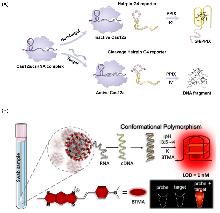

| Fluorescent ligand | G4 name | G4 topology | Ex/Em/nm | Kd/(µmol•L-1) | References |
|---|---|---|---|---|---|
| NIRG-2 | Pu22 | Parallel | 850/940 | 1.71±1.13 | [ |
| 5a | Pu22 | Parallel | 575/650 | 1.549±0.080 | [ |
| 5b | Pu22 | Parallel | 550/630 | 1.783±0.210 | [ |
| AI7 | 21CTA | Hybrid | 389/500 | 1.3 | [ |
| IZIN-1 | mt6363 | Parallel | 538/660 | — | [ |
| ISAP | c-Myc | Parallel | 640/702 | 1.09 | [ |
| SF3 | mt6363 | Parallel | 550/650 | 3.5 | [ |
| Fluorescent ligand | G4 name | G4 topology | Ex/Em/nm | Kd/(µmol•L-1) | References |
|---|---|---|---|---|---|
| NIRG-2 | Pu22 | Parallel | 850/940 | 1.71±1.13 | [ |
| 5a | Pu22 | Parallel | 575/650 | 1.549±0.080 | [ |
| 5b | Pu22 | Parallel | 550/630 | 1.783±0.210 | [ |
| AI7 | 21CTA | Hybrid | 389/500 | 1.3 | [ |
| IZIN-1 | mt6363 | Parallel | 538/660 | — | [ |
| ISAP | c-Myc | Parallel | 640/702 | 1.09 | [ |
| SF3 | mt6363 | Parallel | 550/650 | 3.5 | [ |
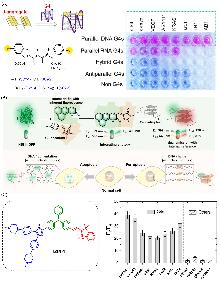

| Name | Sequence (5'-3') |
|---|---|
| Pu27 | TTATGGGGAGGGTGGGGAGGGTGGGGAAGG |
| Myc-2345 | TGAGGGTGGGGAGGGTGGGGAA |
| Myc-1245 | TGGGGAGGGTTTTTAGGGTGGGGA |
| Myc-22 | TGAGGGTGGGTAGGGTGGGTAA |
| Pu241 | TGAGGGTGGIGAGGGTGGGGAA GG |
| ckit1 | CAGAGGGAGGGCGCTGGGAGGAGGGGCTG |
| ckit2 | CCCCGGGCGGGCGCGAGGGGAGGGGAGGC |
| bcl-2 | GTCGGGGCGAGGGCGGGGGAAGGAGGGCGCGGGCGGGGA |
| K-ras | GGGAGGGAGGGAAGGAGGGAGGGAGGGA |
| VEGF | CCCGGGGCGGGCCGGGGGCGGGGTCCCGGCGGGGCGGAG |
| HIF-1α | GCGAGGGCGGGGGAGAGGGGAGGGGCGCG |
| Name | Sequence (5'-3') |
|---|---|
| Pu27 | TTATGGGGAGGGTGGGGAGGGTGGGGAAGG |
| Myc-2345 | TGAGGGTGGGGAGGGTGGGGAA |
| Myc-1245 | TGGGGAGGGTTTTTAGGGTGGGGA |
| Myc-22 | TGAGGGTGGGTAGGGTGGGTAA |
| Pu241 | TGAGGGTGGIGAGGGTGGGGAA GG |
| ckit1 | CAGAGGGAGGGCGCTGGGAGGAGGGGCTG |
| ckit2 | CCCCGGGCGGGCGCGAGGGGAGGGGAGGC |
| bcl-2 | GTCGGGGCGAGGGCGGGGGAAGGAGGGCGCGGGCGGGGA |
| K-ras | GGGAGGGAGGGAAGGAGGGAGGGAGGGA |
| VEGF | CCCGGGGCGGGCCGGGGGCGGGGTCCCGGCGGGGCGGAG |
| HIF-1α | GCGAGGGCGGGGGAGAGGGGAGGGGCGCG |

| [1] |
doi: 10.1093/nar/gki609 pmid: 15914667 |
| [2] |
doi: 10.1021/acs.accounts.2c00519 |
| [3] |
doi: 10.1093/nar/gkab609 pmid: 34255847 |
| [4] |
doi: 10.1002/anie.v55.35 |
| [5] |
doi: 10.1039/C8CC03614D |
| [6] |
doi: 10.1021/acsnano.0c04727 |
| [7] |
doi: 10.1016/j.jelechem.2020.114017 |
| [8] |
|
| [9] |
doi: 10.1073/pnas.48.12.2013 |
| [10] |
doi: 10.1073/pnas.85.20.7652 |
| [11] |
doi: 10.1038/334364a0 |
| [12] |
doi: 10.1038/350718a0 |
| [13] |
doi: 10.1021/ja309588h |
| [14] |
doi: 10.1021/ja803507d |
| [15] |
doi: 10.1016/j.ccr.2024.216157 |
| [16] |
|
|
(黄子恒, 邹建梅, 李小青, 何庆, 聂瑾芳, 分析化学, 2021, 49, 1258.)
|
|
| [17] |
doi: 10.2174/138161212799958431 |
| [18] |
doi: 10.1021/acs.analchem.3c01153 pmid: 37290004 |
| [19] |
doi: 10.1021/jacs.3c13851 |
| [20] |
doi: 10.1002/cmdc.v3:5 |
| [21] |
doi: 10.1134/S1068162023330014 |
| [22] |
doi: 10.7150/ijbs.10190 |
| [23] |
doi: 10.1002/cmdc.v9.5 |
| [24] |
doi: 10.1016/S1074-5521(98)90006-0 |
| [25] |
|
| [26] |
doi: 10.1021/acssensors.2c00992 |
| [27] |
doi: 10.1021/ac802558f |
| [28] |
doi: 10.1093/nar/gkz749 |
| [29] |
doi: 10.1039/C4AN02282C |
| [30] |
doi: 10.1039/c0cc01695k |
| [31] |
doi: 10.1021/ac101894b |
| [32] |
doi: 10.1039/c3cc39020a |
| [33] |
doi: 10.1016/j.talanta.2021.122405 |
| [34] |
doi: 10.1021/ja105849m |
| [35] |
doi: 10.3390/ijms241411556 |
| [36] |
doi: 10.1039/C3AY42023J |
| [37] |
doi: 10.1016/j.bios.2013.12.019 |
| [38] |
doi: 10.1016/j.bbrc.2020.02.178 |
| [39] |
doi: 10.3390/molecules24030396 |
| [40] |
doi: 10.1016/j.snb.2019.127351 |
| [41] |
doi: 10.1046/j.1365-2141.2003.04625.x |
| [42] |
doi: 10.1039/C6SC00001K |
| [43] |
doi: S0956-5663(18)30776-0 pmid: 30308421 |
| [44] |
doi: 10.1016/j.bios.2017.05.027 |
| [45] |
doi: 10.1007/s00604-017-2620-6 |
| [46] |
doi: 10.1016/S1872-2040(20)60051-2 |
|
(李海银, 常加富, 吕文欣, 李峰, 分析化学, 2020, 48, 1325.)
|
|
| [47] |
doi: 10.1016/j.bios.2018.07.029 |
| [48] |
|
| [49] |
doi: 10.1016/j.jim.2004.04.013 |
| [50] |
doi: 10.1002/jcla.v17:5 |
| [51] |
doi: 10.3390/biom12050648 |
| [52] |
|
| [53] |
doi: 10.1016/j.cclet.2022.02.048 |
| [54] |
doi: 10.1016/j.snb.2017.07.181 |
| [55] |
doi: 10.1039/D2AN01057G |
| [56] |
doi: 10.1039/D0AN02188A |
| [57] |
doi: 10.1021/acssensors.4c01233 |
| [58] |
doi: 10.1021/acssensors.1c02113 pmid: 35084824 |
| [59] |
doi: 10.1039/D3SC06862E |
| [60] |
doi: 10.1016/j.talanta.2017.10.023 |
| [61] |
doi: S0003-2670(20)30308-1 pmid: 32370870 |
| [62] |
doi: 10.3390/molecules29194737 |
| [63] |
doi: 10.3390/v16101548 |
| [64] |
|
| [65] |
pmid: 15225096 |
| [66] |
doi: 10.1039/D4AY01106F |
| [67] |
doi: 10.1016/j.microc.2025.112737 |
| [68] |
|
| [69] |
doi: 10.1016/j.snb.2025.137372 |
| [70] |
doi: 10.1016/S1872-2040(20)60048-2 |
| [71] |
doi: 10.1016/j.bios.2020.112494 |
| [72] |
doi: 10.1039/D3CC00740E |
| [73] |
doi: 10.1016/j.cmet.2019.07.011 |
| [74] |
doi: 10.1016/j.tig.2021.10.002 |
| [75] |
doi: 10.18632/oncotarget.v7i6 |
| [76] |
doi: 10.1039/C8RA01605D |
| [77] |
doi: 10.1016/j.ijbiomac.2020.04.171 |
| [78] |
doi: 10.1021/jacs.4c07698 |
| [79] |
doi: 10.1039/D3SC00022B |
| [80] |
doi: 10.1039/c7cs00774d pmid: 29264610 |
| [81] |
doi: 10.1021/acsabm.9b01243 |
| [82] |
doi: 10.1016/j.rechem.2024.102005 |
| [83] |
doi: 10.1039/D2RA01433E |
| [84] |
doi: 10.1016/j.saa.2021.120518 |
| [85] |
doi: 10.1093/nar/gkw006 pmid: 26792894 |
| [86] |
doi: 10.1007/s00018-021-03921-8 |
| [87] |
doi: 10.1093/nar/gkl529 |
| [88] |
doi: 10.1093/nar/gkm986 pmid: 17999996 |
| [89] |
doi: 10.1016/j.aca.2021.338600 |
| [90] |
doi: 10.1016/j.dyepig.2023.111286 |
| [91] |
doi: 10.1016/j.saa.2024.124489 |
| [92] |
doi: 10.1021/acs.analchem.4c03722 pmid: 39412418 |
| [93] |
doi: 10.1016/j.ijbiomac.2025.140556 |
| [94] |
doi: 10.1016/j.biomaterials.2025.123237 |
| [1] | Junyu Zhu, Jinlong Liao, Lei Dai, Wencheng Chen, Yanping Huo. Design, Synthesis, and Electroluminescent Performance Study of meta-Terphenyl-Modified Thermally Activated Delayed Fluorescence Host [J]. Chinese Journal of Organic Chemistry, 2025, 45(9): 3390-3400. |
| [2] | Wanjin Xing, Yirong Zhang, Junwei Chen, Yang Li, Huan Xu, Wei Wang, Kaiyan Lou. Design, Synthesis and Application of CO Donor with Green Light Controlled Release and Fluorescence Enhancement Response [J]. Chinese Journal of Organic Chemistry, 2025, 45(5): 1698-1706. |
| [3] | Hanyue Xiang, Shaoyin Wei, Yuji Wang, Nao Xiao. Recent Advances of Fe(II) Fluorescence Probes Based on N-Oxide Structure [J]. Chinese Journal of Organic Chemistry, 2025, 45(4): 1137-1152. |
| [4] | Haiyang Dong, Jiaxin Pu, Keke Li, Haowen Zhang, Xiaoqing Geng, Tingting Liang, Jianhong Wang. Synthesis and Bioactivity Study of Benzimidazole Derivatives with Fluorescent Self-Labeling and Tubulin Polymerization Inhibition [J]. Chinese Journal of Organic Chemistry, 2025, 45(4): 1315-1324. |
| [5] | Ting Luo, Yufeng Xiao, Xun Li, Wen Xia, Kaka Zhang. Fabrication of Highly-Efficient Thermally Activated Delayed Fluorescence-Type Organic Afterglow Materials Based on Intramolecular Charge Transfer Technology [J]. Chinese Journal of Organic Chemistry, 2025, 45(11): 4202-4209. |
| [6] | Jianye Yang, Pei Zhou, Qifei Shen, Peijuan Zhang, Yanzi Xu, Bingjie Zhao, Dongfeng Dang. Progress of Organic Radical Materials in Biomedical Applications [J]. Chinese Journal of Organic Chemistry, 2025, 45(11): 4013-4025. |
| [7] | Huifen Zhu, Haizhou Pei, Jie Liu, Weiguo Huang. Research Progress in Rigidochromic Fluorophores [J]. Chinese Journal of Organic Chemistry, 2025, 45(11): 3974-3997. |
| [8] | Jiajie Wu, Chen Zhu, Yipu Wang, Yongzhen Yang, Haoke Zhang. Through-Space Conjugation in Multiarylalkanes [J]. Chinese Journal of Organic Chemistry, 2025, 45(11): 4037-4047. |
| [9] | Bingyan Chen, Jie Sun, Linghong Xiong, Xuewen He. Fluorescence Light-Up Detection and Imaging of Atypical Nucleic Acid Structures [J]. Chinese Journal of Organic Chemistry, 2025, 45(11): 4082-4107. |
| [10] | Kaihang Huang, Li Yin, Qingyun Jiang, Qian Wang, Guang Shi, Bingjia Xu. Efficient Thermally Activated Delayed Fluorescence Materials with Aggregation-Induced Emission for Lipid Droplet Imaging [J]. Chinese Journal of Organic Chemistry, 2024, 44(8): 2479-2486. |
| [11] | Yuanhao Wang, Yukai Sun, Yuhang Liu, Zhaoming Zhang, Xuzhou Yan. Construction and Properties of Flexible Light-Emitting Materials Based on Tetraphenylethylene [J]. Chinese Journal of Organic Chemistry, 2024, 44(8): 2538-2544. |
| [12] | Yizhuo Shen, Kangwei Luo, Qingyang Xu, Jianyu Zhang, JingZhi Sun, Haoke Zhang, BenZhong Tang. Weak Interaction-Based Organic Luminescent Materials [J]. Chinese Journal of Organic Chemistry, 2024, 44(8): 2453-2468. |
| [13] | Junchu He, Junqi Wu, Jianghui Wang, Jingwen Xu, BenZhong Tang, Zujin Zhao. Blue Aggregation-Induced Delayed Fluorescence Materials with 5,10-Dihydrodibenzo[b,e][1,4]azasiline as Donor [J]. Chinese Journal of Organic Chemistry, 2024, 44(8): 2513-2522. |
| [14] | Jie Zhang, Nan Li, Na Zhao. Recent Progress of Aggregation-Induced Emission Molecule Nanozyme Composites [J]. Chinese Journal of Organic Chemistry, 2024, 44(8): 2469-2478. |
| [15] | Jiasong Hu, Chunjuan Li, Bin Xu, Wenjing Tian. Research Progress of Solid-State Fluorescent Photoswitching Molecules [J]. Chinese Journal of Organic Chemistry, 2024, 44(8): 2425-2440. |
| Viewed | ||||||
|
Full text |
|
|||||
|
Abstract |
|
|||||
