

Chinese Journal of Organic Chemistry ›› 2025, Vol. 45 ›› Issue (11): 4082-4107.DOI: 10.6023/cjoc202503034 Previous Articles Next Articles
REVIEWS
陈冰燕a, 孙洁a, 熊玲红b, 何学文a,*( )
)
收稿日期:2025-03-31
修回日期:2025-05-23
发布日期:2025-06-30
基金资助:
Bingyan Chena, Jie Suna, Linghong Xiongb, Xuewen Hea,*()
Received:2025-03-31
Revised:2025-05-23
Published:2025-06-30
Contact:
*E-mail: xheao@suda.edu.cn
Supported by:Share
Bingyan Chen, Jie Sun, Linghong Xiong, Xuewen He. Fluorescence Light-Up Detection and Imaging of Atypical Nucleic Acid Structures[J]. Chinese Journal of Organic Chemistry, 2025, 45(11): 4082-4107.
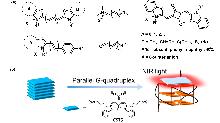

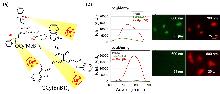

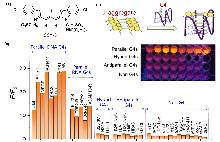

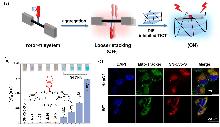

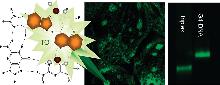

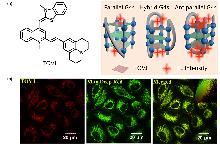

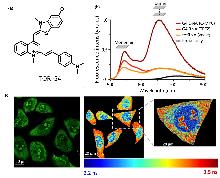

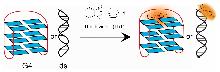

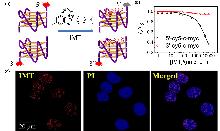

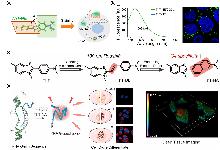

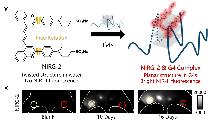

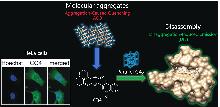









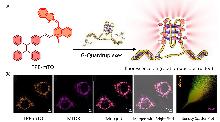

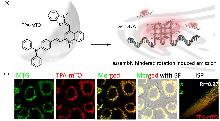

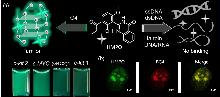

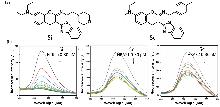









| Probe | Types of nucleic acid | Key features | Ref. |
|---|---|---|---|
| CSTS | G4s | Disaggregation-Induced Emission (DIE), V-shaped rigid plane π bracket combined with the parallel G4s through the | [ |
| QCy(BnBT)3 | G4s | High specificity recognition of G4s and 500 times fluorescence enhancement | [ |
| SCY-5 | G4s | J-Aggregates dissociate into monomers, high specificity recognition of parallel G4s | [ |
| SN-Cy5-S | G4s | Disaggregation-Induced Emission (DIE), Y-shaped plane is combined with the top plane at the 5' end of G4s | [ |
| TO | G4s and Triplex | Distinguish between Triplex and G4s, strong fluorescence enhancement | [ |
| TOVJ | G4s | High specificity recognition of antiparallel G4s, near-infrared emission | [ |
| TOR-G4 | G4s | Two-photon excitation, fluorescence lifetime has increased significantly | [ |
| ThT | G4s | High cell membrane permeability, specific recognition ability for G4s | [ |
| IMT | G4s | Stack on the 3'-G4 end plane, low background and high signal-to-noise ratio emissions | [ |
| ThT-NE | G4s | Intramolecular rotation is restricted and fluorescence is activated, high selectivity and sensitivity | [ |
| ThT-NA | G4s | Red light emission, large Stokes shift, high fluorescence turn-on ratio and high selectivity for G4s | [ |
| NIRG-2 | G4s | Near-infrared Region II emission, hydrogen bonds and π-π stacking combine with G4s | [ |
| CQ4 | G4s | Disaggregation-Induced Emission (DIE), specifically bind parallel G4s | [ |
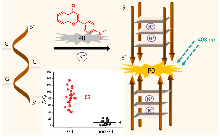
| P0 | G4s | The dimer G4/P0 system carried out highly selective detection of K+ | [ |
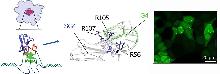
| SiR-PyPDS | G4s | The G4s ligand Pyridostatin (PyPDS) forms hydrogen bonds and hydrophobic interactions to specifically bind to G4s | [ |
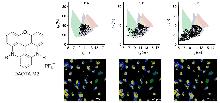
| DAOTA-M2 | G4s | G4s were identified by fluorescence lifetime imaging microscopy (FLIM) technology | [ |
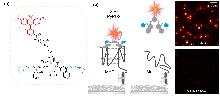
| SG4 | G4s | Antibodies against the structure of human c-MYC G4, bind to green fluorescent protein (GFP) | [ |
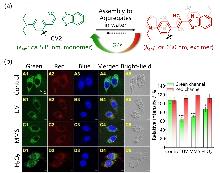
| CV2 | G4s | Peptide sequences specifically recognizing G4s (L-ARG-L-Gli-glutaric acid), Imaging of mitochondrial G4s | [ |
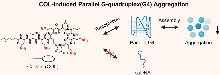
| COL | G4s | Induce parallel G4s to aggregate from the nucleic acid mixture | [ |
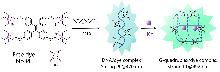
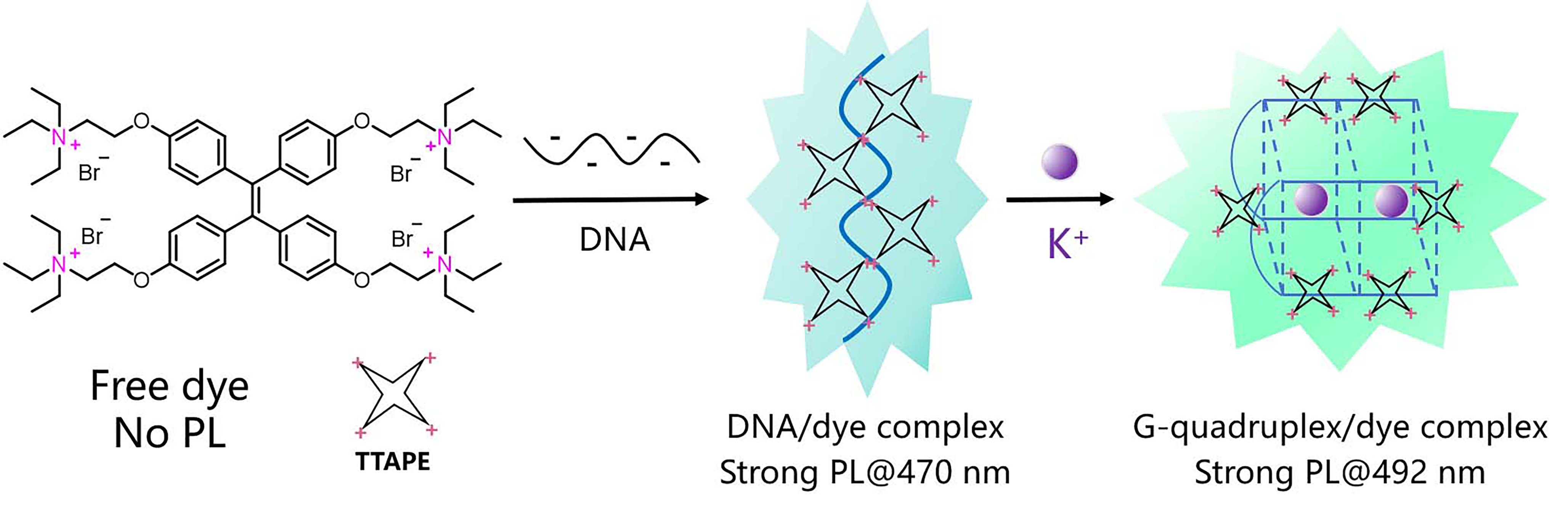
| TTAPE | G4s | Aggregation-induced emission detection (AIE), real-time monitoring of the folding process of G-rich DNA strands to form G4s | [ |
| PZ-1 | G4s | Aggregation-induced emission detection (AIE), G4s is combined through electrostatic interaction and π-π stacking | [ |
| TPE-mTO | G4s | Electron-deficient cation conjugated systems and crescent-shaped scaffolds, specifically locate G4s in mitochondria | [ |
| TPA-mTO | G4s | Near-infrared emission, ideal photostability, and high fluorescence contras | [ |
| HMPQ | G4s | AIEgens of biological origin, the π-π interaction binds to G4s, high selectivity and high sensitivity | [ |
| 5i and 5c | i-motif | Combining different types of I-motifs, the fluorescence intensity is enhanced and the fluorescence lifetime is increased | [ |
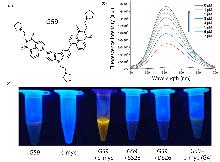
| G59 | i-motif | Specifically recognize and visually detect the i-motif structure of the c-MYC gene promoter | [ |
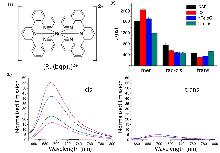
| [Ru(bqp)2]2+ | i-motif | The cis isomer combines with the DAP i-motif, resulting in fluorescence activation and increased fluorescence lifetime | [ |
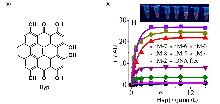
| Hyp | i-motif | The i-motif structures of different lengths were distinguished by fluorescence intensity | [ |
| NIAD-4 | Triplex | Uncharged near-infrared molecular rotor probe, topological match with the Triplex terminal triad | [ |
| FIS | Triplex | The quantity ratio of 2∶1 is combined with Triplex, the ESIPT process is triggered and the green fluorescence lights up | [ |
| Berberine | Triplex | Isoquinoline alkaloids, combined with the Triplex structure, it will show strong fluorescence at 530 nm | [ |
| AgNCs | Triplex | The dynamic changes of photophysical properties with the Triplex structure | [ |
| DFHBI | circRNA | Using circMTO1 as the template, the aptamers generated by RPA and transcriptional amplification techniques were combined with DFHBI | [ |
| LC | circDNA | Efficient intracellular uptake capacity, high-resolution visual imaging detection of mitochondrial DNA (mtDNA) | [ |
| YON | circDNA | Near-infrared twisted intramolecular charge transfer (TICT) fluorescent probe, high sensitivity and large Stokes displacement | [ |
| Probe | Types of nucleic acid | Key features | Ref. |
|---|---|---|---|
| CSTS | G4s | Disaggregation-Induced Emission (DIE), V-shaped rigid plane π bracket combined with the parallel G4s through the | [ |
| QCy(BnBT)3 | G4s | High specificity recognition of G4s and 500 times fluorescence enhancement | [ |
| SCY-5 | G4s | J-Aggregates dissociate into monomers, high specificity recognition of parallel G4s | [ |
| SN-Cy5-S | G4s | Disaggregation-Induced Emission (DIE), Y-shaped plane is combined with the top plane at the 5' end of G4s | [ |
| TO | G4s and Triplex | Distinguish between Triplex and G4s, strong fluorescence enhancement | [ |
| TOVJ | G4s | High specificity recognition of antiparallel G4s, near-infrared emission | [ |
| TOR-G4 | G4s | Two-photon excitation, fluorescence lifetime has increased significantly | [ |
| ThT | G4s | High cell membrane permeability, specific recognition ability for G4s | [ |
| IMT | G4s | Stack on the 3'-G4 end plane, low background and high signal-to-noise ratio emissions | [ |
| ThT-NE | G4s | Intramolecular rotation is restricted and fluorescence is activated, high selectivity and sensitivity | [ |
| ThT-NA | G4s | Red light emission, large Stokes shift, high fluorescence turn-on ratio and high selectivity for G4s | [ |
| NIRG-2 | G4s | Near-infrared Region II emission, hydrogen bonds and π-π stacking combine with G4s | [ |
| CQ4 | G4s | Disaggregation-Induced Emission (DIE), specifically bind parallel G4s | [ |
| P0 | G4s | The dimer G4/P0 system carried out highly selective detection of K+ | [ |
| SiR-PyPDS | G4s | The G4s ligand Pyridostatin (PyPDS) forms hydrogen bonds and hydrophobic interactions to specifically bind to G4s | [ |
| DAOTA-M2 | G4s | G4s were identified by fluorescence lifetime imaging microscopy (FLIM) technology | [ |
| SG4 | G4s | Antibodies against the structure of human c-MYC G4, bind to green fluorescent protein (GFP) | [ |
| CV2 | G4s | Peptide sequences specifically recognizing G4s (L-ARG-L-Gli-glutaric acid), Imaging of mitochondrial G4s | [ |
| COL | G4s | Induce parallel G4s to aggregate from the nucleic acid mixture | [ |
| TTAPE | G4s | Aggregation-induced emission detection (AIE), real-time monitoring of the folding process of G-rich DNA strands to form G4s | [ |
| PZ-1 | G4s | Aggregation-induced emission detection (AIE), G4s is combined through electrostatic interaction and π-π stacking | [ |
| TPE-mTO | G4s | Electron-deficient cation conjugated systems and crescent-shaped scaffolds, specifically locate G4s in mitochondria | [ |
| TPA-mTO | G4s | Near-infrared emission, ideal photostability, and high fluorescence contras | [ |
| HMPQ | G4s | AIEgens of biological origin, the π-π interaction binds to G4s, high selectivity and high sensitivity | [ |
| 5i and 5c | i-motif | Combining different types of I-motifs, the fluorescence intensity is enhanced and the fluorescence lifetime is increased | [ |
| G59 | i-motif | Specifically recognize and visually detect the i-motif structure of the c-MYC gene promoter | [ |
| [Ru(bqp)2]2+ | i-motif | The cis isomer combines with the DAP i-motif, resulting in fluorescence activation and increased fluorescence lifetime | [ |
| Hyp | i-motif | The i-motif structures of different lengths were distinguished by fluorescence intensity | [ |
| NIAD-4 | Triplex | Uncharged near-infrared molecular rotor probe, topological match with the Triplex terminal triad | [ |
| FIS | Triplex | The quantity ratio of 2∶1 is combined with Triplex, the ESIPT process is triggered and the green fluorescence lights up | [ |
| Berberine | Triplex | Isoquinoline alkaloids, combined with the Triplex structure, it will show strong fluorescence at 530 nm | [ |
| AgNCs | Triplex | The dynamic changes of photophysical properties with the Triplex structure | [ |
| DFHBI | circRNA | Using circMTO1 as the template, the aptamers generated by RPA and transcriptional amplification techniques were combined with DFHBI | [ |
| LC | circDNA | Efficient intracellular uptake capacity, high-resolution visual imaging detection of mitochondrial DNA (mtDNA) | [ |
| YON | circDNA | Near-infrared twisted intramolecular charge transfer (TICT) fluorescent probe, high sensitivity and large Stokes displacement | [ |
| [1] |
doi: 10.1038/nsmb1171 pmid: 17146462 |
| [2] |
doi: 10.1093/nar/gkab187 |
| [3] |
doi: 10.1021/acs.jmedchem.4c02518 |
| [4] |
doi: 10.1073/pnas.1810409116 |
| [5] |
doi: 10.1080/10409238.2021.1926417 |
| [6] |
doi: 10.3390/biomedicines10081871 |
| [7] |
|
|
(刘芷玥, 景海涛, 朱婷, 付文强, 张钠, 胡文萱, 生物学杂志, 2025, 42, 7.)
|
|
| [8] |
doi: 10.1021/ja2061984 |
| [9] |
doi: 10.1016/j.drup.2022.100907 |
| [10] |
doi: 10.1093/nar/gkab580 pmid: 34244785 |
| [11] |
doi: 10.1093/nar/gkaa615 |
| [12] |
doi: 10.1007/s00018-021-03921-8 |
| [13] |
doi: 10.1186/s12929-024-01041-6 pmid: 38741159 |
| [14] |
doi: 10.1021/jacs.4c02091 pmid: 38832857 |
| [15] |
doi: 10.1021/acssensors.2c00992 |
| [16] |
doi: 10.1021/jacs.3c11219 pmid: 38191993 |
| [17] |
doi: 10.1002/anie.202100280 pmid: 33539622 |
| [18] |
doi: 10.3390/molecules27051541 |
| [19] |
doi: 10.1021/acschembio.9b00475 pmid: 31532996 |
| [20] |
doi: 10.1016/j.cclet.2022.02.048 |
| [21] |
doi: 10.1016/j.saa.2023.122615 |
| [22] |
doi: 10.6023/A23040121 |
|
(李兰英, 陶晴, 闻艳丽, 王乐乐, 郭瑞妍, 刘刚, 左小磊, 化学学报, 2023, 81, 681.)
doi: 10.6023/A23040121 |
|
| [23] |
doi: 10.1002/anie.v59.25 |
| [24] |
doi: 10.1021/acsami.0c12482 |
| [25] |
doi: 10.1002/anie.v53.52 |
| [26] |
doi: 10.1021/acsnano.4c14792 |
| [27] |
doi: 10.1021/ac500590d |
| [28] |
doi: 10.1016/j.cej.2023.144022 |
| [29] |
doi: 10.1002/adfm.v34.23 |
| [30] |
doi: 10.1093/nar/gky729 pmid: 30107602 |
| [31] |
doi: 10.1016/j.ijbiomac.2025.139844 |
| [32] |
doi: 10.1093/nar/gkx201 |
| [33] |
doi: 10.1021/jacs.1c05468 pmid: 34554731 |
| [34] |
doi: 10.1002/advs.v12.8 |
| [1] |
doi: 10.1093/nar/gkac482 |
| [35] |
doi: 10.1016/j.ijbiomac.2023.126835 |
| [36] |
doi: 10.1016/j.compbiomed.2024.108683 |
| [37] |
|
|
(周鑫辰, 张卓, 董姝含, 靳茁, 战星彤, 王鹤霖, 杨舒惠, 刘丽梅, 化学通报, 2024, 87, 1098.)
|
|
| [38] |
doi: 10.1007/s00216-022-03995-8 |
| [39] |
doi: 10.3389/fchem.2021.707876 |
| [40] |
doi: 10.1002/chem.v21.39 |
| [41] |
doi: 10.1021/ac501619v |
| [42] |
doi: 10.1021/acs.analchem.3c04318 pmid: 37955574 |
| [43] |
doi: 10.1021/jacs.4c07698 |
| [44] |
doi: 10.1021/acs.analchem.3c01153 pmid: 37290004 |
| [45] |
doi: 10.3390/molecules26092828 |
| [46] |
doi: 10.1021/bi1000849 pmid: 20329708 |
| [47] |
doi: 10.1021/acsami.1c07101 |
| [48] |
doi: 10.1021/jacs.3c11908 pmid: 38151240 |
| [49] |
|
| [50] |
doi: 10.1093/nar/gky665 pmid: 30085206 |
| [51] |
doi: 10.1021/jacs.8b10265 |
| [52] |
doi: 10.1021/acs.analchem.2c02049 |
| [53] |
doi: 10.1021/jacs.3c13851 |
| [54] |
doi: 10.1002/anie.201912027 pmid: 31644837 |
| [55] |
doi: 10.1021/acs.analchem.4c02368 |
| [56] |
doi: 10.1038/s41557-020-0506-4 pmid: 32690897 |
| [57] |
doi: 10.1038/ncomms9178 pmid: 26350962 |
| [58] |
doi: 10.1021/jacs.2c10656 |
| [59] |
|
| [60] |
doi: 10.1021/jacs.5c01172 |
| [61] |
doi: 10.1039/c4cs00444b pmid: 25686761 |
| [62] |
|
| [63] |
|
| [64] |
doi: 10.1016/j.biomaterials.2020.119834 |
| [65] |
|
| [66] |
|
| [67] |
doi: 10.3390/molecules27123914 |
| [68] |
doi: 10.3390/molecules28062863 |
| [69] |
doi: 10.3390/bios12080667 |
| [70] |
doi: 10.7150/thno.31844 |
| [71] |
doi: 10.1021/jacs.9b11544 |
| [72] |
doi: 10.1021/acsnano.8b05270 |
| [73] |
doi: 10.1021/acs.analchem.4c01500 |
| [74] |
doi: 10.1021/acsnano.4c03879 |
| [75] |
doi: 10.1039/D5SC01072A |
| [76] |
doi: 10.3390/molecules23020419 |
| [77] |
doi: 10.1016/j.talanta.2023.124562 |
| [78] |
doi: 10.1021/jacs.9b12936 |
| [79] |
doi: 10.1002/anie.v59.18 |
| [80] |
doi: 10.1021/jacs.9b09239 |
| [81] |
doi: 10.3390/molecules29050983 |
| [82] |
|
| [83] |
doi: 10.1002/chem.v14:21 |
| [84] |
doi: 10.1016/j.snb.2020.128990 |
| [85] |
doi: 10.1016/j.snb.2020.128479 |
| [86] |
|
| [87] |
doi: 10.1016/j.cej.2024.154947 |
| [88] |
doi: 10.1002/anie.v57.8 |
| [89] |
doi: 10.1016/j.tig.2024.05.011 |
| [90] |
doi: 10.1093/nar/gky035 |
| [91] |
doi: 10.1038/ncomms2091 |
| [92] |
doi: 10.1016/j.bioorg.2025.108227 |
| [93] |
doi: 10.3390/ijms23073872 |
| [94] |
doi: 10.1021/jacs.0c04789 |
| [95] |
doi: 10.1093/nar/gkac158 |
| [96] |
doi: 10.1021/acs.analchem.2c02875 |
| [97] |
doi: 10.1039/D2SC01793H |
| [98] |
doi: 10.1016/j.cej.2025.159425 |
| [99] |
doi: 10.1021/acs.analchem.3c03147 |
| [100] |
doi: 10.1021/acs.analchem.5b02851 |
| [101] |
doi: S0039-9140(18)30656-8 pmid: 30086897 |
| [102] |
doi: 10.1021/acsnano.2c06631 |
| [103] |
doi: 10.1021/acs.analchem.3c01624 |
| [104] |
doi: 10.1038/s41568-021-00358-w pmid: 34045735 |
| [105] |
doi: 10.1039/C8CC06276E |
| [106] |
doi: 10.1021/acs.analchem.1c05582 |
| [1] | Aopei Peng, Yang Li, Yuanyuan Zhu, Guangwen Wu, Shuangxi Gu. Advances in Chemoselective Recognition of Amino Acids by Schiff Base Fluorescent Probes [J]. Chinese Journal of Organic Chemistry, 2025, 45(9): 3301-3313. |
| [2] | Hanyue Xiang, Shaoyin Wei, Yuji Wang, Nao Xiao. Recent Advances of Fe(II) Fluorescence Probes Based on N-Oxide Structure [J]. Chinese Journal of Organic Chemistry, 2025, 45(4): 1137-1152. |
| [3] | Xiaohong Cheng, Renjie Zhang, Jun You, Wenbin Fu, Wenjie Shen, Yunqiang Luo, Song Wang. A Novel Catalytic Fluorescent Probe and Its Application in Copper Detection in Gas-Generating Agents [J]. Chinese Journal of Organic Chemistry, 2025, 45(11): 4195-4201. |
| [4] | Yixuan Chen, Zheng Zhao. Aggregation-Induced Emission Photosensitizers for Photodynamic Antimicrobial Therapy [J]. Chinese Journal of Organic Chemistry, 2025, 45(11): 3998-4012. |
| [5] | Zixuan Dong, Junjun Su, Hongfei Pan, Xiangkui Ren, Zhijian Chen. Near-Infrared Aggregation-Induced Emission (AIE) Molecules Based on Coupling of Triarylamine-Modified Benzothiadiazole Units [J]. Chinese Journal of Organic Chemistry, 2025, 45(1): 205-211. |
| [6] | Yan Ou, Lin Lan, Zhengxiong Wang, Zhiming Wang, BenZhong Tang. Preparation of Aggregation-Induced Emission Nucleic Acid Probes and Study of Their Nucleic Acid Sensing Principles [J]. Chinese Journal of Organic Chemistry, 2024, 44(8): 2554-2562. |
| [7] | Yujie Yang, Wei Cao, Jikai Yu, Zhixia Zhang, Li Xu, Hua Wang. Synthesis of Donor-Acceptor (D-A) Typed Phenylcyclooctatetrathiophenes and Their Performances on Aggregation Induced Emission and High Pressure Luminescence [J]. Chinese Journal of Organic Chemistry, 2024, 44(8): 2495-2503. |
| [8] | Jidong Zhang, Yao Yang, Jie Zhang, Wei She. Detection of Zn(II) by Tetraphenylethyene Fluorescent Probe Based on Aggregation-Induced Emission (AIE)-Excited State Intramolecular Proton Transfer (ESIPT) Effect [J]. Chinese Journal of Organic Chemistry, 2024, 44(4): 1337-1342. |
| [9] | Chongyang Zeng, Ping Hu, Biqin Wang, Wenyan Fang, Keqing Zhao. Cyanostilbene Bridged Triphenylene Dyad Stimuli-Responsive Discotic Liquid Crystal: Synthesis, Properties and Applications [J]. Chinese Journal of Organic Chemistry, 2023, 43(9): 3287-3296. |
| [10] | Yang Zhao, Panpan Chen, Lizhi Han, Enju Wang. Aggregation-Induced Emission and Cell Imaging of Triphenylimidazole Derivatives [J]. Chinese Journal of Organic Chemistry, 2023, 43(7): 2454-2461. |
| [11] | Wu Zhou, Min Peng, Qingxiang Liang, Aibin Wu, Wenming Shu, Weichu Yu. A Novel Turn-On Fluorescent Probe Based on Naphthalimide for Highly Selective and Sensitive Detection of Hydrogen Sulfide in Solution and Gas [J]. Chinese Journal of Organic Chemistry, 2023, 43(12): 4277-4283. |
| [12] | Yuehua Zhang, Fei Nie, Lu Zhou, Xiaofeng Wang, Yuan Liu, Yanping Huo, Wencheng Chen, Zujin Zhao. Synthesis and Optoelectronic Studies of Thermally Activated Delayed Fluorescence Materials Based on Benzothiazolyl Ketones [J]. Chinese Journal of Organic Chemistry, 2023, 43(11): 3876-3887. |
| [13] | Jidong Zhang, Wanlin Yan, Wenqiang Hu, Dian Guo, Dalong Zhang, Xiaoxin Quan, Xianpan Bu, Siyu Chen. Design and Synthesis of a Zn2+ Fluorescent Probe Based on Aggregation Induced Luminescence Properties [J]. Chinese Journal of Organic Chemistry, 2023, 43(1): 326-331. |
| [14] | Yangyang Li, Xiaofei Sun, Xiaoling Hu, Yuanyuan Ren, Keli Zhong, Xiaomei Yan, Lijun Tang. Synthesis of Triphenylamine Derivative and Its Recognition for Hg2+ with “OFF-ON” Fluorescence Response Based on Aggregation-Induced Emission (AIE) Mechanism [J]. Chinese Journal of Organic Chemistry, 2023, 43(1): 320-325. |
| [15] | Meng Liu, Yanru Huang, Xiaofei Sun, Lijun Tang. An “Aggregation-Induced Emission+Excited-State Intramolecular Proton Transfer” Mechanisms-Based Benzothiazole Derived Fluorescent Probe and Its ClO– Recognition [J]. Chinese Journal of Organic Chemistry, 2023, 43(1): 345-351. |
| Viewed | ||||||
|
Full text |
|
|||||
|
Abstract |
|
|||||
