

化学学报 ›› 2025, Vol. 83 ›› Issue (5): 518-526.DOI: 10.6023/A25030076 上一篇 下一篇
研究论文
墨云鹤, 曹卫刚, 赵乐泉, 唐振强, 郑珑, 蔡宗英*( )
)
投稿日期:2025-03-12
发布日期:2025-04-24
基金资助:
Yunhe Mo, Weigang Cao, Lequan Zhao, Zhenqiang Tang, Long Zheng, Zongying Cai*()
Received:2025-03-12
Published:2025-04-24
Contact:
* E-mail: Supported by:文章分享
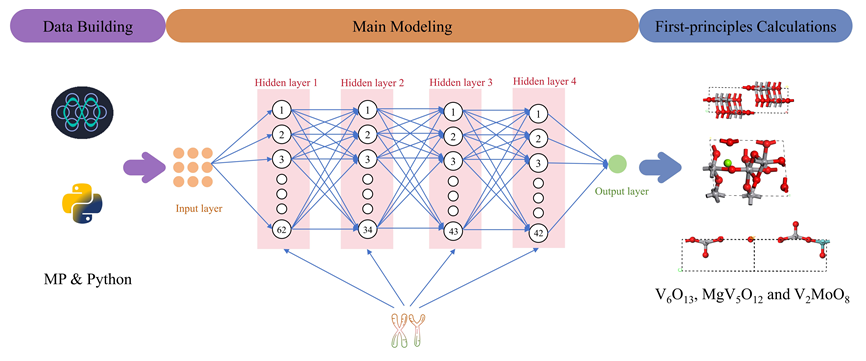
鉴于成本效益、资源丰富性, 钒基锂离子电池电极材料成为科研热点. 通过机器学习模型与第一性原理计算对钒基材料数据库建立了筛选-验证流程, 旨在发现优异潜在钒基电极材料. 从Materials project提取出了4694条钒基数据, 并通过pymatgen (Python Materials Genomics)计算了最大理论容量. 相关性研究发现密度对于钒基材料理论容量的影响比较关键, 经三种机器学习算法联合预测对比, 遗传算法确定超参数的深度神经网络算法(DNN)效果最佳, R2为0.771. 并通过DNN算法的SHAP分析进一步证明. 经模型预测, 根据密度特征选取原始数据集前0.5%数据, 最终确定了26种潜在钒基电极材料. 经机器学习与第一性原理计算验证, 确定了三种理论容量均大于650 mAh/g, 开路电压分别为2.56、0.64、0.49 V的钒基正负两电极候选材料. 这一流程不仅可用于对钒基电极材料的发现, 并有望在不同材料体系扩展.
墨云鹤, 曹卫刚, 赵乐泉, 唐振强, 郑珑, 蔡宗英. 基于机器学习与第一性原理筛选锂离子电池钒基电极材料[J]. 化学学报, 2025, 83(5): 518-526.
Yunhe Mo, Weigang Cao, Lequan Zhao, Zhenqiang Tang, Long Zheng, Zongying Cai. Screening Vanadium-Based Electrode Materials for Lithium-Ion Batteries Based on Machine Learning and First-Principles[J]. Acta Chimica Sinica, 2025, 83(5): 518-526.


| ID | Formula | Density/(g•cm–3) | Specific capacity/(mAh•g–1) |
|---|---|---|---|
| mp-18896 | V6O13 | 3.927 | 755.468 |
| mp-2229279 | MgV5O12 | 3.877 | 699.022 |
| mp-27877 | V2MoO8 | 3.755 | 678.126 |
| ID | Formula | Density/(g•cm–3) | Specific capacity/(mAh•g–1) |
|---|---|---|---|
| mp-18896 | V6O13 | 3.927 | 755.468 |
| mp-2229279 | MgV5O12 | 3.877 | 699.022 |
| mp-27877 | V2MoO8 | 3.755 | 678.126 |


| [1] |
|
| [2] |
|
|
(刘继洪, 祝佳鹏, 张旭, 张纪阳, 黄超洋, 贾桂霄, 安胜利, 化学学报, 2025, 83, 101.)
doi: 10.6023/A24110356 |
|
| [3] |
|
| [4] |
|
|
(陈博文, 徐克, 陈琪, 陈立桅, 化学学报, 2024, 82, 1209.)
doi: 10.6023/A24090267 |
|
| [5] |
|
| [6] |
|
| [7] |
|
| [8] |
|
| [9] |
|
| [10] |
|
| [11] |
|
| [12] |
|
| [13] |
|
| [14] |
|
| [15] |
doi: 10.1021/acsanm.9b00703 |
| [16] |
doi: 10.1021/acsaem.8b01895 |
| [17] |
|
| [18] |
|
|
(李珺卿, 宋千禧, 刘子义, 王东琪, 化学学报, 2024, 82, 387.)
doi: 10.6023/A23100473 |
|
| [19] |
|
| [20] |
|
| [21] |
|
| [22] |
|
| [23] |
|
| [24] |
|
| [25] |
|
| [26] |
|
| [27] |
|
| [28] |
|
| [29] |
|
| [30] |
|
| [31] |
|
| [32] |
|
| [33] |
|
| [34] |
|
| [35] |
|
| [36] |
|
| [37] |
doi: 10.1038/s41467-020-15355-0 pmid: 32214093 |
| [38] |
|
| [39] |
|
|
(王筑城, 刘磊, 朱梦媛, 孙悦, 赵晴, 丁玉寅, 陆继鑫, 王存国, 李奇, 贺爱华, 叶付臣, 化学学报, 2024, 82, 589.)
doi: 10.6023/A24020048 |
|
| [40] |
|
| [41] |
|
| [42] |
|
| [43] |
|
| [44] |
|
| [45] |
|
| [46] |
|
| [47] |
|
| [48] |
|
| [49] |
|
| [50] |
doi: 10.1038/s41598-024-77050-0 pmid: 39462071 |
| [51] |
|
| [52] |
|
| [53] |
|
| [54] |
doi: 10.1038/s41467-021-27094-x pmid: 34824213 |
| [55] |
|
| [56] |
|
| [57] |
|
| [58] |
|
| [59] |
doi: 10.1038/s41467-024-48071-0 pmid: 38802332 |
| [60] |
|
| [61] |
|
| [62] |
|
| [63] |
|
| [64] |
|
| [65] |
|
| [66] |
|
| [67] |
|
| [68] |
|
| [1] | 田野, 张博尧, 陈俊宇, 姬梦鑫, 任浩, 匙玉华. MoSi2N4/ZrS2(HfS2) II型异质结调节电子传输用于光催化制氢的研究[J]. 化学学报, 2025, 83(5): 498-509. |
| [2] | 张旭, 郭鑫, 张纪阳, 刘继洪, 祝佳鹏, 黄超洋, 黎明, 贾桂霄, 安胜利. 分散的LiMn6对Li1.17Ni0.17Fe0.17Mn0.49O2层状正极材料结构稳定性及氧化机理的影响研究[J]. 化学学报, 2025, 83(4): 369-376. |
| [3] | 胡国伟, 王晓欢, 原志鹏, 新巴雅尔, 乌力吉贺希格. Ag掺杂对铁酸铋系化合物光催化性能的影响[J]. 化学学报, 2025, 83(3): 229-236. |
| [4] | 刘继洪, 祝佳鹏, 张旭, 张纪阳, 黄超洋, 贾桂霄, 安胜利. 锂离子电池富锂层状正极材料Li-Ni-Mn-O应变机理研究[J]. 化学学报, 2025, 83(2): 101-109. |
| [5] | 郑坤贵, 刘君珂, 胡轶旸, 尹祖伟, 周尧, 李君涛, 孙世刚. 用于石墨负极的高性能聚丙烯酸锂基复合粘结剂的制备及性能研究[J]. 化学学报, 2024, 82(8): 833-842. |
| [6] | 王筑城, 刘磊, 朱梦媛, 孙悦, 赵晴, 丁玉寅, 陆继鑫, 王存国, 李奇, 贺爱华, 叶付臣. 1,5-二氨基蒽醌(AAQ)复合材料用作锂离子电池新型正极材料的性能研究[J]. 化学学报, 2024, 82(6): 589-595. |
| [7] | 李珺卿, 宋千禧, 刘子义, 王东琪. 机器学习方法预测含硼材料能隙[J]. 化学学报, 2024, 82(4): 387-395. |
| [8] | 顾晓瑜, 李进, 孙千, 王朝阳. 微量量热法分析锂离子电池热失控过程[J]. 化学学报, 2024, 82(2): 146-151. |
| [9] | 张凯, 武晓君. 具有室温铁磁性的二维Janus钛硫属化物★[J]. 化学学报, 2023, 81(9): 1142-1147. |
| [10] | 贾洋刚, 陈诗洁, 邵霞, 程婕, 林娜, 方道来, 冒爱琴, 李灿华. 高性能无钴化钙钛矿型高熵氧化物负极材料的制备及储锂性能研究[J]. 化学学报, 2023, 81(5): 486-495. |
| [11] | 戚兴怡, 胡耀峰, 王若愚, 杨雅清, 赵宇飞. 机器学习在新材料筛选方面的应用进展[J]. 化学学报, 2023, 81(2): 158-174. |
| [12] | 张雅岚, 苑志祥, 张浩, 张建军, 崔光磊. 高镍三元高比能固态锂离子电池的研究进展[J]. 化学学报, 2023, 81(12): 1724-1738. |
| [13] | 常婉莹, 谭莹瑛, 吴静怡, 刘英杰, 蔡金海, 赖春艳. 三维结构Li6.28La3Zr2Al0.24O12增强聚氧化乙烯基固态电解质的性能研究[J]. 化学学报, 2023, 81(12): 1708-1715. |
| [14] | 韩逸之, 蓝建慧, 刘学, 石伟群. 基于机器学习势函数的熔盐体系分子动力学研究进展[J]. 化学学报, 2023, 81(11): 1663-1672. |
| [15] | 张爽, 杨成飞, 杨玉波, 冯宁宁, 杨刚. 基于废旧锂电池回收制备LixMO (x=0.79, 0.30, 0.08; M=Ni/Co/Mn)材料作为锂-氧气电池正极催化剂的电化学性能研究[J]. 化学学报, 2022, 80(9): 1269-1276. |
| 阅读次数 | ||||||
|
全文 |
|
|||||
|
摘要 |
|
|||||
