

化学学报 ›› 2025, Vol. 83 ›› Issue (10): 1237-1251.DOI: 10.6023/A25080280 上一篇 下一篇
综述
李晖a,*( ), 殷亮b,*()
投稿日期:2025-08-15
发布日期:2025-09-15
通讯作者:
李晖, 殷亮
作者简介: |
李晖, 运城学院应用化学系副教授. 本科毕业于南开大学; 硕士毕业于天津大学(导师: 姜申德教授). 主要从事铜催化反应研究和药物中间体合成工艺研究等. |
 |
殷亮, 中国科学院上海有机化学研究所研究员、课题组长. 本科和硕士毕业于南开大学; 博士毕业于东京大学(导师: Masakatsu Shibasaki教授和Motomu Kanai教授); 于哈佛大学(导师: EJ Corey教授)和日本微生物化学研究所(导师: Masakatsu Shibasaki教授)开展博士后研究. 目前主要从事一价铜催化的不对称C—C键和C—X键成键反应研究. |
基金资助:
Hui Lia,*(), Liang Yinb,*()
Received:2025-08-15
Published:2025-09-15
Contact:
Hui Li, Liang Yin
Supported by:文章分享

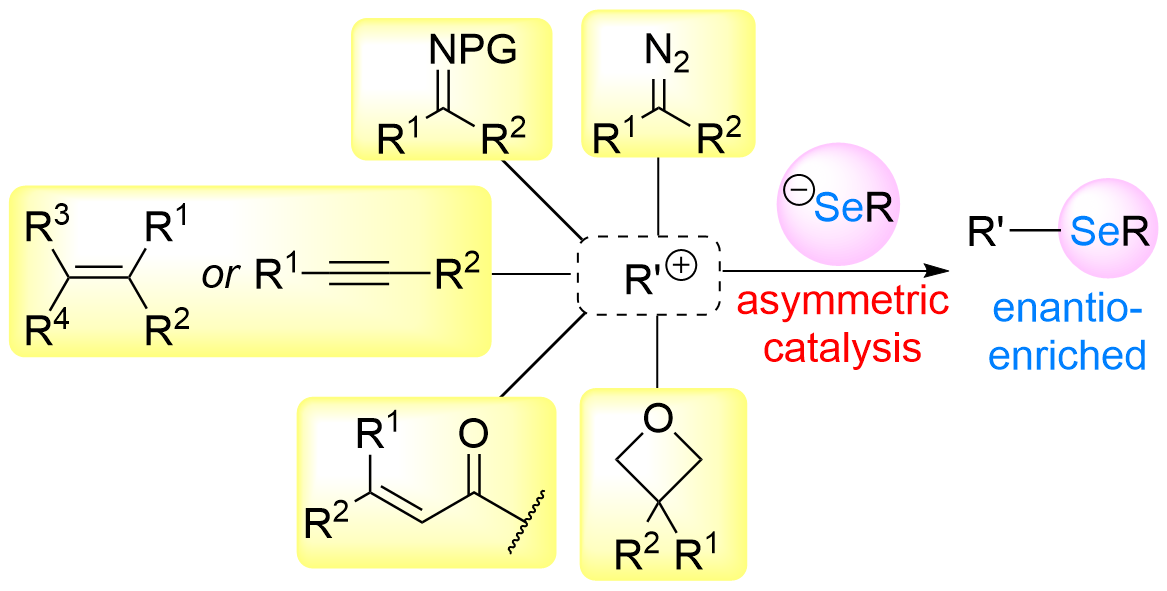
手性有机硒化合物在合成化学、材料科学、医药和农药等领域具有广泛的应用, 在不对称催化领域还可以用作手性配体或有机小分子催化剂. 因此, 手性有机硒化合物的不对称合成受到化学家们的重视. 利用含硒试剂与相应底物的催化不对称C—Se偶联反应是合成有机硒化合物最直接且最有效的策略之一. 此综述着重介绍了利用该策略构建手性有机硒化合物的研究进展. 根据不同的硒源类型, 将反应分为亲电有机硒试剂与亲核底物的不对称偶联反应和亲核有机硒试剂与亲电底物的不对称偶联反应两类. 另外, 对一些代表性反应的机理和底物适用范围做了简要介绍.
李晖, 殷亮. 手性有机硒化合物的催化不对称合成研究进展[J]. 化学学报, 2025, 83(10): 1237-1251.
Hui Li, Liang Yin. Research Progress on Catalytic Asymmetric Synthesis of Chiral Organoselenium Compounds[J]. Acta Chimica Sinica, 2025, 83(10): 1237-1251.









| [4] |
(c)
pmid: 38299513 |
| [5] |
(a)
|
|
(b)
|
|
|
(c)
|
|
| [6] |
(a)
|
|
(b)
|
|
| [7] |
(a)
|
|
(b)
|
|
|
(c)
|
|
|
(d)
|
|
| [1] |
|
| [2] |
(a)
doi: 10.1021/cr900352j pmid: 20384363 |
|
(b)
pmid: 20384363 |
|
|
(c)
pmid: 20384363 |
|
| [3] |
(a)
|
|
(b)
|
|
|
(c)
|
|
| [4] |
(a)
doi: 10.1089/ars.2023.0285 pmid: 38299513 |
|
(b)
pmid: 38299513 |
|
| [7] |
(e)
|
| [8] |
(a)
|
|
(b)
|
|
|
((c)
|
|
|
(冯书晓, 钟轩, 陈嘉豪, 张宗洛, 谷广娜, 王俊岭, 郭亚菲, 马军营, 张守仁, 有机化学, 2025, 45, 2425.)
doi: 10.6023/cjoc202411011 |
|
| [9] |
(a)
|
|
(b)
|
|
|
(c)
|
|
| [10] |
(a)
pmid: 27862465 |
|
(b)
pmid: 27862465 |
|
|
(c)
doi: 10.1002/anie.201104819 pmid: 27862465 |
|
|
(d)
pmid: 27862465 |
|
|
(e)
doi: 10.1002/chem.201604781 pmid: 27862465 |
|
|
(f)
pmid: 27862465 |
|
|
(g)
pmid: 27862465 |
|
|
(h)
pmid: 27862465 |
|
| [11] |
(a)
|
|
(b)
|
|
|
((c)
|
|
|
(于婷婷, 宋冬雪, 许颖, 刘冰, 陈宁, 刘颖杰, 有机化学, 2022, 42, 4202.)
doi: 10.6023/cjoc202204037 |
|
| [12] |
doi: 10.1021/ja106837b pmid: 20961070 |
| [13] |
|
| [14] |
|
| [15] |
doi: 10.1021/ja510113s pmid: 25380129 |
| [16] |
|
| [17] |
|
| [18] |
|
| [19] |
|
| [20] |
|
| [21] |
|
| [22] |
|
| [23] |
|
| [24] |
|
| [25] |
(a)
|
|
(b)
|
|
| [26] |
|
| [27] |
(a)
|
|
(b)
|
|
|
(c)
|
|
|
(d)
|
|
|
(e)
|
|
|
(f)
|
|
| [28] |
|
| [29] |
pmid: 27748489 |
| [30] |
|
| [31] |
|
| [32] |
|
| [33] |
|
| [34] |
doi: 10.1021/jacsau.4c01182 pmid: 40017750 |
| [35] | |
| [36] |
|
| [37] |
|
| [38] |
|
| [39] |
|
| [40] |
|
| [41] |
|
| [42] |
|
| [43] |
|
| [44] |
|
| [45] |
|
| [46] |
|
| [47] |
|
| [48] |
|
| [49] |
|
| [50] |
|
| [51] |
|
| [52] |
|
| [53] |
|
| [54] |
|
| [1] | 鱼章龙, 李忠良, 杨昌江, 顾强帅, 刘心元. 铜催化的二醇类化合物对映选择性去对称化反应研究进展★[J]. 化学学报, 2023, 81(8): 955-966. |
| [2] | 杨爽, 王宁宜, 杭青青, 张宇辰, 石枫. 邻羟基苯基取代的对亚甲基苯醌参与的催化不对称反应研究进展★[J]. 化学学报, 2023, 81(7): 793-808. |
| [3] | 王瑞祥, 赵庆如, 顾庆, 游书力. 金/铱接力催化炔基酰胺环化/不对称烯丙基苄基化串联反应★[J]. 化学学报, 2023, 81(5): 431-434. |
| [4] | 高杨, 张学鑫, 余金生, 周剑. α-手性三级叠氮化合物的不对称催化合成新进展★[J]. 化学学报, 2023, 81(11): 1590-1608. |
| [5] | 孟庆端, 韩佳宏, 潘一骁, 郝伟, 范青华. C1-对称手性氮杂环卡宾(NHC)配体的不对称合成及其催化性能研究★[J]. 化学学报, 2023, 81(10): 1271-1279. |
| [6] | 张崃, 肖检, 王雅雯, 彭羽. 苯酚(醌)与烯烃的不对称[3+2]环化反应: 手性二氢苯并呋喃的合成进展[J]. 化学学报, 2022, 80(8): 1152-1164. |
| [7] | 马进越, 黄露霏, 周宝文, 姚琳. 无机手性纳米结构的可控构筑及其催化研究进展[J]. 化学学报, 2022, 80(11): 1507-1523. |
| [8] | 赵庆如, 蒋茹, 游书力. 铱催化串联不对称烯丙基取代/双键异构化构建轴手性化合物[J]. 化学学报, 2021, 79(9): 1107-1112. |
| [9] | 穆博帅, 张志豪, 武文彪, 余金生, 周剑. 手性1,2-二氢吡啶化合物的合成研究进展[J]. 化学学报, 2021, 79(6): 685-693. |
| [10] | 李翼, 徐明华. 不对称Petasis反应在手性胺类化合物合成中的应用[J]. 化学学报, 2021, 79(11): 1345-1359. |
| [11] | 朱仁义, 廖奎, 余金生, 周剑. P-手性膦氧化物的不对称催化合成研究进展[J]. 化学学报, 2020, 78(3): 193-216. |
| [12] | 王强, 顾庆, 游书力. 过渡金属催化不对称C—H键官能团化反应构建轴手性联芳基化合物研究进展[J]. 化学学报, 2019, 77(8): 690-704. |
| [13] | 蔡倩, 马浩文. 手性高价碘试剂的发展及展望[J]. 化学学报, 2019, 77(3): 213-230. |
| [14] | 周远春, 周志, 杜玮, 陈应春. HOMO活化的2-吡喃酮与2,5-二烯酮反电子需求的不对称Diels-Alder反应[J]. 化学学报, 2018, 76(5): 382-386. |
| [15] | 李树森, 王剑波. 不对称三氟甲硫基化反应研究进展[J]. 化学学报, 2018, 76(12): 913-924. |
| 阅读次数 | ||||||
|
全文 |
|
|||||
|
摘要 |
|
|||||
