化学学报 上一篇    下一篇

研究通讯

叔丁基取代的Xantphos配体支撑的单核一价钯卤化物

王翔宇a, 夏天骐a, 冷雪冰a, 王东阳a, 邓亮*a,b   

  1. a中国科学院上海有机化学研究所 金属有机化学全国重点实验室 上海 200032;
    b国科大杭州高等研究院 化学与材料科学学院 杭州 310024
  • 投稿日期:2026-01-05
  • 基金资助:
    项目受中国科学技术部国家重点研发计划(2023YFA1507500)、中国科学院战略性先导科技专项(XDB0610000和XDA0540000)、国家自然科学基金(Nos. 22231010, 92461311和22571315)资助.

Mononuclear Palladium(I) Halides Supported by tert-Butyl-Substituted Xantphos Ligand

Xiangyu Wanga, Tianqi Xiaa, Xuebing Lenga, Dongyang Wanga, Liang Deng*a,b   

  1. a State Key Laboratory of Organometallic Chemistry, Shanghai Institute of Organic Chemistry, Chinese Academy of Sciences, Shanghai 200032;
    b School of Chemistry and Materials Science, Hangzhou Institute for Advanced Study, University of Chinese Academy of Sciences, Hangzhou 310024
  • Received:2026-01-05
  • Contact: *E-mail: deng@sioc.ac.cn
  • Supported by:
    Project supported by the National Key Research and Development Program of the Ministry of Science and Technology of China (2023YFA1507500), the Strategic Priority Research Program of the Chinese Academy of Sciences (XDB0610000 and XDA0540000), Natural Science Foundation of China (22231010, 92461311 and 22571315).

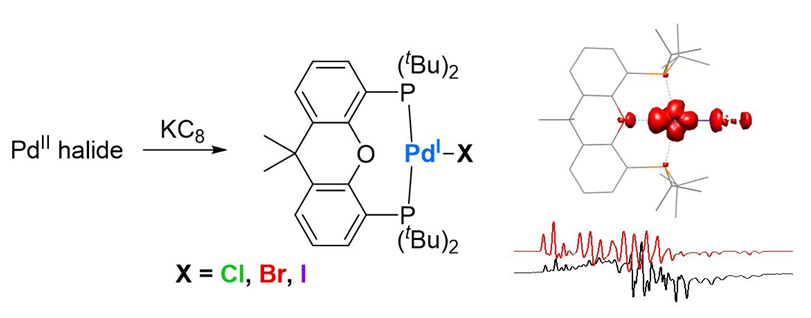
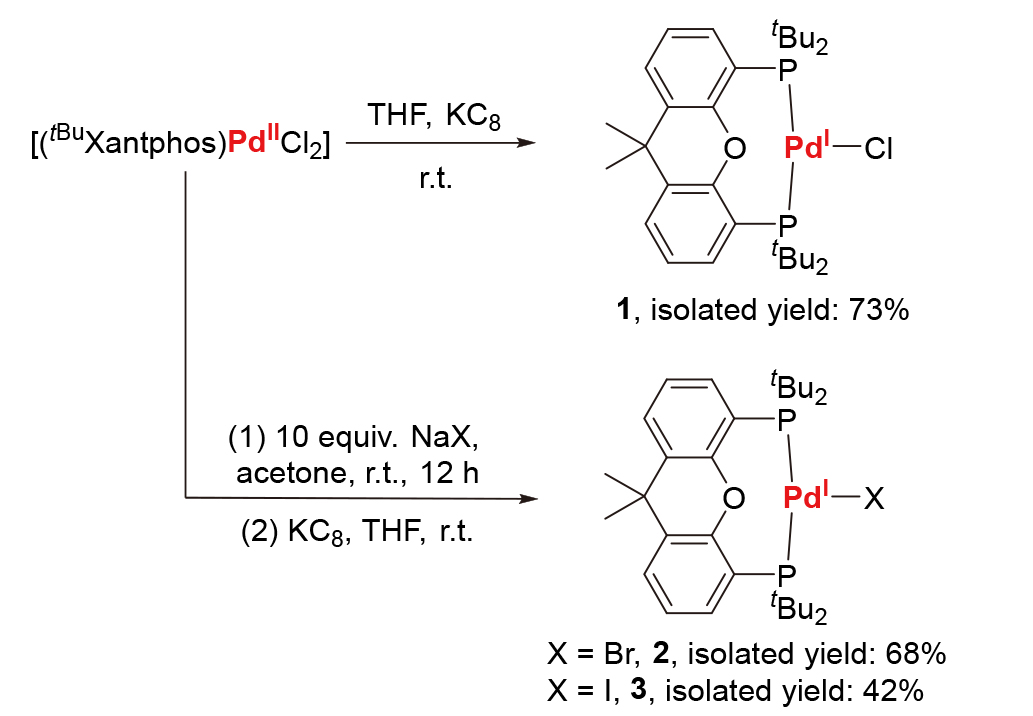
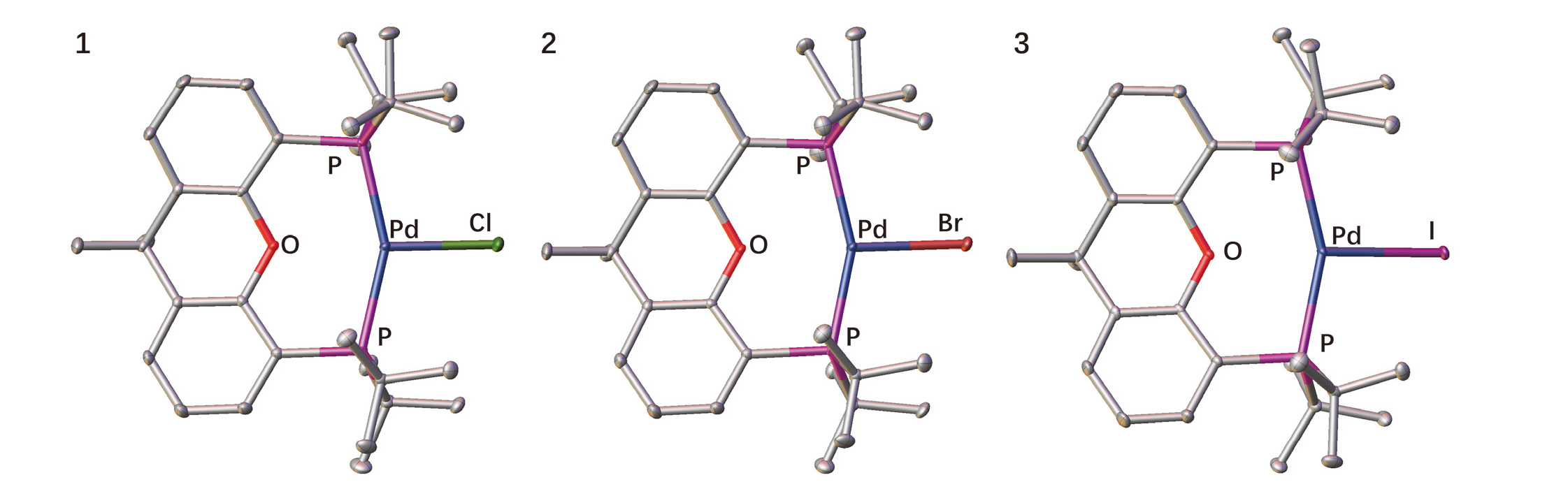
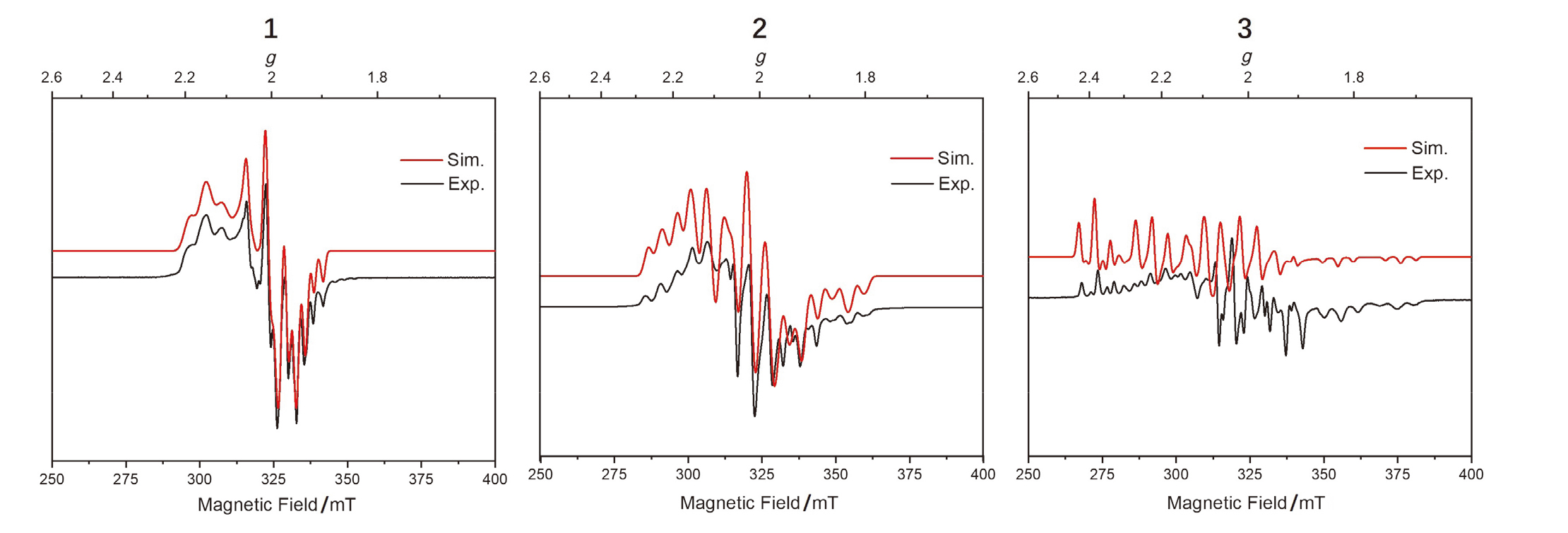
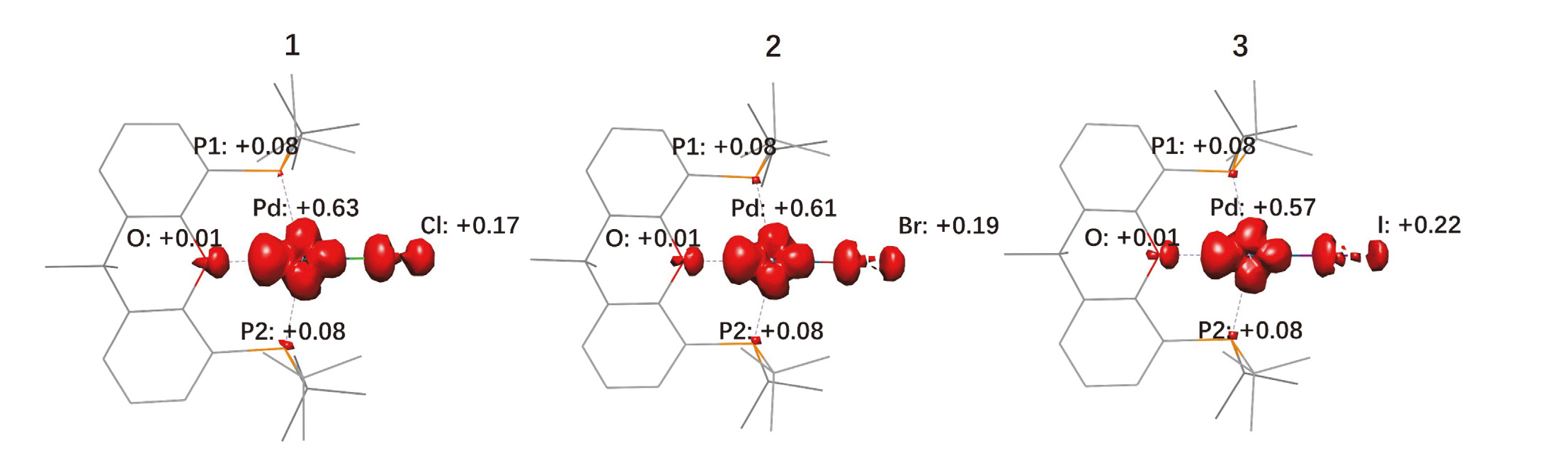
单核一价钯卤化物是许多钯催化反应的中间体,然而目前报道可分离的单核一价钯卤化物极少. 本研究发现,使用4,5-双(二叔丁基膦)-9,9-二甲基氧杂蒽(tBuXantphos)作为配体可以有效稳定单核一价钯卤化物. 单核一价钯氯化物[(tBuXantphos)PdCl]可以通过石墨钾还原[(tBuXantphos)PdCl2]得到,单核一价钯溴化物[(tBuXantphos)PdBr]与碘化物[(tBuXantphos)PdI]则由过量NaX (X = Br, I)与[(tBuXantphos)PdCl2]反应后进一步用石墨钾还原得到. 单晶X-射线衍射确定[(tBuXantphos)PdX] (X = Cl, Br, I)具有扭曲的T-构型结构. 100K下的电子顺磁共振谱图显示,[(tBuXantphos)PdX]的g因子giso = [2.231, 2.079, 2.034] (X = Cl), [2.195, 2.081, 2.035] (X = Br), [2.201, 2.129, 2.074] (X = I),卤素原子引起的超精细耦合常数Aiso(X) = [33, 27, 90] MHz (X = Cl), [312, 75, 425] MHz (X = Br), [360, 150, 600] MHz (X = I). 密度泛函理论计算结果表明,这些一价钯卤化物的单占据分子轨道为Pd的dx2-y2轨道与配体np轨道之间所成的σ*轨道,Pd中心的自旋密度分布从氯化物到碘化物依次较少,分别为0.63, 0.61, 0.57,卤素原子上的自旋密度分布依次增加,分别为0.17, 0.19, 0.22.

关键词: 单核, 一价钯, 开壳型, 膦, 卤化物

Mononuclear palladium(I) halides are proposed intermediates in many palladium-catalyzed reactions. However, isolable examples of such species remain scarce. Herein, we report that 9,9-dimethyl-4,5-bis(di-tert-butylphosphino)xanthene (tBuXantphos) ligand can effectively stabilize mononuclear palladium(I) halides. Mononuclear palladium(I) chloride [(tBuXantphos)PdCl] (1) was synthesized in 73% yield via the reduction of [(tBuXantphos)PdCl₂] using excess potassium graphite (KC₈) in THF under strictly controlled reaction time. Similarly, mononuclear palladium(I) bromide and iodide, [(tBuXantphos)PdBr] (2) and [(tBuXantphos)PdI] (3), were obtained with the yields of 68% and 42% respectively, through reduction of the reaction mixtures of [(tBuXantphos)PdCl₂] with NaX (X = Br, I) with excess KC₈. These three complexes are stable under nitrogen atmosphere and sensitive to air and moisture. Single-crystal X-ray diffraction studies revealed that all three complexes adopt a distorted T-shaped geometry, and the Pd-X bond lengths in [(tBuXantphos)PdX] (0.2469(2) nm, 0.2591(1) nm, and 0.2739(1) nm, for 1-3, respectively) are longer than those in the three-coordinate mononuclear palladium(I) halides [(dtbpf)PdX] (dtbpf = 1,1’-bis-(di-tert-butylphosphino)ferrocene) (J. Am. Chem. Soc. 2025, 147, 44552-44561.). The 1H NMR spectra of these three complexes exhibit similar paramagnetically shifted signals as six broad peaks fall in the range of δ = 0-20 ppm, while no 31P NMR signal was observed. Electron paramagnetic resonance (EPR) spectroscopy recorded at room temperature indicated that g-factors of [(tBuXantphos)PdX] are giso = 2.115 (X = Cl), 2.109 (X = Br), 2.096 (X = I), with hyperfine splitting constants attributed to the halogen atoms of Aiso(X) = 213 MHz (X = Br), 273 (X = I) MHz. The g-values of [(tBuXantphos)PdX] are larger than those of [(dtbpf)PdX], whereas the hyperfine splitting constants A(31P) is smaller and A(X) is larger. Density functional theory (DFT) calculations demonstrated that the singly occupied molecular orbitals (SOMOs) of 1-3 correspond to the antibonding interactions from the overlap of the dx2-y2 orbitals of palladium and the np orbitals of halogen. The calculated spin density on the palladium center decreases sequentially in complexes 1-3 (0.63, 0.61, and 0.57, respectively) which is larger than [(dtbpf)PdX]. On the other hand, the spin density on the halogen atoms increases correspondingly (0.17, 0.19, and 0.22, respectively), which is smaller than [(dtbpf)PdX]. Recently, Mirica and coworkers reported the mononuclear palladium(I) chloride [((tBuXantphos)PdCl] and bromide [((tBuXantphos)PdBr] (J. Am. Chem. Soc. 2025, 147, 41882-41896). While the structure and spectroscopic features of the two complexes in their report are nearly identical to what we observed here, they use cobaltocene as the reductant for the synthetic reactions and noted these compounds are unstable, which differ from our findings. Additionally, they did not achieve the synthesis of the iodide [(tBuXantphos)PdI] (3).

Key words: mononuclear, palladium(I), open-shell, phosphine, halide