

化学学报 ›› 2026, Vol. 84 ›› Issue (6): 840-848.DOI: 10.6023/A26010015 上一篇 下一篇
研究论文
马洪芳, 邓玉雪, 周平凡, 黄鹏, 吴岭, 曲会鑫, 李金焕*( ), 申来法*(), 张校刚*(), 佟浩*()
投稿日期:2026-01-13
发布日期:2026-05-20
基金资助:
Hongfang Ma, Yuxue Deng, Pingfan Zhou, Peng Huang, Ling Wu, Huixin Qu, Jinhuan Li*(), Laifa Shen*(), Xiaogang Zhang*(), Hao Tong*()
Received:2026-01-13
Published:2026-05-20
Contact:
E-mail: Supported by:文章分享
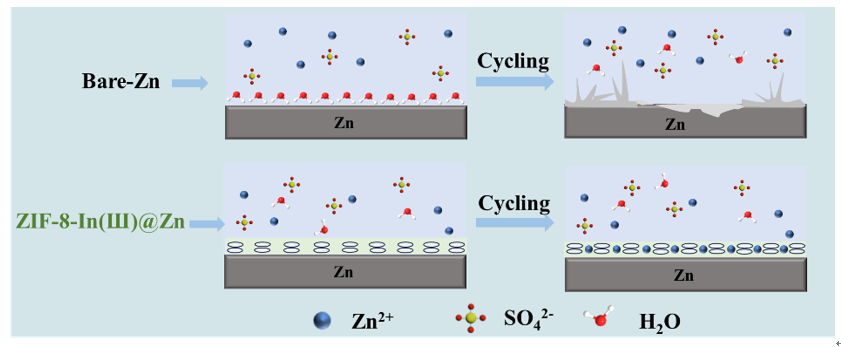
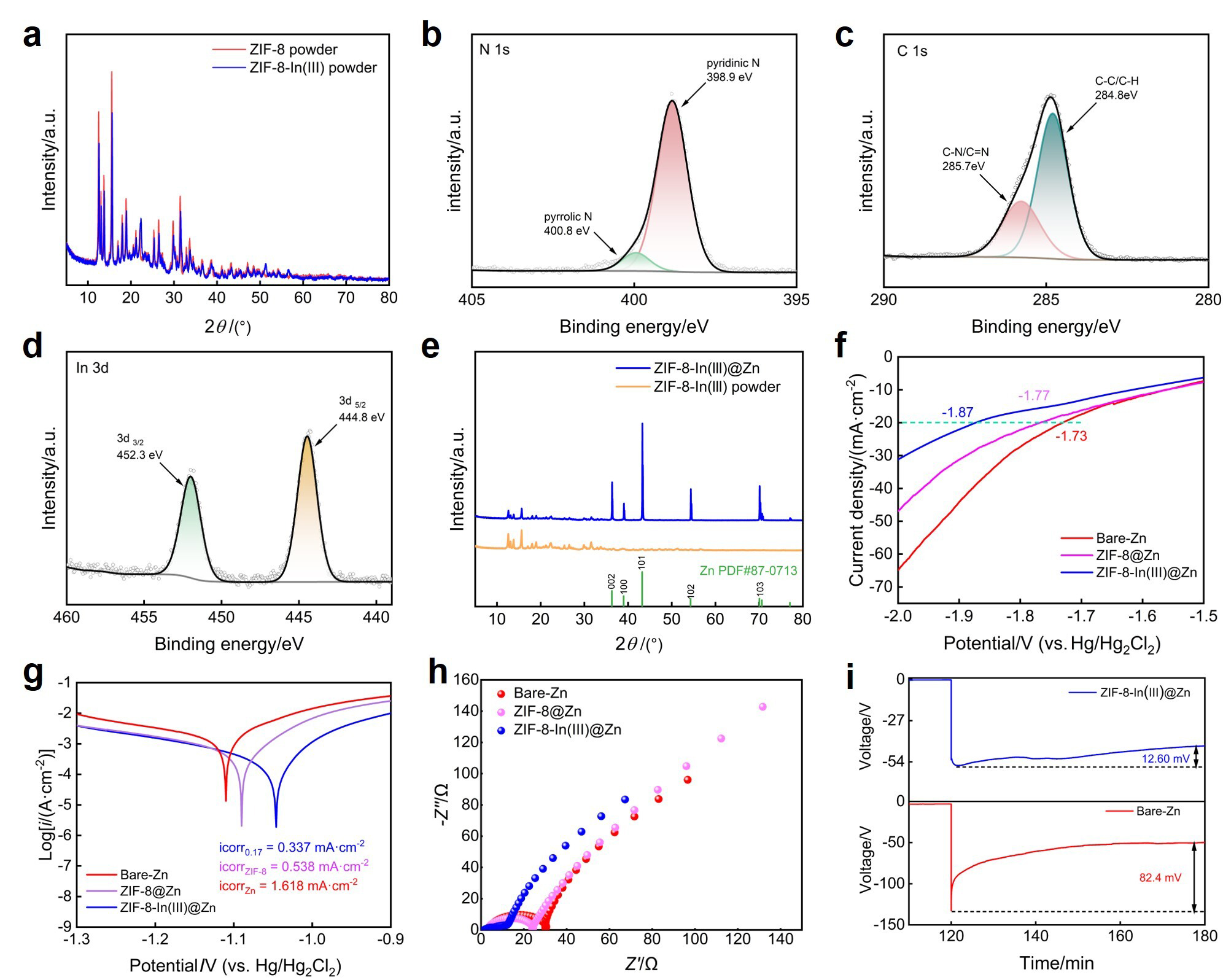
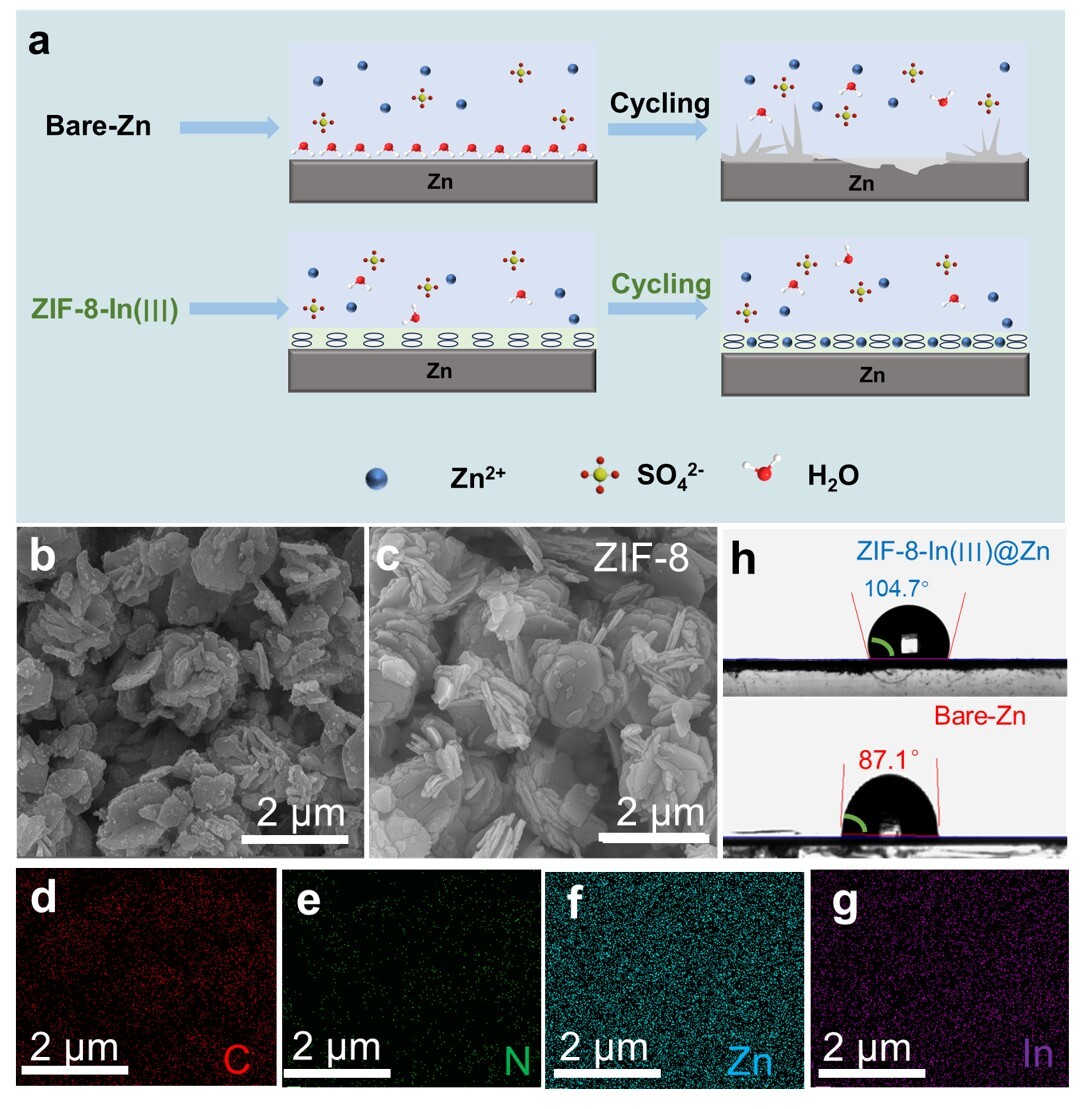
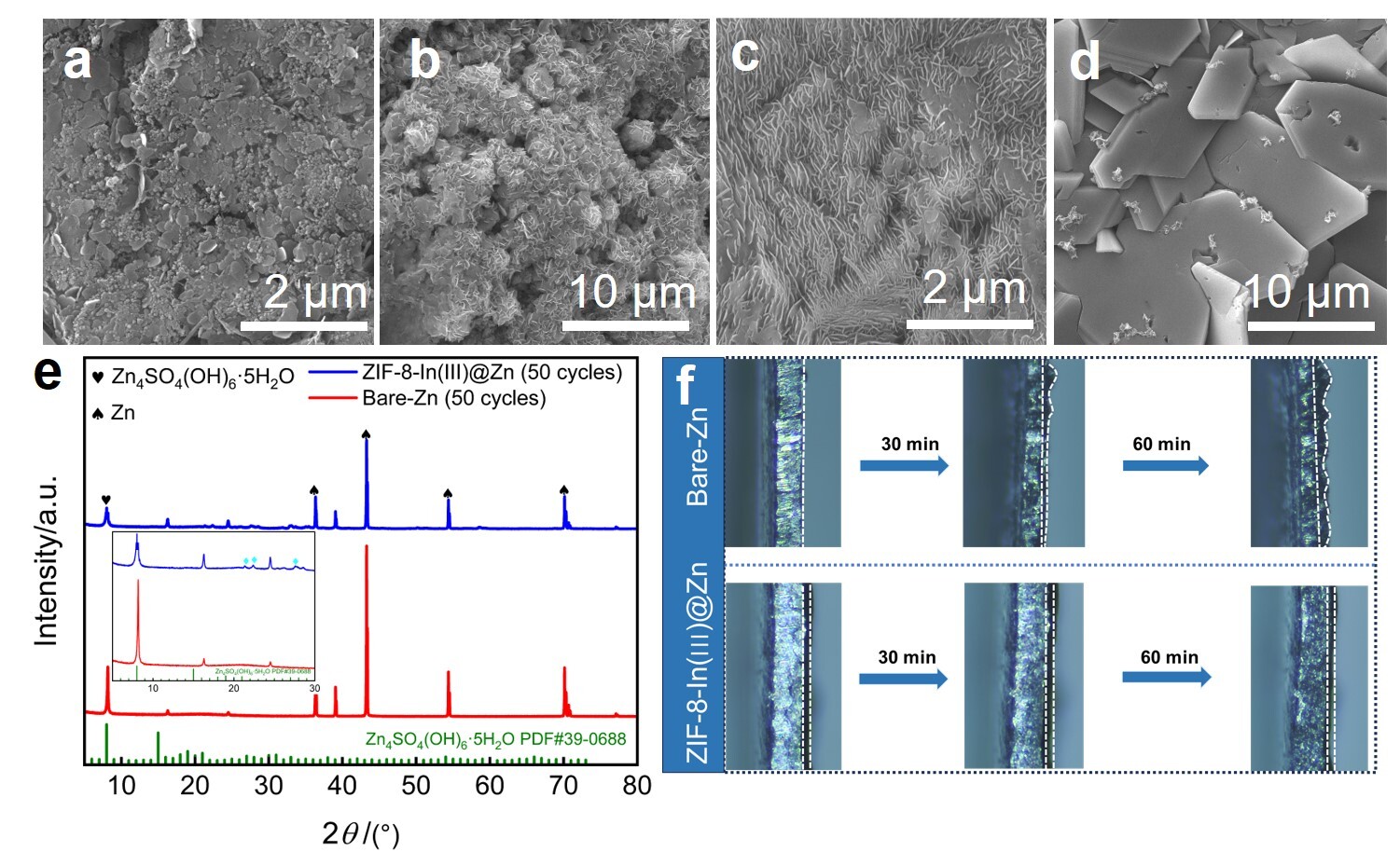
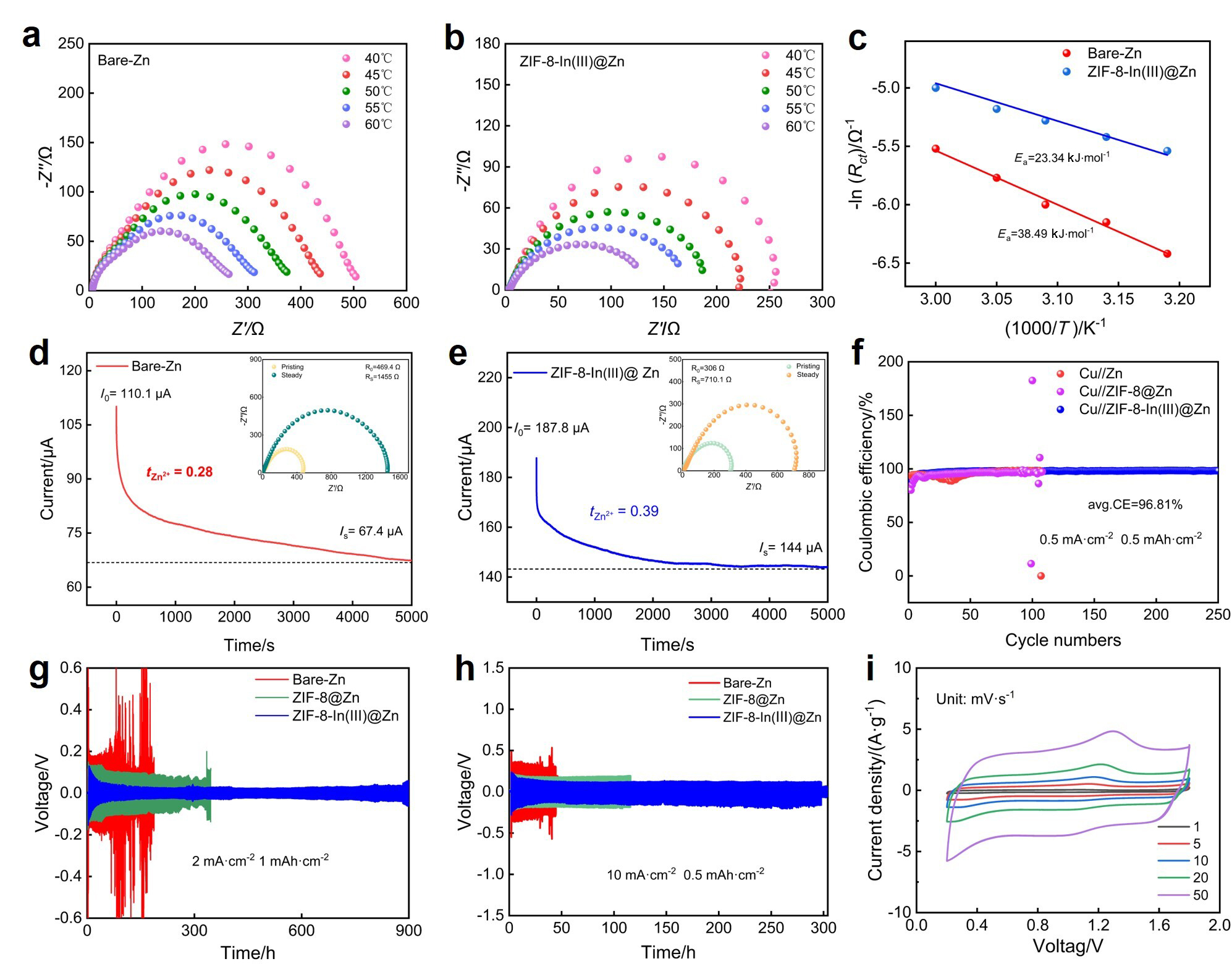
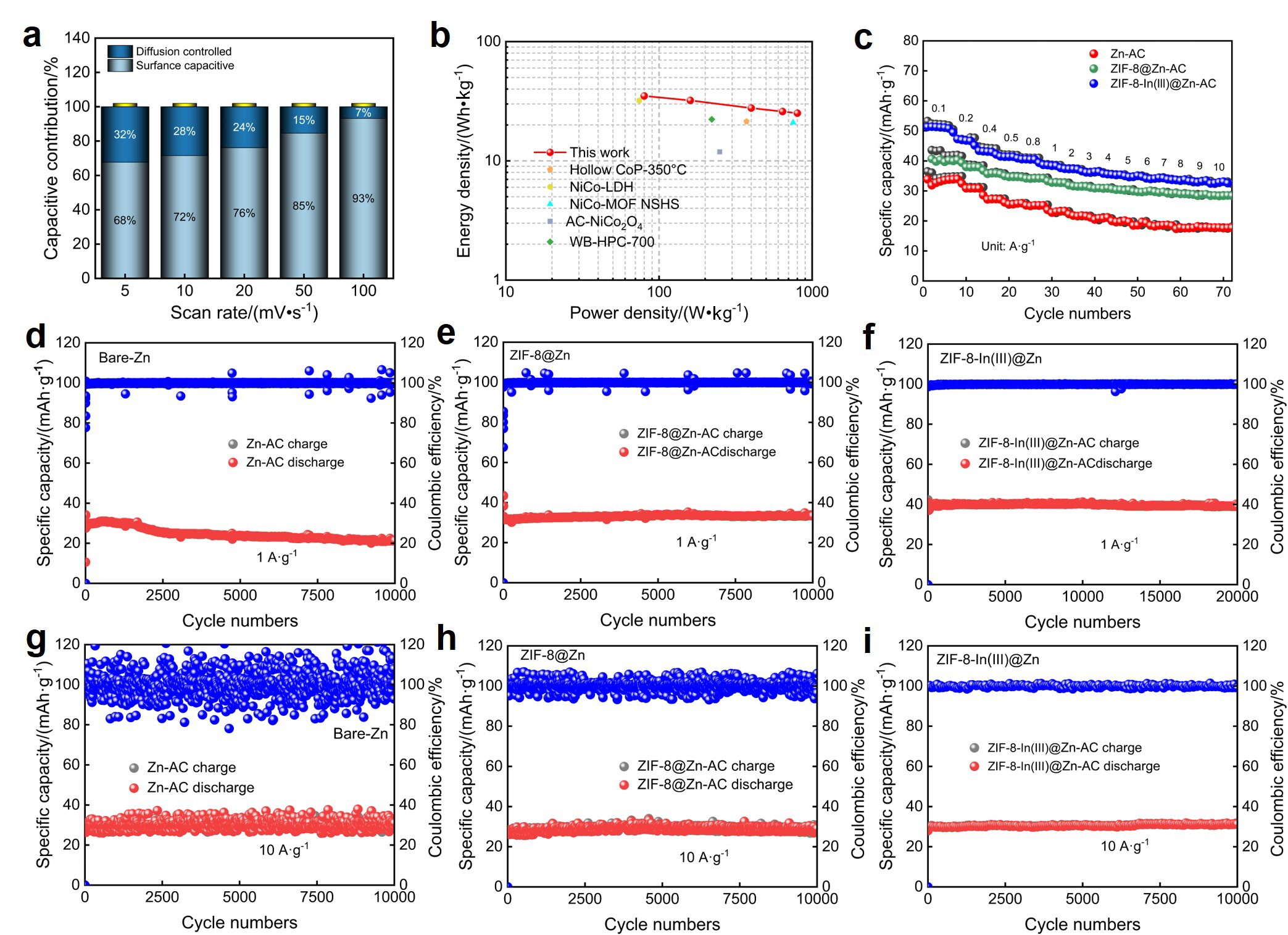
水系锌离子混合电容器具备超级电容器与电池的双重优势, 展现出高功率密度、低成本以及高安全性能, 成为极具开发潜力的储能器件之一. 但水系锌离子混合电容器仍面临一系列挑战, 尤其是锌负极的问题, 包括枝晶生长、腐蚀以及析氢反应. 鉴于金属有机框架(MOF)材料高孔隙率、高导电性的特性, 其被广泛用于锌负极改性. 本研究以MOF典型材料ZIF-8为基底, 合成过程中掺杂铟离子构建ZIF-8-In(III)人工界面保护层: ZIF-8的三维规整孔道可定向引导Zn2+迁移, In3+则调节孔道表面电荷增强正电性, 避免Zn2+团聚. 电化学测量和原位光学图像显示, ZIF-8-In(III)界面促进了锌离子均匀沉积, 同时有助于锌负极的防腐. 并且与ZIF-8@Zn和裸锌相比, 通过组装扣式电池, 对称的ZIF-8-In(III)@Zn涂层改性的锌电极电池表现出极低的极化电压, 并在2 mA•cm−2达到900 h的工作时间, 同时组装成锌离子电容器, 在1 A•g−1比容量约达到39.05 mAh•g−1, 可获得20000次的长循环寿命, 容量保持率接近100%.
马洪芳, 邓玉雪, 周平凡, 黄鹏, 吴岭, 曲会鑫, 李金焕, 申来法, 张校刚, 佟浩. 铟离子掺杂ZIF-8涂层修饰锌电极实现锌离子混合电容器长循环寿命[J]. 化学学报, 2026, 84(6): 840-848.
Hongfang Ma, Yuxue Deng, Pingfan Zhou, Peng Huang, Ling Wu, Huixin Qu, Jinhuan Li, Laifa Shen, Xiaogang Zhang, Hao Tong. Indium-Ion-Doped ZIF-8 Coating Modified Zinc Electrode for Long Cycle Life of Zinc-Ion Hybrid Capacitors[J]. Acta Chimica Sinica, 2026, 84(6): 840-848.
| [1] |
doi: 10.6023/A22100413 |
|
(姬慧敏, 谢春霖, 张旗, 李熠鑫, 李欢欢, 王海燕, 化学学报, 2023, 81, 29.)
doi: 10.6023/A22100413 |
|
| [2] |
doi: 10.6023/A20090409 |
|
(张璐, 王文凤, 张洪明, 韩树民, 王利民, 化学学报, 2021, 79, 158.)
doi: 10.6023/A20090409 |
|
| [3] |
doi: 10.3390/membranes14120277 |
| [4] |
doi: 10.1002/smtd.v8.12 |
| [5] |
doi: 10.1002/adma.v36.32 |
| [6] |
doi: 10.1002/adma.v37.45 |
| [7] |
doi: 10.1002/celc.v7.14 |
| [8] |
doi: 10.1039/D3TA01943H |
| [9] |
doi: 10.1002/cey2.v4.6 |
| [10] |
|
| [11] |
doi: 10.1021/acsami.4c01028 |
| [12] |
|
| [13] |
doi: 10.1016/j.ssi.2025.116790 |
| [14] |
doi: 10.6023/A24120389 |
|
(李奔, 赵宇, 高欣, 孙雨涵, 赵宝雁, 罗巧梅, 樊小勇, 化学学报, 2025, 83, 237.)
doi: 10.6023/A24120389 |
|
| [15] |
doi: 10.1002/aenm.v15.30 |
| [16] |
doi: 10.6023/A24010006 |
|
(郝再涛, 赵健飞, 李慧同, 李展, 潘朗, 李江, 化学学报, 2024, 82, 416.)
doi: 10.6023/A24010006 |
|
| [17] |
doi: 10.1016/j.jcis.2024.03.126 |
| [18] |
doi: 10.6023/A25120395 |
|
(周平凡, 邓玉雪, 黄鹏, 马洪芳, 吴岭, 曲会鑫, 申来法, 许真铭, 张校刚, 佟浩, 化学学报, 2026, 84, 324.)
doi: 10.6023/A25120395 |
|
| [19] |
doi: 10.1002/batt.v7.12 |
| [20] |
doi: 10.1016/j.matlet.2025.138182 |
| [21] |
doi: 10.1021/acs.langmuir.4c01037 |
| [22] |
doi: 10.1016/j.nanoen.2022.107269 |
| [23] |
|
| [24] |
doi: 10.1016/j.ijoes.2025.101023 |
| [25] |
doi: 10.1021/acs.accounts.5c00226 |
| [26] |
|
| [27] |
doi: 10.1016/j.electacta.2025.146423 |
| [28] |
doi: 10.1016/j.jpowsour.2025.238084 |
| [29] |
doi: 10.1016/j.jcis.2022.01.072 |
| [30] |
doi: 10.1016/j.scib.2020.06.020 |
| [31] |
doi: 10.1016/j.jhazmat.2024.134150 |
| [32] |
doi: 10.1038/s41467-020-17757-6 |
| [33] |
doi: 10.1016/j.cej.2024.150465 |
| [34] |
|
| [35] |
doi: 10.1021/acsanm.3c04104 |
| [36] |
doi: 10.1016/j.electacta.2013.05.114 |
| [37] |
doi: 10.1021/acs.inorgchem.8b01524 |
| [38] |
doi: 10.1021/acsnano.9b02106 |
| [39] |
doi: 10.1039/C7DT04942K |
| [40] |
doi: 10.1021/acssuschemeng.8b03763 |
| [1] | 汪佳艳, 郭焕焕, 殷逍遥, 张昀照, 王威, 赵晨瑞, 陈洁, 文洁, 孙伟海. 四乙基氢氧化铵界面修饰制备高效甲脒溴化铅钙钛矿太阳能电池[J]. 化学学报, 2026, 84(2): 231-239. |
| [2] | 高林, 江东彬, 徐源, 姚青, 刘冯立, 孙伟海, 杜振波, 孙留学, 吴季怀, 兰章. 界面修饰和偶极子实现高效碳基CsPbI2Br钙钛矿太阳能电池[J]. 化学学报, 2026, 84(2): 223-230. |
| [3] | 薛兰, 刘爽, 章硕, 伽龙. Ni2+掺杂改性对LiMn0.75Fe0.25PO4正极材料电化学性能的影响[J]. 化学学报, 2025, 83(8): 853-860. |
| [4] | 梁世硕, 康树森, 杨东, 胡建华. 锂金属负极界面修饰及其在硫化物全固态电池中的应用[J]. 化学学报, 2022, 80(9): 1264-1268. |
| [5] | 戴敏, 雷钢铁, 张钊, 李智, 曹湖军, 陈萍. 五氧化二钒促进MgH2/Mg室温吸氢※[J]. 化学学报, 2022, 80(3): 303-309. |
| [6] | 郭镇域, 周欢萍. 钙钛矿组分和结构设计及其发光二极管器件性能研究进展[J]. 化学学报, 2021, 79(3): 223-237. |
| [7] | 张静, 汤功奥, 曾誉, 王保兴, 刘力玮, 吴强, 杨立军, 王喜章, 胡征. 可溶性氧化-还原介质促进分级结构碳纳米笼的锂氧电池性能[J]. 化学学报, 2020, 78(6): 572-576. |
| [8] | 杨英, 林飞宇, 朱从潭, 陈甜, 马书鹏, 罗媛, 朱刘, 郭学益. 无机钙钛矿太阳能电池稳定性研究进展[J]. 化学学报, 2020, 78(3): 217-231. |
| [9] | 王啸, 李有彬, 杜玲玉, 高福杰, 吴强, 杨立军, 陈强, 王喜章, 胡征. 石墨烯包覆的硫填充碳纳米笼自支撑整体材料的制备及其锂硫电池性能研究[J]. 化学学报, 2018, 76(8): 627-632. |
| [10] | 裴娟, 郝彦忠, 吕海军, 孙宝, 李英品, 王尚鑫. 异质结界面修饰对TiO2/P3HT杂化太阳电池光电性能的增强作用[J]. 化学学报, 2014, 72(12): 1245-1250. |
| [11] | 陆霞, 吴仁香, 李波波, 朱云峰, 李李泉. 用于聚合物镍氢电池的新型PVA/SiO2碱性微孔聚合物电解质[J]. 化学学报, 2013, 71(03): 427-432. |
| [12] | 刘素琴,陈东洋,黄可龙,仲晓铃. MgNi-x% TiNi0.5Mn0.5 (x=10, 30, 50)贮氢合金的制备与电化学性能[J]. 化学学报, 2009, 67(6): 513-518. |
| [13] | 王新智, 李智, 王小芳, 董发昕, 王惠. 铁粉为原料催化改性铁氧化物的储氢性能[J]. 化学学报, 2008, 66(4): 437-442. |
| [14] | 王小芳, 王惠, 田勇, 董发昕, 史启祯, 文振翼. 一种新型储氢材料——改性四氧化三铁的储氢性能研究[J]. 化学学报, 2007, 65(7): 601-606. |
| [15] | 冯艳,焦丽芳,袁华堂,王一菁,刘强,刘毅. Mg0.9Ti0.1Ni1-xCox (x=0.05, 0.1, 0.15, 0.2)合金的合成及电化学性能研究[J]. 化学学报, 2006, 64(5): 423-427. |
| 阅读次数 | ||||||
|
全文 |
|
|||||
|
摘要 |
|
|||||
