

化学学报 ›› 2026, Vol. 84 ›› Issue (7): 1040-1048.DOI: 10.6023/A26030070 上一篇 下一篇
研究论文
陶骏飞, 许世攀, 杜旭洋, 尹赫, 闫安, 杭怀腾, 陈亮, 周桂江*( ), 孙源慧*(), 杨晓龙*()
投稿日期:2026-03-08
发布日期:2026-04-29
基金资助:
Junfei Tao, Shipan Xu, Xuyang Du, He Yin, An Yan, Huaiteng Hang, Liang Chen, Guijiang Zhou*(), Yuanhui Sun*(), Xiaolong Yang*()
Received:2026-03-08
Published:2026-04-29
Contact:
* E-mail: zhougj@xjtu.edu.cn;
sunyuanhui@xjtu.edu.cn;
xiaolongyang@xjtu.edu.cn
Supported by:文章分享
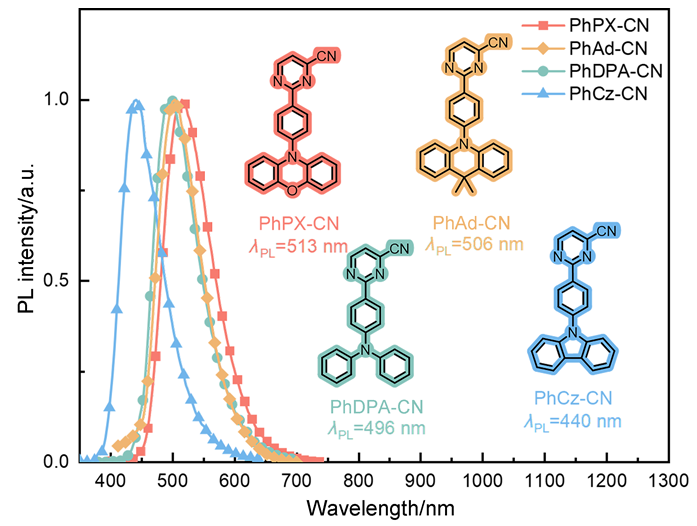
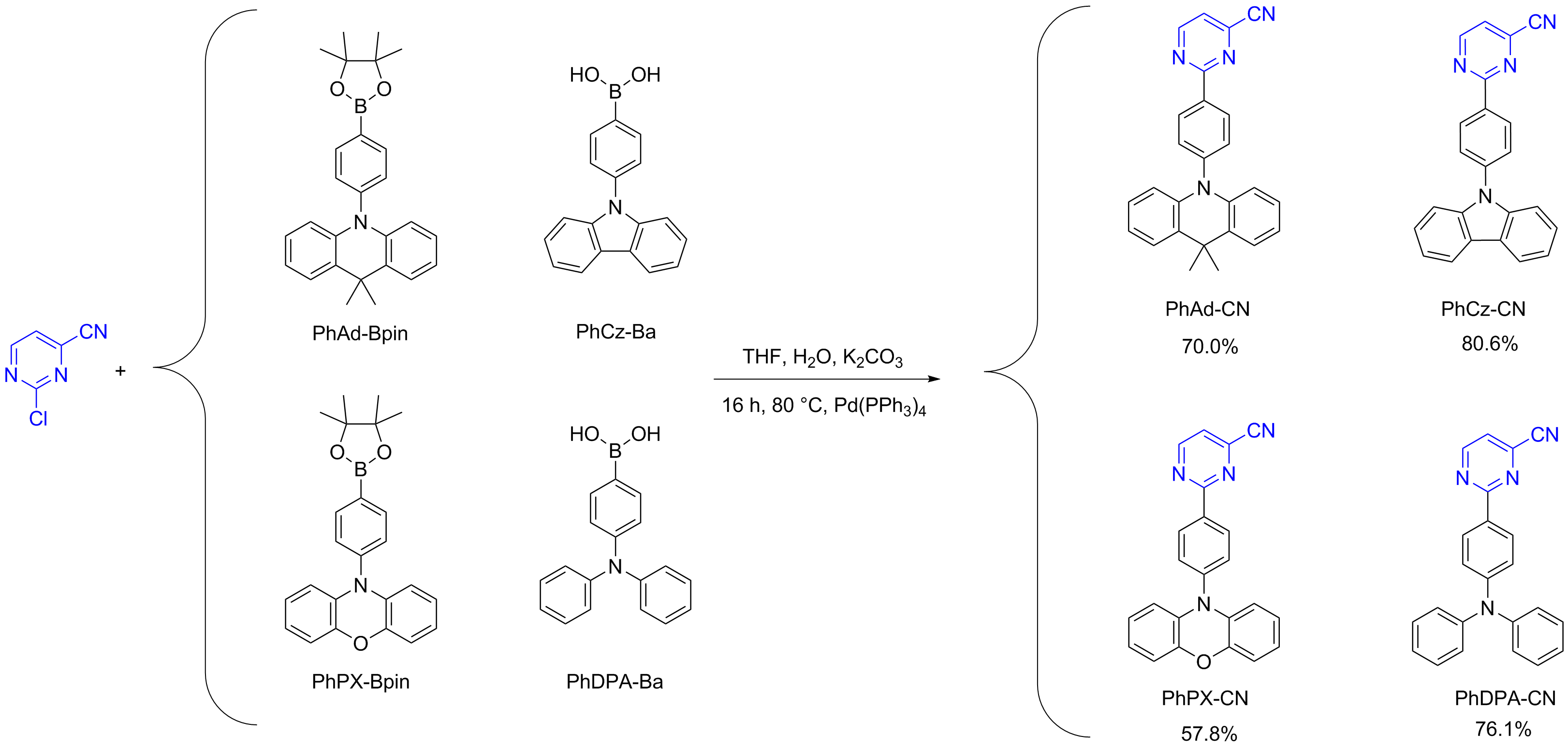
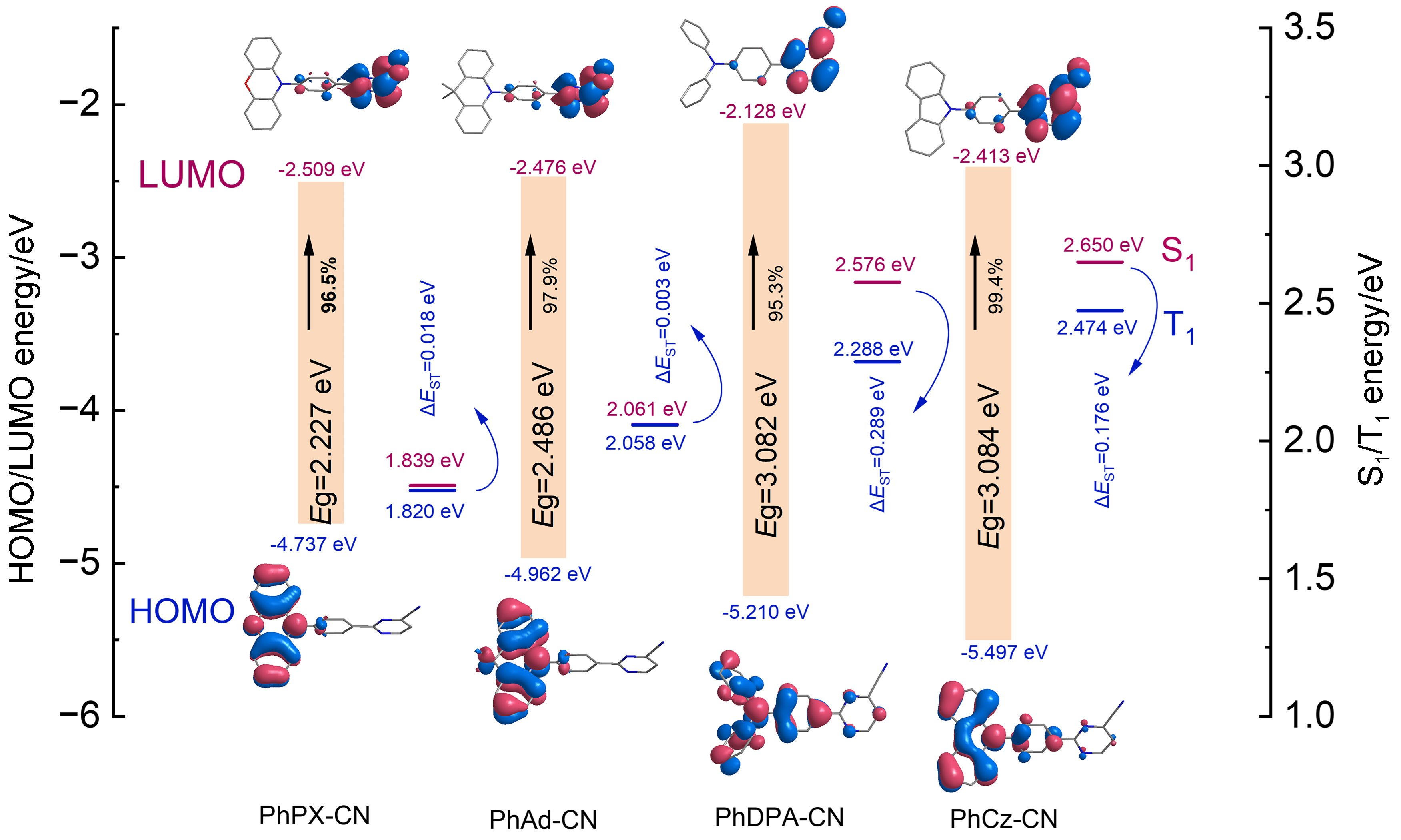
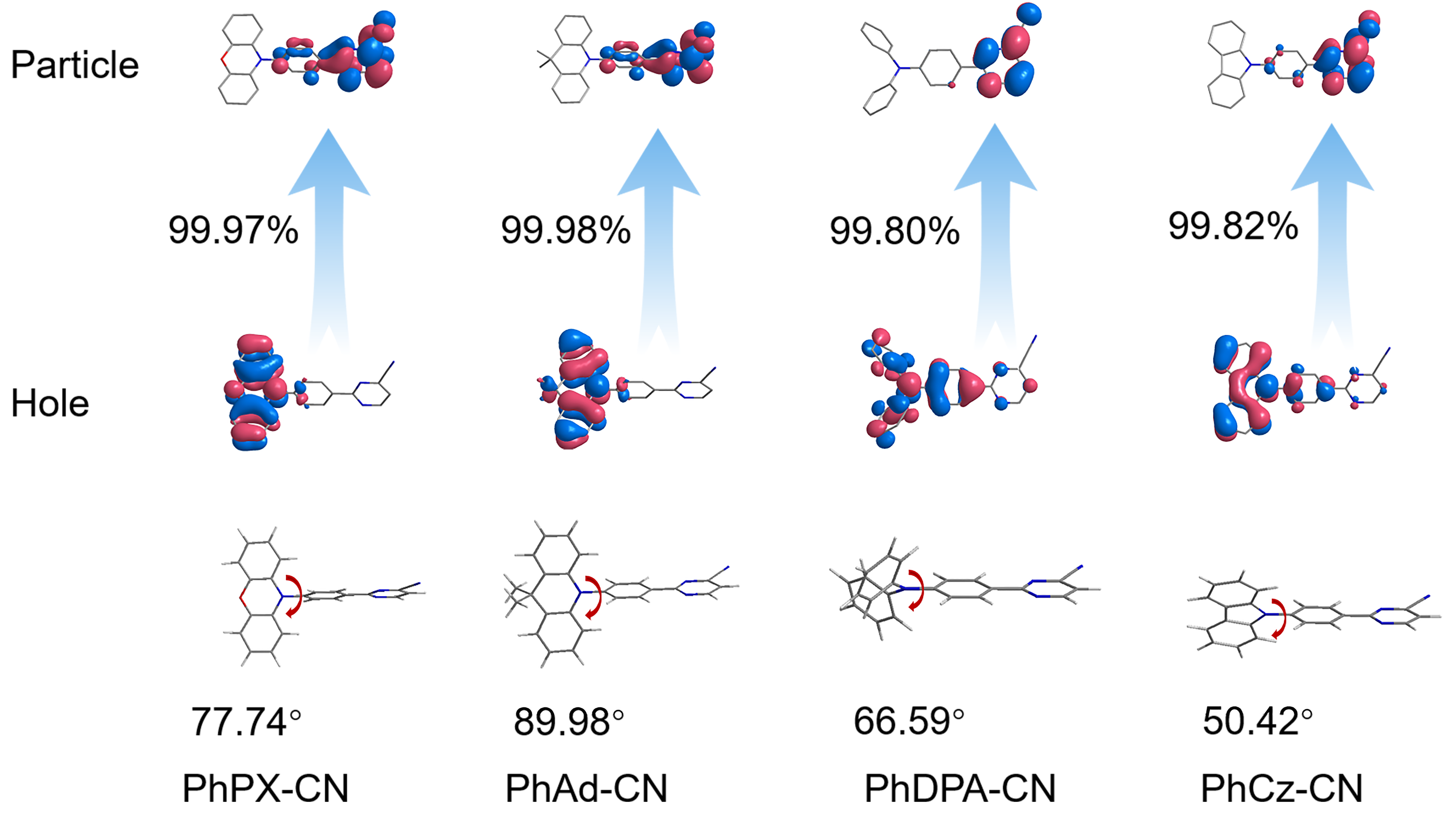
热活化延迟荧光(TADF)材料因其成本低廉和高内量子效率(IQE)在有机发光二极管(OLED)领域有巨大的应用前景. 本工作以4-氰基嘧啶为受体, 吩噁嗪、吖啶、二苯胺和咔唑为给体, 将给体和受体通过苯环桥连设计合成了4种给体-受体(D-A)型热活化延迟荧光材料PhPX-CN、PhAd-CN、PhDPA-CN和PhCz-CN, 制备了4种D-A型分子均有扭曲的结构. 最高占据分子轨道(HOMO)和最低未占分子轨道(LUMO)分别位于给体和受体分子上, 实现了HOMO与LUMO空间上的分离, 4种分子展现出较小的单线态与三线态的能极差(ΔEST<0.3 eV)和明显的TADF性质. 同时, 通过改变给体的给电子能力实现了对ΔEST的调控. 以PhDPA-CN为客体材料制备的绿色OLED器件的最大外量子效率(EQE)为6.85%, 以PhCz-CN为客体材料制备的蓝光OLED器件的最大EQE为3.04%.
陶骏飞, 许世攀, 杜旭洋, 尹赫, 闫安, 杭怀腾, 陈亮, 周桂江, 孙源慧, 杨晓龙. 基于4-氰基嘧啶受体的热活化延迟荧光材料合成及其电致发光性能研究[J]. 化学学报, 2026, 84(7): 1040-1048.
Junfei Tao, Shipan Xu, Xuyang Du, He Yin, An Yan, Huaiteng Hang, Liang Chen, Guijiang Zhou, Yuanhui Sun, Xiaolong Yang. Synthesis and Electroluminescence Performance of Thermally Activated Delayed Fluorescence Materials Based on 4-Cyanopyrimidine Acceptor[J]. Acta Chimica Sinica, 2026, 84(7): 1040-1048.

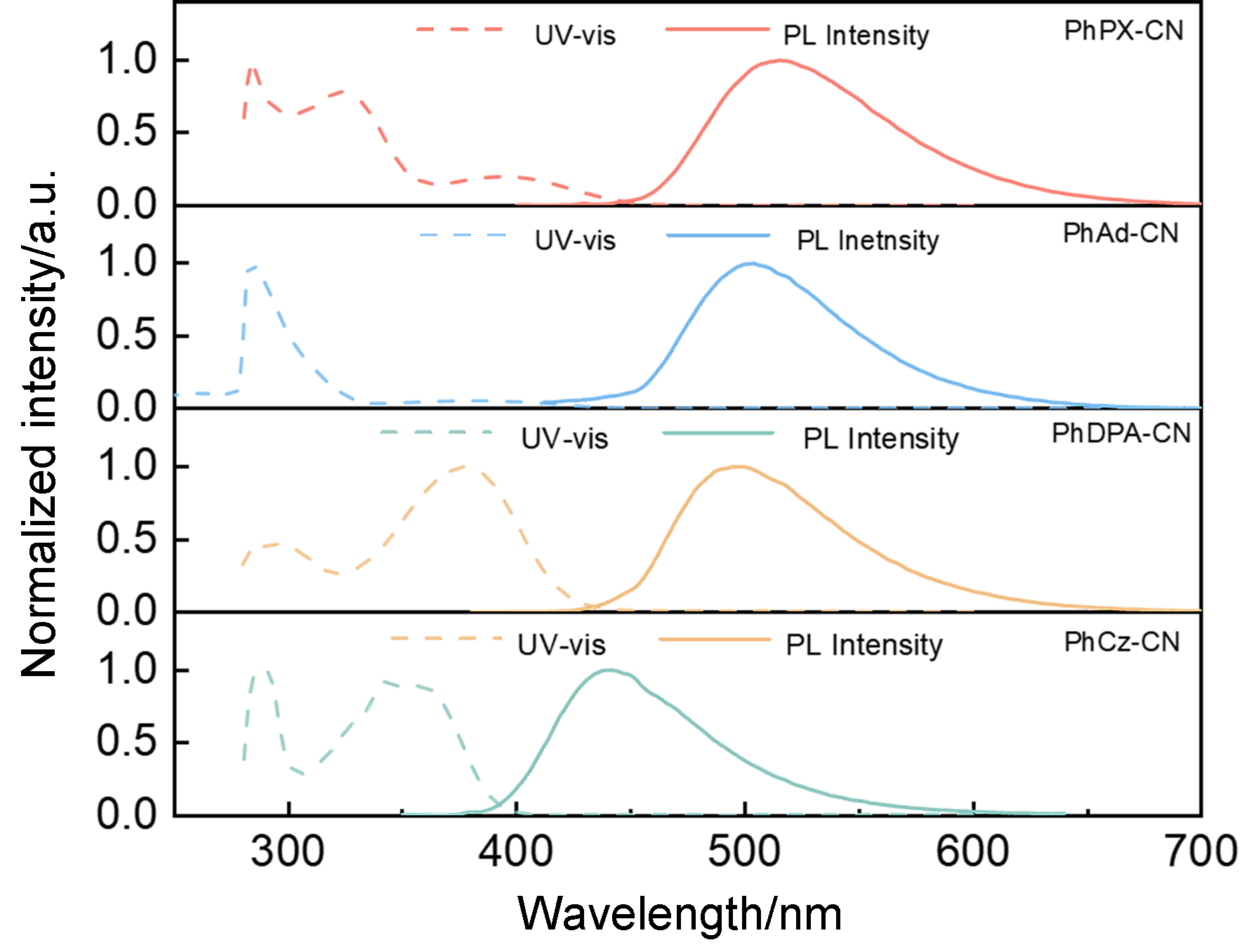
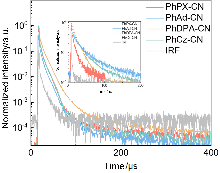
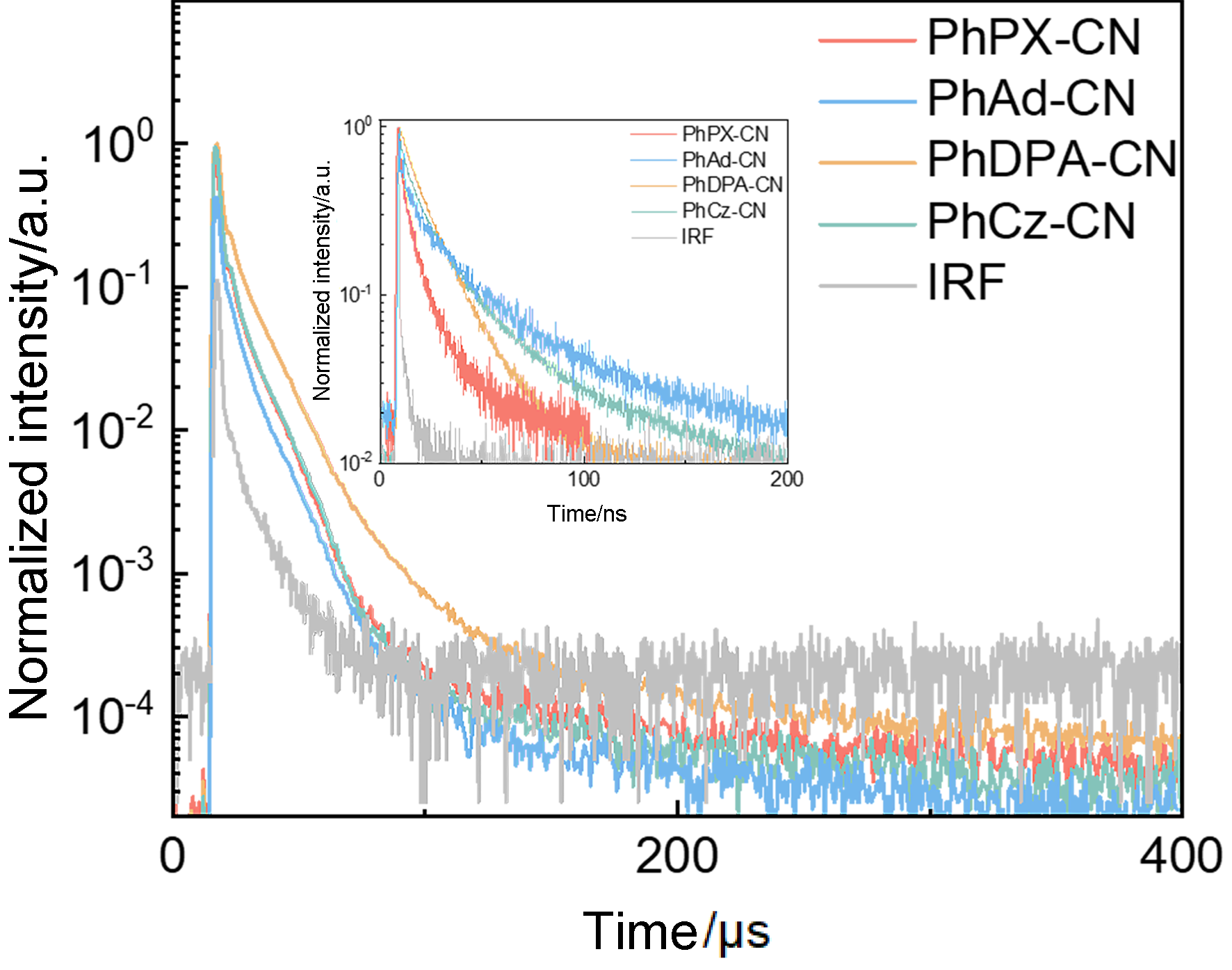
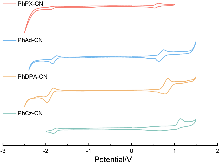
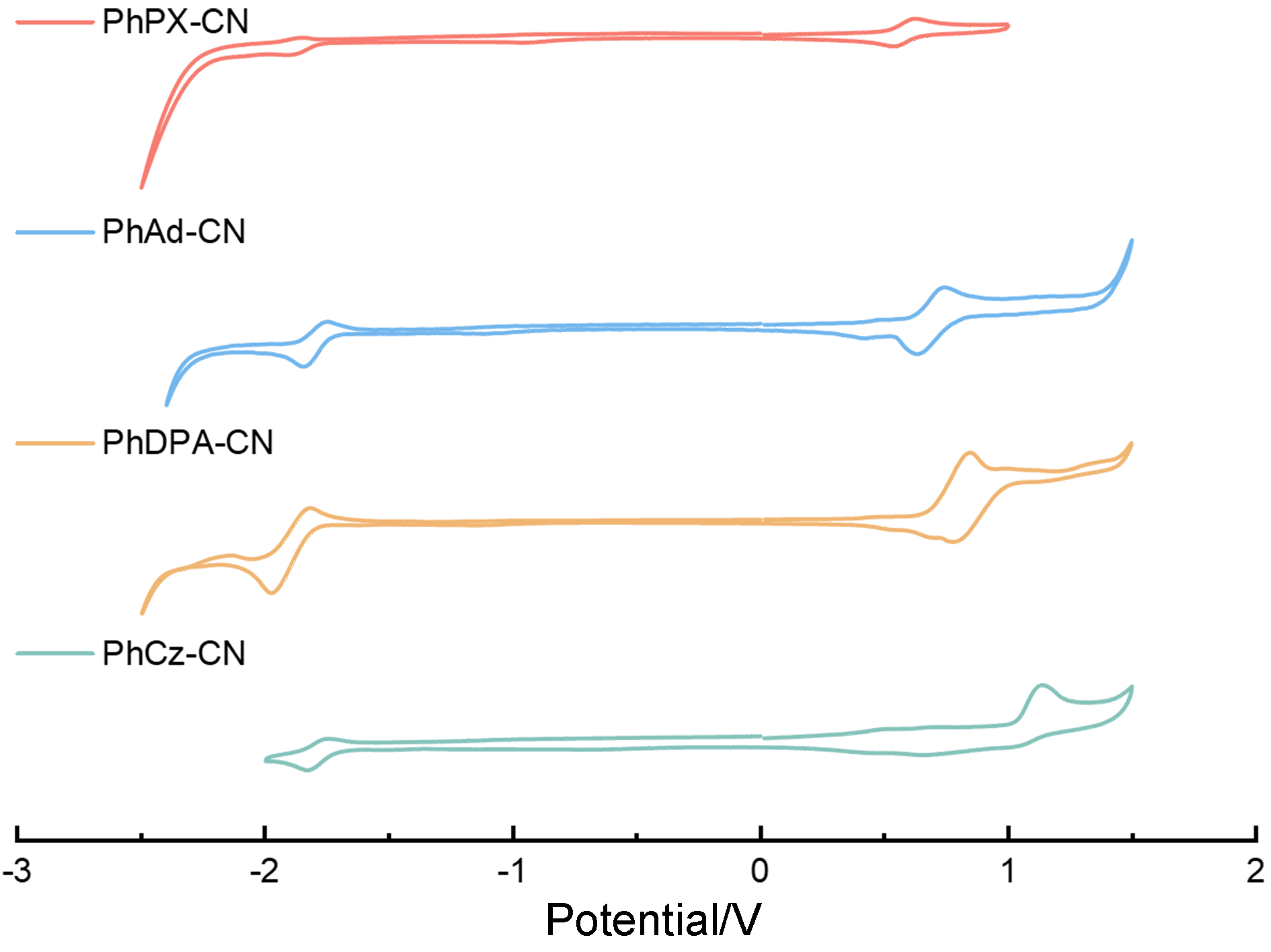
| Compound | λabs a/nm | λPL solution b/film c (nm) | FWHM solution b/film c (nm) | τPF d/τDF e (ns/μs) | EHOMO f/ELUMO g (eV) | Eg h/eV | PLQY i/% |
|---|---|---|---|---|---|---|---|
| PhPX-CN | 284, 324, 396 | 513/518 | 89/91 | 8.11/9.50 | -5.22/-2.98 | 2.24 | 67 |
| PhAd-CN | 385 | 502/522 | 80/90 | 29.52/9.11 | -5.05/-2.78 | 2.28 | 52 |
| PhDPA-CN | 294, 376 | 496/510 | 83/85 | 14.01/10.95 | -5.30/-2.97 | 2.33 | 59 |
| PhCz-CN | 288, 356 | 440/470 | 75/94 | 19.74/9.60 | -5.66/-2.98 | 2.68 | 45 |
| Compound | λabs a/nm | λPL solution b/film c (nm) | FWHM solution b/film c (nm) | τPF d/τDF e (ns/μs) | EHOMO f/ELUMO g (eV) | Eg h/eV | PLQY i/% |
|---|---|---|---|---|---|---|---|
| PhPX-CN | 284, 324, 396 | 513/518 | 89/91 | 8.11/9.50 | -5.22/-2.98 | 2.24 | 67 |
| PhAd-CN | 385 | 502/522 | 80/90 | 29.52/9.11 | -5.05/-2.78 | 2.28 | 52 |
| PhDPA-CN | 294, 376 | 496/510 | 83/85 | 14.01/10.95 | -5.30/-2.97 | 2.33 | 59 |
| PhCz-CN | 288, 356 | 440/470 | 75/94 | 19.74/9.60 | -5.66/-2.98 | 2.68 | 45 |
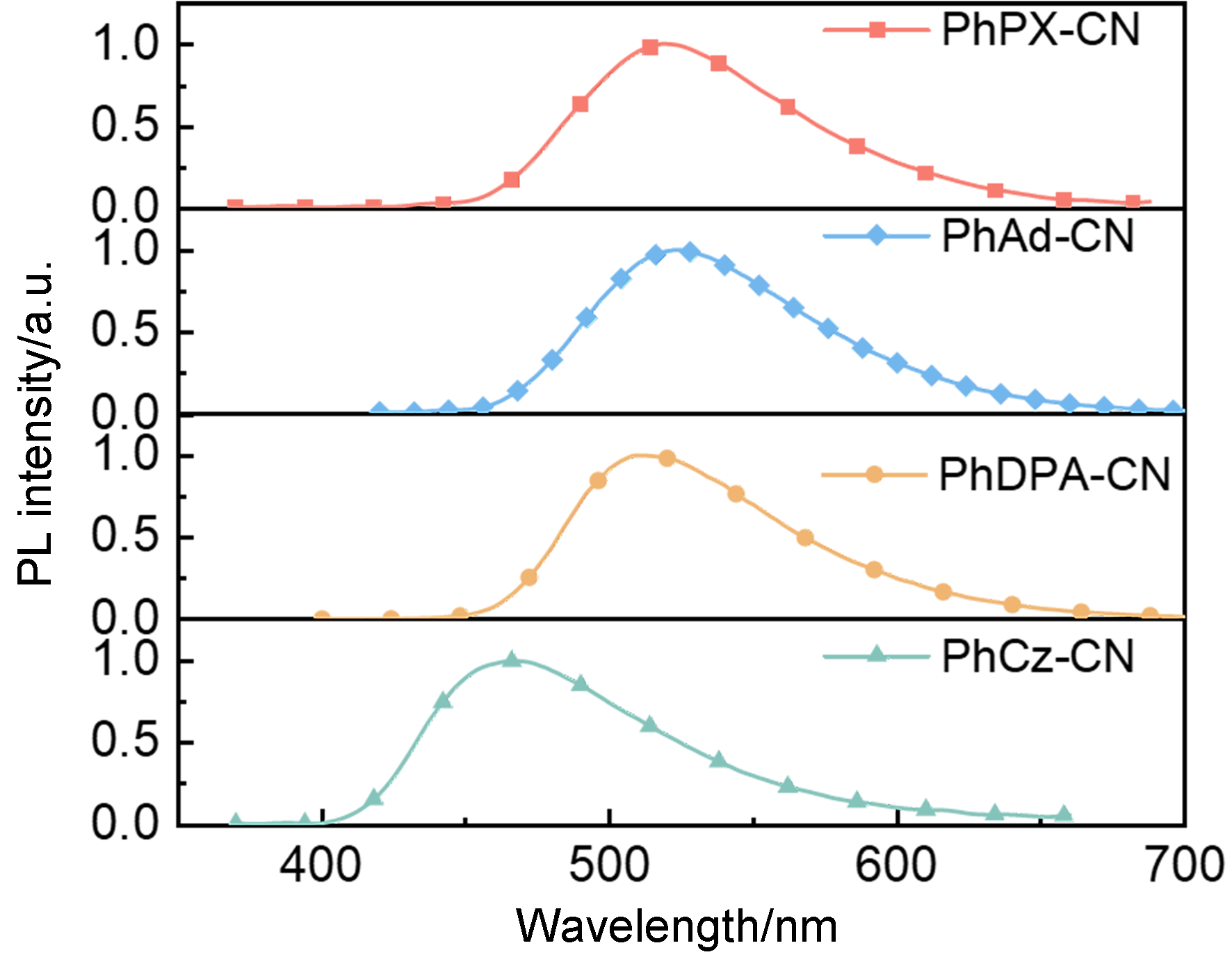
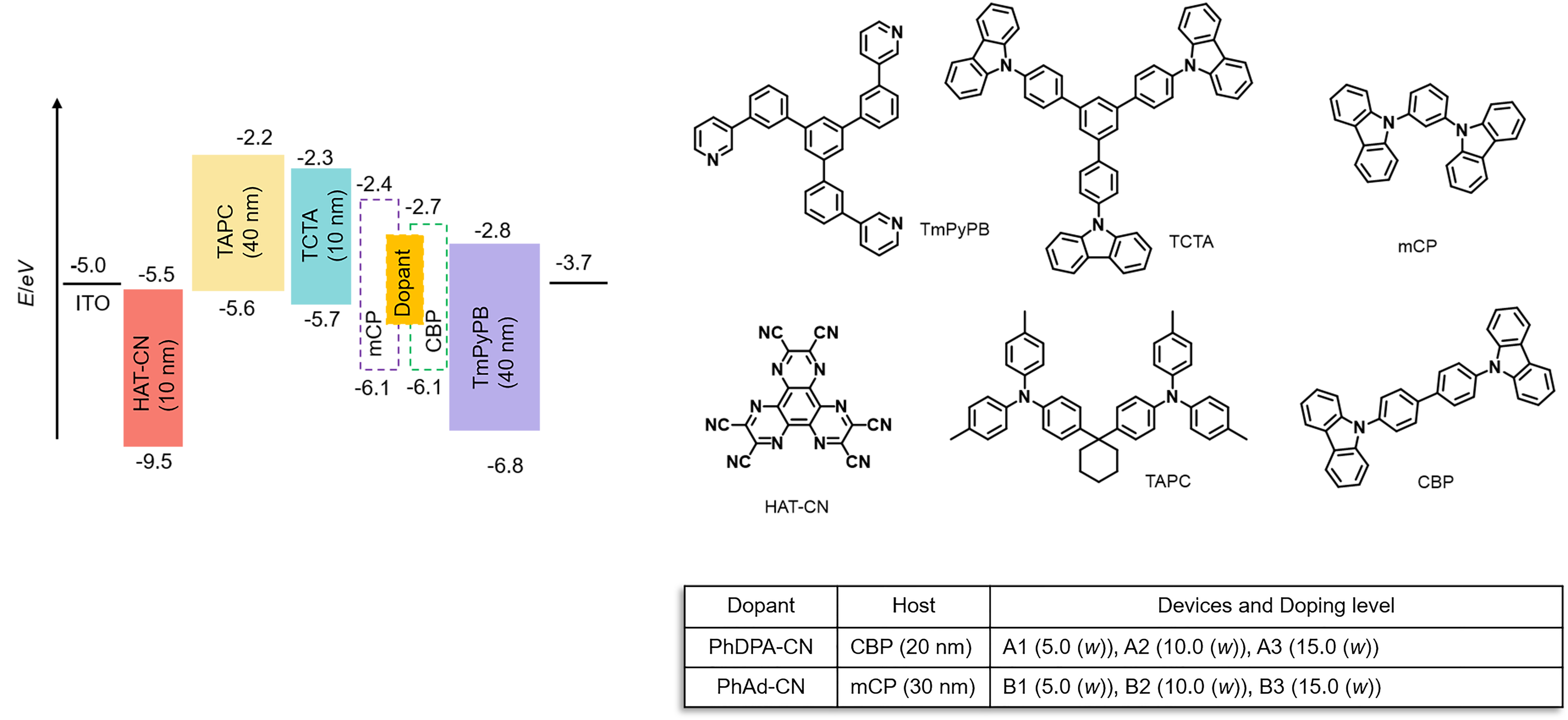
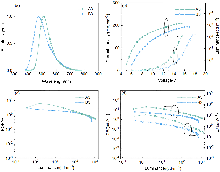

| Device | Vona/V | Lmax b/ (cd•m−2) | EQEmax c/% | CEmax d/ (cd•A−1) | PEmax e/ (lm•W−1) | λEL f/ nm | FWHM/nm |
|---|---|---|---|---|---|---|---|
| A1 | 5.5 | 1106 | 6.52 | 18.03 | 9.44 | 500 | 84 |
| A2 | 5.0 | 1253 | 6.85 | 19.85 | 11.34 | 508 | 86 |
| A3 | 5.0 | 1503 | 6.83 | 20.13 | 11.50 | 512 | 87 |
| B1 | 7.0 | 340 | 1.14 | 1.32 | 0.59 | 464 | 96 |
| B2 | 6.0 | 426 | 1.72 | 2.11 | 1.11 | 468 | 85 |
| B3 | 6.0 | 712 | 3.04 | 6.26 | 3.27 | 476 | 112 |
| Device | Vona/V | Lmax b/ (cd•m−2) | EQEmax c/% | CEmax d/ (cd•A−1) | PEmax e/ (lm•W−1) | λEL f/ nm | FWHM/nm |
|---|---|---|---|---|---|---|---|
| A1 | 5.5 | 1106 | 6.52 | 18.03 | 9.44 | 500 | 84 |
| A2 | 5.0 | 1253 | 6.85 | 19.85 | 11.34 | 508 | 86 |
| A3 | 5.0 | 1503 | 6.83 | 20.13 | 11.50 | 512 | 87 |
| B1 | 7.0 | 340 | 1.14 | 1.32 | 0.59 | 464 | 96 |
| B2 | 6.0 | 426 | 1.72 | 2.11 | 1.11 | 468 | 85 |
| B3 | 6.0 | 712 | 3.04 | 6.26 | 3.27 | 476 | 112 |
| [1] |
doi: 10.1021/acs.chemrev.3c00761 |
| [2] |
doi: 10.1002/adfm.v29.15 |
| [3] |
doi: 10.1021/acs.chemrev.0c00936 |
| [4] |
doi: 10.1038/s41467-025-55954-3 |
| [5] |
doi: 10.1002/anie.v62.19 |
| [6] |
|
|
(张泽华, 于海涛, 祁彦宇, 物理化学学报, 2025, 41, 2309042.)
|
|
| [7] |
doi: 10.6023/A23040153 |
|
(王银凤, 李猛, 陈传峰, 化学学报, 2023, 81, 588.)
doi: 10.6023/A23040153 |
|
| [8] |
doi: 10.6023/A24100310 |
|
(马金珠, 李阳, 高珊, 赵越, 丁磊, 周东营, 樊健, 化学学报, 2025, 83, 471.)
|
|
| [9] |
|
|
(檀康明, 闫敏楠, 王英男, 解令海, 钱妍, 张宏梅, 黄维, 物理化学学报, 2017, 33, 1057.)
|
|
| [10] |
|
|
(薛楷, 闫敏楠, 潘飞, 田梦颖, 潘旭东, 张宏梅, 物理化学学报, 2019, 35, 896.)
|
|
| [11] |
doi: 10.6023/cjoc202212037 |
|
(张祎, 杜呈卓, 李继坤, 王小野, 有机化学, 2023, 43, 1645.)
doi: 10.6023/cjoc202212037 |
|
| [12] |
doi: 10.1016/j.cej.2024.158284 |
| [13] |
doi: 10.1002/adma.v36.25 |
| [14] |
doi: 10.1016/j.cej.2022.137457 |
| [15] |
doi: 10.1016/j.cej.2022.137432 |
| [16] |
doi: 10.1002/adma.v36.45 |
| [17] |
doi: 10.1038/s41586-023-06976-8 |
| [18] |
doi: 10.1038/nature11687 |
| [19] |
doi: 10.1039/D1CS00198A |
| [20] |
doi: 10.1002/anie.v61.47 |
| [21] |
doi: 10.1002/adma.v34.3 |
| [22] |
doi: 10.1038/s41563-021-01132-x |
| [23] |
doi: 10.1002/adma.v34.1 |
| [24] |
doi: 10.1002/anie.v61.30 |
| [25] |
doi: 10.1002/adfm.v29.4 |
| [26] |
doi: 10.1021/acs.jpcc.7b06299 |
| [27] |
doi: 10.1002/adma.v36.50 |
| [28] |
doi: 10.1021/acs.chemrev.3c00755 |
| [29] |
doi: 10.1002/adma.v33.44 |
| [30] |
doi: 10.1021/acsami.2c12778 |
| [1] | 汪庆辉, 任正, 张凯, 周东营, 樊健. 基于3,6-二苯硒基咔唑的多重共振热活化延迟荧光分子[J]. 化学学报, 2026, 84(2): 248-256. |
| [2] | 闫生荣, 刘文浩, 段芳, 陈明清, 东为富, 陆双龙, 杜明亮. 基于sp2-碳连接具有D-A结构共价有机框架的构筑及其光催化产双氧水性能研究[J]. 化学学报, 2025, 83(7): 685-693. |
| [3] | 方素琴, 童恺宁, 陈思浛, 张千峰, 童碧海, 冯敏强, 孔辉. 基于呫吨酮电子受体的高效圆偏振热活化延迟荧光材料[J]. 化学学报, 2025, 83(5): 471-478. |
| [4] | 朱韵飞, 郭可威, 王子路, 李昊, 朱爱云, 马靖尧, 祝守加, 冯全友, 解令海. 芴基功能化D-A型可拉伸电致发光聚合物及其发光二极管[J]. 化学学报, 2025, 83(11): 1300-1308. |
| [5] | 闫安, 许世攀, 杜旭洋, 刘文平, 赵堃翔, 李胜利, 钟道昆, 周桂江, 杨晓龙, 孙源慧. 位阻诱导扭曲结构的蓝光材料合成及其在蓝色有机发光二极管(OLED)中的应用[J]. 化学学报, 2025, 83(11): 1317-1323. |
| [6] | 张登朝, 贾吉慧, 梁栋, 蔡显宝, 赵雨晴, 胡祥龙, 江钰冰, 卢灿忠. 基于氮杂螺环配体的Cu(I)配合物延迟荧光材料的设计合成及性能研究[J]. 化学学报, 2024, 82(8): 887-893. |
| [7] | 赵雨晴, 梁栋, 贾吉慧, 余荣民, 卢灿忠. 具有双吸电子基团D-A型配体的Ag(I)发光配合物的合成与性能研究[J]. 化学学报, 2024, 82(5): 486-492. |
| [8] | 王一诺, 邵世洋, 王利祥. 窄谱带多重共振有机高分子荧光材料研究进展★[J]. 化学学报, 2023, 81(9): 1202-1214. |
| [9] | 葛凤洁, 张开志, 曹清鹏, 徐慧, 周涛, 张文浩, 班鑫鑫, 张晓波, 李娜, 朱鹏. 柔性芴基嵌段型延迟荧光二聚体的设计、合成及电致发光性能[J]. 化学学报, 2023, 81(9): 1157-1166. |
| [10] | 刘振宇, 饶俊峰, 祝守加, 王兵洋, 余帆, 冯全友, 解令海. 溶液加工型自主体热活化延迟荧光材料的研究进展[J]. 化学学报, 2023, 81(7): 820-835. |
| [11] | 周路, 陈嘉雄, 籍少敏, 陈文铖, 霍延平. 喹喔啉类红光热活化延迟荧光材料研究进展[J]. 化学学报, 2022, 80(3): 359-372. |
| [12] | 周静, 田雪迎, 王斌凯, 张沙沙, 刘宗豪, 陈炜. 低温原子层沉积封装技术在OLED上的应用及对有机、钙钛矿太阳能电池封装的启示[J]. 化学学报, 2022, 80(3): 395-422. |
| [13] | 周涛, 钱越, 王宏健, 冯全友, 解令海, 黄维. 热活化延迟荧光蓝光小分子取代基效应的研究进展[J]. 化学学报, 2021, 79(5): 557-574. |
| [14] | 梁志鹏, 唐瑞, 邱雨晨, 王阳, 陆洪彬, 吴正光. 基于八氢联萘酚的大位阻手性发光材料构建及光电性质研究[J]. 化学学报, 2021, 79(11): 1401-1408. |
| [15] | 曹洪涛, 李波, 万俊, 余涛, 解令海, 孙辰, 刘玉玉, 王锦, 黄维. 氰基取代的螺芴氧杂蒽衍生物:激基复合物发光与性质调控[J]. 化学学报, 2020, 78(7): 680-687. |
| 阅读次数 | ||||||
|
全文 |
|
|||||
|
摘要 |
|
|||||
