化学学报 ›› 2026, Vol. 84 ›› Issue (6): 805-811.DOI: 10.6023/A26030083 上一篇 下一篇
研究通讯
朱伯汉a,b,*( ), 李佳诚b, 吴功德c, 叶龙武b,c,d,e,*()
投稿日期:2026-03-25
发布日期:2026-05-21
基金资助:
Bohan Zhua,b,*(), Jiacheng Lib, Gongde Wuc, Longwu Yeb,c,d,e,*()
Received:2026-03-25
Published:2026-05-21
Contact:
E-mail: Supported by:文章分享
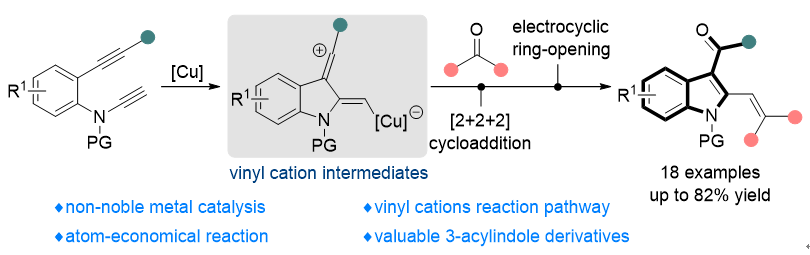
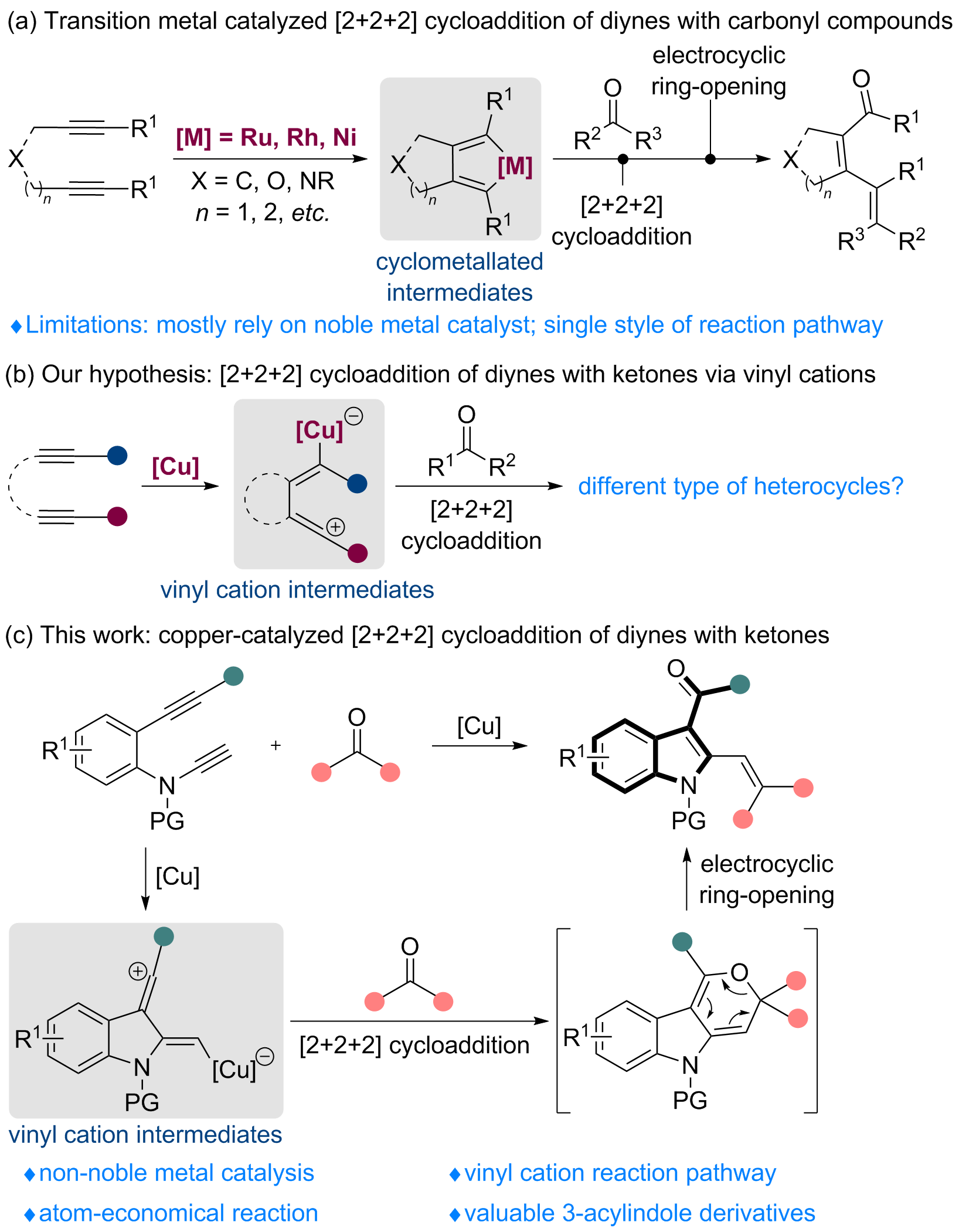
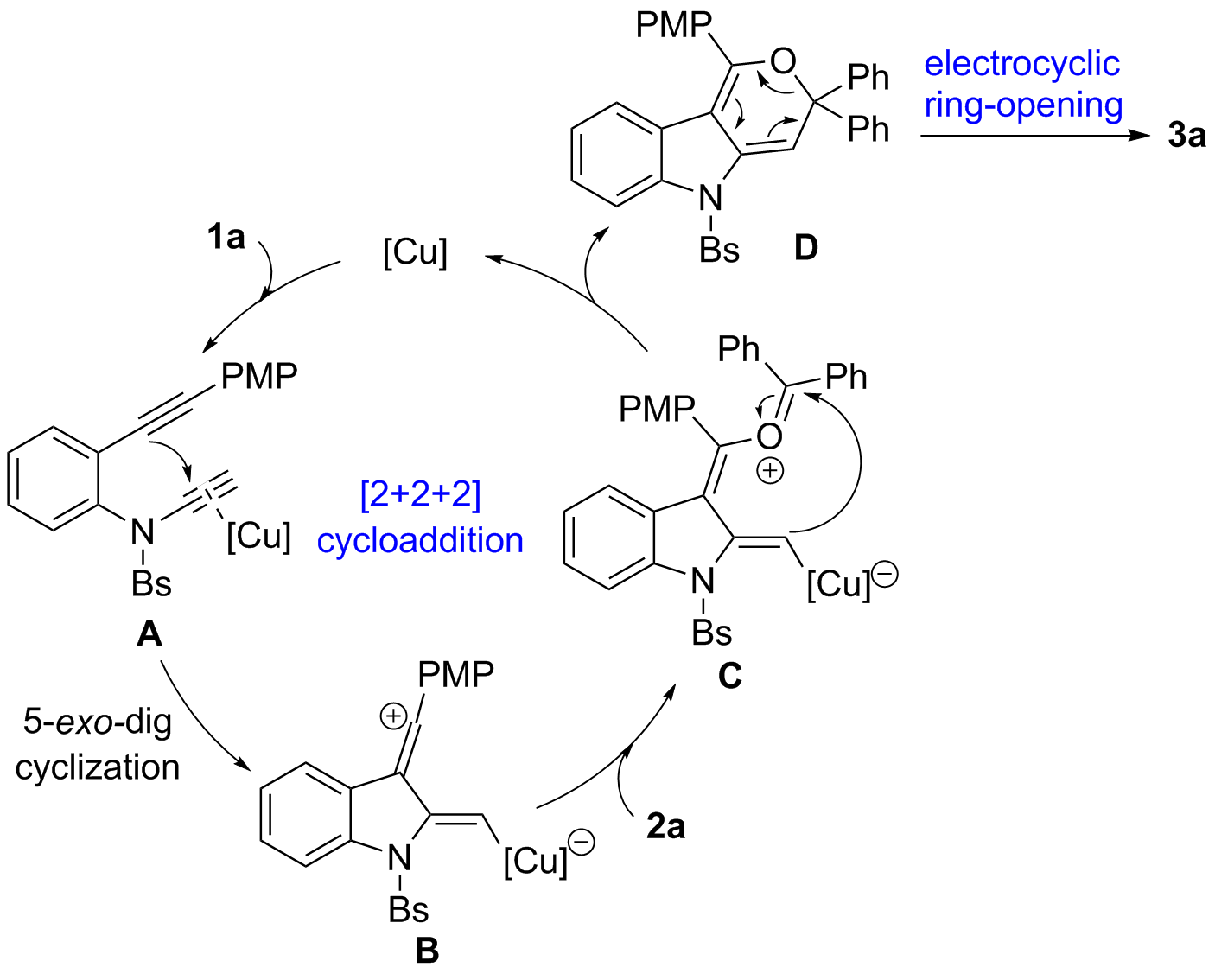
过渡金属催化炔烃与羰基化合物的[2+2+2]环加成反应是合成各类杂环化合物的有效手段. 然而, 已有的方法主要依赖于贵金属催化剂且均局限于环金属化路径. 本工作报道了通过烯基阳离子途径实现的铜催化1,6-二炔与酮的[2+2+2]环加成反应. 该反应能以中等至优异的产率, 高效制备系列具有重要生物活性的3-酰基吲哚骨架. 该类环化反应具有催化剂及反应试剂廉价易得、操作简单、反应条件温和、底物适用范围良好等优势. 特别是, 本研究是首次通过过渡金属催化二炔与酮的[2+2+2]环加成反应实现该类重要骨架的构建.
朱伯汉, 李佳诚, 吴功德, 叶龙武. 铜催化1,6-二炔与酮的[2+2+2]环加成反应构建3-酰基吲哚类衍生物[J]. 化学学报, 2026, 84(6): 805-811.
Bohan Zhu, Jiacheng Li, Gongde Wu, Longwu Ye. Construction of 3‑Acylindole Derivatives via Copper‑Catalyzed [2+2+2] Cycloaddition of 1,6‑Diynes with Ketones[J]. Acta Chimica Sinica, 2026, 84(6): 805-811.
| Entry | Catalyst | L | Conditions | Yieldb/% |
|---|---|---|---|---|
| 1 | CuTC | L1 | DCE, 40 ℃, 10 h | 58 |
| 2 | CuOTf | L1 | DCE, 40 ℃, 24 h | 37 |
| 3 | CuOAc | L1 | DCE, 40 ℃, 24 h | <5 |
| 4 | Cu(CH3CN)4BF4 | L1 | DCE, 40 ℃, 12 h | 50 |
| 5 | Cu(CH3CN)4PF6 | L1 | DCE, 40 ℃, 4 h | 61 |
| 6 | Cu(CH3CN)4PF6 | L1 | THF, 40 ℃, 48 h | <5 |
| 7 | Cu(CH3CN)4PF6 | L1 | PhMe, 40 ℃, 8 h | 49 |
| 8 | Cu(CH3CN)4PF6 | L1 | PhCl, 40 ℃, 8 h | 46 |
| 9 | Cu(CH3CN)4PF6 | L1 | PhCF3, 40 ℃, 8 h | 68 |
| 10 | Cu(CH3CN)4PF6 | L1 | CH2Cl2, 40 ℃, 2 h | 76 |
| 11 | Cu(CH3CN)4PF6 | L2 | CH2Cl2, 40 ℃, 2 h | <5 |
| 12 | Cu(CH3CN)4PF6 | L3 | CH2Cl2, 40 ℃, 12 h | 30 |
| 13 | Cu(CH3CN)4PF6 | L4 | CH2Cl2, 40 ℃, 43 h | 66 |
| 14 | Cu(CH3CN)4PF6 | L1 | CH2Cl2, r.t., 5 h | 80 |
| Entry | Catalyst | L | Conditions | Yieldb/% |
|---|---|---|---|---|
| 1 | CuTC | L1 | DCE, 40 ℃, 10 h | 58 |
| 2 | CuOTf | L1 | DCE, 40 ℃, 24 h | 37 |
| 3 | CuOAc | L1 | DCE, 40 ℃, 24 h | <5 |
| 4 | Cu(CH3CN)4BF4 | L1 | DCE, 40 ℃, 12 h | 50 |
| 5 | Cu(CH3CN)4PF6 | L1 | DCE, 40 ℃, 4 h | 61 |
| 6 | Cu(CH3CN)4PF6 | L1 | THF, 40 ℃, 48 h | <5 |
| 7 | Cu(CH3CN)4PF6 | L1 | PhMe, 40 ℃, 8 h | 49 |
| 8 | Cu(CH3CN)4PF6 | L1 | PhCl, 40 ℃, 8 h | 46 |
| 9 | Cu(CH3CN)4PF6 | L1 | PhCF3, 40 ℃, 8 h | 68 |
| 10 | Cu(CH3CN)4PF6 | L1 | CH2Cl2, 40 ℃, 2 h | 76 |
| 11 | Cu(CH3CN)4PF6 | L2 | CH2Cl2, 40 ℃, 2 h | <5 |
| 12 | Cu(CH3CN)4PF6 | L3 | CH2Cl2, 40 ℃, 12 h | 30 |
| 13 | Cu(CH3CN)4PF6 | L4 | CH2Cl2, 40 ℃, 43 h | 66 |
| 14 | Cu(CH3CN)4PF6 | L1 | CH2Cl2, r.t., 5 h | 80 |
| [1] |
(a)
doi: 10.1021/acs.jafc.5c04293 |
|
(b)
doi: 10.6023/cjoc202404031 |
|
|
(夏登鹏, 吴奇, 蔡志华, 杜广芬, 有机化学, 2025, 45, 349.)
doi: 10.6023/cjoc202404031 |
|
|
(c)
doi: 10.6023/A25040121 |
|
|
(林健, 李恒渊, 周波, 叶龙武, 化学学报, 2025, 83, 551).
doi: 10.6023/A25040121 |
|
|
(d)
doi: 10.6023/A24030077 |
|
|
(李雷, 唐鋆磊, 王丽涛, 李江涛, 全洪林, 林冰, 王宏, 李佳奇, 周太刚, 化学学报, 2024, 82, 748.)
doi: 10.6023/A24030077 |
|
|
(e)
doi: 10.6023/A24030094 |
|
|
(郑灏宁, 刘金宇, 化学学报, 2024, 82, 641.)
doi: 10.6023/A24030094 |
|
|
(f)
doi: 10.6023/cjoc202310009 |
|
|
(彭天凤, 赵玉祥, 浦绍健, 罗娟, 刘腾, 缪应纯, 沈先福, 有机化学, 2024, 44, 1160.)
doi: 10.6023/cjoc202310009 |
|
|
(g)
doi: 10.1039/D3MD00677H |
|
|
(h)
doi: 10.1038/s41467-023-40598-y |
|
|
(i)
doi: 10.1039/C2SC21185H |
|
|
(j)
doi: 10.1002/ddr.v72.3 |
|
| [2] |
(a)
doi: 10.1039/D4NJ00771A pmid: 23631463 |
|
(b)
doi: 10.1039/D3CC04144A pmid: 23631463 |
|
|
(c)
doi: 10.1039/D2CC03658D pmid: 23631463 |
|
|
(d)
doi: 10.1016/j.ejmech.2014.12.017 pmid: 23631463 |
|
|
(e)
doi: 10.1021/jm400268b pmid: 23631463 |
|
| [3] |
(a)
doi: 10.1039/D4GC05239K pmid: 32037416 |
|
(b)
doi: 10.1039/D4CC03257H pmid: 32037416 |
|
|
(c)
doi: 10.1021/acs.chemrev.8b00782 pmid: 32037416 |
|
|
(d)
doi: 10.1039/c9ob02550b pmid: 32037416 |
|
|
(e)
doi: 10.1039/C9OB00622B pmid: 32037416 |
|
|
(f)
doi: 10.1039/C7RA11362E pmid: 32037416 |
|
|
(g)
doi: 10.1021/acs.joc.6b00580 pmid: 32037416 |
|
|
(h)
doi: 10.1039/C5GC01931A pmid: 32037416 |
|
|
(i)
doi: 10.1021/acs.orglett.6b01970 pmid: 32037416 |
|
| [4] |
(a)
doi: 10.1021/acs.orglett.5c03216 |
|
(b)
doi: 10.1021/cs5019106 |
|
| [5] |
(a)
doi: 10.1016/j.cclet.2013.10.004 |
|
(b)
doi: 10.1039/c3ob42171f |
|
|
(c)
doi: 10.1021/ja2048495 |
|
| [6] |
(a)
doi: 10.1055/s-0040-1719831 pmid: 33576620 |
|
(b)
doi: 10.1021/acs.chemrev.0c00062 pmid: 33576620 |
|
|
(c)
doi: 10.1021/acs.chemrev.0c01133 pmid: 33576620 |
|
|
(d)
doi: 10.1021/acs.accounts.5b00054 pmid: 33576620 |
|
|
(e)
doi: 10.1002/adsc.v348:16/17 pmid: 33576620 |
|
| [7] |
doi: 10.1021/ja00233a057 |
| [8] |
(a)
doi: 10.1021/acs.joc.7b01229 pmid: 17458977 |
|
(b)
doi: 10.1246/cl.160961 pmid: 17458977 |
|
|
(c)
doi: 10.1002/anie.v50.19 pmid: 17458977 |
|
|
(d)
doi: 10.1002/anie.201105519 pmid: 17458977 |
|
|
(e)
pmid: 17458977 |
|
|
(f)
pmid: 17458977 |
|
|
(g)
doi: 10.1021/ja0664786 pmid: 17458977 |
|
|
(h)
doi: 10.1021/ol0515558 pmid: 17458977 |
|
|
(i)
doi: 10.1021/ja0264100 pmid: 17458977 |
|
| [9] |
(a)
doi: 10.1007/s11426-021-1117-2 pmid: 30474269 |
|
(b)
doi: 10.1002/anie.201810701 pmid: 30474269 |
|
| [10] |
(a)
doi: 10.1038/s41467-025-67716-2 |
|
(b)
doi: 10.1038/s41467-025-59328-7 |
|
|
(c)
doi: 10.1002/anie.v64.38 |
|
|
(d)
doi: 10.1002/anie.v64.6 |
|
|
(e)
doi: 10.1016/j.cclet.2025.110870 |
|
|
(f)
doi: 10.1002/cjoc.v43.18 |
|
|
(g)
doi: 10.1039/D4QO02371D |
|
|
(h)
|
|
|
(i)
doi: 10.1038/s41467-024-53605-7 |
|
|
(j)
doi: 10.1038/s41467-024-46288-7 |
|
|
(k)
doi: 10.1002/anie.v63.51 |
|
|
(l)
doi: 10.1038/s41467-023-42805-2 |
|
|
(m)
doi: 10.1002/anie.v62.23 |
|
|
(n)
doi: 10.1002/anie.v61.43 |
|
|
(o)
doi: 10.1002/anie.v61.7 |
|
|
(p)
doi: 10.1021/jacs.0c01918 |
|
|
(q)
doi: 10.1021/jacs.9b09303 |
|
| [11] |
(a)
doi: 10.1039/D4CS01329H |
|
(b)
doi: 10.1021/acs.accounts.3c00743 |
|
|
(c)
doi: 10.1002/cjoc.v42.24 |
|
|
(d)
doi: 10.1039/D0CS00283F |
|
|
(e)
doi: 10.1039/D0CS00474J |
|
|
(f)
doi: 10.1039/D0CS00769B |
|
|
(g)
doi: 10.1021/acs.accounts.0c00417 |
|
|
(h)
doi: 10.1021/acscatal.0c04180 |
|
|
(i)
|
|
|
(j)
doi: 10.1021/ar400193g |
| [1] | 张杰豪, 徐明金, 古满珍, 马浩文, 蔡倩. 铜催化不对称Kinugasa/Aldol反应构建手性螺环β-内酰胺[J]. 化学学报, 2025, 83(7): 667-673. |
| [2] | 成泽恺, 温子扬, 李红卫, 李娜, 王欢. 铜(I)催化炔-叠氮环加成反应的转动扩散动力学★[J]. 化学学报, 2025, 83(11): 1293-1299. |
| [3] | 李晖, 殷亮. 一价铜催化的酮或酮亚胺的不对称烯丙基化反应研究进展[J]. 化学学报, 2024, 82(12): 1274-1288. |
| [4] | 鱼章龙, 李忠良, 杨昌江, 顾强帅, 刘心元. 铜催化的二醇类化合物对映选择性去对称化反应研究进展★[J]. 化学学报, 2023, 81(8): 955-966. |
| [5] | 孟庆端, 韩佳宏, 潘一骁, 郝伟, 范青华. C1-对称手性氮杂环卡宾(NHC)配体的不对称合成及其催化性能研究★[J]. 化学学报, 2023, 81(10): 1271-1279. |
| [6] | 邱孔茜, 李杰, 马浩文, 周伟, 蔡倩. 捕捉环加成反应中的有机亚铜中间体构筑氮杂环化合物研究进展[J]. 化学学报, 2023, 81(1): 42-63. |
| [7] | 徐清浩, 魏立谱, 张震, 肖斌. 铜促进的锗亲电试剂与烷基溴合成四烷基锗※[J]. 化学学报, 2022, 80(4): 428-431. |
| [8] | 满清敏, 付尊蕴, 刘甜甜, 郑明月, 蒋华良. Cu催化偶联反应合成烷基芳基醚的DFT机理研究[J]. 化学学报, 2021, 79(7): 948-952. |
| [9] | 邓卓基, 欧阳溢凡, 敖运林, 蔡倩. 铜催化不对称去对称化分子内烯基C—N偶联反应[J]. 化学学报, 2021, 79(5): 649-652. |
| [10] | 张荣华, 许冰, 张展鸣, 张俊良. Ming-Phos/铜催化的亚甲胺叶立德与硝基烯烃的不对称[3+2]环加成反应[J]. 化学学报, 2020, 78(3): 245-249. |
| [11] | 黄浩, 林华鑫, 王敏, 廖建. 1,2-苯基异噁唑为氮源的铜催化苯乙烯不对称硼胺化[J]. 化学学报, 2020, 78(11): 1229-1234. |
| [12] | 梁欢, 苟阿龙, 高珠鹏, 雷林生, 王博文, 余兰, 徐学涛, 王少华. 铜催化的α-氨基丙二腈的脱氰氧代反应:一种合成叔酰胺的新方法[J]. 化学学报, 2020, 78(10): 1064-1068. |
| [13] | 林凤闺蓉, 梁宇杰, 郦鑫耀, 宋颂, 焦宁. 氧气氧化铜催化的苯胺邻位叠氮化反应[J]. 化学学报, 2019, 77(9): 906-910. |
| [14] | 张衡, 牟学清, 陈弓, 何刚. 铜催化苯甲酰亚胺高烯丙酯的分子内胺化全氟烷基化反应[J]. 化学学报, 2019, 77(9): 884-888. |
| [15] | 成忠明, 陈品红, 刘国生. 光/铜共催化远程C—H键的不对称氰基化反应[J]. 化学学报, 2019, 77(9): 856-860. |
| 阅读次数 | ||||||
|
全文 |
|
|||||
|
摘要 |
|
|||||