

化学学报 ›› 2026, Vol. 84 ›› Issue (7): 1049-1056.DOI: 10.6023/A26040131 上一篇 下一篇
研究论文
张颖敏a, 仝欣欣a, 陈玉凤a, 李建彤a, 王鑫b,*( ), 吴兆申a, 刘俊豪a, 刘健c,*(), 杨升宏a,*()
投稿日期:2026-04-21
发布日期:2026-06-11
基金资助:
Yingmin Zhanga, Xinxin Tonga, Yufeng Chena, Jiantong Lia, Xin Wangb,*(), Zhaoshen Wua, Junhao Liua, Jian Liuc,*(), Shenghong Yanga,*()
Received:2026-04-21
Published:2026-06-11
Contact:
* E-mail: wx19971221@163.com;
jianliu18@jxnu.edu.cn;
yangsh@qlu.edu.cn
Supported by:文章分享
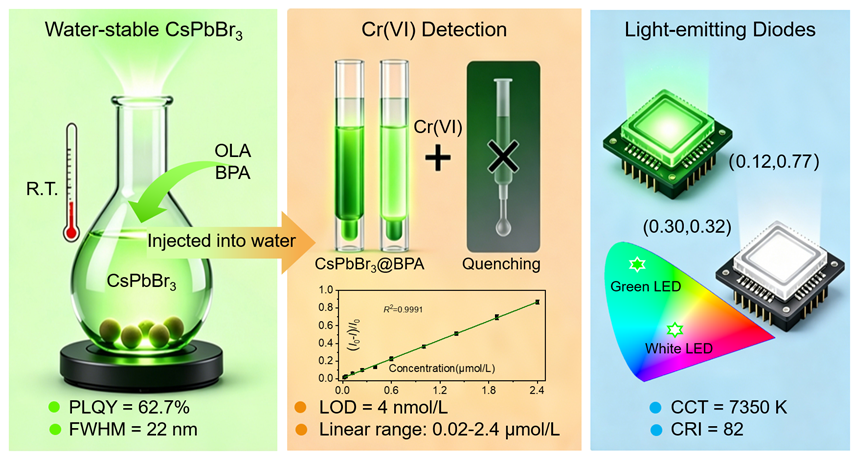
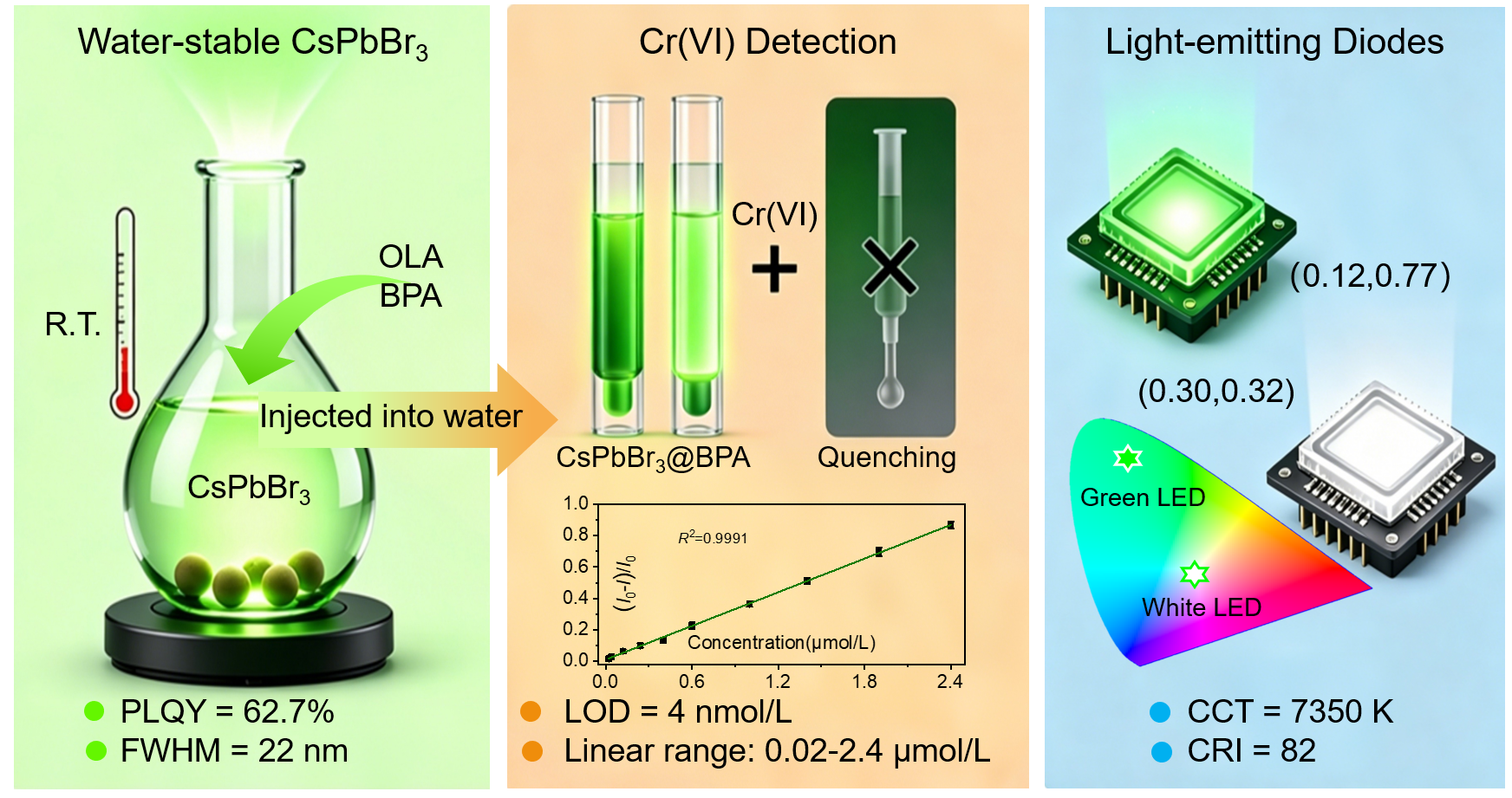
为解决钙钛矿量子点水稳定性差、合成条件苛刻的难题, 并实现六价铬(Cr(VI))的高效检测, 本研究通过双配体协同钝化设计, 采用3-溴-2-(溴甲基)丙酸(BPA)和油胺构筑配体界面, 在温和的室温环境中成功合成了高性能、水相发光稳定的CsPbBr3@BPA量子点. 所合成量子点的发射半峰宽仅为22 nm, 量子产率可达62.7%. 基于其良好的水相荧光性能和Cr(VI)诱导的动态荧光猝灭机制, 建立了高灵敏度和高特异性的检测方法, 检测限低至4 nmol/L, 线性范围0.02~2.4 μmol/L. 该方法成功用于实际水样中Cr(VI)检测, 回收率在93.3%~106.0%之间, 证实了方法的可靠性和实用性. 合成的量子点还被用于制备高色纯度发光二极管, 展示了其在环境监测与固态照明领域的双功能应用价值.
张颖敏, 仝欣欣, 陈玉凤, 李建彤, 王鑫, 吴兆申, 刘俊豪, 刘健, 杨升宏. 室温构筑水稳定钙钛矿量子点用于六价铬检测与发光二极管[J]. 化学学报, 2026, 84(7): 1049-1056.
Yingmin Zhang, Xinxin Tong, Yufeng Chen, Jiantong Li, Xin Wang, Zhaoshen Wu, Junhao Liu, Jian Liu, Shenghong Yang. Room-temperature Construction of Water-stable Perovskite Quantum Dots for Cr(VI) Detection and Light-emitting Diodes[J]. Acta Chimica Sinica, 2026, 84(7): 1049-1056.
| [1] |
doi: 10.1039/D0CS01165G |
| [2] |
doi: 10.1021/acs.est.5c07765 |
| [3] |
|
|
(闵鹏, 周凡琪, 于凡芮, 陈建秋, 郭瑞昕, 刘艳华, 付岚, 环境化学, 2025, 44, 265.)
|
|
| [4] |
doi: 10.1016/j.cej.2024.157946 |
| [5] |
|
|
(孙金博, 赵莹, 张超艳, 熊杰, 白利平, 郭晓欣, 周友亚, 马杰, 环境化学, 2025, 44, 3683.)
|
|
| [6] |
doi: 10.1016/j.jhazmat.2026.141347 |
| [7] |
doi: 10.1016/j.watres.2024.121230 |
| [8] |
doi: 10.1016/j.jhazmat.2024.136399 |
| [9] |
doi: 10.1021/acssensors.4c01708 |
| [10] |
doi: 10.1016/j.foodchem.2026.148369 |
| [11] |
doi: 10.1016/j.cej.2022.138524 |
| [12] |
doi: 10.1360/SSC-2019-0077 |
|
(刘璐璐, 李志泽, 刘毅飞, 张晓安, 中国科学: 化学, 2020, 50, 39.)
|
|
| [13] |
doi: 10.1360/SSC-2022-0096 |
|
(朱盼盼, 张展华, 张彤, 陈威, 中国科学: 化学, 2022, 52, 1087.)
|
|
| [14] |
doi: 10.1016/j.carbpol.2024.122748 |
| [15] |
doi: 10.1021/acs.analchem.0c03709 |
| [16] |
doi: 10.1016/j.cej.2025.170513 |
| [17] |
doi: 10.1016/j.jhazmat.2026.141366 |
| [18] |
doi: 10.6023/A14100711 |
|
(王娜娜, 司俊杰, 金一政, 王建浦, 黄维, 化学学报, 2015, 73, 171.)
doi: 10.6023/A14100711 |
|
| [19] |
doi: 10.1002/lpor.v19.1 |
| [20] |
doi: 10.1016/j.ccr.2025.217517 |
| [21] |
doi: 10.1002/lpor.v19.4 |
| [22] |
doi: 10.6023/A24030066 |
|
(彭亚晶, 赵雨新, 杨金辉, 仉昕昕, 程佳玲, 化学学报, 2024, 82, 879.)
doi: 10.6023/A24030066 |
|
| [23] |
doi: 10.1016/j.cej.2026.173123 |
| [24] |
doi: 10.1016/j.cej.2026.172788 |
| [25] |
doi: 10.1021/acsnano.5c08578 |
| [26] |
doi: 10.1021/jacs.5c22209 |
| [27] |
doi: 10.1002/adfm.v35.36 |
| [28] |
doi: 10.1002/advs.v12.26 |
| [29] |
doi: 10.1021/jacs.2c08622 |
| [30] |
doi: 10.1016/j.jmst.2024.05.017 |
| [31] |
doi: 10.1016/j.cej.2024.152638 |
| [32] |
doi: 10.1002/adfm.v36.12 |
| [33] |
doi: 10.1016/j.cej.2025.163360 |
| [34] |
doi: 10.1021/acsnano.5c07518 |
| [35] |
doi: 10.1021/acsnano.6c00180 |
| [36] |
|
| [37] |
doi: 10.1016/j.cej.2024.155515 |
| [38] |
doi: 10.1021/acsnano.4c02057 |
| [39] |
doi: 10.1002/anie.v61.22 |
| [40] |
doi: 10.1016/j.microc.2024.110043 |
| [41] |
doi: 10.1021/acsenergylett.5c00128 |
| [42] |
doi: 10.1016/j.jechem.2025.09.084 |
| [43] |
doi: 10.1016/j.nanoen.2026.111859 |
| [44] |
doi: 10.1002/adfm.v34.46 |
| [45] |
doi: 10.1016/j.cej.2025.162689 |
| [46] |
doi: 10.1039/D4CC00619D |
| [47] |
doi: 10.1016/j.jcis.2026.140486 |
| [48] |
doi: 10.1016/j.jhazmat.2025.139959 |
| [49] |
doi: 10.1016/j.jhazmat.2022.128360 |
| [50] |
doi: 10.6023/A20080386 |
|
(李严, 李金航, 许蕾梦, 陈嘉伟, 宋继中, 化学学报, 2021, 79, 126.)
doi: 10.6023/A20080386 |
| [1] | 张瀚月, 王日升, 杨昊, 张玲玲, 宋芳, 冷稚华. SrCaLuScAl2Si2O12:Ce3+宽带绿色荧光粉的发光性能及其在白光发光二极管上的应用[J]. 化学学报, 2026, 84(7): 1087-1095. |
| [2] | 陶骏飞, 许世攀, 杜旭洋, 尹赫, 闫安, 杭怀腾, 陈亮, 周桂江, 孙源慧, 杨晓龙. 基于4-氰基嘧啶受体的热活化延迟荧光材料合成及其电致发光性能研究[J]. 化学学报, 2026, 84(7): 1040-1048. |
| [3] | 汪庆辉, 任正, 张凯, 周东营, 樊健. 基于3,6-二苯硒基咔唑的多重共振热活化延迟荧光分子[J]. 化学学报, 2026, 84(2): 248-256. |
| [4] | 方素琴, 童恺宁, 陈思浛, 张千峰, 童碧海, 冯敏强, 孔辉. 基于呫吨酮电子受体的高效圆偏振热活化延迟荧光材料[J]. 化学学报, 2025, 83(5): 471-478. |
| [5] | 杨太群, 叶铖, 周申, 丁思琪, 米朋贺, 王天慧, 李磊, 陈国庆. 溶剂调控合成铜纳米团簇组装体及其在发光二极管中的应用[J]. 化学学报, 2025, 83(2): 87-92. |
| [6] | 闫安, 许世攀, 杜旭洋, 刘文平, 赵堃翔, 李胜利, 钟道昆, 周桂江, 杨晓龙, 孙源慧. 位阻诱导扭曲结构的蓝光材料合成及其在蓝色有机发光二极管(OLED)中的应用[J]. 化学学报, 2025, 83(11): 1317-1323. |
| [7] | 朱韵飞, 郭可威, 王子路, 李昊, 朱爱云, 马靖尧, 祝守加, 冯全友, 解令海. 芴基功能化D-A型可拉伸电致发光聚合物及其发光二极管[J]. 化学学报, 2025, 83(11): 1300-1308. |
| [8] | 谭可莹, 方平, 丁杜鹏, 袁诗晨, 刘辰, 杨诗羽, 魏昌庭, 徐勃. 基于蒽基电子传输材料设计及蓝光钙钛矿QLED性能研究[J]. 化学学报, 2025, 83(1): 1-9. |
| [9] | 陈蕾, 张瀚月, 卿青, 宋芳, 李莉萍, 冷稚华. CsZn2B3O7:Eu2+宽带绿色荧光粉的发光性质及其在白光发光二极管上的应用[J]. 化学学报, 2024, 82(8): 894-902. |
| [10] | 李明昭, 李想, 何洪波, 宋芳, 冷稚华. Li3Cs2Sr2B3P6O24:Eu2+窄带蓝色荧光粉的发光性质及其在广色域背光显示上的应用[J]. 化学学报, 2024, 82(12): 1241-1249. |
| [11] | 葛凤洁, 张开志, 曹清鹏, 徐慧, 周涛, 张文浩, 班鑫鑫, 张晓波, 李娜, 朱鹏. 柔性芴基嵌段型延迟荧光二聚体的设计、合成及电致发光性能[J]. 化学学报, 2023, 81(9): 1157-1166. |
| [12] | 王一诺, 邵世洋, 王利祥. 窄谱带多重共振有机高分子荧光材料研究进展★[J]. 化学学报, 2023, 81(9): 1202-1214. |
| [13] | 刘振宇, 饶俊峰, 祝守加, 王兵洋, 余帆, 冯全友, 解令海. 溶液加工型自主体热活化延迟荧光材料的研究进展[J]. 化学学报, 2023, 81(7): 820-835. |
| [14] | 郑文山, 高冠斌, 邓浩, 孙涛垒. Ag2Se@Ag2S核壳量子点的室温合成及其近红外荧光性能优化[J]. 化学学报, 2023, 81(7): 763-770. |
| [15] | 李奎琛, 郑开元, 何静嘉, 金泽浩, 何秋, 王丽丽. 单相硫化锌量子点制作白光发光二极管(WQLEDs)[J]. 化学学报, 2023, 81(10): 1327-1333. |
| 阅读次数 | ||||||
|
全文 |
|
|||||
|
摘要 |
|
|||||
