

化学学报 ›› 2026, Vol. 84 ›› Issue (8): 1343-1354.DOI: 10.6023/A26060209 上一篇 下一篇
综述
戴枫荣, 陈忠宁*( )
)
投稿日期:2026-06-19
发布日期:2026-07-27
作者简介: |
戴枫荣, 中国科学院福建物质结构研究所研究员, 博士生导师, 主要从事功能配合物化学相关的研究工作. |
 |
陈忠宁, 中国科学院福建物质结构研究所研究员, 博士生导师, 国家自然科学基金杰出青年科学基金获得者, 入选新世纪百千万人才工程国家级人选. 主要从事配位化学相关的研究工作. |
★“纪念兰州大学化学学科创建80周年”专辑.
基金资助:
Fengrong Dai, Zhongning Chen*()
Received:2026-06-19
Published:2026-07-27
Contact:
E-mail: About author:★For the VSI “Celebration of 80th Anniversary of Chemistry in Lanzhou University”.
Supported by:文章分享
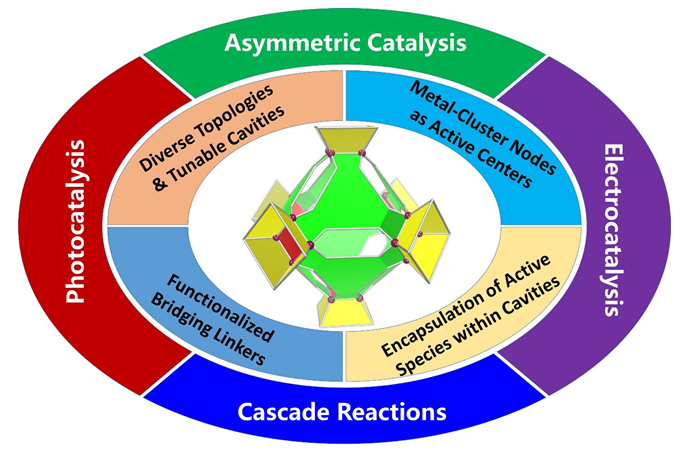
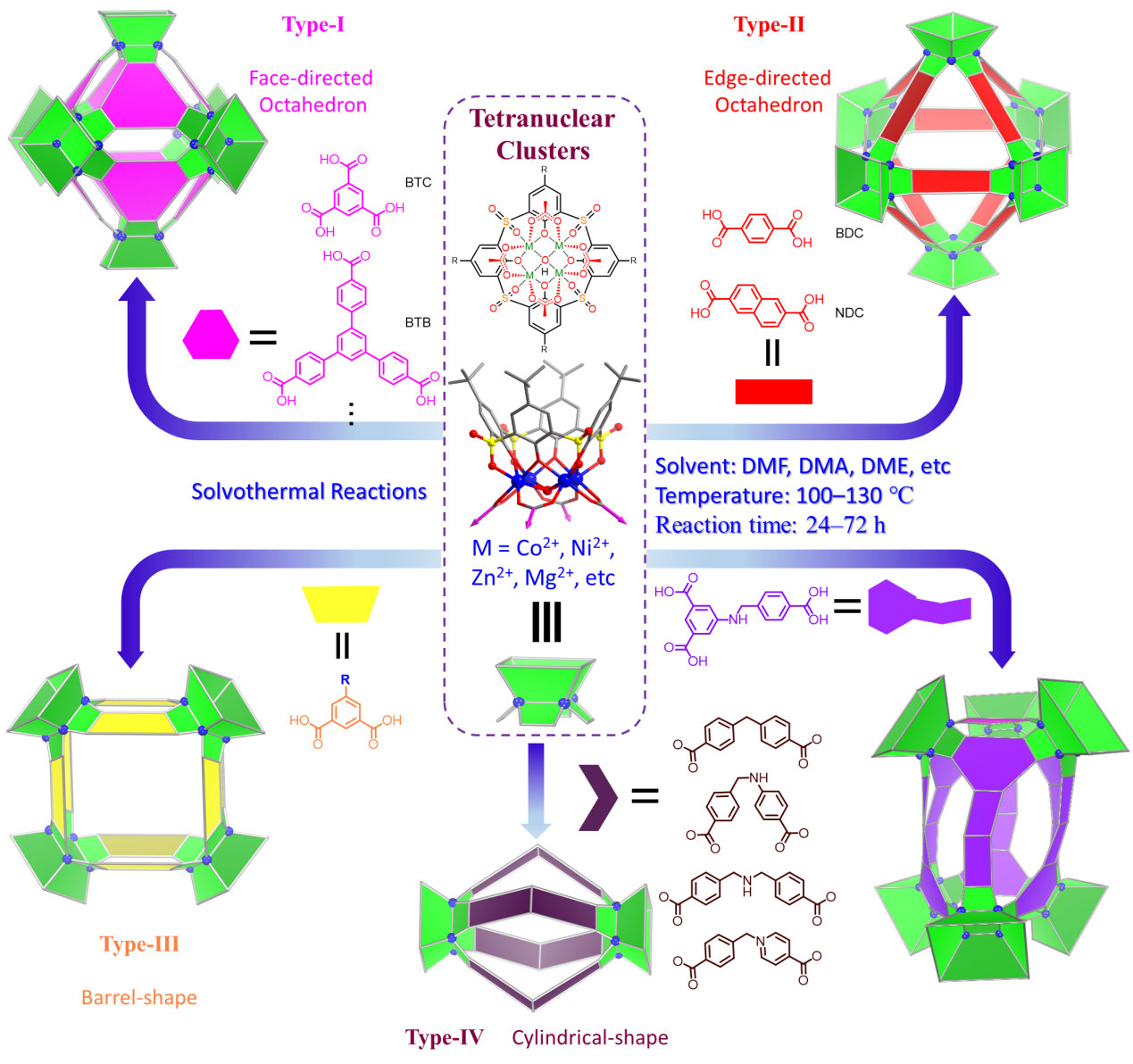
超分子催化旨在模拟天然酶的高效与特异性, 配位分子笼因其可编程的纳米空腔而成为这一领域最有活力和发展前途的方向之一. 硫代杯[4]芳烃及其氧化衍生物磺酰基杯[4]芳烃作为一类具有独特锥形构象和多配位点的“预组织”大环配体, 能够与过渡金属离子组装形成结构明确、稳定性优异的多核簇次级构筑单元. 基于“硫代/磺酰基杯[4]芳烃-金属簇”结构基元, 结合不同的多羧酸桥联配体, 已成功构筑了一系列拓扑丰富、尺寸可调的配位分子笼. 借助于该类配位超分子体系, 发展出多种催化功能化策略, 包括利用空腔限域效应、在骨架上引入活性位点以及封装金属纳米颗粒等, 成功实现了从简单模型反应到不对称合成、光/电催化及串联反应等复杂化学转化. 系统总结了基于硫 代/磺酰基杯[4]芳烃的配位分子笼在催化领域的最新研究进展, 着重分析了该领域从“依赖空腔物理限域”向“理性设计协同催化”的范式演进过程, 并特别强调了赋予催化选择性和效率的设计思路与设计原理, 并为该领域未来的发展方向提供了展望.
戴枫荣, 陈忠宁. 磺酰基杯[4]芳烃基配位分子笼的催化应用★[J]. 化学学报, 2026, 84(8): 1343-1354.
Fengrong Dai, Zhongning Chen. Catalytic Applications of Sulfonylcalix[4]arene-Based Coordination Cages★[J]. Acta Chimica Sinica, 2026, 84(8): 1343-1354.
| 催化体系 | 催化活性中心来源 | 核心结构/策略 | 催化应用 | 关键性能指标 | 文献 |
|---|---|---|---|---|---|
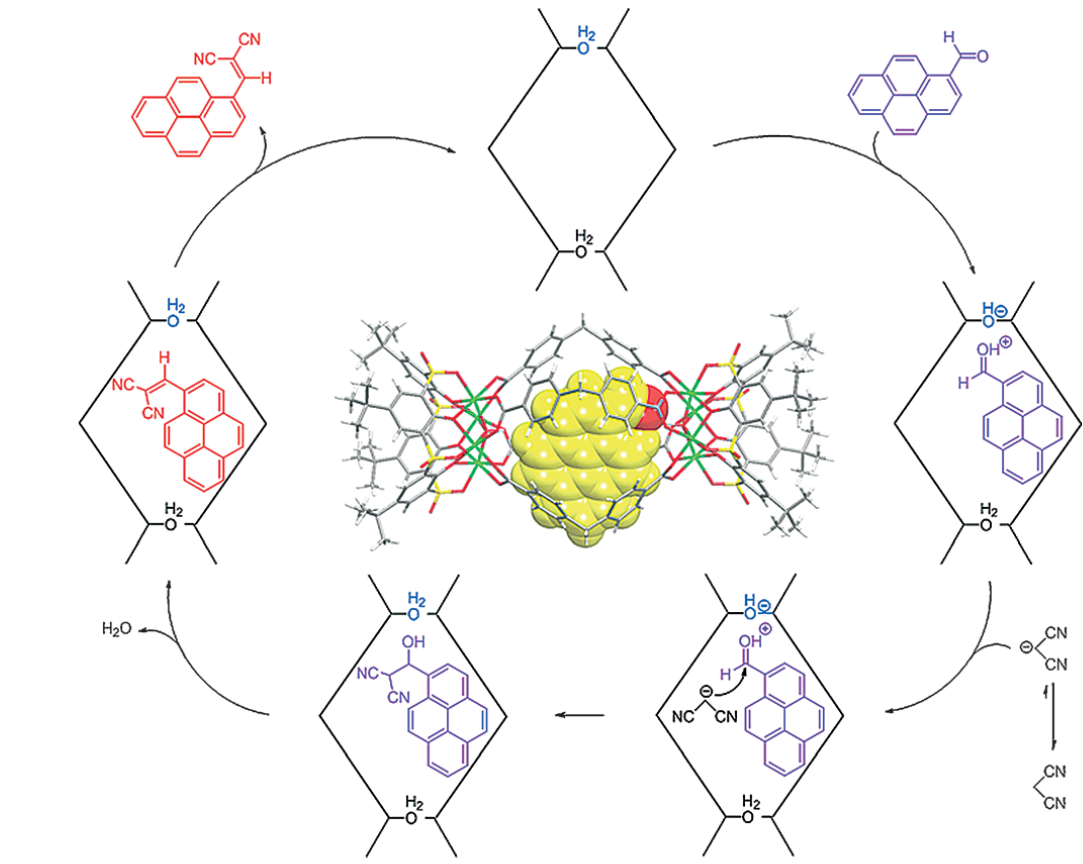
| MOSC-1, MOSC-2 | 金属簇节点: Brønsted酸性μ4-H2O | 空腔限域 静电别构调控 | Knoevenagel缩合 | 底物选择性: 1-芘甲醛, 产率67% vs 2-萘甲醛, 产率5% | [ |
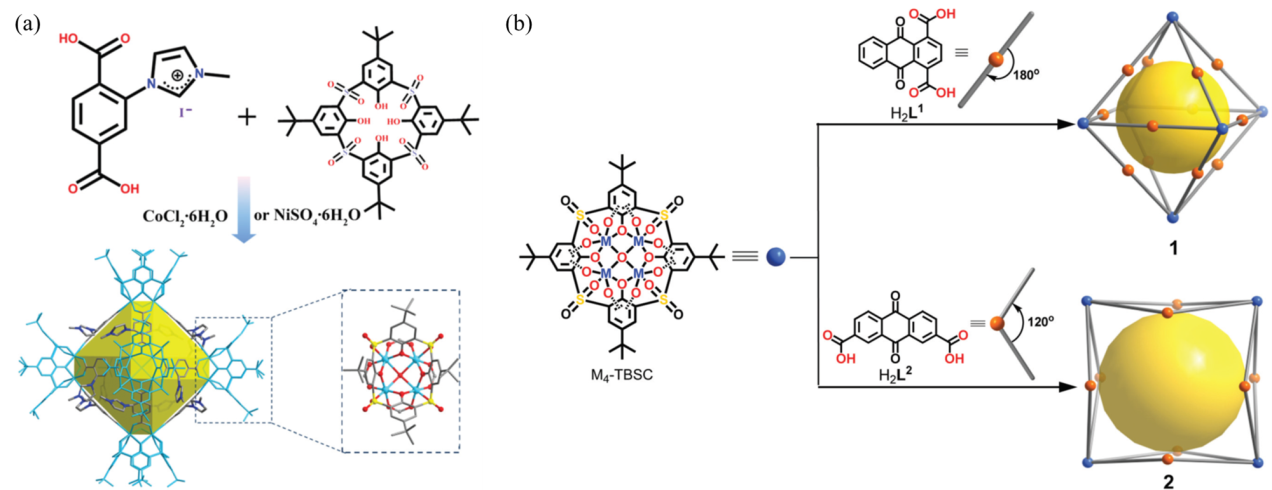
| 1-Co, 1-Ni | 金属簇节点: M4TBSC, M=Co, Ni; 配体功能化: 吡啶鎓功能化 | 骨架离子化 静电微环境调控 | 电化学析氧反应(OER) | 过电位: 0.290 V @10 mA•cm-2 (1-Co); Tafel斜率: 75 mV•dec-1; 稳定性: 48 h连续电解无显著衰减 | [ |
| Cu4TBSC基分子笼 | 金属簇节点: 配位不饱和Cu(II)位点) | 结构缺陷 开放金属位点 | 伯醇选择性氧化(醇→羧酸) | 底物选择性: 4-甲氧基苄醇99%产率(4 h)、4-硝基苄醇仅得19%羧酸+74%醛(中间体); 循环性: 4次循环后活性保持>90% | [ |
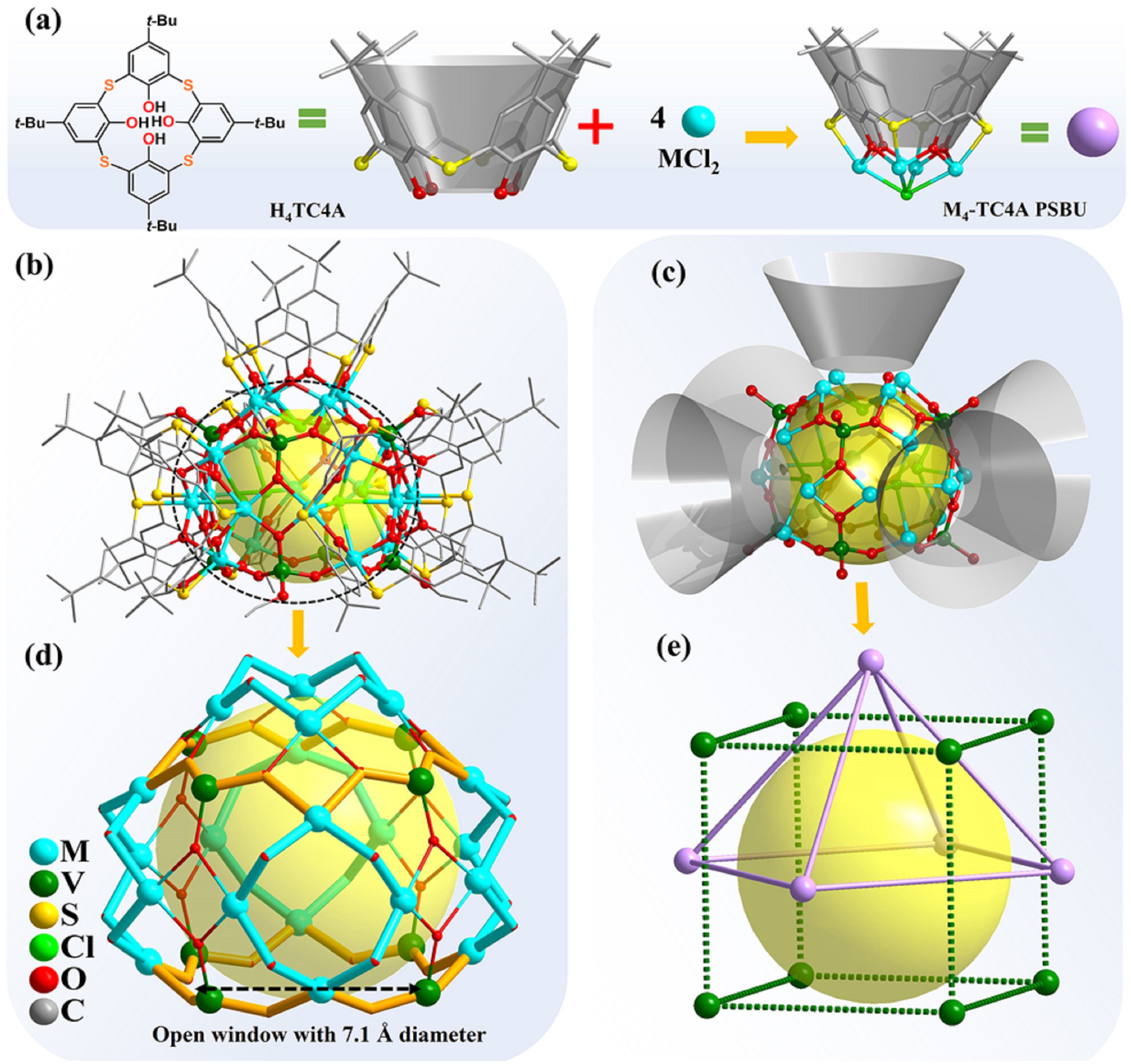
| {M20V8} (M=Fe, Co, Ni)方锥纳米笼 | 金属簇节点: M20V8簇 | 金属替换 能带调控 | 可见光光热催化硫醚氧化脱硫 | 光热转换效率: Fe20V8 85.87%; 催化转化率: Fe20V8>99%; 性能排序: Fe20V8>>Co20V8>Ni20V8 | [ |
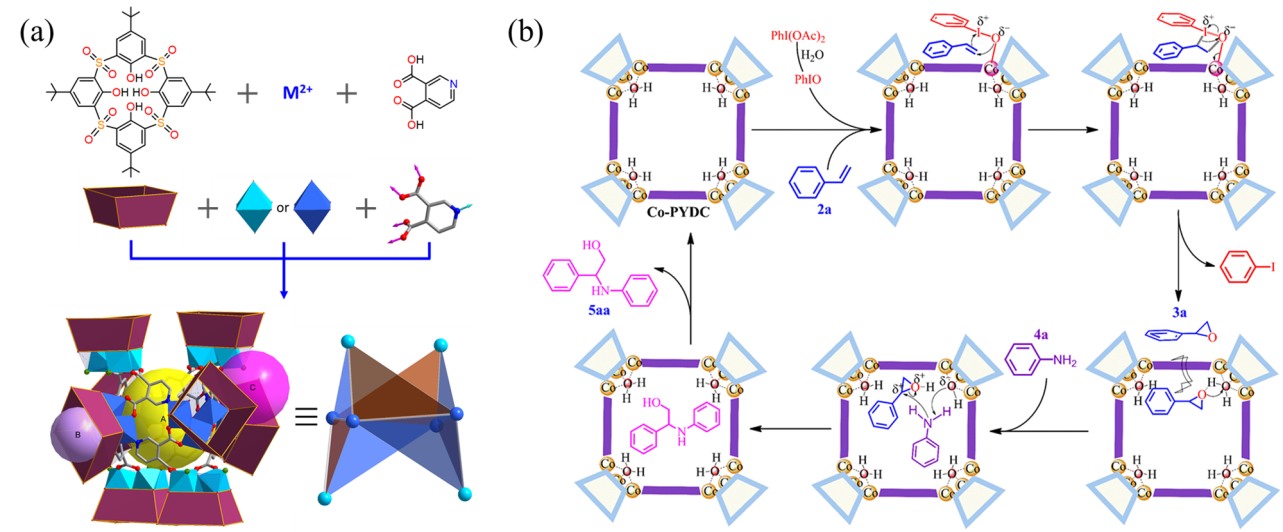
| Co-PYDC | 金属簇节点: 开放Co(II)位点+Brønsted酸性μ3-H2O | 缺陷工程 双活性区域(外腔/内腔) | 串联催化: 烯烃→β-氨基醇 | 一锅法转化率: 苯乙烯衍生物) 96%; 区域选择性: 仅生成β-位开环产物 | [ |
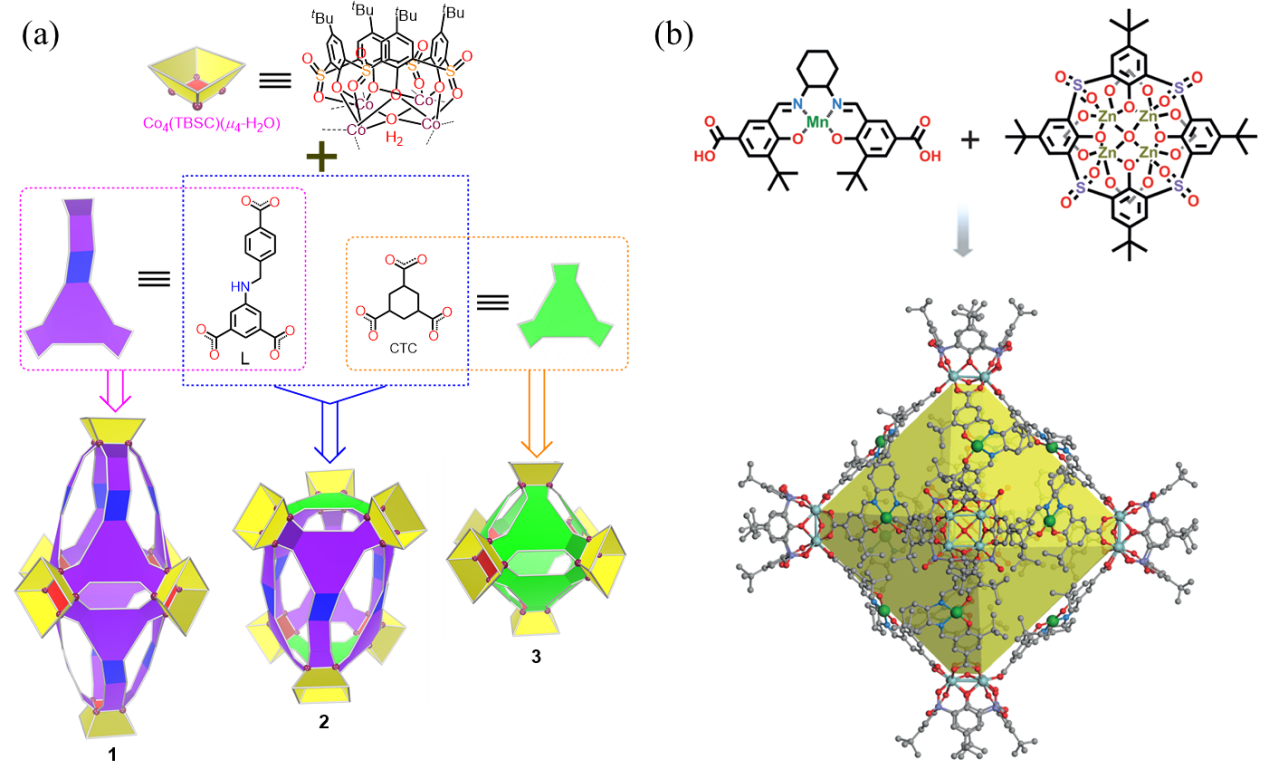
| 延长型八面体笼 | 配体功能化: -CH2NH- Brønsted碱 金属簇节点: Brønsted酸性μ4-H2O | 几何操纵(空腔拉伸) 酸碱双功能协同 | Knoevenagel缩合 | 底物1-芘甲醛, 产率89% | [ |
| 手性Mn(salen)笼 | 配体功能化: 手性Mn(salen)活性中心 | 骨架隔离 空腔限域 | 氧化动力学拆分 (仲醇)/烯烃环氧化 | 对映选择性(ee): 1-苯乙醇>99% (拆分产物); 选择性因子(krel): 最高35.0 (vs游离Mn(salen) 10.3~26.9); | [ |
| ImBDC-Co, ImBDC-Ni | 配体功能化: 咪唑鎓Lewis酸/卤素抗衡离子 | 离子型功能化配体 均相/异相结合 | CO2环加成反应 | 产物选择性:>99% (环氧氯丙烷); 底物范围: 脂肪族环氧化物产率>97%, 芳香族环氧化物>80%; 循环性: 3次循环无明显活性损失 | [ |
| 蒽醌基光催化笼 | 配体功能化: 蒽醌光敏剂 | 光活性骨架 空腔预组织 | 光催化[2+2]环加成(查尔酮) | 非对映选择性(dr): syn-HH∶anti-HT=13∶1; 转化率: 96% (12 h) | [ |
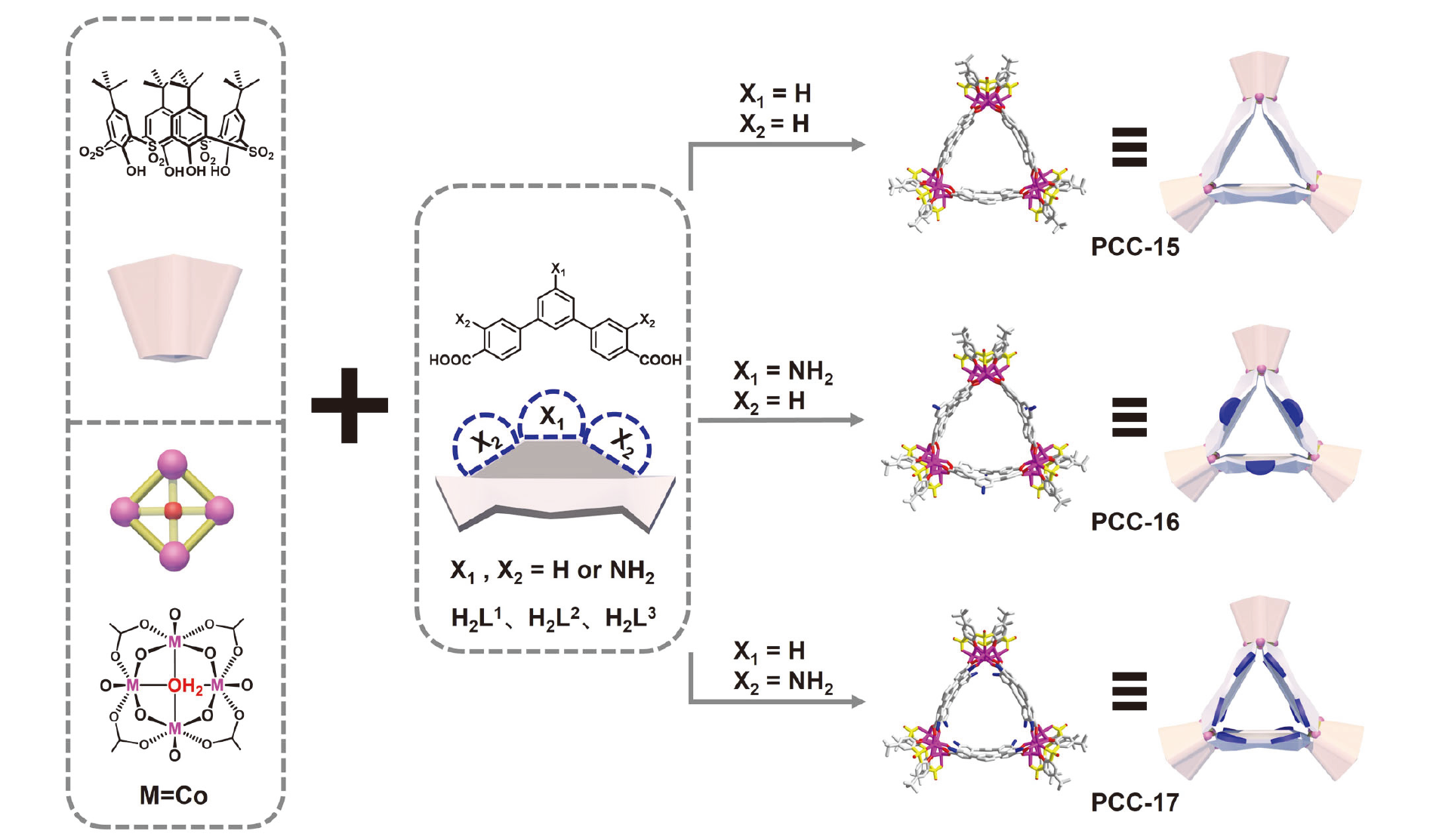
| PCC-15/16/17 | 配体功能化: -NH2- Brønsted碱) 金属簇节点: Brønsted酸性μ4-H2O | 活性位点间距精确调控: 调节-NH2-与μ4-H2O距离(从5.6 Å至12.4 Å) | Knoevenagel缩合 | 间距-活性关系: PCC-17 (5.6 Å) 96%产率>PCC-16 (12.4 Å) 21% 产率>PCC-15 (无-NH2)<5%产率; 底物范围: 多种芳香醛产率>95% | [ |
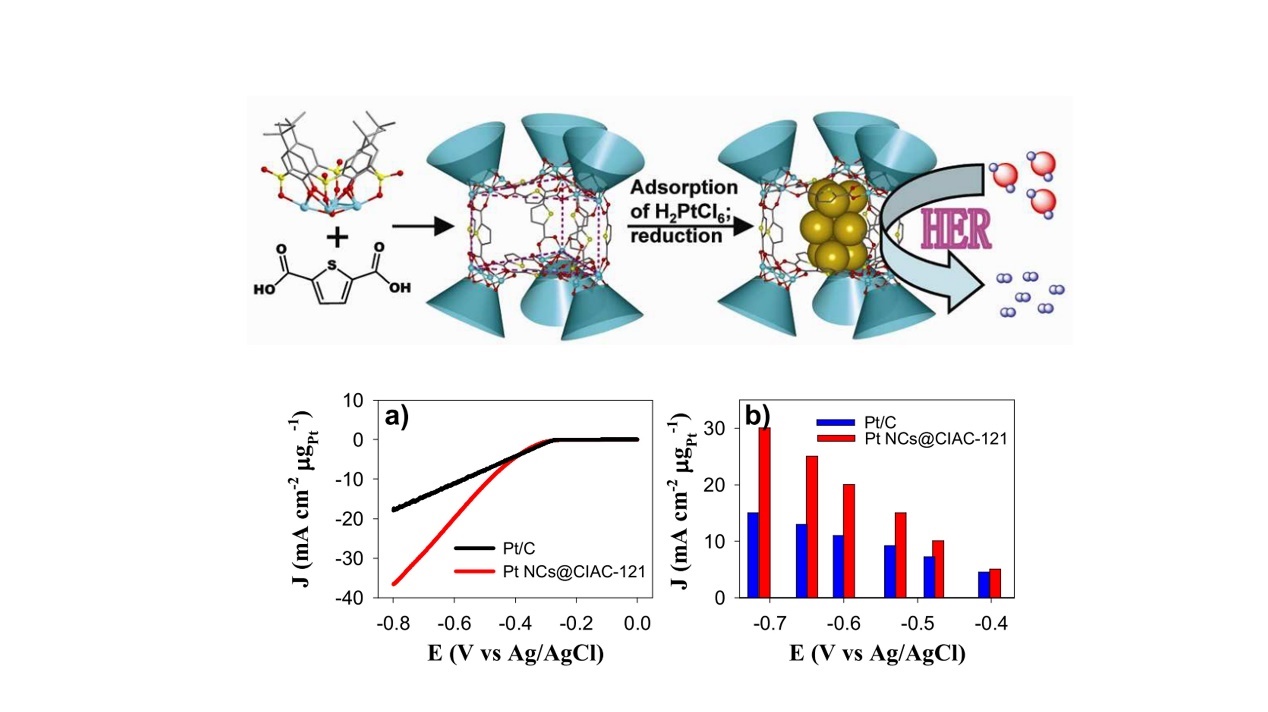
| Pt@CIAC-121 | 封装客体: Pt纳米簇 | S-锚点(化学) 空腔限域(物理) | 电解水析氢反应(HER) | 起始电位: -0.24 V (vs Ag/AgCl, 略正于Pt/C); 电流密度: 在-0.60 V时, Pt@CIAC-121为 20 mA•cm-2•µg-1 (Pt/C的2倍) | [ |
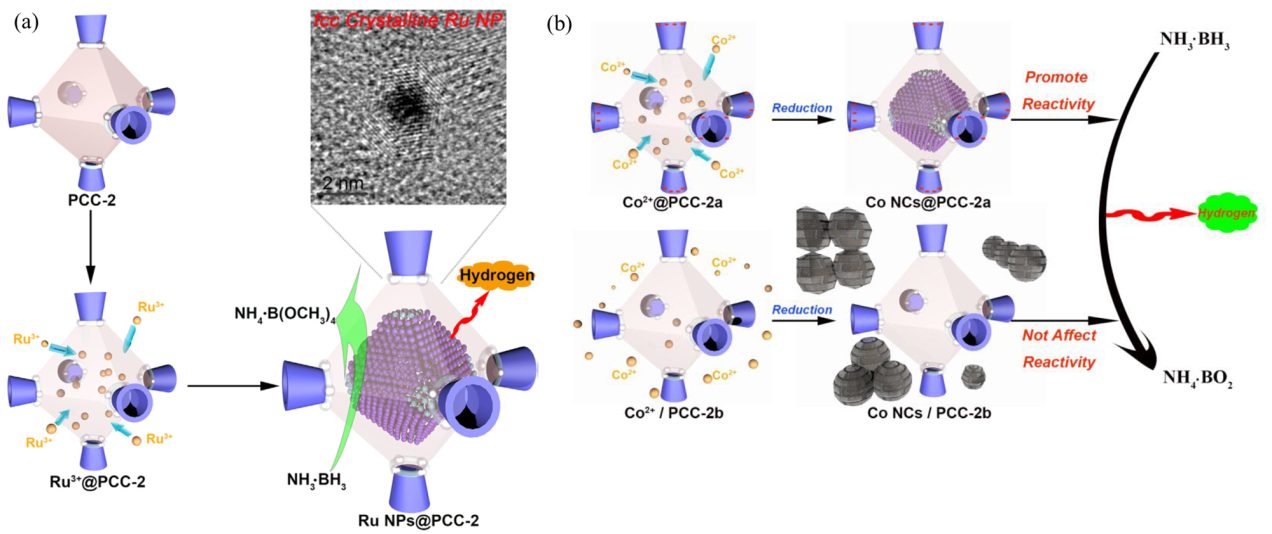
| Ru NPs@PCC-2a | 封装客体: Ru纳米颗粒 | 高负电荷笼(-30) 静电排斥/空间限域 | 氨硼烷甲醇解脱氢 | TOF: 304.4 min-1 (当时金属基催化剂最高值); 反应时间: 4.5 min内完成[n(H2)∶n(AB)=3.0∶1] | [ |
| Co NCs@PCC-2a, Co NCs@PCC-2b | 封装客体: Co 纳米簇 | 高负电荷笼(-30, PCC-2a) vs 低负电荷笼(-6, PCC-2b) (对比论证电荷效应关键作用) | 氨硼烷水解 | TOF (PCC-2a): 90.1 min-1 (第一过渡系金属最高); TOF (PCC-2b): 22.5 min-1 (严重聚集) | [ |
| Ru(bpy)3@PCC-2a | 封装客体(Ru(bpy)32+ 分子催化剂 | 共封装(催化剂+底物) | 光催化降解亚甲基蓝(MB) | 降解率(4 h): 94.9% (Ru(bpy)3@PCC-2a) vs 19.8% (游离Ru(bpy)32+); 循环性: 5次循环后活性保持>90% | [ |
| 催化体系 | 催化活性中心来源 | 核心结构/策略 | 催化应用 | 关键性能指标 | 文献 |
|---|---|---|---|---|---|
| MOSC-1, MOSC-2 | 金属簇节点: Brønsted酸性μ4-H2O | 空腔限域 静电别构调控 | Knoevenagel缩合 | 底物选择性: 1-芘甲醛, 产率67% vs 2-萘甲醛, 产率5% | [ |
| 1-Co, 1-Ni | 金属簇节点: M4TBSC, M=Co, Ni; 配体功能化: 吡啶鎓功能化 | 骨架离子化 静电微环境调控 | 电化学析氧反应(OER) | 过电位: 0.290 V @10 mA•cm-2 (1-Co); Tafel斜率: 75 mV•dec-1; 稳定性: 48 h连续电解无显著衰减 | [ |
| Cu4TBSC基分子笼 | 金属簇节点: 配位不饱和Cu(II)位点) | 结构缺陷 开放金属位点 | 伯醇选择性氧化(醇→羧酸) | 底物选择性: 4-甲氧基苄醇99%产率(4 h)、4-硝基苄醇仅得19%羧酸+74%醛(中间体); 循环性: 4次循环后活性保持>90% | [ |
| {M20V8} (M=Fe, Co, Ni)方锥纳米笼 | 金属簇节点: M20V8簇 | 金属替换 能带调控 | 可见光光热催化硫醚氧化脱硫 | 光热转换效率: Fe20V8 85.87%; 催化转化率: Fe20V8>99%; 性能排序: Fe20V8>>Co20V8>Ni20V8 | [ |
| Co-PYDC | 金属簇节点: 开放Co(II)位点+Brønsted酸性μ3-H2O | 缺陷工程 双活性区域(外腔/内腔) | 串联催化: 烯烃→β-氨基醇 | 一锅法转化率: 苯乙烯衍生物) 96%; 区域选择性: 仅生成β-位开环产物 | [ |
| 延长型八面体笼 | 配体功能化: -CH2NH- Brønsted碱 金属簇节点: Brønsted酸性μ4-H2O | 几何操纵(空腔拉伸) 酸碱双功能协同 | Knoevenagel缩合 | 底物1-芘甲醛, 产率89% | [ |
| 手性Mn(salen)笼 | 配体功能化: 手性Mn(salen)活性中心 | 骨架隔离 空腔限域 | 氧化动力学拆分 (仲醇)/烯烃环氧化 | 对映选择性(ee): 1-苯乙醇>99% (拆分产物); 选择性因子(krel): 最高35.0 (vs游离Mn(salen) 10.3~26.9); | [ |
| ImBDC-Co, ImBDC-Ni | 配体功能化: 咪唑鎓Lewis酸/卤素抗衡离子 | 离子型功能化配体 均相/异相结合 | CO2环加成反应 | 产物选择性:>99% (环氧氯丙烷); 底物范围: 脂肪族环氧化物产率>97%, 芳香族环氧化物>80%; 循环性: 3次循环无明显活性损失 | [ |
| 蒽醌基光催化笼 | 配体功能化: 蒽醌光敏剂 | 光活性骨架 空腔预组织 | 光催化[2+2]环加成(查尔酮) | 非对映选择性(dr): syn-HH∶anti-HT=13∶1; 转化率: 96% (12 h) | [ |
| PCC-15/16/17 | 配体功能化: -NH2- Brønsted碱) 金属簇节点: Brønsted酸性μ4-H2O | 活性位点间距精确调控: 调节-NH2-与μ4-H2O距离(从5.6 Å至12.4 Å) | Knoevenagel缩合 | 间距-活性关系: PCC-17 (5.6 Å) 96%产率>PCC-16 (12.4 Å) 21% 产率>PCC-15 (无-NH2)<5%产率; 底物范围: 多种芳香醛产率>95% | [ |
| Pt@CIAC-121 | 封装客体: Pt纳米簇 | S-锚点(化学) 空腔限域(物理) | 电解水析氢反应(HER) | 起始电位: -0.24 V (vs Ag/AgCl, 略正于Pt/C); 电流密度: 在-0.60 V时, Pt@CIAC-121为 20 mA•cm-2•µg-1 (Pt/C的2倍) | [ |
| Ru NPs@PCC-2a | 封装客体: Ru纳米颗粒 | 高负电荷笼(-30) 静电排斥/空间限域 | 氨硼烷甲醇解脱氢 | TOF: 304.4 min-1 (当时金属基催化剂最高值); 反应时间: 4.5 min内完成[n(H2)∶n(AB)=3.0∶1] | [ |
| Co NCs@PCC-2a, Co NCs@PCC-2b | 封装客体: Co 纳米簇 | 高负电荷笼(-30, PCC-2a) vs 低负电荷笼(-6, PCC-2b) (对比论证电荷效应关键作用) | 氨硼烷水解 | TOF (PCC-2a): 90.1 min-1 (第一过渡系金属最高); TOF (PCC-2b): 22.5 min-1 (严重聚集) | [ |
| Ru(bpy)3@PCC-2a | 封装客体(Ru(bpy)32+ 分子催化剂 | 共封装(催化剂+底物) | 光催化降解亚甲基蓝(MB) | 降解率(4 h): 94.9% (Ru(bpy)3@PCC-2a) vs 19.8% (游离Ru(bpy)32+); 循环性: 5次循环后活性保持>90% | [ |
| [1] |
doi: 10.1126/science.1159747 |
| [2] |
doi: 10.1021/cr0503106 pmid: 16895325 |
| [3] |
doi: 10.1038/nchem.2461 |
| [4] |
doi: 10.1038/nchem.744 pmid: 20651721 |
| [5] |
doi: 10.1039/C3CS60037H |
| [6] |
doi: 10.1039/c3cs35486e |
| [7] |
doi: 10.1002/chem.v19.20 |
| [8] |
doi: 10.1021/cs200171u |
| [9] |
doi: 10.1002/anie.v42:40 |
| [10] |
|
| [11] |
doi: 10.1016/j.ccr.2007.10.010 |
| [12] |
pmid: 11749254 |
| [13] |
doi: 10.1016/j.ccr.2025.216726 |
| [14] |
doi: 10.1021/cr200345v pmid: 22251425 |
| [15] |
doi: 10.1039/c2cs35254k pmid: 23032789 |
| [16] |
doi: 10.1021/cr200077m pmid: 21863792 |
| [17] |
doi: 10.1002/cjoc.v43.20 |
| [18] |
doi: 10.1016/j.ccr.2019.01.023 |
| [19] |
doi: 10.1002/chem.v25.3 |
| [20] |
doi: 10.1021/ja402630g |
| [21] |
doi: 10.1038/nchem.2452 pmid: 26892554 |
| [22] |
doi: 10.1021/acs.accounts.8b00261 |
| [23] |
doi: 10.1002/cjoc.v43.6 |
| [24] |
doi: 10.1002/cjoc.v43.9 |
| [25] |
doi: 10.6023/A23120538 |
|
(王敏, 陈帮塘, 陈桥林, 王俊, 陈名钊, 蒋志龙, 王平山, 化学学报, 2024, 82, 336.)
doi: 10.6023/A23120538 |
|
| [26] |
pmid: 17165689 |
| [27] |
doi: 10.1002/ejic.v2006:9 |
| [28] |
doi: 10.3390/molecules29061220 |
| [29] |
|
| [30] |
doi: 10.1016/j.ccr.2020.213656 |
| [31] |
doi: 10.1039/b614961h pmid: 18197342 |
| [32] |
doi: 10.1039/c9cs00091g pmid: 31339148 |
| [33] |
doi: 10.1016/j.ccr.2026.217842 |
| [34] |
doi: 10.1021/acs.jchemed.5c01732 |
| [35] |
doi: 10.1002/anie.v55.41 |
| [36] |
doi: 10.1039/C5QI00212E |
| [37] |
doi: 10.1039/C7TA05797K |
| [38] |
doi: 10.1007/s11426-023-1584-y |
| [39] |
doi: 10.1039/D5CC02007G |
| [40] |
doi: 10.1007/s11426-025-3004-8 |
| [41] |
doi: 10.1021/acs.accounts.4c00467 |
| [42] |
doi: 10.1016/S1872-2067(26)65001-2 |
| [43] |
doi: 10.31635/ccschem.021.202100987 |
| [44] |
doi: 10.1002/anie.v57.8 |
| [45] |
doi: 10.1039/D0CC08098E |
| [46] |
doi: 10.1039/D1DT00652E |
| [47] |
doi: 10.1002/sstr.v7.3 |
| [48] |
doi: 10.1039/D4SC08729A |
| [49] |
doi: 10.1007/s11426-024-2168-4 |
| [50] |
doi: 10.1021/jacs.6b11218 |
| [51] |
doi: 10.1016/j.chempr.2018.01.004 |
| [52] |
doi: 10.1002/anie.v57.19 |
| [53] |
doi: 10.1039/c8sc05315d pmid: 30996944 |
| [1] | 徐袁利, 潘辉, 杨义, 左智伟. 连续流条件下蒽-铈协同催化的苄位碳氢键选择性氧化反应★[J]. 化学学报, 2023, 81(5): 435-440. |
| [2] | 郭彩霞, 马小杰, 王博. 金属有机框架基复合材料的制备及其光热性能研究[J]. 化学学报, 2021, 79(8): 967-985. |
| [3] | 张洪浩, 俞寿云. 过渡金属与光氧化还原协同催化的烯丙基取代反应的研究进展[J]. 化学学报, 2019, 77(9): 832-840. |
| [4] | 焦阳, 张希. 超分子自由基:构筑、调控与功能[J]. 化学学报, 2018, 76(9): 659-665. |
| [5] | Khan Ijaz, 李红芳, 吴学, 张勇健. 钯配合物与手性方酰胺协同催化的乙烯基碳酸乙烯酯与醛的不对称脱羧环加成反应[J]. 化学学报, 2018, 76(11): 874-877. |
| [6] | 周锵, 陆平. 手性路易斯碱和过渡金属协同催化反应的进展[J]. 化学学报, 2018, 76(11): 825-830. |
| [7] | 余思凡, 傅祥, 刘耿鑫, 邱晃, 胡文浩. 通过不对称多组分反应高效构建手性磺酰胺类化合物[J]. 化学学报, 2018, 76(11): 895-900. |
| [8] | 王乐明, 王骞, 陈杰安, 黄湧. Lewis酸对氮杂环卡宾协同催化体系中反应途径的调控[J]. 化学学报, 2018, 76(11): 850-856. |
| [9] | 张毛毛, 骆元元, 陆良秋, 肖文精. 过渡金属与有机小分子协同催化的不对称烯丙基取代反应研究进展[J]. 化学学报, 2018, 76(11): 838-849. |
| [10] | 王德红, 张龙, 罗三中. 催化不对称光诱导自由基反应[J]. 化学学报, 2017, 75(1): 22-33. |
| 阅读次数 | ||||||
|
全文 |
|
|||||
|
摘要 |
|
|||||
