

化学学报 ›› 2026, Vol. 84 ›› Issue (8): 1294-1304.DOI: 10.6023/A26060225 上一篇 下一篇
研究论文
王天祥, 王梦蝶, 周嘉榆, 张玺宇, 张燕霞, 王伟杰, 张雨生, 张尧赫, 赵永青*( )
)
投稿日期:2026-06-25
发布日期:2026-09-01
作者简介:★“纪念兰州大学化学学科创建80周年”专辑
基金资助:
Tianxiang Wang†, Mengdie Wang†, Jiayu Zhou, Xiyu Zhang, Yan-Xia Zhang, Weijie Wang, Yusheng Zhang, Yaohe Zhang, Yong-Qing Zhao*()
Received:2026-06-25
Published:2026-09-01
Contact:
E-mail: About author:These authors contributed equally to this work
★For the VSI “Celebration of 80th Anniversary of Chemistry in Lanzhou University”
Supported by:文章分享
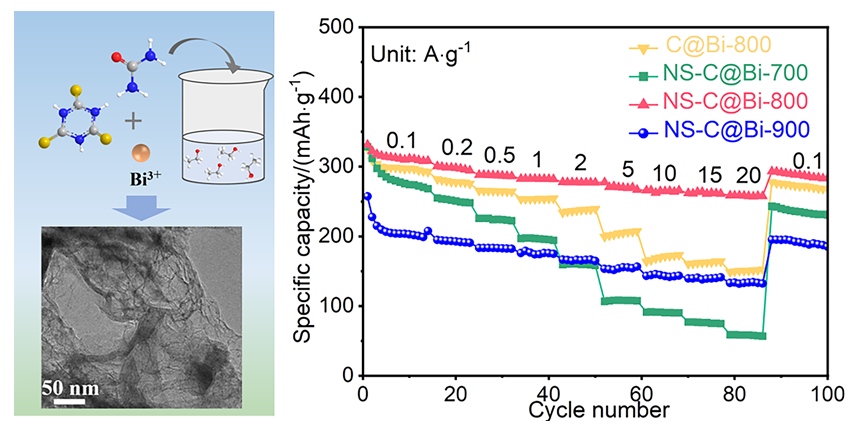
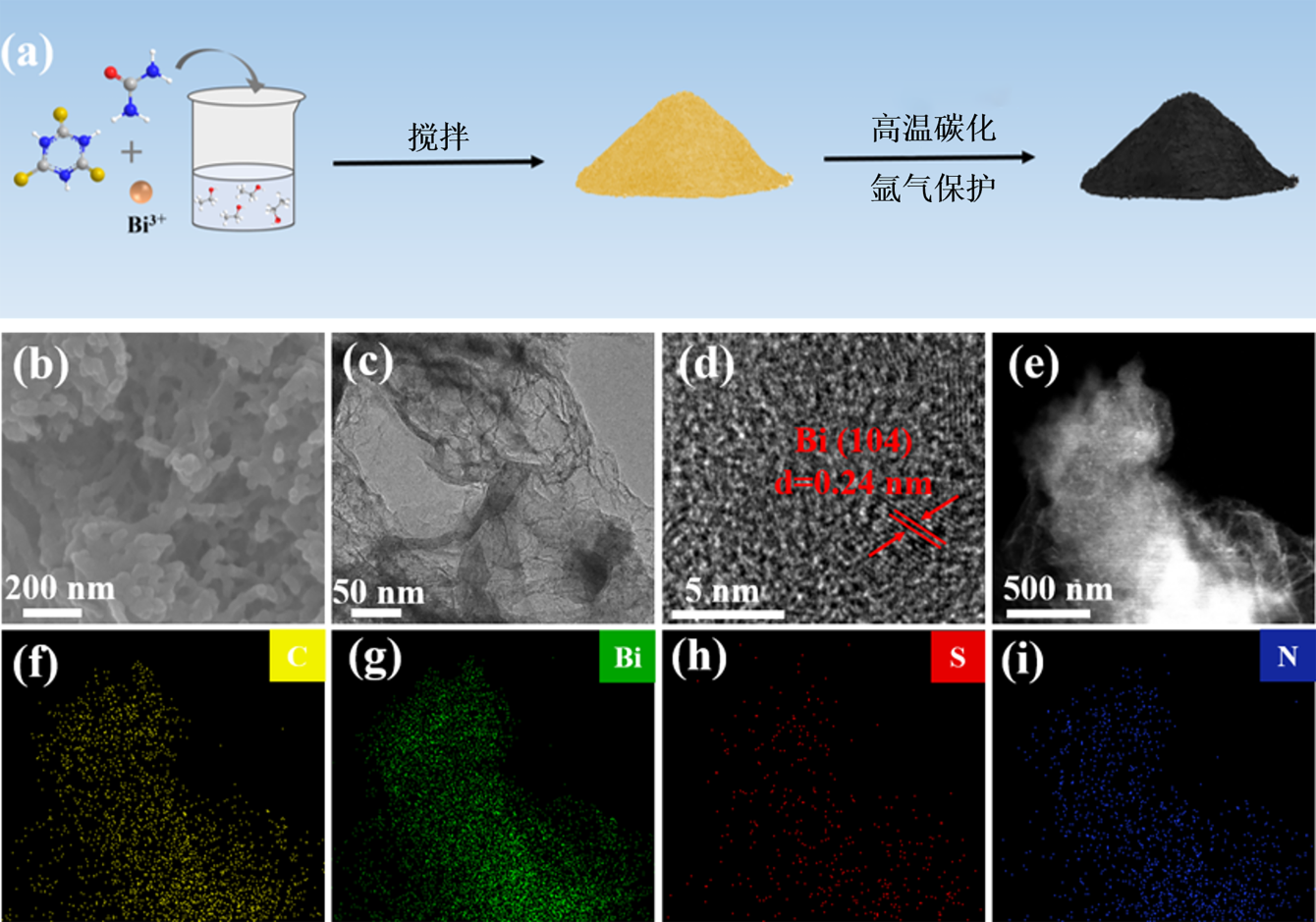
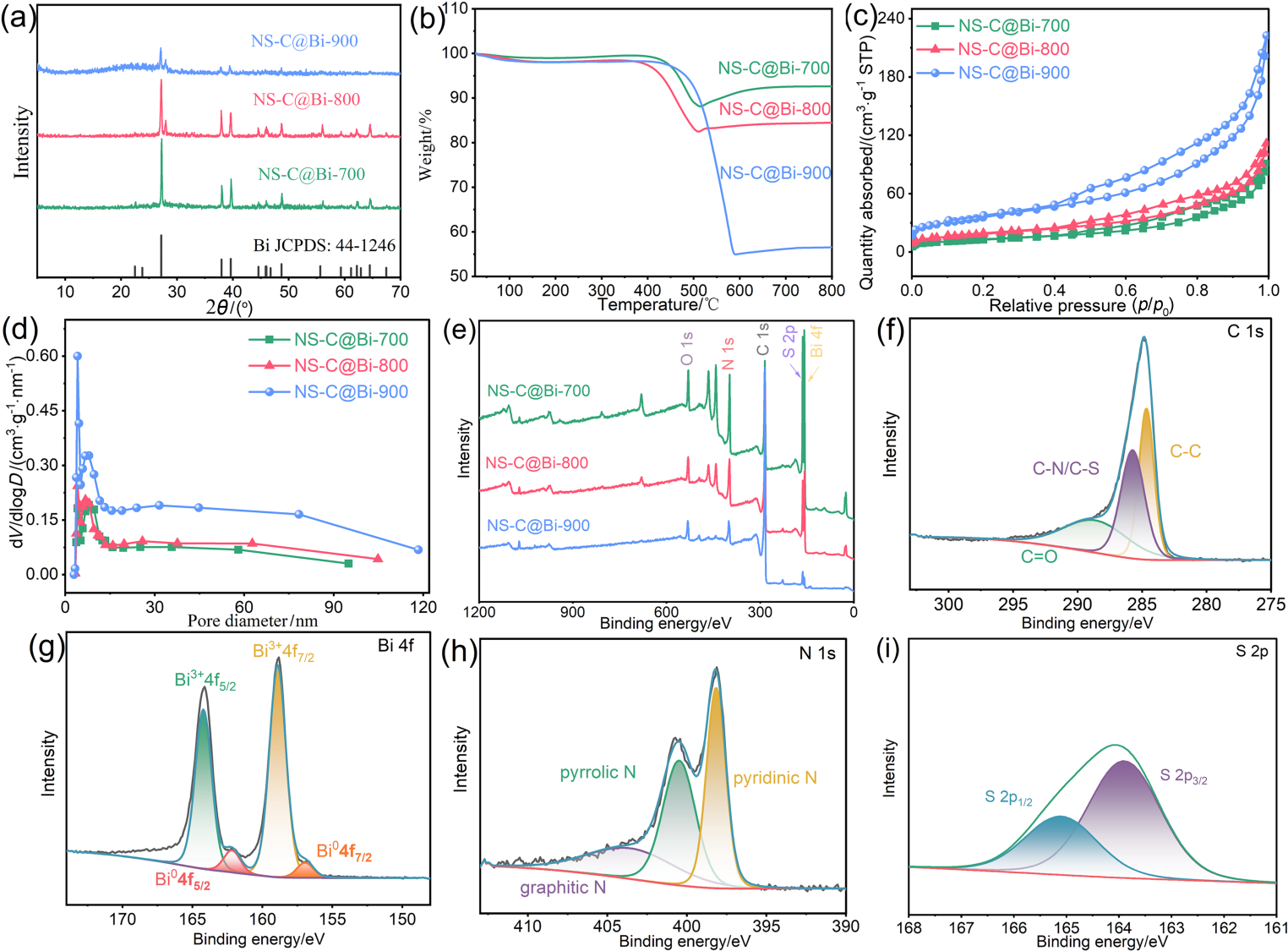
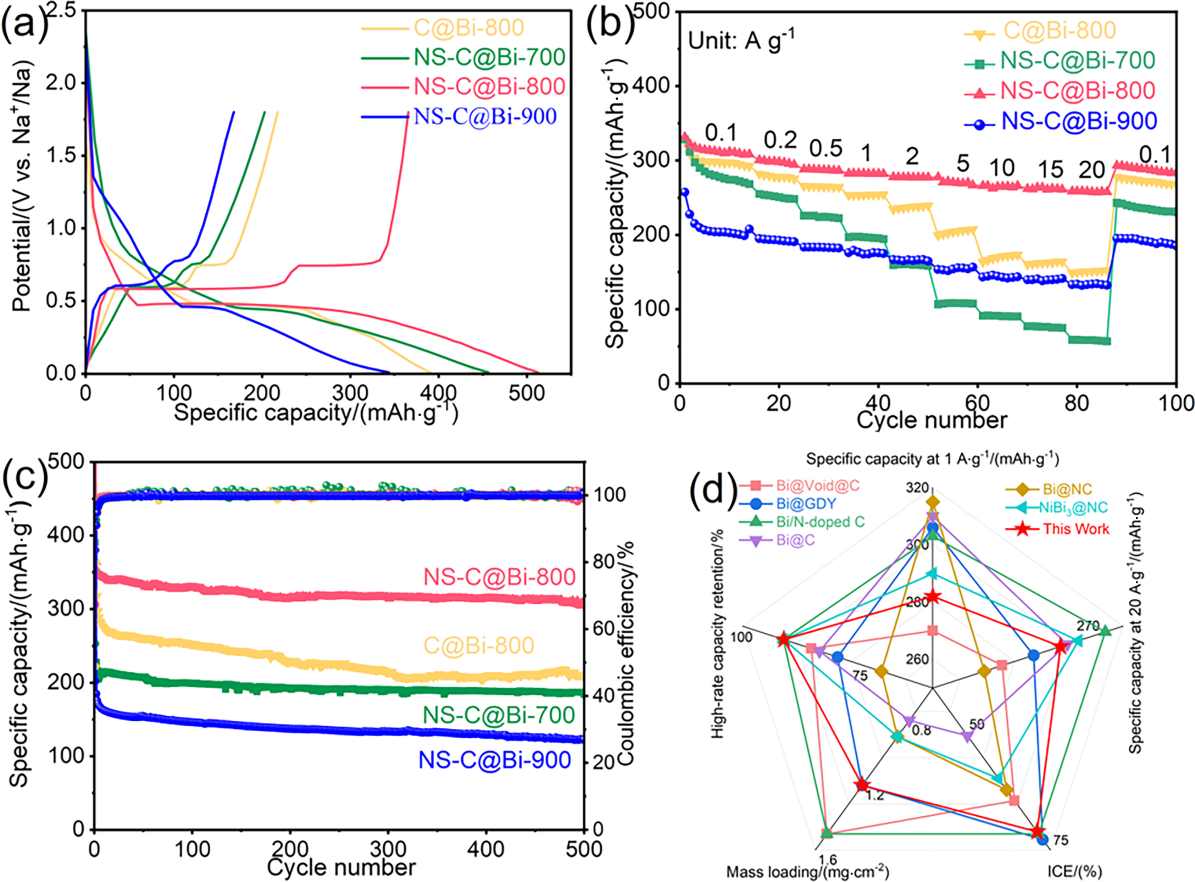
金属铋(Bi)是一种极具应用潜力的钠离子电池(SIBs)负极材料, 因其具有高理论比容量以及安全的储钠电位等优势而备受关注. 然而, 其存在较差的本征导电性、迟缓的Na+嵌入/脱出反应动力学, 以及充放电过程中易发生体积膨胀等问题, 严重制约了其实用化进程. 针对该问题, 本工作提出了一种氮/硫共掺杂碳包覆策略, 以期高效提升铋基负极的高倍率储钠性能. 通过简便的液相共沉淀结合高温碳化策略, 制备了一类铋/氮硫共掺杂碳复合材料(NS-C@Bi-X). 在该材料体系中, N、S共掺杂的碳层不仅提升了材料导电性, 并提供丰富的储钠活性位点, 而互联开放的碳包覆网络结构有效缓冲了Bi纳米颗粒的体积膨胀. 其中NS-C@Bi-800展现出卓越的储钠倍率性能与优秀的循环稳定性: 20 A•g-1的超高电流密度下仍具有257 mAh•g-1的高比容量; 1 A•g-1下循环500圈后, 比容量仍可维持在304 mAh•g-1, 容量保持率可达87%. 此外, 经解析其组成结构与储钠动力学之间的关系, 阐明了其具备高倍率响应与大电流充放电耐受性的工作机制.
王天祥, 王梦蝶, 周嘉榆, 张玺宇, 张燕霞, 王伟杰, 张雨生, 张尧赫, 赵永青. 氮/硫共掺杂碳包覆策略解锁铋基负极高倍率储钠性能★[J]. 化学学报, 2026, 84(8): 1294-1304.
Tianxiang Wang, Mengdie Wang, Jiayu Zhou, Xiyu Zhang, Yan-Xia Zhang, Weijie Wang, Yusheng Zhang, Yaohe Zhang, Yong-Qing Zhao. Unlocking High-Rate Sodium Storage Performance of Bismuth-based Anodes via Nitrogen/Sulfur Co-Doped Carbon Coating Strategy★[J]. Acta Chimica Sinica, 2026, 84(8): 1294-1304.
| [1] |
doi: 10.1016/j.nanoen.2024.109996 |
| [2] |
doi: 10.1038/s41558-020-00975-7 |
| [3] |
doi: 10.6023/A25060228 |
|
(张贤碧, 项爽, 唐有根, 孙旦, 李欢欢, 王海燕, 化学学报, 2025, 83, 947.)
doi: 10.6023/A25060228 |
|
| [4] |
doi: 10.1039/C6CS00823B |
| [5] |
|
| [6] |
doi: 10.1038/nchem.680 |
| [7] |
doi: 10.1002/aenm.v9.20 |
| [8] |
doi: 10.1016/j.cej.2017.10.007 |
| [9] |
doi: 10.6023/A26010013 |
|
(赵紫璞, 孙雨涵, 张静洁, 郭文迪, 鲍晓冰, 罗巧梅, 苟蕾, 樊小勇, 化学学报, 2026, 84, 871.)
doi: 10.6023/A26010013 |
|
| [10] |
doi: 10.1016/j.cej.2022.138882 |
| [11] |
doi: 10.1039/C9TA13377A |
| [12] |
doi: 10.1021/acs.nanolett.9b04829 |
| [13] |
|
| [14] |
doi: 10.1021/acsnano.3c02892 |
| [15] |
doi: 10.1002/smll.v17.9 |
| [16] |
doi: 10.1002/aenm.v9.42 |
| [17] |
doi: 10.1016/j.jechem.2021.11.011 |
| [18] |
doi: 10.1002/adma.v38.1 |
| [19] |
doi: 10.1039/D1TA06558K |
| [20] |
|
| [21] |
doi: 10.1016/j.cej.2017.03.054 |
| [22] |
doi: 10.1021/acs.nanolett.8b05189 |
| [23] |
doi: 10.1021/acssuschemeng.2c01798 |
| [24] |
doi: 10.1021/acsaem.9b01799 |
| [25] |
doi: 10.1016/j.cej.2024.152505 |
| [26] |
doi: 10.1039/D0TA02414G |
| [27] |
doi: 10.1002/smll.v13.36 |
| [28] |
|
| [29] |
doi: 10.1016/j.compositesb.2025.112538 |
| [30] |
doi: 10.1021/acsnano.9b06629 |
| [31] |
doi: 10.1016/j.jpowsour.2025.237471 |
| [32] |
doi: 10.1016/j.est.2023.110339 |
| [33] |
doi: 10.1016/j.est.2024.113746 |
| [34] |
doi: 10.1016/j.jechem.2017.11.022 |
| [35] |
doi: 10.1002/adma.v31.48 |
| [36] |
doi: 10.1039/D3DT01015E |
| [37] |
doi: 10.1016/j.carbon.2025.120821 |
| [38] |
doi: 10.1016/j.cej.2024.150872 |
| [39] |
|
| [40] |
|
| [41] |
doi: 10.1002/aenm.v10.36 |
| [42] |
doi: 10.1002/adfm.v33.16 |
| [43] |
doi: 10.1021/acsami.2c05262 |
| [44] |
doi: 10.1016/j.cej.2022.138824 |
| [45] |
doi: 10.1002/adma.v32.8 |
| [46] |
|
| [47] |
doi: 10.1039/D6EE00760K |
| [48] |
doi: 10.1002/adma.v38.35 |
| [49] |
doi: 10.1039/D4EE05871B |
| [50] |
doi: 10.1016/j.cej.2025.162747 |
| [51] |
doi: 10.1016/j.actamat.2026.122547 |
| [52] |
doi: 10.1016/j.cej.2024.155880 |
| [53] |
doi: 10.1016/S1872-5805(25)61015-8 |
| [54] |
doi: 10.1016/j.jechem.2025.06.035 |
| [55] |
doi: 10.1002/cey2.v6.9 |
| [56] |
doi: 10.1021/acsami.1c03642 |
| [57] |
doi: 10.1002/adfm.v31.2 |
| [58] |
doi: 10.1007/s12598-024-03017-9 |
| [1] | 赵紫璞, 孙雨涵, 张静洁, 郭文迪, 鲍晓冰, 罗巧梅, 苟蕾, 樊小勇. 钴掺杂提升夏威夷果壳基硬碳的储钠稳定性和高倍率容量[J]. 化学学报, 2026, 84(6): 871-878. |
| [2] | 张庆堂, 杜纯阳, 高鹏飞, 王晓梅. 富锰P2/P3双相Na0.67Mn0.9Ni0.1O2自蔓延燃烧合成与储钠性能[J]. 化学学报, 2026, 84(1): 64-72. |
| [3] | 张贤碧, 项爽, 唐有根, 孙旦, 李欢欢, 王海燕. 钠离子电池硫酸铁钠正极的关键问题及设计策略★[J]. 化学学报, 2025, 83(8): 947-961. |
| [4] | 马慧, 张桓荣, 薛面起. 水系钠离子电池的研究进展及实用化挑战[J]. 化学学报, 2021, 79(4): 388-405. |
| [5] | 董瑞琪, 吴锋, 白莹, 吴川. 钠离子电池硬碳负极储钠机理及优化策略[J]. 化学学报, 2021, 79(12): 1461-1476. |
| [6] | 谢佶晟, 肖竹梅, 左文华, 杨勇. 钠离子电池钴酸钠正极材料研究进展[J]. 化学学报, 2021, 79(10): 1232-1243. |
| [7] | 宋学霞, 李继成, 李朝晖, 李喜飞, 丁燕怀, 肖启振, 雷钢铁. 钾掺杂对钒酸钠纳米片储钠性能的影响[J]. 化学学报, 2019, 77(7): 625-633. |
| [8] | 渠璐平, 任彤, 王宁, 史月丽, 庄全超. 硬碳材料电极首周嵌钠过程的电化学阻抗谱研究[J]. 化学学报, 2019, 77(7): 634-640. |
| [9] | 王玲, 杨国锐, 王嘉楠, 王思岚, 彭生杰, 延卫. 静电纺丝在钠离子电池中的应用研究进展[J]. 化学学报, 2018, 76(9): 666-680. |
| [10] | 李攀, 刘建, 孙惟袆, 陶占良, 陈军. 铜钱状二硫化钒的制备及储钠性能研究[J]. 化学学报, 2018, 76(4): 286-291. |
| [11] | 郑卓, 吴振国, 向伟, 郭孝东. 高倍率球形锂离子电池正极材料LiNi0.5Co0.2Mn0.3O2的制备及其电化学性能研究[J]. 化学学报, 2017, 75(5): 501-507. |
| [12] | 张思伟, 张俊, 吴思达, 吕伟, 康飞宇, 杨全红. 钠离子电池用碳负极材料研究进展[J]. 化学学报, 2017, 75(2): 163-172. |
| [13] | 刘丽露, 戚兴国, 胡勇胜, 陈立泉, 黄学杰. 钠离子电池新型Cu基隧道型氧化物正极材料研究[J]. 化学学报, 2017, 75(2): 218-224. |
| [14] | 向兴德, 卢艳莹, 陈军. 钠离子电池先进功能材料的研究进展[J]. 化学学报, 2017, 75(2): 154-162. |
| [15] | 李慧, 吴川, 吴锋, 白莹. 钠离子电池:储能电池的一种新选择[J]. 化学学报, 2014, 72(1): 21-29. |
| 阅读次数 | ||||||
|
全文 |
|
|||||
|
摘要 |
|
|||||
