

化学学报 ›› 2025, Vol. 83 ›› Issue (11): 1317-1323.DOI: 10.6023/A25060223 上一篇 下一篇
研究论文
闫安, 许世攀, 杜旭洋, 刘文平, 赵堃翔, 李胜利, 钟道昆, 周桂江*( ), 杨晓龙*(), 孙源慧*()
投稿日期:2025-06-17
发布日期:2025-07-09
基金资助:
Yan An, Xu Shipan, Du Xuyang, Liu Wenping, Zhao Kunxiang, Li Shengli, Zhong Daokun, Zhou Guijiang*(), Yang Xiaolong*(), Sun Yuanhui*()
Received:2025-06-17
Published:2025-07-09
Contact:
*E-mail: zhougj@xjtu.edu.cn;
xiaolongyang@xjtu.edu.cn;
sunyuanhui@xjtu.edu.cn
Supported by:文章分享

有机电致发光技术已广泛应用于全彩柔性显示和固态照明领域. 蓝色作为三原色之一, 蓝光材料是有机发光二极管(OLED)应用领域的研究重点. 将3,6-二叔丁基咔唑引入至联吡啶氮原子的邻、间和对位, 构建了三种不同的发光材料. 该材料中咔唑取代基与联吡啶核心发生强烈的扭曲, 形成位阻诱导的扭曲结构. 这种分子结构有效限制分子共轭体系的长度, 并抑制分子内振动对能量的消耗, 从而确保了蓝光具有很高的色纯度. 2,2'-双(3,6-二叔丁基-9H-咔唑-9-基)-3,3'-联吡啶(2TCzOBPy)和4,4'-双(3,6-二叔丁基-9H-咔唑-9-基)-3,3'-联吡啶(2TCzPBPy)器件的CIE坐标分别为(0.152, 0.063)和(0.172, 0.098), 它们的色度坐标y值均小于0.1, 属于高色纯度的深蓝光. 此外, 3,3'-双(3,6-二叔丁基-9H-咔唑-9-基)-4,4'-联吡啶(2TCzMBPy)器件获得的最大外量子效率(EQE)为3.6%, 获得最大亮度为5423 cd•m−2.
闫安, 许世攀, 杜旭洋, 刘文平, 赵堃翔, 李胜利, 钟道昆, 周桂江, 杨晓龙, 孙源慧. 位阻诱导扭曲结构的蓝光材料合成及其在蓝色有机发光二极管(OLED)中的应用[J]. 化学学报, 2025, 83(11): 1317-1323.
Yan An, Xu Shipan, Du Xuyang, Liu Wenping, Zhao Kunxiang, Li Shengli, Zhong Daokun, Zhou Guijiang, Yang Xiaolong, Sun Yuanhui. Synthesis of Blue-Emitting Materials with Sterically Induced Twisted Structures and Their Application in Blue Organic Light-Emitting Diode (OLED)[J]. Acta Chimica Sinica, 2025, 83(11): 1317-1323.


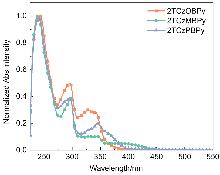
| Compound | Absorptiona/nm | Emissionb/nm | τb/ns | PLQYb/% | Td/℃ |
|---|---|---|---|---|---|
| 2TCzOBPy | 243, 295, 328, 342 | 440 | 2.8 | 50.7 | 337 |
| 2TCzMBPy | 239, 297, 345, 391 | 487 | 11.6 | 94.4 | 317 |
| 2TCzPBPy | 241, 296, 344 | 422 | 3.2 | 38.0 | 340 |
| Compound | Absorptiona/nm | Emissionb/nm | τb/ns | PLQYb/% | Td/℃ |
|---|---|---|---|---|---|
| 2TCzOBPy | 243, 295, 328, 342 | 440 | 2.8 | 50.7 | 337 |
| 2TCzMBPy | 239, 297, 345, 391 | 487 | 11.6 | 94.4 | 317 |
| 2TCzPBPy | 241, 296, 344 | 422 | 3.2 | 38.0 | 340 |


| Device | Vona/V | Lmaxb/(cd•m−2) | EQEc/% | CEd/(cd•A−1) | PEe/(lm•W−1) | λEL/nm | CIE (x, y) |
|---|---|---|---|---|---|---|---|
| 2TCzOBPy | 4.5 | 2888 | 2.4/2.3 | 5.4 | 2.9 | 437 | (0.172, 0.098) |
| 2TCzMBPy | 4.6 | 5423 | 3.6/2.4 | 11.2 | 6.3 | 496 | (0.224, 0.399) |
| 2TCzPBPy | 5.4 | 71 | 0.5/— | 0.3 | 0.2 | 416 | (0.152, 0.063) |
| Device | Vona/V | Lmaxb/(cd•m−2) | EQEc/% | CEd/(cd•A−1) | PEe/(lm•W−1) | λEL/nm | CIE (x, y) |
|---|---|---|---|---|---|---|---|
| 2TCzOBPy | 4.5 | 2888 | 2.4/2.3 | 5.4 | 2.9 | 437 | (0.172, 0.098) |
| 2TCzMBPy | 4.6 | 5423 | 3.6/2.4 | 11.2 | 6.3 | 496 | (0.224, 0.399) |
| 2TCzPBPy | 5.4 | 71 | 0.5/— | 0.3 | 0.2 | 416 | (0.152, 0.063) |
| [1] |
doi: 10.1038/s41566-024-01508-w |
| [2] |
doi: 10.1002/adma.v32.35 |
| [3] |
doi: 10.1002/adfm.v35.5 |
| [4] |
doi: 10.6023/A24100310 |
|
(马金珠, 李阳, 高珊, 赵越, 丁磊, 周东营, 樊健, 化学学报, 2025, 83, 17.)
doi: 10.6023/A24100310 |
|
| [5] |
doi: 10.1038/nature11687 |
| [6] |
doi: 10.6023/cjoc202207042 |
|
(连铭槟, 叶泽聪, 穆英啸, 胡德华, 刘源, 张浩力, 籍少敏, 霍延平, 有机化学, 2023, 43, 573.)
doi: 10.6023/cjoc202207042 |
|
| [7] |
doi: 10.1002/adma.v33.9 |
| [8] |
doi: 10.1002/adma.v28.14 |
| [9] |
doi: 10.6023/cjoc201807007 |
|
(邱志鹏, 谭继华, 蔡宁, 王凯, 籍少敏, 霍延平, 有机化学, 2019, 39, 679.)
doi: 10.6023/cjoc201807007 |
|
| [10] |
doi: 10.3390/nano13182521 |
| [11] |
doi: 10.1016/j.optmat.2019.03.043 |
| [12] |
doi: 10.1039/D4CC02880E |
| [13] |
doi: 10.1038/s41566-022-00958-4 |
| [14] |
doi: 10.6023/A23040187 |
|
(陶鹏, 郑小康, 王国良, 盛星浩, 姜贺, 李文桃, 靳继彪, 王瑞鸿, 苗艳勤, 王华, 黄维扬, 化学学报, 2023, 81, 891.)
doi: 10.6023/A23040187 |
|
| [15] |
|
|
(谭继华, 霍延平, 蔡宁, 籍少敏, 李宗植, 张力, 有机化学, 2017, 37, 2457.)
doi: 10.6023/cjoc201704015 |
|
| [16] |
doi: 10.6023/A23040119 |
|
(刘振宇, 饶俊峰, 祝守加, 王兵洋, 余帆, 冯全友, 解令海, 化学学报, 2023, 81, 820.)
doi: 10.6023/A23040119 |
|
| [17] |
doi: 10.1038/s41467-023-37687-3 |
| [18] |
doi: 10.1021/ja809046p |
| [19] |
doi: 10.1002/advs.v11.38 |
| [20] |
doi: 10.1039/C6CS00368K |
| [21] |
doi: 10.1039/C8TC06293E |
| [22] |
doi: 10.6023/A23040186 |
|
(王一诺, 邵世洋, 王利祥, 化学学报, 2023, 81, 1202.)
doi: 10.6023/A23040186 |
|
| [23] |
doi: 10.1021/acs.chemmater.6b05324 |
| [24] |
doi: 10.1016/j.cej.2021.129097 |
| [25] |
|
| [26] |
doi: 10.1002/adom.v13.10 |
| [27] |
doi: 10.1002/adfm.v35.27 |
| [28] |
doi: 10.1039/D1NJ02492B |
| [29] |
doi: 10.1021/acsami.3c11702 |
| [30] |
doi: 10.1039/D1TC02081A |
| [31] |
doi: 10.1016/j.dyepig.2020.109088 |
| [32] |
doi: 10.1002/adfm.v34.48 |
| [33] |
|
| [1] | 方素琴, 童恺宁, 陈思浛, 张千峰, 童碧海, 冯敏强, 孔辉. 基于呫吨酮电子受体的高效圆偏振热活化延迟荧光材料[J]. 化学学报, 2025, 83(5): 471-478. |
| [2] | 朱韵飞, 郭可威, 王子路, 李昊, 朱爱云, 马靖尧, 祝守加, 冯全友, 解令海. 芴基功能化D-A型可拉伸电致发光聚合物及其发光二极管[J]. 化学学报, 2025, 83(11): 1300-1308. |
| [3] | 王敏, 陈帮塘, 陈桥林, 王俊, 陈名钊, 蒋志龙, 王平山. 6,6″-二(2,6-二甲氧基苯)-三联吡啶及其衍生物金属配位自组装的研究进展[J]. 化学学报, 2024, 82(3): 336-347. |
| [4] | 王一诺, 邵世洋, 王利祥. 窄谱带多重共振有机高分子荧光材料研究进展★[J]. 化学学报, 2023, 81(9): 1202-1214. |
| [5] | 葛凤洁, 张开志, 曹清鹏, 徐慧, 周涛, 张文浩, 班鑫鑫, 张晓波, 李娜, 朱鹏. 柔性芴基嵌段型延迟荧光二聚体的设计、合成及电致发光性能[J]. 化学学报, 2023, 81(9): 1157-1166. |
| [6] | 刘振宇, 饶俊峰, 祝守加, 王兵洋, 余帆, 冯全友, 解令海. 溶液加工型自主体热活化延迟荧光材料的研究进展[J]. 化学学报, 2023, 81(7): 820-835. |
| [7] | 任妍妍, 李欣, 韩英锋. 基于氮杂环卡宾蓝光有机自由基的合成及其光学性质研究★[J]. 化学学报, 2023, 81(7): 735-740. |
| [8] | 张璇, 熊军, 张旺. 通过聚(3,4-乙烯二氧噻吩)-聚苯乙烯磺酸改性实现高性能蓝色钙钛矿发光二极管[J]. 化学学报, 2023, 81(12): 1695-1700. |
| [9] | 李志凯, 罗思琪, 陈敏, 於秀君, 李霄鹏. 双三联吡啶钌配合物的研究进展★[J]. 化学学报, 2023, 81(10): 1447-1461. |
| [10] | 周路, 陈嘉雄, 籍少敏, 陈文铖, 霍延平. 喹喔啉类红光热活化延迟荧光材料研究进展[J]. 化学学报, 2022, 80(3): 359-372. |
| [11] | 周静, 田雪迎, 王斌凯, 张沙沙, 刘宗豪, 陈炜. 低温原子层沉积封装技术在OLED上的应用及对有机、钙钛矿太阳能电池封装的启示[J]. 化学学报, 2022, 80(3): 395-422. |
| [12] | 周涛, 钱越, 王宏健, 冯全友, 解令海, 黄维. 热活化延迟荧光蓝光小分子取代基效应的研究进展[J]. 化学学报, 2021, 79(5): 557-574. |
| [13] | 梁志鹏, 唐瑞, 邱雨晨, 王阳, 陆洪彬, 吴正光. 基于八氢联萘酚的大位阻手性发光材料构建及光电性质研究[J]. 化学学报, 2021, 79(11): 1401-1408. |
| [14] | 李媛, 刘文娜, 郑行望. 四(三羟甲基氨基甲烷)合铜(II)电催化联吡啶钌/二氧化硅复合纳米粒子电化学发光分析特性研究[J]. 化学学报, 2015, 73(7): 749-754. |
| [15] | 王芳芳, 陶友田, 黄维. 高效蓝光有机电致磷光主体材料的研究进展[J]. 化学学报, 2015, 73(1): 9-22. |
| 阅读次数 | ||||||
|
全文 |
|
|||||
|
摘要 |
|
|||||
