

化学学报 ›› 2026, Vol. 84 ›› Issue (3): 324-332.DOI: 10.6023/A25120395 上一篇 下一篇
研究论文
周平凡, 邓玉雪, 黄鹏, 马洪芳, 吴岭, 曲会鑫, 申来法*( ), 许真铭*(), 张校刚*(), 佟浩*()
投稿日期:2025-12-05
发布日期:2026-02-24
基金资助:
Zhou Pingfan, Deng Yuxue, Huang Peng, Ma Hongfang, Wu Ling, Qu Huixin, Shen Laifa*(), Xu Zhenming*(), Zhang Xiaogang*(), Tong Hao*()
Received:2025-12-05
Published:2026-02-24
Contact:
*E-mail: lfshen@nuaa.edu.cn;
xuzhenming@nuaa.edu.cn;
azhangxg@nuaa.edu.cn;
tongh@nuaa.edu.cn
Supported by:文章分享
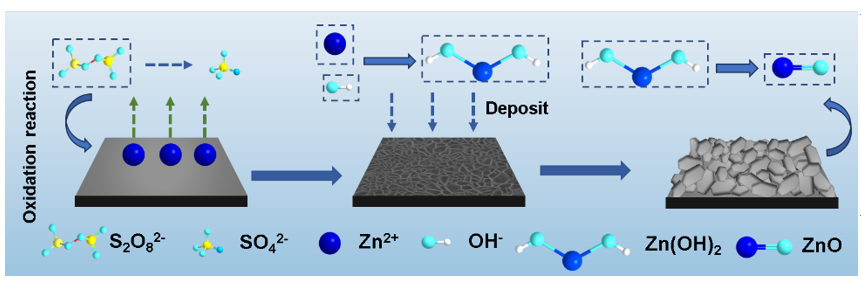
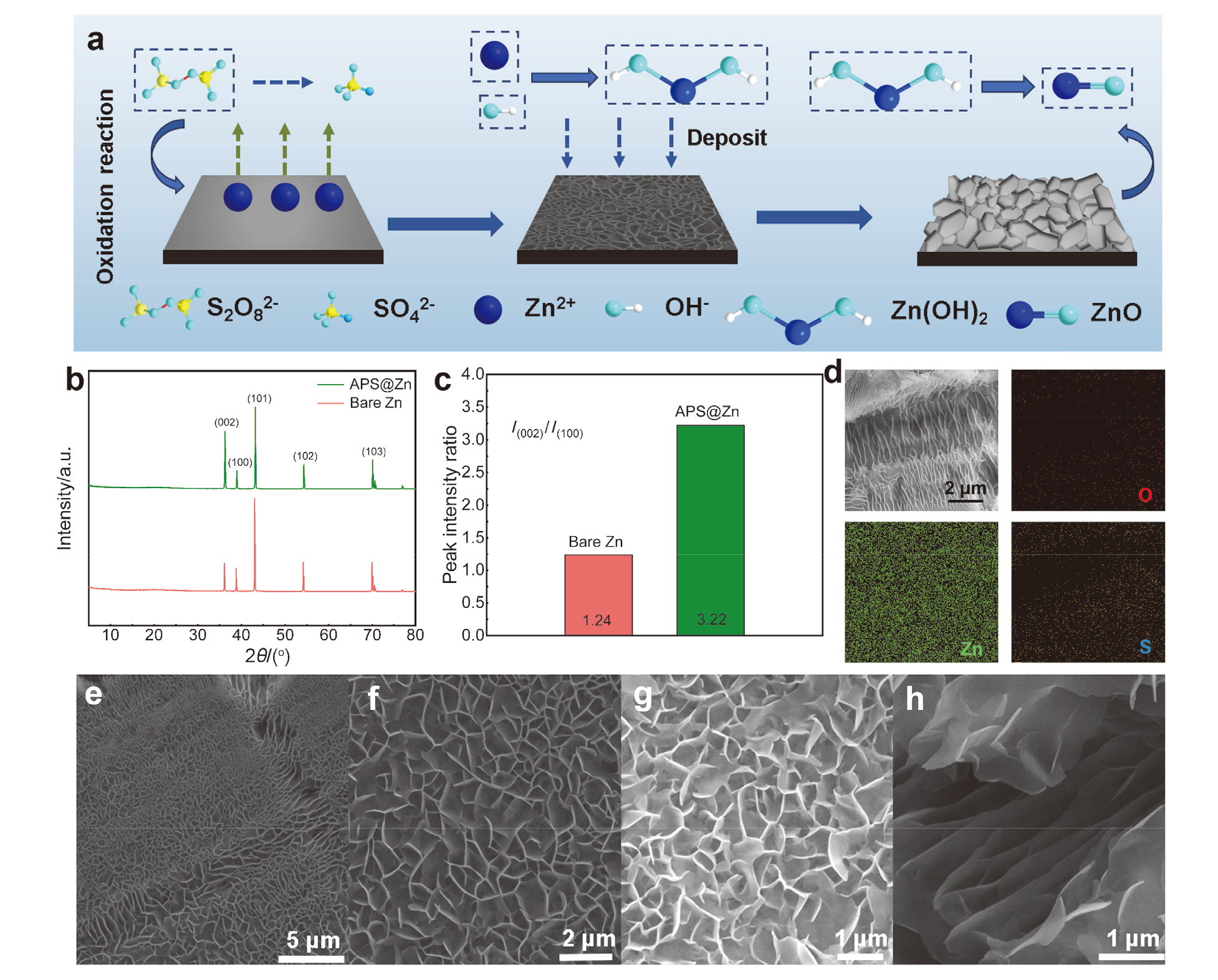
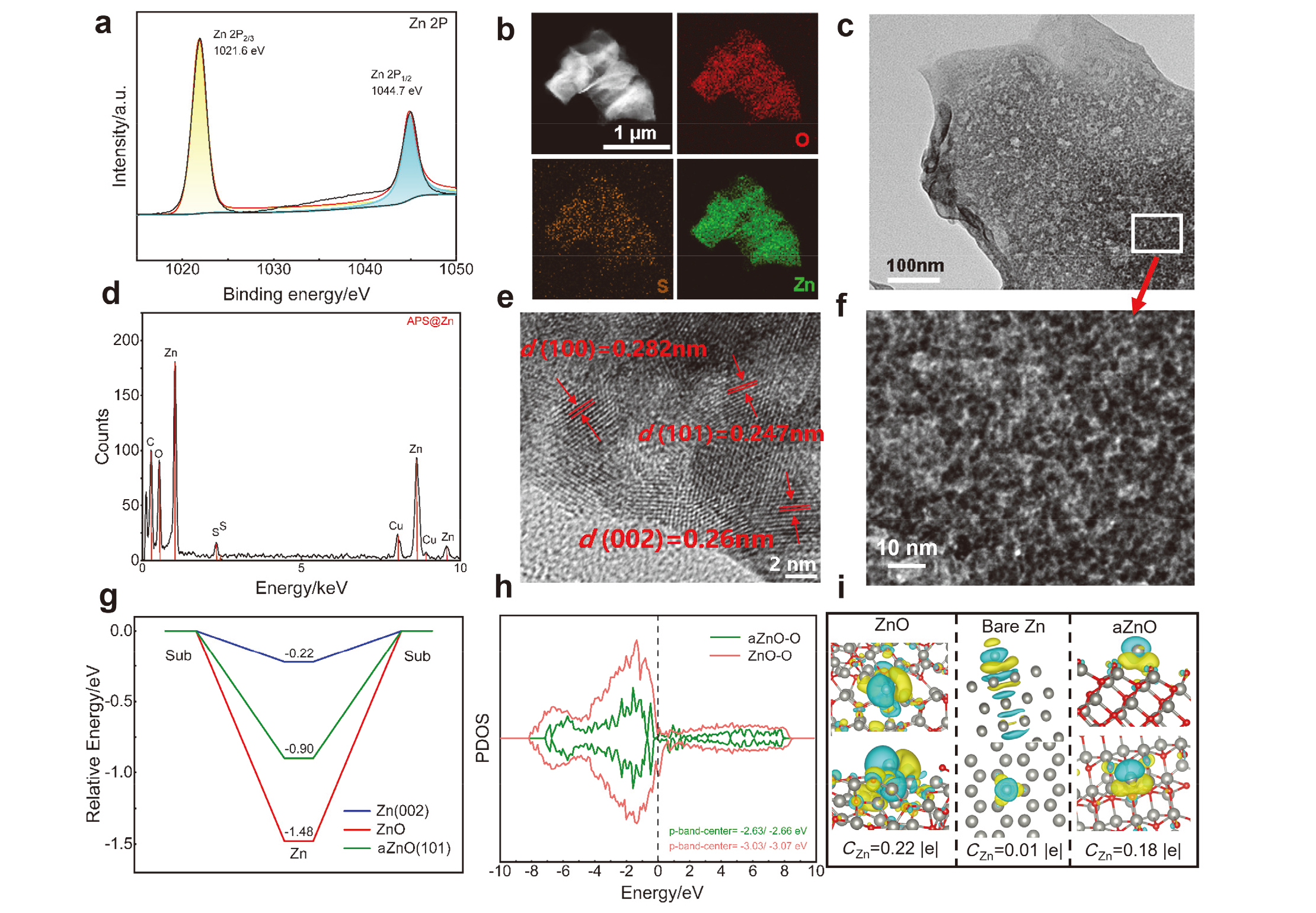
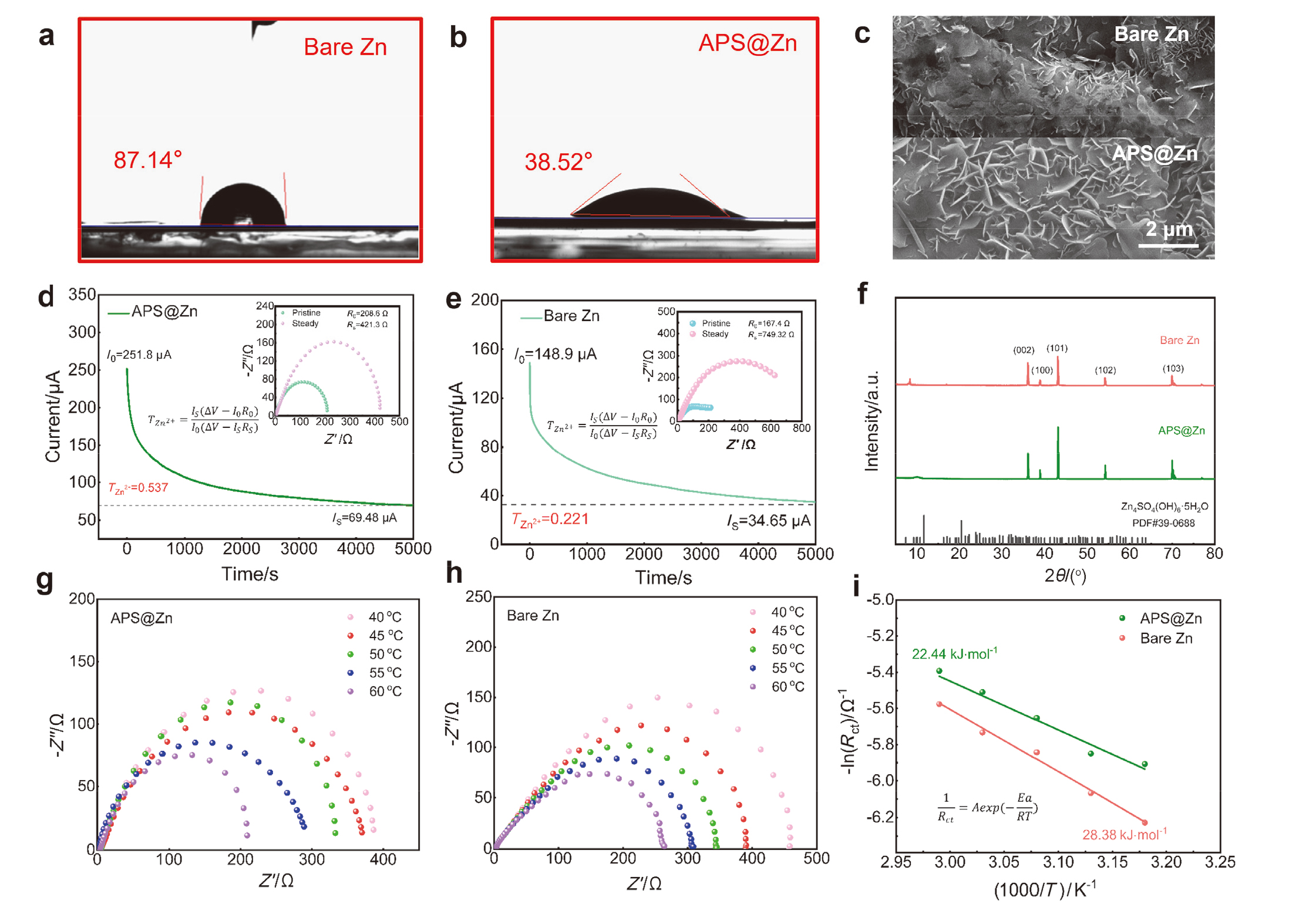
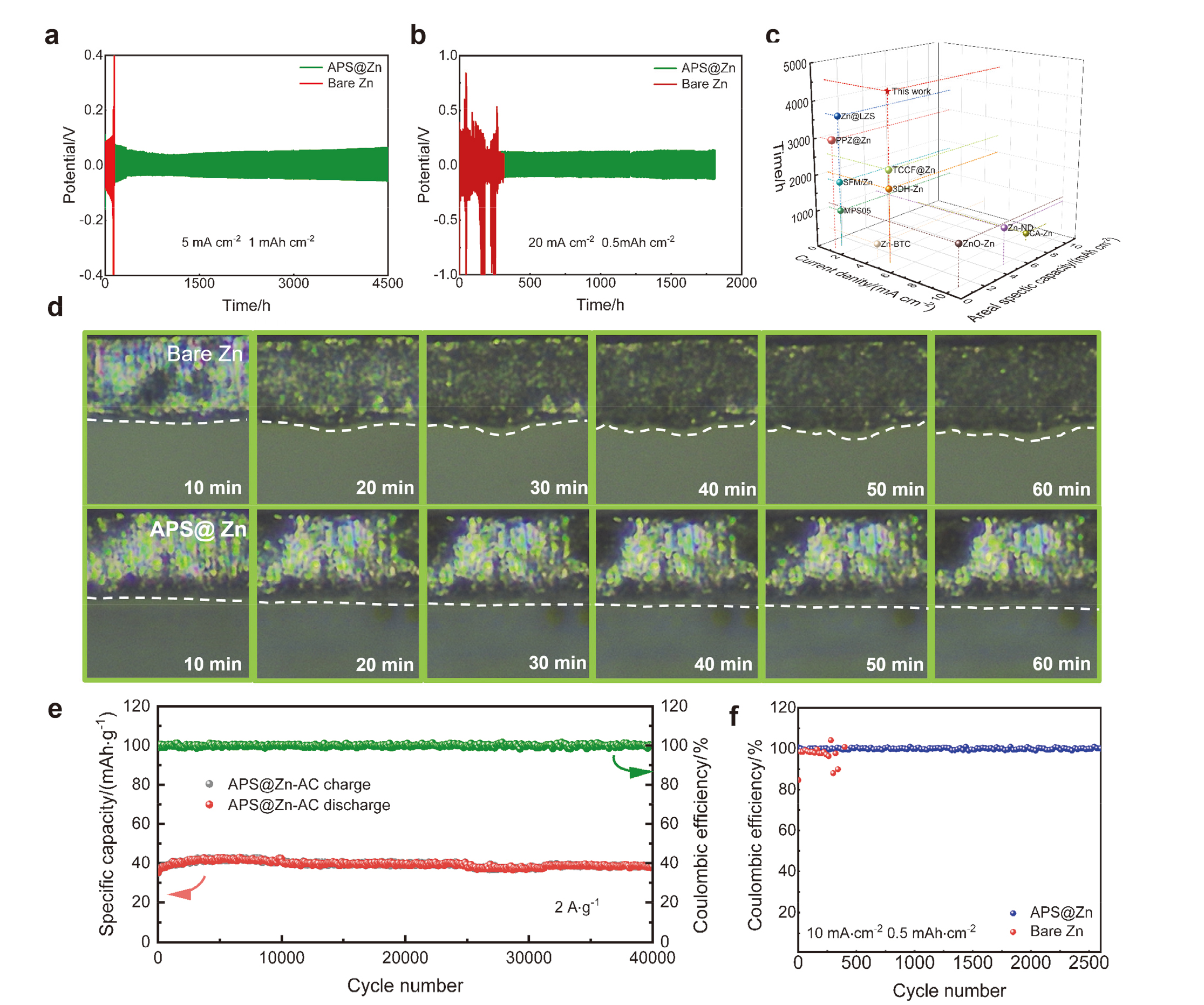
电化学储能技术因其高能效、模块化和环境友好性, 已成为新型储能体系研究的重点方向. 相比于成本高、安全性差的锂离子电池, 水系锌离子电池(ZIBs)因其高安全性、低成本及绿色可持续性, 被视为大规模储能的理想候选. 然而, 锌阳极在长期循环过程中易发生枝晶生长和副反应, 导致循环稳定性差与库仑效率低, 严重制约了其应用发展. 针对上述问题, 本研究通过过硫酸铵(APS)处理在锌电极表面构建多孔三维结构ZnO层的简便策略, 制备新型APS@Zn电极. 所得ZnO层兼具晶态结构的稳定性与非晶态相的高离子扩散特性, 可在锌沉积过程中诱导均匀成核, 优化电场与浓度分布, 有效抑制枝晶生长及副反应的发生. 电化学测试结果表明, APS@Zn对称电池在5 mA•cm−2、1 mAh•cm−2条件下可稳定循环4500 h. 该研究通过构建三维多孔ZnO界面层, 实现了锌负极界面调控与结构稳定性的协同优化, 为高稳定性水系锌离子电池的设计提供了一种简便、可扩展的新思路.
周平凡, 邓玉雪, 黄鹏, 马洪芳, 吴岭, 曲会鑫, 申来法, 许真铭, 张校刚, 佟浩. 锌阳极的三维ZnO层修饰实现超长循环寿命的水系锌离子电容器[J]. 化学学报, 2026, 84(3): 324-332.
Zhou Pingfan, Deng Yuxue, Huang Peng, Ma Hongfang, Wu Ling, Qu Huixin, Shen Laifa, Xu Zhenming, Zhang Xiaogang, Tong Hao. 3D ZnO Layer-Modified Zinc Anodes with Ultra-Long Cycle Life in Aqueous Zinc-Ion Capacitors[J]. Acta Chimica Sinica, 2026, 84(3): 324-332.
| [1] |
|
| [2] |
doi: 10.6023/A24120389 |
|
(李奔, 赵宇, 高欣, 孙雨涵, 赵宝雁, 罗巧梅, 樊小勇, 化学学报, 2025, 83, 237.)
doi: 10.6023/A24120389 |
|
| [3] |
doi: 10.6023/A22100413 |
|
(姬慧敏, 谢春霖, 张旗, 化学学报, 2023, 81, 29.)
doi: 10.6023/A22100413 |
|
| [4] |
doi: 10.6023/A20090409 |
|
(张璐, 王文凤, 张洪明, 化学学报, 2021, 79, 158.)
doi: 10.6023/A20090409 |
|
| [5] |
doi: 10.1016/j.jpowsour.2024.234638 |
| [6] |
doi: 10.1016/j.apsusc.2022.154526 |
| [7] |
doi: 10.1002/adma.v33.13 |
| [8] |
doi: 10.1002/aenm.v13.28 |
| [9] |
doi: 10.1002/aenm.v11.1 |
| [10] |
doi: 10.1016/j.nantod.2024.102461 |
| [11] |
|
| [12] |
doi: 10.1038/ncomms8760 |
| [13] |
|
| [14] |
|
| [15] |
doi: 10.1002/aenm.v13.12 |
| [16] |
doi: 10.1016/j.jpowsour.2019.227668 |
| [17] |
doi: 10.1002/adfm.v35.14 |
| [18] |
doi: 10.1002/aenm.v9.1 |
| [19] |
doi: 10.1002/adfm.v31.48 |
| [20] |
doi: 10.1002/adma.v33.11 |
| [21] |
doi: 10.1002/aenm.v14.33 |
| [22] |
|
| [23] |
doi: 10.1021/acs.nanolett.3c04806 |
| [24] |
doi: 10.1002/adma.v36.2 |
| [25] |
doi: 10.1002/advs.v11.28 |
| [26] |
doi: 10.1002/adfm.v34.30 |
| [27] |
doi: 10.1002/aenm.v14.33 |
| [28] |
doi: 10.1002/adfm.v34.52 |
| [29] |
doi: 10.1002/adfm.v34.49 |
| [30] |
doi: 10.1002/adfm.v34.13 |
| [31] |
doi: 10.1002/adfm.v34.46 |
| [32] |
doi: 10.1016/j.ssi.2023.116437 |
| [33] |
doi: 10.1039/D1TA10245A |
| [34] |
doi: 10.1016/j.electacta.2025.145685 |
| [35] |
|
| [36] |
doi: 10.1103/physrevb.54.11169 pmid: 9984901 |
| [37] |
doi: 10.1103/PhysRevB.50.17953 |
| [38] |
|
| [1] | 佟浩, 邓玉雪, 李磊, 陶铮, 申来法, 张校刚. 高载量ZnO@C@NiCo-LDH异质结构电极的制备及其超电容性能研究[J]. 化学学报, 2025, 83(2): 110-118. |
| [2] | 张帆帆, 蔡元韬, 陶剑波, 常国菊, 郭欣辰, 郝仕油. Zn, C引入量和煅烧温度对ZnO/C/CeO2光催化还原Cu2+效率的影响[J]. 化学学报, 2024, 82(8): 871-878. |
| [3] | 薛冰, 关伟鑫, 王鹏, 侯少文, 陈欣辉, 王奕星, 苟焕其, 郭锋浩, 王梦闯, 王天姿, 刘金德, 郑洲, 柴寿根, 陈家锐, 张建林, 棘云飞, 倪珺. 氮改性ZnO-ZrO2/SBA-15催化剂的酸碱性与其催化乙醇合成1,3-丁二烯反应性能的关系[J]. 化学学报, 2024, 82(5): 493-502. |
| [4] | 王娟, 肖华敏, 谢丁, 郭元茹, 潘清江. 铜掺杂与氮化碳复合氧化锌材料结构和二氧化氮气体传感性质的密度泛函理论计算[J]. 化学学报, 2023, 81(11): 1493-1499. |
| [5] | 倪宇欣, 张晨杰, 袁亚仙, 徐敏敏, 姚建林. 纳米ZnO的表面增强拉曼散射效应来源研究[J]. 化学学报, 2019, 77(7): 641-646. |
| [6] | 孟双艳, 王明明, 吕柏霖, 薛群基, 杨志旺. Eu掺杂的ZnO/MIL-53(Fe)光催化剂的合成及其对醇类选择性氧化的催化性能研究[J]. 化学学报, 2019, 77(11): 1184-1193. |
| [7] | 郝彦忠, 范龙雪, 孙宝, 孙硕, 裴娟. P3HT与CdTe纳米枝晶p-n异质结敏化ZnO纳米管阵列的光电化学研究[J]. 化学学报, 2014, 72(1): 114-120. |
| [8] | 郝彦忠, 曹寅虎, 孙宝, 张彦辉, 李英品, 徐东升, 李香玲. P3HT/CdS/TiO2/ZnO 一维有序核壳式纳米棒阵列的构制及其在杂化太阳电池中的应用研究[J]. 化学学报, 2012, 70(10): 1139-1144. |
| [9] | 范高超, 黄在银, 陈洁, 马玉洁. 尺寸效应对氧化锌微/纳体系热力学性质的影响[J]. 化学学报, 2012, 70(07): 938-942. |
| [10] | 宋继中, 贺英, 潘照东, 朱棣, 陈杰, 王均安. 磁场作用下原位聚合制备聚苯胺/纳米ZnO复合材料[J]. 化学学报, 2011, 69(13): 1582-1588. |
| [11] | 赵斌, 赵肃清, 张焜, 刘端, 苏娟. 硫脲修饰Cd掺杂ZnO水溶性量子点的制备及表征[J]. 化学学报, 2011, 69(07): 777-782. |
| [12] | 李忠, 刘岩, 何忠, 范辉, 郑华艳. Cu/Zn比对微波辐射老化制备CuO/ZnO/Al2O3催化剂结构和活性的影响[J]. 化学学报, 2011, 69(05): 570-576. |
| [13] | 刘晓钰, 郭平均, 周功兵, 裴燕, 乔明华, 范康年. 焙烧温度对Cu/ZnO水煤气变换催化剂开停循环性能的影响[J]. 化学学报, 2010, 68(24): 2523-2528. |
| [14] | 李长全, 罗来涛, 熊光伟. CeO2/ZnO复合纳米管的制备及其光催化性能的研究[J]. 化学学报, 2010, 68(10): 1023-1026. |
| [15] | 马军虎,杨合情,李丽,谢小莉,刘斌,张丽惠,张丽娜. 加热覆盖有ZnCl2溶液的锌片制备ZnO亚微米棒阵列[J]. 化学学报, 2009, 67(13): 1515-1522. |
| 阅读次数 | ||||||
|
全文 |
|
|||||
|
摘要 |
|
|||||
