

化学学报 ›› 2026, Vol. 84 ›› Issue (6): 859-870.DOI: 10.6023/A26020056 上一篇 下一篇
研究论文
胡雨青a, 关志强a, 朱从乐a, 李晨a, 赵含玥a, 李俊哲a,*( ), 伊廷锋b,*()
投稿日期:2026-02-12
发布日期:2026-05-06
基金资助:
Yuqing Hua, Zhiqiang Guana, Congle Zhua, Chen Lia, Hanyue Zhaoa, Junzhe Lia,*(), Tingfeng Yib,*()
Received:2026-02-12
Published:2026-05-06
Contact:
E-mail: Supported by:文章分享
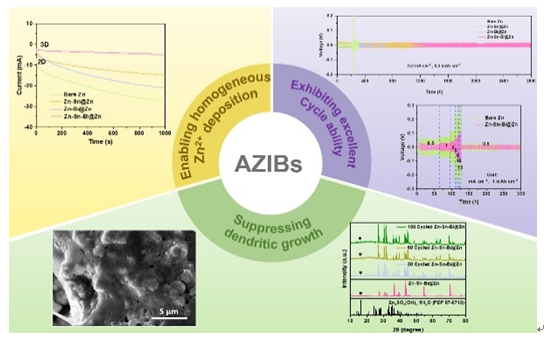
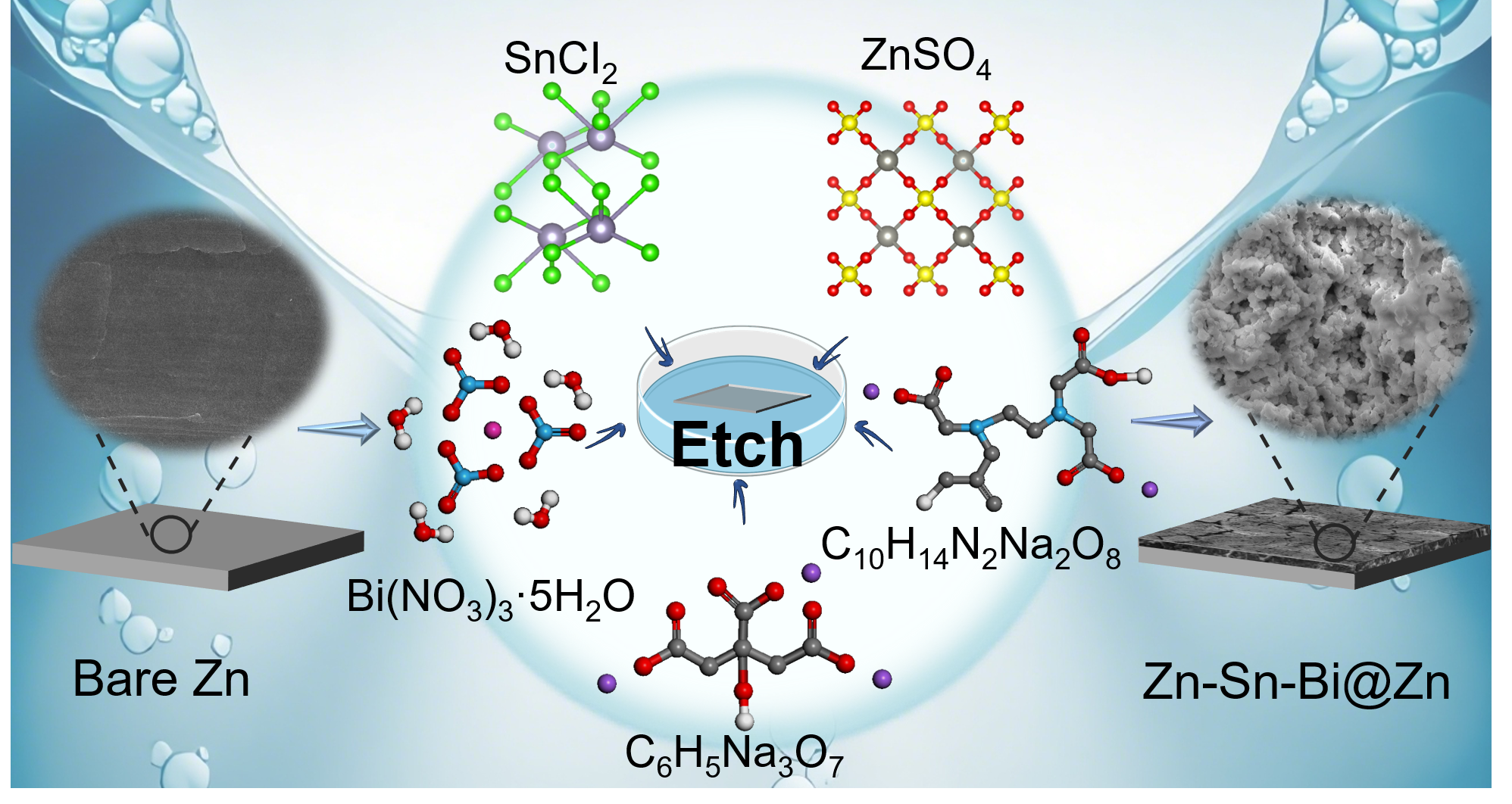
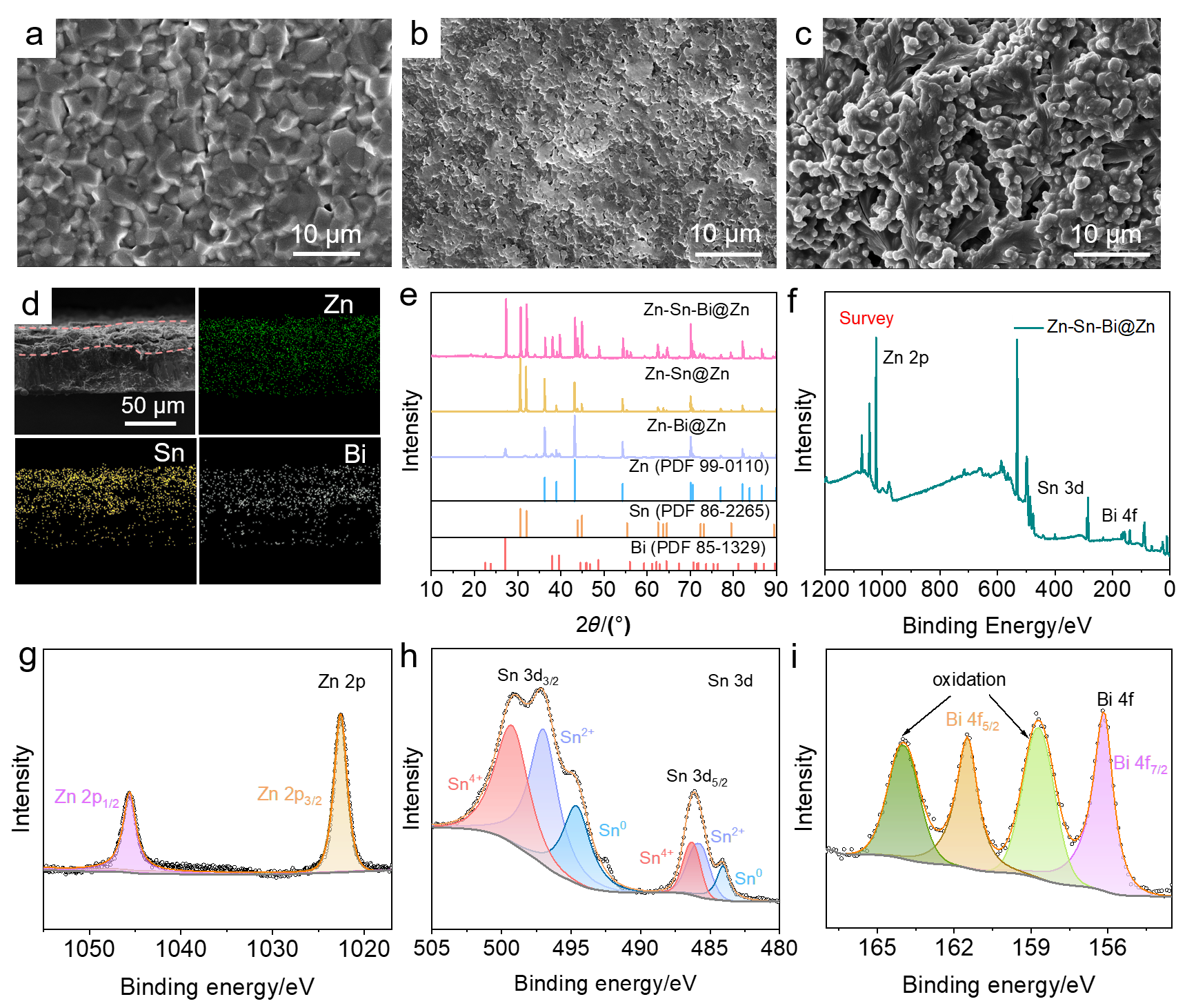
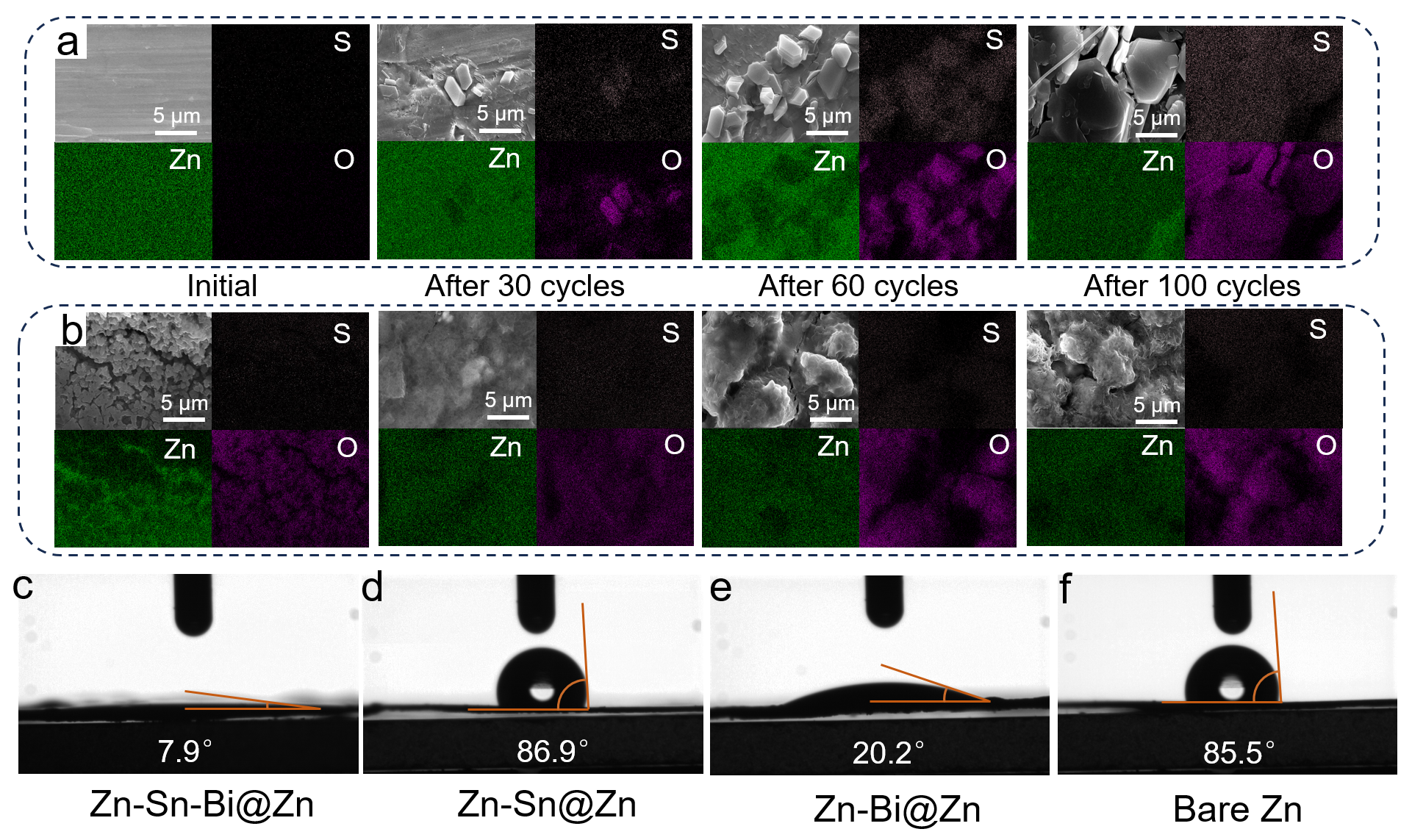
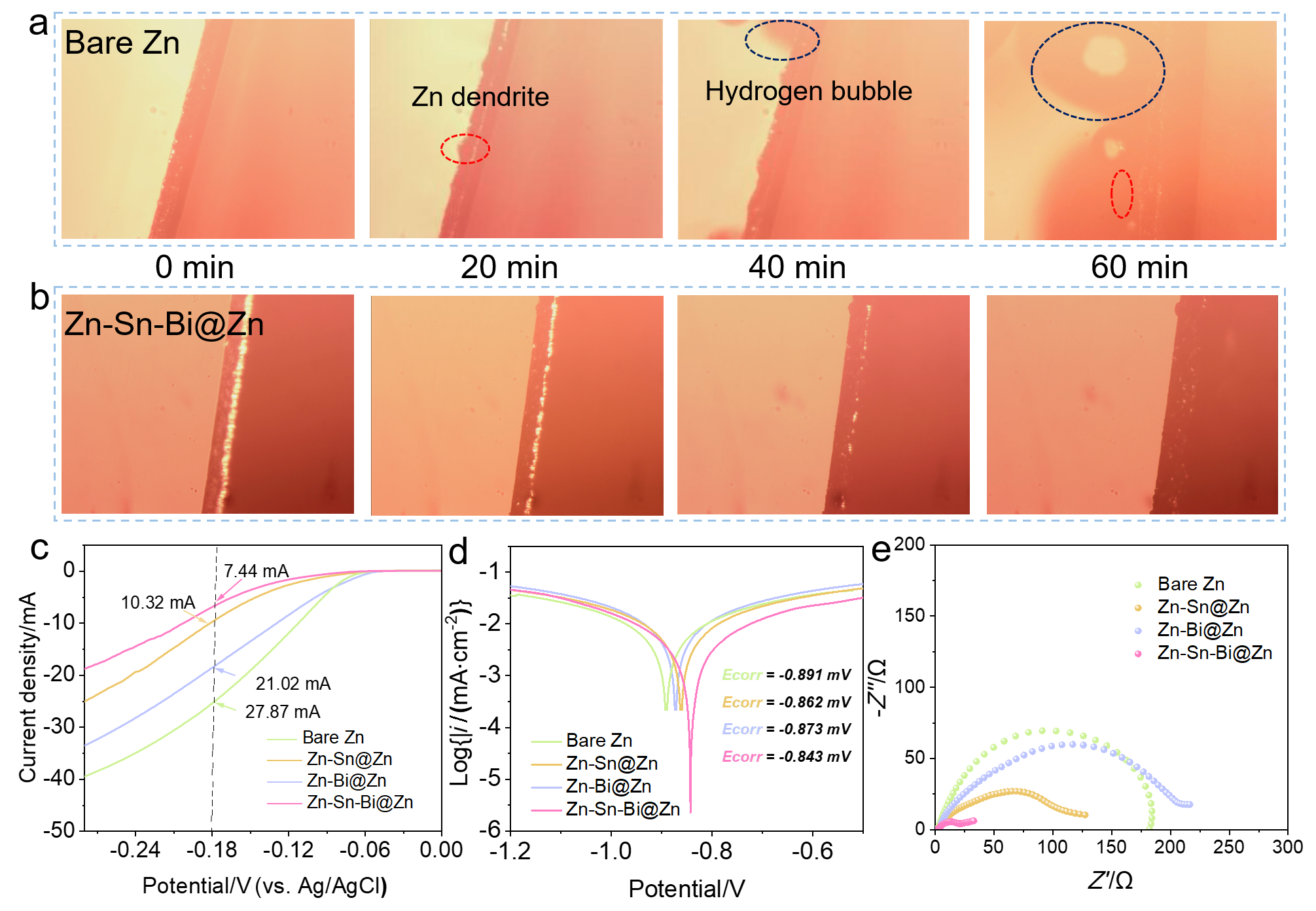
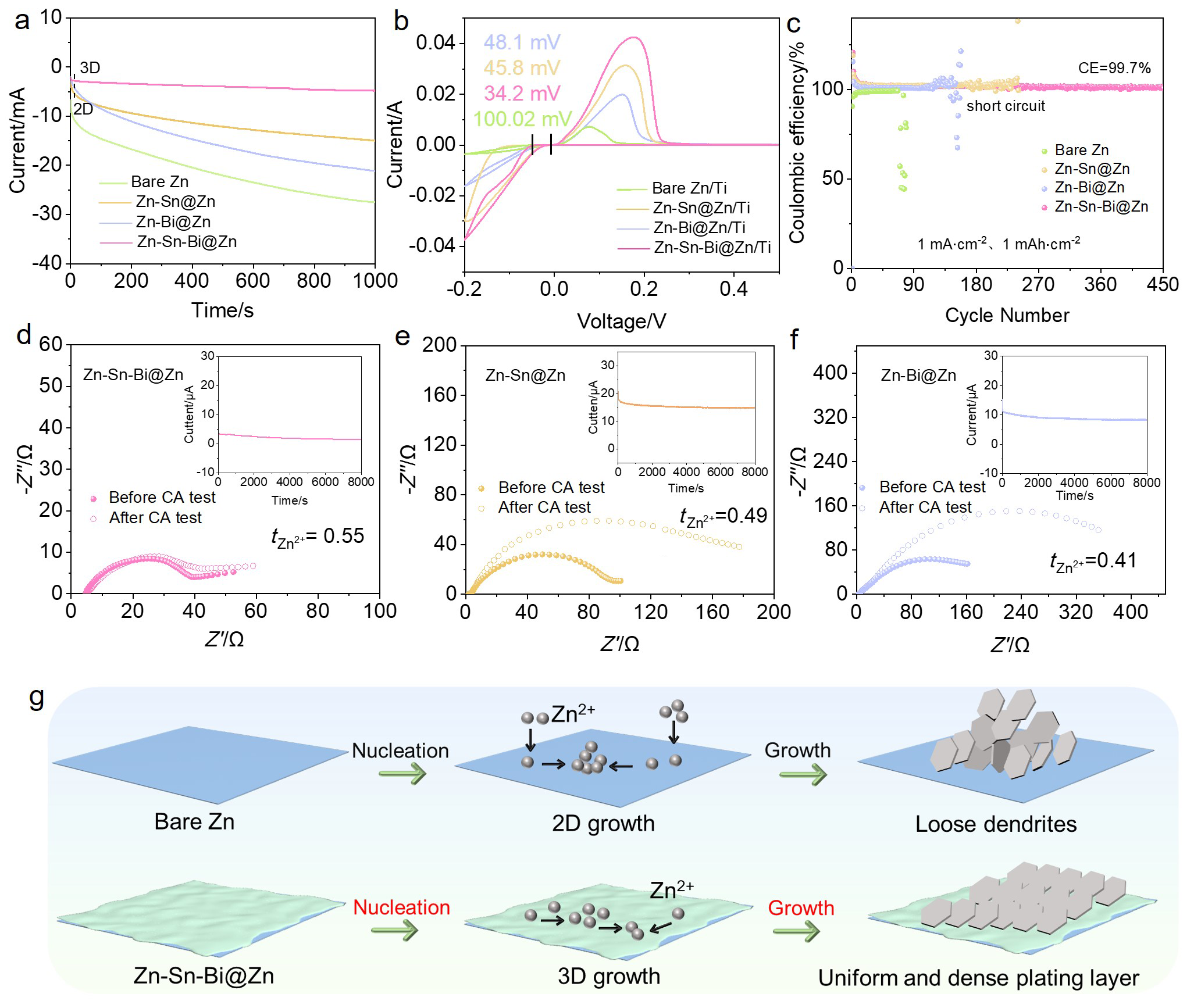
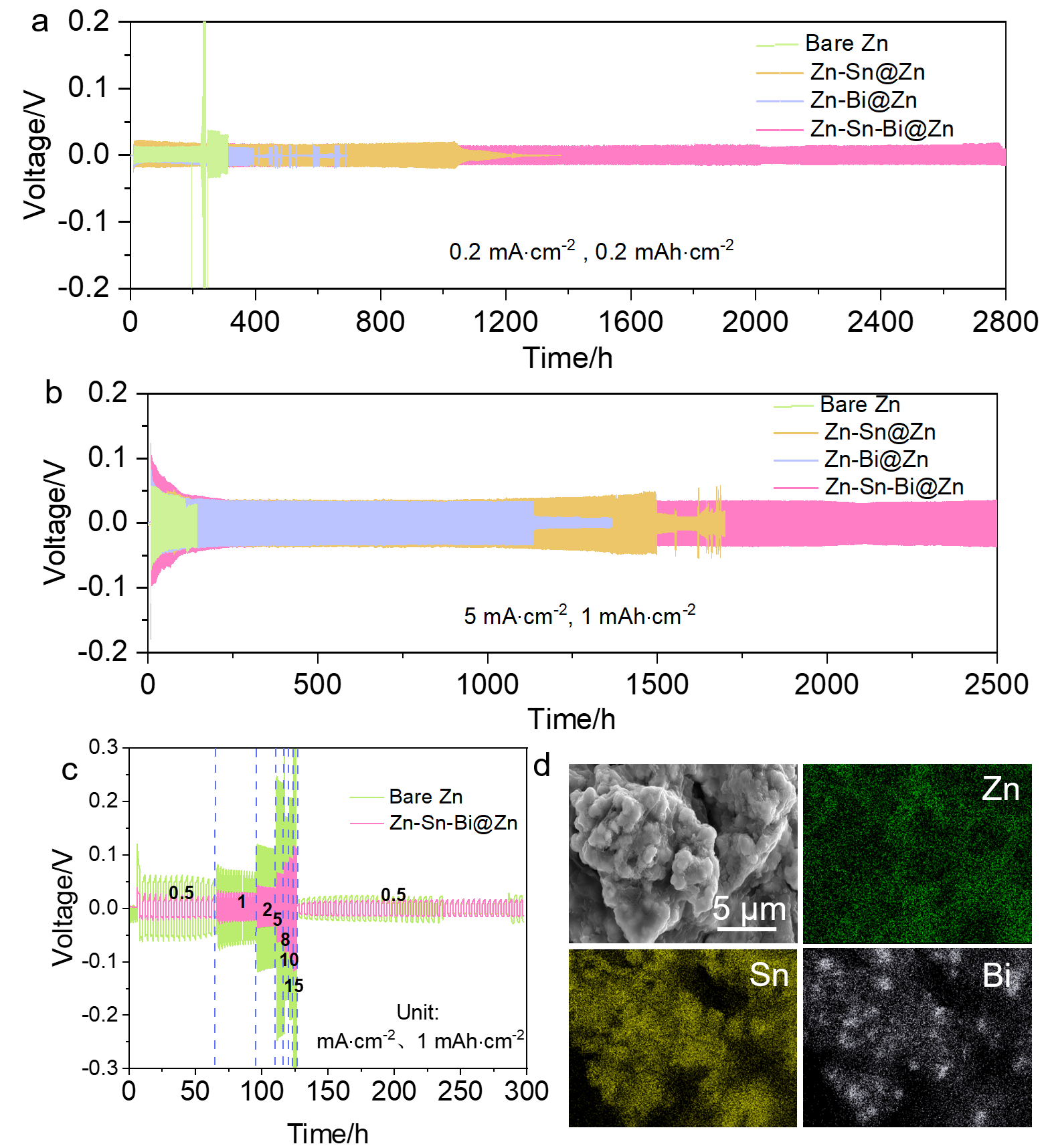
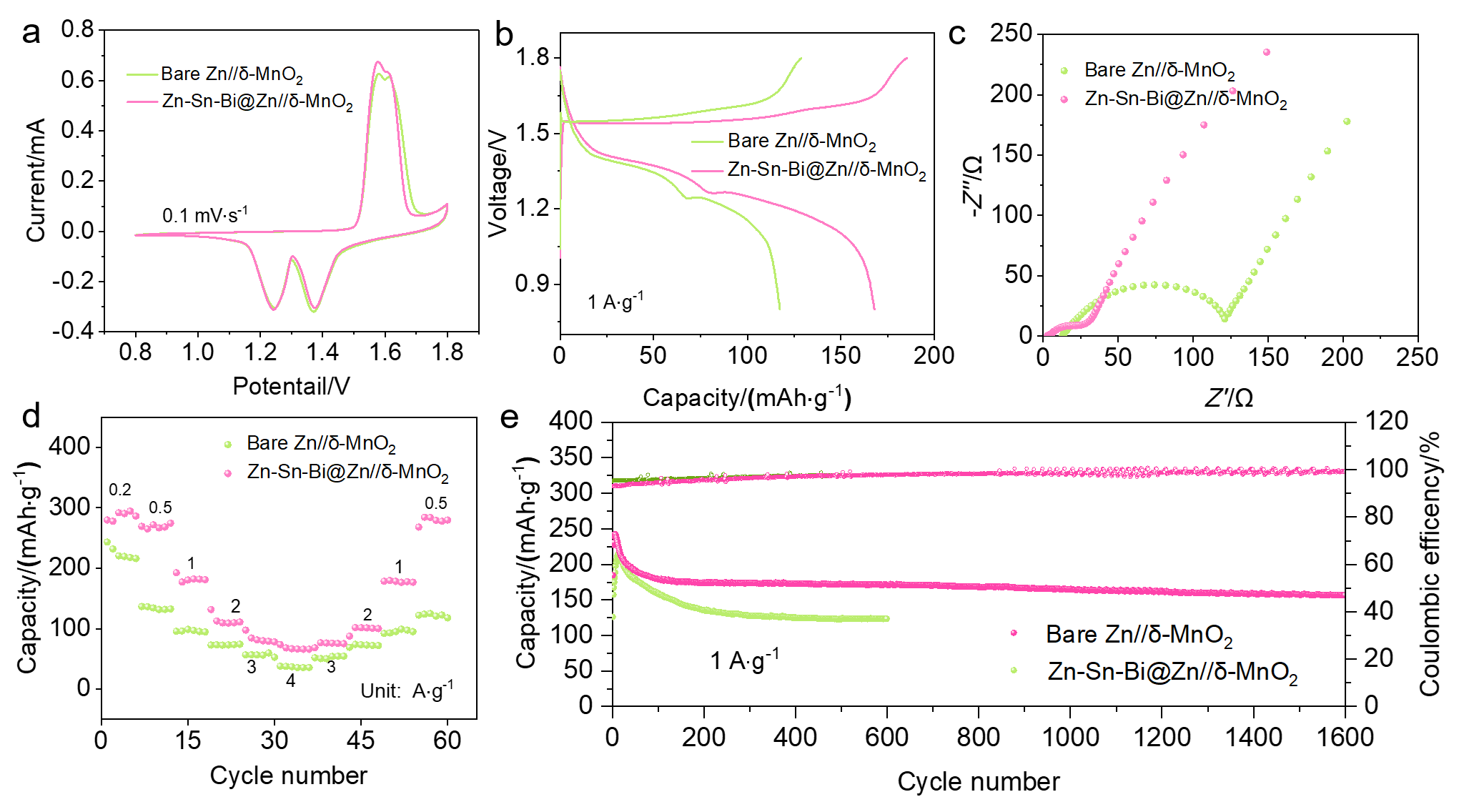
水系锌离子电池凭借其固有的安全性、成本效益及环境相容性, 已成为电网规模储能领域极具应用前景的候选体系. 然而, 锌金属负极在实际应用中面临严峻挑战: 锌离子的不规则电镀/剥离过程易诱发锌枝晶的不可控生长, 同时伴随析氢反应、界面钝化等副反应的发生. 这些问题不仅导致电池库仑效率降低、锌利用率下降, 还会显著缩短电池循环寿命, 严重制约了水系锌离子电池的产业化应用进程. 本研究采用可控蚀刻技术, 在锌箔表面原位构筑了具有三维分层结构的Zn-Sn-Bi三元合金修饰层(Zn-Sn-Bi@Zn). 其中, 引入的亲锌性Sn和Bi金属位点可显著降低锌的形核过电位, 引导Zn2+实现均匀成核; 独特的三维分层骨架结构具备丰富的活性位点与较大的比表面积, 能有效局域化电流密度, 促进锌的均匀沉积, 从物理层面抑制枝晶的生长; 此外, 该合金修饰层良好的亲水性与优异的导电性, 可显著加速界面电荷转移效率, 提升电池反应动力学性能. 得益于合金修饰层的多重保护作用, Zn-Sn-Bi@Zn对称电池在0.2 mA•cm−2电流密度、0.2 mAh•cm−2面积容量条件下, 实现了超过2800 h的超长稳定循环, Zn-Sn-Bi@Zn半电池循环450周后, 平均库仑效率高达99.7%, 展现出优异的镀锌/剥离可逆性及耐腐蚀性能. 将其与δ-MnO2正极组装成全电池后, 在1 A•g−1电流密度下循环1600次, 仍可保持156.6 mAh•g−1的高可逆比容量, 其循环稳定性与倍率性能均显著优于基于裸锌负极的对照电池. 该项工作为高性能水系锌离子电池的开发提供了一种有效的技术理念.
胡雨青, 关志强, 朱从乐, 李晨, 赵含玥, 李俊哲, 伊廷锋. 可控刻蚀原位构筑Zn-Sn-Bi修饰层及其抑制锌负极枝晶性能[J]. 化学学报, 2026, 84(6): 859-870.
Yuqing Hu, Zhiqiang Guan, Congle Zhu, Chen Li, Hanyue Zhao, Junzhe Li, Tingfeng Yi. In-Situ Construction of Zn-Sn-Bi Modification Layer by Controlled Etching and Its Performance in Inhibiting Zinc Dendrites[J]. Acta Chimica Sinica, 2026, 84(6): 859-870.
| [1] |
doi: 10.1021/jacs.4c15126 pmid: 40059326 |
| [2] |
doi: 10.1002/adma.v37.48 |
| [3] |
doi: 10.1002/adfm.v34.39 |
| [4] |
doi: 10.6023/A25040107 |
|
(韦正兵, 鲍梦凡, 徐世彪, 程怡, 陈诗洁, 林娜, 冒爱琴, 化学学报, 2025, 83, 868.)
doi: 10.6023/A25040107 |
|
| [5] |
doi: 10.1002/anie.v63.22 |
| [6] |
|
| [7] |
|
| [8] |
doi: 10.1016/j.jcis.2025.137338 |
| [9] |
|
| [10] |
doi: 10.1002/aenm.v15.21 |
| [11] |
doi: 10.1002/adfm.v35.34 |
| [12] |
|
| [13] |
doi: 10.1002/adma.v36.3 |
| [14] |
doi: 10.6023/A24120389 |
|
(李奔, 赵宇, 高欣, 孙雨涵, 赵宝雁, 罗巧梅, 鲍晓冰, 苟蕾, 崔艳华, 樊小勇, 化学学报, 2025, 83, 237.)
doi: 10.6023/A24120389 |
|
| [15] |
doi: 10.1016/j.ccr.2025.216478 |
| [16] |
doi: 10.1039/D5TA03948G |
| [17] |
doi: 10.1002/anie.v64.39 |
| [18] |
doi: 10.1002/anie.v64.40 |
| [19] |
doi: 10.1016/j.jcis.2024.09.150 |
| [20] |
doi: 10.1002/smm2.v6.1 |
| [21] |
|
| [22] |
doi: 10.1021/acssuschemeng.5c04021 |
| [23] |
doi: 10.1002/smm2.v6.4 |
| [24] |
doi: 10.1007/s40820-025-01765-6 |
| [25] |
doi: 10.1016/j.jallcom.2025.178521 |
| [26] |
|
| [27] |
doi: 10.1016/j.cej.2024.159115 |
| [28] |
doi: 10.1002/smsc.v6.1 |
| [29] |
doi: 10.1021/acsenergylett.2c01960 |
| [30] |
doi: 10.1039/D5TA05002B |
| [31] |
doi: 10.1016/j.est.2025.117769 |
| [32] |
doi: 10.1016/j.esci.2025.100455 |
| [33] |
doi: 10.1021/acsami.5c00853 |
| [34] |
doi: 10.1002/adfm.v36.16 |
| [35] |
doi: 10.1016/j.matlet.2025.138099 |
| [36] |
doi: 10.3390/ma18132997 |
| [37] |
doi: 10.1016/j.electacta.2025.147610 |
| [38] |
doi: 10.1016/j.est.2025.119578 |
| [39] |
doi: 10.1039/D5GC03908H |
| [40] |
doi: 10.1002/aenm.v15.43 |
| [41] |
doi: 10.1021/acsaem.5c00620 |
| [42] |
doi: 10.1016/j.jallcom.2026.186158 |
| [43] |
doi: 10.6023/A24010006 |
|
(郝再涛, 赵健飞, 李慧同, 李展, 潘朗, 李江, 化学学报, 2024, 82, 416.)
doi: 10.6023/A24010006 |
|
| [44] |
doi: 10.6023/A24010019 |
|
(宋瑞, 赵铭钦, 王帅, 卢垚, 鲍晓冰, 罗巧梅, 苟蕾, 樊小勇, 李东林, 化学学报, 2024, 82, 426.)
doi: 10.6023/A24010019 |
|
| [45] |
|
| [1] | 郝再涛, 赵健飞, 李慧同, 李展, 潘朗, 李江. 亲锌聚阴离子交联聚合物薄膜与铜刻蚀协同稳定锌负极[J]. 化学学报, 2024, 82(4): 416-425. |
| [2] | 宋瑞, 赵铭钦, 王帅, 卢垚, 鲍晓冰, 罗巧梅, 苟蕾, 樊小勇, 李东林. 三维多孔结构和亲锌性梯度协同构筑无枝晶锌电极[J]. 化学学报, 2024, 82(4): 426-434. |
| [3] | 洪梅, 高金强, 李彤, 杨世和. 原位刻蚀调控多级孔分子筛策略及其应用进展★[J]. 化学学报, 2023, 81(8): 937-948. |
| [4] | 李燕丽, 于丹丹, 林森, 孙东飞, 雷自强. α-MnO2纳米棒/多孔碳正极材料的制备及水系锌离子电池性能研究[J]. 化学学报, 2021, 79(2): 200-207. |
| [5] | 张璐, 王文凤, 张洪明, 韩树民, 王利民. 水系锌离子电池研究进展和挑战[J]. 化学学报, 2021, 79(2): 158-175. |
| [6] | 李志伟, 仲佳亮, 陈楠楠, 薛兵, 米红宇. 氮掺杂多孔炭片的模板法制备及其储锂性能研究[J]. 化学学报, 2018, 76(3): 209-214. |
| [7] | 李扬, 齐利民. 气液界面胶体球刻蚀法制备二维有序多孔薄膜[J]. 化学学报, 2015, 73(9): 869-876. |
| [8] | 刘松, 郭雪峰. 基于单壁碳纳米管的功能分子电子器件研究[J]. 化学学报, 2013, 71(04): 478-484. |
| [9] | 李涛, 周春兰, 宋洋, 张磊, 惠俊, 杨海峰, 郜志华, 段野, 李友忠, 励旭东, 许颖, 赵雷, 刘振刚, 王文静. SiO2/SiNx:H选择性刻蚀改善光诱导化学镀/电镀多晶硅太阳能电池过镀现象[J]. 化学学报, 2011, 69(07): 848-852. |
| [10] | 陈强, 李刚, 潘爱平, 金庆辉, 赵建龙, 程建功, 徐元森. 玻璃微流控芯片廉价快速制作方法的研究[J]. 化学学报, 2007, 65(17): 1863-1868. |
| [11] | 管自生,张强. 激光刻蚀硅表面的形貌及其对浸润性的影响[J]. 化学学报, 2005, 63(10): 880-884. |
| [12] | 宋焱焱, 张禹, 夏兴华. 碱性水溶液中甲醛在硅电极表面的电化学行为及其对硅化学刻蚀的影响[J]. 化学学报, 2004, 62(15): 1415-1418. |
| [13] | 杨迎春,管自生,冯文辉,叶自义,司宗兴,宋延林,江雷. 激光刻蚀sol-gelTiO_2薄膜的浸润性研究[J]. 化学学报, 2002, 60(10): 1773-1777. |
| [14] | 卢平和,张抗战,郑企克,秦启宗. 角分辨飞行时间法研究GaAs(100)表面蚀刻反应动力学[J]. 化学学报, 1994, 52(2): 105-110. |
| [15] | 李雨林,蔡中厚,孙令虹,秦启宗. 分子束弛豫谱研究Ge(111)表面与氯分子热反应动态学[J]. 化学学报, 1990, 48(9): 85-855. |
| 阅读次数 | ||||||
|
全文 |
|
|||||
|
摘要 |
|
|||||
