

化学学报 ›› 2026, Vol. 84 ›› Issue (5): 736-754.DOI: 10.6023/A26010025 上一篇 下一篇
所属专题: “框架材料化学”合集
综述
陈中胜, 雷天灏, 彭炜, 陈娴琳, 燕春培, 罗峰*( )
)
投稿日期:2026-01-24
发布日期:2026-02-10
作者简介: |
陈中胜, 东华理工大学教授, 2012年博士毕业于中南大学粉末冶金研究院. 目前研究方向: 稀土发光材料、共价有机框架(COFs)材料的设计及其在放射性核素污染修复和海水提铀应用研究. 先后主持国家自然科学基金、江西省重点研发计划、江西省自然科学基金项目等科研项目多项, 以第一和通讯作者公开发表SCI论文20余篇. |
 |
雷天灏, 东华理工大学硕士研究生, 目前研究方向: 新型共价有机框架(COFs)材料设计开发及其在贵金属离子吸附、放射性核素吸附与光催化还原应用. |
 |
彭炜, 东华理工大学在读博士研究生, 目前研究方向: 光催化复合材料的设计、制备及其在放射性核素污染修复领域的应用研究. |
 |
陈娴琳, 东华理工大学硕士研究生, 目前研究方向: 共价有机框架(COFs)的合成设计及其在含放射性核素废水的光催化应用. |
 |
燕春培, 东华理工大学讲师, 2019年博士毕业于北京科技大学/北京有色金属研究总院. 目前研究方向: 主要从事无机稀土功能材料设计、合成与性能研究, 放射性废水处理; 主持和参与国家自然科学基金、江西省科技合作专项、江西省自然科学基金等项目9项; 以第一和通讯作者公开发表SCI论文10余篇. |
 |
罗峰, 东华理工大学二级教授、博士生导师, 2009年博士毕业于南开大学化学系, 长期致力于金属有机框架(MOFs)和共价有机框架(COFs)的分子设计和性质、放射性核素污染修复和海水提铀等领域的研究. 先后主持国家自然科学基金项目7项, 江西省自然科学基金项目4项, 江西省教学改革研究课题1项; 出版专著2项, 申请专利11项; 在Nat. Commun., J. Am. Chem. Soc., Angew. Chem. Int. Ed., CCS Chem.等期刊上发表SCI论文300余篇. 获江西省自然科学一等奖、二等奖、三等奖各一项, 江西省高校科技成果一等奖一项. |
★“框架材料化学”专辑
基金资助:
Zhongsheng Chen, Tianhao Lei, Wei Peng, Xianlin Chen, Chunpei Yan, Feng Luo*()
Received:2026-01-24
Published:2026-02-10
Contact:
* E-mail: ecitluofeng@163.com
About author:★ For the VSI "Chemistry of Framework Materials".
Supported by:文章分享
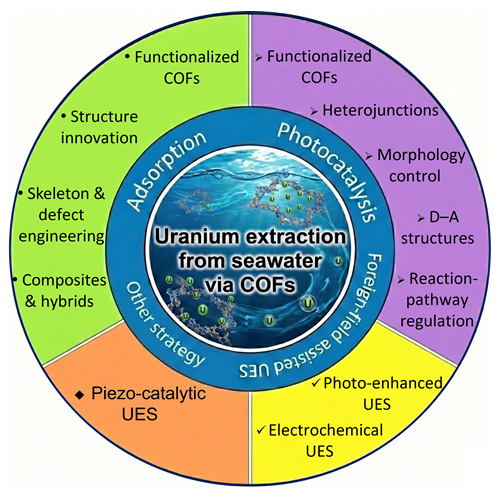
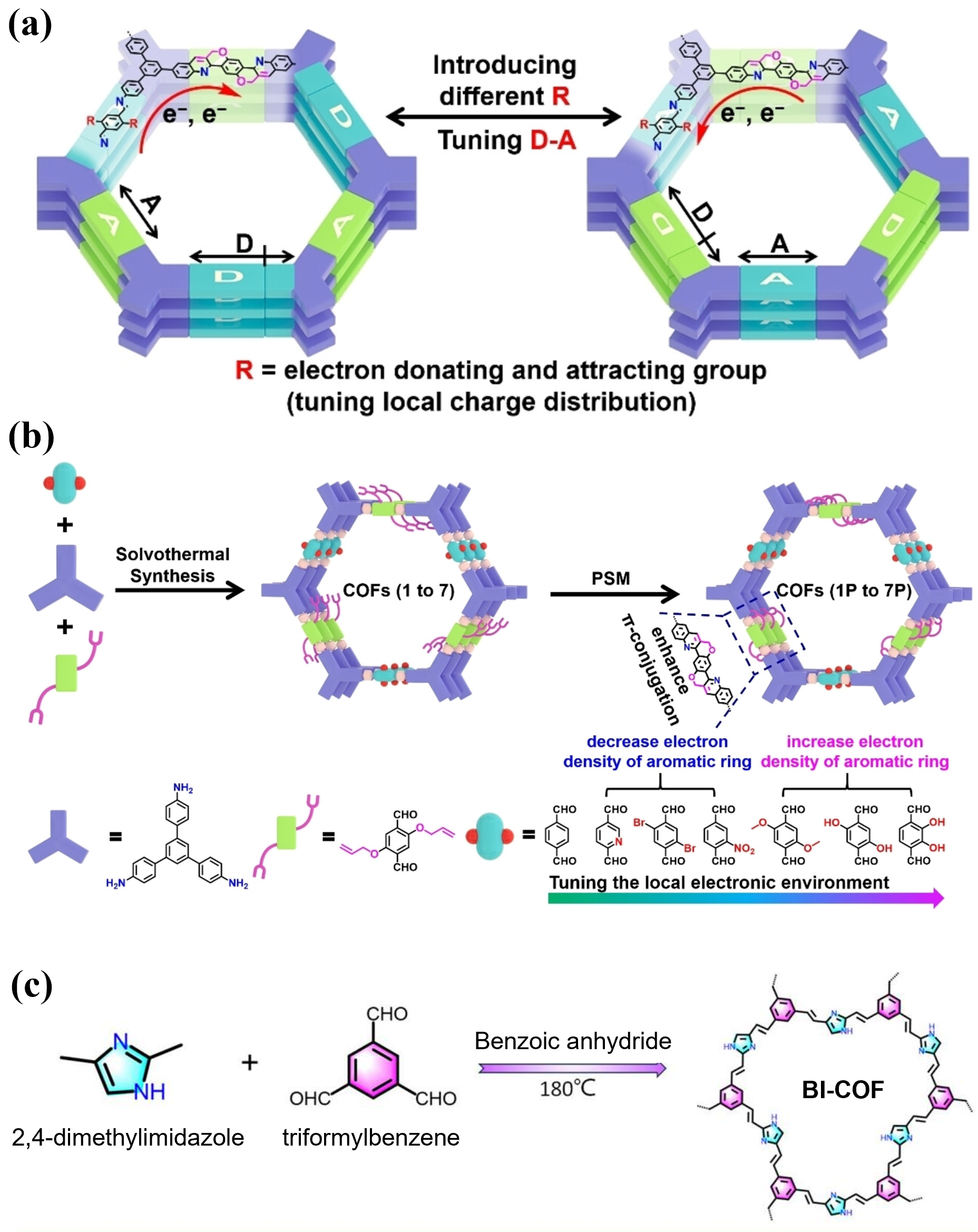
海水中蕴藏着储量极其丰富的铀资源, 被认为是缓解未来铀资源短缺、支撑核能可持续发展的重要战略途径. 然而, 海水中铀浓度极低、共存离子复杂且生物污损严重, 使高效、选择性提铀面临巨大挑战. 共价有机框架(COFs)作为一类结构可设计、孔道规整、比表面积大且化学稳定性优异的晶态多孔材料, 近年来在海水提铀领域展现出独特优势. 本文系统综述了COFs材料在海水提铀方面的最新研究, 重点总结了其在吸附法、光催化法以及光、电等外场协同提铀中的应用与作用机制. 围绕官能团修饰、骨架与缺陷工程、复合与异质结、形貌控制、供体-受体(D-A)结构和反应路径调控等策略, 分析了COFs在提升铀提取容量、选择性、动力学性能及抗生物污损能力方面的关键进展. 最后, 对当前COFs材料在规模化应用、长期稳定性及成本控制等方面面临的挑战进行了讨论, 并对未来高性能海水提铀材料的设计方向与发展趋势进行了展望. 本综述为COFs材料在海水提铀领域的深入研究与应用提供系统参考与思路启示.
陈中胜, 雷天灏, 彭炜, 陈娴琳, 燕春培, 罗峰. 共价有机框架材料在海水提铀中的研究进展★[J]. 化学学报, 2026, 84(5): 736-754.
Zhongsheng Chen, Tianhao Lei, Wei Peng, Xianlin Chen, Chunpei Yan, Feng Luo. Recent Progress and Prospects of Covalent-organic Frameworks Materials for Uranium Extraction from Seawater★[J]. Acta Chimica Sinica, 2026, 84(5): 736-754.
| COF Materials | Functional Groups | Adsorption conditions | Surface area/ (m²•g-1) | Extraction efficiency/Adsorption capacity/(mg•g-1) | Extraction time | Selectivity (U/V) | Reference | |
|---|---|---|---|---|---|---|---|---|
| COF-TpDb-AO | Amidoxime groups | Spiked seawater, C0=20 ppm, m/V=25 mg•L-1 | 826 | 127 | 1.5 h | N/A | [ | |
| COF-HHTF-AO | Amidoxime groups | Natural seawater, m=1 mg, m/V=0.1 mg•L-1 | 275 | 5.12 | 25 d | 1.61 | [ | |
| AF Anti-COF | Amidoxime groups | Natural seawater, m/V=0.33 mg•L-1, V=15 L | 722 | 6.64 | 28 d | N/A | [ | |
| COF-AO | Amidoxime, hydroxyl groups, imine bonds | Natural seawater, V=25 L | 151.3 | 16.0 | 28 d | 4.92 | [ | |
| COF-PAO | Amidoxime groups | Natural seawater, C0≈3.4 ppb, V=100 L | 110 | 12.26 | 10 d | 38.1 | [ | |
| [NH4]+[COF-SO3−] | Sulfonic groups (coordination interaction and ion exchange) | Concentrated seawater, C0=10 ppb, m/V=0.33 mg•L-1, V=30 L | ≈110 | 17.8 | 7 d | N/A | [ | |
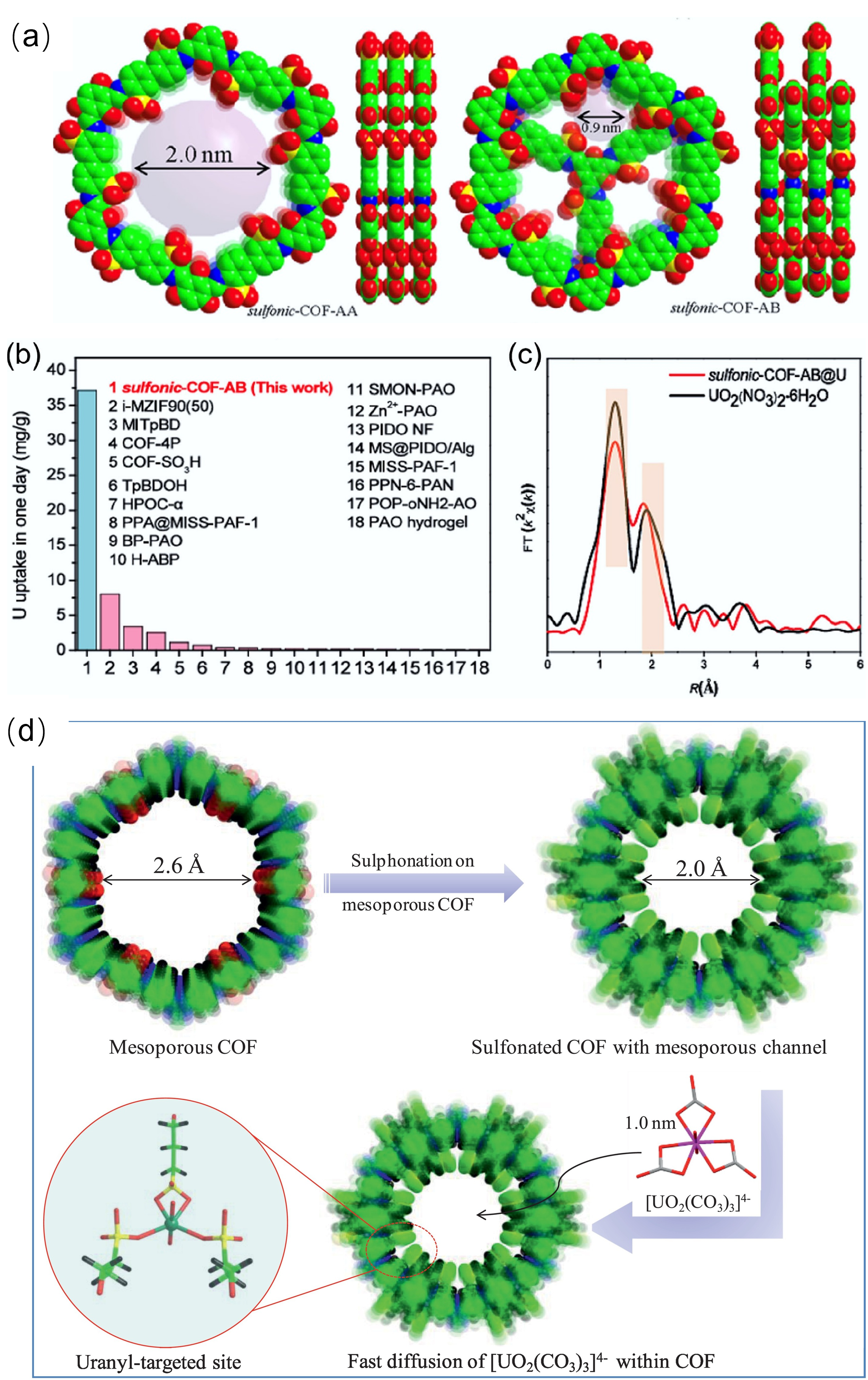
| Sulfonic-COF-AB | Sulfonic groups | Natural seawater, pH=8, m/V=0.067 mg•L-1 | 158 | 31.5 | 1 d | >7.3×10³ | [ | |
| 37.1 | 7 d | |||||||
| ECUT-COF-102 | Sulfonic groups | Natural seawater, C0=3.3 ppb, m/V=0.1 mg•L-1 | 517.9 | 2 9.2 | 1 d 7 d | 3×10³ | [ | |
| COF-PA | Phosphate groups | Simulated seawater, C0=8 ppm, pH=5, m/V=20 mg•L-1; natural seawater, m/V=0.1 mg•L-1 | 338 | 645.6 (simulated seawater); 2.0 (natural seawater) | 15 d | >10 (estimated) | [ | |
| JUC-505-COOH | Amidoxime, carboxyl groups | Natural seawater, m/V=100 mg•L-1 | 310 | 4.604 | 12 h | N/A | [ | |
| TpMa-COOH | Carboxyl groups | Natural seawater | 90.28 | 31.61 | 7 d | 347.8 | [ | |
| COF-R5 | Hydrazine-carbonyl, hydroxypropoxy groups | Natural seawater, pH=8 | 584.7 | 11.3 | 15 d | Kd=9.2×10⁵ | [ | |
| MITpBD | Hydroxyl groups, NH4+ cations | Natural seawater, C0≈3.4 ppb | 216.7 | 23.66 | 7 d | 69.3 | [ | |
| COF-IZL | Imidazoline groups | Simulated seawater, C0=4.525 ppb, pH=8.3 | 249.5 | 8.3 | 7 d | 7.1 | [ | |
| Py-COF | Imine N, phenol groups | Natural seawater, C0≈3.3 ppb | 1521.4 | 45 | 15 d | N/A | [ | |
| 2,3-DhaTat-COF | Ortho-chelating hydroxyl groups | Spiked seawater, C0=20 ppm | 1067 | 383 | 2 h | >1 (estimated) | [ | |
| DhaTpt-COF | Ether bonds, triazine groups | Spiked simulated seawater, C0≈20 ppm, pH=5, m/V=300 mg•L-1 | 784 | 660 | N/A | 3.37 | [ | |
| Tp-AD | β-ketoenamine, anthraquinone | Simulated seawater, C0=10 ppm, pH=6, m/V=500 mg•L-1 | 609.06 | 60% | 1 d | Kd=1.03×10⁴ | [ | |
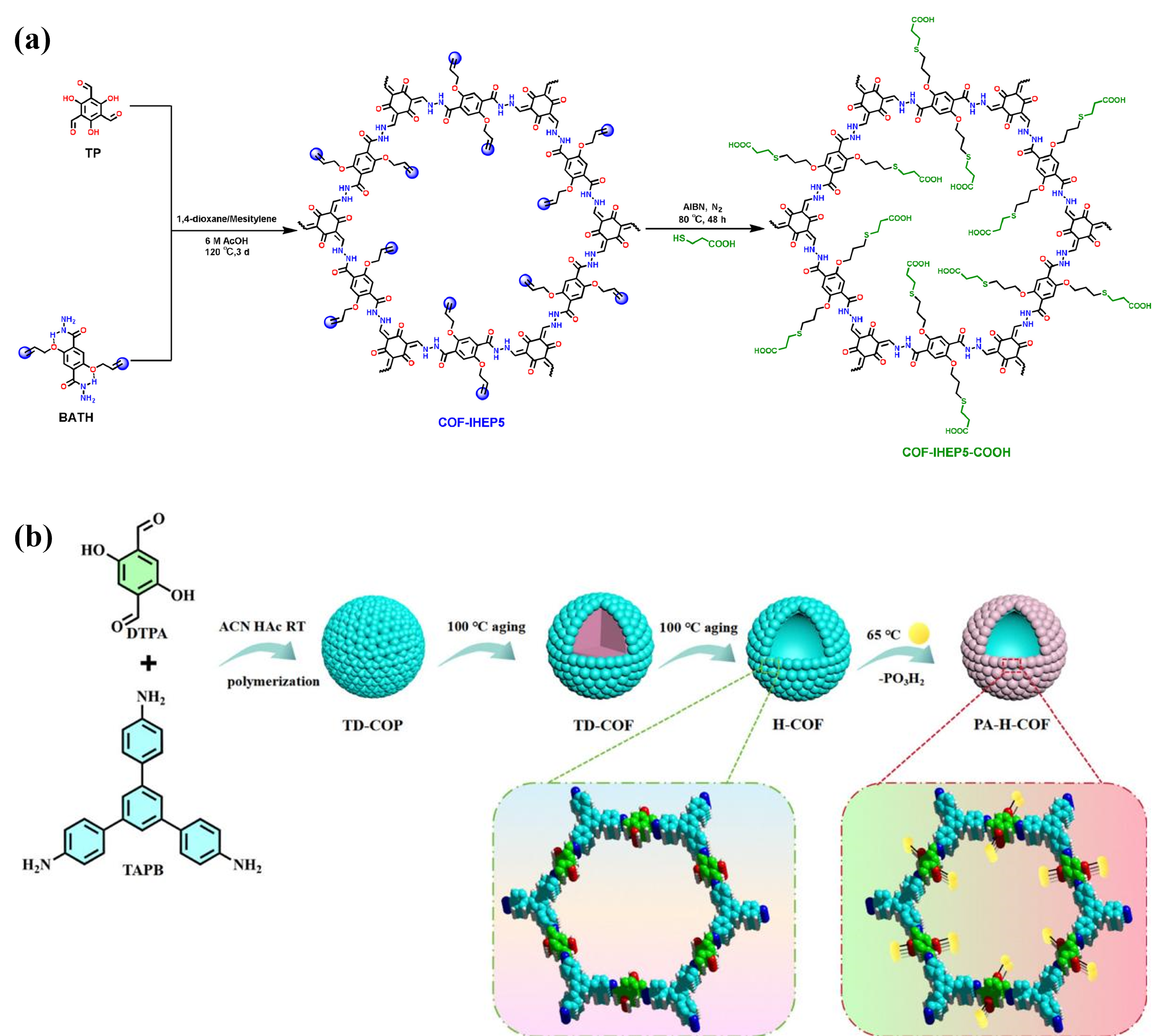
| COF-IHEP5-COOH | Hydrazone-carbonyl /carboxyl groups | Spiked natural seawater, C0=100 ppb, 1000 ppb, m/V=100 mg•L-1 | 47 | ≈80% | >4000 h | 4.5 | [ | |
| PA-H-COF | Phosphate groups | Natural seawater, m/V=0.3 mg•L-1 | 259.48 | 7.38 | 20 d | >120 | [ | |
| COF-AO-PSS | Amidoxime/Sulfonic acid groups | Natural seawater, C0≈3.4 ppb, m/V=0.05 mg•L-1 | 490.3 | 11.24 | 20 d | N/A | [ | |
| MITpBD-BE | Carboxyl groups | Natural seawater, m/V=0.14 mg•L-1 | 167.7 | 25.3 | 35 d | >163.1 | [ | |
| UiO-66-NH2@ HDU-27 | Amino, carbonyl groups | Natural seawater, m/V=1 mg•L-1 | 790.1 | 4.82 | 25 d | N/A | [ | |
| MXene-AO@LZU1 | Amidoxime/sulfonic groups | Spiked natural seawater, C0=20 ppm, pH=8.3, m/V=100 mg•L-1 | 20.3 | 6.8 | N/A | N/A | [ | |
| R-EPCu-COF-TA | Carboxyl/hydroxyl groups, Cu(0) | Spiked seawater, C0=20 ppm, m/V=100 mg•L-1; Natural seawater, m/V=0.167 mg•L-1 | 6.2 | 588.3 (spiked seawater); 2.92 (natural seawater) | 30 d | N/A | [ | |
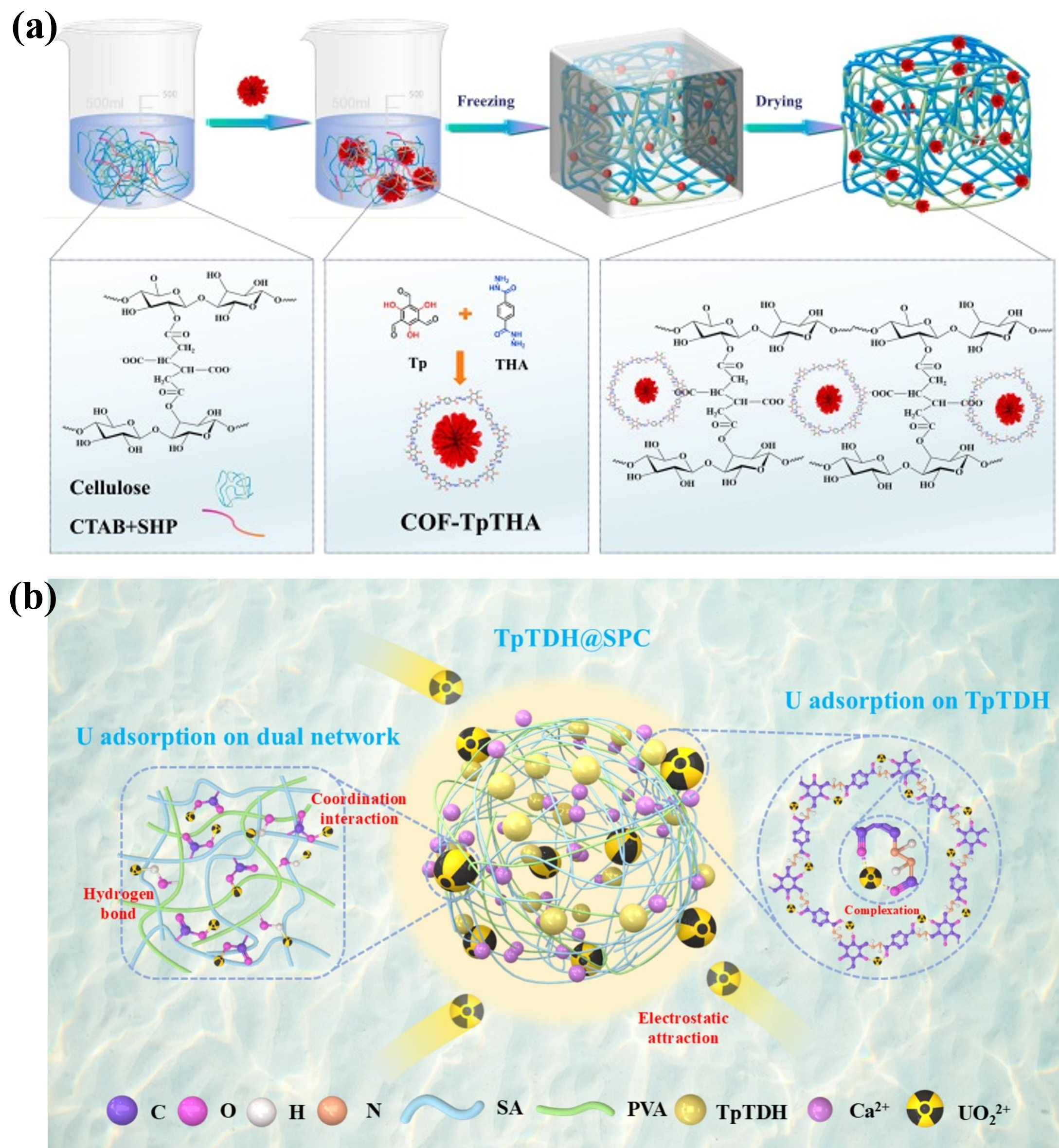
| TpTHA/CNF aerogel | Hydroxyl/carbonyl/amino groups | Simulated seawater, C0=0.03 mol•L-1, pH=6, m/V=250 mg•L-1 | 28.15 | 6.62 | N/A | 2.4 | [ | |
| BCCOF-SO3NH4 aerogel | Sulfonic groups, hydroxyl, NH4+ cations | Simulated seawater, C0=330 ppb, m/V=50 mg•L-1 | 70.77 | 6.25 | 24 h | >3 (estimated) | [ | |
| CP-150 (COF/Polymer aerogel) | Amidoxime groups | Spiked simulated seawater, C0=8 ppm, m/V=10 mg•L-1; Spiked natural seawater, C0=330 ppb, m/V=5 mg•L-1 | N/A | 275 (spiked simulated seawater); 17.4 (spiked natural seawater) | 48 h | N/A | [ | |
| TpTDH@SPC aerogel | Carboxyl/hydroxyl group | Spiked natural seawater, C0=20 ppm, m/V=100 mg•L-1; natural seawater, m/V=0.5 mg•L-1 | 89.38 | 9.80 (Spiked natural seawater; 6.25 (natural seawater) | 8 d | 6 | [ | |
| COF Materials | Functional Groups | Adsorption conditions | Surface area/ (m²•g-1) | Extraction efficiency/Adsorption capacity/(mg•g-1) | Extraction time | Selectivity (U/V) | Reference | |
|---|---|---|---|---|---|---|---|---|
| COF-TpDb-AO | Amidoxime groups | Spiked seawater, C0=20 ppm, m/V=25 mg•L-1 | 826 | 127 | 1.5 h | N/A | [ | |
| COF-HHTF-AO | Amidoxime groups | Natural seawater, m=1 mg, m/V=0.1 mg•L-1 | 275 | 5.12 | 25 d | 1.61 | [ | |
| AF Anti-COF | Amidoxime groups | Natural seawater, m/V=0.33 mg•L-1, V=15 L | 722 | 6.64 | 28 d | N/A | [ | |
| COF-AO | Amidoxime, hydroxyl groups, imine bonds | Natural seawater, V=25 L | 151.3 | 16.0 | 28 d | 4.92 | [ | |
| COF-PAO | Amidoxime groups | Natural seawater, C0≈3.4 ppb, V=100 L | 110 | 12.26 | 10 d | 38.1 | [ | |
| [NH4]+[COF-SO3−] | Sulfonic groups (coordination interaction and ion exchange) | Concentrated seawater, C0=10 ppb, m/V=0.33 mg•L-1, V=30 L | ≈110 | 17.8 | 7 d | N/A | [ | |
| Sulfonic-COF-AB | Sulfonic groups | Natural seawater, pH=8, m/V=0.067 mg•L-1 | 158 | 31.5 | 1 d | >7.3×10³ | [ | |
| 37.1 | 7 d | |||||||
| ECUT-COF-102 | Sulfonic groups | Natural seawater, C0=3.3 ppb, m/V=0.1 mg•L-1 | 517.9 | 2 9.2 | 1 d 7 d | 3×10³ | [ | |
| COF-PA | Phosphate groups | Simulated seawater, C0=8 ppm, pH=5, m/V=20 mg•L-1; natural seawater, m/V=0.1 mg•L-1 | 338 | 645.6 (simulated seawater); 2.0 (natural seawater) | 15 d | >10 (estimated) | [ | |
| JUC-505-COOH | Amidoxime, carboxyl groups | Natural seawater, m/V=100 mg•L-1 | 310 | 4.604 | 12 h | N/A | [ | |
| TpMa-COOH | Carboxyl groups | Natural seawater | 90.28 | 31.61 | 7 d | 347.8 | [ | |
| COF-R5 | Hydrazine-carbonyl, hydroxypropoxy groups | Natural seawater, pH=8 | 584.7 | 11.3 | 15 d | Kd=9.2×10⁵ | [ | |
| MITpBD | Hydroxyl groups, NH4+ cations | Natural seawater, C0≈3.4 ppb | 216.7 | 23.66 | 7 d | 69.3 | [ | |
| COF-IZL | Imidazoline groups | Simulated seawater, C0=4.525 ppb, pH=8.3 | 249.5 | 8.3 | 7 d | 7.1 | [ | |
| Py-COF | Imine N, phenol groups | Natural seawater, C0≈3.3 ppb | 1521.4 | 45 | 15 d | N/A | [ | |
| 2,3-DhaTat-COF | Ortho-chelating hydroxyl groups | Spiked seawater, C0=20 ppm | 1067 | 383 | 2 h | >1 (estimated) | [ | |
| DhaTpt-COF | Ether bonds, triazine groups | Spiked simulated seawater, C0≈20 ppm, pH=5, m/V=300 mg•L-1 | 784 | 660 | N/A | 3.37 | [ | |
| Tp-AD | β-ketoenamine, anthraquinone | Simulated seawater, C0=10 ppm, pH=6, m/V=500 mg•L-1 | 609.06 | 60% | 1 d | Kd=1.03×10⁴ | [ | |
| COF-IHEP5-COOH | Hydrazone-carbonyl /carboxyl groups | Spiked natural seawater, C0=100 ppb, 1000 ppb, m/V=100 mg•L-1 | 47 | ≈80% | >4000 h | 4.5 | [ | |
| PA-H-COF | Phosphate groups | Natural seawater, m/V=0.3 mg•L-1 | 259.48 | 7.38 | 20 d | >120 | [ | |
| COF-AO-PSS | Amidoxime/Sulfonic acid groups | Natural seawater, C0≈3.4 ppb, m/V=0.05 mg•L-1 | 490.3 | 11.24 | 20 d | N/A | [ | |
| MITpBD-BE | Carboxyl groups | Natural seawater, m/V=0.14 mg•L-1 | 167.7 | 25.3 | 35 d | >163.1 | [ | |
| UiO-66-NH2@ HDU-27 | Amino, carbonyl groups | Natural seawater, m/V=1 mg•L-1 | 790.1 | 4.82 | 25 d | N/A | [ | |
| MXene-AO@LZU1 | Amidoxime/sulfonic groups | Spiked natural seawater, C0=20 ppm, pH=8.3, m/V=100 mg•L-1 | 20.3 | 6.8 | N/A | N/A | [ | |
| R-EPCu-COF-TA | Carboxyl/hydroxyl groups, Cu(0) | Spiked seawater, C0=20 ppm, m/V=100 mg•L-1; Natural seawater, m/V=0.167 mg•L-1 | 6.2 | 588.3 (spiked seawater); 2.92 (natural seawater) | 30 d | N/A | [ | |
| TpTHA/CNF aerogel | Hydroxyl/carbonyl/amino groups | Simulated seawater, C0=0.03 mol•L-1, pH=6, m/V=250 mg•L-1 | 28.15 | 6.62 | N/A | 2.4 | [ | |
| BCCOF-SO3NH4 aerogel | Sulfonic groups, hydroxyl, NH4+ cations | Simulated seawater, C0=330 ppb, m/V=50 mg•L-1 | 70.77 | 6.25 | 24 h | >3 (estimated) | [ | |
| CP-150 (COF/Polymer aerogel) | Amidoxime groups | Spiked simulated seawater, C0=8 ppm, m/V=10 mg•L-1; Spiked natural seawater, C0=330 ppb, m/V=5 mg•L-1 | N/A | 275 (spiked simulated seawater); 17.4 (spiked natural seawater) | 48 h | N/A | [ | |
| TpTDH@SPC aerogel | Carboxyl/hydroxyl group | Spiked natural seawater, C0=20 ppm, m/V=100 mg•L-1; natural seawater, m/V=0.5 mg•L-1 | 89.38 | 9.80 (Spiked natural seawater; 6.25 (natural seawater) | 8 d | 6 | [ | |
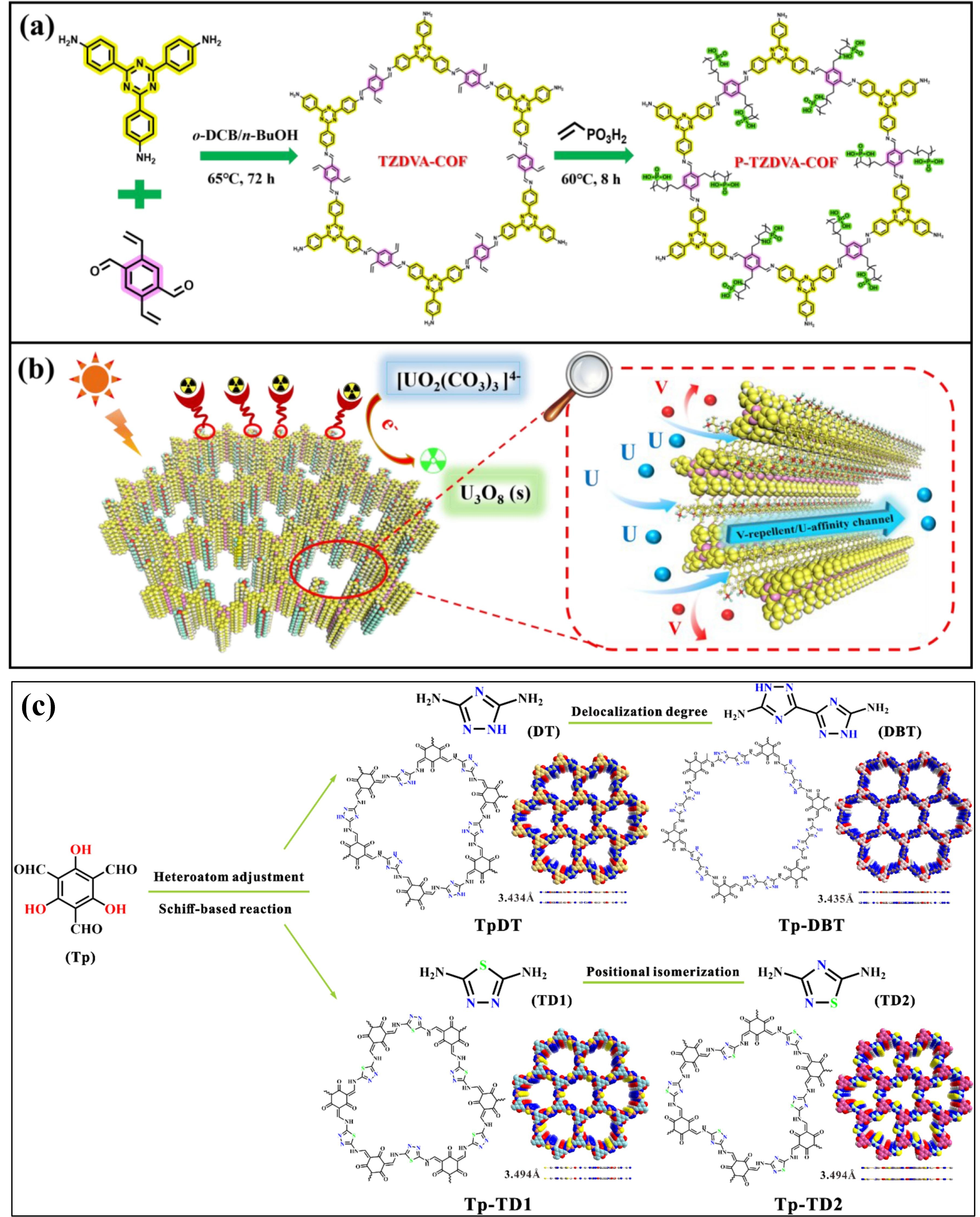
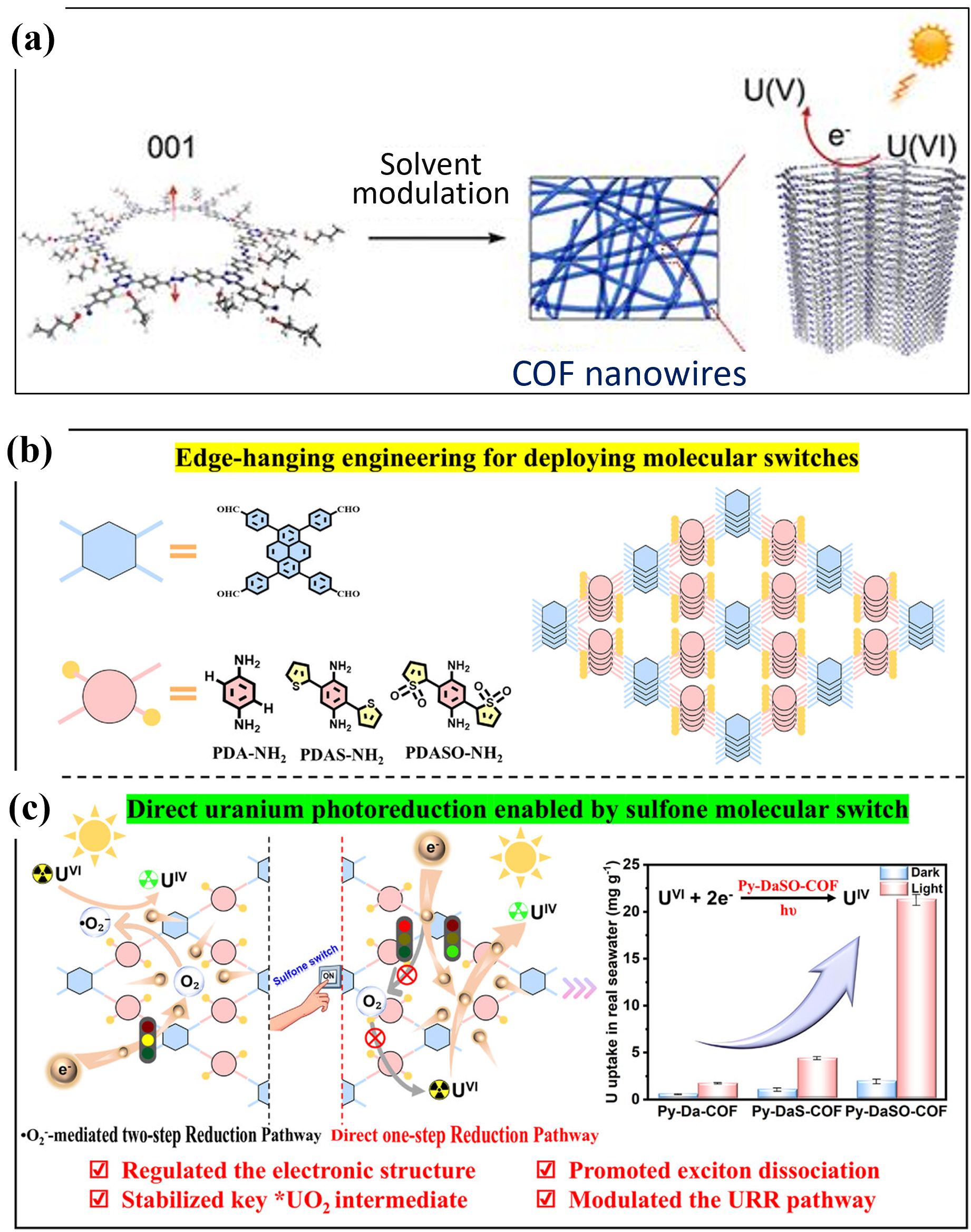
| COFs Materials | Photocatalytic conditions | Light, atmosphere, and sacrificial agent | Surface area/ (m²•g-1) | Extraction capacity/ (mg•g-1) | Reaction time | Selectivity (U/V) | Reference |
|---|---|---|---|---|---|---|---|
| CPP (hydrogel) | Natural seawater, m/V=0.12 mg•L-1 | Natural sunlight, air, no sacrificial agent | 59.8 | 4.15 | 10 d | ≈4 | [ |
| BHMS3 (COF sponge) | Natural seawater, m/V=0.253 mg•L-1 | Natural sunlight, air, no sacrificial agent | 634.00 | 5.14± 0.15 | 12 d | >10 | [ |
| PAE-COF-DC | Spiked seawater, m/V=200 mg•L-1 | Visible light, air, no sacrificial agent | N/A | 80% | 11 h | N/A | [ |
| P-TZDVA-COF | Natural seawater, m/V=0.1 mg•L-1, m=5 mg | 300 W Xe lamp, air, no sacrificial agent | 48.6 | 18.42 | 1.25 d | 5.79 | [ |
| TpTD2 | Natural seawater, C0=10 ppm | Sunlight, air, CH3OH as sacrificial agent | 36.2 | 6.96 | 3 d | N/A | [ |
| COF-4 | Spiked seawater, C0≈20 ppm, m/V=100 mg•L-1; natural seawater, m=9 mg | 300 W Xe lamp, air, no sacrificial agent | 878.9 | 182 (spiked seawater) | 24 h | >15 | [ |
| ≈6.84 mg•g-1•d-1 (natural seawater) | 3 d | ||||||
| COF-4P | Natural seawater, m/V=50 mg•L-1, m=10 mg | 300 W Xe lamp, air, no sacrificial agent | 655.4 | 24.06 (8.02 mg•g-1•d-1) | 3 d | 5 | [ |
| TI-COF | Natural seawater, m/V=0.167 mg•L-1, m=5 mg | 300 W Xe lamp/natural sunlight, air, no sacrificial agent | 695 | 8.8 mg•g-1•d-1 (Xe lamp); 6.9 mg•g-1•d-1 (sunlight) | 1 d | N/A | [ |
| 2DCOF-S | Spiked simulated seawater, C0=8 ppm | 300W Xe lamp, air, no sacrificial agent | 587 | 643 | 2 h | N/A | [ |
| TpPa-N2-m | Actual seawater, C0=10 ppm | Xe lamp, air, no sacrificial agent | 1251.4 | 25.8 | 5 d | N/A | [ |
| N3-COF60 (nanowires) | Natural seawater, C0=3.3 ppb, pH=8.2, m=3 mg | 300W Xe lamp, air, no sacrificial agent | 852 | 34.5 | 42 d | ≈1.7 | [ |
| COF-hcb-defect | Natural seawater | 300 W Xe lamp, air, CH3OH as sacrificial agent | 131 | 3.3 | 1 d | 258 | [ |
| Tp-Py | Natural seawater, m=10 mg | 300 W Xe lamp, air, no sacrificial agent | 799.81 | 154.50 | 12 d | N/A | [ |
| LB-COF | Spiked aqueous solution, C0=8 ppm, pH=5.5, m/V=10 mg•L-1 | 300 W Xe lamp, air, no sacrificial agent | N/A | 320 | 150 min | N/A | [ |
| TpTt@Bi/ BiOBr | Simulated seawater, C0=50 mg•L-1, m/V=100 mg•L-1, m=5 mg | 300 W Xe lamp, air, CH3OH as sacrificial agent | N/A | 81.6% | 180 min | N/A | [ |
| TiOCs∈COF-TZ | Spiked seawater, C0=300 ppb, pH=8.5, m/V=1000 mg•L-1; natural seawater, C0=3.3 ppb, m/V=1000 mg•L-1, m=50 mg | 300 W Xe lamp, N2, CH3OH as sacrificial agent | 824 | 94.4% (spiked seawater) 89.9% (natural seawater) | N/A | N/A | [ |
| COF3 | Natural seawater, m/V=0.09 mg•L-1, m=9 mg | 300 W Xe lamp, air, no sacrificial agent | 161.84 | 33.33 | 4 d | N/A | [ |
| TFA-TAT- COF-Q | Spiked seawater, C0=20 ppm, pH=8.1 | 300 W Xe lamp, air, CH3OH as sacrificial agent | 725 | 74.3% | 6 h | N/A | [ |
| COF-3S | Spiked seawater, C0=30 ppm, m/V=50 mg•L-1 | 300 W Xe lamp, air, no sacrificial agent | 559.1 | 69.1% | 4 h | N/A | [ |
| COF-3 | Spiked seawater, C0≈20 ppm, m/V=100 mg•L-1, m=10 mg | 300 W Xe lamp, air, no sacrificial agent | 671.9 | 88% | 2 h | N/A | [ |
| Py-DaSO-COF | Natural seawater, m/V=0.5 mg•L-1, m=5 mg | 300 W Xe lamp, air, no sacrificial agent | 1934 | 21.25 | 30 d | 7.13 | [ |
| COFs Materials | Photocatalytic conditions | Light, atmosphere, and sacrificial agent | Surface area/ (m²•g-1) | Extraction capacity/ (mg•g-1) | Reaction time | Selectivity (U/V) | Reference |
|---|---|---|---|---|---|---|---|
| CPP (hydrogel) | Natural seawater, m/V=0.12 mg•L-1 | Natural sunlight, air, no sacrificial agent | 59.8 | 4.15 | 10 d | ≈4 | [ |
| BHMS3 (COF sponge) | Natural seawater, m/V=0.253 mg•L-1 | Natural sunlight, air, no sacrificial agent | 634.00 | 5.14± 0.15 | 12 d | >10 | [ |
| PAE-COF-DC | Spiked seawater, m/V=200 mg•L-1 | Visible light, air, no sacrificial agent | N/A | 80% | 11 h | N/A | [ |
| P-TZDVA-COF | Natural seawater, m/V=0.1 mg•L-1, m=5 mg | 300 W Xe lamp, air, no sacrificial agent | 48.6 | 18.42 | 1.25 d | 5.79 | [ |
| TpTD2 | Natural seawater, C0=10 ppm | Sunlight, air, CH3OH as sacrificial agent | 36.2 | 6.96 | 3 d | N/A | [ |
| COF-4 | Spiked seawater, C0≈20 ppm, m/V=100 mg•L-1; natural seawater, m=9 mg | 300 W Xe lamp, air, no sacrificial agent | 878.9 | 182 (spiked seawater) | 24 h | >15 | [ |
| ≈6.84 mg•g-1•d-1 (natural seawater) | 3 d | ||||||
| COF-4P | Natural seawater, m/V=50 mg•L-1, m=10 mg | 300 W Xe lamp, air, no sacrificial agent | 655.4 | 24.06 (8.02 mg•g-1•d-1) | 3 d | 5 | [ |
| TI-COF | Natural seawater, m/V=0.167 mg•L-1, m=5 mg | 300 W Xe lamp/natural sunlight, air, no sacrificial agent | 695 | 8.8 mg•g-1•d-1 (Xe lamp); 6.9 mg•g-1•d-1 (sunlight) | 1 d | N/A | [ |
| 2DCOF-S | Spiked simulated seawater, C0=8 ppm | 300W Xe lamp, air, no sacrificial agent | 587 | 643 | 2 h | N/A | [ |
| TpPa-N2-m | Actual seawater, C0=10 ppm | Xe lamp, air, no sacrificial agent | 1251.4 | 25.8 | 5 d | N/A | [ |
| N3-COF60 (nanowires) | Natural seawater, C0=3.3 ppb, pH=8.2, m=3 mg | 300W Xe lamp, air, no sacrificial agent | 852 | 34.5 | 42 d | ≈1.7 | [ |
| COF-hcb-defect | Natural seawater | 300 W Xe lamp, air, CH3OH as sacrificial agent | 131 | 3.3 | 1 d | 258 | [ |
| Tp-Py | Natural seawater, m=10 mg | 300 W Xe lamp, air, no sacrificial agent | 799.81 | 154.50 | 12 d | N/A | [ |
| LB-COF | Spiked aqueous solution, C0=8 ppm, pH=5.5, m/V=10 mg•L-1 | 300 W Xe lamp, air, no sacrificial agent | N/A | 320 | 150 min | N/A | [ |
| TpTt@Bi/ BiOBr | Simulated seawater, C0=50 mg•L-1, m/V=100 mg•L-1, m=5 mg | 300 W Xe lamp, air, CH3OH as sacrificial agent | N/A | 81.6% | 180 min | N/A | [ |
| TiOCs∈COF-TZ | Spiked seawater, C0=300 ppb, pH=8.5, m/V=1000 mg•L-1; natural seawater, C0=3.3 ppb, m/V=1000 mg•L-1, m=50 mg | 300 W Xe lamp, N2, CH3OH as sacrificial agent | 824 | 94.4% (spiked seawater) 89.9% (natural seawater) | N/A | N/A | [ |
| COF3 | Natural seawater, m/V=0.09 mg•L-1, m=9 mg | 300 W Xe lamp, air, no sacrificial agent | 161.84 | 33.33 | 4 d | N/A | [ |
| TFA-TAT- COF-Q | Spiked seawater, C0=20 ppm, pH=8.1 | 300 W Xe lamp, air, CH3OH as sacrificial agent | 725 | 74.3% | 6 h | N/A | [ |
| COF-3S | Spiked seawater, C0=30 ppm, m/V=50 mg•L-1 | 300 W Xe lamp, air, no sacrificial agent | 559.1 | 69.1% | 4 h | N/A | [ |
| COF-3 | Spiked seawater, C0≈20 ppm, m/V=100 mg•L-1, m=10 mg | 300 W Xe lamp, air, no sacrificial agent | 671.9 | 88% | 2 h | N/A | [ |
| Py-DaSO-COF | Natural seawater, m/V=0.5 mg•L-1, m=5 mg | 300 W Xe lamp, air, no sacrificial agent | 1934 | 21.25 | 30 d | 7.13 | [ |
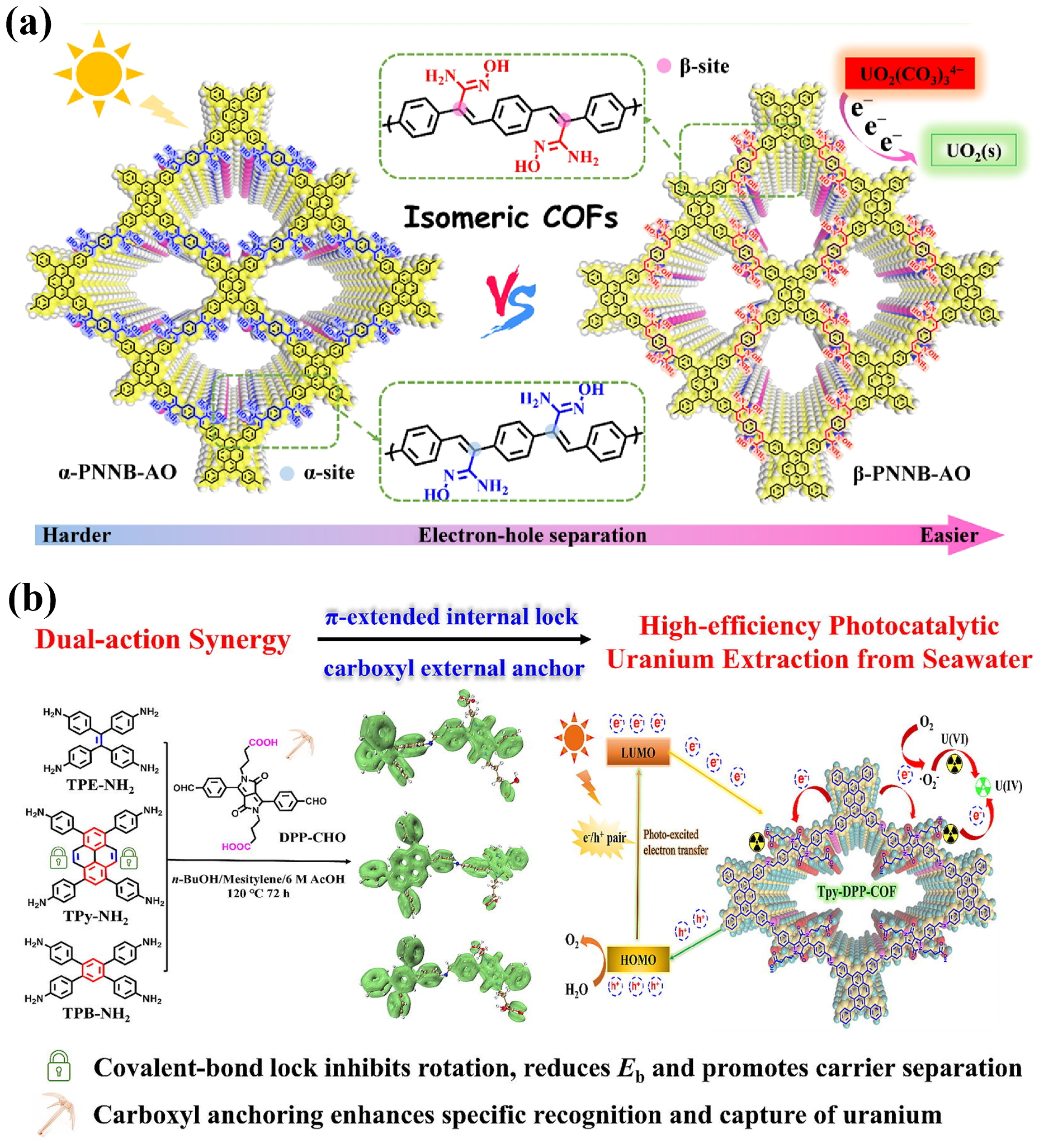
| COFs materials | Photocatalytic/Adsorption conditions | Light, atmosphere, and sacrificial agent | Surface area/ (m²•g-1) | Extraction capacity/(mg•g-1) | Reaction time | Selectivity (U/V) | Reference |
|---|---|---|---|---|---|---|---|
| NDA-TN-AO | Natural seawater, m=5 mg, m/V=0.1 mg•L-1 | 300 W Xe lamp, air, no sacrificial agent | 820.9 | 6.07 (light); 4.56 (dark) | 27 d | N/A | [ |
| PT-BN-AO | Natural seawater, m=5 mg, m/V=0.1 mg•L-1 | 300 W Xe lamp, air, no sacrificial agent | 895.5 | 5.78 (light); 4.07 (dark) | 27 d | N/A | [ |
| Tp-DBD | Natural seawater, m=5 mg, m/V=0.1 mg•L-1 | 300 W Xe lamp, air, no sacrificial agent | 478.9 | 10.31 | 8 d | 19.2 | [ |
| BD-TN-AO | Natural seawater, m/V=0.1 mg•L-1 | 300 W Xe lamp, air, no sacrificial agent | 639 | 5.9 (light); 4.0 (dark) | 5 d | N/A | [ |
| KTG3 (COF hydrogel) | Spiked seawater, C0=35 ppm, pH=5, m=5 mg, m/V=10 mg•L-1 | 300 W Xe lamp, air, no sacrificial agent | N/A | 521.6 (light) | 6 h | N/A | [ |
| Natural seawater, m=5 mg, m/V=5 mg•L-1 | Natural sunlight, air, no sacrificial agent | 5.19 (light); 3.93 (dark) | 10 d | ||||
| PCA10.0 (COF aerogel) | Spiked seawater, C0=10 ppm, m=10 mg, m/V=50 mg•L-1 | Daylight (D65, standard simulated sunlight, 50 W), air, no sacrificial agent | 188.27 | 361.40 (light); 38.50 (dark) | 24 h | 26.99 | [ |
| SACA (COF aerogel) | Spiked seawater, C0=128 ppm, pH=4, m/V=100 mg•L-1 | Visible light (405 nm), air, no sacrificial agent | 183 | 580 | 24 h | 110.36 | [ |
| COF 4-Pd-AO | Natural seawater, m=10 mg | 300 W Xe lamp, air, CH3OH as sacrificial agent | 989 | 13.86 | 3 d | N/A | [ |
| COF 2-Ru-AO | Natural seawater, m=10 mg, m/V=0.25 mg•L-1 | 300 W Xe lamp, air, no sacrificial agent | 896.8 | 7.36 | 3 d | 2.9 | [ |
| TTh-COF-AO | Spiked seawater, C0=20 ppm, m=5 mg, m/V=20 mg•L-1 | 300 W Xe lamp, air, no sacrificial agent | 511.2 | ≈650 | 30 h | >3 | [ |
| Natural seawater, m=5 mg, m/V=0.1 mg•L-1 | 10.24 | 30 d | |||||
| β-PTTN-AO | Natural seawater, m=5 mg, m/V=0.1 mg•L-1 | 300 W Xe lamp, air, no sacrificial agent | 386.8 | 12.74 | 30 d | 3.74 | [ |
| TPy-DPP-COF | Natural seawater, m=5 mg, m/V=0.1 mg•L-1 | 300 W Xe lamp, air, no sacrificial agent | 242.7 | 16.33 | 3 d | 3.82 | [ |
| COF-nTs3 | Spiked seawater, C0=0.65 ppm, m/V=5 mg•L-1 | 300 W Xe lamp, air, no sacrificial agent | 260.5 | 76 | 7 d | N/A | [ |
| CNF-As | Natural seawater, m=5 mg, m/V=1 mg•L-1 | Visible light (405 nm), air, no sacrificial agent | 396.15 | 2.87 | 15 d | 2.31 | [ |
| UiO-66@ TFBT-0.035 | Natural seawater, m=10 mg, m/V=0.1 mg•L-1 | 300 W Xe lamp, air, no sacrificial agent | N/A | 10.9 | 20 d | N/A | [ |
| COFs materials | Photocatalytic/Adsorption conditions | Light, atmosphere, and sacrificial agent | Surface area/ (m²•g-1) | Extraction capacity/(mg•g-1) | Reaction time | Selectivity (U/V) | Reference |
|---|---|---|---|---|---|---|---|
| NDA-TN-AO | Natural seawater, m=5 mg, m/V=0.1 mg•L-1 | 300 W Xe lamp, air, no sacrificial agent | 820.9 | 6.07 (light); 4.56 (dark) | 27 d | N/A | [ |
| PT-BN-AO | Natural seawater, m=5 mg, m/V=0.1 mg•L-1 | 300 W Xe lamp, air, no sacrificial agent | 895.5 | 5.78 (light); 4.07 (dark) | 27 d | N/A | [ |
| Tp-DBD | Natural seawater, m=5 mg, m/V=0.1 mg•L-1 | 300 W Xe lamp, air, no sacrificial agent | 478.9 | 10.31 | 8 d | 19.2 | [ |
| BD-TN-AO | Natural seawater, m/V=0.1 mg•L-1 | 300 W Xe lamp, air, no sacrificial agent | 639 | 5.9 (light); 4.0 (dark) | 5 d | N/A | [ |
| KTG3 (COF hydrogel) | Spiked seawater, C0=35 ppm, pH=5, m=5 mg, m/V=10 mg•L-1 | 300 W Xe lamp, air, no sacrificial agent | N/A | 521.6 (light) | 6 h | N/A | [ |
| Natural seawater, m=5 mg, m/V=5 mg•L-1 | Natural sunlight, air, no sacrificial agent | 5.19 (light); 3.93 (dark) | 10 d | ||||
| PCA10.0 (COF aerogel) | Spiked seawater, C0=10 ppm, m=10 mg, m/V=50 mg•L-1 | Daylight (D65, standard simulated sunlight, 50 W), air, no sacrificial agent | 188.27 | 361.40 (light); 38.50 (dark) | 24 h | 26.99 | [ |
| SACA (COF aerogel) | Spiked seawater, C0=128 ppm, pH=4, m/V=100 mg•L-1 | Visible light (405 nm), air, no sacrificial agent | 183 | 580 | 24 h | 110.36 | [ |
| COF 4-Pd-AO | Natural seawater, m=10 mg | 300 W Xe lamp, air, CH3OH as sacrificial agent | 989 | 13.86 | 3 d | N/A | [ |
| COF 2-Ru-AO | Natural seawater, m=10 mg, m/V=0.25 mg•L-1 | 300 W Xe lamp, air, no sacrificial agent | 896.8 | 7.36 | 3 d | 2.9 | [ |
| TTh-COF-AO | Spiked seawater, C0=20 ppm, m=5 mg, m/V=20 mg•L-1 | 300 W Xe lamp, air, no sacrificial agent | 511.2 | ≈650 | 30 h | >3 | [ |
| Natural seawater, m=5 mg, m/V=0.1 mg•L-1 | 10.24 | 30 d | |||||
| β-PTTN-AO | Natural seawater, m=5 mg, m/V=0.1 mg•L-1 | 300 W Xe lamp, air, no sacrificial agent | 386.8 | 12.74 | 30 d | 3.74 | [ |
| TPy-DPP-COF | Natural seawater, m=5 mg, m/V=0.1 mg•L-1 | 300 W Xe lamp, air, no sacrificial agent | 242.7 | 16.33 | 3 d | 3.82 | [ |
| COF-nTs3 | Spiked seawater, C0=0.65 ppm, m/V=5 mg•L-1 | 300 W Xe lamp, air, no sacrificial agent | 260.5 | 76 | 7 d | N/A | [ |
| CNF-As | Natural seawater, m=5 mg, m/V=1 mg•L-1 | Visible light (405 nm), air, no sacrificial agent | 396.15 | 2.87 | 15 d | 2.31 | [ |
| UiO-66@ TFBT-0.035 | Natural seawater, m=10 mg, m/V=0.1 mg•L-1 | 300 W Xe lamp, air, no sacrificial agent | N/A | 10.9 | 20 d | N/A | [ |
| COFs materials | Electrochemical extraction methods | Electrochemical Conditions | Surface area/ (m²•g-1) | Extraction capacity/ (mg•g-1) | Reaction time | Selectivity (U/V) | Reference |
|---|---|---|---|---|---|---|---|
| TFPM- PDAN-AO | Adsorption- electrocatalysis (HW-ACE) | Spiked seawater, C0=1000 ppm, pH=5.0; natural seawater | 728.4 (TFPM-PDAN) | 4685 (spiked seawater); 12.8 (natural seawater) | 10 h; 20 d | >3 | [ |
| sp2c-COF film | Adsorption- electrocatalysis (electrodeposition) | Spiked seawater, C0=500 ppm | N/A | 2475 | 3 h | N/A | [ |
| S-COF | Adsorption- electrocatalysis | Natural seawater, C0≈3.3 ppb | 584 (AO-g-C34N6-COF) | 48.04 | 21 d | N/A | [ |
| PEDOT@ sp2c-COF-AO | Adsorption- electrocatalysis (electrodeposition) | Spiked seawater, C0=400 ppm, pH=6.0; natural seawater | 88 | 26500 (spiked seawater); 17.4 (natural seawater) | 5 d; 56 d | N/A | [ |
| MICOF-14 | Adsorption- electrocatalysis | Natural seawater, C0≈3.4 ppb | 258 | 20.8 | 5 d | N/A | [ |
| COF-316-AO/ PAO (CP@C) | Adsorption- electrocatalysis (HW-ACE) | Spiked seawater, C0=3.3 ppb Natural seawater, C0=3.0 ppb | 20.9 | 12.2 (spiked seawater); 0.14 (natural seawater) | 14 d; 1 d | 3.4 | [ |
| COFs materials | Electrochemical extraction methods | Electrochemical Conditions | Surface area/ (m²•g-1) | Extraction capacity/ (mg•g-1) | Reaction time | Selectivity (U/V) | Reference |
|---|---|---|---|---|---|---|---|
| TFPM- PDAN-AO | Adsorption- electrocatalysis (HW-ACE) | Spiked seawater, C0=1000 ppm, pH=5.0; natural seawater | 728.4 (TFPM-PDAN) | 4685 (spiked seawater); 12.8 (natural seawater) | 10 h; 20 d | >3 | [ |
| sp2c-COF film | Adsorption- electrocatalysis (electrodeposition) | Spiked seawater, C0=500 ppm | N/A | 2475 | 3 h | N/A | [ |
| S-COF | Adsorption- electrocatalysis | Natural seawater, C0≈3.3 ppb | 584 (AO-g-C34N6-COF) | 48.04 | 21 d | N/A | [ |
| PEDOT@ sp2c-COF-AO | Adsorption- electrocatalysis (electrodeposition) | Spiked seawater, C0=400 ppm, pH=6.0; natural seawater | 88 | 26500 (spiked seawater); 17.4 (natural seawater) | 5 d; 56 d | N/A | [ |
| MICOF-14 | Adsorption- electrocatalysis | Natural seawater, C0≈3.4 ppb | 258 | 20.8 | 5 d | N/A | [ |
| COF-316-AO/ PAO (CP@C) | Adsorption- electrocatalysis (HW-ACE) | Spiked seawater, C0=3.3 ppb Natural seawater, C0=3.0 ppb | 20.9 | 12.2 (spiked seawater); 0.14 (natural seawater) | 14 d; 1 d | 3.4 | [ |
| [1] |
doi: 10.1021/acs.chemrev.7b00355 |
| [2] |
doi: 10.1016/j.ccr.2023.215234 |
| [3] |
doi: 10.1016/j.ccr.2023.215097 |
| [4] |
doi: 10.1039/D2CS00595F |
| [5] |
doi: 10.1039/D3TA05099H |
| [6] |
doi: 10.1016/j.seppur.2025.135988 |
| [7] |
doi: 10.1021/acs.iecr.5b03679 |
| [8] |
doi: 10.1007/s11426-025-2784-1 |
| [9] |
doi: 10.1007/s11356-023-29589-0 |
| [10] |
doi: 10.1002/smtd.v9.3 |
| [11] |
doi: 10.6023/A24020041 |
|
(徐晗, 王聪芝, 刘峙嵘, 石伟群, 化学学报, 2024, 82, 458.)
|
|
| [12] |
doi: 10.1021/acs.iecr.3c02831 |
| [13] |
doi: 10.1002/smll.v20.26 |
| [17] |
doi: 10.1007/s10967-023-08980-8 |
| [18] |
doi: 10.1016/j.seppur.2024.130899 |
| [19] |
doi: 10.1007/s44246-024-00137-w |
| [20] |
|
| [21] |
doi: 10.1002/cjoc.v43.12 |
| [22] |
doi: 10.6023/A25050193 |
|
(江惠星, 郑丽彬, 陈小丰, 张珍珍, 陈秋水, 杨黄浩, 化学学报, 2025, 83, 987.)
doi: 10.6023/A25050193 |
|
| [23] |
doi: 10.1021/accountsmr.4c00195 |
| [24] |
doi: 10.3390/polym15051279 |
| [25] |
doi: 10.1016/j.ccr.2022.214917 |
| [26] |
doi: 10.1016/j.cej.2024.156783 |
| [27] |
|
| [28] |
doi: 10.1002/sus2.70022 |
| [29] |
|
|
(田国新, 刘婷婷, 杨素亮, 原子能科学技术, 2023, 57, 1.)
doi: 10.7538/yzk.2022.youxian.0885 |
|
| [30] |
doi: 10.1002/adma.v30.20 |
| [31] |
doi: 10.1016/j.scib.2021.05.012 pmid: 36654169 |
| [32] |
doi: 10.1007/s10311-020-01179-3 |
| [33] |
doi: 10.1039/D5TA03879K |
| [34] |
doi: 10.1002/adfm.v35.3 |
| [35] |
doi: 10.6023/A24080234 |
|
(黄伊晨, 聂长明, 王聪芝, 陈树森, 宋艳, 李昊, 石伟群, 化学学报, 2024, 82, 1050. )
doi: 10.6023/A24080234 |
|
| [36] |
doi: 10.1002/advs.v6.16 |
| [37] |
doi: 10.1021/jacs.5c10932 |
| [38] |
doi: 10.1016/j.cej.2025.165743 |
| [39] |
doi: 10.1016/j.desal.2025.119367 |
| [40] |
doi: 10.1016/j.cej.2022.134623 |
| [41] |
doi: 10.1016/j.desal.2025.119767 |
| [42] |
|
| [43] |
doi: 10.1038/s44221-024-00346-y |
| [44] |
doi: 10.1016/j.cej.2024.158513 |
| [45] |
doi: 10.1016/j.watres.2024.121470 |
| [46] |
doi: 10.1002/smll.v21.18 |
| [47] |
doi: 10.1016/j.jhazmat.2023.131978 |
| [48] |
doi: 10.1016/j.cej.2024.157017 |
| [49] |
doi: 10.1039/D5TA01632K |
| [50] |
doi: 10.1016/j.cclet.2025.111378 |
| [51] |
doi: 10.1039/D5MH01439E |
| [52] |
doi: 10.1007/s11426-024-2037-5 |
| [53] |
doi: 10.1002/adma.v37.17 |
| [54] |
doi: 10.1016/j.seppur.2025.136438 |
| [55] |
doi: 10.1016/j.colsurfa.2024.133977 |
| [56] |
doi: 10.1016/j.cej.2025.166623 |
| [57] |
doi: 10.1016/j.ijbiomac.2024.137156 |
| [58] |
doi: 10.1016/j.seppur.2024.129654 |
| [59] |
doi: 10.1016/j.seppur.2025.132611 |
| [60] |
doi: 10.1016/j.desal.2026.119845 |
| [61] |
doi: 10.1016/j.ccr.2022.214615 |
| [62] |
doi: 10.3390/nano13132005 |
| [63] |
doi: 10.1002/cssc.v18.17 |
| [64] |
doi: 10.1002/chem.v31.28 |
| [65] |
|
| [66] |
doi: 10.1039/D1TA06732J |
| [67] |
doi: 10.1021/acsami.1c04419 |
| [68] |
doi: 10.1021/acsapm.4c03164 |
| [69] |
doi: 10.1016/j.cej.2025.171420 |
| [70] |
doi: 10.1016/j.seppur.2025.132890 |
| [71] |
|
| [72] |
doi: 10.1038/s41467-023-36710-x |
| [73] |
doi: 10.1002/ange.v135.30 |
| [74] |
doi: 10.1039/D4SC02554G |
| [75] |
|
| [76] |
doi: 10.1039/D5TA09027J |
| [77] |
doi: 10.1021/jacs.4c07699 |
| [78] |
doi: 10.31635/ccschem.024.202405043 |
| [79] |
doi: 10.1038/s41467-024-50951-4 |
| [80] |
|
| [81] |
doi: 10.1016/j.seppur.2025.133120 |
| [82] |
doi: 10.1016/j.chempr.2023.06.008 |
| [83] |
doi: 10.1016/j.scib.2025.12.002 |
| [84] |
doi: 10.1016/j.cej.2025.163078 |
| [85] |
doi: 10.1021/acscentsci.5c01645 |
| [86] |
|
| [87] |
|
| [88] |
doi: 10.1002/anie.v59.40 |
| [89] |
|
| [90] |
doi: 10.1002/smll.v17.6 |
| [91] |
doi: 10.31635/ccschem.020.202000618 |
| [92] |
doi: 10.1016/j.cej.2021.131178 |
| [93] |
doi: 10.1016/j.cej.2024.155756 |
| [94] |
doi: 10.1021/acsapm.5c03517 |
| [95] |
doi: 10.31635/ccschem.022.202201897 |
| [96] |
doi: 10.1021/jacsau.2c00614 |
| [97] |
|
| [98] |
doi: 10.26599/NR.2025.94907677 |
| [99] |
doi: 10.1016/j.jechem.2025.08.061 |
| [100] |
doi: 10.1002/smll.v21.22 |
| [101] |
doi: 10.1007/s40820-025-01984-x |
| [102] |
doi: 10.1016/j.desal.2025.119662 |
| [103] |
doi: 10.1016/j.cej.2024.152341 |
| [104] |
|
| [105] |
doi: 10.1007/s11426-022-1466-9 |
| [106] |
doi: 10.1002/smll.v19.35 |
| [14] |
doi: 10.1039/D4NR04603J |
| [15] |
doi: 10.1016/j.seppur.2024.126507 |
| [16] |
doi: 10.1016/j.ccr.2025.216589 |
| [107] |
doi: 10.1039/D4SC00011K |
| [108] |
doi: 10.1038/s41467-025-62501-7 |
| [109] |
doi: 10.1002/adfm.v35.2 |
| [110] |
doi: 10.1016/j.seppur.2025.135220 |
| [111] |
doi: 10.1038/s41467-025-56471-z |
| [112] |
|
| [113] |
|
| [114] |
doi: 10.1016/j.ccr.2025.217523 |
| [115] |
|
| [1] | 张琳琳, 袁浩轩, 龙亿涛, 郎超, 应佚伦. 用于水-有机溶剂体系单分子测量的聚合物膜-蛋白质纳米孔道系统[J]. 化学学报, 2026, 84(4): 459-464. |
| [2] | 彭天资, 沈嘉克, 郭淑雅, 夏潇潇, 李炜. 迁移学习预测金属/共价有机骨架材料内小分子气体自扩散系数研究[J]. 化学学报, 2026, 84(3): 305-315. |
| [3] | 宋玉朋, 华紫辉, 葛介超, 王春儒, 吴波. 具有强大内建电场的C60@TpPa共价有机框架材料高效光催化产氢[J]. 化学学报, 2026, 84(3): 370-376. |
| [4] | 汪晨程, 欧阳班来, 钟品勇, 张莺瑢, 刘晋彪. 光催化2-氨基苯甲醇与异硫氰酸酯脱硫环化合成2-氨基-1,3-苯并噁嗪[J]. 化学学报, 2026, 84(1): 1-7. |
| [5] | 史同同, 李佳, 殷一樊, 孙凯. 光化学驱动α-三氟甲基烯烃的多样性转化[J]. 化学学报, 2026, 84(1): 135-159. |
| [6] | 彭琼慧, 彭佳, 蔡迎丽, 王祖利, 易荣楠, 沈超, 何卫民. 二苯醚介导氧化铈半多相光催化2-异腈基联苯氟烷基化反应[J]. 化学学报, 2025, 83(9): 1013-1017. |
| [7] | 江惠星, 郑丽彬, 陈小丰, 张珍珍, 陈秋水, 杨黄浩. 基于钛基金属有机框架的孔径调控策略及其在海水提铀中的应用★[J]. 化学学报, 2025, 83(9): 987-992. |
| [8] | 高春, 张松涛, 庞欢. 金属有机框架复合材料★[J]. 化学学报, 2025, 83(8): 962-980. |
| [9] | 闫生荣, 刘文浩, 段芳, 陈明清, 东为富, 陆双龙, 杜明亮. 基于sp2-碳连接具有D-A结构共价有机框架的构筑及其光催化产双氧水性能研究[J]. 化学学报, 2025, 83(7): 685-693. |
| [10] | 李文静, 杨黎燕, 关丽, 张雪娇, 尤静, 沈思语, 赵钰琦, 段琛. 可见光/硫酚催化烯烃C=C双键的氧化裂解反应[J]. 化学学报, 2025, 83(6): 596-601. |
| [11] | 崔雨琪, 李军玉, 孙建科. 多孔有机笼用于能源转换及储存的研究进展[J]. 化学学报, 2025, 83(6): 624-638. |
| [12] | 罗雅玲, 庄展洋, 范峰滔, 李灿. Al掺杂SrTiO3的合成调控及其光催化全分解水性能[J]. 化学学报, 2025, 83(6): 608-615. |
| [13] | 卢一林, 董盛杰, 崔方超, 薄婷婷, 毛卓. 希托夫紫磷烯/SnS2范德华异质结作为直接全解水光催化剂的理论构建[J]. 化学学报, 2025, 83(4): 377-389. |
| [14] | 李国凯, 朱滨锋, 胡涛, 樊瑞峰, 孙蔚青, 和振秀, 陈景超, 樊保敏. 光催化叔胺的脱烷基酰化反应[J]. 化学学报, 2025, 83(3): 199-205. |
| [15] | 胡国伟, 王晓欢, 原志鹏, 新巴雅尔, 乌力吉贺希格. Ag掺杂对铁酸铋系化合物光催化性能的影响[J]. 化学学报, 2025, 83(3): 229-236. |
| 阅读次数 | ||||||
|
全文 |
|
|||||
|
摘要 |
|
|||||
