

Acta Chimica Sinica ›› 2026, Vol. 84 ›› Issue (2): 248-256.DOI: 10.6023/A25090323 Previous Articles Next Articles
Article
汪庆辉a,†( ), 任正a,†(), 张凯b,*(), 周东营a,*(), 樊健a,c,*()
投稿日期:2025-09-27
发布日期:2025-11-10
基金资助:
Qinghui Wanga(), Zheng Rena(), Kai Zhangb,*(), Dongying Zhoua,*(), Jian Fana,c,*()
Received:2025-09-27
Published:2025-11-10
Contact:
*E-mail: 15692312996@163.com;dyzhou@suda.edu.cn;jianfan@suda.edu.cn
About author:Supported by:Share
Qinghui Wang, Zheng Ren, Kai Zhang, Dongying Zhou, Jian Fan. Multiple Resonance Thermally Activated Delayed Fluorescence Molecule Based on 3,6-Diphenylselenylcarbazole[J]. Acta Chimica Sinica, 2026, 84(2): 248-256.


| 化合物 | ФPL/% | Фd/% | τp/ns | τd/μs | Kp/108 s−1 | Kd/105 s−1 | KrS/107 s−1 | KIC/107 s−1 | KISC/108 s−1 | KRISC/106 s−1 | |
|---|---|---|---|---|---|---|---|---|---|---|---|
| 2SetCzBN | 70 | 63.98 | 1.30 | 3.27 | 7.69 | 2.14 | 4.63 | 1.98 | 7.03 | 2.49 | |
| 化合物 | ФPL/% | Фd/% | τp/ns | τd/μs | Kp/108 s−1 | Kd/105 s−1 | KrS/107 s−1 | KIC/107 s−1 | KISC/108 s−1 | KRISC/106 s−1 | |
|---|---|---|---|---|---|---|---|---|---|---|---|
| 2SetCzBN | 70 | 63.98 | 1.30 | 3.27 | 7.69 | 2.14 | 4.63 | 1.98 | 7.03 | 2.49 | |
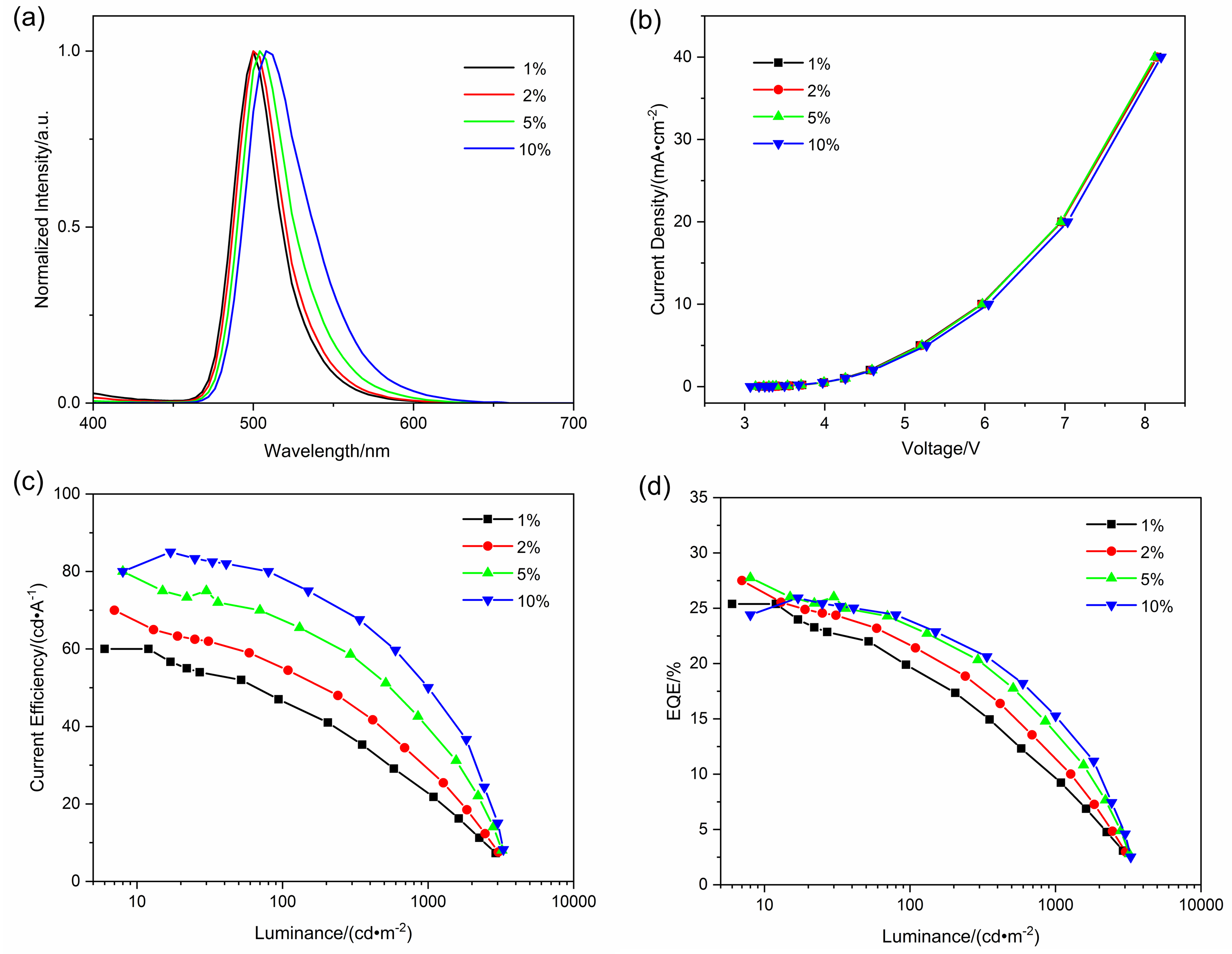
| 发光材料 | Dop (w/%) | Vona/V | EQEb/% | CEmaxc/(cd•A−1) | λem/nm | FWHM/nm | ||
|---|---|---|---|---|---|---|---|---|
| Max | @103 cd/m2 | |||||||
| 2SetCzBN | 1 2 5 10 | 3.2 3.2 3.1 3.1 | 25.4 27.5 27.7 25.9 | 9.8 11.7 13.9 15.2 | 60 70 80 85 | 500 500 504 508 | 32 32 36 44 | |
| 发光材料 | Dop (w/%) | Vona/V | EQEb/% | CEmaxc/(cd•A−1) | λem/nm | FWHM/nm | ||
|---|---|---|---|---|---|---|---|---|
| Max | @103 cd/m2 | |||||||
| 2SetCzBN | 1 2 5 10 | 3.2 3.2 3.1 3.1 | 25.4 27.5 27.7 25.9 | 9.8 11.7 13.9 15.2 | 60 70 80 85 | 500 500 504 508 | 32 32 36 44 | |
| 发光材料 | Dop (w/%) | Von/V | EQE/% | CE/(cd•A−1) | λem/nm | FWHM/nm | ||||
|---|---|---|---|---|---|---|---|---|---|---|
| Max | @103 cd/m2 | Max | @103 cd/m2 | |||||||
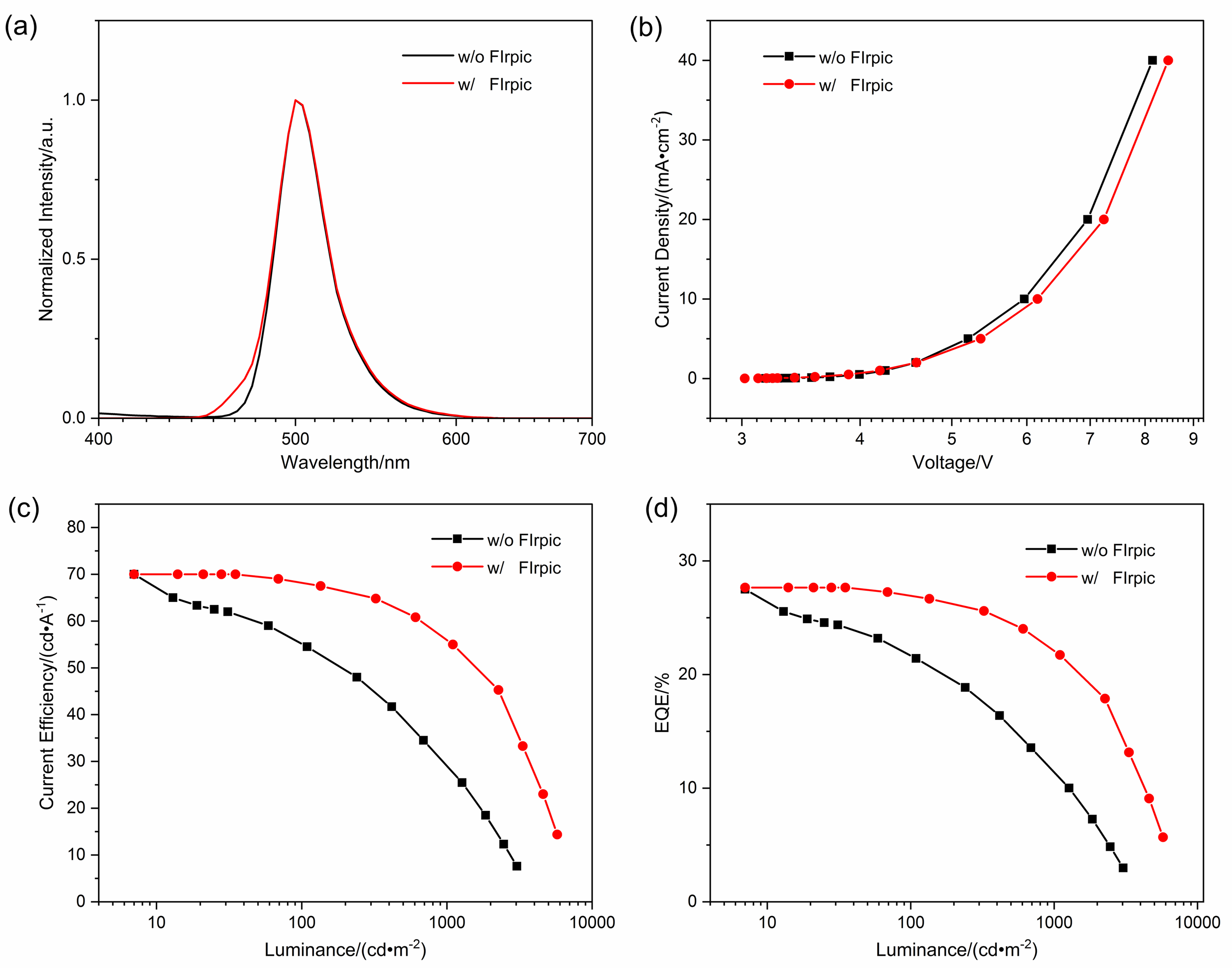
| 2SetCzBN 2SetCzBN:Firpic | 2 2 | 3.2 3.1 | 27.5 27.6 | 11.7 22.2 | 70.0 70.0 | 29.7 56.2 | 500 500 | 32 32 | ||
| 发光材料 | Dop (w/%) | Von/V | EQE/% | CE/(cd•A−1) | λem/nm | FWHM/nm | ||||
|---|---|---|---|---|---|---|---|---|---|---|
| Max | @103 cd/m2 | Max | @103 cd/m2 | |||||||
| 2SetCzBN 2SetCzBN:Firpic | 2 2 | 3.2 3.1 | 27.5 27.6 | 11.7 22.2 | 70.0 70.0 | 29.7 56.2 | 500 500 | 32 32 | ||

| [1] |
doi: 10.1126/science.abc8530 |
| [2] |
doi: 10.6023/A23020051 |
|
(葛凤洁, 张开志, 曹清鹏, 徐慧, 周涛, 张文浩, 班鑫鑫, 张晓波, 李娜, 朱鹏, 化学学报, 2023, 81, 1157.)
doi: 10.6023/A23020051 |
|
| [3] |
doi: 10.1002/jsid.v29.6 |
| [4] |
doi: 10.1038/s41377-020-0341-9 |
| [5] |
|
|
(刘彭义, 唐振方, 孙汪典, 暨南大学学报, 2002, 23, 66.)
|
|
| [6] |
doi: 10.1039/C5CC03114A |
| [7] |
doi: 10.1021/ja306538w |
| [8] |
|
|
(郑贤, 杨朝龙, 发光学报, 2022, 43, 1027.)
|
|
| [9] |
doi: 10.1038/nature11687 |
| [10] |
doi: 10.1039/D3CC05460H |
| [11] |
doi: 10.6023/A24100310 |
|
(马金珠, 李阳, 高珊, 赵越, 丁磊, 周东营, 樊健, 化学学报, 2025, 83, 17.)
doi: 10.6023/A24100310 |
|
| [12] |
doi: 10.6023/A24040148 |
|
(张登朝, 贾吉慧, 梁栋, 蔡显宝, 赵雨晴, 胡祥龙, 江钰冰, 卢灿忠, 化学学报, 2024, 82, 887.)
doi: 10.6023/A24040148 |
|
| [13] |
doi: 10.6023/A25010010 |
|
(方素琴, 童恺宁, 陈思浛, 张千峰, 童碧海, 冯敏强, 孔辉, 化学学报, 2025, 83, 471.)
doi: 10.6023/A25010010 |
|
| [14] |
doi: 10.7536/PC160520 |
|
(姜贺, 靳继彪, 陈润锋, 郑超, 黄维, 化学进展, 2016, 28, 1811.)
doi: 10.7536/PC160520 |
|
| [15] |
doi: 10.6023/A23040186 |
|
(王一诺, 邵世洋, 王利祥, 化学学报, 2023, 81, 1202.)
doi: 10.6023/A23040186 |
|
| [16] |
doi: 10.1002/adma.v28.14 |
| [17] |
doi: 10.1002/adma.v36.48 |
| [18] |
doi: 10.1038/s41467-023-38086-4 |
| [19] |
doi: 10.1021/acs.jpclett.3c03317 |
| [20] |
doi: 10.1038/nature09887 |
| [21] |
doi: 10.1063/1674-0068/cjcp2406082 |
| [22] |
|
| [23] |
doi: 10.1021/acsami.2c12017 |
| [24] |
doi: 10.1038/s41566-022-01083-y |
| [25] |
|
| [26] |
doi: 10.1002/anie.v58.47 |
| [27] |
doi: 10.1002/adom.v8.9 |
| [28] |
doi: 10.1002/adma.v35.6 |
| [29] |
doi: 10.1002/adfm.v30.35 |
| [30] |
|
|
(朱彤珺, 李来运, 半导体技术, 2007, 04, 358.)
|
|
| [31] |
|
|
(季兴桥, 黎威志, 钟志有, 王涛, 蒋亚东, 量子电子学报, 2006, 23, 416.)
|
|
| [32] |
|
| [33] |
|
| [34] |
doi: 10.3866/PKU.WHXB201201163 |
|
(王健, 张福俊, 徐征, 王永生, 物理化学学报, 2012, 28, 949.)
|
|
| [35] |
|
|
(王琪, 黄天宇, 张东东, 段炼, 发光学报, 2023, 44, 77.)
|
|
| [36] |
doi: 10.1109/JDT.2007.895354 |
| [37] |
doi: 10.1002/advs.v9.25 |
| [38] |
doi: 10.1039/D5TC01782C |
| [1] | Dongqing Xu, Haishan Dong, Luyan Shi, Ting Zhang. Pyridine-Based Bipolar Host Materials for Phosphorescent Organic Light-emitting Diodes [J]. Acta Chimica Sinica, 2026, 84(2): 240-247. |
| [2] | Suqin Fang, Kaining Tong, Sihan Chen, Qianfeng Zhang, Bihai Tong, Mankeung Fung, Hui Kong. Xanthone Based Thermally Activated Delayed Fluorescence Enantiomers for Efficient Circularly Polarized Electroluminescence [J]. Acta Chimica Sinica, 2025, 83(5): 471-478. |
| [3] | Yan An, Xu Shipan, Du Xuyang, Liu Wenping, Zhao Kunxiang, Li Shengli, Zhong Daokun, Zhou Guijiang, Yang Xiaolong, Sun Yuanhui. Synthesis of Blue-Emitting Materials with Sterically Induced Twisted Structures and Their Application in Blue Organic Light-Emitting Diode (OLED) [J]. Acta Chimica Sinica, 2025, 83(11): 1317-1323. |
| [4] | Zhu Yunfei, Guo Kewei, Wang Zilu, Li Hao, Zhu Aiyun, Ma Jingyao, ZhuShoujia, Feng Quanyou, Xie Linghai. Fluorene-based Functionalized D-A Stretchable Electroluminescent Polymers and Their Light-emitting Diodes [J]. Acta Chimica Sinica, 2025, 83(11): 1300-1308. |
| [5] | Hui Li, Liang Yin. Research Progress on Catalytic Asymmetric Synthesis of Chiral Organoselenium Compounds [J]. Acta Chimica Sinica, 2025, 83(10): 1237-1251. |
| [6] | Jinzhu Ma, Yang Li, Shan Gao, Yue Zhao, Lei Ding, Dongying Zhou, Jian Fan. High-efficiency Near Infrared Thermally Activated Delayed Fluorescence Based on Phenazine Acceptor [J]. Acta Chimica Sinica, 2025, 83(1): 17-24. |
| [7] | Dengchao Zhang, Jihui Jia, Dong Liang, Xianbao Cai, Yuqing Zhao, Xianglong Hu, Yubing Jiang, Canzhong Lu. Design, Synthesis and Properties of Cu(I) Complexes with a Nitrogen-containing Spirocycle Ligand for Delayed Fluorescence Materials [J]. Acta Chimica Sinica, 2024, 82(8): 887-893. |
| [8] | Yuqing Zhao, Dong Liang, Jihui Jia, Rongmin Yu, Can-Zhong Lu. Synthesis and Characterization of an Emissive Ag(I) Complex with a D-A Type Ligand Containing Two Electron-withdrawing Groups [J]. Acta Chimica Sinica, 2024, 82(5): 486-492. |
| [9] | Fengjie Ge, Kaizhi Zhang, Qingpeng Cao, Hui Xu, Tao Zhou, Wenhao Zhang, Xinxin Ban, Xiaobo Zhang, Na Li, Peng Zhu. Design, Synthesis and Electroluminescence Performance of Flexible Fluorenyl Block Delayed Fluorescence Dimers [J]. Acta Chimica Sinica, 2023, 81(9): 1157-1166. |
| [10] | Yinuo Wang, Shiyang Shao, Lixiang Wang. Recent Advances in Multiple Resonance Organic/Polymer Fluorescent Materials with Narrowband Emission★ [J]. Acta Chimica Sinica, 2023, 81(9): 1202-1214. |
| [11] | Zhenyu Liu, Junfeng Rao, Shoujia Zhu, Bingyang Wang, Fan Yu, Quanyou Feng, Linghai Xie. Research Progress of Solution-Processed Self-Host Thermally Activated Delayed Fluorescence Materials [J]. Acta Chimica Sinica, 2023, 81(7): 820-835. |
| [12] | Yinfeng Wang, Meng Li, Chuanfeng Chen. Chiral Triptycene-Based Red Thermally Activated Delayed Fluorescence Polymers and Their Organic Light-Emitting Diodes★ [J]. Acta Chimica Sinica, 2023, 81(6): 588-594. |
| [13] | Shaoqin Zhang, Meiqing Li, Zhongjun Zhou, Zexing Qu. Theoretical Study on the Multiple Resonance Thermally Activated Delayed Fluorescence Process [J]. Acta Chimica Sinica, 2023, 81(2): 124-130. |
| [14] | Lu Zhou, Jia-Xiong Chen, Shaomin Ji, Wen-Cheng Chen, Yanping Huo. Research Progress of Red Thermally Activated Delayed Fluorescent Materials Based on Quinoxaline [J]. Acta Chimica Sinica, 2022, 80(3): 359-372. |
| [15] | Bixia Lin, Yingshan Huang, Shuai Chen, Zhenyu Xing. Research Progress of Key Materials for Sodium-selenium Batteries [J]. Acta Chimica Sinica, 2021, 79(5): 641-648. |
| Viewed | ||||||
|
Full text |
|
|||||
|
Abstract |
|
|||||
