原文献图片引用均已获得原作者许可
[1] Zhang M.; Zhuang, T. Processable, High-Performance Circularly Polarized Luminescence Architectures for Information Interaction. Acc. Chem. Res.2026, 59, 1507-1521. DOI: 10.1021/acs.accounts.5c00911.
[2] Huang R.; Qiao Q.; Seah D.; Shen T.; Wu X.; de Moliner F.; Wang C.; Ding N.; Chi W.; Sun H.; Vendrell M.; Xu Z.; Fang Y.; Liu, X. Precision Molecular Engineering of Compact Near-Infrared Fluorophores. J. Am. Chem. Soc.2025, 147, 5258-5268. DOI: 10.1021/jacs.4c16087.
[3] Zhang M.; Xin C.; Hou S.; Li, K. Circularly Polarized Luminescent-Active Small Organic Molecules with Thermally Activated Delayed Fluorescence Properties. Chem. Commun.2026, 62, 5178-5195. DOI: 10.1039/d5cc06059a.
[4] Kim H.; Park W.; Kim Y.; Filatov M.; Choi C. H.; Lee, D. Relief of Excited-State Antiaromaticity Enables the Smallest Red Emitter. Nat. Commun.2021, 12, 5409. DOI: 10.1038/s41467-021-25677-2.
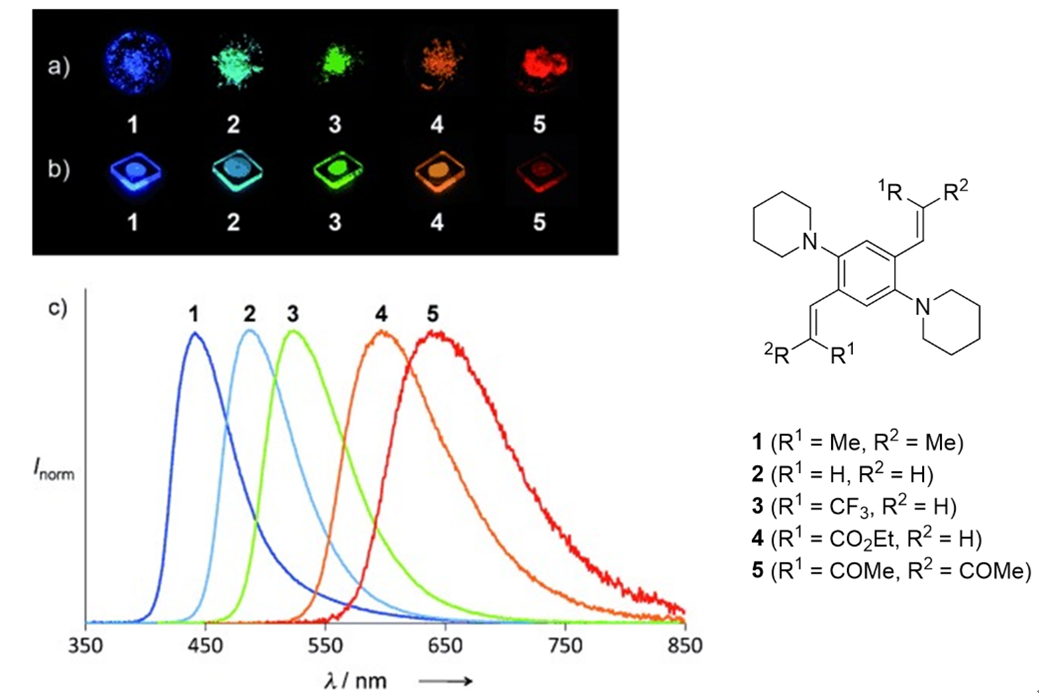
[5] Shimizu M.; Takeda Y.; Higashi M.; Hiyama, T. 1 4-Bis(alkenyl)-2,5-dipiperidinobenzenes: Minimal Fluorophores Exhibiting Highly Efficient Emission in the Solid State. Angew. Chem. Int. Ed.2009, 48, 3653-3656. DOI: 10.1002/anie.200900963.
[6] Beppu T.; Tomiguchi K.; Masuhara A.; Pu Y.-J.; Katagiri, H. Single Benzene Green Fluorophore: Solid-State Emissive, Water-Soluble, and Solvent- and pH-Independent Fluorescence with Large Stokes Shifts. Angew. Chem. Int. Ed.2015, 54, 7332-7335. DOI: 10.1002/anie.201502365.
[7] Benson S.; Fernandez A.; Barth N. D.; de Moliner F.; Horrocks M. H.; Herrington C. S.; Abad J. L.; Delgado A.; Kelly L.; Chang Z.; Feng Y.; Nishiura M.; Hori Y.; Kikuchi K.; Vendrell, M. SCOTfluors: Small, Conjugatable, Orthogonal, and Tunable Fluorophores for In Vivo Imaging of Cell Metabolism. Angew. Chem. Int. Ed.2019, 58, 6911-6915. DOI: 10.1002/anie.201900465.
[8] Tang B.; Liu H.; Li F.; Wang Y.; Zhang, H. Single-benzene solid emitters with lasing properties based on aggregation-induced emissions. Chem. Commun.2016, 52, 6577-6580. DOI: 10.1039/C6CC02616H.
[9] Zhang, X.; Wang, J.; Zhao, H.; Jiang, Z.; Chen, K.; Wang, T.; Huang, X.; Wang, N.; Hao, H. Efficient single benzene AIE system: Optical waveguide and invisible ink. Dyes Pigm. 2023, 209, 110947. DOI: 10.1016/j.dyepig.2022.110947.
[10] Raghava T.; Chattopadhyay A.; Banerjee S.; Sarkar, N. Conversion of amino-terephthalonitriles to multi-substituted single benzene fluorophores with utility in bioimaging. Org. Biomol. Chem.2024, 22, 364-373. DOI: 10.1039/D3OB01761C.
[11] Heo J.-M.; Park J.; Flórez-Angarita M. F.; Wang L.; Yu C.; Choi J.; Woo H.; Milián-Medina B.; Matzger A. J.; Kwon M. S.; Gierschner J.; Kim J. Elucidating the molecular structural origin of efficient emission across solid and solution phases of single benzene fluorophores. Nat. Commun.2025, 16, 5560. DOI: 10.1038/s41467-025-60316-0.
[12] Kim H.; Kim Y.; Lee, D. Small is Beautiful: Electronic Origin and Synthetic Evolution of Single-Benzene Fluorophores. Acc. Chem. Res.2024, 57, 140-152. DOI: 10.1021/acs.accounts.3c00605.
[13] Riehl J. P.; Richardson F. S.Circularly Polarized Luminescence Spectroscopy. Chem. Rev. 1986, 86, 1-16. DOI: 10.1021/cr00071a001.
[14] Sánchez-Carnerero,E. M.; Agarrabeitia, A. R.; Moreno, F.; Maroto, B. L.; Muller, G.; Ortiz, M. J.; de la Moya, S. Circularly Polarized Luminescence from Simple Organic Molecules. Chem. Eur. J. 2015, 21, 13488-13500. DOI: 10.1002/chem.201501178.
[15] Arrico L.; Di Bari L.; Zinna, F. Chem. Eur. J.2021, 27, 2920-2934. DOI: 10.1002/chem.202002791.
[16] Zhang T.; Zhang Y.; He Z.; Yang T.; Hu X.; Zhu T.; Zhang Y.; Tang Y.; Jiao J. Recent Advances of Chiral Isolated and Small Organic Molecules: Structure and Properties for Circularly Polarized Luminescence. Chem. Asian J.2024, 19, e202400049. DOI: 10.1002/asia.202400049.
[17] Liu Y.; Hao A.; Xing P.Chiroluminophores Based on Non-Conjugated Benzenes. Sci. China Chem. 2023, 66, 2130-2140. DOI: 10.1007/s11426-023-1630-5.
[18] Pan X.; Zheng A.; Yu X.; Di Q.; Li L.; Duan P.; Ye K.; Naumov P.; Zhang, H. A Low-Temperature-Resistant Flexible Organic Crystal with Circularly Polarized Luminescence. Angew. Chem. Int. Ed.2022, 61, e202203938. DOI: 10.1002/anie.202203938.
[19] Guo Y.; Fang S.; Zhu L.; Song J.; Che J.; Xiang H.; Wang, T. Stereodivergent Access to C-N Atropisomers via Phosphonium Salt-Enabled Desymmetrizing Remote Cyclization/Aromatization Cascade. Angew. Chem. Int. Ed.2026, 65, e202518310. DOI: 10.1002/anie.202518310.
[20] Li Z.-Y.; Liu F.; Li H.; Guo X.; Jiao L.; Hao, E. Rhodium-Catalyzed Two-Fold, Regioselective and Enantioselective C-H Activation: an Efficient Strategy to Chiral Single-Benzene-Based Fluorophores. Org. Lett.2024, 26, 444-449. DOI: 10.1021/acs.orglett.3c03467.
[21] Wei S.-Q.; Li Z.-H.; Sun C.-L.; Li Y.; Wang X.-Y.; Ding T.-M.; Zhu X.; Tu Y.-Q.; Zhang S.-Y.Circularly Polarized Luminescence with Large Dissymmetry Factor over 10-1 Based on Flexible Point-Chirality via Programming at Molecular Level.Angew. Chem. Int. Ed. 2025, e202523152. DOI: 10.1002/anie.202523152.
[22] Kim Y.; Kim H.; Son J. B.; Filatov M.; Choi C. H.; Lee N. K.; Lee, D. Single-Benzene Dual-Emitters Harness Excited-State Antiaromaticity for White Light Generation and Fluorescence Imaging. Angew. Chem. Int. Ed.2023, 62, e202302107. DOI: 10.1002/anie.202302107.
[23] Stachelek P.; Serrano-Buitrago S.; Maroto B. L.; Pal R.; de la Moya, S. Circularly Polarized Luminescence Bioimaging Using Chiral BODIPYs: A Model Scaffold for Advancing Unprecedented CPL Microscopy Using Small Full-Organic Probes. ACS Appl. Mater. Interfaces2024, 16, 67246-67254. DOI: 10.1021/acsami.4c14127.
[24] Xiong Z.; Liu X.; Zhang Z.; Wei S.; Liu J.; Xu Q.; Sun J. Z.; Zhang J.; Tang B. Z.; Zhang, H. Intrinsic Circularly Polarized Luminescence with a Record-High Dissymmetry Factor via Dynamic Through-Space Conjugation. Chem2026, 12, 102858. DOI: 10.1016/j.chempr.2025.102858.
[25] Zinna F.;Di Bari, L. Emerging Field of Chiral Ln(III) Complexes for OLEDs. In Lanthanide-Based Multifunctional Materials: From OLEDs to SIMs; Martín-Ramos, P.; Ramos Silva, M., Eds.; Elsevier: Amsterdam, 2018; pp 171-194. DOI: 10.1016/B978-0-12-813840-3.00005-3.
[26] Nagata Y.; Mori T. Irreverent Nature of Dissymmetry Factor and Quantum Yield in Circularly Polarized Luminescence of Small Organic Molecules. Front. Chem.2020, 8, 448. DOI: 10.3389/fchem.2020.00448.
[27] Wong, K.-L.; Bünzli, J.-C. G.; Tanner, P. A. Quantum Yield and Brightness. J. Lumin. 2020, 224, 117256. DOI: 10.1016/j.jlumin.2020.117256.
[28] Wang H.-Q.; Tang Y.; Huang Z.-Y.; Wang F.-Z.; Qiu P.-F.; Zhang X.; Li C.-H.; Li, Q. A Dual-Responsive Liquid Crystal Elastomer for Multi-Level Encryption and Transient Information Display. Angew. Chem. Int. Ed.2023, 62, e202313728. DOI: 10.1002/anie.202313728.
[29] VanOrman Z. A.; Kitzmann W. R.; Reponen A.-P. M.; Deshpande T.; Jöbsis H. J.; Feldmann, S. Chiral Light-Matter Interactions in Solution-Processable Semiconductors. Nat. Rev. Chem.2025, 9, 208-223. DOI: 10.1038/s41570-025-00690-x.
[30] Grimm J. B.; Lavis, L. D. Caveat Fluorophore: An Insiders’ Guide to Small-Molecule Fluorescent Labels. Nat. Methods2022, 19, 149-158. DOI: 10.1038/s41592-021-01338-6.
[31] Harada T.; Kuroda R.; Moriyama, H. Solid-State Circularly Polarized Luminescence Measurements: Theoretical Analysis. Chem. Phys. Lett.2012, 530, 126-131. DOI: 10.1016/j.cplett.2012.01.059.
[32] Stachelek P.; MacKenzie L.; Parker D.; Pal, R. Circularly Polarised Luminescence Laser Scanning Confocal Microscopy to Study Live Cell Chiral Molecular Interactions. Nat. Commun.2022, 13, 553. DOI: 10.1038/s41467-022-28220-z.
[33] De Rosa, D. F.; Stachelek, P.; Black, D. J.; Pal, R. Rapid Handheld Time-Resolved Circularly Polarised Luminescence Photography Camera for Life and Material Sciences. Nat. Commun. 2023, 14, 1537. DOI: 10.1038/s41467-023-37329-8.
[34] Wang Y.; Niu D.; Ouyang G.; Liu M.Double Helical π-Aggregate Nanoarchitectonics for Amplified Circularly Polarized Luminescence. Nat. Commun. 2022, 13, 1710. DOI: 10.1038/s41467-022-29396-0.
[35] Liu Z.-F.; Liu X.-X.; Zhang H.; Zeng L.; Niu L.-Y.; Chen P.-Z.; Fang W.-H.; Peng X.; Cui G.; Yang Q.-Z.Intense Circularly Polarized Luminescence Induced by Chiral Supramolecular Assembly: The Importance of Intermolecular Electronic Coupling. Angew. Chem. Int. Ed. 2024, 63, e202407135. DOI: 10.1002/anie.202407135.
[36] Sengupta A.; Roy G.; Likhar A. R.; Asthana D.A Supramolecular Assembly-Based Strategy towards the Generation and Amplification of Photon Up-Conversion and Circularly Polarized Luminescence. Nanoscale 2023, 15, 18999-19015. DOI: 10.1039/D3NR04184K. |