有机化学 ›› 2026, Vol. 46 ›› Issue (7): 2529-2543.DOI: 10.6023/cjoc202602023 上一篇 下一篇
综述与进展
张文钰a, 刘星雨a, 薛琦a, 李杨a,*( ), 汪苇杭b,*(), 李金恒a,c,*()
收稿日期:2026-02-28
修回日期:2026-05-01
发布日期:2026-06-03
基金资助:
Wenyu Zhanga, Xingyu Liua, Qi Xuea, Yang Lia,*(), Weihang Wangb,*(), Jinheng Lia,c,*()
Received:2026-02-28
Revised:2026-05-01
Published:2026-06-03
Contact:
*E-mail: liyang1989@hnu.edu.cn;218202047@csu.edu.cn;jhli@hnu.edu.cn
Supported by:文章分享

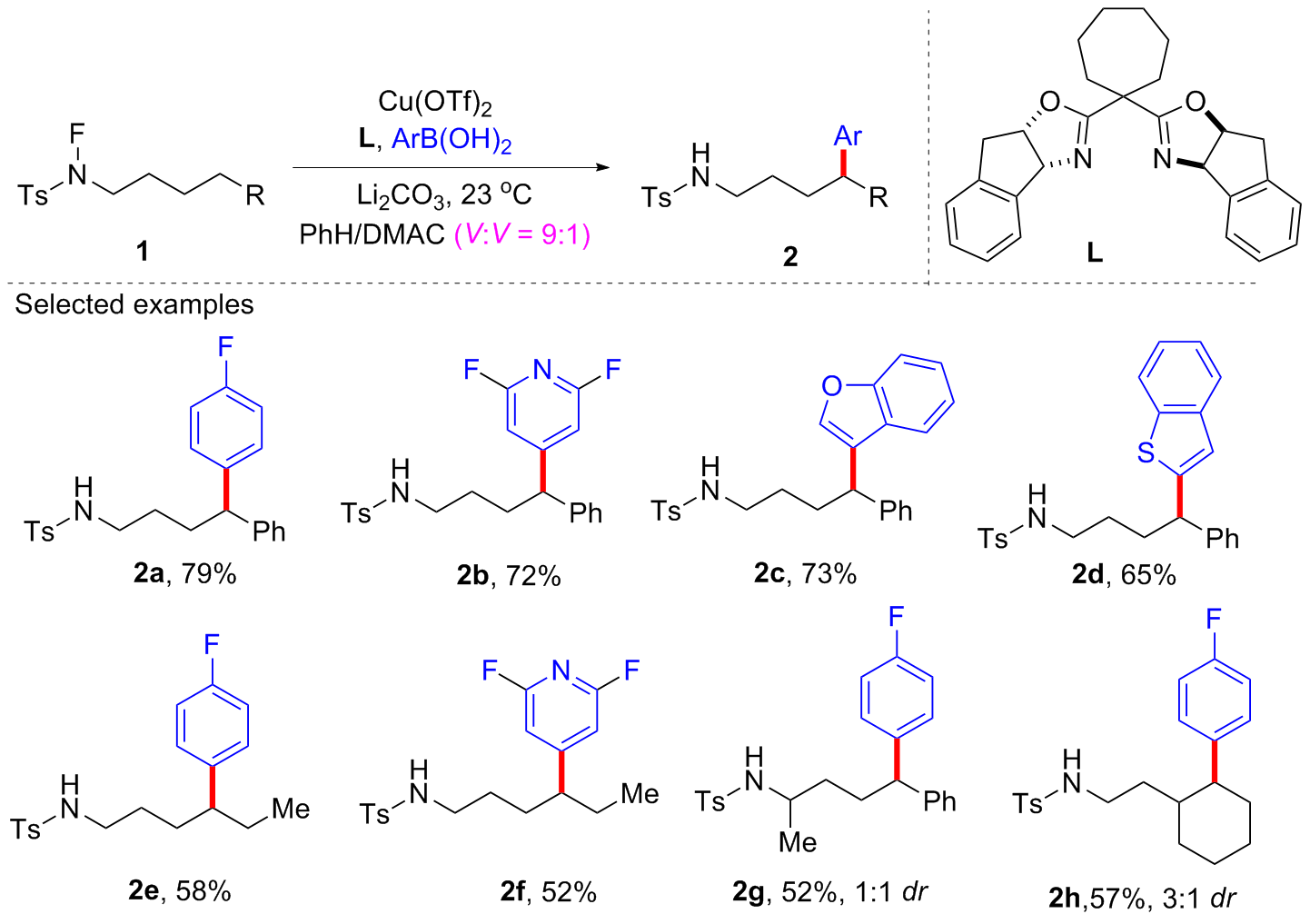
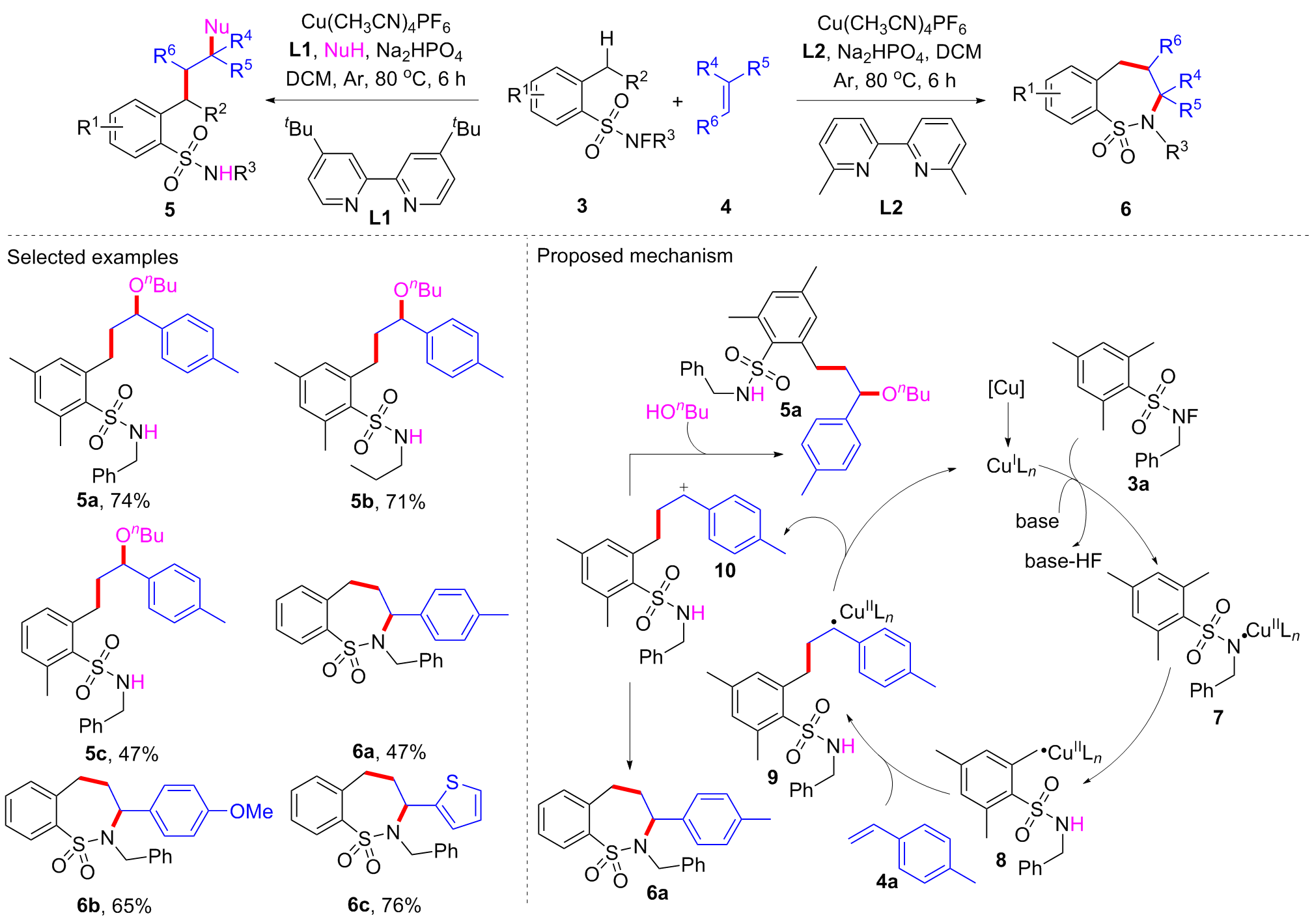
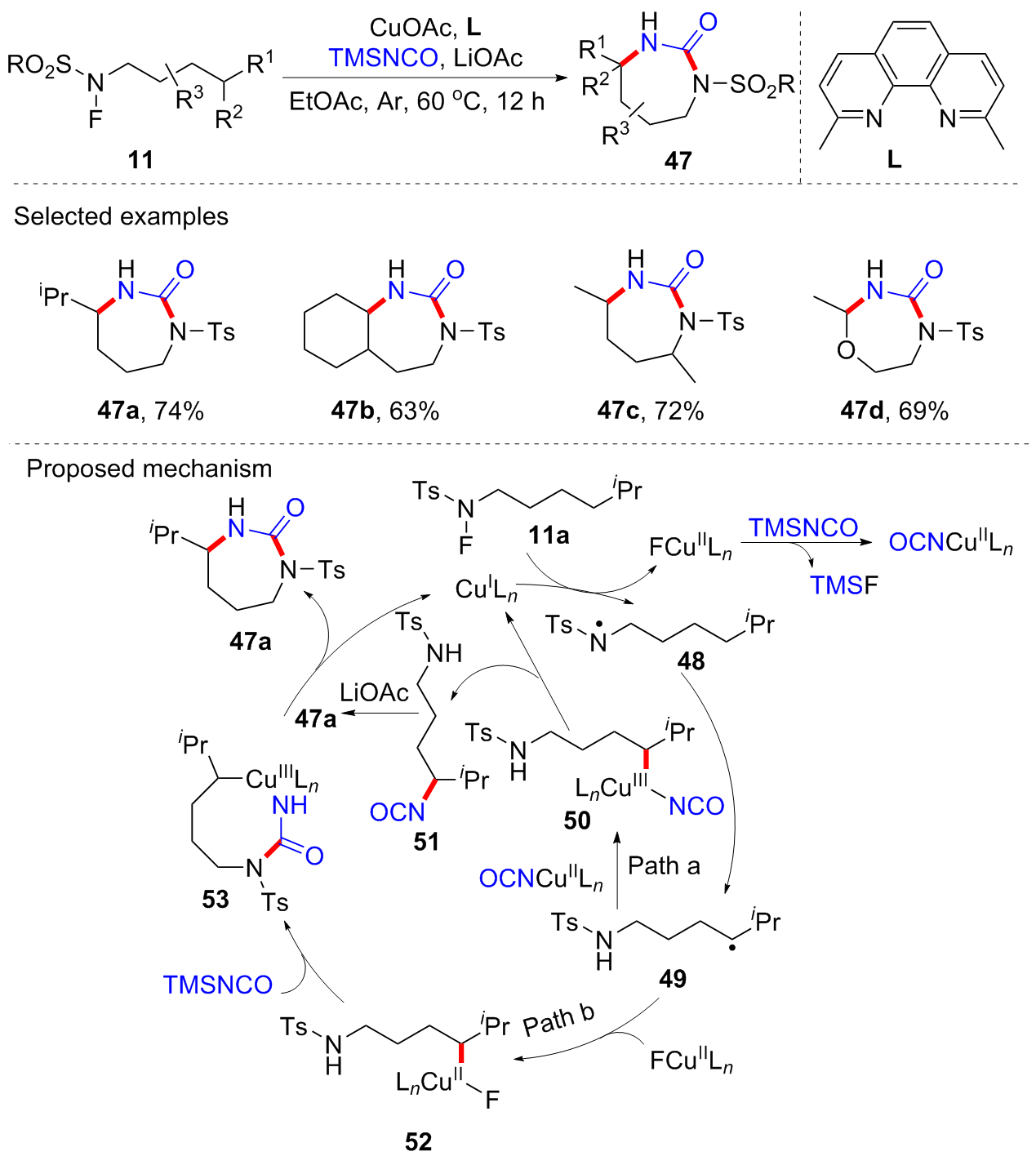
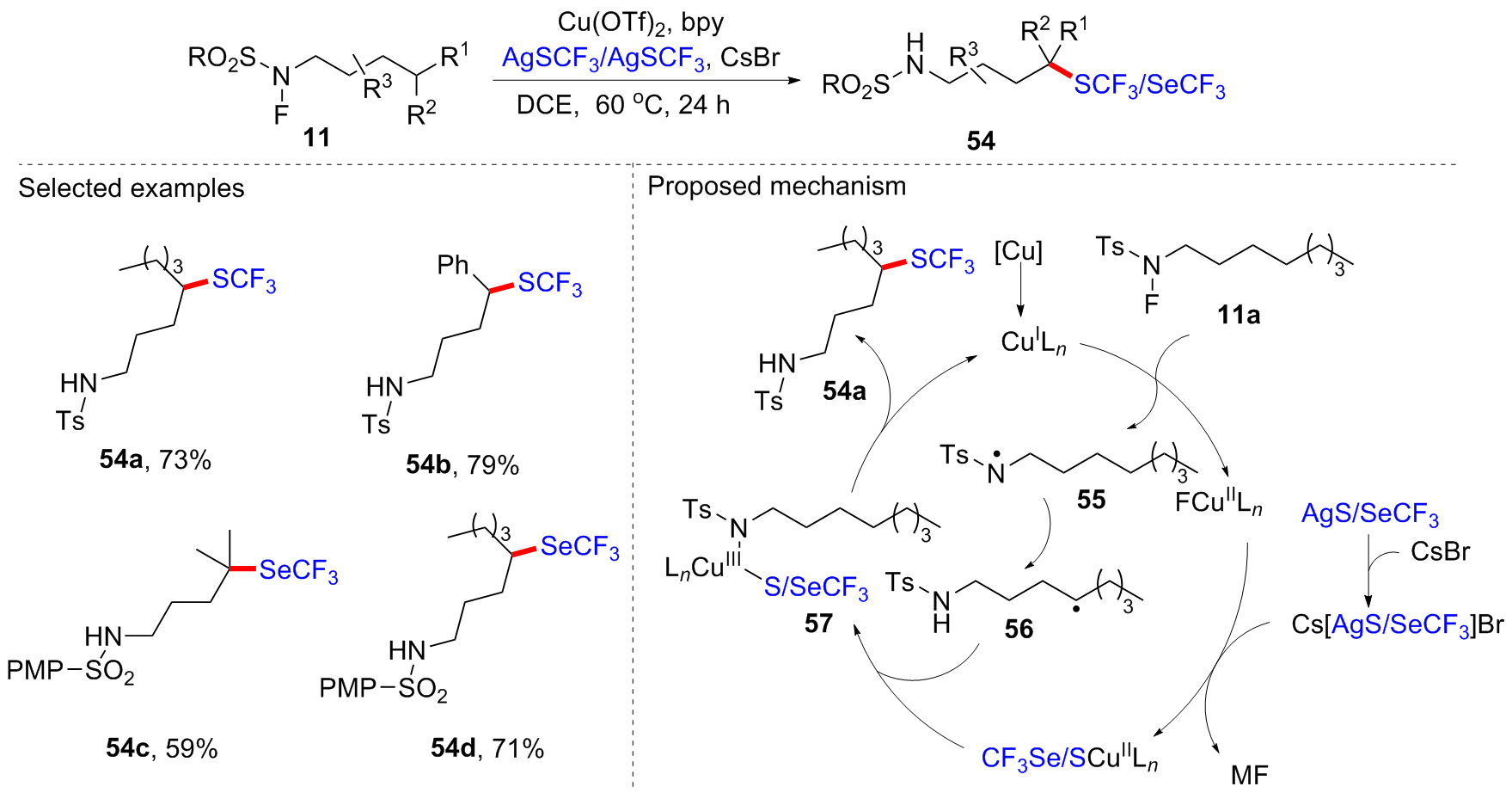
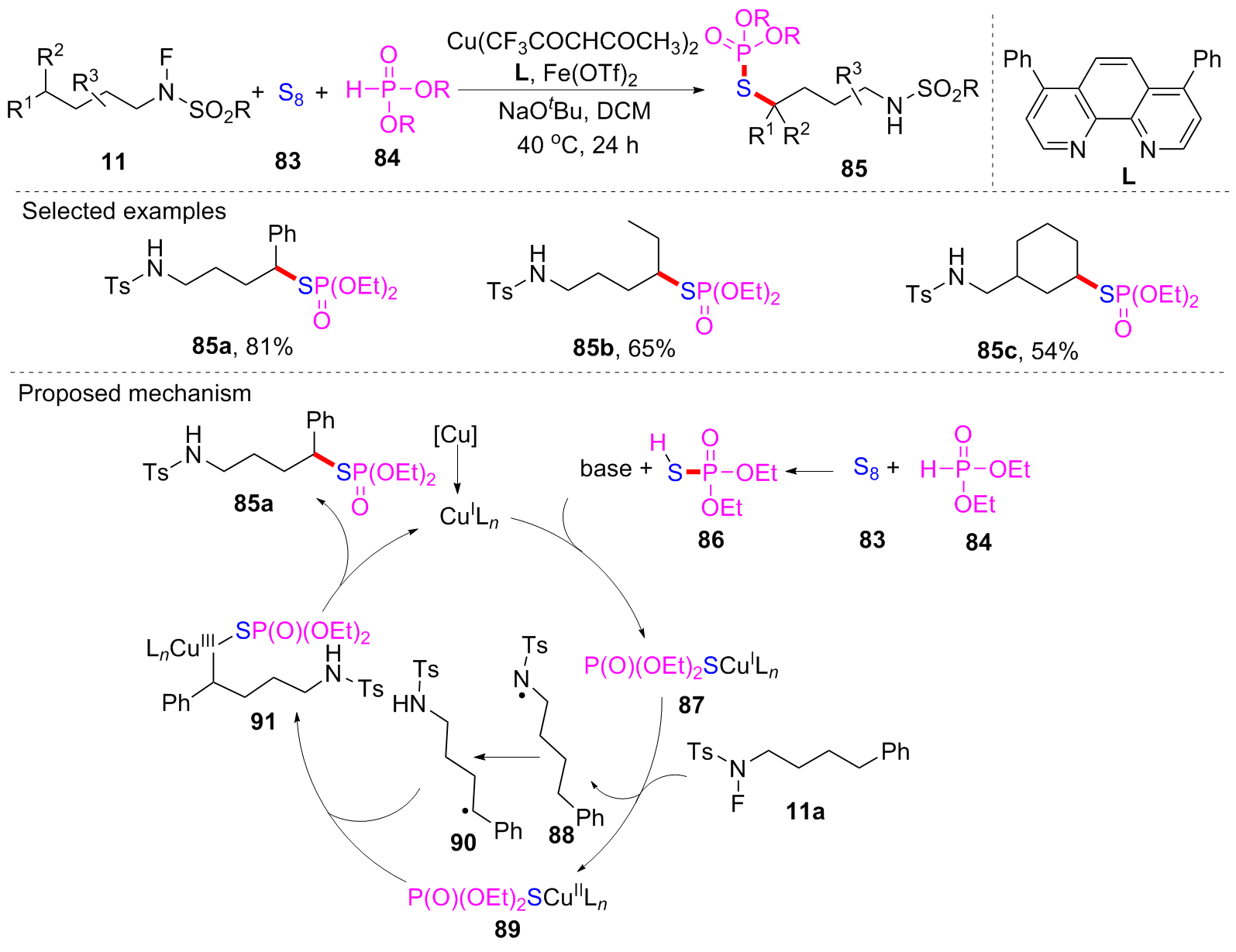
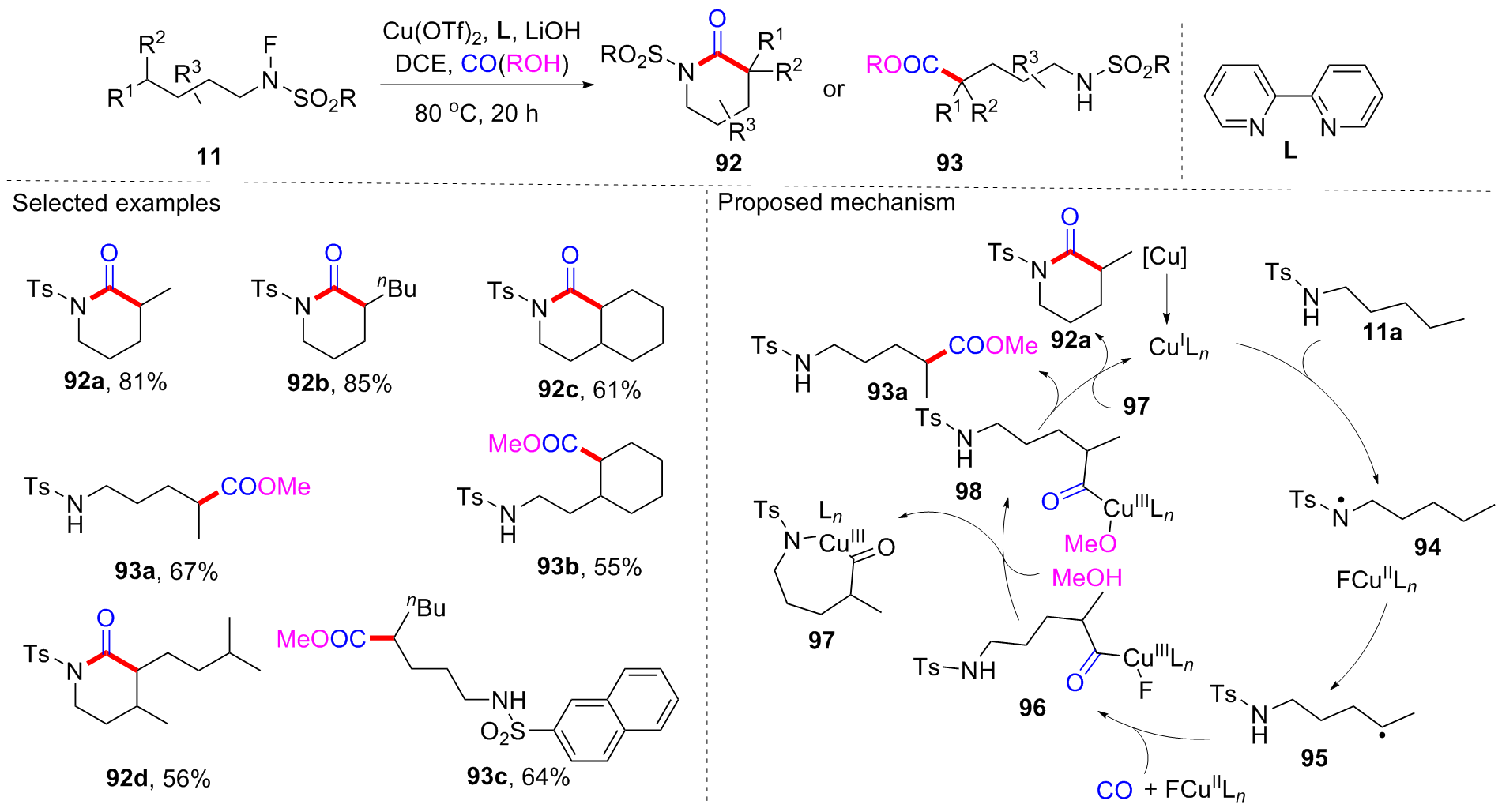
C—H键的选择性官能团化是现代合成化学的核心研究内容之一, 其中C(sp3)—H键具有键离解能高、酸性弱的固有特性, 且广泛存在于不同类型分子中, 化学环境高度相似, 因此实现其位点选择性的精准调控仍面临巨大挑战. 氢原子转移策略为实现非活化C(sp3)—H键的直接转化提供了新的可能, 近年来基于氢原子转移策略的铜催化N-氟代磺酰胺C(sp3)—H键官能团化反应得到了迅速发展, 梳理了该领域的研究进展, 重点围绕反应机理与底物拓展进行论述, 并对未来发展方向与应用前景做出展望.
张文钰, 刘星雨, 薛琦, 李杨, 汪苇杭, 李金恒. 基于氢原子转移策略的铜催化N-氟代磺酰胺C(sp3)—H键官能团化研究进展[J]. 有机化学, 2026, 46(7): 2529-2543.
Wenyu Zhang, Xingyu Liu, Qi Xue, Yang Li, Weihang Wang, Jinheng Li. Recent Advances in Copper-Catalyzed C(sp3)—H Bond Functionalization of N-Fluorosulfonamides via Hydrogen Atom Transfer[J]. Chinese Journal of Organic Chemistry, 2026, 46(7): 2529-2543.
| [1] |
doi: 10.1021/acs.chemrev.1c00519 |
| [2] |
doi: 10.1038/s41467-020-20770-4 pmid: 33473126 |
| [3] |
doi: 10.1021/acs.chemrev.6b00620 |
| [4] |
doi: 10.1021/acs.chemrev.1c00582 |
| [5] |
doi: 10.1038/s41570-022-00388-4 pmid: 35965690 |
| [6] |
doi: 10.1039/c5cs00105f pmid: 26791791 |
| [7] |
doi: 10.1039/C9CC04977K |
| [8] |
doi: 10.1021/ja01492a035 |
| [9] |
doi: 10.1021/cr60221a004 |
| [10] |
doi: 10.1039/D1CS00727K |
| [11] |
doi: 10.1021/acs.accounts.9b00381 |
| [12] |
doi: 10.1021/acs.accounts.8b00265 |
| [13] |
doi: 10.1021/acs.orglett.1c04317 |
| [14] |
doi: 10.1039/D2SC00764A |
| [15] |
doi: 10.1021/acs.orglett.2c00666 |
| [16] |
doi: 10.1039/C8SC04366C |
| [17] |
doi: 10.1021/jacs.1c10053 |
| [18] |
doi: 10.1038/s41467-022-33996-1 |
| [19] |
doi: 10.1021/acs.orglett.2c01427 pmid: 35687371 |
| [20] |
doi: 10.1021/acs.orglett.2c03135 |
| [21] |
doi: 10.1021/acs.orglett.1c04280 |
| [22] |
doi: 10.1021/acs.joc.2c02461 |
| [23] |
doi: 10.1016/j.chempr.2019.09.010 |
| [24] |
doi: 10.1021/acs.orglett.9b00553 |
| [25] |
doi: 10.1016/j.isci.2019.10.048 |
| [26] |
doi: 10.1002/adsc.v361.23 |
| [27] |
doi: 10.1021/acscatal.0c03853 |
| [28] |
doi: 10.1002/anie.v58.8 |
| [29] |
doi: 10.1002/anie.v58.26 |
| [30] |
doi: 10.1021/acs.joc.4c01163 |
| [31] |
doi: 10.1039/D0QO01012J |
| [32] |
doi: 10.1021/acs.orglett.9b04542 |
| [33] |
doi: 10.1021/jacs.9b10316 |
| [34] |
doi: 10.1021/acs.orglett.4c00336 |
| [35] |
doi: 10.1039/D5OB00257E |
| [36] |
doi: 10.1021/acs.orglett.1c02564 |
| [37] |
doi: 10.1021/acscatal.3c05154 |
| [38] |
doi: 10.1021/acscatal.4c00116 |
| [39] |
doi: 10.1039/C9SC04169A |
| [40] |
doi: 10.1021/acs.orglett.1c03075 |
| [41] |
|
| [42] |
|
| [43] |
doi: 10.1021/acs.joc.9b00105 |
| [44] |
doi: 10.1021/jacs.9b05850 pmid: 31280562 |
| [45] |
doi: 10.1039/D0CS00774A |
| [46] |
doi: 10.1055/s-0036-1591930 |
| [47] |
doi: 10.1021/jacs.2c06718 |
| [48] |
doi: 10.1038/nature13274 |
| [49] |
doi: 10.1021/ar500035q |
| [1] | 吴志杰, 周超, 李金山, 徐佳欣, 张义成, 刘杰, 王磊. 可见光促进通过氢原子转移合成1,4-二羰基衍生物[J]. 有机化学, 2026, 46(8): 3158-3168. |
| [2] | 韩银松, 王东炜, 肖佳怡, 冯若昆. 酰胺噁唑啉导向的铜催化[2.2]对环芳烷直接C—H酰氧基化反应[J]. 有机化学, 2026, 46(8): 3147-3157. |
| [3] | 于丰恺, 朱先进, 徐紫涵, 石凌宇, 石永佳, 李旭锋, 杨道山. 铜催化三组分反应合成含硫醚片段的三氮唑类化合物[J]. 有机化学, 2026, 46(7): 2825-2834. |
| [4] | 高鹰鹏, 张林军, 宋基懿, 钟品勇, 刘晋彪. 铜催化2-氨基苯甲酸与异硫氰酸酯脱硫环化合成2-氨基苯并-1,3-噁嗪-4-酮[J]. 有机化学, 2026, 46(7): 2808-2815. |
| [5] | 李凌岳, 张嘉沛, 张硕, 崔露元, 刘希功, 刘磊. 无配体铜催化四氢-β-咔啉的氧化重排反应[J]. 有机化学, 2026, 46(7): 2789-2795. |
| [6] | 王弘毅, 周韦屹, 彭凌子, 郭昌. 铜催化的α-亚胺酯不对称烷基化反应对映选择性合成(S)-BIRT-377[J]. 有机化学, 2026, 46(7): 2779-2788. |
| [7] | 王雷雷, 吴娟娟, 侯易, 王景和, 孙岩, 刘静, 郭佳蕾, 齐笑, 朱超, 刘强, 吕雷阳. 铜催化6-氮杂尿嘧啶与环烷烃的交叉脱氢偶联反应[J]. 有机化学, 2026, 46(7): 2770-2778. |
| [8] | 金海瑞, 秦杰, 赵亚婷, 夏吾炯. 铜(I)促进芳香类C(sp2)—H键的硝化反应[J]. 有机化学, 2026, 46(7): 2733-2742. |
| [9] | 刘佩雯, 叶富, 袁伟明. 可见光介导铜催化1,3-烯炔的双官能团化反应进展[J]. 有机化学, 2026, 46(7): 2563-2580. |
| [10] | 刘妍伶, 张毅涵, 陈霞, 周晓玉, 崔颖娜, 刘海龙. 铜催化的Sonogashira偶联/亲电环化构建3-(苯硒基)苯并呋喃衍生物[J]. 有机化学, 2026, 46(6): 2379-2386. |
| [11] | 廖云, 唐丽娟, 宗映彤, 于道鸿. 钌催化C(sp²)—H键的不对称官能化研究进展[J]. 有机化学, 2026, 46(5): 1795-1812. |
| [12] | 于琛, 李宁, 薛琦, 李杨, 汪苇航, 李金恒. 自由基介导双C—H键转化的烯烃官能团化反应研究进展[J]. 有机化学, 2026, 46(4): 1440-1463. |
| [13] | 陈鑫, 王树涛, 杨文鹏, 王楚阳, 段新华, 郭丽娜. 可见光诱导铜催化螺二氢喹唑啉酮与靛红的碳碳键裂解/偶联: 一种合成3-烷基-3-羟基-2-氧化吲哚的方法[J]. 有机化学, 2026, 46(4): 1685-1698. |
| [14] | 赵丽玮, 张梁, 胡鹏. 氢原子迁移(HAT)介导的官能团迁移反应[J]. 有机化学, 2026, 46(4): 1284-1302. |
| [15] | 罗辉, 王文权, 贺瑜, 王富强, 杨金会. 无金属电化学C—H键活化构建C—N/C—O键的研究进展[J]. 有机化学, 2026, 46(3): 697-724. |
| 阅读次数 | ||||||
|
全文 |
|
|||||
|
摘要 |
|
|||||


